Embarrassingly Parallel Inference for Gaussian Processes
Michael Minyi Zhang [email protected]
Department of Computer Science Princeton University
Princeton, NJ 08544, USA
Sinead A. Williamson [email protected] Department of Statistics and Data Science
Department of Information, Risk and Operations Management The University of Texas at Austin
Austin, TX 78712, USA
Editor:Manfred Opper
Abstract
Training Gaussian process-based models typically involves anO(N3) computational bottle-neck due to inverting the covariance matrix. Popular methods for overcoming this matrix inversion problem cannot adequately model all types of latent functions, and are often not parallelizable. However, judicious choice of model structure can ameliorate this problem. A mixture-of-experts model that uses a mixture ofK Gaussian processes offers modeling flexibility and opportunities for scalable inference. Our embarrassingly parallel algorithm combines low-dimensional matrix inversions with importance sampling to yield a flexible, scalable mixture-of-experts model that offers comparable performance to Gaussian process regression at a much lower computational cost.
Keywords: Gaussian process, parallel inference, machine learning, Bayesian non-parametrics.
1. Introduction
Gaussian processes (GPs) provide a flexible family of distributions over functions, that have been widely adopted for problems including regression, classification and optimization due to their ease of use in modeling latent functions. Additional flexibility can be achieved using mixture-of-experts models (Gramacy and Lee, 2008; Rasmussen and Ghahramani, 2002; Meeds and Osindero, 2006), which use a mixture of Gaussian processes. Different mixture components can have different covariance patterns, allowing for non-stationarity in the resulting function without resorting to explicitly non-stationary covariance functions.
Unfortunately, the flexibility of Gaussian processes and related models comes at a cost. Inference in GP models with N observations involves repeated inversion of an N ×N
matrix, which typically scales O N3. Mixture-of-experts models fare slightly better since, conditioned on the partition, we are inverting a block-diagonal matrix; however the computational savings are tempered by the cost of averaging over partitions, typically using MCMC. This computational bottleneck has thus far prevented Gaussian processes and mixtures-of-experts from being used in so-called “big data” situations.
c
Two main approaches have been proposed to ameliorate the computational complexity for inference in the simple Gaussian process regression setting: sparse methods, that aim to reduce the size of the matrix to be inverted, and local methods, that aim to simplify its structure. Unfortunately, both methods exhibit key failure modes as we reduce the computational cost: local methods can miss long-range correlations, and sparse methods tend to miss short-range fluctuations. Further, methods of these types are not typically parallelizable to run efficiently on a distributed architecture.
In this paper, we propose a novel inference algorithm for fitting mixtures of partitioned Gaussian processes that is flexible and easily distributed. The “Importance Sampled Mixture of Experts” (IS-MOE) uses importance sampling to average over Gaussian processes with block-diagonal covariance matrices. A location-based distribution over partitions allows us to capture non-stationarity. We learn, in parallel, multiple partitioned Gaussian processes sampled from the conditional distribution over partitions given the input locations thereby allowing us to take advantage of the lower inversion cost of a block-diagonal matrix. Minibatch-based stochastic approximations reduce the size of these blocks further, while maintaining competitive performance. Importance weights are also calculated in a distributed manner, with the only global communication occurring when the importance-weighted samples are combined. The resulting posterior predictive distribution has a more expressive expected covariance matrix than a single block-diagonal matrix, avoiding edge effects common with local methods and allowing for an expressive covariance structure that can model both long- and short-range covariance as well as non-stationary behavior in the latent function.
We start in Section 2 by reviewing the Gaussian process and describing existing methods for scaling inference. We then describe our approach in Section 3, before presenting detailed experimental evaluation in Section 4 to showcase its efficacy versus existing methods. Further extensions and applications are discussed in Section 5.
2. Background
2.1. Gaussian processes and related models
A Gaussian process is a distribution over functions f :RD →R, parametrized by some mean functionm(x), typically taken as zero, and a covariance function Σ(x, x0). For a given m
and Σ, a GP is a unique distribution over functionsf such that for any finite set of points,
x1, . . . , xN ∈RD, the function evaluated at those points is multivariate normally distributed with mean and covariance given by m and Σ evaluated at these inputs.
This distribution over functions can be used in a variety of applications, including regression, classification and optimization (see for example Rasmussen and Williams, 2006; Snoek et al., 2012; Wang et al., 2005). For simplicity, we focus here on the regression setting, where a function f ∼GP(0,Σ) maps our inputs X = (xi)iN=1 to our outputs Y = (yi)Ni=1, such thatyi ∼N(f(xi), σ2).
In this setting, the posterior distribution of f givenX, Y and Σ is analytically tractable, and the inference challenge reduces to inferring the hyperparameters, Θ, that control the form of the covariance function. Optimizing or sampling these hyperparameters involves inverting the covariance matrix Σobtained by evaluating Σ(·,·) at the inputsx1, . . . , xN.
Mixture-of-experts models (Jacobs et al., 1991) are a hierarchical extension of Gaussian processes, that model each output yi using a mixture of Gaussian processes. This mixture
can be specified either by a distribution over partitions of the input space (Rasmussen and Ghahramani, 2002; Gramacy and Lee, 2008; Yuan and Neubauer, 2009) or on the joint space of inputs and outputs (Meeds and Osindero, 2006). This offers two advantages over a single Gaussian process. First, each composite Gaussian process can have a separate covariance function, allowing us to capture different behaviors in different regions. Second, conditioned on the partition we haveKindependent Gaussian processes with average sizeN/K, reducing the computational cost of matrix inversion.
Unfortunately, this computational advantage is counterbalanced by the computational cost of inferring the distribution over partitions, which is done using either MCMC (Ras-mussen and Ghahramani, 2002; Gramacy and Lee, 2008; Meeds and Osindero, 2006) or variational methods (Yuan and Neubauer, 2009). As a result, mixture of expert models are typically not considered “scalable”. Performing MCMC-based inference over partitions can be expensive and while variational methods are generally faster, the Markovian relationship between samples precludes direct parallelization.
2.2. Scalable inference methods for Gaussian processes
Most scalable inference approaches focus on reducing the O(N3) cost of covariance matrix inversion. Two broad classes of methods have been proposed: “sparse” methods which parametrize the covariance based on M << N inducing inputs, and “local” methods that replace the denseN ×N covariance matrix with a block-diagonal matrix.
Sparse GP approximations parameterize the covariance matrix of the GP model withM
pseudo-inputs, whereM << N. The pseudo-input locations are chosen so that the posterior function evaluated at these points is a good approximation to the true posterior, for example by maximum likelihood optimization (Snelson and Ghahramani, 2005) or variational inference (Titsias, 2009). The computational saving comes from replacing anN×N covariance matrix with an M×M matrix. In the regression case, this reduces the training cost toO(N M2). Further computational savings can be obtained by using stochastic variational inference (SVI) to update the inducing points by calculating necessary gradients based only on size-B
subsets of the N datapoints, reducing computational cost toO M2min{M, B}
(Hensman et al., 2013). While sparse methods can yield impressive speed-ups, they tend to have a decreased ability to model high-frequency fluctuations in the function, since the number of inducing points limits the amount of variation we can capture. Additionally, as with the full-covariance GP it approximates, the sparse GP cannot naturally model non-stationary data without resorting to a non-stationary kernel.
inference in the local GP scales approximately as O(N3/K2), since we need to invert K
matrices of average size NK ×NK. Park et al. (2011) also use a block-diagonal approximation, and use a boundary value function to ensure continuity between regions.
Taking a different perspective, Kaufman et al. (2008) applies a “tapering” function to the covariance matrix so that observation pairs with low correlation are set to zero and provides theorems for estimator consistency when the covariance function used is a Mat´ern kernel. Gramacy and Apley (2015) try to learn the local approximation by taking the
n-nearest neighbors of a predictive valueX∗ to the data X and learns both the function hyperparameters and predictive distribution jointly by iteratively increasing the size of the nearest neighbors until a stopping criteria is satisfied for all predictive inputs.
As noted in Low et al. (2015), local methods will be good at capturing short-range correlations, where the correlation structure is well approximated. Further, if a block-diagonal covariance is used, they allow us to use different covariance hyperparameters in different blocks, capturing behavior which is locally approximately stationary, but where the lengthscale varies across the input space (Tresp, 2000; Rasmussen and Ghahramani, 2002). This is in contrast with sparse methods, where the number of inducing points limits the ability to learn very short-range correlations, and which can only capture non-stationarity if we use an explicitly non-stationary covariance function.
The disadvantage of the local methods, however, is that they risk ignoring important correlations. For example, the block-diagonal approaches assume zero correlation between different blocks in the partition. If the data points are partitioned based on location, this means that long-range correlations will be ignored; if they are partitioned randomly, the model will tend to perform poorly if the number of observations in some region of RD is low. Moreover, Liu et al. (2018) show that local methods like the RBCM will systematically produce overconfident predictions which violates one of the major benefits of using Bayesian methods in the first place–that being proper uncertainty quantification.
2.3. Distributed inference for Gaussian processes
The sparse and local approximations described above aim to reduce the overall computational burden by reducing the size of matrices to be inverted. When run on a single machine, this reduction in computational cost leads directly to faster inference. However, we may also be interested in distributing computation cost across multiple threads or machines. Even if the total computational cost is the same, we can reduce total time by distributing computation onto multiple parallel threads. Alternatively, if we increase the computational budget then we may be able to improve our posterior estimate by running multiple samplers in parallel and then combining the results without increasing the time budget.
2.4. Fast Bayesian inference via stochastic approximations
When performing Bayesian inference on large datasets, much of the computational cost is due to calculating functions of the data – for example, gradients or likelihoods. One way to reduce computational costs is to approximate these functions using noisy estimates based on much smaller subsets of the data. The intuition here is that much of the data at hand is “redundant” for learning the posterior so it is more efficient from a computational and memory perspective to perform Bayesian inference on a subset of the data. For example, stochastic variational inference (Hoffman et al., 2013) uses minibatches of data to approximate gradients in a variational context. Stochastic gradient MCMC methods (Ma et al., 2015; Welling and Teh, 2011) perform a similar approximation in a gradient-based MCMC setting. In a Gaussian process context, as mentioned in Section 2.2, SVI has been used to speed up inference in sparse Gaussian processes from O(N M2) to O M2min{M, B}
, where B is the minibatch size.
An alternative is to use a minibatch to approximate the full posterior. Several em-barrassingly parallel MCMC methods combine noisy posterior estimates obtained using subsets of the data (Minsker et al., 2014). Srivastava et al. (2015) show that such stochastic approximation of sub-posteriors is strongly consistent. The Bayesian coresets approach aims to learn the posterior based on a reweighted posterior (Huggins et al., 2016). While not directly equivalent (since it uses a single subset), Banerjee et al. (2008) approximates a full Gaussian process model using a smaller subset of the data to form a prediction of the entire model.
3. Embarrassingly parallel inference with importance sampled mixture of experts
We now introduce our novel method of fitting mixtures of Gaussian processes. We assume our covariates X = {x1, . . . , xN} are distributed according to a Dirichlet mixture of K
Gaussian components,
xi∼Normal(µzi,Γzi), (µk,Γk)∼Normal-Inv. Wishart(µ0, λ,Ψ, ν)
zi ∼Categorical(π), π ∼Dirichlet(α).
(1)
The outputs are then assumed to be generated by K independent Gaussian processes,
{yi :zi =k}|({xi:zi =k},Θk)∼GP(0,ΣΘk), (2)
where ΣΘk is the covariance matrix between{xi:zi =k}parametrized by Θk. Conditioned
on the zi, we have a simple local GP with block diagonal structure, of the sort considered in
Section 2.2. Rather than invert theN ×N covariance matrix, we only need invert theK
blocks. These can be inverted in parallel usingK threads, each costingO(N3/K2).
Marginalizing over thezi in Equation 1 to give a mixture-of-experts model avoids the
The typical mixture of experts approach of marginalizing over partitions using MCMC is expensive (due to slow mixing) and difficult to parallelize. Instead, we use a trivially parallelizable importance sampling scheme. In short, we independently sampleJ partitions of the input space, conditioned on the covariates X, by sampling from a Dirichlet mixture of K Gaussians, conditioned on the inputs X and ignoring the outputs Y,
P(zi =k|−)∝πkP(Xi|µk,Σk),
where the mixture parameters are drawn from the prior distribution P(µ,Σ), which we assume is Normal-Inverse Wishart.
We then fit independent Gaussian processes to each of the K partitions of each of the
J samples. We then (independently) calculate the appropriate importance weights, and use these weights to combine the J samples. If our we assume the latent function we are modeling is generated from a mixture of GP functions, then our proposed method is an exact algorithm for fitting the model and calculating the marginal likelihood. However, if the latent function is a single GP then our algorithm is a fast approximation of the full GP and its marginal likelihood.
To further reduce memory and computational constraints, we can sample size B << N
minibatches of the data without replacement and approximate the full likelihood by raising it to theN/B power. We detail these steps below in Sections 3.2 and 3.3, and provide a summary of the process in Algorithm 1.
Algorithm 1:Importance Sampled Mixture of Experts (IS-MOE)
for j= 1, . . . , J in parallel do
Draw partition withK clusters of data from P(Z|X) FitK independent GP models on the partitioned data. Predict new observations on each importance sample with
P(fj∗|Zj,−) = K X
k=1
P(fj∗|Zj∗,−)P(Zj∗|−).
Obtain weightswj = QK
k=1P(Yk,j|Xk,j, Zj).
Normalize weights, wj :=wj/PJj=1wj.
Average predictions using importance weights: P( ¯f∗|−) =PJj=1wjP(fj∗|Zj,−)
3.1. Design choices
Our proposed method makes a number of design choices, each of which carries important consequences for the performance of our algorithm which we will discuss in this section. In Equation 2, we assume that each GP has its own set of hyperparameters, Θk. This allows us
The Gaussian likelihood in Equation 1 is a design choice that is chosen to be appropriate in a wide range of settings. A mixture of Gaussians allows us to exploit correlations in the input location, and encourages preservation of short-range covariances though alternative likelihoods could also be used. In Section 4.1.2, we will show that placing structure on the input space produces better results than simple uniform partitioning of the data or, at the very least, produces results that are not different than uniform partitioning when there is no structure in the input space. We consider the general setting where each GP has its own set of hyperparameters, Θk.
To avoid explicitly selecting the number of mixtures, K, to use to model our input space, we may instead draw partitions from the Dirichlet process mixture model (DPMM) instead, as seen in Rasmussen and Ghahramani (2002); Meeds and Osindero (2006); Yuan and Neubauer (2009) and control the number of partitions via the concentration parameter,
α. We choose a finite mixture model for two reasons. First, a Dirichlet distribution with
α > 1 avoids the rich-get-richer behavior of the Dirichlet process, encouraging similarly sized clusters rather than one very large cluster. Second, a finite mixture model allows us to explicitly investigate the effect of increasing the number of clusters on the performance of our algorithm. However, the issue of selectingK is vital in practice. To address this problem, we could fit a mixture model on the data (or a subset, in “big data” cases) beforehand and empirically estimateK from this mixture model’s posterior. Or, we could adopt a more systematic method of selecting K by using a Bayesian optimization method (Snoek et al., 2012, for example) to explore the optimal number of partitions.
3.2. Importance sampling
We wish to capture posterior uncertainty about the partition and the associated covariance function Σ, while ensuring our algorithm can be distributed. Importance sampling allows us to estimate the posterior expectations E[g(f)] of some functional of f, such as the posterior predictive distribution, using an appropriately weighted collection of samples from some simpler distribution. Unlike MCMC, these samples can be collected independently, facilitating distributed computing.
We choose our proposal distribution over partitions to be the posterior distribution
P(Z|X) under the Gaussian mixture model given in Equation 1 conditioned on the input valuesX, ignoring the output valuesY. We obtain approximate samples from this distribution by drawing mixture locations randomly from the prior,P(θk,Γk) and assign data to clusters
fromP(zi =k|−). After fitting the local GPs derived from this partition, we then weight
these particles using self-normalized importance sampled weights 1
wj ∝
p(Z|X, Y)
p(Z|X) ,
where P
jwj = 1 andp(Z|X, Y)∝P(Y, X|Z)P(Z) is the cluster assignments using output
and input data (as opposed to only input data in P(Z|X)). We can then obtain an
asymptotically unbiased estimate ˆµ toE[g(f)] as ˆ µ= J X j=1
wjg(fj).
As a concrete example, the posterior predictive distribution is approximated as
ˆ
p(f∗|x∗, X, Y) =
J X
j=1
wjp(fj∗|Zj, x∗, X, Y),
where Zj is the partition associated with thejth sample.
Calculating the wj involves integrating over the covariance parameters Θ,
wj ∝
p(Z|X, Y)
p(Z|X) ∝
p(X, Y|Z)p(Z)
p(X|Z)p(Z) =p(Y|X, Z) =
Z
p(Y|X, Z,Θ)p(Θ)dΘ. (3)
where p(Θ) is the prior over the covariance parameters. If we are allowing separate hyperpa-rameters, Θj,k, for each partition, we assume that p(Θ) =
Q
kp(Θk), so
wj ∝ K Y
k=1
p({yi:zj,i=k}|{xi:zj,i=k}) (4)
=
K Y
k=1
Z
p({yi:zj,i=k}|{xi :zj,i=k},Θk)p(Θk)dΘk (5)
We must approximate the intractable integral. Depending on our accuracy/speed trade-off, we can obtain an unbiased estimate of thewj using a sample-based approximation; we
can perform a Laplace approximation about the MAP solution ˆΘ; or we can directly use the MAP approximation p(Y|X, Z)≈p(Y|X, Z,Θ). In our experiments, we choose to directlyˆ use the MAP solution, obtained using gradient descent; while this is not as accurate as sampling hyperparameters it is significantly faster, and mirrors the choices made by our comparison methods.
Calculating the MAP approximation of Θ (or indeed, inferring the hyperparameters using MCMC or another method) requires calculating the marginal likelihood p(Y|X, Z,Θ).ˆ This means there is no additional cost involved in calculating the importance weights, up to a normalizing constant. Independence between each importance sample means that the samples and their normalizing constants can be obtained in parallel. The only global communication required is at the end of the procedure, when the importance weights are normalized and the samples are combined to give our predictive distribution (or other desired expectation). In the regression scenario, we can obtain the exact marginal likelihood to fit mixtures of GPs due to the tractability of the classic regression model. However, we can show that in Section 4.2.3 it is possible to use an approximation to the marginal likelihood as an importance weight to fit classification IS-MOE models that obtain good performance.
Bayesian treed GP (BTGP), and the robust Bayesian committee machine (RBCM). While the O(J N3/K2) cost isO(J) higher than sparse methods and local methods based on a fixed partition such as RBCM, we note that theJ samples can be performed and weighted in parallel—meaning the time taken is comparable if we are willing to sacrifice computational resources.2 In this procedure, the only communication between processors occurs at the end of the prediction step when we normalize the weights,wj, and obtain the importance
averaged predictions, ¯f∗. This is vital in any distributed computation algorithm due to the high overhead cost of inter-processor communication. We can also make use of the independence of the K partitions to parallelize further, using J K threads each taking
O(N3/K3). As shown in Table 1, this leads to an equivalent wall-time cost comparable with the distributed RBCM. As we will see in Section 4, the extra computational cost required to ensure a full posterior predictive distribution yields improved performance over methods that are based on a fixed partition.
However, importance sampling has inherent issues that can hinder practical performance for inference and prediction. First, importance samplers have a tendency to produce weights where one proposal completely dominates the rest of the proposals and obtains an importance probability of nearly one. To this end, we could smooth out the importance weights with a Pareto distributed smoother in order to obtain more stable estimates from our importance sampler (Vehtari et al., 2015). Additionally, choosing a good proposal distribution is critical to the performance of the importance sampler but it is not obvious how to select the best distribution. Kahn and Marshall (1953) show that the optimal distribution which minimizes the estimator variance is |g(f)|p(f) for the expectation µ = R
g(f)p(f)/q(f) df though practically speaking we may not be able to easily sample from this distribution or calculate importance weights.
3.3. Minibatched importance samples
Although we can obtain significant computational and memory saving advantages using our low-rank approximation, we still may encounter major bottlenecks from attempting to approximate the covariance matrix of the full training set. To overcome this issue, we propose a “minibatching” solution, where each importance sample is obtained and weighted based only on a subset of sizeB << N sampled uniformly without replacement. Given a random subsetB of observations, we can approximatep(Θ|X, Y, Z) with the subset posterior
p(Θ|Xmb, Ymb, Z) evaluated on a size-B minibatch (Xmb, Ymb). Such a posterior estimate is
strongly consistent, but will tend to underestimate the posterior variance (Srivastava et al., 2015). To achieve realistic credible intervals, we can assume we have seen each pair (xi, yi)
in our minibatchN/B times; mathematically, this corresponds to raising the contribution of the likelihood to the subset posterior to the (N/B)-th power.
We use this stochastic approximation trick to estimate the posterior distribution over parameters for each importance sample, allowing us to reduce our overall complexity from
O(J N3/K2) to O(J B3/K2). Empirical results in Section 4 will show that this stochastic approximation performs favorably on large datasets in comparison with both the non-SA IS-MOE method and other scalable GP inference methods.
Table 1: Comparison of inference complexity. N is the number of data points, K is the number of experts or local GPs, and M =N/K is the number of inducing points. For the Monte Carlo based methods,J is the number of MCMC iterations or importance samples.
Full GP Sparse SVI
Complexity N3 N M2 M2min(M, B) RBCM BTGP IS-MOE SA IS-MOE
Complexity N3/K2 J N3/K2 J N3/K2 J B3/K2
Comp/thread N3/K3 × N3/K3 B3/K3
4. Experimental evaluation
To showcase the performance of our method, we compare it with a number of competing methods on both synthetic and real data sets.
4.1. Evaluation on synthetic data
4.1.1. Comparison with competing methods
We begin by evaluating our method on synthetically generated data, in order to allow us to explore and visualize a range of regimes, and to allow comparison with methods that do not scale to our real-world dataset. In our studies, we will compare our Importance Sampled Mixture of Experts approach (IS-MOE) against a full Gaussian process (GP); three sparse approximations to this model: FITC (Snelson and Ghahramani, 2005), DTC (Seeger et al., 2003), and SVI (Hensman et al., 2013); the Bayesian treed GP (Gramacy and Lee, 2008, BTGP); and the robust Bayesian committee machine (Deisenroth and Ng, 2015, RBCM). All models use a squared exponential covariance matrix. Our IS-MOE code uses the Gaussian process modules in GPyin Python with parallelization executed through mpi4py(Dalc´ın et al., 2005).3 We ran the full GP, FITC, DTC and SVI implementations also throughGPy, BTGP in tgp, and RBCM in gptf.
We first consider three data settings, the first two were generated on a linearly spaced grid of values on [−1,1] and the last one has more data generated in the center of the range [−1,1] in order to test how our method approach works when data are not uniformly generated. For these experiments we did not use minibatching in IS-MOE.
1. Stationary, long-range correlationsgenerated with inverse length scaleγ = 15.
2. Stationary, short-range correlationsgenerated with inverse length scaleγ = 5000.
3. Non-stationary generated piecewise with fast and slow moving periodic functions.
In examples 1 and 2, we generated data from a GP with zero mean squared exponential covariance kernel with amplitudeν = 1. For all examples we added Gaussian noiseσ2 = 1
to the observed outputs. We generated a training data set with 1,000 observations and a test set with 100 observations.
For fitting the stationary data, we restrict the hyperparameters on our IS-MOE method to be the same on allKblocks. For (3), we allowed each mixture to have its own hyperparameters in order to model the non-stationarity of the data. In all methods except BTGP we infer hyperparameters through the MAP estimate via gradient descent optimization, and for BTGP we infer the hyperparameters through MCMC sampling. For the sparse methods, we usedM = 100 inducing points, and for the local methods (including the IS-MOE) we used
K = 10 partitions to have a comparable level of computational complexity. For the BTGP we ran the MCMC sampler for 10 iterations; for the IS-MOE we usedJ = 10 independent importance-weighted samples. Figures 2, 3, and 4 shows the posterior predictive results and predictive intervals obtained using the five methods, and Tables 2a and 2b show the corresponding test set log likelihoods and mean squared errors.
We first consider the one-dimensional stationary examples. Recall that, in general, sparse methods perform well when the covariance structure is dominated by longer-range correlations, and local methods perform well when we have significant local variation in our function. For these results, we deliberately setJ to a small number to see how IS-MOE performs when there is “not enough” importance samples as a difficult scenario in comparison to the other methods. Looking at the results on the dataset with long-range correlations (Figure 2), we see that the IS-MOE can capture the predictive variance unlike RBCM which is over-confident in its predictions, and only performs slightly worse than the full GP and the sparse approximations, again due to a small number of importance samples.
If we look at the dataset with short-range correlation (Figure 3), we see the sparse methods struggle to learn the function–with a small number of inducing points, it is impossible to capture the high-frequency variation. Looking at the quantitative results in Tables 2a and 2b, we see that the IS-MOE outperforms the RBCM because our method is capable of learning the proper predictive variance whereas the RBCM is over-confident in its results. The BTGP likely produces poor predictive performance is because of lack of convergence of the MCMC chain: the underlying model is fairly complex and will tend to mix slowly and at a comparable level of computational complexity in this evaluation, does not have enough MCMC iterations to converge.
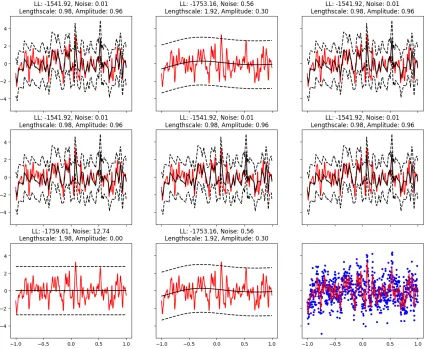
We can also see that the full GP struggles in this scenario between assuming the function is one that exhibits high noise in the data or that the function exhibits short-range correlation. Figure 1 shows an example of this multimodal structure in the marginal GP likelihood. Here, if we randomly initialize the hyper-parameter values from the distribution Gamma(1,4) for the full GP we can see that the optimizer can get stuck in suboptimal modes. Monte Carlo methods like importance sampling generally do not suffer from converging to suboptimal local optima as much as gradient descent methods or MCMC would because importance samplers will independently explore different parts of the marginal likelihood surface and place more weight on particles in more optimal modes than less optimal ones.
Figure 2: Posterior mean and 95% predictive intervals on Synthetic 1 (stationary, long length scale).
Figure 3: Posterior mean and 95% predictive intervals on Synthetic 2 (stationary, short length scale).
Figure 4: Posterior mean and 95% predictive intervals on Synthetic 3 (non-stationary).
Table 2: Test set performance on synthetic datasets
(a) Log likelihood
Data IS-MOE GP FITC DTC SVI RBCM BTGP
Long Lengthscale -152.41 -143.52 -143.39 -143.81 -156.51 -5207.89 -231.84 Short Lengthscale -157.16 -172.32 -172.26 -172.26 -173.38 -251.50 -212.61 Non-stationary -158.21 -181.40 -181.30 -181.30 -198.00 -910.54 -256.73
(b) MSE
Data IS-MOE GP FITC DTC SVI RBCM BTGP
Long Lengthscale 1.20 1.03 1.02 1.02 1.30 1.03 2.07 Short Lengthscale 1.35 1.83 1.83 1.83 1.87 1.06 2.46 Non-stationary 1.39 2.18 2.17 2.17 2.12 1.00 2.64
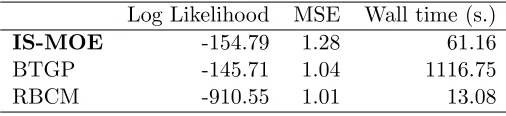
Table 3: Predictive log likelihood, MSE and total run time for the non-stationary example,
J = 6000
Log Likelihood MSE Wall time (s.)
IS-MOE -154.79 1.28 61.16
BTGP -145.71 1.04 1116.75
Figure 5: Posterior mean and 95% predictive intervals on Synthetic 3 (non-stationary),
J = 6000.
To provide a deeper comparison with the treed Gaussian process, we then run the non-stationary example with the local methods (IS-MOE, BTGP and RBCM, as these methods are the only ones considered in the experiments that can model non-stationary data) when there is sufficient computational resources for the MCMC chain in the BTGP to converge (or in other words, when we setJ = 6000). In Figure 5, we see that BTGP learns a much smoother latent function that the one in Figure 4 while the results for IS-MOE and RBCM still largely remain the same. Table 3 shows the predictive and timing comparisons between the three methods. We see that BTGP obtains the best predictive log likelihood and RBCM obtains the best MSE and fastest run time. However, our method, IS-MOE, produces the best compromise between BTGP and RBCM as we obtain only slightly worse predictive log likelihood results than BTGP while being more than eighteen times as fast. Thus, we can understand our method as being a fast, parallelizable, approximate variant of the BTGP. Though IS-MOE is slower and less accurate (with respect to MSE) than RBCM in this experiment, we obtain far better uncertainty quantification of our predictions as reflected in the poor log likelihood results of the RBCM.
4.1.2. The importance of importance sampling
The IS-MOE falls under the “local” framework, much like the RBCM and the BTGP; however it out-performs both methods. This can be attributed to importance sampling a distribution over partitions. To demonstrate this, we consider our performance on a synthetic dataset of 10,000 training observations, 2,000 test observations and 100 covariates. The input data are sampled from a GMM on R100 withK = 50 mixture components. The output, Y, is drawn from a GP model with zero mean and an RBF kernel with inverse length scale.001, observation noise variance of.25 and amplitude of 2.
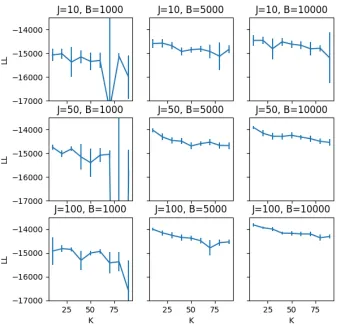
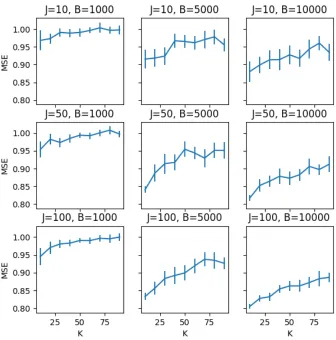
The RBCM uses a single, fixed partition. Conversely, the IS-MOE uses a distribution over partitions, combined using importance sampling weights. Figures 6 and 7 show how varying the number of importance samples, for a range of values ofK and B (remember,
K = 1, B=N = 10,000 corresponds to the full Gaussian process, and as K increases orB
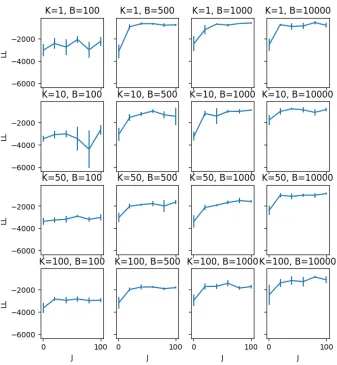
Figure 6: Evaluation on synthetic data of the effect of the number of samples J on the test set log likelihood of IS-MOE (with 95% confidence intervals), for various values ofB andK.
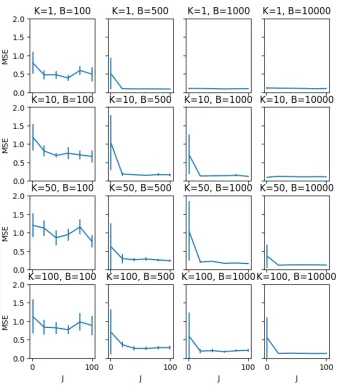
improvements level off. This confirms that averaging over partitions improves performance, but suggests that in this setting, we need relatively few samples to approximate the posterior. In Figure 8, we can visualize why this is the case if we compare the resulting expected covariance matrices in a product of expert type approach like the RBCM with a mixture of expert approach like ours. We note that BTGP also averages over partitions and can achieve high quality predictions as a result; however the slow mixing of the MCMC algorithm and the inability to distribute inference means we get worse performance for the same computational effort, and precludes the use of BTGP on large datasets.
Figure 7: Evaluation on synthetic data of the effect of the number of samples J on the test set MSE of IS-MOE (with 95% confidence intervals), for various values of B and K.
as above, with J = 10, K= 10 and B= 1000), using importance samples with reweighted likelihood minibatches results in better predictive performance than either not upweighting the minibatched likelihood or using uniform weights to combine predictions.
Figure 8: Dense, partitioned and averaged covariance matrices for a latent function with a short lengthscale. “Dense Covariance” is the dense covariance matrix Σ(X, X0). “Partitioned Covariance” is one instance of a block diagonal covariance matrix. “Averaged Covariance” is an averaging of several block diagonal partitioned covariance matrices.
Table 4: Test set log likelihood and MSE for various weighting schemes. Standard errors are in parentheses
Setting LL MSE
IS with SA -354.96 (28.59) 0.096 (0.003) IS without SA -423.93 (41.24) 0.097 (0.002) Unif. with SA -726.67 (14.19) 0.19 (0.019) Unif. without SA -842.88 (9.82) 0.25 (0.337)
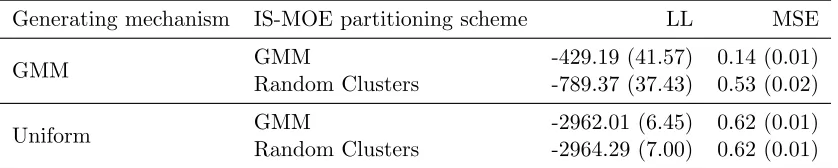
IS-MOE model used J = 10, K= 10 andB = 1000; note that the number of clusters used does not match the number of generating clusters. As we can see in Table 5, when the input data exhibits clustering behavior, we perform better when we place structure in the input clustering as opposed to purely random partitioning. When there is no structure (i.e. the inputs are sampled from a uniform distribution) there is no significant difference between the two models. This suggests that using a GMM is a reasonable default choice, since it can
Table 5: Test set log likelihood and MSE for two different covariate partitioning schemes when the input space is generated according to a GMM, and where the inputs are i.i.d Uniform. Standard errors are in parentheses.
Generating mechanism IS-MOE partitioning scheme LL MSE
GMM GMM -429.19 (41.57) 0.14 (0.01)
Random Clusters -789.37 (37.43) 0.53 (0.02)
Uniform GMM -2962.01 (6.45) 0.62 (0.01)
Figure 9: Wall clock time, predictive log likelihood and MSE results for large synthetic dataset with increasingK. SVI, FITC and DTC obtain very similar predictive performances.
.
take advantage of any structure in the input space but does not degrade performance in the absense of structure.
Lastly, we are interested to see how different GP methods compare with regards to the total wall clock time for fitting the model. Using the same data set, with J = 128 andB = 1000 for SVI and IS-MOE, we evaluate the speed and predictive performance of IS-MOE against the other methods compared in this paper. As seen in Figure 9, we can see that IS-MOE is faster than all other methods (most notably, SVI) at low values of K
while maintaining good predictive log likelihood and MSE performance. Only RBCM can outperform IS-MOE compared to the full GP in terms of MSE, but, as cited earlier, RBCM will systematically produce overconfident predictions. Counter-intuitively, we would expect local methods to perform faster with respect to wall time as K increases, but the results of IS-MOE and RBCM show that increasingK actually can increase wall time. We claim that the reason for this is because there is additional computational overhead involved with increasing the number of experts, as we must increase the number of GP models instantiated, whereas increasing K for sparse methods corresponds to reducing M, meaning there are less parameters to fit in the sparse model.
4.2. Evaluation on real data
As seen in our experiments on synthetic data, the IS-MOE is applicable to many different data regimes where other approximations may fail. Its inherently parallelizable nature also makes it an appealing choice for larger, real-world datasets where use of a full GP is computationally infeasible. To evaluate performance in this “big data” regime, we used an empirical dataset consisting of 209,631 mid-tropospheric CO2 measurements over space and time from the Atmospheric Infrared Sounder (AIRS)4. First, in Section 4.2.1, we use this dataset to explore the sensitivity of our model to different parameter values, to show how we can trade off between predictive accuracy and computational cost. Then, in Section 4.2.2 we compare its performance against competing approaches.
4.2.1. Sensitivity to model settings
Figure 10: Evaluation on the AIRS dataset of the effect of B,K, and J on the test set log likelihood of IS-MOE (with 95% confidence intervals).
Clearly, both the performance and the cost of inference of our model will depend on the number of blocks K in our approximation, the number of importance samples J, and the minibatch sizeB. On the one hand, inference scales asO(J B3/K2), so we can speed up inference by decreasing J orB or by increasingK. On the other hand, a smaller number of blocks will allow us to better approximate a dense covariance matrix; a larger number of importance samples helps us explore the full posterior; larger minibatches reduce the noise in our estimators.
Figure 11: Evaluation on the AIRS dataset of the effect of B, K, andJ on the test set MSE of IS-MOE (with 95% confidence intervals).
partitions. This suggests that the practitioner can modifyB, J and K within a wide range to achieve acceptable computational costs without a dramatic drop in quality.
4.2.2. Comparison with competing methods
Using the same CO2 dataset and squared exponential kernel as before, we compare the IS-MOE with SVI – the only other method that would scale to this dataset.5 For IS-MOE, we set J = 100 and B= 1000 and explored a range of values of K; for SVI we chose values for inducing points that gave a comparable level of computational complexity. We evaluated performance over 20 cross-validation splits. Our importance sampling method provides for a richer predictive model due to the averaging over importance proposals, and we see the benefit of this in our results. As Figure 12 shows, the IS-MOE typically performs comparably to SVI at equal levels of computational complexity in predictive performances using both
5. While RBCM is designed to scale to large data, we were unable to run the available Python package
Figure 12: Comparison of IS-MOE and SVI on AIRS dataset for variousK, withJ = 100 and B = 1000. SVI parameters chosen to have equivalent computational cost.
metrics until approximately 90 clusters, in which our method performs notably worse due to the long range correlation present in this dataset.
4.2.3. Applications beyond regression
Finally, to highlight that our method is not limited to a specific GP model, we apply our method on a binary classification task, using a Laplace approximation with a squared exponential kernel. We compare with the full GP (Williams and Barber, 1998) and the sparse GP (Hern´andez-Lobato and Hern´andez-Lobato, 2016) on three classification datasets from the UCI repository: the Pima Indians diabetes dataset; the Parkinsons dataset; and the Wisconsin diagnostic breast cancer (WDBC) dataset.6 As Table 6 shows, the IS-MOE can approximate the full GP results very well, with comparable area under the curve (AUC) scores and log likelihood to a full GP and a sparse approximation.
In addition, we also ran IS-MOE in comparison with the sparse variational GP (Hensman et al., 2013) on a binary classification dataset to distinguish background processes from Higgs-Boson particles. Our training data contains one million observations and 28 features and a test set of 100,000 observations withJ = 128,K= 20 andB = 1000. Figure 14 shows the comparison of IS-MOE against SVI for this large scale classification task. We see that IS-MOE obtains better predictive log likelihood and AUC scores, while performing slower in comparison to SVI in terms of wall time. Given this fact, it may be possible that the latent generating process for the Higgs-Boson data is non-stationary leading to better performance for IS-MOE over SVI. On the other hand, SVI’s apparent superior performance in terms of wall time but not predictive performance could be explained by the fact that there is a local optima that SVI tends to converge to quickly which produces sub-optimal results, whereas IS-MOE must spend more time exploring the posterior space but can find a better result. Nevertheless, the fact that IS-MOE inference procedure can obtain a wall time of about six minutes on a training set of size one million is still quite impressive and it does suggest that IS-MOE can perform well with marginal likelihood approximations to the full model as well.
6. All empirical classification datasets are available in the UCI repository at
Figure 13: Binary classification task: label probabilities obtained using the full GP and the IS-MOE.
Table 6: Test set log likelihood and AUC on three classification datasets.
Log Likelihood AUC
Data Full GP IS-MOE FITC Full GP IS-MOE FITC Pima -128.79 -135.09 -128.61 0.83 0.81 0.83 Parkinsons -17.00 -22.76 -28.42 0.86 0.93 0.88 WDBC -15.50 -12.62 -18.01 0.83 0.91 0.81
5. Summary and future work
While Gaussian processes provide a flexible framework for a wide variety of modeling scenarios, their use has been limited in the “big data” regime, since most implementations scale cubically with the number of data points. As discussed in Section 2, a number of approximations have been proposed to reduce this cost but these approximations come with notable failure modes. The IS-MOE avoids these pitfalls, using parallelizable importance sampling to explore a
mixture of block-diagonal, easily invertible matrices. However, importance sampling can be a rather rudimentary approach to inference. For more sophisticated settings, we may need to resort to particle filters or other sequential Monte Carlo techniques. Of course in such inference methods, the proposal distribution is crucial for performance but difficult to choose in practice. We are interested in investigating the theoretical behavior of proposal distributions in this setting.
In this paper, we have focused on regression models using a Gaussian mixture model on the covariates, but the scope of the IS-MOE is much broader. For example, we could use alternative distributions over partitions, or embed the IS-MOE within a more complex model–particularly in deep Gaussian process models and non-Gaussian likelihoods. We are also interested in refinements to importance sampling to improve their inferential quality, such as alternative proposal distributions. Another potential avenue for future research is to explore whether we can achieve further speed-ups by using GPU-based computation (Dai et al., 2014; Gramacy et al., 2014; Gramacy and Apley, 2015, for example). We leave such explorations for future work.
Acknowledgments
Michael Zhang and Sinead Williamson were supported by NSF grant 1447721. Sinead Williamson’s contribution was written before her employment at Amazon.
References
Sudipto Banerjee, Alan E. Gelfand, Andrew O. Finley, and Huiyan Sang. Gaussian predictive process models for large spatial data sets. Journal of the Royal Statistical Society: Series B (Statistical Methodology), 70(4):825–848, 2008.
Yanshuai Cao and David J. Fleet. Generalized product of experts for automatic and principled fusion of Gaussian process predictions. In Modern Nonparametrics 3: Automating the Learning Pipeline workshop at NIPS, 2014.
Zhenwen Dai, Andreas Damianou, James Hensman, and Neil D. Lawrence. Gaussian process models with parallelization and GPU acceleration. arXiv preprint arXiv:1410.4984, 2014.
Lisandro Dalc´ın, Rodrigo Paz, and Mario Storti. MPI for Python. Journal of Parallel and Distributed Computing, 65(9):1108 – 1115, 2005.
Marc P. Deisenroth and Jun Wei Ng. Distributed Gaussian processes. In International Conference on Machine Learning, pages 1481–1490, 2015.
GPy. GPy: A Gaussian process framework in Python. http://github.com/SheffieldML/ GPy, 2012.
Robert B. Gramacy and Herbert K. H. Lee. Bayesian treed Gaussian process models with an application to computer modeling. Journal of the American Statistical Association, 103(483):1119–1130, 2008.
Robert B. Gramacy, Jarad Niemi, and Robin M. Weiss. Massively parallel approximate Gaussian process regression. SIAM/ASA Journal on Uncertainty Quantification, 2(1): 564–584, 2014.
James Hensman, Nicolo Fusi, and Neil D. Lawrence. Gaussian processes for big data. In
Uncertainty in Artificial Intelligence, 2013.
Daniel Hern´andez-Lobato and Jos´e Miguel Hern´andez-Lobato. Scalable Gaussian process classification via expectation propagation. InArtificial Intelligence and Statistics, pages 168–176, 2016.
Matthew D. Hoffman, David M. Blei, Chong Wang, and John Paisley. Stochastic variational inference. The Journal of Machine Learning Research, 14(1):1303–1347, 2013.
Jonathan Huggins, Trevor Campbell, and Tamara Broderick. Coresets for scalable Bayesian logistic regression. InAdvances in Neural Information Processing Systems, pages 4080– 4088, 2016.
Robert A. Jacobs, Michael I. Jordan, Steven J. Nowlan, and Geoffrey E. Hinton. Adaptive mixtures of local experts. Neural Computation, 3(1):79–87, 1991.
Herman Kahn and Andy W. Marshall. Methods of reducing sample size in Monte Carlo computations. Journal of the Operations Research Society of America, 1(5):263–278, 1953.
Cari G. Kaufman, Mark J. Schervish, and Douglas W. Nychka. Covariance tapering for likelihood-based estimation in large spatial data sets. Journal of the American Statistical Association, 103(484):1545–1555, 2008.
Augustine Kong. A note on importance sampling using standardized weights. Technical Report 348, University of Chicago, Dept. of Statistics, 1992.
Haitao Liu, Jianfei Cai, Yi Wang, and Yew-Soon Ong. Generalized robust Bayesian committee machine for large-scale Gaussian process regression. In International Conference on Machine Learning, pages 3137–3146, 2018.
Kian Hsiang Low, Jiangbo Yu, Jie Chen, and Patrick Jaillet. Parallel Gaussian process regression for big data: Low-rank representation meets Markov approximation. In AAAI Conference on Artificial Intelligence, 2015.
Yi-An Ma, Tianqi Chen, and Emily Fox. A complete recipe for stochastic gradient MCMC. In Advances in Neural Information Processing Systems, pages 2917–2925, 2015.
Stanislav Minsker, Sanvesh Srivastava, Lizhen Lin, and David B. Dunson. Scalable and robust Bayesian inference via the median posterior. In International Conference on Machine Learning, pages 1656–1664, 2014.
Jun Wei Ng and Marc P. Deisenroth. Hierarchical mixture-of-experts model for large-scale Gaussian process regression. arXiv preprint arXiv:1412.3078, 2014.
Chiwoo Park, Jianhua Z. Huang, and Yu Ding. Domain decomposition approach for fast Gaussian process regression of large spatial data sets. Journal of Machine Learning Research, 12(May):1697–1728, 2011.
Carl E. Rasmussen and Zoubin Ghahramani. Infinite mixtures of Gaussian process experts. In Neural Information Processing Systems, pages 881–888, 2002.
Carl E. Rasmussen and Christopher K. I. Williams. Gaussian processes for machine learning.
Gaussian Processes for Machine Learning, 2006.
Matthias Seeger, Christopher K. I. Williams, and Neil D. Lawrence. Fast forward selection to speed up sparse Gaussian process regression. In Artificial Intelligence and Statistics, 2003.
Edward Snelson and Zoubin Ghahramani. Sparse Gaussian processes using pseudo-inputs. In Neural Information Processing Systems, pages 1257–1264, 2005.
Jasper Snoek, Hugo Larochelle, and Ryan P. Adams. Practical Bayesian optimization of machine learning algorithms. InNeural Information Processing Systems, pages 2951–2959, 2012.
Sanvesh Srivastava, Volkan Cevher, Quoc Dinh, and David B. Dunson. WASP: Scalable Bayes via barycenters of subset posteriors. In Artificial Intelligence and Statistics, pages 912–920, 2015.
Michalis K. Titsias. Variational learning of inducing variables in sparse Gaussian processes. In Artificial Intelligence and Statistics, volume 5, pages 567–574, 2009.
Volker Tresp. A Bayesian committee machine. Neural Computation, 12(11):2719–2741, 2000.
Aki Vehtari, Andrew Gelman, and Jonah Gabry. Pareto smoothed importance sampling.
arXiv preprint arXiv:1507.02646, 2015.
Jack M. Wang, David J. Fleet, and Aaron Hertzmann. Gaussian process dynamical models. In Neural Information Processing Systems, 2005.
Max Welling and Yee Whye Teh. Bayesian learning via stochastic gradient Langevin dynamics. In International Conference on Machine Learning, pages 681–688, 2011.
Christopher K.I. Williams and David Barber. Bayesian classification with Gaussian processes.
IEEE Transactions on Pattern Analysis and Machine Intelligence, 20(12):1342–1351, 1998.
Chao Yuan and Claus Neubauer. Variational mixture of Gaussian process experts. In