Abirami et al. World Journal of Pharmaceutical and Life Sciences
FORMULATION AND EVALUATION OF EUDRAGIT RL 100 AND EUDRAGIT RS100
LOADED SESQUITERPENOIDS NANOPARTICLES
A. Abirami*, N. Chidambaranathan, S. Mohammed Halith and M. Nagarajan
Department of Pharmaceutics, K. M. College of Pharmacy, Uthangudi, Madurai, India.
Article Received on 07/11/2017 Article Revised on 28/11/2017 Article Accepted on 19/12/2017
INTRODUCTION
Nowadays, a new and renovated interest toward herbal medicines is observed. Some of the reasons which justify this fact are: (i) the sale of herbal medicines and their secure use have considerably increased over the last 10 years; (ii) herbal medicines are used to treat a wide range of problems; (iii) the development of new diseases, with severe complications, for which there is still no appropriate treatment; (iv) the belief that herbal remedies are innocuous, in contrast to conventional drugs; (v) the idea that what is natural can only be good, etc.[1,2] Among herbal medicines, extracts rich in sesquiterpenoids have elicited particular interest. Sesquiterpenes are a class of terpenes that consist of three isoprene units and have the Molecular formula C15H24. Like monoterpenes, sesquiterpenes may be acyclic or contain rings, including many unique combinations. Biochemical modifications such as oxidation or rearrangement produce the related sesquiterpenoids. Sesquiterpenes are found naturally in plants and insects, as semiochemicals, e.g. defensive agents or pheromones. Caryophyllene is a sesquiterpenoid which is a constituent of many essential oils. Caryophyllene is obtained from the plant Naregamia alata (Meliaceae) which has been used in traditional medicines in India and elsewhere in the
treatment of rheumatism, itch, malarial and chronic fevers, wounds, anaemia, enlarged spleen, ulcers, vitiated conditions of pitta and vata, halitosisand cough.[3-5]
The delivery of these compounds therefore requires product formulators to maintain the active molecular form up to the time of consumption and preserve the stability, bioactivity and bioavailability. These features are the central goal of nanoparticle systems.[6,7] In this context, the present study aimed to formulate nanoparticles of β-caryophylline to overcome the disadvantages of its instability, protect the compound and thereby improve the bioavailability. The nanoparticles which contain sesquiterpenoids were prepared by were prepared by solvent evaporation method using rotary flash evaporator.
Biodegradable nanoparticles are frequently used to improve the therapeutic value of various water-soluble/insoluble medicinal drugs and bioactive molecules by improving bioavailability, solubility and retention time. These nanoparticle–drug formulations increase drug efficacy, specificity, tolerability and therapeutic index of corresponding drugs. At the same time they reduce the patient’s expenses, risks of toxicity and have many advantages such as the protection of
World Journal of Pharmaceutical and Life Sciences
WJPLS
www.wjpls.org SJIF Impact Factor: 4.223
*Corresponding Author: A. Abirami
Department of Pharmaceutics, K. M. College of Pharmacy, Uthangudi, Madurai, India.
ABSTRACT
Objective: β-Caryophyllene (BCP) is a natural sesquiterpene existing in the essential oil of many plants, has exhibited a wide range of biological activities. However, its volatility and poor water-solubility limit its application in pharmaceutical field. β-Cyclodextrin (β-CD) has intrinsic ability to form specific inclusion complexes with different drugs to enhance their stability, solubility and bioavailability. The aim of this study is to investigate on the formulation and evaluation of sesquiterpenoid nanoparticles. Methods: Sesquiterpenoid nanoparticles were prepared by solvent evaporation method using Eudragit RL100 and Eudragit RS100 alone and combinations by rotary flash evaporator. These nanoparticles were evaluated for drug entrapement effeciency, invitro release,SEM and zeta potential measurement. Conclusion: In FX formulation the concentration (drug 50mg, Eudragit RL100 15mg, Eudragit RS100 30mg) showed the highest entrapement efficiency 98%. In the FX formulation the percentage of drug release was 99.45% in 24 hours. The optimized formulation was analysed by scanning electrone microscope and stability studies and zetapotential. The sesquiterpenoids nanoparticles exhibited nanometer size ranging from 41.61nm to 77.95nm. and also zeta potential charge.
premature degradation and interaction with the biological environment, and enhancement of intracellular penetration.[8] Novel formulations using the nanoencapsulation method have been successful when applied to plant active compounds and extracts enhancing stability, sustained delivery and pharmacological activity.[9]
MATERIALS AND METHODS
Sesquiterpenoids was purchased from Redox pharmaceuticals pvt ltd and Eudragit RL100 and Eudragit RS100 was collected from Micro labs, Hosur. β-Cyclodextrin were collected from S.D. Fine chemicals, Boisar.
Method of Preparation of Sesquiterpenoids
Nanoparticles
Solvent Evaporation Method
All batches of nanoparticles(FI – FXIV) were prepared using Eudragit RL100 and Eudragit RS100 alone and combinations by solvent evaporation method. The required quantity of drug and polymer was dissolved in 5ml ethanol (I portion) and mixed with required quantity of cyclodextrin. This mixture was homogenized using vortex homogenizer at 10,000rpm for 1 min. Then the mixture was sonicated using probe sonicator for 2minutes. Then nanoparticles were collected after solvent drying by flash evaporator.[10]
Evaluation of Nanoparticles Drug entrapement effeciency
The efficiency study was determined by free drug content in the supernatant which is obtained after centrifuging the solid lipid suspension at (15,000rpm for 20 min at 0°C using ultra centrifuge) The absorbance
was measured at 205 nm by UV
spectrophotometrically.[11]
Invitro Drug Release Studies By uv spectrophotometric method
The invitro drug release study was carried out by using diffusion membrane technique. The nanoparticles preparation was placed in a dialysis membrane and it is dropped into a beaker containing 200 ml of diffusion medium (phosphate buffer saline 6.8) the medium was maintained at 37oC under magnetic stirring at constant speed .At fixed time interval 1ml of sample was taken from the diffusion medium for every 1 hour and it was replaced by 1ml fresh medium. This process was carried out for 24 hours. The sample was measured UV spectrophotometrically at 205nm.[11]
Scanning electron microscopy (SEM)
The optimized formulation was morphologically characterized by scanning electron microscopy (SEM) .The sample for SEM analysis was mounted in the specimen using an adhesive small sample wad mounted directly in scotsch double adhesive tape. The sample was
Surface charge (zeta potential) determination
The prepared nanoparticles were characterized with respect to zeta potential by using zeta potential analyser (Malvern Zeta Seizer).zeta potential is electrical charges on particles surface it create electrical barrier it is very important for drug stability. The effect of Eudragit RL and Eudragit RS100 on the surface characterized of the nanoparticle was studied.[12]
Kinetics of Drug Release
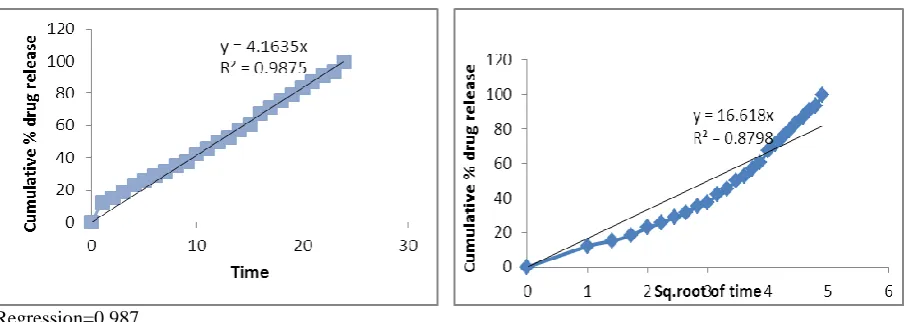
The optimized formulation subjected to graphical treatment to assess the kinetic of drug release.
Zero order plot
The optimized formulation is most suitable for parental administration as it founds to be good in the in vitro release kinetic study. The zero order plot obtained plot by plotting cumulative % drug release versus time.
Higuchi plot
The higuchi plot made by plotting cumulative %drug release versus square root of time.
RESULTS AND DISCUSSION
Drug and Polymer Compatibility Study
IR spectrum obtained from the physical mixture matched with the original spectra .Similarly peaks for the polymers were also noticed in the physical mixture spectrum. There was no disappearance of any characteristic peaks which confirms the absence of interaction between the drug and polymer.
Evaluation of Sesquiterpenoids Nanoparticles Drug entrapement effeciency
In the present investigation herbal nanoparticles were prepared with various polymers Eudragit RL100 and Eudragit RS100 alone and combination at different concentration.
Formulation F1 (drug 50mg, Eudragit RL100 10mg) which showed poor or less entrapement efficiency 46% in order to increase the entrapement efficiency the formulation FII was prepared by increasing the concentration (drug 50mg,Eudragit RL100 20mg) showed less entrapement efficiency 54%.The formulation FIII was prepared by further increasing the concentration (drug 50mg,Eudragit RL100 30mg) . The entrapement efficiency was 51%.
The formulation FIV, FV and FVI was done by replacing the polymer (drug 50mg, Eudragit RS100 10mg, 20 and 30 mg). The entrapement efficiency was 55%, 85% and 78% respectively. The entrapement efficiency was not satisfactory limit. So we made the further formulations using combination of Eudragit RL100 and Eudragit RS100.
50mg, Eudragit RL100 15mg, Eudragit RS100 --15mg) The entrapement efficiency was 68%. The formulation F8 was prepared (drug 50mg, Eudragit RL100 15mg, Eudragit RS100 20mg) The entrapement efficiency was74%.The formulation F9 was prepared (drug 50mg, Eudragit RL100 15mg, Eudragit RS100 25mg) The entrapement efficiency was 91%.
In order to study the effect of two polymers Eudragit RL100 and Eudragit RS100 at different concentration drug 50mg, Eudragit RL100 15mg, Eudragit RS100 25mg) which showed the better entrapement efficiency 91%.
In another formulation FX the concentration of Eudragit RS100 was increased (drug 50mg, Eudragit RL100 15mg, Eudragit RS100 30mg) it showed the highest entrapement efficiency 98%, This formulation was selected as optimized and suitable for carrying out further study.
The drug entrapement efficiency profile based on chemical structure of drug and polymer used. The sesquiterpenoids ( caryophylline) is a terpene with 2 ring consists of 3 isoprene units which is insoluble in water. The Eudragit RL100 contains more number of polar groups compared with Eudragit RS100.The Eudragit RS100contains more number of non polar groups and So that Eudragit RS100 has less repulsive force with drug molecules. Eudragit RS100 has high entrapement efficiency compared with Eudragit RL100.
The combination of Eudragit RL100 and Eudragit RS100 polymer with drug has high entrapement efficiency.So the sesquiterpenoids nanoparticles is suitable for novel drug delivery system.
In Vitro Release of Sesquiterpenoids
In the present investigation herbal nanoparticles were prepared with various polymers Eudragit RL100 and
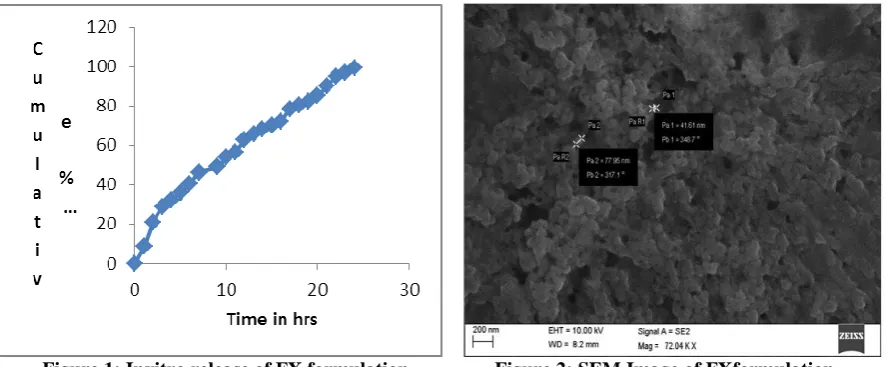
Eudragit RS100 alone and combination at different concentration and their invitro studies was determined for 24hrs. The in vitro drug release of sesquiterpenoids nanoparticle carried out by membrane diffusion method and in vitro drug release study was carried out for 24 hours.
The in vitro drug release of formulation F1 (drug 50mg, Eudragit RL100 10mg). The percentage of drug release was 92.43% in 17 hours. The formulation FII was prepared by increasing the concentration (drug 50mg, Eudragit RL100 20mg). The percentage of drug release was 97.43% in 19 hours. The formulation FIII was prepared by further increasing the concentration (drug 50mg, Eudragit RL100 30mg). The percentage of drug release was 93.43% in 21 hours.
The formulation FIV, FV and FVI was done by replacing the polymer (drug 50mg, Eudragit RS100 10mg,20 mg, 30 mg) The percentage of drug release was 91% in 18hrs, 95% in 24 hrs 92% in 24hrs.
In further formulations FVII, FVIII and FIX the combination of Eudragit RL100 and Eudragit RS100 were used. The formulation FVII was prepared (drug 50mg, Eudragit RL100 15mg, Eudragit RS10015mg) The percentage of drug release was 94% in 21 hours. The formulation FVIII was prepared (drug 50mg, Eudragit RL100 15mg, Eudragit RS100 20mg) The percentage of drug release was 90% in 24 hours. The formulation FIX was prepared (drug 50mg, Eudragit RL100 15mg, Eudragit RS100 25mg) The percentage of drug release was 94% in 23hours.
In FX formulation (drug 50mg, Eudragit RL100 15mg,
Eudragit RS100 30mg) The percentage of drug release was 99.45% in 24 hours.
Scanning Electron Microscopy
The appearance of nanoparticles in scanning electron microscope is in granule form, which indicates a thin and uniform coating over the drug. SEM image revealed that the sesquiterpenoids nanoparticles were in nano size range, and smooth spherical in shape in this FX Formulation, the particle size diameter ranging from 41.61nm to 77.95nm.
Surface Charge (Zeta Potential)
The zeta potential of the nanoparticle formulation with Eudragit(RL10 ans EudragitRS100(formulation FX) particles which present in the formulation are de-aggregated and remain same and more stable in the substance and zeta potential (mV) is 13.4and zeta Deviation (mV) is 5.45 and conductivity (mS/cm) is 0.181.So this polymer is more suitable for nanoparticles preparation and the result shows smooth surface character and efficient repelled action.
Regression=0.987
Figure 4: Zero order plot for FX. Figure 5: Higuchi plot for FX.
CONCLUSION
In this investigation various batches of sesquiterpenoids nanoparticles were prepared the drug with biodegradable polymer Eudragit RL100 and Eudragit RS100 at different concentration by solvent evaporaton technique. In FX formulation the concentration (drug 50mg, Eudragit RL100 15mg, Eudragit RS100 30mg) showed the highest entrapement efficiency 98%. In the FX formulation the percentage of drug release was 99.45% in 24 hours. The sesquiterpenoids nanoparticles exhibited nanometer size ranging from 41.61nm to 77.95nm. and also zeta potential charge. This sesquiterpenoids nanoparticles can be used to improve the therapeutic efficacy of the poorly soluble drug and bioavailability.
REFERENCES
1. Capasso R, Izzo AA, Pinto L, Bifulco T, Vitobello C, Mascolo N. Phytotherapy and quality of herbal medicines. Fitoterapia, 2000; 71: 58-65.
2. Zhang J, Wider B, Shang H, Li X, Ernst E. Quality of herbal medicines: challenges and solutions.
Complement Ther Med, 2011;
doi:10.1016/j.ctim.2011.09.004.
3. Jacob, Sonu; Anil John, J.; Thomas, Leena; Sabulal, BI. In vitro pharmacological activity of the whole plant Naregamia alata. Asian Journal of Research in Chemistry, 2012; 5(2): 265.
4. Nadkarni, K.M. Indian Materia Medica. Bombay Popular Prakashan Private Limited, 1976; 842. 5. Hao XJ et al. Chemical constituents from Cipadessa
cinerascens (Pellegr) Hand.-Mazz (Meliaceae). Biochemical Systematics and Ecology, 2009; 37(4): 528-530.
6. Fessi H, Puisieux F, Devissaguet JP, Ammoury N, Benita S. Nanocapsule formulation by interfacial polymer deposition following solvent displacement. Int J Pharm, 1989; 55: 1-4.
7. Reis CP, Neufeld RJ, Ribeiro AJ, Veiga F. Nanoencapsulation I. Methods for preparation of drugloaded polymeric nanoparticles. Nanomedicine: Nanotech Biol Med, 2006; 2: 53–65.
8. Kumari A, Yadav SK, Yadav SC. Biodegradable polymeric nanoparticles based drug delivery systems. Colloid Surfaces B, 2010; 75: 1–18. 9. Ajazuddin, Saraf S. Applications of novel drug
delivery system for herbal formulations. Fitoterapia, 2010; 81: 680-689.
10. T. Sobana premlatha and S. Kothai. Synthesis, Characterization and Antibacterial Activity of Gelatin-Herb Nanocomposite. Asian Journal of Biomedical and Pharmaceutical Sciences, 2015; 5(50): 34-36.