1 Copyright © 2011-15. Vandana Publications. All Rights Reserved.
Volume-5, Issue-1, February-2015 International Journal of Engineering and Management Research
Page Number: 01-05
Attitude towards E-learning Technology -- A study in Kerala
Dr. K P Saraswathy Amma1, Samoj M Panicker2
1
Principal (Retired) NSS College Nemmara, Palakkad, INDIA 2
Vice president, Standard Chartered Bank, Chennai, INDIA
ABSTRACT
The rapid pace of technological and economic developments has placed greater demands on educational systems. To cater to the newer requirements and leveraging on the newer technologies, e-learning has emerged as the key driver of knowledge dissemination. It is widely believed that e-learning, if implemented properly, will empower all learners to fully engage in the 21st century. Several studies have been conducted to examine attitude towards e-learning in the west and other parts of the world. However, there is lack of research exists in this area in Kerala. The major objective of this study is to analyze the attitude towards e-learning in Kerala. This is a pioneering research conducted to study the attitude of students, teachers and society towards e-learning in Kerala. The purpose of this paper is to study the factors that would influence the attitude of e-learning technologies by college teachers, students and society of
Kerala. This study is based on Technology Acceptance Model (TAM) to analyze attitude towards e-learning.
The general opinion about e-learning is that a student might be less willing to complete tasks because of a lack of constant supervision, something that is considered to be very important by parents in the Indian society. The fact that e-learning requires an internet connection also makes it vulnerable to other distractions available on the internet like social media, entertainment and news. E-learning being the latest method in imparting education is in serious need of acceptance by the society as a whole. This study may provide insights for institutions, faculty members and society to strengthen their e-learning implementations and further improve learner satisfaction.
Keywords--- Attitude, E-learning, TAM, and ICT
I.
INTRODUCTION
Information Communication Technology (ICT) plays an important role in all human activities in the present millennium. The rapid pace of technological and economic developments has placed greater demands on educational systems. The crucial need for students now is to focus on the importance of lifelong learning, that is, to continuously upgrade their knowledge and skills, to think critically and to inspire creativity and innovation so as to adapt to global changes. To cater to the newer requirements and leveraging on the newer technologies, e-learning has emerged as the key driver of knowledge dissemination. It is widely believed that e-learning, if implemented properly, will empower all learners to fully engage in the 21st century.
The use of e-learning initiatives in the academic institutions has been increasing in last few years. There is a lack of research on the attitude of students, faculty members and society towards adoption of e-learning. Many educationalists and researchers had high hopes for
e-learning, believing that it would provide more access to information and communication and would ultimately lead to a new revolution in education. Several studies have been conducted to examine attitude towards e-learning in the west and other parts of the world. However, there is lack of research exists in this area in Kerala. This basic information can be useful for formulating plans for focused research on e-learning.
The major objective of this study is to analyze the attitude towards e-learning in Kerala. More specifically the study aims to:
1. To determine if perceived usefulness has a positive effect
on students’ attitude towards e-learning
2. To find out perceived ease of use has a positive effect on
students’ attitude towards e-learning
3. To examine the impact of facilitating conditions on
students’ attitude towards e-learning
4. Analyze the teachers attitude towards e-learning
5. Examine the society’s attitude towards e-learning
6. To study the impact of gender and education on the
2 Copyright © 2011-15. Vandana Publications. All Rights Reserved.
II.
REVIEW OF LITERATURE
Attitudes concerning e-learning, echoed by scholarly and academic reviews, range from neutral to positive. On one hand, it is noted that e-learning is at least as effective as traditional instructional strategies (Rosenberg, Grad and Matear, 2003), and that there are no major differences in academic performance between the more traditional and more technology-oriented modes of instruction (Cavanaugh, 2001). On the other hand, many reviews go further, reflecting a principally positive attitude towards the impact of e-learning (Maier, 2007). The current piece sought to demystify e-learning by concentrating on how specific e-learning factors (socio-demographic characteristics, hours spent on-line and prior computer skills) influence individual academic performance.
Majid Amouzad Khalili1, Razieh Eskandari (2014) the main objective of their study was to find factors that affect student’s intention to adopt e-learning in India. The theory of technology acceptance model was really designed to test user’s intention to adopt new technology. This paper investigates factors which affect student’s intention to adopt e-learning. The results show that attitude towards e-learning was found the most important independent variable in determining intentions to adopt e-learning.
III.
E-LEARNING IN KERALA
Akshaya, an innovative project implemented in the state of Kerala, aimed at bridging the digital divide, addresses the issues of Information Communication Technology, access basic skill sets and availability of relevant content. Quality Information Communication Technology dissemination and service delivery facilities are set up within a maximum of 2 kilometers for any household and networked leveraging entrepreneurship, governance etc. Thus the project is having a long standing impact on social, economic and political scenario of the state.
Today Akshaya is acting as an instrument in rural empowerment and economic development. The project is a catalyst in creating massive employment in the state by focusing on the various facts of e-learning, e-transaction and e-governance.
IV.
METHODOLOGY
This is a pioneering research conducted to study the attitude of students, teachers and society towards e-learning in Kerala. The purpose of this paper is to study the factors that would influence the attitude of e-learning technologies by college teachers, students and society of Kerala. The study was conducted among 200 college
students and 50 college teachers from five districts namely Palakkad, Kozhikode, Ernakulam, Kottayam and Trivandrum constituting 40 students and 10 teachers from each district by selecting 4 arts and science colleges in each district and 50 well placed persons from five districts.
The study is divided into three parts. First part is carried out among 200 College students randomly selected from 20 arts and science colleges from five districts in Kerala. Second part is carried out among 50 college teachers from the above 20 colleges and third part is 50 well placed persons from the society randomly selected from five districts. Three interview schedules were prepared based on the factors affecting the attitude towards e-learning that were identified during the literature review. a) Students’ attitude towards e-learning
The following is the research design for analyzing the attitude of students towards e-learning.
In this study, perceived usefulness, perceived ease of use , self efficacy, facilitating conditions such as computer anxiety, increases confidence in learning, necessity to learn, higher degrees are required for future job are analyzed by using the following hypothesis ;
1. Hypothesis H1, Perceived usefulness is positively related
to students attitude towards e-learning
2. Hypothesis H2, states that perceived ease of use is
positively related to student’s attitude towards e-learning
3. Hypothesis H3, facilitating conditions are positively
related to students attitude towards e-learning
4. Hypothesis H4, Self efficacy is positively related to
students attitude towards e-learning
b) Faculty members attitude towards e-learning
Inorder to analyse faculty members attitude towards e-learning the data were collated under the following categories:
• Infrastructure of the institution
3 Copyright © 2011-15. Vandana Publications. All Rights Reserved.
• Attitude towards training
• Usage of technology
The data collected through the questionnaire was analyzed using statistical tools such as mean and standard deviation.
c) Society’s attitude towards e-learning
A structured questionnaire was used to collect information from the respondents about their positive or negative attitude towards e-learning. The selected group were between the age group of 25-45.
Statistical Package for Social Sciences (SPSS) Version 21 was used for analysis.
V.
RESULTS OF HYPOTHESIS
TESTING
A) Attitude of students towards e-learning -
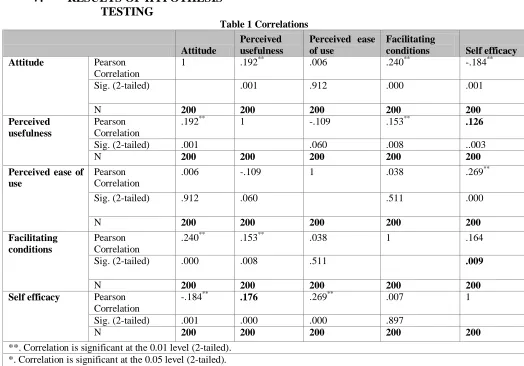
Correlation and regression analysis are performed with the model variables. Correlation and regression analysis is done to measure the degree of association between two sets of quantitative data.
Here the degree of association between attitudes towards e-learning with the dimensions such as perceived usefulness, perceived ease of use, facilitating conditions, and self efficacy
Table 1 Correlations
Attitude
Perceived usefulness
Perceived ease of use
Facilitating
conditions Self efficacy
Attitude Pearson
Correlation
1 .192** .006 .240** -.184**
Sig. (2-tailed) .001 .912 .000 .001
N 200 200 200 200 200
Perceived usefulness
Pearson Correlation
.192** 1 -.109 .153** .126
Sig. (2-tailed) .001 .060 .008 ..003
N 200 200 200 200 200
Perceived ease of use
Pearson Correlation
.006 -.109 1 .038 .269**
Sig. (2-tailed) .912 .060 .511 .000
N 200 200 200 200 200
Facilitating conditions
Pearson Correlation
.240** .153** .038 1 .164
Sig. (2-tailed) .000 .008 .511 .009
N 200 200 200 200 200
Self efficacy Pearson
Correlation
-.184** .176 .269** .007 1
Sig. (2-tailed) .001 .000 .000 .897
N 200 200 200 200 200
**. Correlation is significant at the 0.01 level (2-tailed). *. Correlation is significant at the 0.05 level (2-tailed).
1. Perceived usefulness and attitude
Hypothesis H1 Perceived usefulness is positively related to students attitude towards e-learning is accepted as the t - value 3.066 is significant at 5% level of significance. It means that students perceives e-learning as a useful method for acquiring degrees and improving their knowledge.
2. Perceived ease of use and attitude
4 Copyright © 2011-15. Vandana Publications. All Rights Reserved.
positively related to student’s attitude towards e-learning is accepted as t = -2.764 is significant at 5% level of significance.
3. Facilitating conditions and attitude
Hypothesis 3 facilitating conditions are positively related to students attitude towards e-learning is accepted as the t value is 2.905 is significant at 5% level of significance. Facilitating conditions are computer anxiety, increases confidence in learning, necessity to learn, higher degrees are required for future job and e-learning is positively influencing the attitude of students towards e-learning.
4. Self efficacy and attitude
Self efficacy refers to the motivation to achieve everything that one is capable of. E-learning, being a new technology, may help students to fulfill their self efficacy motive by keeping up with innovative ideas. In such circumstances, they will likely perceive the facility of e-learning a useful tool for them.
Hypothesis 4, Self efficacy is positively related to student’s attitude towards e-learning. Contrary to my expectation, the results t = 1.248 is not significant at 5% level of significance. So the hypothesis that self efficacy have positive effect on attitude to use is rejected.
B) Attitude of college teachers towards e-learning The data was collated under the following categories:
• Infrastructure of the institution
• Knowledge and technical skill
• Attitude towards training
• Usage of technology
Infrastructure facilities of the institution include internet connectivity, computer facilities and availability of support staff. The survey shows that 81% of the respondents are of the opinion that computer facility is available to the staff in colleges. 32% of the faculty members agreed that good internet connectivity is available. Regarding the availability of support staff, 27% agreed that they are getting support from the technical staff of the college.
Another important problem found in this study is the technical skill and knowledge in using computer as an aid in teaching. 43% of the respondents have the skill to use word processors and power point presentation. 74% know how to browse the internet. But only 12% of the faculty members are using computer facility for teaching purposes.
The survey shows that only 16% of the respondents have received computer training. 57% possess computer skills through self-learning. 89% of the respondents are of the opinion that in colleges, there is no training facility for improving the computer knowledge and skill. However, a positive a trend is that 79% of the respondents are really willing to undergo training and improve the ICT skill, which is a positive attitude towards the use of ICT in education.
As per the study 68% of the faculty members use their computers for email and internet browsing once in a week, but when the respondents were asked about their usage of technology in teaching only 12% of them admitted to actually using technology. The reason being, most of the faculty members do not have the needed skill for using the technology.
C) Attitude of society towards e-learning
Out of the 50 respondents 37 (74%) have positive attitude towards e-learning and only 13 (26%) have negative attitude towards e-learning. Young respondents are of the opinion that e-learning is an ‘ocean of knowledge’ if used properly, it will be beneficial to the society at large. Most of the respondents in the age group of 35-45 have negative response because of their minimum exposure to learning. They are of the opinion that e-learning without the intervention of a teacher or a mentor is considered to be an ineffective means to measure the progress of a student and also clarify doubts that may arise.
VI.
CONCLUSION
According to this study, student’s anxiety also hampers their satisfaction. Helping students build their confidence in using computers will make e-learning more enjoyable. A fundamental computer course could be a prerequisite to better prepare students. One of interesting results of the study is that e-learning usefulness, ease of use facilitating conditions and self-efficacy play an important role in affecting attitude towards e-learning among students. . Therefore, it is necessary for the university to put more emphasis on e-learning by offering a greater variety of e-learning courses and advertising the benefits of e-learning to attract students.
Resistance to change, fear of technology and increase in work load are the barriers in using e-learning system in teaching. In an institutional set up, implementation of e-learning requires strategic planning. Teachers, therefore, must be encouraged to become active participants in the design and implementation of e-learning processes instead of having it imposed upon them.
5 Copyright © 2011-15. Vandana Publications. All Rights Reserved.
the higher the education the more favourable is the attitude towards e-learning.
E-learning being the latest method in imparting education is in serious need of acceptance by the society as a whole. This study may provide insights for institutions, faculty members and society to strengthen their e-learning implementations and further improve learner satisfaction.
The findings from the study will provide an insight for educationalists and institutional administrators to address the barriers for the successful implementation of e-learning technologies.
REFERENCES
[1] Rosenberg, H., Grad, H. A., &Matear, D. W. (2003). The effectiveness of computer-aid, self-instructional programs in dental education: A systematic review of the literature. Journal of Dental Education,67(4), 524–532. [2] Cavanaugh, C. S. (2001). The effectiveness of interactive distance education technologies in K-12
learning: A meta-analysis. International Journal of
Educational Telecommunications,7(1), 73–88.
[3] Majid Amouzad Khalili1, RaziehEskandari(2014) International Journal of Modern Management Sciences, 3(1): 1-7UN Human Rights (1948): Fiftieth anniversary of the universal declaration of human rights 1948-1998. Adopted and proclaimed by General Assembly resolution 217 A (III) of 10 December 1948, URL: http://www.un.org/Overview/rights.html