130
Copyright © 2011-15. Vandana Publications. All Rights Reserved.
Volume-5, Issue-2, April-2015 International Journal of Engineering and Management Research
Page Number: 130-135
Implementation of 5S Practices in a Small Scale Organization: A Case
Study
1
Prof. Saad Shaikh,2Ansari Noor Alam, 3Khan Naseem Ahmed, 4Sawant Ishtiyak, 5
1
Faculty of Mechanical Engineering, Anjuman-I-Islam Kalsekar Technical Campus School of Engineering, Panvel, Mumbai University, Maharashtra, INDIA
2,3,4,5
B.E. Mech.(Students), Anjuman-I-Islam Kalsekar Technical Campus School of Engineering, Panvel, Mumbai University, Maharashtra, INDIA
Sayyed Ziaul Hasan,
ABSTRACT
A small scale industry plays an important role in Indian economy. In an organization the prime importance is given to the quality and productivity. Since a problem come across due to the defects in materials, down time in production, working conditions, housekeeping etc. This case study deals with the 5S implementation in an industry, Implementation of 5S can result in considerable improvements in environmental performance beside with improved housekeeping and health and safety.[5]5S can improve the quality, productivity and working conditions in organizations.[5]
Keywords---- 5S, Strategic Planning, Down Time, Change
I.
INTRODUCTION
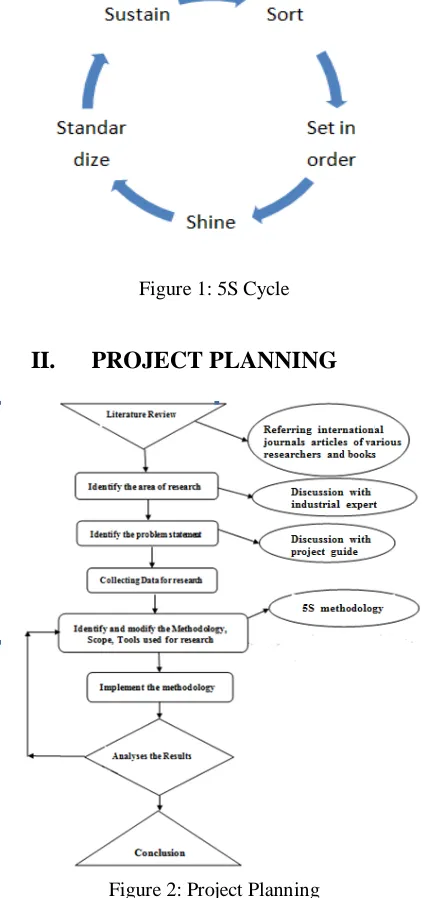
In this changing business it is important to win hearts of customer though quality and cost of the product or service. It is also required to have productive production with continuous improvement. The present need of the organization is to deliver high quality product through continuous improvement. To fulfill these requirement, 5S technique emerged for better production in the industries. 5S is a technique originated from Japan and it was first developed by Hiroyuki Hirano. It include five words of S i.e. Seiri, Seiton, Seiso, Seiketsu and Shitsuke, which means Sort, Set in order, Shine, Standardize and Sustain respectively. The 5S technique is derived from "Kaizen"
which means "change for the better". It allows the enhancement of efficiency and productivity in the industry. The 5S technique is a program to achieve total organization cleanliness, and standardization in the workplace for better productivity. The benefit of 5S technique is improvement in productivity, quality, health and safety. Term of 5S given as:
SEIRI(sort): Removal of all unwanted & unnecessary materials in the workplace.
SEITON(set in order): Putting everything in an assigned place so that it can be accessed quickly as well as returned in that same place quickly.
SEISO(shine or clean): Cleaning up the workplace and giving it a 'shine'.
SEIKETSU(standardize): Defining the standards by which one must measure and maintain cleanliness.
131
Copyright © 2011-15. Vandana Publications. All Rights Reserved.
Figure 1: 5S Cycle
II.
PROJECT PLANNING
Figure 2: Project Planning
In this paper , project planning has been done by referring international journals articles of various researches and books. After referring journals and having discussion with industrial expert, we found area of research. Once identifying the area of research problem was defined with the help of project guide. After discussion , the data related to the research area was collected. By understanding the reliability process methodology ,scope, tools used were identified. After this 5S methodology was implemented and result was analyzed.
III.
LITERATURE REVIEW
132
Copyright © 2011-15. Vandana Publications. All Rights Reserved.
IV.
COMPANY BACKGROUND
A one of the leading company in M.I.D.C Ambernath Maharashtra India relatively new to lean concepts. The company is engaged in manufacturing of Filters such as Air Filter, Cartridge Filter Coolant Filter, Sand Filter, Slot Tube Filter, Bar Filter, Basket Filter, Strainer Filter etc.
In company employee were working in uncomfortable, dirty, messy environment, no rules and regulation, employee do not worry about safety storeroom was usually full of unused materials. Because of this condition, it was difficult to find the proper tools which were needed in production.[5]
V.
PROBLEM STATEMENT
In that leading company, much time was wasted in set up than machining time and material and equipment handling time. So to increase the productivity, it was necessary to reduce the non productive time on production line and tool handling time[5].
VI.
5S STRATEGY
5S is a strategy for attaining workplace organization and cleanliness, and it will improve quality, productivity and moral than any other lean manufacturing improvement.
Figure 3: Fish Bone Diagram
Above fishbone diagram shows various phases of 5S methodology. In each phases we have describe the problem by using this phases we have solved the store management problem.
The first 'S' stand for seiri (Sort)
It is a waste reduction step; all materials are separated as necessary and unnecessary. Sorting elimination of waste materials (raw materials, tools and material), and damaged tools. To sort out necessary and unnecessary materials red tag is used. Its helps to maintain the clean workplace and improves the
efficiency of searching and receiving things, shortens the time of running the operation.[5], In sorting we distinguished the useful and scrap items. Then scrap items were kept all aside at one location and we named the location as scrap yard which is just located besides the entrance of storeroom.
Figure 4: Scrap Area and Store Room Entrance
The above image is of the company’s storeroom where we have segregated the scrap and placed it besides the entrance and named it as scrap yard. In this scrap yard we placed all the scrap at one time and some of the scraps are placed at different location due to shortage of space.
133
Copyright © 2011-15. Vandana Publications. All Rights Reserved.
The second ‘S’ stands for Seiton (Set in order)
The materials that were separated in earlier stage is stored orderly and labeled, so as to it will easily found when ever required. It will reduce the time required for searching the materials and tools.[5]
Figure 6: Shows Orderliness of Cutting Wheels
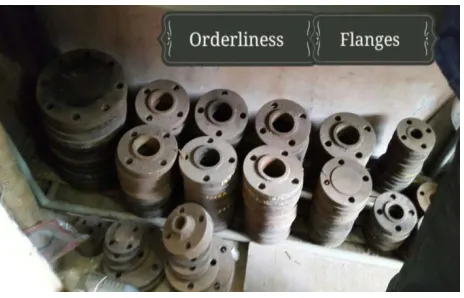
Figure 7: Orderliness of Flanges
Sorted and arranged the flanges in accordance to their sizes i.e 20NB, 25NB, 50NB, 80NB, 65NB, 100NB
The third ‘S’ stands for Seiso (shine),
It is related to the cleaning, shine and sweeping of work place and machinery. During cleaning, it is checked the cleanness of machine, workplace area, and sources of light, preventive maintenance of the machinery and equipment etc.[5], , we implemented this method as we were proceeding with the sorting method. As we were proceeding the sorting , we were differentiating used & not used items and then we claeaned the whole work place, then after this we reached every racks & then cleaned every racks for cleaning method. For cleaning we removed all the items from their racks and cleaned racks. While cleaning we also fixed the air conditioner leaked pipe.
Figure 9: Removing All Un-Necessary Things Shine
The fourth ‘S’ stands for Seiketsu (standardize),
In this step standard procedure, audit sheet and work instructions are prepared to maintain Sieso. Before starting of work to check and correct the sorted items, placing equipments at its place and cleaning etc. and give proper reading on audit sheet and create awareness in employee to maintain this thing on production line or on non productive line.[5] The fifth ‘S’ stands for Shitsuke (sustain),
Sustain is about the mental and physical disciplines required to maintain the other Seiketsu items. It is done with help of co - operation between employees , store keeper, engineer and manager.[5]
VII.
RESULTS AND DISCUSSION
Time Analysis Of Implementation Of 5S
134
Copyright © 2011-15. Vandana Publications. All Rights Reserved.
TABLE.1, PROCESSES EFFECTIVENESS AFTER AND BEFORE IMPLEMENTATION OF 5S
Sr. No.
Processes BEFORE AFTER
1 Material Searching Time
0.7 0.9
2 Tool Arrangement 0.6 0.8
3 Tool Sequence 0.5 0.7
4 Material Arrangement 0.4 0.5
5 Process Path Cleaning 0.4 0.8
6 Working
Environment
0.5 0.8
7 Safety 0.7 0.8
8 Working Efficiency 0.6 0.7
9 Overall Change In
Percentage
55% 75%
TIME COMPARISON OF Y-STRAINER
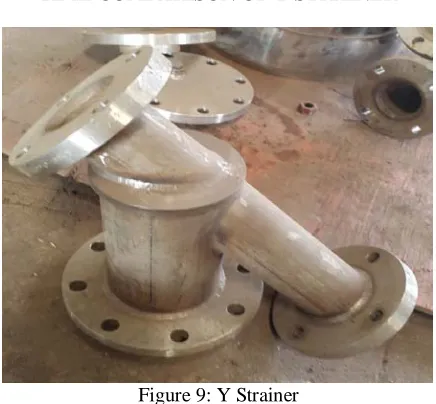
Figure 9: Y Strainer
After applying 5S we analyzed a product called y- strainer and studied that how much time is required for making a product before implementing 5S and after 5S and we made graph on that.
Figure 10: Line Graph
In above Line Graph diagram ,we did time comparison of industrial product "Y STRAINER". Before implementation, it takes more time for production of one product. But after implementation of all phases of 5S, it takes less time for production of Y Strainer.
VIII.
CONCLUSION
The 5S is an effectiveness to manage tools and materials which can improve housekeeping, environmental conditions and health and safety standards and increase productivity and quality. 5S sort stage eliminates unused, unwanted material from the storage room which reduces clutter. Set in order allocates space for components, due to this it give more space for storing more material and tools and results in reduction in searching time. 5S reduce the searching time and improve the production and quality of the products and employees and organization become self disciplined.[5]
REFERENCES
[1] Aziz Wan Asri Wan Abdul, Mat Azman Che, “The Effectiveness of Implementation of 5S on Employee Motivation” , Business and Social Sciences Review (BSSR), Vol. 1, No. 1, pp. 41-51, 2011.
[2 ]Osada T. “The 5S: Five Keys to a Total Quality Environment”, Asian Productivity Organisation, Tokyo.1991
[3] Nilipour Akbar, Jamshidian Mehdi, “5S As an Environmental Organization Management Tool; Benefits and Barriers”, 3rd International Management Conference, pp.1-10, 2005.
135
Copyright © 2011-15. Vandana Publications. All Rights Reserved.
[5] R. A. Pasale, Prof. J. S. Bagi," 5S Strategy for Productivity Improvement: A Case Study", Indian Journal Of Research, Volume : 2, Issue : 3, Issn-2250-1991, 2013. [6] P. M. Rojarsra, M. N. Qureshi, " Performance Improvement through 5S in Small Scale Industry: A Case study ", International Journal of Modern Engineering Research (IJMER), Vol. 3, Issue 3, pp-1654-1660, 2013.
[7] Chauhan et al., “Measuring the status of Lean manufacturing using AHP” International journal of Emerging technology, vol.1 no.2, pp.115-120, 2010.
[8] Miller et al., “A case study of Lean, sustainable Manufactu-ring” journal of Industrial Engineering and Management, vol.3 no.1, pp.11-32, 2010.
[9] Girish Sethi and Prosanto Pal, “ Energy Efficiency in Small Scale Industries – An Indian Perspective” Tata Energy research Institute.
[10] Chakraborty et al. “ Internal obstacles to quality for small scale enterprises”’, International Journal of Exclusive managem- ent research, , vol. 1, no. 1, pp. 1-9, 2011.
[11] Upadhye et al. “ Lean manufacturing system for medium size manufacturing enterprise: An Indian case ” , International journal of management science and engineering management. Vol.5, no. 5, pp. 362-375, 2010. [12] Hudli and Imandar, “ Areas of Lean manufacturing for productivity improvement in a manufacturing unity”, world academy of science, engineering and technology, vol. 69, 2010.
[13] Lukas et al. “Lean implementation in a low volume manufac turing environment: A case study” Proceedings Industrial Engineering Research Conference, 2010.
[14] Kumar and Kumar. “ Steps for Implementation of 5S”, International Journal of management. IT and Engineering. vol. 2, no.6, pp. 402-416, 2012.
[15] Gheorghe Dulhai. “ The 5S strategy for continuous improvement of the manufacturing process in auto car exhausts”, Management and marketing, vol. 3, no. 4, pp. 115-120, 2008.
[16] Khedkar at el. “ Study of implementing 5S techniques in Plastic Moulding” International Journal of modern engineering research., vol. 2, no 5, pp. 3653-3656, 2012.
[17] Prashant Koli.” General Implementation and Calculation of 5S Activity in any Organization” International journal of Science and Research, vol.1 no.3, pp.229-232, 2012.
[18]WALKER, T. Creating total quality improvement that lasts, National Productivity Review, 114, 2008, 473-478 p 2008.
[19]ANSARI, S. L., BELL, J., Target Costing: The Next Frontier in Strategic Cost Management, Irwin Professional Publishing, Chicago, IL, USA., 1997
[20] BOCA,G., 5S in practice, XXIV Micro CAD,
International Scientific Conference, University of Miskolc, 29-34 p., ISBN: 978-963-661-916-3, 2010. [21] BLACK, S., PORTER, L., Identification of the critical factors of TQM, Decision Sciences, Vol.27, N0