A Diversity-Multiplexing Tradeoff Optimal Low Complexity Zero Forcing
Method Based on ZP-OFDM
1. Bharath kuppal B S (Mtech Student NIU, Greater Noida- Digital Communication), 2. Prof. R L Sharma -H.O.D-Electronics and Communication Department,
Noida International University, Greater Noida.
Abstract— Due to the Mathematical complexity of maximum-likelihood signal decoding methodology, the different equalizers with less complexity are considered in the literature. Employing the zero forcing (ZF) equalizer, zero-padded orthogonal frequency-division multiplexing(ZP-OFDM) for Digital Audio broadcasting(DAB)is capable of benefiting the maximum available multipath diversity with the computational complexity of inverting a matrix of the size of data block length, which incurs an extra implementation cost relative to the fast Fourier transform-based OFDM decoder. In this paper, based on the ZP-OFDM encoding scheme, we propose a two-stage decoder that attains the maximum multipath diversity with lower computational complexity, as compared with the ZF ZP-OFDM and prove analytically that our proposed decoder is diversity-multiplexing tradeoff optimal. It has also been shown that by setting the decoder parameters, it can attain any arbitrary diversity gain smaller than the maximum multipath diversity. Moreover, the more the diversity gain is decreased the more the computational complexity is reduced in audio Signal broadcasting.
Index Terms—Diversity-multiplexing tradeoff, inter symbol interference (ISI), zero forcing equalization, ZP-OFDM, Digital Audio DAB.
I.INTRODUCTION
VARIOUS block transmission schemes have been proposed to improve the performance of data trans-mission in the L tap multipath channel [1]–[8]. In these methods, generally the transmitter sends K data symbols (K ≤ N − L + 1) of the N -length block. For the N − K remaining time slots which is usually greater than or equal to the channel memory length, L − 1, the transmitter sends the symbols known to the receiver, thereby conveying no information. In the literature, different metrics have been used to analyze the performance of the diverse block trans-mission and decoding schemes in the inter symbol inter-ference (ISI) channels. The most important of these metrics are the diversity gain, transmission rate and decoding complexity. In [9] it has been reasoned that
linear equalization has the same computational complexity as the CP-OFDM. In [4] the performance of the SC-FDE with linear equalization has been analyzed. It was shown in [4] that by using the ZF equalizer, SC-FDE can only obtain the order-1 diversity. In addition, by analyzing the minimum mean-square-error (MMSE) equalizer, Tajer and Nosratinia demonstrated that the diversity order in the MMSE SC-FDE varies between 1 and the channel length L, depending on the data transmission rate, channel memory length, and transmission block length. This result is also used for the diversity analysis of the vector OFDM (VOFDM) MMSE receiver [13] and MMSE receiver in the frequency selective MIMO channels [14]. It is noteworthy that the MMSE SC-FDE diversity analysis is only valid at the fixed rate and by increasing the data rate in proportion with the logarithm of the signal to noise ratio only the diversity 1 is achieved [4]. Reference [15] in a general analysis proved that with the cyclic prefix and any rate-1 unitary precoding, which includes the uncoded/coded-OFDM/SC-FDMA systems as special cases, the linear equalizers can only obtain the order-1 diversity. In [16], redundant precoders for the multicarrier systems in the form of finite impulse response (FIR) transmitter filterbanks is developed which guarantees the perfect equalization of FIR channels with FIR receiver filterbanks. The conditions for obtaining the optimal receiver filterbank are derived in [17].
Another category of block transmission schemes is the ZP block transmissions [5]. In [1], the single-carrier zero padding (SC-ZP) is considered as a transmission scheme and it was shown that both ZF and MMSE equalizers as N approaches infinity are DMT optimal. However, inverting a non diagonal K × K matrix is needed for the equalization with this method. Reference [6] by proposing a three-step procedure attempted to reduce the complexity of the matrix inversion in the SC-ZP while keeping the maximum diversity. As mentioned in [6], despite achieving the maximum diversity, we may not be able to take advantage of it in practice due to the noise amplification by the proposed equalizer. The ZP-OFDM is another encoding scheme, which achieves the maximum multipath diversity using the ZF equalizer [7], [8]. Unlike the CP-OFDM, the ZP-OFDM due to transmitting zeros at the guard interval has the computational complexity of inverting a K × K matrix for it’s the linear equalization. In order to reduce the complexity of the ZP-OFDM, [7] proposed two methods, namely ZP-OFDM-FAST and ZP-OFDM overlap-add (ZP-OFDM-OLA). Although both mentioned methods are computationally efficient, none of them achieve the
maximum available diversity of the channel. In order to improve the bandwidth efficiency in the multicarrier systems, [18] proposed the adaptive ZP-OFDM (AZP-OFDM). AZP-OFDM offers performance similar to that of CP-OFDM, complexity similar to that of ZP-OFDM, with band width efficiency higher than that of both CP- and ZP-OFDM.
In this paper, we consider the ZP-OFDM as the transmission scheme and propose a low complexity two-stage algorithm to decode the received data, which is called the reduced complexity zero forcing (RCZF). We analytically obtain the DMT of our decoding method. We show that the proposed method can achieve the optimal DMT with lower computational complexity compared to the any other linear DMT optimal method proposed in the literature. We also demonstrate analytically that by adjusting the parameters of RCZF decoder, any lower that optimal diversity gain is achievable and the complexity is also reduced. To the best of our knowledge there is no method in the literature with a flexible diversity gain and complexity. It is noteworthy that the RCZF method has managed to reduce the decoding complexity without losing any performance gain
Compared to the DMT optimal zero forcing ZP-OFDM.
The rest of this paper is organized as follows. In Section II System model and encoding and decoding schemes are provided. Performance analysis for our proposed algorithm is provided in Section III, Section IV provides numerical evaluations and simulation results and Section V concludes this paper.
Notation: Matrices are denoted by upper bold face letters and vectors by lower bold face letters. The real part is denoted as Re {.}. We reserve |a| as the absolute value of a and a stands for Euclidean norm. Superscripts H and * denote the Hermitian and the conjugate of a matrix, respectively. P (·) and E {·} stand for the probability and the expectations, respectively. Furthermore, we use the notation diag {a} to indicate the diagonal matrix with a on its main diagonal and we denote the complex field by. We denote the nth element of a vector a,
II SYSTEM MODEL AND PROBLEM STATEMENT
A. Transmission Model
We consider a wireless point-to-point frequency selective channel with Rayleigh fading. The L channel coefficients are denoted by the vector h = [h0,…, hL-1]T and are independent and identically distributed (i.i.d) CN(0, 1). Also throughout this paper, we will assume that the channel remains unchanged over the transmission block of the length L and it is known to the receiver. The channel input/output model is expressed as
Y[n]= , (1)
Where the additive noise w[n] is i.i.d and is distributed as w[n] = CN (0 2). Assuming that E{ǀx[m]ǀ2} =1, m =1, …, K, the transmit SNR can be defined as p 2. Throughout this paper we say that the two functionsf (p) = g (P), when
The ordering operators ≥ and ≤ are also defined accordingly [9].
A. Diversity Analysis
To evaluate the diversity, we adopt the DMT measure. In particular, the diversity gain for the target rate R = r log p is defined s [19].
D(r)-
(2)
Where Pe(p) is the symbol error probability for given transmit signal-to noise ratio r represents the multiplexing gain. We perform the outage analysis to obtain d out ® defined as [19].
Dout(r)- (3)
Where P out (p) is the outage probability for the given transmit signal-to noise ratio. It has been illustrated in [1] that the optimal DMT for the L-tap frequency selective .channels can be given by d(r) = L (1-r), indicating that the maximum achievable diversity gain is L. Additionally, it has
been shown that in the block transmission using
L – Trailing zeros as guard interval to mitigate the inter block interference, the maximum achievable diversity is given by d(r) = L (1-r'), where
r' =
(4)
B. Encoding Scheme
The uncoded ZP-OFDM is considered as the encoding scheme in this paper. In the baseband model of ZP-OFDM the information block X is first proceeded by IFFT matrix FK. Then the L – 1 trailing zeros are padded at the proceeded block to yield the transmitted vector of length N = K + L – 1. The entries of the resulting block are finally sent sequentially through the channel to form the received vector block. The ZP-OFDM decoding is performed at the end of each N-length block based only on the associated received vector. The input/output model is matrix form is represented as
Y + HFH/KX+ W (5)
Where y is the received vector and the entries y[m], m = 1… N; x is the transmitted vector and has the entries x[m], m = 1… K; w is the noise vector and has the entries w[m], m = 1… K; F is the DFT matrix with elements
Fk (m, n) = 1 / exp (- j (m -1) (n-1))
(6) For m, m = 1… K Also HF is the channel matrix given by
H = 1
1 1
0
L o L
L
o o
h
o
h
h
h
h
o
o
h
(7) C. Decoding Scheme
stages.
Ordered statistics OLA (OS-OLA) Algorithm: The received vector y should first be split into its upper K X 1 part y1 = H1FkX and its lower (L-1) X 1 part padded with K – L + 1 zeros as y2 = [(H2Fkx)T ] T , where H1 is the corresponding K x K partition of H and H2 is the corresponding (L – 1) X K partition of H. Now, adding y1 to y2, yOLAis obtained as [7].
yOLA = y1 + y2= HcF X + W1,
(8)
Where Hc is the OLA equivalent circulant matrix. And w1 is the OLA equivalent noise vector. Due to the circulant property of Hc it has eigen decomposition F Fk, where the diagonal matrix contains the k- point DFT of the first column of Hcgiven by
m , for m + 1, ....,
K. (9) Each given value is the linear combination of the channel coefficient. Which are zero mean and complex Gaussian random variables. Therefore, =1 also have zero mean complex Gaussiaon
distribution. Using the Eigen decomposition of Hc and applying FFT matrix Fk to the YOLA in (8), we have
Z X + , (10)
Where Defining ( ak,...., λa1) sort (׀λ1׀,....,׀λk׀) as the sorted magnitude of the channel frequency responses in the descending order and AQ
{ak... } to be the set of the index corresponding to the largest Q channel frequency responses the symbol detection for m Aqis performed as
[m] =argmin׀ ׀fom x[m] X
Where X is the constellation and [m] .
Consequently the Q symbol from the vector x corresponding to the largest Q channel frequency response are decoded at the first stage of the algorithm.
2) Equalization of the Remaining symbols: The remaining K – Q symbol of vector X are decoded following a four-step procedure.
• Vector is formed from the detected symbol in the former stage of the algorithm i.e. [m] as
(12)
• Using is calculated as
= y - , (13)
Where H .
• Hr is formed by removing all the columns of Heq, which has the indexes belonging to AQ.
• Pseudo inverse of Hr is computed as = ( Hr) -1 is defined as
= yr (14)
Where is equalized vector for the remaining indexes from the first stage of the algorithm and the decoder output is given by
[m] – x[m]׀for m
Where [m] is the mth element of the vector . Hence the remaining K –Q symbol are detected.
III. PERFORMANCE ANALYSIS
In this section, we will derive the tradeoff between the diversity gain and multiplexing gain of the proposed method and discuss the different cases such as the case in which the decoder id DMT optimal.
Thermo 1: The diversity-multiplexing trade off achieved by the ZP-OFDM transmission scheme and the proposed decoder of the section II-D is
d(r) = min (L, K – Q + 1) (1 - r’), (16) Where r’ is given by (4)
The above thermo leads to some results which are stated in the following corollary and remark before expressing the proof thermo 1.
Corollary 1: Choosing Q = K – L + 1 the diversity multiplexing tradeoff achieved by the proposed RCZF decoder satisfies.
In the other words, if we select the symbol which are affected by the K – L + 1 largest frequency response to be decoded at the first stage of the algorithm and leave the detection of the L – 1 remaining symbol for the second stage of algorithm, the maximum achievable diversity will be obtained. It is noteworthy that this is the same tradoff achieved by block transmission with L -1 trailing zeros scheme and the ZF decoder [1].
Choosing Q to be any integer value greater than K – L + 1 the proposed decoder achieves an optional diversity gain smaller than the optimal tradoff (17) related to Q as
d(r) = (K – Q + 1) (1 - r') (18)
Also for all the cases tatQ K – L + 1. The proposed decoder achieves the optimal diversity tradoff.
Remark 1: To analyze the complexity of our decoder we study each stages of the algorithm separately. The computational of the equalizer output at the first stage of algorithm entails the calculation of Z in (10), which means need sorting and to obtain , we have to perform Q scaler divisions. The dominant order of the above computations is related to the FFT processing, which is K log K. The main computations of the equalizer output at the second stage of algorithm are related to the calculation of the pseudo inverse of Hr, which entails the multiplication of Hrwith maximum complexity of O ((K –Q) 2 N), the calculations of Hr)-1 with the maximum complexity order of O ((K –Q) 3) and multiplication of Hr)-1 by with the maximum complexity of O ((K –Q) 2 N). Thus. The complexity order of the whole algorithm is O ((K –Q)2 N + K log K). Please note that by choosing the different values for Q, the complexity of the algorithm becomes different and to obtain a DMT optimal equalizer it is sufficient to choose K – Q + L- 1. For example if we choose K - Q = 1, Hr, will become N X 1 vector and the calculation of its pseudo inverse has the complexity order O (N). This means that in this case while the order-2 diversify is achievable; the complexity of the whole algorithm is O (log K + N / K) per symbol, which is approximately equal to that of computationally efficient CP-OFDM. As mentioned in corollary 1 any value of Q smaller than K – L + 1 also leads to the DMT optimal decoder for example RCZF decoder with Q = 0 is
the conventional zero forcing ZP- ODFM decoder. However, the more the value of Q is decreased, due to the increased size of Hr, at the second stage of the algorithm, the more computational complexity is imposed to the decoder.
Proof of Theorem 1: To prove the thermo 1, we intend to compute the symbol error probability of the proposed decoder.
To this end we need to compute the error probability lower and upper bounds. It is well known that the outage probability lower and upper bounds. It is well known that the outage probability is a lower bound for the error probability [9]. Thus, by computing the error probability behaves asymptomatically the same as the outage probability. The probability of detecting the mth symbols erroneously is
P(
+ . (19)
Let O and denote the outage and non-outage events, respectively. An outage is defined ads the event tha the mutual information does not support a target data rate of equivalently the outage occurs if { h: I (x [m]: [m] [h = h) R
IV. SIMULATION RESULTS
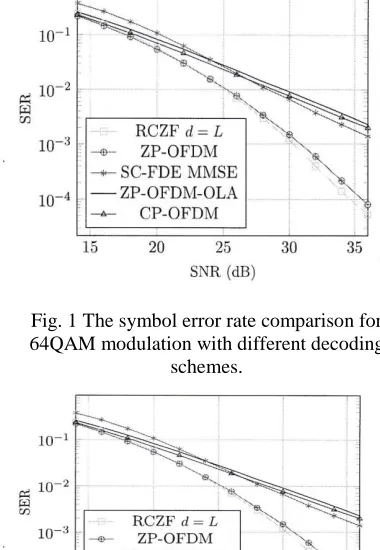
equalizer which for the decoding process should compute the inverse of the K X K matrix corresponding to its equivalent channel matrix and has more computational complexity compared to the RCZF.
Fig. 1 The symbol error rate comparison for 64QAM modulation with different decoding
schemes.
Fig. 2. The outage probability comparison for different decoding schemes.
Fig. 2 illustrates the outage probability for RCZF, ZP-OFDM, CP-OFDM and ZP-OFDM-OLA. The outage probability is given by (20) and r1 = 0.5. The block length and the channel length are considered N = 22 and L= 6, respectively. It is shown that the DMT optimal methods has lower outage probabilities compared to the other method. Fig. 3 provides the comparison between the SER of uncoded RCZF for different values of Q compared to the uncoded ZP-OFDM-FAST-MMSE of [7]. The transmission block length is considered N = 20, the number of channel paths is L = 4 and Q = 17, 18, 19, 20. As the Q increases the performance of RCZF drops and when Q = 20, all the symbol are decoded at the first stage of algorithm and our method is equivalent to ZP-OFDM-OLA, which attains the diversity gain d = 1. It is worth nothing that when Q = 19 or equivalently when K – Q = 1
only a scalar division and N multiplication are performed at the second stage of the RCZF algorithm and still benefits from the gain d = 2 of diversity and for Q = 18 the reduced equivalent matrix of the second stage of algorithm is 2 X 2.
V. CONCLUSION
In this study, we propose we propose a zero forcing method based on the ZP-OFDM transmission scheme and we derive its DMT. We illustrate that the RCZF as a DMT optimal scheme has lower computational complexity than that of the conventional zero forcing ZP-OFDM. We also show that there is a tradeoff between the achievable diversity and the computational complexity in our method and the lower diversity gains compared to the optimal DMT can be obtained with a lower computational complexity.
VI.REFERENCES
1. L. H. Grokop and D. N. C. Tse "Diversity– multiplexing tradeoff in ISI channels" IEEE Trans. Inf. Theory, vol. 55 no. 1 pp. 109-135 Jan. 2009.
2. Z. Wang X. Ma and G. B. Giannakis "OFDM or single-carrier block transmissions?" IEEE Trans. Commun. vol. 52 no. 3 pp. 380-394 Mar. 2004.
3. C. Tepedelenlioğlu "Maximum multipath diversity with linear equalization in precoded OFDM systems" IEEE Trans. Inf. Theory, vol. 50 no. 1 pp. 232-235 Jan. 2004.
4. A. Tajer and A. Nosratinia "Diversity order in ISI channels with single-carrier frequency-domain equalizers" IEEE Trans. Wireless Commun. vol. 9 no. 3 pp. 1022-1032 Mar. 2010.
5. Z. Wang and F. Giannakis "Complex-field coding for OFDM over fading wireless channels" IEEE Trans. Inf. Theory vol. 49 no. 3 pp. 707-720 Mar. 2003.
7. B. Muquet Z. and Wang G. B. Giannakis M. de Courville P. Duhamel "Cyclic prefixing or zero padding for wireless multicarrier transmissions?" IEEE Trans. Commun. vol. 50 no. 12 pp. 2136-2148 Dec. 2002.
8. Z. Wang G. B. Giannakis "Linearly precoded or coded OFDM against wireless channel fades?" Proc. Workshop Signal Process. Adv. Wireless Communpp. 267-270 Mar. 2001. Pp. 2136-2148.
9. L. Zheng and D. N. C. Tse "Diversity and multiplexing: A fundamental tradeoff in multiple-antenna channels" IEEE Trans. Inf. Theoryvol. 49 no. 5 pp. 1073-1096 May 2003.
10. L. J. Cimini "Analysis and simulation of a digital mobile channel using orthogonal frequency division multiplexing" IEEE Trans. Commun. vol. COM-33 no. 7 pp. 665-675 Jul. 1985.
11. X. Ma and W. Zhang "Fundamental limits of linear equalizers: Diversity capacity and complexity" IEEE Trans. Inf. Theory vol. 54 no. 8 pp. 3442-3456 Aug. 2008.
12. M. Geles and A. Averbuch O. Amrani D. Ezri "Performance bounds for maximum likelihood detection of single carrier FDMA" IEEE Trans. Commun. vol. 60 no. 7 pp. 1945-1952 Jul. 2012.
13. Y. Li I. Ngebani X. G. Xia and A. Host-Madsen "On performance of vector OFDM with linear receivers" IEEE Trans. Signal Process. vol. 60 no. 10 pp. 5268-5280 Oct. 2012.
14. A. H. Mehana and A. Nosratinia "Performance of linear receivers in frequency-selective MIMO channels" IEEE Trans. Wireless Commun. vol. 12 no. 6 pp. 2697-2705 Jun. 2013.