Table of Contents
Abstract 4
Initiation into Seeing 5
Previous Works 10
Thesis Year 15
Phenomena – Thesis Exhibition 24
Conclusion 26
Bibliography 30
Abstract
In the following text I describe the origin and the process of my thesis works. Phenomena is a body of work curated from hundreds of paintings made over the last nine months. Each painting is the result of chance, conscious decision-‐making, fixed laws of natural phenomena (evaporation, surface tension, capillary action), and its surrounding environment. I
introduce how I learned to see my surroundings and how it directly relates to my process of making phenomenological paintings. I explain how the works evolved to reflect a
transformation from working in a highly controlled manner to accepting what I could not control. Paramount to this transformation is an exploration and awareness of my decision making process.
Initiation into a New Way of Seeing
A winged-‐one's impromptu route Attempting longitudinal incisions Parallel sides engulf her within a carbon lined atmosphere
Emerged, her path is manifested Mark making movements reveal her buoyant steps
Newly minted curiosity Embraces every crevice in her rival mind
Weeping structures assist Nature's dynamic facade Her traceable path is dispersed
Traversing a temporary history Imprinted on deceivingly white pages content flows though melted pathways
A concentric ring embellished wake tails her sanguine rhythm
unavoidably revealed
Poem by Jessica Goldberg
On January 2nd 2008 I moved from sunny Florida to Chicago, the windy city. Everybody told
me I would freeze, but I was too distracted by the excitement of being immersed in a new environment to feel the forewarned effects.
I could never have imagined walking through a monochromatic white landscape; I was completely enchanted by it. Blinding at first, but quickly revealing to me its subtleties, I began to read artifacts indented in the ground’s impressionable facade like a painting.
Footprints that spoiled the snow were beautiful compositions packed with information. My curiosity led me to decode how each mark was made and who or what made it. Paths that I wouldn’t have taken were revealed to me through the footsteps of those that created them earlier. There was so much information to glean. The heavier the step the darker the mark, and the more space between the prints the taller the person must have been. Tires were like thick pencils making symmetrical marks wherever they went (Figure 1).
(Figure 1, Artifacts in the Snow)
Early one morning on a walk to the bus I came across a mark stamped in the snow that I couldn’t decipher, three concentric circles, the largest one about an inch and a half in diameter. It looked like a frozen ripple in the water. This was new. Up to this point, I had been able to readily guess what had made the marks I had been seeing.
Along the way to figuring out where the mark came from I discovered more phenomena within the landscape. Snow settling on a body of water became a fantastical scene (Figure 2). The reflections of the trees and their branches mimicked the patterns created by the ice itself. I was starting to become aware of the fact that forms are repeated in nature all over the place, but I couldn’t seem to find those concentric circles again.
A few weeks later I walked along Lake Michigan. The white snow had disguised the layers of the landscape beneath it, and I couldn’t see where the land ended and the water began (Figure 3). It reminded me of flying above a cloudy horizon line.
Nobody had walked along this path since the last time it snowed. The urge to walk a path that is anything but a straight line came over me. I realized that I was trying to figure out how to get the attention of future passersby. Maybe if something were out of place they would notice the intense blue shadows and the collection of colors cast upon the snow by the surrounding landscape.
(Figure 3, Lake Michigan 2008 Photo: Jessica Goldberg)
The walk along Lake Michigan inspired me to do a project to help people see the landscape like I did. I filled 300 sandwich bags with colored water and placed them out in the snow to look like a magnified picture of snow revealing individual pixels. I wanted to amplify the colors that I noticed from my walk so that others could see them too. My goal was to get people to notice the details of their surroundings (Figure 4).
(Figure 4, Pixelating the Snow Installation by Jessica Joy 2008)
During the next winter while I was getting off a bus and in front of me was an older
gentleman with a cane. I looked down, careful not to fall and there, a set of three concentric circles an inch and a half in diameter was being printed in the snow, exactly as I had seen a year before.
I have since told this mystery story to many people who habitually complain about the oncoming winter and they often seem to perk up at the prospect of being able to see the numbing Chicago winters with a new curiosity.
While making the work that forms the basis of this thesis I found myself trying to solve mysteries similar to the concentric circle mystery. Artifacts of unknown processes were appearing on the surfaces of my paintings and I was trying to figure out what was causing them.
I imagined if it rained color, the landscape would look like my paintings. Shades of blue would flow from leaf to fallen leaf picking them up and repositioning them on bright green blades of grass and grey concrete in harmonious compositions. Passersby would step in puddles of yellow tracking footsteps across the land changing blues into greens and reds into oranges. Pinks and oranges would flow between the spaces of rocks too heavy to be carried away, staining them and evaporating back into clouds. I imagined that I could measure the water levels by the colorful striations left behind.
In my everyday life I was drawn into a realistic version of this fantasy:
water stains on metal water fountains, the markings on stairs from years of people walking on them, painted concrete ground that peels up and gives glimpses of the past, tea and coffee stains on countertops. The artifacts of these spaces and processes engaged me and over the last nine months I found a way to facilitate similar processes in my creative work.
(Figure 5, Water stains on water fountain)
Previous Works
Active Transport
I want to take you on a journey through the development of the work that is included in my thesis show. Before I started graduate school I would not have expected to show paintings in my thesis exhibition. In fact, I had a grudge with painting. I was wholly unsatisfied with the predictable way each new element was applied to the surface. The decision making process involved in making a painting one mark at a time was excruciating because it did not feel right. However, it was the only way I knew how to paint and I wasn’t aware that there were other options. I tried to avoid making decisions, thinking I could produce a more organic and less biased result by closing my eyes during the first stroke, loosening my wrist, holding the brush at the end, and painting with a fluid material like watercolors. I wanted my
an example of this painting process that I found frustrating. I arrived at graduate school looking for my process.
(Figure 6, Active Transport)
Ink Videos
Early in my graduate studies I filmed ink as I dropped it into a glass bowl filled with water. The spontaneity of the forms that were created and the revealing of this process enchanted me. As I continued to make these videos I asked: How can I materialize the spontaneity, flow, and ethereal nature of the processes revealed in these videos? There were no obvious solutions at the time, but I felt like I was closer to what I was looking for.
I.V. Apparatus
In March of 2012 I tried an experiment and filled a plastic bag with red ink and water, hooked it up to an I.V. drip, and let the ink and water drop on to a surface of Yupo paper, a polystyrene plastic material that does not absorb wet media. The ink and water evaporated slowly from the surface of the Yupo paper, because it could not be absorbed into its
synthetic surface. I didn’t realize it at the time, but I was making a painting. After the little red puddle dried, it was like looking at a photograph of the surface of Mars or the inside of a body. It felt more genuine than any painting I had ever made. I found a process to create the kind of imagery I had only been able to mimic for years.
(Figure 8, I.V. Ink Apparatus Painting 1)
After I made this painting, I started developing two lines of investigation. In the first, I continued to develop apparatuses to drip ink and water on Yupo paper, sometimes using two differently colored inks that mixed together via gravity. This reminded me of Tim Knowles work, particularly his “Tree Drawings”, a series of drawings produced using drawing implements attached to the tips of tree branches, so that the wind's effects on the tree would be recorded on paper (www.timknowles.co.uk).
In the second, I worked directly on the Yupo paper using eyedroppers, ink, fine point Micron markers, and alcohol. I focused on the second process because it was more immediate and allowed me to be more engaged with the act of painting than when utilizing the I.V.
apparatus.
(Figure 9, I.V. Ink Apparatus)
(Figure 11, I.V. Apparatus Painting 2)
(Figure 12, The Origin)
Over the summer before my thesis year, I continued to create paintings by working directly with Yupo paper, ink, alcohol and water. I decided not to continue using markers, limiting myself to these materials, and I spent a lot of time observing their interactions.
Thesis Year
Creating a System
I produced at least one large painting per week during the 9 months leading up to my thesis exhibition. During this time I realized that I was making the same decisions over and over. What color(s) should I use? How much of each color should I use? How much water should I use? Where should I dispense it on the paper?…and so on. The biases that I had developed while making my paintings throughout my career became more obvious during this intense period of time. Once I was able to recognize my biases and question why I made these decisions I realized that there were alternatives. I didn’t want to be trapped by these biases anymore so I developed a system that I hoped would eliminate them.
During my graduate studies I spent some time in a biomedical research lab run by Dr. Deborah Gumucio. Her team focused on understanding how the intestines develop. The systematic approach taken in this lab to understand the normally invisible variables at play in the development of the intestines presented me with the opportunity to appropriate a systematic approach to my studio practice.
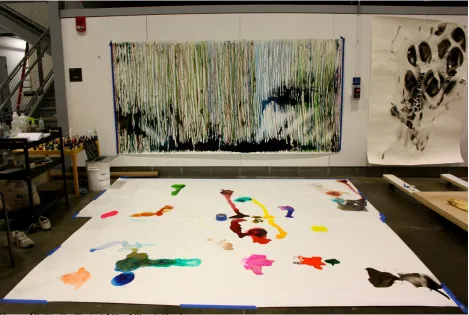
My studio procedure began as I identified the decisions I was continuously making and then designed a system that would remove me from the decision making process. I created a grid of 1’ squares on a 10’ x 10’ sheet of Yupo paper to determine where I would dispense the materials. Then I assigned inks, pigments and materials to another numbered grid. I also created a numbered system that described the tools and methods I would use to apply the various materials – methods such as the amount of water, amount of ink, and how to
disperse it on the surface. Then I rolled 12-‐sided die to determine which materials would be placed on the Yupo paper, what tool I would use, what process I would use, which inks I would use, and where I would dispense the materials on the paper. If there was an unexpected, unusual, or desirable reaction, I recorded the process that led to it.
This procedure evolved as I continued to notice more nuanced decisions I was still making. Once I had to make a decision twice I added it into my system. At first I rolled the die to determine the process to fill one grid area at a time and then I reevaluated that process and decided to try rolling the die to find parameters for about 8 grid areas at a time. For
example, when I ended up with the same location for rolls #64 and roll #67 I wrote in my notebook, “ Does knowing the fate of this spot ahead of time alter my actions?” I wondered if I would be less careful because I knew the form that developed in the grid would change anyway. Would I wait for the form in the first grid to dry before I continued? This is where the ideas of fate and determinism entered into the work, which made me re-‐evaluate my system. I found that my personal belief systems were also evolving alongside the system I was developing in the studio.
(Figure 13, Studio Shot of 10’ x 10’ painting)
This piece started out as an exercise to generate alternative combinations of variables but became a metaphor for my system of decision-‐making. It helped me practice being aware of the nuanced decisions I was making on a regular basis and the core belief system I
unconsciously used to make them.
Timeline
In “Timeline” (Figure 14) I refined the formulas for the results I deemed most visually interesting from the 10’ x 10’ painting. This time I focused on the sequence in which the variables were applied on the surface to determine if there was a significant difference in the result if the order was changed. I applied the same materials in the same amounts only changing the order in which they were dispensed. I did this three times for each process, generating 3 individual artifacts to compare. I also dispensed them sequentially in a linear array along the paper rather than randomly within a grid system so that the order of each result was made visible. In the end, it became a timeline of my process. While the result of this sequential process was more interesting than the random 10’ x 10’ painting, if I were to continue I would have locked myself into constraints that would have limited the ability for my process to evolve. I also would have ended up with one very long painting.
Figure 14 shows all my materials lined up on the floor and the grid of ink on the bottom shelf of the cart.
[image:16.612.95.564.67.382.2](Figure 14, Studio Shot of Timeline)
Artifacts of Adjacent Possibilities
I pushed my process even further by identifying the results I found most compelling from the previous two paintings. I was able to replicate them by following the procedures that I had carefully documented during previous paintings. The criteria for which artifact I would try to reproduce were based on how photo-‐like the results were, the complexity of the color palette, and how unrecognizable or unusual the textured effect was. For the series “Artifacts of Adjacent Possibilities,” I exactly replicated a procedure 10-‐12 times on separate 11” x 14” sheets of Yupo paper. I wanted to see how similar the results would be if every drop of ink, every cubic centimeter of water, and all the other variables I could control were the same. Despite using identical procedures, the paintings exhibited a stochastic effect. Even though the materials, the amounts, and the processes I was using were held constant, there were results that I could not control or predict accurately. This is when I recognized that each painting was an artifact of the natural phenomena that produced it. The forces underlying these phenomena included capillary action, surface tension, evaporation, gradient
formation, boundary formation, dispersion and diffusion, to name a few. I named this series “Artifacts of Adjacent Possibilities” because I believed each artifact within a set procedure illustrated one of several possible outcomes. This series became a metaphor for the decisions I was making and the infinite number of possible outcomes.
(Figure 16, Artifacts of Adjacent Possibilities: Magenta + Purple Series 12/12 detail)
Size
After making a few sets of the “Artifacts of Adjacent Possibilities” series I attempted to scale up the procedure. I was going from 11” x 14” to 60” x 72”. Trying to make larger versions of the 11” x 14” pieces that required such precise measurements of materials was harder than I anticipated because I was not able to control my materials at a larger scale. There was more surface area and there were several new variables which I could not contend with that were introduced at this large size. This included keeping the water to ink ratio the same so that the highly detailed effects I was able to facilitate in the previous series would happen on a larger scale. After making these 60” x 72” pieces I continued to increase the size of the paper and the quantity of the materials.
Working in a large scale presented many new challenges. I thought about how I could access the surfaces of my paintings while working horizontally on the floor. I thought about
New Materials
Once I accepted that I was not going to be able to have as much control at this scale I began to approach each painting as an individual paintings rather than a larger version of the Artifacts of Adjacent Possibilities series. I still kept many variables the same, but I chose a different material to add to each one. I called them additives. This helped me focus on the materials I had been using and how they related to the processes that were taking place on the surfaces of the Yupo paper. The work exhibited visual effects and details that I had seen while observing bodies of water, hiking in the mountains, and rock climbing. I started adding household materials to my water and ink mixtures, such as alcohol, starch, vinegar, and salt, and garlic skin, a material I had been drawn to for years. I used material remnants from previous projects and other materials I was drawn to at home and in my studio. I decided to go on walks outside where I gathered materials to bring back to the studio. I gathered bags of grass, leaves, rocks, and foliage.
Figure 17 shows the materials sitting on each painting. One piece has garlic skin on it, another piece has grass, and another has rocks. There is also a piece without any material other than ink and water that I created as a controlled reference.
[image:20.612.92.439.361.713.2]
Losing Control
”Phenomena – Purple + Green” (Figure 18) represents a benchmark in my process because it was one of the first paintings where I combined multiple materials rather than isolating materials to observe their behavior. Now I was trying to make a painting by combining several effects to facilitate more complex discoveries. I placed liquid-‐absorbing irrigation beads, grass, garlic, and aluminum shavings on the surface to interact with the ink and water leaving their unique marks.
While working on this painting the water and ink ran off the surface onto the floor and underneath the painting. I was pulled out of a calm thoughtful state when this happened. My instinct was to prevent this from happening so my precious ink supply wouldn’t be wasted. I noticed that whenever I attempted to stop the flow, it caused a very unnatural and regular border where the paper was propped up. When I finished this painting I had to turn it over to let the underside dry. The outcome of this “floor print” was unexpectedly enchanting. After responding several times to my instinct to prevent the ink from running off of the surface I questioned whether it was a useful instinct. I started to think more about my role as a maker and whether my instinct to save precious materials from being wasted actually stunted the painting’s potential.
(Figure 18, Phenomena Purple)
(Figure 20, Studio Shot of Striae)
Giving Up Control
Even though I was allowing the materials to flow off the surface, I was still controlling other aspects of my process in ways I was not aware of. I realized this when I invited several young children to make paintings with me. The children became new variables. I let them choose colors, drop the colors into several bottles of water, and apply the materials to the surface. One child went from puddle to puddle making sure to jump in all of them. Toward the end of this experience she accidentally dropped a large container of bouncy irrigation beads onto the surface. The bouncing beads went everywhere and it took a group effort to clean them up, but the effect it created on the paper was something I knew I would have never been irrational enough to purposely create. After the image dried I noticed a big difference between this piece and the pieces that preceded it. This fortunate accident loosened me up and subsequent large works became more successful. Now they were intriguing when seen as a whole piece from a distance rather than being interesting only when studied close up. Giving up control helped me make this important transition.
(Figure 21, Studio Shot, Figure A, C, D, & E were created after I brought kids into the studio)
Floor Prints
When I realized I was creating imagery on the back of my paintings as water and pigment flowed beneath them I created a process to reproduce this phenomenon. First I tried a passive method by placing a blank piece of Yupo paper next to a painting I was actively working on. I hoped that if water flowed off the piece I was working on, it would flow under the one I wasn’t working. Unfortunately that didn’t work out so I took a more active
approach.
To make the “Floor Prints,” I poured water and ink directly on a concrete floor and then placed large (72” x 60”) pieces of Yupo paper over the wet floor. Sometimes I would flip the paper over immediately, sometimes after 1 minute, 5 minutes, or 24 hours later. The ink and water would move in many directions on the paper at speeds and distances relative to how dry the paper had become. I learned to be careful about which edge to hold when I flipped the paper over because artifacts of the flipping process affected the final piece. After I turned the paper over I immediately dripped contrasting colors on the surface while the water was still moving, recording the movement of the water and the pigment.
At first I tended to overwork the paintings. I would flip the paper back onto the floor with new inks once the previous layer had dried but eventually found that this was making them muddy. The initial gesture held the magic; it just took me a few paintings to realize it. Working this way was a big leap forward in the evolution of my process. Instead of working on a stationary surface, the surface was being moved. The process was capturing the
movement of the water and color. This process is not unlike making a monoprint or a photogram. Figure 22 is an example of a successful piece from this series.
(Figure 23, Studio Shot of Floor Prints)
Similar to the artist Adam Fuss, who makes photograms, I am facilitating processes that take place in the natural world to make my work. Just as I use ink to capture the movement and interactions of my materials, Fuss uses the light sensitive properties of photo paper to capture the fleeting movements of smoke, babies, snakes, and water (Fuss).
(Figure 24, Adam Fuss – Untitled Photogram)
Phenomena – Thesis Exhibition
Curating
When it came time for me to curate my work for a thesis exhibition, I had over 100 works to choose from. The paintings became a timeline reflecting the development of my process. I used this idea of a timeline to choose which works to show and how to structure the viewer’s experience as they walked through the space. I chose one to two works to represent each shift in my process over the 9-‐month period leading up to my thesis exhibition.
(Figure 25, Phenomena -‐ Red)
(Figure 26, Phenomena -‐ Red, detail)
One of the goals I had was to draw the viewer in to look closely at the works so that they would pause and become enthralled in the details. I wanted the work to help the viewers see their surroundings anew.
In order to try to achieve this, I decided to show the large paintings in an uncovered, raw state. I wanted to bring the viewer directly to the surface where the phenomena occurred. The paintings became the phenomena.
I also included paintings that had remnants of the materials I used to make them, garlic skins, leaves, and grass. I wanted to provide a clue about the process to the viewer. I also wanted to help the viewer understand that they were looking at the actual objects, the painted surface itself, and not a printed copy of the work. “Figure 27” is an example of a piece where garlic skin was left as part of the final piece as a clue.
(Figure 27, Artifacts of Adjacent Possibilities Green Series, detail)
Conclusion
Interactions with the Work
While my exhibition was on view I observed people interacting with the work. I hoped that people would get close, pause and really look. I watched several people begin walking straight towards “Phenomena -‐ Red” when they entered the space (Figure 25), only to be unexpectedly drawn in by one of the “Abstracts of Adjacent Possibilities” paintings. Once they got close I saw them go back to the beginning to examine each painting. When viewers arrived at “Phenomena -‐ Red,” they froze in front of it.
Everybody who spoke to me asked me about my process. They wanted to know how I achieved the effects that they could not identify and how I generated the high magnitude of detail and photo-‐realism. They were especially surprised to learn that I never went back into the work with a brush or a fine marker. I explained that natural phenomena generated the works and that my role was to facilitate these processes.
In an interview with NPR, Adam Fuss said,
“One doesn't have complete control over the individual picture in the way one steps back. The force that makes the picture, the actual construction of the picture is not made by the hand it is made by the law of nature, the form that the nature takes. But one creates the situation that allows it to take place. So there is a great degree of taking the helm. But there is also a situation where it is beyond, it is like another world. So there is no way you can do that. I like the aesthetic of me not being there, of their being no helm...”
(Fuss, Photogram.org)
“Figures 28” is a detail of the work “Phenomena – Grass.” I believe that when viewers looked closely at pieces like this, they saw something that they didn’t expect. The work presented them with a mystery that prompted them to wonder.
In the beginning of a book entitled, Wonder, The Rainbow, and the Aesthetics of Rare Experiences, Philip Fisher explains this observation well.
Fisher states,
“The experience of wonder no less than that of the sublime makes up part of the aesthetics of rare experiences. Each depends on moments in which we find ourselves struck by effects within nature whose power over us depends on their not being common or everyday. Finally, they are both experiences tied to the visual taken in a deeply intellectual way; they both lead back to reflection on ourselves and on our human powers; and they both have deep connections to mathematics, as Kant
showed in the case of what he called the mathematical sublime, and to whatever link there might be between mathematics and the most essential details of thinking itself. How we think and how we are drawn to think about just this, rather than just that…” (Fisher, 1)
(Figure 28, Detail of Phenomena -‐ Grass)
The Beginning
The summer after a visit to Japan I came back to my studio in Ann Arbor and asked what my thesis would be about. “What do I need?” I am now truly able to answer this for the first time.
“I need calm.”
“What makes me calm?” “Being in nature.”
“Giving up control to nature.”
I now realize that I was allowing natural phenomena to happen on the surfaces of my
paintings, instead of trying to mimic nature through deliberate mark-‐making. Just as the ink revealed invisible phenomena on the surfaces, the systems I created in the studio also revealed my internal decision making patterns. This allowed me to accept, reject, or change them. The visceral effect I had while making this work was similar to exploring an
enchanting landscape. What started out as a desire to create a calming process turned into a material exploration that unexpectedly became a system for decision-‐making in both my creative practice and in my life.
Bibliography
Ball, Philip. The Self-Made Tapestry: Pattern Formation in Nature. New York: Oxford University Press, 2001. Print.
Barney, Matthew. Drawing Restraint. SFMOMA, 2006. Web. Dec. 2012. Web.
file://localhost/< http/::www.sfmoma.org:explore:multimedia:videos:31>.
Brecht, George. Chance-Imagery. Esthetics Contemporary, ed. Richard Kostelanetz. Buffalo, NY: Prometheus Books, 1978, 116-‐127. Print.
Fisher, Philip. Wonder, The Rainbow, and the Aesthetics of Rare Experiences. Massachusetts: Harvard University Press, 1998. Print.
Fuss, Adam. The Aesthetic of Me Not Being There. Photogram, n.d. Web. March, 2013. Web. <http://www.photogram.org/concept/statements/adamfuss.html>
Knowles, Tim, Tree Drawings. Timknowles, n.d. May, 2012. Web.
file://localhost/<http/::www.timknowles.co.uk:Work:TreeDrawings:tabid:265:Default.aspx >
Moore, Thomas. The Re-‐Enchantment of Everyday Life. New York: Harper Collins Publishers,1996. Print
Pollock, Jackson. Jackson Pollock on His Process. SFMOMA, 2000. Web. Oct. 2012. Web.
file://localhost/<http/::www.sfmoma.org:explore:multimedia:videos:250>
Thompson, D’Arcy. On Growth and Form. Cambridge: University Press, 1942. Print.