-a9
11.11/4.Surge Irrigation : 1. An Overview*
Allan S. Humpherys'
Abstract : Soil infiltration rates are generally reduced by the intermittent application of water during surge irrigation such that this technique can be used to increase the wetting front advance compared to continuous flow and to control runoff. Surge flow principles related to water advance and infiltration in furrows are summarized. Computer models to simulate surge flow irrigation are noted, particularly the kinematic wave model which has become the standard for surge irrigation. Commercial valves and controllers are available for automating surge irrigation systems. Field test results with different soil and field conditions at a number of locations are discussed. Results have varied but show that the greatest effect on infiltration rates occurs during the advance phase on light-textured soils and during the first irrigation of the season or following tillage.
Résumé : Le taux d'infiltration est gêneralement reduit en utilisant la methode d'irrigation par intermittence. En comparaison avec l'irrigation continue, la distance parcourue par le front d'eau est plus grande avec la methode d'irrigation par intermittence. Elle permet aussi un meilleur contrOle du ruissellement. Les principes de l'irrigation par intermittence en relation avec le front d'eau et la vitesse d'avancement de ce front sont discutes. Des modeles informatiques simulant cette methode sont notes, en particulier le modele de vagues cinematiques, devenu un standard dans le domaine. Des vannes et contrelles automatiques sont maintenant disponibles sur le marche. Des resultats de travaux de recherche effectues sur le terrain pour diverses conditions et types de sol sont discutes. Les resultatsvarient mais demontrent que l'effet principal de l'irrigation par intermittence se note sur sols legers durant la phase d'avancement et pendant la premiere irrigation ou suite a un travail du sol.
•
L'Irrigation par Intermittence I. Une revue(Contribution from the ICID Working Group on Mechanized Irrigation of the Committee on Practices)
Agricultural Engineer, USDA - Agricultural Research Service, 3793 N, 3600 E, Kimberly, Idaho 83341, USA, Chairman, ICID Working Group on Mechanized Irrigation
Manuscript received 21 August 1989
Introduction
Surge irrigation is the intermittent application of water to surface irrigated furrows or borders in a series of relatively short on and off time periods during the irrigation which usually vary from about 20 minutes to two hours. With this technique, water is applied intermittently rather than with a continuous stream, as in conventional surface irrigation. The concept of "surge flow" was introduced at Utah State University by Stringham and Keller (1979). It was originally conceived as a means of achieving time-averaged cutback furrow stream sizes while at the same time maintaining a constant field supply stream. The authors found that intermittent water applications during the irrigation advance phase generally reduced infiltration by providing a short drainage period following wetting. This resulted in a more rapid advance of the wetting front than with continuous flows. Thus, the difference in intake opportunity time between the upper and lower ends of furrows was less and resulted in a more uniform distribution of water intake over the length of the furrows.
The technique can be used as originally envisioned to achieve cutback stream sizes to reduce runoff, however, it is more commonly used as an irrigation management tool. Surge flow has the potential to improve the performance, versatility, and efficiency of surface irrigation systems where conditions favor its use.
The surge effect depends upon a number of factors such as soil texture and consolidation, prior wetting history, and duration of the on and off periods. Because of its variability and also its potential to improve surface irrigation performance, a coordinated regional research project in the western states of the U.S.A. was undertaken to obtain a greater understanding of surge flow and how to best utilize the concept. The research involved laboratory and field studies in several states and the development of computer models and equipment along with design and evaluation guidelines. The final report for this project was published as a research bulletin by Utah State University (Stringham, 1988).
The objective of this paper is to present an overview of surge irrigation including principles and theory, models, systems and equipment, and field experience. A second paper (Humpherys, 1989) presents general management guidelines and how surge can be used to improve irrigation efficiency. Surge irrigation is a new technique and has wide potential to improve surface irrigation performance since most of the world's 220 million ha of irrigated land is irrigated by surface methods.
Surge flow principles and theory
Infiltration
to quantify and predict these relationships and their effects. The intake rate reduction phenomenon is caused by a combination of factors or mechanisms, some of which likely predominate under one set of conditions more than under other conditions because of differences in soil properties. Mechanisms by which surge irrigation affects infiltration as proposed by various researchers (Blair, et al., 1984; Kemper et al., 1988; Malano, 1982; Samani et al. 1985) include : (1) surface soil consolidation, as negative hydraulic gradients develop in the soil water during flow interruption; (2) filling of cracks, which form in the furrow bed when flow is interrupted, by bed load when water reenters the furrows; (3) sealing of the furrow bed as water remaining in the furrow after each flow interruption infiltrates and deposits its fine sediment in large pores or as a fine seal on absorbing surfaces; (4) more complete disintegration of soil particles in the wetted perimeter as a result of faster wetting by the advancing water front, (5) surface sealing caused by particle migration and reorientation; (6) hydration and expansion of clay particles; (7) redistribution of infiltrated water in the soil profile, and (8) air entrapment.
Of these, the primary mechanisms noted most often are : (1) soil consolidation due to negative hydraulic gradients and (2) surface sealing caused by soil particle migration, reorientation, and deposition on the soil surface. Each of these factors independently can decrease hydraulic conductivity but when they occur simultane-ously, their combined effect can intensify or increase the reduction in infiltration rate. Samani et al. (1985) presented data for four different soils which showed that as negative pressures were applied to previously saturated loam, silty clay loam, silt loam, and sandy loam soils, the resulting increases in soil bulk density were accompanied by decreases in saturated hydraulic conductivity. They concluded that negative hydraulic gradients which accompany intermittent water applications will increase the instantaneous intake rate of the soil unless the soil's bulk density increases. However, if the bulk density increases during the off-time due to soil consolidation such that the hydraulic conductivity is decreased enough to more than offset the increased hydraulic gradient, the effect of surge flow will be a net reduction in the infiltration rate. The amount of consolidation of previously wetted soil during the surge off-time depends upon the magnitude of the negative pressures developed which in turn is influenced by surface sealing (Brown et al., 1988) and by soil properties prior to irrigation, such as soil structure, texture, bulk density, degree of saturation, and organic matter. Increasing the off-time of surge flow for some conditions and within limits, may allow greater negative pressures to develop which can increase soil consolidation. Researchers have found that surge irrigation has its greatest effect during the first irrigation of the season or following tillage when the soil bulk density is low. As the soil consolidates during subsequent irrigations, surging may actually increase the soil intake rate because of an increased hydraulic gradient during the off-time (Samani et al). This can partially explain why the effects of surge irrigation are less pronounced in wheel track furrows than non-wheel furrows and have either not decreased the infiltration rate or, in some cases, have increased it on compacted soils.
Continuous 26 L/min.
Surge 26 L/min.
Continuous 29 L/min.
Surge 29 L/min.
20 40 60 80 100 120 140 160 180 200
Coarse-textured sandy loam soils have shown greater intake rate reductions in response to surging than have fine-textured soils such as silt and clay foams (Testezlaf et al., 1987; Walker et al., 1982). Some clay and silty clay soils have shown little or no response (Bautista and Wallender, 1985; Manges et al., 1985; Pitts and Ferguson, 1985).
Advance
A rapid furrow stream advance rate was one of the earliest observed effects of surge irrigation (Bishop et al., 1981; Coolidge et al., 1982; Stringham and Keller, 1979) and this has since been documented by many other investigators. Because of the reduction in infiltration rate, which typically occurs after the first surge cycle, a larger down-field furrow stream is available to advance the wetting front than would occur under the higher furrow infiltration rate of a continuous stream. Average advance
Distance - meters
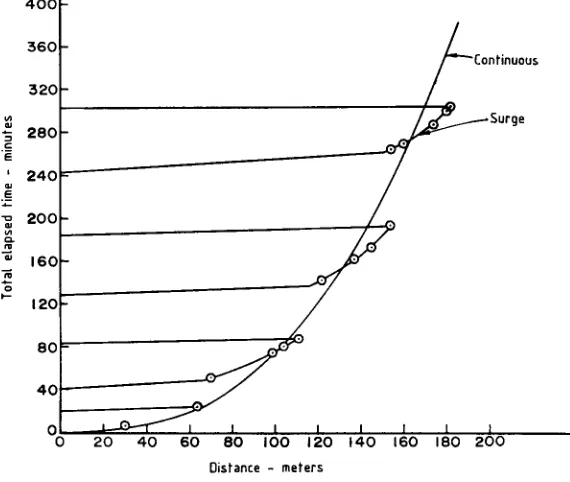
Figure 1. Advance curves for surged and continuous furrow streams on a silt loam soil near Kimberly, Idaho. Cumulative time for surged streams is the elapsed time minus the off-time.
Continuous
20 40 60 80 100 120 140 160 180 200
it
n.
in represents the actual cumulative time that water was in the furrow so it can be more
is
directly compared to the continuous curve. Typical advance curves for individualsurges in one of the furrows with elapsed time are shown in Fig. 2 along with the id continuous flow curve. As illustrated by these curves, water advanced to the ends of the surged furrows with the 26 L/m streams in about half the supply time as for continuous flow. Or, expressed another way, twice as many furrows were wet in about the same elapsed clock time and with approximately the same volume of water as with constant size streams. The effectiveness of surge irrigation in hastening advance is expressed as the advance volume ratio, Vs/Vc, where Vs is the volume of water used to advance the wetting front to the end of a field by surging while Vc
to is the volume required with a continuous stream. This ratio for the curves shown in
Fig. 1 is 0.53 and 0.73 for the 26 and 29 L/m streams, respectively. Surge was more
ir effective in hastening advance with the small stream size, while the water volume
:e required for full advance was less with the larger streams. The small, non-erosive stream sizes required for highly erodible soils may require long advance times which can result in excessive deep percolation and low efficiencies. As shown in Fig. 1, small streams, which are less erosive, can sometimes be efficiently advanced by surging. This is significant because light-textured soils on which surging is most effective are also usually the most erosive soils. Thus, longer lengths of irrigation runs, which are more efficient for field operations with machinery, are sometimes possible by surging small streams that otherwise would not reach the ends of long runs.
Distance - meters
Figure 2. Advance curves for individual surges in one furrow with progressively increasing on -times and the average advance curve for continuous flow.
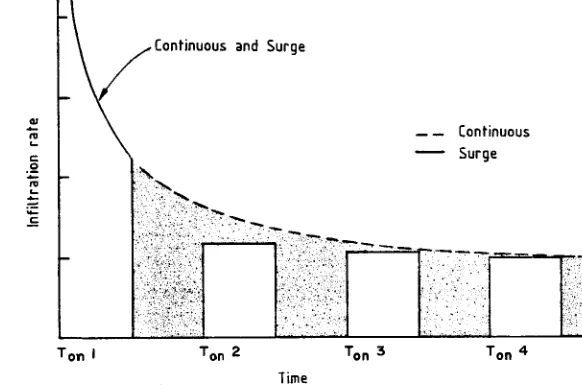
The differences in infiltrated volumes during advance on an elapsed time basis between continuous and surge irrigation are illustrated in Fig. 3 (patterned after Izuno et al., 1985) where a surge cycle includes one "on" (wetting) and one "of' (dewatering) period. This shows that after the first surge cycle, the infiltration rate is reduced from a time dependent rate to a value which approaches the soil's basic
Continuous and Surge
— Continuous — Surge
Ton I T or, 2 Ton 3 T on 4
Time
Figure 3. Infiltrated volumes during advance, on an elapsed time basis, as represented by the area under the curve and within the surge segments for continuous and surge irrigation respec-tively (compare to Izuno et al., 1985)
time independent intake rate with the reduction decreasing with subsequent surges. Izuno et al. (1985) concluded that the infiltration rate is reduced in a step drop and appears not to undergo further reduction with subsequent surges; other researchers have reported infiltration reductions at progressively smaller rates following the first surge, as shown in Fig. 3 (Blair and Smerdon, 1987; Musick et al., 1987; Purkey and Wallender, 1988).
Surge 1, T
Surge 2, T+AT,
Surge 3, T-FAT2
Surge 4, T+AT,
Over irrigation
by surging Profile at end of advance
Desired irrigation depth .41ka.4.4.4.4nA
weA,
Over irrigation
by continuous flow
Profile at end of surge irrigation Profile at end of continuous irrigation
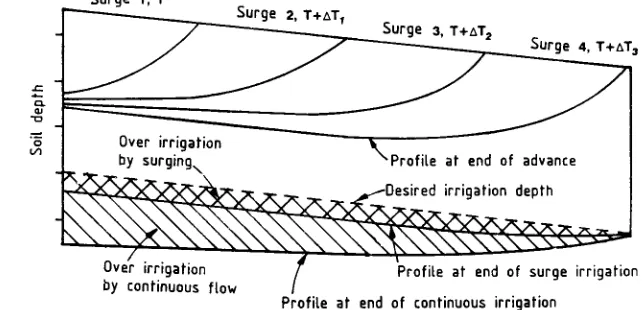
Figure 4. Diagram of cumulative infiltration profiles for surge flow with increasing on-times com-pared to that for continuous flow.
Models
Computer models have been used for a number of years to simulate continuous irrigation in furrow, border, and basin irrigation systems. New versions of these models have been developed to simulate the surge flow process. The unique features of surge flow such as spatially and temporally varying infiltration, flow over a wet-dry interface, simultaneous advance and recession, and surge cycle time and ratios must be considered. A discussion of the various models that have been developed and reported in the literature is beyond the scope of this paper. However, three general types have emerged as being satisfactory (Stringham, 1988); i.e., kinematic wave (Blair et al., 1984; Blair and Smerdon, 1987; Izuno and Podmore, 1985; Walker and Humphcrys, 1983), zero-intertia (Purkey and Wallender, 1988; Raye and Wallender, 1985; Wallender and Raye, 1985), and the hydrodynamic model (Walker and Skogerboe, 1987). The kinematic wave model has become the standard for simulating surge flow in furrows (Stringham, 1988).
Sensitivity analyses were conducted to determine the effects of variations in model input parameters on predicted surge advance and performance (Izuno and Pod-more, 1985; Stringham, 1988). Those parameters which are most important are infiltration, field length, inflow rate, and cycle on-time. Relatively large variations in these parameters result in relatively large variations in performance. Those parame-ters which have a relatively small influence are the physical parameparame-ters of slope, furrow roughness, and furrow cross sectional area and shape factors. Relatively large variations in these parameters result in relatively small variations in system performance. Surge flow simulations will be primarily affected by the accuracy of the inflow and infiltration input data.
ICID BULLETIN 1989, VOL.38 NO. 2 41
The Kostiakov and extended Kostiakov infiltration equations
z = kta (1)
and
z = kta + ct (2)
along with variations of these equations are commonly used in the models to characterize infiltration where
z = cumulative intake, liters per meter of furrow length (L/m)
t = intake opportunity time in minutes (min)
k = Kostiakov constant (L/min a/m)
a = Kostiakov exponent, dimensionless
c = basic furrow intake rate, liters per minute per meter (L/min/m)
Three infiltration conditions under surge flow have been identified as dry, wet, and transition (Izuno et al., 1985; Walker and Humphcrys, 1983). The dry regime is where water advances over dry soil and the intake rate is time dependent; the cumulative intake is described by Equation 1. The wet regime occurs during subsequent surges where water flows over previously wetted soil surfaces. The intake for this section of the furrow has been reduced by surging and approaches the basic intake rate; the cumulative intake can be represented by the second term of Equation 2. The transition regime occurs during subsequent surges when water flows over the section of furrow that was partially wetted during the previous surge and the infiltration lies between the high time-dependent rate and the surge-lowered basic rate.
The zero-inertia model is considered the standard method of analysis for continu-ous flow in borders and basins and more accurately describes furrow irrigation than other models for nearly flat slopes. This model has been improved and extended for surge flow simulation (Purkey and Wallender, 1988; Raye and Wallender, 1985; Wallender and Raye, 19850.
Most research modelers have used data from recirculating flowing infiltrometers to characterize surge flow infiltration because it is more representative than that from static methods. Several types of flowing infiltrometers have been used (Bautista and Wallender, 1985; Blair and Smerdon, 1987; Dedrick et al., 1985; Stringham, 1988; Testezlaf et al., 1987; Walker et al., 1982). With good representative infiltration input data, the computer models that are now available can simulate surge flow for many conditions and are useful in designing and evaluating surge flow systems. They can be used as a management tool to predict and optimize performance and to provide management alternatives such as cycle times and cutback regimes.
Surge flow systems and equipment
To efficiently utilize the surge technique, irrigation systems must be automated. Some of the valves and controllers commonly used were described by Humpherys (1986) and Stringham (1988). The most common system is a split-set layout with a valve constructed in a tee configuration at the center of a gated pipeline. A surge set consists of a block of furrows of equal size on each side of the valve. The valve diverts flow alternately from side to side. To minimize costs, one valve is commonly used for each field and is located in the center of the field. Each subsequent irrigation set uses a different block of furrows on each side of the valve. The pipe gates for the block of furrows on each side are manually opened and closed for each irrigation set. Irrigation proceeds set-by-set in sequence either starting at the outer ends of the pipeline and progressing towards the valve or starting at the valve and progressing toward the outer ends of the pipe. Systems with this configuration have a cycle ratio of 0.5. Both water-operated and electrically-powered mechanical valves are used. Commercial valves are available with their associated controllers which have various features and degrees of sophistication. Solar battery-charging options are available for most. Some have self-computing capability with fixed and variable algorithms. Most valves can be programmed for a cutback mode to provide reduced stream sizes in both blocks of furrows simultaneously following advance.
A single furrow valve control system (Stringham, 1988) uses individually automated outlets, one for each furrow, that are operated simultaneously in groups. The individual valves are operated pneumatically or electrically. Both the cycle ratio and time can be varied such that ratios other than the 0.5 commonly used are possible. Multiple groups or blocks of furrows are operated sequentially in various combina-tions to obtain different cycle ratios. This system also has the capability of using short cycle times to obtain time-averaged stream sizes during cutback.
Surging from concrete-lined ditches can be accomplished if the ditches have individual furrow outlets. A system of this type was described by Testezlaf et al. (1986). The lined ditch was constructed in a series of level bays with an elevation drop between each bay and with furrow outlet tubes at the same elevation in each bay. The bays are operated in pairs with an automated surge gate located between them. The gate alternately checks the water to irrigate from the upstream bay or bypasses the water to irrigate from the downstream bay. Other ditches, which have notched furrow outlets near the top of the ditch on the discharge side, have been automated by using a motorized, vertical-axis butterfly gate for surging between two bays.
Field experience and results
Furrow
Field experience on many soils has generally shown that a given size stream will often advance to the end of the field by surging in about the same elapsed time as that required for continuous flow. Thus, with a cycle ratio of 0.5, twice as many furrows can be wetted during the advance phase with approximately the same volume of water and time as can be wetted by continuous irrigation. Field tests reported by Bishop et al. (1981) on a silt loam soil used variable cycle time and ratios. The stream advance under surge flow conditions in non-wheel track furrows was three to four times faster than continuous flow. These results are more dramatic than those reported by most researchers. The surge effects were most pronounced during the first irrigation of the season and in nonwheel track furrows. Another significant observation reported by Bishop et al. was the reduced variability in advance rates under surge irrigation. During the season, over the field, and among replications, furrow stream advance times ranged from 270 to 3490 min. for continuous flow compared to 60 to 130 min for surged furrows. This reduction in variability has also been reported by others (Evans et al., 1987; Izuno et al., 1985; Purkey and Wallender, 1988).
Typical comparisons between continuous and surged furrows on a silty clay loam, 400 m field length, 60 min. cycle time and a 0.5 cycle ratio were reported by Izuno et al. (1985). The volume , of water applied during the advance phase in surged, nonwheel track furrows was 36% of that required for continuous streams, while that for surged wheel track furrows was 60% (advance volume ratio, Vs/Vc = 0.36 and 0.6, respectively). Kemper, et al. (1988) reported variable results from surging on a silt loam soil for different field conditions. The advance volume ratio, Vs/Vc, in wheel and nonwheel furrows varied from 0.44 to 1.17 for the various conditions. Testezlaf et al. (1987) reported that surge flow caused a one-third to two-thirds reduction in infiltration rates on loam, fine sandy loam, and clay loam soils with the greatest reduction on the coarser-textured fine sandy loam.
41.
average reduction in cumulative water intake. Thus, deep percolation was signifi-cantly reduced while still satisfying the crop water requirements. Surge reduced cumulative intake by17% during the next four seasonal irrigations following the first. The surge cycle time was 1.5 hours, with a cycle ratio of 0.5 with 24 hour total set time on a 400 m long field. Tailwater was reduced by surging from 16% for continuous flow to 10.1% for surge flow. However, the authors pointed out that unless surge flow is carefully managed, tailwater can be increased because of the reduced furrow intake rate.
Goldhamer et al. (1986) compared surge to continuous flows on sandy loam, clay loam, and silty clay soils and reported that the average advance volume ratio for the three cases studied was 0.61. Surging increased the average distribution uniformity* for all three soils from 63% to 78%. This resulted in 58% and 80% reduction in deep percolation for the clay loam and silty clay soils, respectively. However, average cumulative runoff was increased almost three times because the reduced infiltration rates caused by surging required longer application times to apply a given volume of water. The systems were not managed to reduce runoff because runoff was reused. In a Colorado study of surge vs. continuous irrigation, Israeli (1988) reported an irrigation application efficiency of 85% for surge compared to 55% for continuous irrigation.
The relationships between furrow erosion, crop residue, and surge irrigation were studied by Evans et al. (1987) and Miller et al. (1987) on a sandy loam soil with a slope of about 3% with surged and continuous flow at different residue levels. Total elapsed clock times for both furrow streams to advance to the end of the field were approximately the same at the same residue levels and inflow rates. Thus, since water was only on for half the time with surged streams, only about half the water was used. There was a trend toward higher sediment concentrations in the outflow from surged furrows, but the total seasonal sediment discharge was less because water flowed in surged furrows only half as long as in continuous furrows. Irrigation performance was better for surged furrows with residue because large surged streams could be used for rapid advance while erosion normally caused by large streams was kept within tolerable levels by the residue. Increased infiltration caused by the residue was partially offset by the decreased infiltration resulting from surging.
Average low-quarter depth of water infiltrated Distribution uniformity (DU) =
Average depth of water infiltrated
The average low-quarter depth is the average of the lowest one-fourth of the measured values of water infiltrated where each measured value represents an equal area.
Basins and Borders
Surge irrigation trials on basins and borders have been very limited (Walker et al., 1981). For surge irrigation to reduce infiltration rates, the field surface must be dewatered between surges. This may require longer cycle times than is feasible in some cases, particularly with level basins which have a large surface storage and no downslope drainage. Preliminary tests were made in Montana (Westesen and Biglen, 1986) with 30.5 m wide borders 762 m long on a medium clay loam soil having a slope of 0.0031. The 76 mm root zone was adequately irrigated for the full field length by surging in 60% of the time required for continuous irrigation with the same stream size. Further study is needed to determine benefits and management criteria for surge irrigation of basins and borders.
Summary
Surge irrigation is the intermittent application of water to surface irrigated furrows or borders in a series of relatively short on and off time periods. Surge irrigation can be managed to achieve a more rapid advance of the wetting front and to control runoff. Infiltration rate reduction by surging is attributed primarily to soil consoli-dation caused by negative hydraulic gardients and surface sealing caused by soil particle migration, reorientation, and deposition. The greatest benefits from surging during stream advance occur on light-textured, high intake rate soils and during the first irrigation of the season or following tillage when surface soils are loose. Computer models have been developed to simulate surge irrigation performance and with good representative input data, can be used as aids to design and evaluate surge irrigation systems. The kinematic wave model has evolved as the standard model. Automation is needed to fully implement surge irrigation and commercial equipment is available that can provide management options to increase surface irrigation efficiencies and optimize labor inputs. Field experience with surge irrigation has been variable depending on field and soil conditions. The volume of water and supply time to advance furrow streams to the ends of furrows have ranged from about one-third of that required for continuous flow to approximately 15% more. Most researchers have reported an increase in distribution uniformity by surging. Surging combined with residue management has been beneficially used to control erosion and runoff.
Bibliography
Bautista, E., and Wallender, W.W., 1985, "Spatial variability of infiltration in furrows", Trans. ASAE, v 28, n 6, p 1846-1851, 1955.
Bishop, A.A., Walker, W.R.,Allcn, N.L., and Poole, G.J., 1981, "Furrowadvance rates undersurge flow systems", Am. Soc. Civil Engr., J. Irrig. and Drain. Div., v 107, n IR3, p 257-264.
Blair, A.W., and Smerdon, ET., 1987, "Modeling surge irrigation infiltration", Am. Soc. Civil Engr. J. Irrig. and Drain. Engrg., v 113, n 4,.p 497-515.
Blair, A.W., Smerdon, E.T., and Rutledge, J., 1984, "An infiltration model for surge flow irrigation", Am. Soc. Civil Engr. Proc. of Irrig. and Drain. Div. Spec. Conf., Flagstaff, Ariz.. p 691-700. Brown, MJ., Kemper, W.D., Trout, T.J., and Humphcrys, A.S., 1988, "Sediment, erosion and water
intake in furrows", Irrig. Science, v 9, p 45-55.
Clemmens, A.J., 1981, "Evaluation of infiltration measurements for border irrigation", Agricuitural Water Management, v 3, n 4, p 251-267.
Coolidge, P.S., Walker, W.R., and Bishop, A.A., 1982, "Advance and runoff-surge flow furrow irrigation", Am. Soc. Civ. Engr., J. Irrig. and Drain. Div, v 108, n IRI, p 35-42.
Dedrick, A.R., Hardy, L.A., Clemmens, A.J., Replogle JA., and Clemmens, LM., 1985, "Trailer mounted flowing furrow infiltrometer,"Am. Soc. Agric. Engrs., Applied Engineering in Agricul-ture, v 1, n 2, p 79-83.
Evans, RG., Aarstad, J.S, Miller, D.E., and Kroegcr, M.W., 1987, "Crop residue effects on surge furrow irrigation hydraulics", Trans. ASAE, v 30, n 2, p 424-429.
Goldhamer, D.A., Mohammad, A.H., and Phene, R.C., 1986, "Comparison of surge and continuous flow irrigation in California", Am. Soc. Civil Engr. Proc. Irrig. and Drain. Div. Spec. Conf., Portland, Ore., pp 392-408.
Humpherys, A.S., 1986," Automated farm surface irrigation systems worldwide", Int. Comm. on Irrig. and Drain., New Delhi, pp 92.
Humpherys, A.S., 1989, "Surge Irrigation : II. Management for furrow irrigation", ICID Bulletin, v 38, n 2.
Israeli, I., 1988, "Comparison of surge and cablegation to continuous furrow irrigation", Am. Soc. Agric. Engrs., St. Joseph, Mich., ASAE Paper No. 88-2014, pp 14.
Izuno, F.T., and Podmore,T.H., 1985, "Kinematic wave model for surge irrigation research in furrows", Trans. ASAE, v 28, n 4, pp 1145-1150.
Izuno, F.T., and Podmore, T.H., and Duke. H.R., 1985, "Infiltration under surge irrigation", Trans. ASAE, v 28, n 3, pp 517-521.
Kemper, W.D., Trout, T.J., Humphcrys, A.S., and Bullock, M.S., 1988, "Mechanisms by which surge irrigation reduces furrow infiltration rates in a silty loam soil", Trans. ASAE, v 31, n 3, pp 821-829. Malano, H.M., 1982, "Comparison of the infiltration process under continuous and surge flow", M.S.
Thesis, Agric. and Irrig. Engr. Dept., Utah State Univ., Logan, pp 107.
Manges, H.L., Hooker, M.L., and Ortel, T.W., 1985, "Variable cycle time effects in surge irrigation", Am. Soc. Agric. Engrs., St. Joseph, Mich., ASAE Paper No. 85-2583, pp 7.
Miller, D.E., Aarstad, J.S., and Evans, R.J., 1987, "Control of furrow erosion with crop residues and surge flow irrigation", J. Soil Sci. Soc. Am., v 51, n 2, pp 421-425.
Musick, J.T., Walker, J.D., Schneider, A.D., and Pringle, F.B., 1987, "Seasonal evaluation of surge flow irrigation for corn", Am. Soc. Agric. Engrs., Applied Engineering in Agriculture, v 3, n 2, pp 247-251.
Pitts, Di., and Ferguson, JA., 1985, "A comparison of surge and continuous flow furrow irrigation on clay soil with flat grade", ASAE l'aper No. 85-2584, Am. Soc. Agric. Engrs., St. Joseph, Mich., pp 12
Purkey, D.R., and Wallender, W.W., 1988, "Surge flow infiltration variability", Am. Soc. Agric. Engrs., St. Joseph, Mich., ASAE Paper No. 88-2015, pp 18.
Rayej, M., and Wallender, W.W., 1985, "Furrow irrigation simulation time reduction", Am. Soc. Civil Engrs. J. Irrig. and Drain. Engrg., V III, n 2, pp 134-146.
Samani, Z.A., Walker, W.R, and Willardson, L.S., 1985, "Infiltration under surge flow irrigation", Trans. ASAE, v 28 n 5, pp 1539-1542.
Stringham, G.E., (ed.), 1988, "Surge flow irrigation, final report of the Western Regional Research Project W-163", Utah Agric. Exp. Sta. Utah State Univ., Logan, Utah, Research Bulletin 515, pp 92.
Stringham, G.E., and Keller, J., 1979, "Surge flow for automatic irrigation", Am. Soc. Civil Engrs., Irrig. and Drain. Div. Spec. Conf., Albuquerque, New Mex., pp 132-142.
Testezlaf, R., Garton, J.E., Cudrak, A.J., and Elliott, R.L., 1986, "An open ditch surge flow furrow irrigation system", Am. Soc. Agric. Engrs., Applied Engineering in Agriculture, v 2, n 2, pp 133-136. Testezlaf, R.R., Elliott., L., and Garton, J.E., 1987, "Furrow infiltration under surge flow irrigation",
Trans. ASAE, v 30, n 1, pp 193-197.
Walker, W.R., Henggler, J.C., and Bishop A.A., 1981, "Effect of surge flow in level basins", Am. Soc. Agric. Engrs., St. Joseph, Mich., ASAE Paper No. 81-25555, pp 13.
Walker, W.R., and Humpherys, A.S., 1983, "Kinematic-wave furrow irrigation model", Am. Soc. Civil Engrs., J. Irrig. and Drain. Div., v 109, n IR4, pp 377-392.
Walker, W.R, Malano H., and Reploge, JA., 1982, "Reduction in infiltration rates due to intermittent wetting", Am. Soc. Agric. Engrs., St. Joseph, Mich., ASAE Paper No. 82-2029, pp 14.
F.
Walker, W.R, and Skogerboe, G.V., 1987, "Chapter 9 - Surge flow surface irrigation". In : Surface Irrigation : Tneory and Practice, Prentice-I lall, Inc., Englewood Cliffs, New Jersey.
Wallender, W.W., and Bautista. E., 1983, "Spatial variability of water distribution under furrow irrigation", Am. Soc. Agric. Engrs., St. Joseph, Mich., ASAE Paper No. 83-2574, pp 21.
Wallender, W.W., and Rayej, M., 1985, "Zero-inertia surge model with wet-thy advance", Trans. ASAE, v 28, n 5, p 1530-1534.