VOL. 1, NO. 2, December 2014, pp. 111-118
111
I. INTRODUCTION
Power Line Communications is called as PLC and it is a generic name for the communication mode which uses power lines. This technology consists of high-frequency signals and places the stored information on the power line and the data is transmitted by the power lines. Frequency signals can be separated from the power lines through the dedicated power line modems, and then transmitted to the terminal devices. PLC has two modes (i.e. High-speed PLC and Low-speed PLC) and High-speed PLC uses the frequency band of 0.5~30MHz achieving the speed of 14Mbps~1Gbps while Low-speed PLC utilizes the frequency band of 10~450KHz exerting the speed less than 9.6Kbps - mainly used to control electronic devices.
The power line communication media is originally designed for power rather than data transmission. For data communication, its channel characteristics are not ideal, the specific performances are obvious noise and serious signal attenuation [2,3].
To improve the reliability of PLC, one can consider from the physical layer. For example, channel estimation and selection, filtering design, power distribution and so on [3,4].
Nowadays, PLC is being used for the configuration of Home-Networks or factory automations. Owing to the improvements in both the stability and the transmission speed, resulting from recent digital power line communication method, it’s field of application is getting wider [5] and holding the limelight.
Meanwhile, PLC has been studied widely lately for it is considered as a low-cost communication solution using power distribution networks and for the Smart Metering system. The instability in a noisy channel environment requires careful simulation and modeling for the PLC based solution. Modeling of PLC’s physical characteristics using different simulation tools has been studied in the past and still remains as a research subject [5,12].
This organization of this paper is that the related researches are examined in Chapter 2, the description of
PLC-Based Smart grid Home Network System
Design and Implementation using OPNET Simulation
Author: Jun-Ho Huh
1,
Kyungryong Seo
2,*Abstract
The Smart grid refers to the technology that enables efficient usage of electric power by collecting information concerning the power usage and power lines grafting information and communications technology to onto power grids. There are Zigbee, PLC or IEEE 802.11 WLAN MAC as a core technology of the Smart grid, but in this paper, the discussion is focused on the PLC.
The PLC is the technology that carries out data communications using power lines and put into practical use in the field of lights or home appliances control recently but PLC-applied communications between electronic devices are rarely seen. For the reason that the PLC uses high-voltage power lines and has a disadvantage of experiencing higher data loss rate caused by the noises produced by going through transformers, the technology is yet to be used in many areas. Nevertheless, the PLC has been studied widely recently in respect that it's the low-cost communication solution for the Smart Metering [1]. Moreover, this technology is emerging as a novel data communication method and discussed as an important technology lately due to the developments of the Smart grid systems and Internet of things (IoT). Thus, in this paper, the results obtained from designing and performing implementation scenario for the PLC-based Smart grid home network system were compared and analyzed with that of IEEE 802.11 WLAN MAC (the foundation technology at Jeju Smart grid Test bed)-based Smart grid home network. Thus, in this paper, OPNET 14.5 PL8, OSI 7 layer, PLC router nodes and PLC nodes had been used for the designing and implementation simulations of both systems. Additionally, QoS was not considered in order to guarantee that all the traffics would not have the same processing priority.
Key Words: PLC, Smart grid, Home Network System, OPNET Simulation.
Manuscript received November 03, 2014; Revised December 13, 2014; Accepted December 30, 2014. (ID No. JMIS-2014-0010) Corresponding Author(*): Kyungryong Seo, Pukyong National University, 45, Yongso-ro, Nam-gu, [email protected]
1
Department of Computer Engineering, Pukyong National University, Busan, Republic of Korea, [email protected] 2
112 system in Chapter 3, and the scenario analysis and
conclusion in Chapter 4 and 5, respectively.
II. RELATED RESERARCH
2.1. OPNET Modeler
The origin of OPNET Modeler and IT Guru products, which are getting the spotlight as the best communications and networks simulation solutions, can be trace back the network simulator carried forward as part of the project which was ordered by the Department of Defense to MIT in 1986 and have reached their present forms as a result of continuous efforts and studies by the participating developers. OPNET solutions have been used and verified over 20+ years, and with the established trust, they are expanding their scope of application to the areas of Network Capacity Planning, Network Engineering, Network Management, etc.
2.2. PLC Router node model
Most of foreign countries' environmental control systems use RFID technology and as the control signals, they employ external sensors and voice recognition. Carol Rus et al. [6] proposed the voice control Smarthouse to control devices with the voice recognitions. Corcoran et al. [7] proposed the Universal Plug-n-Play (UPnP) to provide services to the wireless home network users with their PDAs and mobile phones or wearable devices. The user can send out the requests with his voice or user interface to the home server and in this case, the inconveniences caused by the pre-set areas and pre-recorded voice commands can be overcome. Hwang et al. [8] introduced RFID-based multi-user access control algorithm for the UPnP Smarthome. The users are required to carry RFID tags to monitor their access situations automatically so that many additional RFID detectors have to be installed in each different place. Helal et al. [9] and Liau et al. [10] suggested wireless smartfloor technology in which pressure sensors had been mounted to detect the location of the residents [11,12].
2.3. PLC Router node model
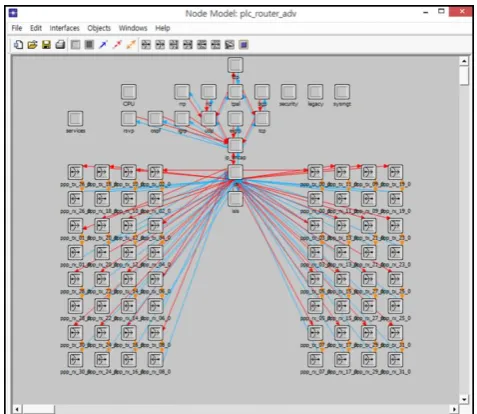
Figure 1 Shows a PLC Router node model has been developed based on the route model to perform generating, discarding and relay functions and supports routing OSPF, RIP and others provided by OPNET. As a linking interface with other node models, we used PPP interface because of its extendibility, which was taken into consideration in designing process. The design enables the linkages with 32 nodes max and should the number of the links exceeds 32, the situation can be solved by linking 2 or more relay nodes. Respective router node is comprised
with "Start type" and contains all the characteristics of router provided by OPNET.
Fig. 1. PLC Router node model.
Fig. 2. Attributes of PLC Router node model.
The router node model includes all the attributes of routers provided by OPNET and is possible to set IP address, routing protocol, and other parameters.
VOL. 1, NO. 2, December 2014, pp. 111-118
113
Fig. 3. PLC Router node model mechanism.
2.4. PLC terminal node model
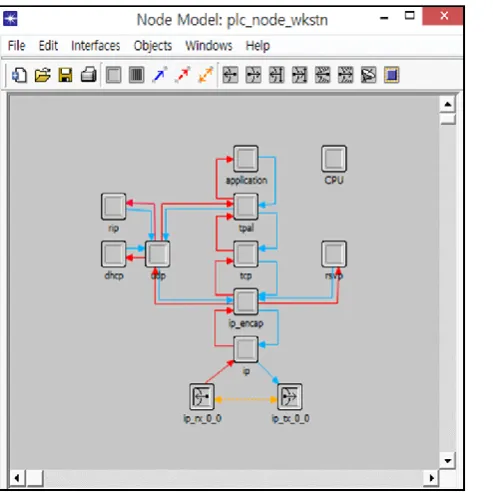
PLC terminal node model can generate and discard IP packets but cannot perform relay function. It was designed to provide basic IP protocol and to use UDP, TCP as transport protocols. Like the Router model, PPP interface is used as a linking interface with other node models. This is used as an end-to-end terminal model and can be connected to only one adjacent node.
Figure 4 Shows a PLC terminal node model includes all the terminal attributes that provided by OPNET, and it is possible to set IP address and transport protocol parameters, etc.
Fig. 4. PLC terminal node model.
Fig. 5. Attributes of PLC terminal node model.
As shown in Figure 6, the connections between the nodes are made up with 1:1 connection so that in order to connect with remotely located node, one has to go through another node(s). Thus, ring-form connection can be established. However, in this form, failure in 1 node could lead to whole network failure and such phenomenon can be fixed with FDDI.
Meanwhile, the terminal node model incorporates all the attributes of terminals provided by OPNET and is possible to set IP address, transmission protocol parameters.
114
2.5. PLC link model
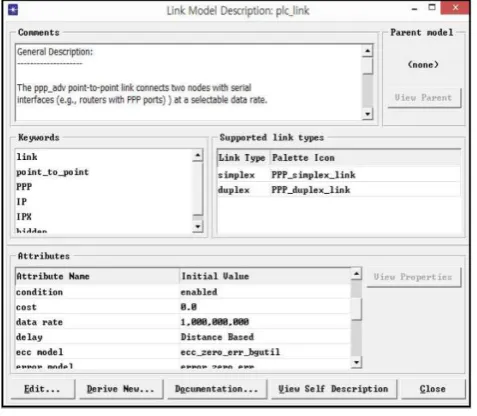
The link model refers to a model that links nodes. That is, traffics flow between the nodes. The PLC link model had been implemented based on the PPP model and the default bandwidth (for data rate) was set at 11Mbps. The linking speed (bandwidth) of each node may vary so that it was made the way that the user could change the linking speed.
In order to alter the bandwidth of the link model, right-click the model with a mouse, and then open 'Edit Attributes' to select or input desired bandwidth to set the data rate. Figure 7 shows link model setting display and, Figure 8 shows link bandwidth setting display.
Fig. 7. Link model setting display.
Fig. 8. Link bandwidth setting display.
2.6. PLC palette model
The purpose of the palette model is to make a scenario production in OPNET easier. It is comprised in a way that the user can take convenient 'drag & drop' steps by creating the PLC palette for the node or link model, which is produced with the PLC model. When arranging the
node model in a scenario, one only need to open 'Object Palette', select the node model to place, and then assign to the scenario. Figure 9 shows PLC palette model. In this paper we made many things.
Fig. 9. PLC palette model
III. PLC-BASED SMART GRID HOME
NETWORK SYSTEM
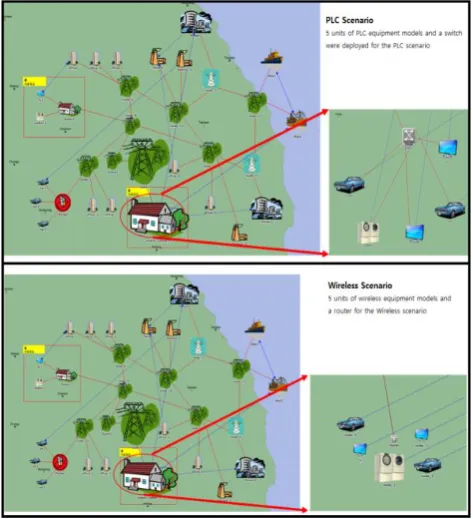
As the scenarios, 5 equipments had been deploy in the home network. 5 units of PLC equipment models and a switch were deployed for the PLC scenario and 5 units of wireless equipment models and a router for the Wireless scenario in order to construct them on the same level. For the traffics, 5 demands had been connected and G.729 traffic generation was observed. Simulation environment for performance evaluation, hardware and software are shown in Table 1.
Table 1. Simulation Environment
Working Environment Computer Specifications
CPU 3.0+ GHz using x86, EM64T, x86
AMD, or AMD64 (dual-core)
RAM 2GB
System File
Space 3GB
Working
File Space 100MB
Display
Resolution 1024x768
Development Environment
OS Windows 7 Professional (32 bit)
Compiler Microsoft Visual Studio 6.0
M&S Tool OPNET Modeler 14.5 PL8
VOL. 1, NO. 2, December 2014, pp. 111-118
115 according to the speed of the PLC link and we placed the minimum number of elements to analyze the results. And to ensure that all traffics do not have the same processing priority, QoS was not used.
Fig. 10. PLC-Based Smart grid home network system.
IV. SCENARIO ANALYSIS
4.1. Traffic Scenario
The scenario is one that the "Traffic" has been introduced in the Baseline scenario. Minimal elements were input to analyze the results. Traffic scenario configuration information is shown in Table 2. Arrangement of the nodes, connections of the links, and the traffics were randomly determined.
Table 2. Traffic Scenario Configuration Information.
Arrangement of the node
5 units of PLC equipment models and a switch were deployed for the PLC scenario and 5 units of wireless equipment models and a router for the Wireless scenario in order to construct them on the same level.
Traffic 5 demand connection (G.729 traffic)
11 Demand connection (G.729 traffic)
11Mbps
Execution time 1 hour
Performance indicators
Traffic transmission rate, end-to-end transmission delay, Jitter
4.2. Results of analysis
Traffic T/R volumes, delays and jitters were analyzed comparatively.
4.2.1. Traffic T/R rate (bits/sec)
The average rate was 30kbps equaling to the generated traffic volume and there was no message losses when traffic T/R rates were compared. Both networks had generated the traffics within 11Mbps and 100% volume was received without any loss.
The loss could have occurred in case of wireless network but owing to the WLAN's CSMA-CA (collision avoidance) and ARQ functions, the loss did not occur. Figure 11 shows comparison between PLC and wireless type T/R rates (bits/sec).
Fig. 10. Comparison between PLC and wireless type T/R rates.
4.2.2. End-to-end delays (sec)
The delay for PLC-based network was 0.0008sec and for the wireless network, it was 0.0013sec showing around 1.7 fold differences. Since Wireless type uses CSMA-CA method which considers times taken for Backoff, collision avoidance and retransmission, more delays are longer than the PLC type. Figure 12 shows comparison between PLC and wireless type End-to-End delays (sec).
4.2.3. Jitters (sec)
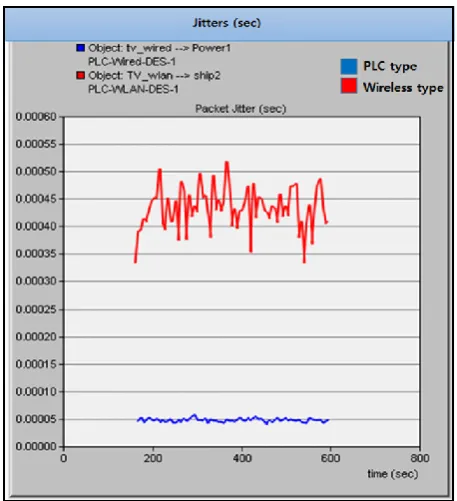
The average jitter for PLC type was 0.00005sec and 0.00045sec for Wireless type showing around 9 fold differences. Such difference seems to have been caused by the same reason mentioned above - the characteristic of the CSMA-CA. Figure 13 shows comparison between PLC and wireless type Jitters (sec).
4.2.4. Summary
116
Fig. 11. Comparison between PLC and wireless type End-to-End delays.
Fig. 12. Comparison between PLC and wireless type Jitters.
V. CONCLUSION
In this paper, the PLC Router node and PLC node-based modeling had been performed and on the basis of this model, designing and implementation of the Smart grid Home Network System were achieved. For a simulation environment, OPNET Modeler 14.5 PL8 was used, and to ensure all the traffics would not have the same processing priority, QoS was not considered.
In this study, the results obtained from designing and performing the implementation scenario for the PLC-based Smart grid home network system were compared and analyzed with that of IEEE 802.11 WLAN MAC(the foundation technology at Jeju Smart grid Test bed)-based Smart grid home network. OPNET 14.5 PL8, OSI 7 layer, PLC router nodes and PLC nodes had been used for the designing and implementation simulations of both systems. Additionally, QoS was not considered in order to guarantee that all the traffics would not have the same processing priority.
Acknowledgement
The first draft of this thesis was presented in Korea Computer Congress 2014, June 27-28. I am grateful to 3 anonymous commentators who have contributed to the enhancement of the thesis's completeness with their valuable suggestions at the Congress.
REFERENCES
[1] Panchadcharam. S, Taylor. G.A, Pisica. I, Irving. M.R, "Power and Energy Society General Meeting," 2012 IEEE, pp.22-26, July 2012.
[2] H. Hrasnica, A. Haidine, and R. Lehnert, “Broadband
Powerline Communications Networks: Network
Design,” New York, Wiley, 2004.
[3] Liu Xiao-sheng, Zhang Liang, ZHOU Yan, Xu
Dian-guo, “Performance Analysis of Power Line
Communication Network Model Based on Spider
Web,” 8th International Conference on Power
Electronics ECCE Asia, pp.953-959, May 30-June 3, 2011.
[4] D. Sabolic, “Influence of the transmission medium quality on the automatic meter reading system capacity,” IEEE Trans. Power Del., vol. 18, no. 3, pp. 725–728, Jul. 2003.
[5] Tsuzuki. S, Areni. I.S, Yamada. Y, "A feasibility study of 1Gbps PLC system assuming a high-balanced DC power-line channel," 2012 16th IEEE International
Symposium, pp.386-391, Mar 2012.
[6] Carol Rus, Kontola, K., Curcio, I.D.D., Defee, I.,
“Mobile TV content to home WLAN,” IEEE
Transactions on Consumer Electronics, vol.54, no.3, 2008.
[7] P.M. Corcoran, Desbonnet, J. Bigioi, P. Lupu, I., “Home network infrastructure for handheld/wearable
appliances,” IEEE Transactions on Consumer
Electronics, vol. 48 , no. 3, pp. 490-495.
“Location-VOL. 1, NO. 2, December 2014, pp. 111-118
117 aware UPnP AV session Manager for Smart home,” IEEE First International Conference on Networked Digital Technologies, 2009.
[9] Sumi Helal, Mann W., El-Zabadani H., King J., Kaddoura Y., Jansen E., “The Gator Tech Smart house:
A programmable pervasive space,” IEEE Computer
Society, 2005.
[10] Wen-Hau Liau, Chao-Lin Wu, Li-Chen Fu, “Inhabitants tracking system in a cluttered home
Environment Via Floor Load sensors,” IEEE
Transactions on Automation Science and Engineering,
vol.5, no.1, 2008.
[11] Chien-Zhi Ou, Bor-Shyh Lin, Che-Jui Chang, Chin-Teng Lin, “Brain Computer Interface-based Smart
Environmental Control System,” 2012 Eighth
International Conference on Intelligent Information Hiding and Multimedia Signal Processing IEEE computer society, pp.281-284, 2012.
[12] Jun-Ho Huh, Young-Hwan Park, Kyungryong Seo, “PLC Based SMARTGRID System Design and
Implementation using OPNET,” Korea Computer
Congress 2014, pp.1016-1018, June 27-28, 2014.
Authors
Jun-Ho Huh received Bachelor
of Science Degree from Department of Major of Applied Marine Sciences, Bachelor of Engineering Degree (Double Major) from Department of Major of Computer Engineering from Jeju National University, Jeju, Republic of Korea in Aug. 2007.
Master of Education Degree from Department of Major of Computer Science Education, Graduate School of Education, Pukyoug National University, Busan, Republic of Korea in Aug. 2012. Student in the Doctor Course Major of Computer Engineering, Graduate School, Pukyoug National University, Busan, Republic of Korea. His research directions are Green IT, Network Security, Curriculum of Computer, High Availability Computing.
Kyungryong Seo received
118