The New Approach for Solving Task Scheduling in Cloud
Computing Environment Using Combination of Genetic
Algorithm and Tabu Search
Fereshte Habibi
Department of computer Engineering , Sari Branch, Islamic Azad University, Sari, Iran, [email protected]
Dr. Homayon Motameni
Department of computer Engineering, Sari Branch, Islamic Azad University, Sari, Iran ,[email protected]
Farhad Ramezani
Department of computer Engineering ,Sari Branch, Islamic Azad University, Sari, [email protected]
Abstract — Taskscheduling problem in cloud computing environment is an important challenge that has a direct effect on quality of service provided therein. Task scheduling includes the process of tasks mapping to available resources based on task requirements and features. Task scheduling problem in cloud computing is a very important problem and included in Np problems that specifies an optimal schedule for implementation of tasks and optimal allocation of resources so that within shorter time, more task can be processed. Various algorithms have been offered so far for solving task scheduling problem in cloud computing. In this paper, a combined algorithm was presented for improvement of task scheduling problem in infrastructure layer of cloud computing, based on evolutionary genetic algorithm as well as tabu search algorithm. Empirical results indicated that the offered algorithm has a high efficiency and created a balance between users’ criteria.
Keyword — Cloud Computing, Genetic Algorithm, Tabu Search Algorithm,Task Scheduling.
1. I
NTRODUCTIONUpon increasing development of information technology and increase of various applications, doubtless need to integrated calculations is necessary for more users. Considering various applied needs of users, varied processing processes are required. In case these processes are performed based on more completely developed method, then need frequent and varied processors, but it is not possible for plenty of users. Therefore, use of technologies such as cloud computing that upon accepting the users’ need to do computational processes of users and recover the obtained results, seems to be necessary. Hence, based on such perspective of software, users get needless of hardware and computational environments.
National Society of Standards and Technologies defines cloud computing as below:
“Cloud computing is a model for enabling ubiquitous, convenient, on-demand network access to a shared pool of configurable computing resources (e.g., networks, servers, storage, applications, and services) that can be rapidly provisioned and released with minimal management effort or service provider interaction.” [1]. In fact, cloud computing technology in infrastructure layer provides usability of computational resources and saving as a service in terms of need type and through making an abstract layer on all physical resources aiding virtualization, provides resources management dynamically.
Task scheduling is a key process in the cloud infrastructure layer that process of tasks mapping to available resources is formed based on tasks requirements and features and its goal is implementing inputted demands to system on the resources in an efficient procedure and assuming other cloud environment characteristics. In cloud computing environment, any user may face hundreds of virtual resources for performing any task. In this case, assigning tasks to virtual resources by the own user is impossible. Due to dynamic features of cloud computing and different needs of various applications of resources, tasks scheduling discussion is assumed as Np problem [2]. For this purpose, different algorithms have been presented so far including as below: FCFS [3], Round Robin [4], Min-min [5], Max-Min-min [6], genetic [7], ant colony [8], simulated annealing [9], tabu search algorithm [10]. Among these methods, genetic algorithm was raised as the most well-known algorithm and used in different academic contexts such as engineering sciences as a powerful mean for solving optimization problems. Therefore, in this paper, the offered algorithm was compared to genetic algorithm.
general search capabilities of genetic algorithm to local search of tabu algorithm.
In this paper, in second part, offered architecture was explained. In third part, the offered algorithm was described and later in fourth part, summary of implementation was provided and fifth part includes conclusion.
2. O
FFEREDA
RCHITECTUREThere are N Data Centers In the presented cloud environment that each one of these Data Centers may be located at each point of geographical environment. Each Data Center is comprised of a few virtual machines that are connected to their respective Data Center using communication canals.
Every virtual machine is comprised of a few processors for processing information with varied processing power and performance of virtual machines is also varied. In addition, virtual machines may have processors with varied performance.
Furthermore, each processor has different costs for data processing. Processors are connected to their respective virtual machine using communication canals. Ultimately, all of these Data Centers in cloud environment are connected to each other via communication canals. In this environment, users that need different processors for their data processing, transmit their demands in a file for Scheduler system of cloud environment with varied transmission rates. In continue, schedulersystem of cloud environment receives demands of users and using scheduling algorithm deals with allocation of resources for users’ tasks processing. Moreover, each user for processing all of his tasks determines a proposed end time and proposed cost. In addition, user can suppose a priority for the said two parameters. Purpose of this scheduling algorithm is processing and implementing users’ tasks within minimum time and lower cost. After tasks scheduling by scheduling algorithm and their implementation in cloud system, processed data is transmitted to users.
2.1. Parameters assumed for offered architecture 2.1.1. Features of a Data Center
In the offered architecture, each one of Data Centers has following features:
Band broadness usable in Data Center for receiving and transmitting data in cloud environment system; List of virtual machines provided in cloud environment by respective Data Center
Geographical zone of Data Center
2.1.2. Features of a virtual machine
Each virtual machine in the offered architecture has following features:
Operating system type of respective virtual machine Architecture of respective virtual machine such as Intel, IBM, Mac etc.
List of available processors
2.1.3. Features of a processor
In the offered architecture, each one of processors has following features:
Processing ability of respective processor based on MIPS
Cost of users’ tasks performed on respective processor for each second
Rate of available processing ability by processor in Working days
Rate of available processing ability by processor in holidays
Rate of available processing ability by processor in other times such as midnight.
2.1.4. Users
In the offered architecture, users transmit their requests with following features for cloud environment system.
List of tasks: Request of each user may include several tasks that each one may need a specific processor.
Offered time for processing total tasks Offered price for processing total tasks Geographical zone of user
Band broadness usable by users for receiving and transmitting data in cloud environment system Priority of “offered time” and “offered price” parameters that its value is within [0,1] range: Price priority + time priority = 1
2.1.5. Requested tasks
Number of requested task Instructions of user based on MIPS
Size of file that data related to user’s respective request is saved therein.
Operating system type required for user’s requested task.
Architecture type required for user’s requested task.
2.2. Constraints assumed in this architecture
Users’ tasks are space-shared or offline and transmitted to scheduler system.
There is no pause for processors, it means when a processor is allocated to a task, will be at the disposal of processor until end of its respective task processing.
No constraint has been supposed for order of users’ tasks processing.
Any task must be processed on a processor with its related operating system and architecture.
3. O
FFEREDA
LGORITHMenvironment of offered model as described in table (1). In this sample cloud environment, two Data Centers so that each Data Center comprised of two virtual machines with different capabilities, were used. Each machine uses two processors for processing users’ tasks.
Table (1): Basic information of Data Center in offered cloud environment Data Center
information
Machine information Processor information
Data center
name
Trans missi on rate
Geogra phical zone
Virtual machin e name
Operatin g system
type
Archite cture
type
Proce ssor name
Throu ghput
Cost Max.available throughput Working
day
Holid ay day
Other times
D1
58 +03:30
M1 Windows Intel P1 10 1000 50% 90% 30% P2 25 2500 45% 50% 25% M2 Unix IBM P1 30 3000 56% 80% 60%
P2 10 1500 70% 89% 50%
D2 70 +03:00
M1 Windows IBM P1 20 2000 30% 70% 40% P2 35 3000 60% 95% 15% M2 Unix Intel P1 15 1500 30% 90% 25% P2 40 4000 40% 90% 35% In addition, basic information related to users’ tasks is
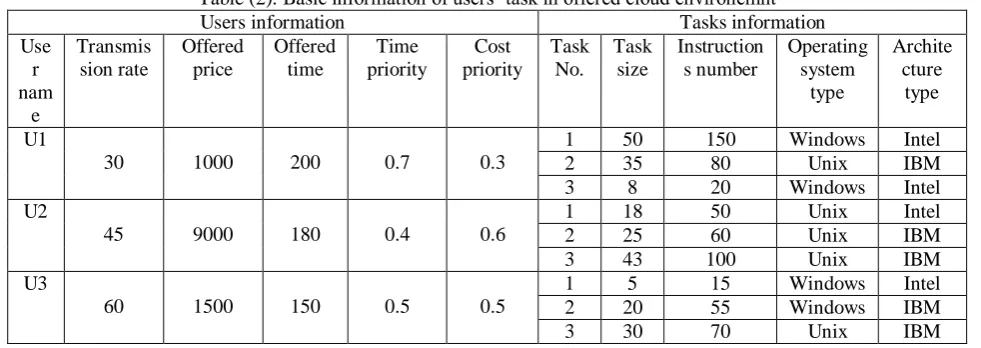
provided in table (2). In this table, there are 3 users that each one has transmitted specifications of his tasks for
scheduler system of cloud environemnt as offline to be processed by processors availble in sample cloud environment.
Table (2): Basic information of users’ task in offered cloud environemnt Users information Tasks information Use
r nam
e
Transmis sion rate
Offered price
Offered time
Time priority
Cost priority
Task No.
Task size
Instruction s number
Operating system
type
Archite cture
type
U1
30 1000 200 0.7 0.3
1 50 150 Windows Intel 2 35 80 Unix IBM 3 8 20 Windows Intel U2
45 9000 180 0.4 0.6
1 18 50 Unix Intel 2 25 60 Unix IBM 3 43 100 Unix IBM U3
60 1500 150 0.5 0.5
1 5 15 Windows Intel 2 20 55 Windows IBM 3 30 70 Unix IBM
In offered algorithm, data coding was used for better identification of resources and processors related to table (1) and processors’ indexing was used for coding the available data, so that in new coding, a unique index is assumed for each one of processors. Table (3) shows coding procedure of table (1). Each row of this table refers to respective processor in table (1).
Table (3): Coded processors in offered cloud environment
Row No.
Data center name
Machine name
Processor name
0 D1 M1 P1
1 D1 M1 P2
2 D1 M2 P1
3 D1 M2 P2
4 D2 M1 P1
5 D2 M1 P2
6 D2 M2 P1
7 D2 M2 P2
this table refers to one of tasks of respective user in table (2). Table (4) shows coding procedure of table (2) tasks.
Table (4): Coded tasks in offered cloud environment
Index No. User name Task No.
0 U1 1
1 U1 2
2 U1 3
3 U2 1
4 U2 2
5 U2 3
6 U3 1
7 U3 2
8 U3 3
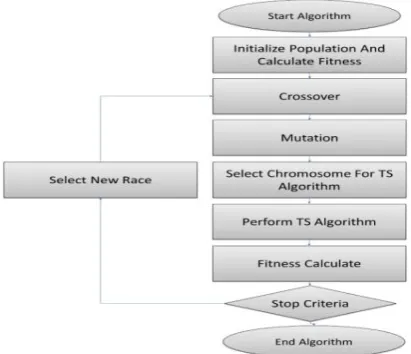
Figure (1) shows general stages of offered algorithm.
Fig.1. General stages of offered algorithm
3.1. Chromosome structure
In the offered algorithm, to exhibit chromosome, a one-dimensional array in the length of total available tasks for processing was used. Each cell of a chromosome that is so called a gene consisted of two fields that are shown as UTi and DPi. First field refers to ith task of coded tasks
table and second field DPi denotes processor No. i in
coded processors table. Figure (2) shows a sample chromosome assumed in offered algorithm.
Fig.2. Chromosome structure in offered algorithm
As it is observed in chromosome structure figure (2), each array number shows the number of task to be processed by respective processor. For instance content of second gene is 1,6 that in fact refers to task 6 of coded tasks table to be processed by processor 1 provided in coded processors table. Each chromosome shows a schedule for performance of all tasks of users.
3.2. Fitness
Fitness function in very important in evolutionary algorithms, because these algorithms work correctly only
when this function has been defined correctly. This function is a benchmark to diagnose if a response is better or competent than other responses. Chromosome fitness in offered algorithm was assumed as reducing completion time of total available tasks for processing in scheduler system of cloud environment as well as fitness of all users for improving users’ tasks processing so that their needs are met completely. Considering definitions and hypotheses explained in previous parts, to compute the fitness of a chromosome, at first fitness of total cost used for processing tasks of user j is calculated based on equation (1).
In above equation, denotes offered cost of user j for processing total respective tasks and denotes calculated cost in schedulersystem of cloud environment for processing tasks of user j and denotes priority assumed by user j for the cost and ultimately denotes fitness of cost supposed for user j.
Later, based on equation (2), fitness of total time needed for processing total tasks of user j is calculated.
In above equation, OTjdenotes offered time of user j for
processing his total respective tasks and TTj denotes
calculated time in scheduler system of cloud environment for processing tasks of user j and PTj denotes assumed
priority of user j for time and finally Tjindicates fitness of
time assumed for user j.
Considerable equations (1) and (2), fitness assumed for user j is calculated based on equation (3).
Fj = Pj + Tj (3)
In this equation, Pj denotes fitness of cost assumed for
user j and Tj denotes fitness of time assumed for user j
and Fj denotes fitness of user j.
Ultimately, fitness of chromosome in offered algorithm was assumed as total fitness of all users and completion time for processing all tasks in scheduler system of cloud environment that whatever chromosome fitness is lower, that chromosome will have better fitness. Equation (4) predicts chromosome fitness in offered algorithm.
Fitness =Makespan+ (4)
In equation (4), Makespan means completion time for processing total tasks of users in scheduler system of cloud environment.
3.3. Selection of parents for crossover and mutation
There are various strategies for selection of best chromosomes. In this algorithm, ranking method was used to select parents. Selection based on ranking is so that all chromosomes are ranked based on fitness as per equation (5). The best chromosome receives the rank of greatest fitness and the worst chromosome obtains rank 1.
So, in this method of selection of parents, all chromosomes will have the chance of selection
.
3.4. Crossover operator
In this algorithm, single point crossover operator was used. In this crossover method, after selecting two parents for crossover operation, one random number is selected within range 0 to n-1 (n denotes number of tasks) and genes located within range 0 to selected random number are transferred from first parent to the child and later its similar genes are deleted in second
parent. Genes remained in second parent are inserted respectively in empty cells. Purpose of using this crossover method is making similar children of parents to can make better children of parents with better fitness. Experimental results indicated that upon using this crossover, chromosomes are dispersed in better space of problem that consequently results in better answer in better time. Figure (3) shows applying crossover operator for two selected chromosomes.
Fig.3. Applying crossover operator for to chromosomes in offered algorithm
3.5. Mutation operator
Mutation causes search in intact spaces of problem. In this algorithm, exchange method was used for mutation so that after selection of a parent chromosome, 1 gene was selected randomly and its processor field is changed. Main purpose of applying this type of mutation is exchanging processor parameter of a task in order that a task can be processed in a better processor. Consequently, each chromosome obtains a better answer in problem space. Figure (4) shows applying mutation operator.
Child
Fig.4. Applying mutation operator in offered algorithm
3.6. Population optimization
At this stage, before selecting chromosomes for transferring to the next generation using tabu search algorithm, a rate of available population chromosomes are optimized and added as new children to the population.
In the offered algorithm, in an iteration ring, a few chromosomes are selected based on ranking method and local search algorithm is calling for them. Local search algorithm in each iteration receives one of genetic chromosomes as current solution and upon applying its operators, optimizes chromosomes during several stages. Neighborhood in tabu search of offered algorithm has been defined based on displacement of 2 genes and one of processors selection modes, so that total probable
displacements of a chromosome’s genes and one of processor selection modes are recorded in a list called tabu list. Selection of 2 genes and one of processor selection modes for displacement was made randomly according to tabu list. Later, this movement is deleted from tabu list to avoid selections of repeated neighborhoods. Number of neighborhoods selection is in accordance with defined number in order to optimize chromosome as possible.
3.7. Selection of chromosome
Chromosomes selection action for next generation in offered algorithm is a combined selection. In this method, at first chromosomes are sorted based on fitness and repeated chromosomes are deleted. Later, a rate of chromosomes with better fitness and remaining chromosomes are selected randomly for population of next generation. In this selection method, chromosomes dispersal will be kept always and chromosomes will be dispersed in problem space, and also causes premature prevention of local optimum points.
3.8. Termination condition
Termination condition in offered algorithm is limiting generation number, it means if algorithm reached to the maximum respective generation, best chromosome is exhibited and algorithm is completed, otherwise stage 2 is repeated.
4. A
SSESSMENT OFA
LGORITHMProgramming language C#.Net 2012 was used for implementation of offered algorithm. Algorithm was implemented on a computer with processor Intel(R) Pentium(R) 4 CPU 3.00GHz and ram 2GB. In addition, results obtained from offered algorithm simulation were compared to genetic algorithm as the most widely used algorithm for solving scheduling problems. To test the
First parent
Second parent
offered algorithm efficiency, 8 data Collection of test were designed to cover small, middle and big cloud environment systems. Each test was named test N_Day. In this naming method, N denotes test number and Day
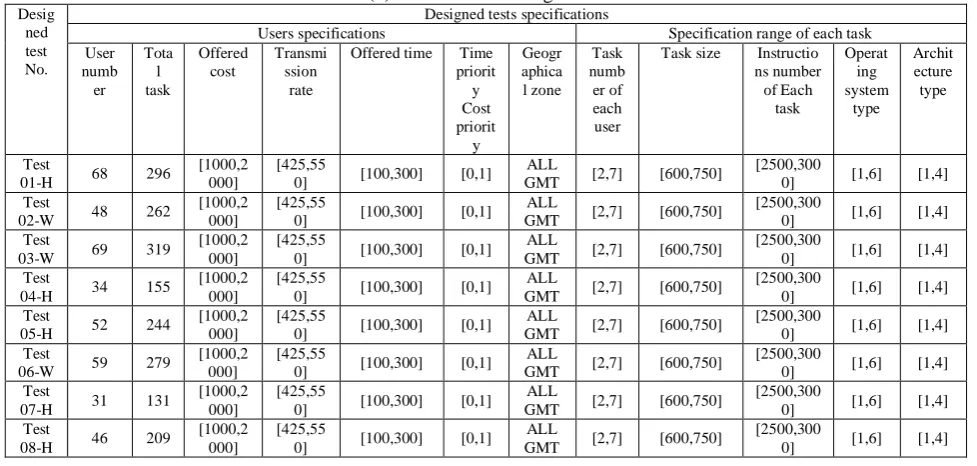
shows working day that this test Collection will be processed in cloud environment. Table (5) shows designed test data.
Table (5): Collection of designed test data
Desig ned test No.
Designed tests specifications
Users specifications Specification range of each task User numb er Tota l task Offered cost Transmi ssion rate
Offered time Time priorit y Cost priorit y Geogr aphica l zone Task numb er of each user
Task size Instructio ns number of Each task Operat ing system type Archit ecture type Test
01-H 68 296
[1000,2 000]
[425,55
0] [100,300] [0,1] ALL
GMT [2,7] [600,750]
[2500,300
0] [1,6] [1,4] Test
02-W 48 262
[1000,2 000]
[425,55
0] [100,300] [0,1] ALL
GMT [2,7] [600,750]
[2500,300
0] [1,6] [1,4] Test
03-W 69 319
[1000,2 000]
[425,55
0] [100,300] [0,1] ALL
GMT [2,7] [600,750]
[2500,300
0] [1,6] [1,4] Test
04-H 34 155
[1000,2 000]
[425,55
0] [100,300] [0,1] ALL
GMT [2,7] [600,750]
[2500,300
0] [1,6] [1,4] Test
05-H 52 244
[1000,2 000]
[425,55
0] [100,300] [0,1] ALL
GMT [2,7] [600,750]
[2500,300
0] [1,6] [1,4] Test
06-W 59 279
[1000,2 000]
[425,55
0] [100,300] [0,1] ALL
GMT [2,7] [600,750]
[2500,300
0] [1,6] [1,4] Test
07-H 31 131
[1000,2 000]
[425,55
0] [100,300] [0,1] ALL
GMT [2,7] [600,750]
[2500,300
0] [1,6] [1,4] Test
08-H 46 209
[1000,2 000]
[425,55
0] [100,300] [0,1] ALL
GMT [2,7] [600,750]
[2500,300
0] [1,6] [1,4]
Whereas each test of table (5) needs a model of cloud environment to process total tasks assumed in each test by processors situated in cloud environment, collection of a model of cloud environment was designed using parameters expressed in previous parts. This collection of model was called Model N_GMT that N denotes number
of a model that designed for test N of table (5) and GMT denotes geographical zone assumed for scheduler center of cloud environment. Table (6) shows collection of model designed for test data of table (5).
Table (6): Collection of designed model
Designed model No.
Specifications of designed model for each test data Specifications rangeof each
Resource
Specifications rangeof each Machine
Specifications rangeof each Processor
Reso urce numb er Transmiss ion rate Geograph ical zone Mac hine num ber Operating system type Architect ure type Process or number Throughp ut
Cost Max range of available throughput Workin g day Holiday day Other time Model
01_+06:30 2 [600,800] All GMT 3 [1,6] [1,4] 6 [60,75] [120,150] [55,65] [55,65] [60,75] Model
02_-12:00 2 [600,800] All GMT 6 [1,6] [1,4] 15 [60,75] [120,150] [55,65] [55,65] [60,75] Model
03_+02:00 2 [600,800] All GMT 3 [1,6] [1,4] 9 [60,75] [120,150] [55,65] [55,65] [60,75] Model
04_+12:00 1 [600,800] All GMT 3 [1,6] [1,4] 5 [60,75] [120,150] [55,65] [55,65] [60,75] Model
05_+03:30 2 [600,800] All GMT 6 [1,6] [1,4] 7 [60,75] [120,150] [55,65] [55,65] [60,75] Model
06_+03:30 1 [600,800] All GMT 3 [1,6] [1,4] 5 [60,75] [120,150] [55,65] [55,65] [60,75] Model
07_+05:00 1 [600,800] All GMT 2 [1,6] [1,4] 4 [60,75] [120,150] [55,65] [55,65] [60,75] Model
08_+12:00 1 [600,800] All GMT 3 [1,6] [1,4] 5 [60,75] [120,150] [55,65] [55,65] [60,75]
Figure (5)shows a comparison between implementation time of results obtained from offered algorithm and genetic algorithm implementation on test data of table
Fig.5. Implementation time of results obtained from offered algorithm and genetic algorithm
implementation
Figure (6) shows comparison between fitness diagram resulted from offered algorithm and genetic algorithm implementation for data of Test 02_w. As shown in figure (6), offered algorithm always in most cases could perform better than genetic algorithm.
Fig.6. Comparison of fitness chart of offered algorithm to genetic algorithm
Figure (7) shows dispersal diagram resulted from offered algorithm and genetic algorithm implementation for data of Test 07_w. According to this figure, in offered algorithm, population dispersal is always kept and more optimal space of problem was searched and use of suitable genetic operators resulted in lack of premature convergence of responses.
Fig.7. Dispersal diagram resulted from implementation of offered algorithm and genetic algorithm
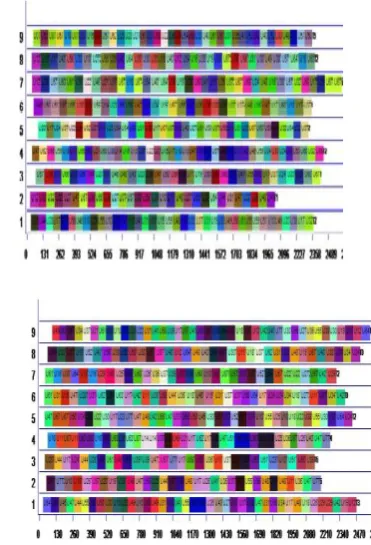
Figure (8) Comparison of Gantt diagram shows sample scheduling for several samples of test data of table (5).
Fig.8. Gantt chart diagram, resulted from offered algorithm implementation for several test samples
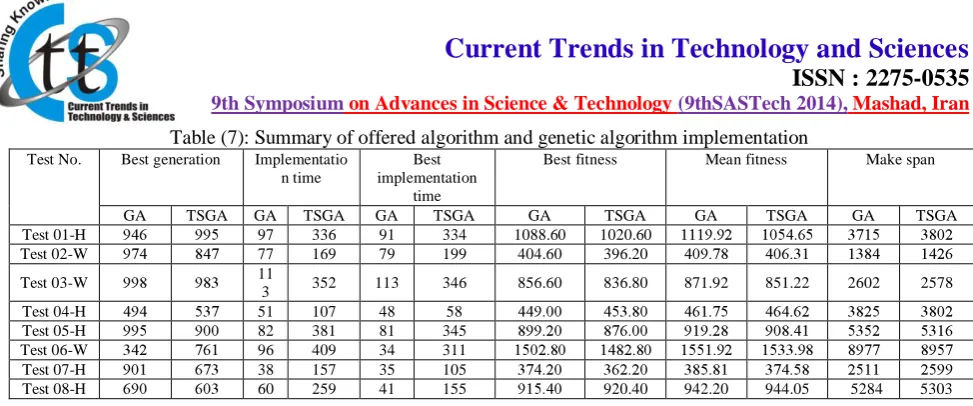
Table (7): Summary of offered algorithm and genetic algorithm implementation
Test No. Best generation Implementatio n time
Best implementation
time
Best fitness Mean fitness Make span
GA TSGA GA TSGA GA TSGA GA TSGA GA TSGA GA TSGA Test 01-H 97 336 91 334 1088.60 1020.60
Test 02-W 77 169 79 199 404.60 396.20 Test 03-W 11
3 352 113 346 856.60 836.80 871.92 851.22 2602 2578 Test 04-H 51 107 48 58
Test 05-H 82 381 81 345 Test 06-W 96 409 34 311 Test 07-H 38 157 35 105
Test 08-H 60 259 41 155 920.40 942.20 944.05 5284 5303
5. C
ONCLUSIONUpon developing cloud environment and increasing diversity of requests, a system based on cloud processing is needed so that to respond the different demands more suitable and rapider. In this paper, a new method was presented using combination of genetic algorithm and tabu search algorithm for solving task scheduling problem in cloud environment. Empirical results indicated that offered algorithm has higher efficiency for solving tasks scheduling problem in cloud environment and could create a balance between users’ criteria. Purpose of balance is that in the offered algorithm, satisfaction of all users to be attracted and to process the tasks on suitable processors in order to process more tasks within shorter time in cloud environment.
R
EFERENCE[1] Peter Mell and Timothy Grance, "The NIST Definition of Cloud Computing", Recommendations of The National Institute of Standards and Technology, September 2011. [2] Hong Sun, Shi-ping Chen, Chen Jin, Kai
Guo,"Research and Simulation of Task Scheduling Algorithm in Cloud Computing", TELKOMNIKA Indonesian Journal of Electrical Engineering, Vol.11, No.11, pp. 6664-6672, 2013.
[3] R. P. BRENT, "Efficient implementation of the First-Fit Strategy for Dynamic Storage Allocation", ACM Transaction on programming Languages and Systems, Vol. 11, No. 3, pp.388-403, 1989.
[4] Daniel Nurmi, Rich Wolski, Chris Grzegorczyk, Graziano Obertelli, Sunil Soman, Lamia Youseff, Dmitrii Zagorodnov, "The Eucalyptus Open-source Cloud-computing System", presented at the IEEE International Symposium on Cluster Computing and the Grid(CCGrid'09), 2009. [5] Tracy D. Braun, Howard Jay Siegel, Noah Beck,
Ladislau L. Boloni, Muthucumaru Maheswaran, Albert I. Reuther, James P. Robertson, Mitchell D. Theys, Bin Yao, Debra Hensgen, Richard F. Freund, "A Comparison of Eleven Static Heuristic for Mapping a Class of Independent Tasks onto Heterogeneous Distributed Computing Systems",
Journal of Parallel and Distributed Computing, Vol.61, pp.810-837, 2001.
[6] Upendra Bhoi, Purvi N. Ramanuj, "Enhanced Max-min Task Scheduling Algorithm in Cloud Computing", International Journal of Application or Innovation in Engineering &Management (IJAIEM), Vol.2, Issue.4, pp.259-264, April 2013. [7] Pardeep Kumar and Amandeep Verma,
"Scheduling Using Improved Genetic Algorithm in Cloud Computing for Independent Tasks", International Conference on Advances in Computing Communications and Informatics (ICACCI), 2012.
[8] Xiangqian Song, Lin Gao, Jieping Wang, "Job scheduling based on ant colony optimization in cloud computing", International Conference on Computer Science and Service System(CSSS), pp.3309-3312,2011.
[9] Monir Abdullah and Mohamed Othman, "Simulated Annealing approach to cost-based multi- quality of service job scheduling in Cloud Computing enviroment", American Journal of Applied Sciences, Vol.11, No.6, pp.872-877, 2014.
[10] I. De Falco, R. Del Balio, E. Tarantino and R. Vaccaro,"Improving search by incorporating evolution principles in parallel tabu search", IEEE Conference on Evolutionary Computation,Vol.2, pp.823-828,1994.