Biolinguistics 4.2–3: 255–288, 2010 ISSN 1450–3417 http://www.biolinguistics.eu
Where is the Progress?
Friedemann Pulvermüller
Recent cognitive neuroscience research improved our understanding of
where, when, how, and why language circuits emerge and activate in the
hu-man brain. Where: Regions crucial for very specific linguistic processes were
delineated; phonetic features and fine semantic categories could be mapped
onto specific sets of cortical areas. When: Brain correlates of phonological,
syntactic and semantic processes were documented early on, suggesting
language understanding in an instant (within 250 ms). How: New
mechan-istic network models mimicking structure and function of left-perisylvian language areas suggest that multimodal action-perception circuits — rather than separate modules for action and perception — carry the processing
re-sources for language use and understanding. Why language circuits emerge
in specific areas, become active at specific early time points and are con-nected in specific ways is best addressed in light of neuroscience principles governing neuronal activation, correlation learning, and, critically, partly predetermined structural information wired into connections between cor-tical neurons and areas.
Keywords: cell assembly; mechanistic explanation; neuroimaging; neuro-science of language; neuroneuro-science principle
1. Introduction: Questions in Focus
The aim of the neuroscience of language is to find the brain correlates of linguistic processes and representations. Correlates of linguistic representations are sought in neuronal structures, that is, nerve cell circuits, and correlates of linguistic processes are sought in patterns of neuronal activation. These aims have as yet not been reached. In many cases, conclusions are still at the level of ‘areas’ ‘performing’ certain functions, a state not untypical for cognitive neuro-science in general. However, such ‘arealogy’ can be understood as an inter-mediate step on the journey towards neuroscientific explanation. To keep the ultimate destination in sight and in focus, it may be relevant to pause and check.
Ultimately, the clarification of the brain correlates of a given cognitive re-presentation R and process P implies answers to (at least) four critical questions:
1. Where-question: Which brain parts, areas, and, eventually, neurons are active during, and are critical for, process P and the representation(s) R P relies on?
2. When-question: At which point in time in the usage or understanding of language does process P occur; when is representation R activated and processed?
3. How-question: Which neuronal circuit, which nerve cells linked in which way, is the brain basis for representation R; which spatiotemporal pattern of neuronal activation in this circuit does underpin the process P?
4. Why-question: For what reason are R and P located in these specific brain parts and activated at these specific points in time, and why is R laid down in this specific neuronal circuit, P being expressed by these specific activation patterns?
The present contribution will briefly review research addressing critical facets of these four questions. A focus will be on recent progress in mapping specific linguistic representations and processes onto brain space and time and a second focus will be on circuit structure and function.
2. Where? Mapping Modules — Mapping Features and (Sub-)Categories
2.1. Where-Question: Meaning
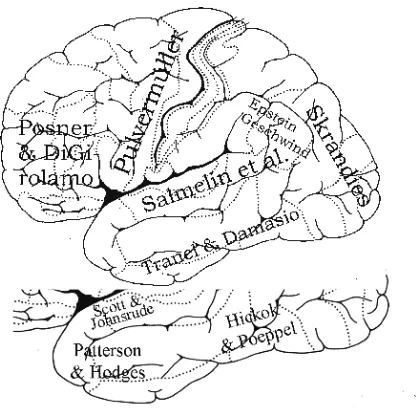
Figure 1: Different authors view different cortical sites as most important for binding the meaning of words to their form. The sketched proposals are based on recent publications (Epstein 1999, Posner & DiGirolamo 1999, Pulvermüller 1999, Salmelin et al. 1999, Skrandies 1999, Tranel & Damasio 1999, Scott & Johnsrude 2003, Hickok & Poeppel 2007, Hodges & Patterson 2007). This paper attempts at developing an integrated perspective.
The principal problem of the debate about such unitary meaning centers — or centers whose function it is to bind any meaning to any word/symbols — is the following: There is solid evidence for the importance of various cortical areas, at least in temporal and frontal lobes, in semantic processing and, by accumu-lating more evidence in favor of the importance of any one area, one cannot, evidently, disprove the role of the other ones. This would only be the case if there was an exclusive either–or, that is, if only one cortical area was allowed to in-clude a major meaning switchboard. Although semantic processing implies the integration of information from different sensory modalities, such integration can be computed locally between adjacent neurons as it can be carried by distributed populations of interacting neurons; hence again no need for a unitary semantic area.
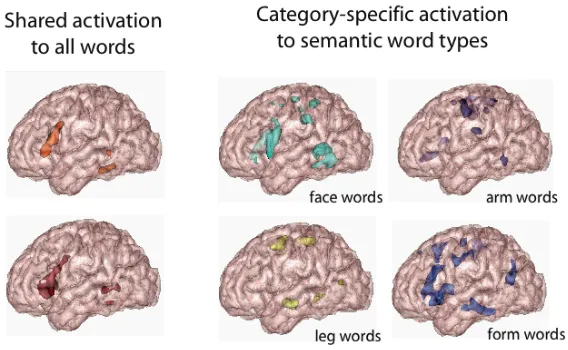
lo-cations of category-specific semantic circuits, as they can be inferred today from neuroimaging data, and contrasts them with brain activations generally seen for meaningful written word stimuli.
Figure 2: Brain activation patterns during passive word reading: Cortical areas activated by all words alike (left side) are contrasted with areas specifically activated by fine-grained semantic word categories (right side), action words related to the face (lick), arms (pick) or legs (kick) and visually-related form words (square) (modified from Pulvermüller, Kherif et al. 2009). Areas found active generally to all kinds of words may indicate the distribution of circuits for processing of general lexical-semantic information, whereas the widely distributed area sets found active for specific semantic types may index the distribution of category-specific semantic circuits.
The temporal lobes are not the only key areas for semantic processing. Words loaded with affective-emotional meaning can activate the amygdale, insular structures, and the posterior cingulated cortex (Straube et al. 2004, de Araujo et al. 2005). Odor words, as compared with matched control words, activate olfactory cortex along with limbic structures (Gonzalez et al. 2006), sound related words activate the superior temporal lobes more strongly than matched control words (Kiefer et al. 2008) and, critically, action-related verbs spark the motor and premotor cortex in such a specific manner that the body part related-ness of the action indexed by the words becomes manifest in somatotopic acti-vation in the motor strip (Pulvermüller et al. 2000, Hauk et al. 2004, Shtyrov et al. 2004, Pulvermüller, Shtyrov & Ilmoniemi 2005). Words such as ‘pick’ and ‘kick’ would therefore specifically activate areas also active when subjects move their finger or foot. The overlap between areas active during motor performance and during congruous word processing is not complete; notably, normal motor per-formance creates somatosensory input, leading to somatosensory postcentral activation which, when overlaid with motor cortex activation, shifts the centre of gravity of activation backward, towards the parietal lobe. However, the somato-topic line-up of premotor activity reflecting aspects of action semantics could be replicated by a range of studies (Tettamanti et al. 2005, Aziz-Zadeh et al. 2006, Tomasino et al. 2007, Kemmerer & Gonzalez-Castillo 2010, Boulenger et al. 2009, Raposo et al. 2009), with occasional failure to replicate activity in specific regions of interest (Postle et al. 2008). In one study, the semantic somatotopy could even be documented in abstract idiom processing (‘grasp the idea’, ‘kick the habit’; cf. Boulenger et al. 2009) consistent with an embodied, partly compositional view on abstract sentence meaning construction, to which lexical meaning contributes (Lakoff 1987, Barsalou 1999).
Importantly, these motor activations seem to index critical parts of the cortical semantic processor. Lesions in the motor system impair the processing of action-related words, especially that of action verbs (Damasio & Tranel 1993, Daniele et al. 1994, Neininger & Pulvermüller 2003, Tranel et al. 2003, Gainotti 2008) and, in addition to these, of the related action concepts (Bak et al. 2001, Bak et al. 2006). In healthy individuals, magnetic stimulation below the motor thresh-old to hand and foot areas in the left motor cortex could be shown to facilitate the processing of hand and foot related words specifically (Pulvermüller, Hauk et al. 2005). These results document a causal role of the motor system in processing action concepts and words semantically related to actions.
of brain areas critically involved in category-specific processing and the bias to-wards temporal cortex may relate to the habit of researchers to test object nouns and their related concepts. Note that important knowledge about most objects comes through the visual modality and the involvement of the inferiortemporal stream of object processing is therefore not surprising. Even for abstract words and sentences, different areas were found active by different researchers (e.g., Noppeney & Price 2004, Binder et al. 2005, Boulenger et al. 2009) raising the question whether category-specificity might hold even at abstract semantic levels (Pulvermüller & Hauk 2006). In one view, gradually more abstract semantic re-presentations develop in progressively anterior areas in temporal and frontal cortex as a consequence of sensorimotor activity (Pulvermüller 2008).
An integrated view proposes category-specific semantic circuits whose precise distribution depends on meaning type (cf. Fig. 2). Areas most important for meaning emerge close to left-perisylvian language cortex — especially the inferior-frontal and superior-temporal gyri and sulci along with the underlying insula. All linguistic functions depend on this perisylvian region, whereas the category-specific meaning circuits extend throughout the cortex, the extrasylvian space. Action and object related meaning circuits draw upon motor and sensory areas and abstract semantic circuits develop in the vicinity of these sensorimotor sites, in anterior temporal and prefrontal cortex. There is differential laterality of linguistic and semantic processes and representations. Due to some property of the left perisylvian cortex (see the why-section 5), linguistic circuits are generally lateralized, although semantic circuits are spread out more symmetrically throughout both hemispheres (Fig. 2; Pulvermüller & Mohr 1996, Pulvermüller, Kherif et al. 2009).
Although the recent support for category-specific semantic circuits appears as a milestone in understanding the brain basis of meaning, it should not be ignored that some colleagues expressed criticisms. Caramazza’s group suggested that motor activity during the processing of action verbs may not be related to semantic processes but may instead be an epiphenomenon related to mental images being retrieved, if not entirely irrelevant ‘overflow’ activation (Oliveri et al. 2004). In face of more recent neuropsychological evidence supporting a crucial role of motor systems for processing words of specific action-related semantic categories (for review, see Pulvermüller & Fadiga 2010), a new proposal now ack-nowledges a (possible) semantic function of the motor system, but complements it with an abstract symbol processor (Mahon & Caramazza 2008), a view similar to Patterson et al.’s (2007) suggestion that a ‘semantic hub’ — according to their data, in the temporal pole — complements widely distributed category-specific semantic circuits (see also Pulvermüller et al., in press).
ob-jects and types of actions (Pulvermüller & Knoblauch 2009). A mechanistic neuro-biological approach captures the storage of the underlying word–word correlations by way of the very same mechanisms it also uses for storing word– world correlations in neuronal links between sensorimotor and perisylvian language cortices (Pulvermüller 2010). Furthermore, correlation learning is not restricted to the single word level, but can, in principle, occur for larger con-structions, especially if they are being used stereotypically in specific contexts (Goldberg 2003). Current neuroimaging results seem consistent with a contri-bution of semantic representations of both constituent words and whole con-structions when the meaning of abstract idiomatic sentences is being processed (Boulenger et al. 2009).
Some issues in the cortical localization of semantic processes are still open. The idea that access to movement knowledge tied to words is reflected in lateral temporal activation just anterior to a movement sensitive visual processing area (Martin et al. 1995) was recently questioned based on a lack of activation differen-ces between nouns with more or less semantic relationship to movement (Bedny et al. 2008). While this finding argues against a role of middle temporal cortex in kinematic semantics, there is still solid evidence that the action-relatedness of word meaning is reflected in the activation of the left middle temporal area (MNI coordinates –62/–52/4; Hauk et al. 2008). The fact that the area activates more strongly to verbs than for nouns (e.g., Bedny et al. 2008, Hauk et al. 2008) is consistent with the action relatedness of most verbs, even verbs used to speak about so-called ‘internal states’. States such as thinking and feeling have characteristic behavioural expressions, thus intrinsically linking the semantics of the respective terms to action (Wittgenstein 1953). Therefore, any noun-verb difference is hopelessly confounded with semantic differences (Pulvermüller et al. 1999). Furthermore, a recent study suggested that in the left middle temporal area, there are, side by side, different subareas that respond to words generally (–53/–49/–1), thus possibly contributing to general lexico-semantic processes, and to very specific semantic subcategories of action verbs (e.g., hand-related action verbs, –49/–51/–9) (Pulvermüller, Kherif et al. 2009). Such fine sub-categorization may be a consequence of recurrent connections with the motor system, where semantic somatotopic activation is established. If the middle-temporal activation to action-related words is due to links with the motor system (rather than to knowledge about moving visual input), it becomes explainable why such activation persists in visually deprived individuals (Mahon et al. 2009) who are not principally limited in their action repertoire and typically learn words, even visually-related ones, in action contexts (see Landau & Gleitman 1985). These data are consistent with a differential role of temporal and frontal areas in semantic processing, although more research may indeed help clarifying the various linguistic roles of middle temporal gyrus activation in word and sentence processing.
2.2. Where-Question: Speech Sounds
steam) and/or posterior part of the superior-temporal cortex (postero-dorsal stream, including planum temporale and lateral superior-temporal gyrus) (Rauschecker & Scott 2009). The planum temporale and other posterior superior-temporal areas have long been viewed as critical for language perception and understanding, based on evidence from clinical language deficits (see, e.g., Geschwind 1970). Recent neuroimaging experiments showed that speech yields stronger activation in antero-ventral superior-temporal areas compared with matched noise patterns (Scott et al. 2000, Uppenkamp et al. 2006), and this evi-dence is also consistent with data from macaques that anterior superior-temporal activity indexes species-specific calls (Romanski et al. 1999). Similar responses in posterior superior-temporal cortex to speech and other acoustic stimuli still allow for a role of this region in speech-language processing. This observation is compatible with a view of postero-dorsal areas, especially planum temporale but possibly also temporo-parietal junction, as a ‘computational hub’ for processing spectrotemporally rich acoustic patterns (Griffiths & Warren 2002). In addition to superior-temporal cortex, inferior-frontal cortex is active during listening to speech, as could be demonstrated using TMS (Fadiga et al. 2002), and inferior-frontal activation even persists during passive exposure to speech, as could be shown using MEG (Pulvermüller 2003, Pulvermüller, Shtyrov & Ilmoniemi 2003). Critical inferior-frontal areas include posterior Broca’s (pars opercularis) and premotor cortex (Wilson et al. 2004). Similar to the posterior superior-temporal cortex, the motor system’s role is not confined to speech processing. The sounds of actions activate different sections of the fronto-central sensorimotor cortex in a very similar manner as linguistic sounds do (Hauk, Shtyrov & Pulvermüller 2006, Lahav et al. 2007). These results suggest that the computational hub for sound processing extends from posterior-temporal cortex to inferior-frontal and pre-motor regions. Precisely timed spatio-temporal patterns of cortical activation spreading in this distributed cortical system may signify the processing of speech and other action sounds (Pulvermüller & Shtyrov 2009).
Similar to the semantic domain, recent advances in our knowledge about phonological representations and processes in the brain relates to specificity. Dif-ferent areas in superior-temporal cortex were found active when subjects listened to different kinds of speech sounds (Diesch et al. 1996, Obleser et al. 2003, Obleser et al., 2006, Pulvermüller et al. 2006, Obleser et al. 2007). Typical examples of the phonemes [p] and [t] for example were mapped to adjacent areas in superior-temporal gyrus, anterior to primary auditory cortex and Heschl’s gyrus. Inter-estingly, a similar phonological mapping was evident in the motor system, where the production of [p] and [t] activated different precentral areas in a soma-totopic fashion. The articulatory mapping of phonemes to the motor system corres-ponded to the localization of the articulators mainly involved in the production of the respective speech sounds — the lips for [p] and the tongue for [t] (Lotze et al. 2000, Hesselmann et al. 2004).
motor systems in speech perception is evident from TMS work stimulating the motor regions of the lips and the tongue: Such stimulation biases the speech com-prehension system in favor of congruent sounds. Therefore, when the tongue (or lips) area was stimulated, subjects tended to perceive [t] (or [p]) sounds more quickly, or even to misperceive [p] sounds as [t] (or the reverse) (D’Ausilio et al. 2009). This observation demonstrates that motor systems critically contribute to the speech perception process.
In the phonological domain, progress seems two-fold. First, the perisylvian cortex, which is well-known to be critical for phonological processing and repre-sentation, can be further subdivided according to phonological properties. Phon-etic distinctive features, DFs, and speech sounds discriminated by these DFs can be mapped on different brain substrates in inferior-frontal and (antero-lateral) superior-temporal cortex. Second, the temporal and frontal neuronal ensembles appear to interact with each other and to be functionally interdependent in pho-nological processing. The summarized data argue against proposals that seem to play down the role of frontal cortex in speech perception (see the how-section 4 below, Hickok & Poeppel 2007, Lotto et al. 2009, and Scott et al. 2009). Note again that left inferior-frontal cortex activates in speech perception even when subjects try to ignore incoming speech sounds. Frontal activation therefore does not depend on attention being focused on speech (Pulvermüller et al. 2003, Pulver-müller & Shtyrov 2006, 2009), although attention certainly exerts a modulatory function on language-elicited brain activity (Garagnani, Shtyrov & Pulvermüller 2009, Shtyrov et al., in press). In the language domain, the posterior-dorsal vs. anterior-ventral stream debate seems, at present, not fully conclusive, as both parts of the superior-temporal cortex are apparently involved in speech proces-sing and the absence of phoneme specificity in the posterior superior-temporal cortex appears as a null result without strong implications. Clear evidence exists for anterior-lateral superior-temporal activation discriminating phonemes from noise and phonemes between each other, but a contribution of posterior parts of superior-temporal cortex to phonological processing also receives support.
2.3. Where-Question: Syntax
the complexity of grammatical structure relates to inferior-frontal and superior-temporal circuits, they do not unambiguously prove this. Ungrammatical sen-tences are rare and therefore exceptional, whereas grammatical ones are normally more common, and among the grammatical ones, the sentences considered to be more complex (e.g., object relatives) are rarer than the ones considered to be sim-pler (e.g., subject relatives). Heroic attempts have been made to control sequential probabilities while, at the same time, varying grammatical structure of well-formed sentences (e.g., Bornkessel et al. 2002). However, as has been argued by linguists, such control has not been perfect (Kempen & Harbusch 2003) making it seem impossible to exclude the probability confound.
Whether syntax depends on discrete combinatorial rules or is best de-scribed in terms of sequential probabilities constitutes a major debate in cognitive science (McClelland & Patterson 2002, Pinker & Ullman 2002). The linguistic po-sition that rules of syntax and universal underlying principles govern grammar is in contrast with approaches using systematic probability mapping in neural net-works or statistical procedures lacking any rule-like symbolic representations. These, too, are capable of modeling linguistic processes and have the additional advantage of explaining aspects of the learning of grammar (Rumelhart & McClelland 1987, Hare et al. 1995). That certain types of syntactic (and, likewise, phonological, semantic) structures a priori require a system of discrete combina-torial rules and representations may, therefore, appear as a too strong statement, although this assumption figures as a firm corner stone of much cognitive theori-zing in the second half of the 20th century. Whether discrete representations and
especially rule-like entities exist turns out to be an empirical issue but also one addressable by brain theory and brain-based modeling (see how-section 4). The term ‘discrete’ — an expression with many facets that is used in different areas of cognitive science with rather different meanings — is used here to refer to a mechanism that either is being engaged in a given condition or is not, with little if any room for gradual intermediate steps. The sentence ‘Build a sentence from (at least) a noun and a verb’ describes a discrete combinatorial mechanism at an ab-stract linguistic level. Can we expect that such discrete rule-like processes, rather than probability mapping, are effective at the neurobiological level?
former was found: The brain response to rare ungrammatical strings was en-hanced, that to grammatical strings was attenuated, regardless of the sequential probability of their constituent words (Pulvermüller & Assadollahi 2007). This result pattern is consistent with, and therefore supports, the rule theory. It should however be noted that a neural approach without discrete representations can be modified to fit these data if appropriate non-linearities are built into the network.
So, again, where is the progress? In the delineation of category-specific semantic circuits distributed over specific sets of cortical areas, in the mapping of phonetic features onto brain systems that encompass superior-temporal and inferior-frontal (including premotor) areas, and in new evidence in favor of discrete combinatorial rules brain-supported by left perisylvian circuits.
3. When? The Rapid Time Course of Language Understanding
A main stream view held that language understanding is a relatively late process (for review, see Barber & Kutas 2007 and Pulvermüller et al., 2009). Semantic pro-cessing, along with lexical ones, were assumed to be first indexed by the N400 component of the event-related brain potential and field. Syntactic processing was assumed to be indexed by an even later component, called P600. Both com-ponents peak around half a second after information necessary for identifying critical stimulus words is present, suggesting that at least this amount of time elapses between presence of a word in the input (say, ‘bear’ in a warning con-text), and the initiation of an appropriate response (for example, running away). Such long-delay comprehension systems may have advantages under certain conditions, however, from a Darwinian perspective, a faster system minimizing the comprehension latency would certainly have constituted an evolutionary ad-vantage.
lumi-nance of written words and the loudness of spoken works and the point in time when they can first be recognized with confidence (Pulvermüller & Shtyrov 2006). Early and late indexes of semantics may reflect different processes in the analysis of word meaning, automatic semantic access and semantic re-analysis (Pulvermüller, Shtyrov & Hauk 2009).
Syntactic processing is long known to have an early brain correlate. Violations of phrase structure rules were found to lead to enhanced negativities already at 100–250 ms, in the early left-anterior negativity (Neville et al. 1991, Friederici et al. 1993). More recently, similar early violation responses, in the syntactic mismatch negativity component, have been reported to violations of the rules of phrase structure and agreement (Shtyrov et al. 2003, Hasting & Kotz 2008, Pulvermüller et al. 2008). It is these early responses that are automatic (see where-section above), whereas the late ones (P600) depend on attention to stimulus sen-tences: Brain correlate of syntactic mismatches in the ‘syntactic mismatch negati-vity’ can be recorded in subjects who do not attend to speech that includes gram-matical violations; the early responses (up to 150 ms) remain unchanged even if subjects are heavily distracted from speech and syntax by a continuously applied attentional streaming task. This proves that at least some early mechanism of the brain’s grammar machinery operates automatically or, as once claimed, ‘like a reflex’ (Fodor 1983).
In sum, syntactic and semantic processes are reflected by relatively late brain responses that depend on task and attention to stimuli. In addition, early, <250 ms, brain indexes of syntax and semantics also exist and these seem to be less dependent on attention being paid to stimuli, in some cases entirely attention-independent. For phonological and pragmatic processes, there are also reports about early as well as late brain correlates. For example, an early brain correlate of phoneme processing is present in the mismatch negativity (Dehaene-Lambertz 1997, Näätänen et al. 1997) and early indexes of pragmatic deviance have been reported in studies of text processing (Brown et al. 2000). Phonological expectancy violations (Rugg 1984, Praamstra & Stegeman 1993) as well as prag-matic and discourse-related ones (van Berkum, Brown et al. 2003, van Berkum, Zwitserlood et al. 2003) also were found to produce late effects at ~400 ms. An interpretation of early vs. late effects is possible along the lines of dual-stage models, such as Friederici’s (2002) influential model. The early process would ac-cordingly be an automatic comprehension or matching process, whereas the late process could either imply an in depth extension of the process or a revision and re-analysis. Friederici proposes this for the syntactic domain but, in light of the early and late components indexing essentially all kinds of psycholinguistic infor-mation, the same general concept can be applied to other psycholinguistic levels of processing, too.
long-lasting and widespread. Evidence for this view has recently been reported. Minimal variability of physical and psycholinguistic stimulus properties is criti-cal for obtaining early effects in lexicriti-cal, semantic, and syntactic processing (Assa-dollahi & Pulvermüller 2001, Pulvermüller & Shtyrov 2006, Penolazzi et al. 2007). Important time aspects are immanent to the orchestration of cortical sources. It has been suggested that the brain uses a precise temporal code to transmit information at the neural level. Serial models had put that phonological, lexical, syntactic, and semantic processes follow each other in a given order (which varied between models). However, the early near-simultaneous neuro-physiological responses mentioned above suggest that these processes run largely in parallel with little if any offset between them (Hauk, Davis et al. 2006). Furthermore, small timing differences have been reported between subtypes of semantic processes. Leg-related action words tend to spark the leg region slightly later than words with arm or face reference activate their corresponding inferior motor areas (Pulvermüller, Shtyrov & Ilmoniemi 2005). Here, timing differences seem to indicate semantic differences. A recent study comparing the timing of left superior-temporal, lateral-central, and inferior-frontal area activations found delays between regions that depended on stimulus type. Phoneme sequences and word stimuli led to a delayed activation of inferior-frontal cortex, 10–25 ms after superior-temporal cortex, whereas noise stimuli failed to elicit a comparable activation delay between regions (Pulvermüller & Shtyrov 2009). Therefore, the delay between regions of interest activations coded the phonological status of acoustic stimuli.
Interestingly, reliable time delays only emerged between superior-temporal and inferior-frontal cortex. The latero-central region including motor and pre-motor areas activated together with superior-temporal cortex. This suggests that the postero-dorsal stream activates more quickly than the antero-ventral stream, but that the latter conveys important information about the phonological status of sounds.
In summary, early near-simultaneous brain responses (latency <250 ms) index different facets of the comprehension process, including word form analysis, semantic access along with syntactic and semantic context integration, suggesting near-simultaneity (or short-delay seriality) in psycholinguistic infor-mation access. The short delays are potentially accountable in terms of cortical conduction times (Pulvermüller et al. 2009).
4. How? Brain-Based Models of Circuits, Their Activations and Delays
solely relate to motor systems activation, but likewise draws on perceptual mech-anisms, as in the co-activation of superior-temporal cortex during silent speaking (Paus et al. 1996). The Lee effect of delayed auditory feedback on speech output (Lee 1950) demonstrates a profound automatic influence of acoustic-phonetic processes on ongoing speech output, a conclusion strengthened by the neuro-functional studies demonstrating motor systems activation by perception of move-ments and speech (Fadiga et al. 1995, Fadiga et al. 2002). Speech perception does not just ‘take place’ in the superior-temporal cortex alone. The motor system is co-activated and assists, modulates, and sharpens the speech perception process.
One may describe this interaction in classic terms. Earlier proposals had suggested that perception is, in part, an active process by which action hypo-theses play a role (see also Bever & Poeppel, this volume). Accordingly, ‘bottom-up’ perceptual analysis triggers a hypothesis about the input, followed by an action-related ‘top-down’ synthesis, the product of which is finally compared with and eventually matched to further input information, thus confirming or rejecting the perceptual hypothesis (Halle & Stevens 1959, 1962). When recogni-zing a naturally spoken syllable such as [pIk], already the vowel includes co-articulatory information about the subsequent consonant, which may give rise to the — still premature — hypothesis that [pIk] is coming up (Warren & Marslen-Wilson 1987, 1988). This hypothesis can be compared with further input — especially the plosion of the final [k] — until a match is reached. In the syntactic domain, a noun may generate the hypothesis that a sentence including a verb will emerge, and the N–V hypothesis can be compared, and eventually matched, with the input, a process compatible with the state sequence of a left-corner parser (Aho et al. 1987). This hypothesis generation and testing, as suggested by classic cognitive theories of phonological analysis-by-synthesis and left-corner parsing may capture aspects of the functional significance of the co-activation of frontal and posterior areas in cognitive processing in general and in language processing in particular.
analysis-by-synthesis approach, made the additional assumption that speech perception as a modular process is separate from other acoustic perceptual processes, a view dif-ficult to reconcile with current neuroimaging data showing that the same cortical foci are active when producing articulator movements and speech sounds (Pulvermüller et al. 2006). An obvious deficit of analysis-by-synthesis approaches is the lack of a time scale. Perceptual analysis, hypothesis generation, and action synthesis and matching could each last for seconds or take place near-simultaneously. This general approach seems to be in need of additional detail to provide mechanistic explanations.
In my view, progress in clarifying the mechanisms underlying action-perception interaction requires brain theory. Correlational information between the speech signal and articulatory gestures together with neuroanatomical and neurophysiological knowledge and principles provide a firm basis for postu-lating action-perception circuits that (i) span inferior-frontal and superior-temporal areas, (ii) become active near-simultaneously with minimal inter-area delays determined by axonal conduction times, (iii) play a role in speech production and in speech perception too, and (iv) provide continuous facilitatory interaction between the inferior-frontal and superior-temporal parts of each circuit while at the same time (v) competing with other action-perception circuits. The mechanisms of and processes in such circuits can be explored in computational work using networks with neuroanatomically realistic structure and plausible neurophysiological function (see Fig. 3; Wennekers et al. 2006, Garagnani et al. 2008).
These simulations show that during the recognition of a word such as [pIk] the following processes take place:
1. The auditory signal leads to stimulation of neuronal populations in superior-temporal cortex where activity spreads from primary auditory cortex, A1, to the surrounding auditory belt, AB, and parabelt, PB. This activation is mainly carried by the best-stimulated circuit(s), the target word, but partly also by its cohort members’ and neighbors’ circuits ([pIp], [kIk]). At the cognitive level, one may say that the system entertains several perceptual hypotheses.
2. With a slight delay (realistically, 10–25 ms), activation also spreads to inferior-frontal cortex, to prefrontal, PF, premotor, PM, and (to a lesser degree) primary motor, M1, areas. This activation spreading is mainly carried by the phonological and lexical circuits best stimulated, which impose a fixed spatio-temporal pattern of activation. The advantage of such action links may lie in the separation of circuits whose perceptual parts overlap to a large degree. The syllable-initial phonemes [p] and [t] sound similar, but are based on motor programs for different articulators con-trolled by motor neurons at different locations in the motor system, in PM and M1, which are ~2 cm apart (Pulvermüller et al. 2006). Although their perceptual circuits (in A1, AB, and PB) overlap substantially, their action circuits (in PM, M1) do not to a similar degree. If circuits overlap, they can-not easily inhibit each other, a requirement for a decision and functional distinction between them. Therefore, the separation of circuit parts in the motor system enables between-circuit inhibition, and thus facilitates a discri-mination and decision process between partly activated overlapping circuits. 3. Activation from the most active motor circuit is fed back to
superior-temporal circuit parts. The superior-superior-temporal part of the circuit organizing the critical word [pIk] receives strong feedback activation from the action system, whereas those of competitor words receive comparably little (due to the competition process in the action system). The word-related cell assembly fully ignites; the correct word is being recognized. At the cogni-tive level, a perceptual decision has emerged.
high entropy conditions (e.g., high noise, very strong neighbors) these processes may be delayed both in superior-temporal and inferior-frontal areas. Note, how-ever, that the inhibition mechanism which, as argued above, is most efficient in inferior-frontal cortex, implies entropy reduction with time. Processes of gener-ating and deciding between hypotheses analogous to the ones spelt out here in detail for speech perception are envisaged to underpin meaning comprehension and speech production as well.
The neurobiological basis of cognitive processes such as perceptual hypo-thesis generation and decision can be traced with explicit neurocomputational studies (Wennekers et al. 2006, Garagnani et al. 2008, Garagnani, Wennekers & Pulvermüller 2009). As mentioned, these models build strong functional links between frontal action circuits and posterior perception circuits. Therefore, a lesion in the action part of the distributed circuits does not only impair actions, it may also impact on perception and understanding, and, vice versa, lesions in the perceptual network part can reduce motor output functions in addition to causing perceptual deficits (Pulvermüller & Fadiga 2010). This is consistent, for example, with well-known reports about speech perception deficits and abnor-malities in patients with different types of aphasia (Basso et al. 1977, Blumstein et al. 1994). Under taxing conditions, aphasic patients with Broca aphasia, which typically relates to frontal lesion, have difficulty understanding single words (Moineau et al. 2005) and even under optimal perceptual conditions, compre-hension is delayed and activation of phonological cohort members reduced (Utman et al. 2001, Yee et al. 2008). Inferior-frontal lesion has a similar effect on gesture discrimination (Pazzaglia et al. 2008). Some colleagues chose to ignore these and similar reports of inferior-frontal lesions and their related speech perception deficits, or play them down as ‘not dramatic’ (Hickok 2009, Bever & Poeppel, this volume; see Pulvermüller & Fadiga 2010 for a review of this dis-cussion). In this context, the reader should also be reminded of the TMS evidence showing that precentral stimulation alters speech perception (see where-section, sounds, and, for example, D’Ausilio et al. 2009), and of the fact that neural degeneration in the motor cortex and inferior part of the frontal lobes leads to language and conceptual deficits, especially for words and concepts related to actions (see where-section 2.1 and, for example, Bak et al. 2001).
(B), and corrected perception (C), inferior-frontal ‘action circuits’ may be critical in the perception process, although the inferior-frontal activation may differ as a function of effort and attention necessary. Consistent with this view, a recent experiment on attention modulation in speech perception showed a modulatory effect of attention on inferior-frontal activation, which was stronger than the one seen in superior-temporal cortex (Shtyrov et al., in press). In order to allow for similarly specific predictions, an action-perception approach — or likewise analysis-by-synthesis approach — needed to be stated in terms of a mechanistic brain-based circuit model.
Cognitive scientists entertain a major debate about the existence of symbol representations that behave in a discrete manner, becoming active in an all-or-none fashion rather than gradually. Linguistic and symbolic linguistic theories build on such discrete representations, whereas many neural processing ap-proaches postulate distributed representations and processes that are gradual. In this case, the gradual distance of an activation pattern to the closest perceptual target vector determines the percept. Using networks fashioned according to the neuroanatomical structure and connection pattern of the left-perisylvian lang-uage cortex along with neurophysiologically realistic synaptic learning, we found neuronal correlates of discrete symbols in distributed action-perception circuits. These circuits indeed behave in a discrete fashion, showing an explosion-like ignition process to above-threshold stimulation. The circuits overlap to a degree and a specific type of realistic learning rule has a network effect of reducing this overlap (Garagnani, Wennekers & Pulvermüller 2009). The finding that distri-buted and discrete circuits develop in realistic neuroscience grounded networks may entail a better understanding of the mechanisms of symbol processing.
5. Why: From Brain Mechanisms to Explanation
There are known properties of the brain and of brain function that can form a basis of neuroscientific explanation. Our brain’s most important structure for cognition, the cortex, is, structurally and functionally, an associative memory (Braitenberg & Schüz 1998). Its neurons are linked by way of their synapses and links strengthen depending on their use, or correlation of activation (Tsumoto 1992). The cortex is not, however, a tabula rasa learning structure. It is equipped with a wealth of information. Some of this information is manifest structurally, in the anatomy of the cortex, in the structure and microstructure of areas, connect-ions between areas and even the microstructure of neurons and their biochemical properties.
Some of the explanations and answers to ‘Why X?’ — questions may therefore recur to such established knowledge. As one example, explanations can be of the form ‘Because X is a necessary consequence of functional correlation of neuronal processes a and b and the structural connections between the neuronal structures (neurons, neuronal assemblies) A and B’. Due to such functional corre-lation of structurally connected units acoustic and articulatory phonological representations connect with each other to form action-perception circuits for integration of phonological information in speech perception and production. Statistical learning of co-occurrence patterns of phonemes in words and mor-phemes accounts for the formation of lexical representations (Saffran et al. 1996, Pelucchi et al. 2009), which are realized as neuronal ensembles distributed over perisylvian cortex. Correlation between word form and activity in sensory and motor systems of the brain also explains the binding between sign and its referential meaning, given the relevant connections necessary for such learning are available in the first place. Information about the referents is available in different brain systems — motor, visual, auditory, olfactory, etc. — for different kinds of words, therefore the differential distribution of category-specific seman-tic circuits results. As soon as a stock of signs with referential meaning is avail-able, indirect, contextual semantic learning is possible due to the correlation of new word forms with familiar ones for which referential semantic information is already available. Co-activation of the new words’ neuronal circuits with seman-tic circuits bound to familiar words, which appear in the context of the new ones, leads to the binding of semantic neurons to the new words’ circuits, thus offering a neuronal basis for in-context semantic learning (Pulvermüller 2002).
An important component of this account is correlation learning and consequent binding (i) between action and perception circuits in phonological learning, (ii) between phonological circuits in lexical learning, (iii) between word form and referential action and perception circuits in semantic learning, and (iv) between new word form circuits and previously established semantic circuits that are co-activated in contextual semantic learning. Note again that such learn-ing is only possible if the necessary neuronal substrates and connections storlearn-ing the critical correlations are available in the first place. These substrates and con-nections are determined to a great extent by the genetic code (Vargha-Khadem 2005, Fisher & Scharff 2009), although some influence of neuronal activity on the formation of connections cannot be denied (Rauschecker & Singer 1979, Hubel 1988, Engert & Bonhoeffer 1999, Nagerl et al. 2007).
regard-ing a major role of correlation-driven learnregard-ing in cognition. This is understand-able, because, historically, modern cognitive science set itself apart from behavi-orism, which had once emphasized the role of some forms of associative learning in a tabula rasa system called a ‘black box’. Evidently, such an approach is unable to explain area-specific activation patterns in the grey matter or the functional relevance of specific white matter tracts and thus cannot succeed in the neuro-biological explanation of cognitive functions. However, a dismissal of the rele-vance of correlation learning at the neurobiological level would seem an undue over-reaction to behaviorism. The empirical support for learning based on correl-ation of neuronal activity seems too strong and its impliccorrel-ations for brain lang-uage theory too clear (see Pulvermüller 1999). Importantly, and in sharp contrast with behaviorist approaches, the effect of correlation of neuronal activation needs to be considered in the context of existing neuroanatomical connectivity.
Neuroanatomical connections of linguistic importance have been docu-mented in the healthy undeprived human brain. In particular, there are multiple connections between superior- and middle-temporal gyrus and inferior-frontal prefrontal, premotor, and opercular cortex via the capsula extrema (Saur et al. 2008, Petrides & Pandya 2009) and further inferior-frontal to superior-temporal connections also including inferior-prefrontal and superior-temporal areas via the fasciculus arcuatus (Glasser & Rilling 2008, Petrides & Pandya 2009). Some of these latter connections seem to stop over in the inferior-parietal cortex and in general the parietal lobe seems strongly linked into the fronto-temporal network (Catani et al. 2005). Some fronto-temporal connections were already evident in non-human primates (Pandya & Yeterian 1985, Petrides & Pandya 2009), although direct comparison showed that especially the arcuate fascicle is most strongly developed in humans (Rilling et al. 2008). This congruency and gradual difference suggests a pathway by which the genetic code did influence the emer-gence of human language in evolution. Strong direct fronto-temporal connections enabled the build-up of a large numbers of action-perception circuits for phono-logical and lexical processing in humans. As the rich fronto-temporal connections could for the first time support a great variety of fronto-temporal action-perception circuits, this proposal suggests a neurobiological explanation for the large vocabularies of human languages. Human languages include large vocabu-laries of 10,000s of spoken words (Pinker 1994), whereas our closest relatives, great apes, use only ~20–40 different signs (Pika et al. 2003, Tomasello & Call 2007), and even under massive training show a limit of ~200–300 symbols (Savage-Rumbaugh et al. 1985). As the documented fronto-temporal links seem to be mainly left-lateralized (Catani et al. 2005), the neuroanatomical-neuro-functi-onal approach also provides a natural explanation for why language is lateralized to the left hemisphere in most human subjects. Because the left hemisphere houses most of the fronto-temporal connections in perisylvian language cortex (Catani et al. 2005), action-perception correlation can best be stored there, so that the phonological and lexical action-perception circuits are lateralized to the left.
probabilities between words in sentences; this information can be used, for example, to automatically classify words into lexical classes (Briscoe & Carroll 1997, Lin 1998). Neural network research demonstrates that such combinatorial information can also be extracted with neuron-like devices and neuro-functionally-inspired algorithms (Elman 1990, Honkela et al. 1995, Christiansen & Chater 1999, Hanson & Negishi 2002). A dispute can still occur about the degree to which the neural processes and structures can be likened to constructs postu-lated by linguists and cognitive scientists. In one view, neural networks processing syntactic information are probability mapping devices entirely dis-similar to the rule systems proposed in linguistics (Elman et al. 1996, McClelland & Patterson 2003).
We recently explored sequence probability mapping in neuronal networks incorporating important features of cortical connectivity frequently omitted by neural approaches (Knoblauch & Pulvermüller 2005, Pulvermüller & Knoblauch 2009). In these networks, we found formation of aggregates of neurons that, after learning, responded in a discrete ‘all-or-nothing’ fashion to similar contexts. These neuronal assemblies were primed by a range of past contexts and, in turn, primed a range of possible successor contexts. As an example, a range of different nouns primed the neuronal aggregate, which, in turn, activated a range of verbs. The neuronal aggregates were connected to word representations in a discrete fashion, i.e. either strongly or very weakly. Such neuronal grouping is similar to the discrete grouping of words into lexical categories (noun or verb) and the linkage of such discrete combinatorial categories bears similarity to syntactic rules linking together lexical and larger syntactic categories in a sequential fashion. A rule such as ‘S → N V’ or ‘S → NP VP’ (along with other syntactic and lexicon rules) would equally connect a wide range of utterances it covers. Inter-estingly, the combinatorial neuronal assemblies connect constituent pairs not pre-viously learned together, thus documenting a degree of generalization along with functional discreteness.
Features of the grammar network setting it apart from other models used in cognitive science to approach aspects of the serial-order problem include the following: Massive auto-associative connections within an area, neurons sensitive to sequential activation of input units, sparse activation and input coding, Hebb-type unsupervised learning, and activity control mechanisms using inhibition. These features, all of which also characterize the cortex, may contribute to the formation of combinatorial neuronal assemblies and may be important for under-standing why brains build rules — assuming, as some evidence suggests, that they indeed do so. The combinatorial neuronal assemblies may play a crucial role in the neuronal grammar machinery, although additional mechanisms are necessary for such a device to process a range of sentence structures (Pulvermüller 2003).
6. Linguistic Summary and Synopsis
From the standpoint of linguistic theory, what is gained from recent neuroscience research? In the semantic domain, we have learned that there is a very real sense in which semantic categories exist. Meaning is not the mental representation of objects, relevant to it are action aspects as well. At the semantic level, language is ‘woven into action’ and this insight from the analytical theory of language is backed by brain research. Motor and sensory systems activation demonstrates semantic categories along brain dimensions. Additional areas, in the vicinity of sensorimotor domains, may play a role in abstract semantic processing and in general meaning access.
In a similar vein, phonological distinctions can be objectified based on brain correlates. Phonetic distinctive features have their correlates in local cortical activation in the auditory and motor systems. This addresses questions about the nature of phonological representation: Should phoneme features be construed as articulatory or as acoustic? In brain terms, they are both as the phonological cir-cuits appear to link motor and auditory circir-cuits with each other.
An intensive debate about the nature of mental computation can be addres-sed baaddres-sed on the results from the neuroscience of language. Neuronal ensemble theory along with empirical neurophysiological evidence supports the existence of discrete cortical representations and mechanistic underpinnings for rules of grammar. The position once backed by neural network simulations that rules do not exist at the neuronal level may be in need of revision.
The idea that it takes about half a second to understand a word or sentence — counted from the point in time when the last word critical for sentence understanding is first unambiguously present in the input — might imply a substantial delay in the comprehension process and, as discussed above, one may wonder whether such a delay could represent a substantial disadvantage biologically. Supportive of rapid, almost instantaneous understanding comes from recent neurophysiological studies suggesting latencies of <250 ms of the earliest brain correlates of semantic word and sentence understanding and syntactic parsing. These neurophysiological results support rapid and parallel psycholinguistic models and argue against slow-serial or -cascaded theories as-suming sequential steps from phonological to syntactic and semantic modules of hundreds of milliseconds. Relevant time delays seem to range around 10–50 ms only, thus indicating near-simultaneous activation and information access.
im-portant achievement, now and in the future, may therefore be neuromechanistic explanations detailing why specific brain areas are necessary for, or light up and index, specific facets of language processing, how neuronal ensembles and distri-buted areas become activated with precisely timed milli-second delays, and which precise neuronal wirings can potentially account for neurometabolic acti-vation of specific cortical clusters in semantic understanding.
References
Aho, Alfred V., John E. Hopcroft & Jeffrey D. Ullman. 1987. Data Structure and Al-gorithms. Reading, MA: Addison-Wesley.
Araujo, Ivan E. de, Edmund T. Rolls, Maria Inés Velazco, Christian Margot & Isa-belle Cayeux. 2005. Cognitive modulation of olfactory processing. Neuron 46, 671–679.
Assadollahi, Ramin & Friedemann Pulvermüller. 2001. Neuromagnetic evidence for early access to cognitive representations. Neuroreport 12, 207–213.
Aziz-Zadeh, Lisa, Stephen M. Wilson, Giacomo Rizzolatti & Marco Iacoboni. 2006. Congruent embodied representations for visually presented actions and linguistic phrases describing actions. Current Biology 16, 1818–1823. Bak, Thomas H., Despina Yancopoulou, Peter J. Nestor, John H. Xuereb, Maria G.
Spillantini, Friedemann Pulvermüller & John R. Hodges. 2006. Clinical, imaging and pathological correlates of a hereditary deficit in verb and action processing. Brain 129 (pt. 2), 321–332.
Bak, Thomas H., Dominic G. O’Donovan, John H. Xuereb, Simon Boniface & John R. Hodges. 2001. Selective impairment of verb processing associated with pathological changes in Brodmann areas 44 and 45 in the Motor Neurone Disease–Dementia–Aphasia syndrome. Brain 124, 103–120.
Barber, Horacio A. & Marta Kutas. 2007. Interplay between computational mo-dels and cognitive electrophysiology in visual word recognition. Brain Re-search Review 53, 98–123.
Barsalou, Lawrence W. 1999. Perceptual symbol systems. Behavioral and Brain Sci-ences 22, 577–609; discussion 610–560.
Basso, Anna, G. Casati & L. A. Vignolo. 1977. Phonemic identification defect in aphasia. Cortex 13, 85–95.
Bedny, Marina, Alfonso Caramazza, Emily Grossman, Alvaro Pascual-Leone & Rebecca Saxe. 2008. Concepts are more than percepts: The case of action verbs. Journal of Neuroscience 28, 11347–11353.
Berkum, Jos J. van, Colin M. Brown, Peter Hagoort & Pienie Zwitserlood. 2003. Event-related brain potentials reflect discourse-referential ambiguity in spoken language comprehension. Psychophysiology 40, 235–248.
Berkum, Jos J. van, Pienie Zwitserlood, Peter Hagoort & Colin M. Brown. 2003. When and how do listeners relate a sentence to the wider discourse? Evi-dence from the N400 effect. Cognitive Brain Research 17, 701–718.
emerging program of research for language and vision.
Binder, Jeffrey R., Chris F. Westbury, K. A. McKiernan, Edward T. Possing & David A. Medler. 2005. Distinct brain systems for processing concrete and abstract concepts. Journal of Cognitive Neuroscience 17, 905–917.
Blumstein, Sheila E., Martha Burton, Shari Baum, Robin Waldstein & Donald Katz. 1994. The role of lexical status on the phonetic categorization of speech in aphasia. Brain and Language 46, 181–197.
Bornkessel, Ina, Matthias Schlesewsky & Angela D. Friederici. 2002. Grammar overrides frequency: Evidence from the online processing of flexible word order. Cognition 85, B21–30.
Boulenger, Véronique, Olaf Hauk & Friedemann Pulvermüller. 2009. Grasping ideas with the motor system: Semantic somatotopy in idiom comprehen-sion. Cerebral Cortex 19, 1905–1914.
Braitenberg, Valentino & Almut Schüz. 1998. Cortex: Statistics and Geometry of Neuronal Connectivity, 2 edn. Berlin: Springer.
Briscoe, Edward & John Carroll. 1997. Automatic extraction of subcategorization from corpora. Proceedings of the 5th ACL Conference on Applied Natural Lang-uage Processing, Washington, DC, 5, 1–9.
Brown, Colin M., Jos J. van Berkum & Peter Hagoort. 2000. Discourse before gender: An event-related brain potential study on the interplay of semantic and syntactic information during spoken language understanding. Journal of Psycholinguistic Research 29, 53–68.
Bruce, Charles J. & Michael E. Goldberg. 1985. Primate frontal eye fields. I. Single neurons discharging before saccades. Journal of Neurophysiology 53, 603–635. Caplan, David, Nathaniel Alpert, Gloria Waters & Anthony Olivieri. 2000. Acti-vation of Broca’s area by syntactic processing under conditions of concur-rent articulation. Human Brain Mapping 9, 65–71.
Caplan, David, Louise Stanczak & Gloria Waters. 2008. Syntactic and thematic constraint effects on blood oxygenation level dependent signal correlates of comprehension of relative clauses. Journal of Cognitive Neuroscience 20, 643– 656.
Catani, Marco, Derek K. Jones & Dominic H. Ffytche. 2005. Perisylvian language networks of the human brain. Annals of Neurology 57, 8–16.
Chao, Linda L., James V. Haxby & Alex Martin. 1999. Attribute-based neural sub-strates in temporal cortex for perceiving and knowing about objects. Nature Neuroscience 2, 913–919.
Christiansen, Morten H. & Nick Chater. 1999. Toward a connectionist model of recursion in human linguistic performance. Cognitive Science 23, 157–205. D’Ausilio, Alessandro, Friedemann Pulvermüller, Paola Salmas, Ilaria Bufalari,
Chiara Begliomini & Luciano Fadiga. 2009. The motor somatotopy of speech perception. Current Biology 19, 381–385.
Damasio, Antonio R. & Daniel Tranel. 1993. Nouns and verbs are retrieved with differently distributed neural systems. Proceedings of the National Academy of Sciences, USA, 90, 4957–4960.
Daniele, Antonio, Laura Giustolisi, M. Caterina Silveri, Cesare Colosimo & Guido Gainotti. 1994. Evidence for a possible neuroanatomical basis for lexical processing of nouns and verbs. Neuropsychologia 32, 1325–1341.
Dehaene-Lambertz, Ghislaine. 1997. Electrophysiological correlates of categorical phoneme perception in adults. NeuroReport 8, 919–924.
Diesch, Eugen, Carsten Eulitz, Scott Hampson & Bernhard Ross. 1996. The neuro-topography of vowels as mirrored by evoked magnetic field measure-ments. Brain and Language 53, 143–168.
Elman, Jeffrey L. 1990. Finding structure in time. Cognitive Science 14, 179–211. Elman, Jeffrey L., Elizabeth Bates, Mark Johnson, Annette Karmiloff-Smith,
Do-menico Parisi & Kim Plunkett. 1996. Rethinking Innateness: A Connectionist Perspective on Development. Cambridge, MA: MIT Press.
Engert, Florian & Tobias Bonhoeffer. 1999. Dendritic spine changes associated with hippocampal long-term synaptic plasticity. Nature 399, 66–70.
Epstein, Herman T. 1999. Other brain effects of words. Behavioral and Brain Sci-ences 22, 287–288.
Fadiga, Luciano, Laila Craighero, Giovanni Buccino & Giacomo Rizzolatti. 2002. Speech listening specifically modulates the excitability of tongue muscles: A TMS study. European Journal of Neuroscience 15, 399–402.
Fadiga, Luciano, Leonardo Fogassi, Giovanni Pavesi & Giacomo Rizzolatti. 1995. Motor facilitation during action observation: A magnetic stimulation study. Journal of Neurophysiology 73, 2608–2611.
Fisher, Simon E. & Constance Scharff. 2009. FOXP2 as a molecular window into speech and language. Trends in Genetics 25, 166–177.
Fodor, Jerry A. 1983. The Modulatity of Mind. Cambridge, MA: MIT Press.
Friederici, Angela D. 2002. Towards a neural basis of auditory sentence proces-sing. Trends in Cognitive Sciences 6, 78–84.
Friederici, Angela D. 2009. Pathways to language: Fiber tracts in the human brain. Trends in Cognitive Sciences 13, 175–181.
Friederici, Angela D., Martin Meyer & D. Yves von Cramon. 2000. Auditory lang-uage comprehension: An event-related fMRI study on the processing of syntactic and lexical information. Brain and Language 74, 289–300.
Friederici, Angela D., Erdmut Pfeifer & Anja Hahne. 1993. Event-related brain potentials during natural speech processing: Effects of semantic, morpho-logical and syntactic violations. Cognitive Brain Research 1, 183–192.
Gainotti, Guido. 2006. Anatomical functional and cognitive determinants of semantic memory disorders. Neuroscience and Biobehavioral Reviews 30, 577– 594.
Gainotti, Guido. 2008. Chapter 9 Disorders of semantic memory. Handbook of Cli-nical Neurology 88, 203–223.
Garagnani, Max, Yury Shtyrov & Friedemann Pulvermüller. 2009. Effects of attention on what is known and what is not: MEG evidence for functionally discrete memory circuits. Frontiers in Human Neuroscience 3, doi:10.3389/ neuro.3309.3010.2009.
Garagnani, Max, Thomas Wennekers & Friedemann Pulvermüller. 2007. A neuro-nal model of the language cortex. Neurocomputing 70, 1914–1919.
neuro-anatomically-grounded Hebbian learning model of attention-language interactions in the human brain. European Journal of Neuroscience 27, 492– 513.
Garagnani, Max, Thomas Wennekers & Friedemann Pulvermüller. 2009. Recruit-ment and consolidation of cell assemblies for words by way of Hebbian learning and competition in a multi-layer neural network. Cognitive Compu-tation 1, 160–176.
Gaskell, M. Gareth & William D. Marslen-Wilson. 2002. Representation and com-petition in the perception of spoken words. Cognitive Psychology 45, 220– 266.
Geschwind, Norman. 1970. The organization of language and the brain. Science 170, 940–944.
Glasser, Matthew F. & James K. Rilling. 2008. DTI tractography of the human brain’s language pathways. Cerebral Cortex 18, 2471–2482.
Goldberg, Adele E. 2003. Constructions: A new theoretical approach to language. Trends in Cognitive Sciences 7, 219–224.
González, Julio, Alfonso Barros-Loscertales, Friedemann Pulvermüller, Vanessa Meseguer, Ana Sanjuán, Vicente Belloch & César Ávila. 2006. Reading ‘cinnamon’ activates olfactory brain regions. Neuroimage 32, 906–912.
Griffiths, Timothy D. & Jason D. Warren. 2002. The planum temporale as a com-putational hub. Trends in Neurosciences 25, 348–353.
Halle, Morris & Kenneth N. Stevens. 1959. Analysis by synthesis. In W. Wathen-Dunn & L. E. Woods (eds.), Proceedings of the Seminar on Speech Compression and Processing, vol. 2, Section D7.
Halle, Morris & Kenneth N. Stevens. 1962. Speech recognition: A model and a program for research. IRE Transactions on Information Theory 8, 155–159. Hanson, Stephen José & Michiro Negishi. 2002. On the emergence of rules in
neural networks. Neural Computation 14, 2245–2268.
Hare, Mary, Jeffrey L. Elman & Kim G. Daugherty. 1995. Default generalisation in connectionist networks. Language and Cognitive Processes 10, 601–630.
Hasting, Anna S. & Sonja A. Kotz. 2008. Speeding up syntax: On the relative timing and automaticity of local phrase structure and morphosyntactic pro-cessing as reflected in event-related brain potentials. Journal of Cognitive Neuroscience 20, 1207–1219.
Hauk, Olaf & Friedemann Pulvermüller. 2004. Neurophysiological distinction of action words in the fronto-central cortex. Human Brain Mapping 21, 191–201. Hauk, Olaf, Ingrid Johnsrude & Friedemann Pulvermüller. 2004. Somatotopic representation of action words in the motor and premotor cortex. Neuron 41, 301–307.
Hauk, Olaf, Matthew H. Davis, Ferath Kherif & Friedemann Pulvermüller. 2008. Imagery or meaning? Evidence for a semantic origin of category-specific brain activity in metabolic imaging. European Journal of Neuroscience 27, 1856–1866.
actions as reflected by mismatch negativity: Rapid activation of cortical sensory-motor networks by sounds associated with finger and tongue movements. European Journal of Neuroscience 23, 811–821.
Hempel, Carl Gustav & Paul Oppenheim. 1948. Studies in the logic of explan-ation. Philosophy of science 15, 135–175.
Hesselmann, Volker, Bettina Sorger, Kathrin Lasek, Orlando Guntinas-Lichius, Barbara Krug, Volker Sturm, Rainer Goebel & Klaus Lackner. 2004. Discri-minating the cortical representation sites of tongue and up movement by functional MRI. Brain Topography 16, 159–167.
Hickok, Gregory. 2009. Eight problems for the mirror neuron theory of action un-derstanding in monkeys and humans. Journal of Cognitive Neuroscience 21, 1229–1243.
Hickok, Gregory & David Poeppel. 2007. The cortical organization of speech pro-cessing. Nature Reviews Neuroscience 8, 393–402.
Hodges, John R & Karalyn Patterson. 2007. Semantic dementia: A unique clinico-pathological syndrome. Lancet Neurology 6, 1004–1014.
Honkela, Timo, Ville Pulkki & Teuvo Kohonen. 1995. Contextual relations of words in Grimm tales analyzed by self-organizing map. Proceedings of the International Conference on Neural Networks (ICANN) 1995, 3–7.
Hubel, David. 1988. Eye, Brain, and Vision. New York: Freeman.
Indefrey, Peter, Colin M. Brown, Frauke Hellwig, Katrin Amunts, Hans Herzog, Rüdiger J. Seitz & Peter Hagoort. 2001. A neural correlate of syntactic encoding during speech production. Proceedings of the National Academy of Sciences, USA, 98, 5933–5936.
Just, Marcel Adam, Patricia A. Carpenter, Timothy A. Keller, William F. Eddy & Keith R. Thulborn. 1996. Brain activation modulated by sentence compre-hension. Science 274, 114–116.
Kemmerer, David & Javier Gonzalez-Castillo. 2010. The two-level theory of verb meaning: An approach to integrating the semantics of action with the mir-ror neuron system. Brain and Language 112, 54–76.
Kempen, Gerard & Karin Harbusch. 2003. An artificial opposition between grammaticality and frequency: Comment on Bornkessel, Schlesewsky & Friederici (2002). Cognition 90, 205–210; discussion 211–203, 215.
Kiefer, Markus, Eun-Jin Sim, Bärbel Herrnberger, Jo Grothe & Klaus Hoenig. 2008. The sound of concepts: Four markers for a link between auditory and conceptual brain systems. The Journal of Neuroscience 28, 12224–12230. Kiefer, Markus, Eun-Jin Sim, Sarah Liebich, Olaf Hauk & James Tanaka. 2007.
Experience-dependent plasticity of conceptual representations in human sensory-motor areas. Journal of Cognitive Neuroscience 19, 525–542.
Knoblauch, Andreas & Friedemann Pulvermüller. 2005. Sequence detector networks and associative learning of grammatical categories. In Stefan Wermter, Günther Palm & Mark Elshaw (eds.), Biomimetic Neural Learning for Intelligent Robots, 31–53. Berlin: Springer.
Lahav, Amir, Elliot Saltzman & Gottfried Schlaug. 2007. Action representation of sound: Audiomotor recognition network while listening to newly acquired actions. The Journal of Neuroscience 27, 308–314.