R E S E A R C H
Open Access
Efficacy of spinal extension exercise
program versus muscle energy technique
in treatment of chronic mechanical low
back pain
E. Fahmy
1, H. Shaker
2, W. Ragab
2, H. Helmy
1*and M. Gaber
2Abstract
Background:Mechanical low back pain (MLBP) is a major cause of illness and disability, especially in people of working age. People with chronic low back pain often experience anger, fear, anxiety, decrease in physical ability, and inadequacy of role fulfillment.
Objective:This study aimed to compare the efficacy of extension exercise program versus muscle energy technique in treating patients with chronic mechanical low back pain.
Subjects and methods:Forty patients complaining of chronic mechanical low back pain participated in the study. Patients were randomly allocated into two equal groups: group A which received spinal extension exercise program and group B which received muscle energy technique. Treatment sessions were given three times per week for four successive weeks. Patients were assessed before and after treatment using visual analogue scale (VAS), Oswestry Disability Index (ODI), and digital goniometer to assess pain intensity, functional disability, and range of motion (ROM) of lumbar spine respectively.
Results:There was significant decrease in the scores of pain and functional disability in both groups post-treatment especially in group B. There was significant increase in lumbar range of motion in both groups post-treatment, especially in group A.
Conclusion:Extension exercise program had better effect on improving lumbar range of motion, whereas muscle energy technique was better in decreasing pain and functional disability in patients with chronic mechanical low back pain.
Keywords:Chronic mechanical low back pain, Muscle energy technique, Spinal extension program
Introduction
Mechanical back pain could be a general definition that refers to any sort of back pain caused by inserting ab-normal stress and strain on muscles of the backbone. Typically, mechanical pain results from dangerous habits, like poor posture, poorly designed seating, and incorrect bending and lifting motions [1]. Mechanical low back pain (LBP) remains a vital health drawback and a serious explanation for incapacity within the operating age, and in most of the cases, there is no clear under-lying pathology [2]. There are several factors inflicting
mechanical low back pain, like excessive masses to nor-mal spinal structures. The loads transmitted to the spine are affected by posture, body mechanics, trunk strength, and also flexibility in addition to strength of the muscles of the pelvic arch and lower extremities [1]. McKenzie extension exercise could be a treatment of selection of LBP that specializes in sustained posture or continual movement, which will cause marvelous improvement in pain intensity [3]. Studies have shown that the goals of McKenzie program have resulted in decreasing and ris-ing pain, improvement of body part quality, and return to normal functioning in daily activities [4, 5]. Muscle energy technique is an associate degree of osteopathic manipulation methodology. The muscles of patients
© The Author(s). 2019Open AccessThis article is distributed under the terms of the Creative Commons Attribution 4.0 International License (http://creativecommons.org/licenses/by/4.0/), which permits unrestricted use, distribution, and reproduction in any medium, provided you give appropriate credit to the original author(s) and the source, provide a link to the Creative Commons license, and indicate if changes were made.
* Correspondence:[email protected] 1Department of Neurology, Cairo University, Cairo, Egypt
were used, on request, to type a singular controlled pos-ition, in a very specific direction, and against a distinctly executed therapist-applied counterforce. Muscle energy technique could be a post-isometric relaxation, because it reduces the tone of a muscle or cluster of muscle after a brief period following an isometric contraction. The result of post-isometric relaxation is mediated by recep-tive input from Golgi connecrecep-tive tissue organ (GTO) that has associate degree repressive result on the antag-onist muscles mediated by the muscle spindle receptive [6]. This study was designed to check the effectualness of extension exercise program versus muscle energy technique in rising pain, practical incapacity, and lumbar spine quality in patients with chronic mechanical low back pain.
Subjects and methods
This is a case-control study conducted on 40 patients with chronic mechanical low back pain with no history of med-ical treatment. The study was approved by the ethmed-ical committee of the Department of Physical Therapy for Neuromuscular Disorder and its Surgery (no. P.T.REC/ 012/002258). Aim and procedures were explained to all patients, and informed written consents were taken from the patients prior to participation.
Patients were selected from neurology, orthopedic, and rheumatology outpatient clinics of Ras-elteen General Hospital in the period from June 2017 to December 2017.
Inclusion criteria were patients (from both sexes) suf-fering from chronic mechanical low back pain for at least 3 months, body mass index (BMI) ranged from 25 to 33 kg/m2, normal plain X-ray, and CT or MRI of the lumbar spine.
Exclusion criteria were patients with lumbar spine dis-eases (for example, disc prolapse or spondylolisthesis), abnormal neurological sign in lower extremities, radicu-lar pain in the lower limb, previous back surgery, hip ar-throsis, congenital musculoskeletal deformity, female patients with pelvic lesions, and pregnant females.
Patients were randomly assigned into two equal groups: group A which included 20 patients who re-ceived spinal extension exercise program and group B which included 20 patients who received muscle energy technique.
Visual analogue scale (VAS) was used to assess pain through a line of 10 cm divided from 0 to 10, where 0 refers to no pain and 10 refers to the worst pain [7]. Oswestry Disability Index (ODI) is a valid and reliable tool for measuring the functional disability in patients with low back pain. It consists of 10 questions, each question includes 6 choices, and the patient selected the best 1 which described his disability. The maximum
score is 50 [7]. Digital goniometer is an
electro-mechanical device or system for measuring a selected
angle of range of motion (ROM), origin the USA, Model B000N549S6.
In this study, the digital goniometer was used to obtain the range of lumbar flexion, extension, and lateral flexion (bending) towards right and left.
Group A patients received McKenzie extension exer-cise program which included active back extension from prone, upper back strengthening, push-up, and back ex-tension from standing.
Group B patients received muscle energy technique which involved isometric contraction of the agonist muscle for 10 s. This contraction started just short of the restriction range. After that, the patient was asked to relax for 2–3 s, and then, the examiner stretched the contracted muscle in the opposite direction for 10 s. This was re-peated three repetitions for each muscle bilaterally [6]. This technique was applied to the gastrocnemius, soleus, thigh adductors, rectus femoris, iliopsoas, hamstring, ten-sor fascia lata, and lower back muscles.
Both groups received 12 sessions of treatment, 3 times per week for successive 4 weeks. Patients were assessed before and after treatment for the outcome measures of pain, functional disability, and ROM of lumbar spine.
Statistical analysis
The collected data were coded, tabulated, and statistically analyzed using IBM SPSS Statistics (Statistical Package for Social Sciences) software version 22.0, IBM Corp., Chicago, USA, 2013. Descriptive statistical analysis was performed for all pre- and post-treatment variables, and all data are expressed as mean and standard deviation. The box and whisker plots of the tested variable were done to detect out-liers. Normality test of data using Shapiro-Wilk test was used that reflects the data was normally distributed for all dependent variables. Accordingly, 2 × 2 mixed design MANOVA was used to compare the tested variables of interest at different tested groups and measuring periods, with the initial alpha level set at 0.05. Prior to the final ana-lysis, data were screened for normality assumption, homo-geneity of variance, and presence of extreme scores. This exploration was done as a pre-requisite for parametric cal-culations of the analysis of difference. Descriptive analysis using histograms with the normal distribution curve showed that ROM of shoulder abduction and flexion, Wolf Motor Function Test (WFMT) (function ability score and time, grip strength), trunk impairment (static and dynamic sitting balance score and coordination) score were normally distributed and not violating the parametric assumption for the measured dependent variable.
Results
General characteristics of patients in both groups are
il-lustrated in Table 1. Both groups were matched as
Pain scores were significantly decreased in both groups post-treatment (p = 0.001). The percentage of decrease in VAS scores was significantly higher in group B than group A (72.97 versus 49.29%). Moreover, there was a significant difference between both groups regarding pain scores post-treatment, being significantly lower in group B (p= 0.001), Table2.
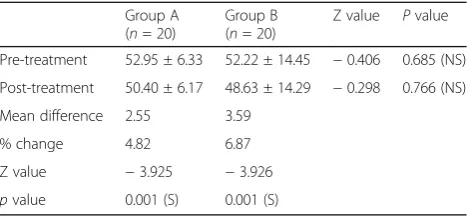
ODI scores showed a significant decrease in both groups post-treatment (p = 0.001) indicating a decrease of functional disability. The percentage of decrease in Oswestry scores was higher in group B than group A (6.87% versus 4.82%). However, no significant difference was detected between both groups regarding ODI scores pre- or post-treatment (p = 0.685, 0.799 respectively), Table3.
The range of flexion of the lumbar spine was
signifi-cantly increased in both groups post-treatment (p =
0.001). The percentage of change in flexion was signifi-cantly higher in group A than group B (19.8 versus 16.67%). However, there was a significant difference be-tween both groups regarding the range of lumbar flexion pre- or post-treatment (p = 0.931, 0.700 respectively), Table4.
The range of extension of the lumbar spine was sig-nificantly increased in both groups post-treatment (p = 0.001). The percentage of change in extension was sig-nificantly higher in group A than group B (33.38 versus 29.61%). However, no significant difference was detected
between both groups regarding the range of lumbar ex-tension pre- or post-treatment (p= 0.191, 0.170 respect-ively), Table5.
The range of right side bending was significantly in-creased in both groups post-treatment (p = 0.001). The percentage of change was significantly higher in group A than in group B (39.52 versus 36.80%). However, no sig-nificant difference was detected between both groups re-garding right side bending pre- or post-treatment (p = 0.711, 0.387 respectively), Table6.
The range of left side bending was significantly in-creased in both groups post-treatment (p = 0.001). The percentage of change was significantly higher in group A than group B (50.35 versus 40.13%). However, no signifi-cant difference was detected between both groups
re-garding left side bending pre- or post-treatment (p =
0.351, 0.541 respectively), Table7.
Discussion
Physical activity could be a viable therapeutic modality for chronic pain conditions that results in helpful effects on pain, sleep, psychological feature, and physical func-tions. International pointers for managing pain in older adults suggest conservative, non-medicinal management, together with mostly exercise-based therapies [8]. The present study disclosed important decrease in pain scores in each team post-treatment particularly in group B who received muscle energy technique (MET). This
Table 2Comparison of mean scores of VAS within and between both groups
Group A (n= 20)
Group B (n= 20) t
value Pvalue Pre-treatment 7.00 ± 1.45 7.40 ± 1.27 −0.927 0.360 (NS) Post-treatment 3.55 ± 0.83 2.00 ± 0.86 5.820 0.001 (S) Mean difference 3.45 5.40
% change 49.29 72.97
tvalue 14.693 23.081
pvalue 0.001 (S) 0.001 (S)
NSnot significant,Ssignificant,VASvisual analogue scale
Table 1General characteristics of both groups
Group A (n= 20)
Group B (n= 20) t
value Pvalue Age (yrs.) 30.10 ± 6.84 33.20 ± 6.62 −1.457 0.153 (NS) Gender
Male [n(%)] 12 (60.0%) 10 (50.0%) 0.404 0.525 (NS) Female [n(%)] 8 (40.0%) 10 (50.0%)
Weight (kg) 84.20 ± 4.97 86.75 ± 8.98 −1.111 0.276 (NS) Height (cm) 172.10 ± 8.80 168.15 ± 5.08 1.738 0.092 (NS) BMI (kg/m2) 28.62 ± 3.29 30.80 ± 4.21 -1.823 0.076 (NS) %percentage,kgkilograms,cmcentimeters,NSnot significant
Table 3Comparison between mean scores of Oswestry Disability Index within and between both groups
Group A (n= 20)
Group B (n= 20)
Z value Pvalue Pre-treatment 52.95 ± 6.33 52.22 ± 14.45 −0.406 0.685 (NS) Post-treatment 50.40 ± 6.17 48.63 ± 14.29 −0.298 0.766 (NS) Mean difference 2.55 3.59
% change 4.82 6.87 Z value −3.925 −3.926
pvalue 0.001 (S) 0.001 (S)
NSnot significant,Ssignificant
Table 4Comparison of mean values of flexion of lumbar spine within and between both groups
Group A (n= 20)
Group B (n= 20) t
value Pvalue Pre-treatment 51.00 ± 11.77 51.30 ± 10.01 −0.087 0.931 (NS) Post-treatment 61.10 ± 11.92 59.85 ± 8.11 0.388 0.700 (NS) Mean difference 10.10 8.55
% change 19.80 16.67 t value −14.522 −7.616
pvalue 0.001 (S) 0.001 (S)
came in agreement with Wilson et al. [9] and Mindy and colleagues [10] who expressed that the patient has larger profit by using MET than using fiber bundle re-education and resistance exercises to scale back low back pain and improve practical level in subjects with re-peated low back pain. Priyanka and colleagues [11] add-itionally found MET possesses value-added helpful result for decreasing pain and incapacity and improve the per-formance of patients with chronic nonspecific low back pain alongside supervised exercises, hot pack, and trans-cutaneous electrical nerve stimulation (TENS). On the contrary, Bindra and colleagues [12] reported no signifi-cance between MET and other therapies regarding pain and functional status.
The physiological mechanisms underlying the thera-peutic effects of MET may involve a variety of
neuro-logical and biomechanical mechanisms, including
hypoalgesia, altered proprioception, increase in stretch tolerance, motor programming and control, and changes in tissue fluid [13].
On the other hand, Murtezani and colleagues [14]
compared McKenzie (MK) exercises with electrophysical agents (heat, ultrasound, interferential current) and found greater reduction of VAS scores in MK exercise group than the electrophsiological agents (EPAs) group. Better results in reducing pain intensity were also ob-tained with MK method compared with resistance
train-ing (Udermann and colleagues [15]) and supervised
exercise (Sakai and colleagues [16]). Pain reduction after treatment by MK might be attributed to posture correc-tion and maintenance of correccorrec-tion which is an import-ant aspect of MK exercise [17].
In this study, there was an important reduction of ODI scores in each team post-treatment, particularly in the group B who received MET. This came in
accord-ance with Udermann and colleagues [15] who showed
that McKenzie coaching improved pain, disability, and psychosocial variables in patients with chronic low back pain. Machado and colleagues [18] additionally showed that there is a discount in pain and incapacity thanks to MK technique for a minimum of 1 week compared with the passive treatment strategies. Moreover, Garcia and
colleagues [19] showed that exploiting MK technique
helps to improve the practical ability of chronic low back pain cases to hold out daily activities while not feeling pain which could flow from to the effectivity of control exercises for patients. This study disclosed important post-treatment increase of body part in flexion, exten-sion, and right and left aspect bending in each team par-ticularly in group A who received MK exercises. These findings are in agreement with Hosseinifar and
col-leagues [20] who showed that MK coaching could be a
favorable technique for reducing pain and increasing various motions of body part flexion in patients with chronic low back pain. Also, Kilpikoski and colleagues [21] found that MK educational program ends up in re-covery of low back pain symptoms like pain within the short-run. Moreover, this coaching is made to mobilize the spine and to strengthen the body part muscles. An attainable rationalization is that MK extension exercise program focuses on sustained posture or continual movement that might cut back pain. It is based mostly chiefly on characterizing the directional preference for spinal movement and the idea for prescription of exer-cises. It incorporates continuous various movements, and also, the direction for exercise depends upon the pa-tients’ response to those repeated movements. Posture correction and maintenance of this correction are the vital aspects of MK exercises [17]. On the opposite hand,
Table 5Comparison of mean values of extension of lumber spine within and between both groups
Group A (n= 20)
Group B (n= 20)
tvalue Pvalue Pre-treatment 39.35 ± 15.69 33.70 ± 10.72 1.330 0.191 (NS) Post-treatment 51.00 ± 14.76 44.95 ± 12.53 1.397 0.170 (NS) Mean difference 11.65 11.25
% change 33.38 29.61
tvalue −11.766 −6.999
pvalue 0.001 (S) 0.001 (S)
NSnot significant,Ssignificant
Table 6Comparison of mean values of right side bending within and between both groups
Group A (n= 20)
Group B (n= 20) t
value Pvalue Pre-treatment 29.10 ± 6.16 28.40 ± 5.71 0.373 0.711 (NS) Post-treatment 40.60 ± 7.49 38.85 ± 4.85 0.878 0.387 (NS) Mean difference 11.50 10.45
% change 39.52 36.80
tvalue −13.373 −17.281
pvalue 0.001 (S) 0.001 (S)
NSnot significant,Ssignificant
Table 7Comparison of mean value of left side bending within and between groups
Group A (n= 20)
Group B (n= 20)
tvalue Pvalue Pre-treatment 28.20 ± 3.50 29.65 ± 5.88 −0.948 0.351 (NS) Post-treatment 42.40 ± 4.08 41.55 ± 4.62 0.617 0.541 (NS) Mean difference 14.20 11.90
% change 50.35 40.13
tvalue −21.218 −14.796
pvalue 0.001 (S) 0.001 (S)
Mesquita and colleagues [22] reported an important in-crease in body part flexion and extension within the MET cluster compared to controls. In distinction, Patil and colleagues [23] determined that MET and also the management intervention were equally effective in in-creasing aspect flexion, spinal flexion, and spinal exten-sion. Ellythy and colleagues [24] additionally reported no distinction in body part flexion and extension between MET and also the management cluster. In conclusion, the authors suggest adding MET to spinal extension ex-ercise programs to extend their effectivity in decreasing pain and incapacity and improve the quality of the per-formance of patients with chronic low back pain.
Limitations
This study is limited because we should compare be-tween acute and chronic cases. Also, we should have lar-ger number of cases.
Abbreviations
ANOVA:One-way analysis variance; BMI: Body mass index; GTO: Golgi tendon organ; MLBP: Mechanical low back pain; ROM: Range of motion;
SPSS: Statistical Program for Social Science; VAS: Visual analogue scale
Acknowledgements
The authors acknowledge the subjects for their participation and cooperation in the study.
Authors’contributions
EF and HS contributed to the research idea and conception. WR, HH, and, MG contributed to the data acquisition, data analysis, interpretation, and manuscript writing and review. All authors read and approved the final manuscript.
Funding
This research received no specific grant from any funding agency in the commercial or not-for-profit sectors.
Availability of data and materials
The datasets generated and/or analyzed during the current study are not publicly available due to current Cairo University regulations and Egyptian legislation but are available from the corresponding author on reasonable request and after institutional approval.
Ethics approval and consent to participate
The aim and procedures of the study were explained to every participant, and an informed written consent was obtained from all the patients before being enrolled in the study. The study was approved by the ethical committee of the Department of Physical Therapy for Neuromuscular Disorder and Its Surgery on May 2017 (No P.T.REC/012/002258), Faculty of Physical Therapy, Cairo University.
Consent for publication
Not applicable.
Competing interests
The authors declare that they have no competing interests.
Author details
1Department of Neurology, Cairo University, Cairo, Egypt.2Department of
Physical Therapy of Neuromuscular Disorders and Its Surgery, Faculty of Physical Therapy, Cairo University, Cairo, Egypt.
Received: 9 April 2019 Accepted: 11 October 2019
References
1. Rucker K, Cole A, Wenistein S. Low back pain, A symptom based approach to diagnosis and treatment. Bulterworth Heinemnn, Boston, USA; 2001. p. 5–7.
2. Lötters F, Burdorf A, Kuiper J, Miedema H. Model for the work-relatedness of low-back pain. Scand J Work Environ Health. 2003;29(6):431–40.
3. Hosseinifar M, Akbari M, Behtash H, Amiri M, Sarrafzadeh J. The effects of stabilization and McKenzie exercises on transverse abdominis and multifidus muscle thickness, pain, and disability: a randomized controlled trial in nonspecific chronic low back pain. J Phys Ther Sci. 2013;25(12):1541–5.
4. Johnson O.E. Therapeutic exercises in the management of non-specific low back pain. 2012, ISBN: 978-953-51-0599-2
5. McKenzie RA, May S. The lumbar spine: mechanical diagnosis and therapy. 2nd ed. Waikanae: Spinal Publications; 2003.
6. Chaitow L. Muscle energy techniques. 3rd ed. Edinburgh: Churchill Livingstone; 2006.
7. Jensen MP, Chen C, Brugger AM. Interpretation of visual analog scale ratings and change scores: a reanalysis of two clinical trials of postoperative pain. J Pain. 2003;4(7):407–14.
8. Wand BM, Parkitny L, O’Connell NE, Luomajoki H, McAuley JH, Thacker M, Moseley GL. Cortical changes in chronic low back pain: current state of the art and implications for clinical practice. Manual Ther. 2001;16:15–20. 9. Wilson E, Payton O, Donegan-Shoaf L, Dec K. Muscle energy technique in
patients with acute low back pain: a pilot clinical trial. J Orthop Sports Phys Ther. 2003;33(9):502–12.
10. Mindy C, Nadine F, Chris W. Randomized controlled trial of specific spinal stabilization exercises and conventional physiotherapy for recurrent low back pain. Spine. 2006;31(9):E670–81.
11. Dhargalkar P, Kulkarni A, Ghodey S. Added effect of muscle energy technique for improving functional ability in patients with chronic nonspecific low back pain. Int J Physiother Res. 2017;5(3):2082–7. 12. Bindra S, Kumar M, Singh P, Singh J. A study on the efficacy of muscle
energy technique as compared to conventional therapy in chronic low back pain due to sacroiliac joint dysfynction. Indian J Physiother Occup Ther. 2012;6(1):200–33.
13. Fryer G, Fossum C. Therapeutic mechanisms underlying muscle energy approaches. In: Fernandez-de-las-Penas C, Lars A-N, Gerwin RD, editors. Tension- Type and Cervicogenic Headache: Pathophysiology, Diagnosis, and Management. Sudbury: Jones and Bartlett Publishers; 2010.
14. Murtezani A, Govori V, Meka VS, Ibraimi Z, Rrecaj S, Gashi S. A comparison of McKenzie therapy with electrophysical agents for the treatment of work related low back pain: a randomized controlled trial. J Back Musculoskelet Rehabil. 2015;28(2):247–53.
15. Udermann BE, Mayer JM, Donelson RG, Graves JE, Murray SR. Combining lumbar extension training with McKenzie therapy: effects on pain, disability, and psychosocial functioning in chronic low back pain patients. Gundersen Lutheran Med J. 2004;3:7–12.
16. Sakai Y, Matsuyama Y, Nakamura H, Katayama Y, Imagama S, Ito Z, et al. The effect of muscle relaxant on the paraspinal muscle blood flow: a randomized controlled trial in patients with chronic low back pain. Spine. 2008;33(6):581–7.
17. Clare HA, Adams R, Maher CG. A systematic review of efficacy of McKenzie therapy for spinal pain. Aust J Physiother. 2004;50(4):209–16.
18. Machado LA, Maher CG, Herbert RD, Clare H, McAuley JH. The effectiveness of the McKenzie method in addition to first-line care for acute low back pain: a randomized controlled trial. BMC Med. 2010;8:10.
19. Garcia JB, Hernandez-Castro JJ, Nunez RG, Pazos MA, Aguirre JO, Jreige A, et al. Prevalence of low back pain in Latin America: a systematic literature review. Pain Physi. 2014;17(5):379–91.
20. Hosseinifar M, Akbari A, Shahrakinasab A. The effects of McKenzie and lumbar stabilization exercises on the improvement of function and pain in patients with chronic low back pain: a randomized controlled trial. J Shahrekord Univ Med Sci J. 2009;11(1):1–9.
22. Mesquita R. Comparison of trunk stabilization exercises and muscle energy technique in recurrent low back pain. A randomized clinical trial. Belgaum: KLE University; 2012.
23. Patil P, Chandu B, Metgud S, Khatri S. Effectiveness of muscle energy on quadratus lumborum in acute low back pain–randomized controlled trial. Indian J Physiother Occup Ther. 2010;4(1):54–8.
24. Ellythy MA. Efficacy of muscle energy technique versus strain counter on low back dysfunction. Bull Fac P Th Cairo Univ. 2012;17(2).
Publisher’s Note