This is an open access journal, and articles are distributed under the terms of the Creative Commons Attribution-Non Commercial-ShareAlike 4.0 License, which allows others to remix, tweak, and build upon the work non-commercially, as long as appropriate credit is given and the new creations are licensed under the identical terms.
© 2018 Journal of Advanced Pharmacy Education & Research | Published by SPER Publication
108
Effect of health promotion intervention on Nurses’ healthy
lifestyle and health-promoting behaviors: RCT study
Shokofe Darkhor
1, Fatemeh Estebsari
2*, Meimanat Hosseini
2, Jamshid Yazdani Charati
3, Parvaneh
Vasli
21MSc Student in Community Health Nursing, School of Nursing & Midwifery, Shahid Beheshti University of Medical Science, Tehran, Iran, 2Assistant professor, Department of Community Health Nursing, School of Nursing & Midwifery, Shahid Beheshti University of Medical Science, Tehran, Iran, 3Associate Professor, Department of Biostatics, Health Sciences Research, Mazandaran University of Medical Science, Sari, Iran.
Correspondence: Fatemeh Estebsari, Assistant professor, Department of Community Health Nursing, School of Nursing & Midwifery, Shahid Beheshti University of Medical Science, Tehran, Iran. E_mail: [email protected]
ABSTRACT
Objectives: Health promoting behaviors (HPBs) are major criteria in determining lifestyle. The present study aimed to investigate the impact of health promotion interventions (HPI) on health-promoting behaviors of nurses. Methods: In this experimental study was conducted in 2016. A total of 100 nurses were randomly selected and divided into two groups of experimental and control. The data was collected using the demographic questionnaire, the Health-Promoting Lifestyle Profile II (HPLP II), the General Self-Efficacy Scale of Schwartz, the Standard Self-Esteem Scale of Rosenberg, and the Brief Self-Control Scale (BSCS) of Tangney. After collecting and analyzing the collected data, the HPI was designed and conducted in 6 sessions for the experimental group. A month and a half after the intervention, the data for both groups were collected and analyzed using SPSS ver 20. Results: Before the HPI, health promoting behaviors, self-efficacy, self-esteem, and self-control had no significant difference among the two groups. After the intervention, the mean scores of health promoting behaviors (p<0.001), self-efficacy (p<0.001), and self-esteem (p<0.001) showed a significant difference between the two groups, but self-control score was not significant (p>0.05). Conclusion: HPI changed HPBs in the nurses, and changes in HPBs will lead to a change in lifestyle. Therefore, it is recommended to use HPI as a comprehensive program to improve and modify lifestyle.
Keywords: Health promotion, behavior, intervention, lifestyle, Nurse
Introduction
Health promoting behavior is a major criterion for determining health and its ultimate goal is to make decisions regarding health and to prepare for desirable behaviors [1]. As an important health factor, health promotion is of the responsibility of individuals and can lead them to higher levels of health [2-4]. Health promoting lifestyle is a multi-causal and multi-dimensional phenomenon which is related to collective patterns of
behavior and control, and consistency in doing a series of health-related behaviors is its essence [5]. Self-efficacy belief is a prediction index for a wide range of health behaviors [6] and results in maintaining and improving health behaviors [7]. Self-efficacy refers to confidence and ability of individuals for performing normal behaviors to achieve a healthy lifestyle. People with higher levels of self-efficacy participate more actively in health promotion programs [8].
Self-efficacy in HPBs play a key role in the adoption of
preventive behaviors through strengthening individual’s
effectiveness, increasing self-confidence, and personal control over the situation [9]. People who believe in the concept of self-efficacy feel that they “can” increase
individual control in HPBs through boosting confidence [10]. Studies have shown that efficacy strengthens self-esteem which in turn influences motivation. Self-self-esteem is the main precondition of health through strengthening the
Access this article online
Website: www.japer.in E-ISSN: 2249-3379
How to cite this article: Shokofe Darkhor, Fatemeh Estebsari, Meimanat Hosseini, Jamshid Yazdani Charati, Parvaneh Vasli. Effect of health promotion intervention on Nurses’ healthy lifestyle and health-promoting behaviors: RCT study. J Adv Pharm Edu Res 2018;8(1):108-114.
power of saying no against risky behaviors [9-11]. Self-efficacy is an effective factor for successful performance of a behavior and communicates knowledge and action [12]. Self-control is one of the factors affecting HPBs and avoidance of unhealthy behaviors. Those without self-control act regardless of long-term benefits of their and others behavior and as a result, will likely perform unhealthy behaviors. Attention to the consequences of doing or not doing preventive behaviors can increase self-control [9]. Studies have shown that self-control skills can be taught to reduce unhealthy behaviors [13].
Health education is a process for empowering individuals and bridges their health information to performance to make changes in their lifestyle. As a result of these changes, individuals perform behaviors that are beneficial for health and avoid from behaviors that are harmful for health [14]. It should be noted that training of HPBs is more than listening, motivational interviewing, and health literacy, rather, it is a training which is intended to facilitate behavior change through motivation and change in belief [3]. HPI increases the person’s sense of self -efficacy and empowerment [15]. Self-esteem and self-efficacy lead to self-control and preventive behaviors which are required for health promotion and lifestyle modification [16]. The results of studies have been showed that nurses menstrual disorders, neck pain, back pain and etc. are due to their unhealthy lifestyle [17], and also nurses do not perform the necessary activities for a healthy lifestyle and this can affect their performance and outcomes of patients [18]. As educators and guides of people in performance of HPBs and promotion of healthy lifestyle, nurses should have healthy behavior, otherwise undesirable behaviors may spread and impact public health [1, 19]. Studies have shown the limited amount of theoretical and practical training conducted on health promotion for nurses [20] thus, this study has investigated the effect of HPI on HPBs of nurses.
Material and Methods
This study is an experimental study and performed in the hospitals of Babol University of Medical Sciences. The study population consisted of all nurses working in Babol University of Medical Sciences. The sample size was determined using means difference and variance in similar studies [14]. Taking into account the 15% loss, a total of 80 qualified nurses were selected by random sampling and divided into experimental and control groups. Written informed consent was obtained from nurses. Inclusion criteria included lack of mental illness, participation in 6 sessions, lack of chronic disease, and no participation in
similar studies. Exclusion criteria were absence in more than two sessions of training and high score of health promoting behavior in pre-test. Nurses with new mental health problems and death of their relatives were excluded from the research.
To evaluate the ability of individuals to perform HPBs not only the diet, sleep, exercise and etc. but also self-esteem, self-efficacy and self-control must be evaluated [21].
The data were collected using 5 tools. The demographic questionnaire which includes age, gender, education, marital status, work experience, workplace ward, work shift, and hours of overtime per month. The Health-Promoting Lifestyle Profile II (HPLP II) is a 52-item questionnaire and measures the frequency of health promoting behaviors in six dimensions of health responsibility, physical activity, nutrition, spiritual growth, stress management, and interpersonal relations. There are 4 options in front of each item: never (1), sometimes (2), often (3), and always (4). Total score range is 52-208 and the score of each dimension is calculated separately [20]. The General Self-Efficacy Scale of Schwartz was used to measure self-efficacy and consisted of 10 items scored with four-point Likert scale: not correct at all (1), less correct (2), partially correct (3), and absolutely correct (4) [22] The Standard Self-Esteem Scale of Rosenberg includes 10 items or comment
on people’s true feelings and is scored as strongly agree =
4, agree = 3, disagree = 2, strongly disagree = 1; a score of 40 represents the maximum self-esteem [23] And finally, the Brief Self-Control Scale (BSCS) of Tangney consisting of 13 items is scored based on 5-point Likert spectrum as never (1), partly (2), no idea (3), high (4), and very high (5). Items 2, 3, 4, 5, 7, 9, 10, 12, and 13 were scored inversely, and the total score ranged from 13 to 65 [24].
Validity and reliability of HPLP II have been approved in the study of Bahiraee et al. and Taghdisi et al [4, 25], and in
the present study, Cronbach’s alpha and correlation
coefficient between the two tests were 0.94 and 0.98, respectively. Cronbach’s alpha and correlation coefficient
Shokofe Darkhor, et al.: Effect of health promotion intervention on Nurses’ healthy
Journal of Advanced Pharmacy Education & Research | Jan-Mar 2018 | Vol 8 | Issue
Health Promotion Intervention
The content of health promotion intervention was designed based on learning objectives and analysis of results obtained from tools completed in the first phase. In addition, last updated website of Ministry of Health (April 2016) and the comments of specialists in health education and health promotion and community health nurses were also used. As a result, a content was designed and developed with the objects of dimensions of health promoting behaviors and nutrition, physical activity, responsibility for health, spiritual growth, interpersonal relations, and stress management, sentences with a positive sense to increase self-esteem, and emphasizing the experiences of others for self-efficacy and self-control. Training was held in 6 meetings during two weeks, 3 sessions per week and 30-40 minutes each session, based on an ongoing schedule [26]. Training was carried out for the intervention. To avoid disruption in services provided by nurses in the wards, it was tried to select the location, the training time, and the group sessions in coordination with nurses and head nurses. Health promotion intervention was performed through lecture, group discussion, question and answer, and educational slides. In addition, a number of educational messages relevant to health promotion intervention were prepared daily and sent via SMS to the experimental group. To inform the participants and avoid forgetting the classes, the time and place of the meetings were reminded by SMS the day before. The educational slides were sent to persons absent at the sessions of health promotion intervention in the experimental group via electronic messages and those with more than two sessions absence were excluded. A month and a half after the health promotion intervention, the tools were completed again by both groups [23] and finally all trainings of the experimental group were provided to the control group as a CD.
Statistical Analysis
Descriptive statistics was used to determine the frequency, mean, and standard deviation of variables, Independent Sample T-Test, Mann-Whitney, Paired Sample T-Test and Wilcoxon, to compare the mean scores of self-efficacy, self-esteem, self-control, and health promoting lifestyle, as well as each relevant subgroup before and after the intervention and a month and a half after the intervention, and independent t-test and chi square test to compare the demographic variables. All statistical evaluations were performed at a significance level 0.05.
Results
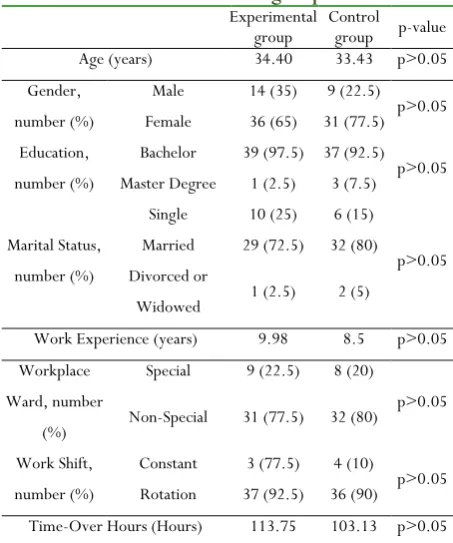
The underlying characteristics of people (age, sex, education, work shift, work experience, workplace ward, marital status, and overtime hours) are shown in Table 1. In this regard, the comparison of the two groups resulted in p-values greater than 0.05, indicating no statistically significant difference between the two groups. The groups were matched in terms of underlying variables.
Table 1: Comparison of the underlying variables between the two groups
Experimental group
Control
group p-value
Age (years) 34.40 33.43 p>0.05
Gender, number (%)
Male 14 (35) 9 (22.5)
p>0.05
Female 36 (65) 31 (77.5)
Education, number (%)
Bachelor 39 (97.5) 37 (92.5)
p>0.05
Master Degree 1 (2.5) 3 (7.5)
Marital Status, number (%)
Single 10 (25) 6 (15)
p>0.05
Married 29 (72.5) 32 (80)
Divorced or
Widowed 1 (2.5) 2 (5)
Work Experience (years) 9.98 8.5 p>0.05
Workplace Ward, number
(%)
Special 9 (22.5) 8 (20)
p>0.05
Non-Special 31 (77.5) 32 (80)
Work Shift, number (%)
Constant 3 (77.5) 4 (10)
p>0.05
Rotation 37 (92.5) 36 (90)
Time-Over Hours (Hours) 113.75 103.13 p>0.05
The parametric and nonparametric tests were used to compare the mean score of health promoting behaviors, self-efficacy, self-esteem, and self-control in the experimental and control groups before and after the intervention. Except for self-control variable (p>0.05), the remaining tests were significant (p<0.05). Mann-Whitney and independent sample t-test were used for comparison of the two groups before the intervention. The results showed no significant relationship between the two groups in terms of the studied variables before the intervention (p>0.05) (Table 2).
Table 2: Results of variables of health promoting behaviors, self-efficacy, self-esteem, and self-control
in the studied nurses before and after the intervention.
Variable Group Mean SD p-value Mean Before Intervention After Intervention SD p-value
Health Promotin
g Behaviors
Experimental 150.4
3 21.66
p>0.05*
170.1
8 20.34 p<
0.001*
Control 149.4
3 18.70
153.0
5 21.04
Self-efficacy
Experimental 26.48 6.34
p>0.05*32.53 5.43 p<
0.001*
Control 28.43 6.14 27.45 5.01
Self- esteem
Experimental 30.68 4.05 p>0.05*
*
33.85 4.04 p<
0.001**
Control 30.83 2.99 30.15 2.65
Self- control
Experimental 46.15 4.57
p>0.05*48.08 5.59 p>
0.05*
Control 45.15 5.96 46.58 5.06
*Independent Samples T-Test ** Mann-Whitney
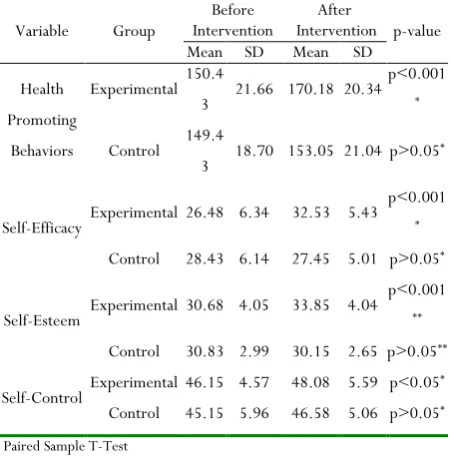
Paired sample t-test and Wilcoxon were used to investigate the relationship between health promoting behaviors, self-efficacy, self-esteem, and self-control in the experimental and control groups before and after the health promotion intervention. The results showed significant correlation between the experimental group before and after the intervention (p<0.05). There was no statistically significant difference between the control group before and after the intervention (p>0.05) (Table 3).
Table 3: Results of variables of health promoting behaviors, self-efficacy, self-esteem, and self-control
in the experimental and control groups before and after the intervention.
Variable Group
Before Intervention
After
Intervention p-value
Mean SD Mean SD
Health Promoting
Behaviors
Experimental 150.4
3 21.66 170.18 20.34
p<0.001
*
Control 149.4
3 18.70 153.05 21.04 p>0.05
*
Self-Efficacy Experimental 26.48 6.34 32.53 5.43
p<0.001
*
Control 28.43 6.14 27.45 5.01 p>0.05*
Self-Esteem Experimental 30.68 4.05 33.85 4.04
p<0.001
**
Control 30.83 2.99 30.15 2.65 p>0.05**
Self-Control Experimental 46.15 4.57 48.08 5.59 p<0.05
*
Control 45.15 5.96 46.58 5.06 p>0.05*
* Paired Sample T-Test ** Wilcoxon
Discussion
This study was carried out to determine the effectiveness of HPI on HPBs in nurses. The findings showed that although the mean scores of HPBs, efficacy, self-esteem, and self-control had no significant difference between the two groups before the HPI, the difference became significant after the intervention. In this study, there was no significant difference between the experimental and control groups before HPI in terms of health promoting behaviors in the majority of nurses (p>0.05), but after the HPI, the difference became significant (p<0.001). In a study by Tsai and Liu, a significant increase was observed in the lifestyle score of nurses after the electronic training intervention [14]. In the study of Ghasemi, the empowerment-based training intervention increased and improved the lifestyle of metanephrine consumers and their families [27]. It was also shown in the study of Heidari et al. that a supportive program on health promotion had a positive effect on the lifestyle of menopaused teachers [28]. In a study by Shaher et al., the training intervention led to changes in lifestyle-related behaviors in health care providers after 6 months through change in attitude [29]. These findings refer to the increasing effect of the used intervention on healthy lifestyle behaviors.
The mean score of nurses’ self-efficacy in the experimental and control groups had no significant difference before intervention (p>0.05). After intervention, the mean score increased in the experimental group and the difference became significant (p<0.001), indicating the positive impact of HPI on self-efficacy; this is consistent with the study of Taghdisi et al. about the effect of training intervention on increased self-efficacy and awareness of women for the prevention of domestic violence [30]. Self-efficacy has been named as a contributing factor in behavior change and empowerment of individuals in several studies [23, 31, 32]. In the study of Sin et al. training intervention improved self-efficacy and led to adoption of healthy lifestyle in the study subjects [33].
The mean score of nurses’ self-esteem in the experimental and control groups had no significant difference before intervention (p>0.05), but the mean increased after intervention in the intervention group and the difference became significant (p<0.001), indicating the positive impact of health promotion intervention on self-esteem of the participants; this is in line with the study of Afkari et al, Solhi et al, and Babazadeh et al [22, 23, 34]. In a study in 2015, Aghajari et al. investigated the positive impact of training intervention on self-esteem of nursing students [35].
Shokofe Darkhor, et al.: Effect of health promotion intervention on Nurses’ healthy
Journal of Advanced Pharmacy Education & Research | Jan-Mar 2018 | Vol 8 | Issue no statistically significant difference (p>0.05), and
difference did not become significant after the intervention (p>0.05). Despite a slight change in the means before and after intervention, self-control was not significant, which indicates ineffectiveness of training on control of HPBs and healthy lifestyle. Since self-control for changing self-responses plays a major role in reaching demands and long-term goals in the mental and behavioral health [36] and given that self-control is a learnable skill [37], no significant change was occurred in self-control of the nurses in this study due to the short time.
This study is one of the few interventions that have been carried out on the lifestyle of nurses in Iran. Limitation of this study can be outlined as follows: small sample size, limited to the two hospitals, the time (a month and a half) of the study.
Conclusion
Health promotion intervention can change health promoting behaviors in nurses and changes in health promoting behaviors will lead to lifestyle changes. Therefore, it is recommended to use health promotion interventions as a comprehensive program to improve and modify lifestyle. Focusing on the lifestyle dimensions of nurses and improving their quality can be an effective step to improve the health care system.
Acknowledgment
This paper is part of the M.Sc. thesis of Shokofe Darkhor. This research was funded by Shahid Beheshti University of Medical Sciences, (Fund No: 13368) and clinical trial IRCT2016063028719N1 in 2016. Then, the authors would like to thank Shahid Beheshti University of Medical Sciences for financial support. Also, we thank all of the nurses who participated in this study.
Conflict of Interest
The authors declare that they have no conflict of interest.
References
1. Moridi G, Valiee S, Nikbakht N A, Esmaeil N G, Khaledi Sh. Meanings of Health for Iranian Diabetic Patients: A qualitative study. Electronic Physician. 2016; 8(9): 2904-2910.
2. Norouzinia R, Aghabarari M, Kohan M, Karimi M. Health promotion behaviors and its correlation with
anxiety and some students’ demographic factors of
Alborz university of medical sciences. JHPM. 2013; 2(4): 39-49.
3. Abadi B D, Dolatian M, Mahmoodi Z, Akbarzadeh B A. Comparison of lifestyles of young women with and without primary dysmenorrhea. Electronic Physician. 2016; 8(3): 2107-2114.
4. Taghdisi M H, Estebsari F, Rahimi Foroushani A, Eftekhar Ardebili H, Shojaeizadeh D, Dastoorpoor M, et al. The educational program based on the
successful aging approach in elder’s health -promoting behaviors: A clinical trial study. RJMS. 2014; 21(125): 26-36.
5. Darviri C, Alexopoulos E, Artemiadis A, Tigani X, Kraniotou C, Darvyri P, et al. The healthy lifestyle and personal control questionnaire (HLPCQ): a novel tool for assessing self-empowerment through a constellation of daily activities. BMC Public Health. 2014; 14(995): 1-10.
6. Goshtaei M, Ravaghi H, Akbari S A, Abdollahi Z. Nutrition policy process challenges in Iran. Electronic Physician. 2016; 8(2): 1865-1873. 7. Baljani E, Rahimi Jh, Amanpour E, Salimi S,
Parkhashjoo M. Journal of Faculty of Nursing and Midwifery, Tehran University of Medical Sciences. 2011; 17(1):41-51.
8. Hosseinzade T, Paryad E, Kazemnejad E, Asiri S. A study of self-efficacy in patients with coronary artery disease and its predictors. Qom Univ Med Sci J. 2013; 7(2): 41-48.
9. Vahedian-azimi A, Alhani F, Goharimogaddam K, Madani S, Naderi A, Hajiesmaeili M. Effect of family-centered empowerment model on the quality of life in patients with myocardial infarction: A clinical trial study. 3 JNE. 2015; 4(1): 8-22. 10. Qorban Sabbagh M, Khanjani N, Fadakar MM,
Iranpour A. Empowerment of women visiting the health centers of Kerman by teaching Self Breast Examination in the presence of Behvarz. Iranian Journal of Breast Diseases. 2014; 1(1). 41-51. 11. Spencer G. Young people and health: Towards a new
conceptual framework for understanding empowerment. Health. 2014; 18(1): 3-22.
12. Bandura A. On the functional properties of perceived self-efficacy revisited. Journal of Management. 2012; 38(1): 9-44.
14. Tsai Y, Liu C. An ehealth education intervention to promote healthy lifestyles among nurses. Nursing Outlook. 2015; 63(2015): 245-254.
15. Padmapriya K, Krishna P, Rasu Th. Prevalence and patterns of physical activity among medical students in Bangalore, India. Electronic Physician. 2016; 8(9): 2904-2910.
16. Seyed Nematollah Roshan F, Navipor H, Alhani F. Effect of family-centered empowerment model (FCEM) on quality of life of mothers having teenagers with iron deficiency anemia. 3 Journal of Nursing Education. 2014; 3 (2): 27-40.
17. Roushan SN, Sadat F, Alhani F. Explanation of Nurses problems to promote a healthy lifestyle. Razi Journal of Medical Sciences. 2014 Jul 15;21(121):36-45.
18. Hosseini M, Ashktorab T, Taghdisi M. Health promotion lifestyle in nursing students: a systematic review. JHPM. 2013; 2(1): 66-79.
19. Hassanpour M, Delshad A, Alemi A. Effect of an educational intervention based on empowerment model on awareness, attitudes, esteem and self-efficacy of men in preventing prostate cancer. PCNM. 2014; 4(1): 9-18.
20. Hilding C, Cunaco L, Lindgren EC, Lidell E. Health promotion in nursing education: attitudes among nurse students. Acta Biomed for Health Professions. 2015; 86(2) 91-96.
21. Darviri C, Alexopoulos EC, Artemiadis AK, Tigani X, Kraniotou C, Darvyri P, Chrousos GP. The Healthy Lifestyle and Personal Control Questionnaire (HLPCQ): a novel tool for assessing self-empowerment through a constellation of daily activities. BMC public health. 2014 Sep 24;14(1):1. 22. Afkari M E, Latifi M, Taghdisi M H, Azam K,
Estebsari F. Indicators of empowerment in women supported by Imam Khomeini relief committee of gorgan in confrontation with violence. Payavard. 2013; 7(1): 32-41.
23. Solhi M, Abasi Hne, Hazavehei M M, Roshanaei G. Effect of educational intervention on empowerment of high school student in prevention of smoking. RJMS. 2014; 21(118): 52-63.
24. Daly M, Delaney L, Egan M, Baumeister R. Childhood self-control and unemployment throughout the life span: Evidence from two British cohort studies. Psychological Science. 2015; 26(6): 709-723.
25. Baheiraei A, Mirghafourvand M, Mohammadi E, Nedjat S, Charandabi SM-A, Rajabi F, et al. Health-promoting behaviors and social support of women of
reproductive age, and strategies for advancing their health: Protocol for a mixed methods study. BMC Public Health. 2011; 11(191):1-5.
26. Sarnquist C, Omondi B, Sinclair J, Gitau C, Paiva L, Mulinge M, et al. Rape prevention through empowerment of adolescent girls. Pediatrics. 2014; 133(5): 1226-1232.
27. Ghasemi A, Estebsari F, Bastaminia A, Jamshidi E, Dastoorpoor M. Effects of Educational Intervention on Health-Promoting Lifestyle and Health-Related Life quality of Methamphetamine Users and Their Families: a Randomized Clinical Trial. Iran Red Crescent Med J. 2014; 16(11):1-8.
28. Heidari F, Mohammad Khan Kermanshahi S, Vanaki Z. The effect of a supportive health promotion program on the lifestyle of premenopause teachers. Feyz. 2013; 17(1): 14-24.
29. Shahar D, Henkin Y, Rozen G, Adler D, Levy O, Safra C, et al. A controlled intervention study of changing health-providers’ attitudes toward personal
lifestyle habits and health-promotion skills. Nutrition. 2009; 25(2009): 532-539.
30. Taghdisi M H, Latifi M, Afkari M E, Dastoorpour M, Estebsari F, Jamalzadeh F. The impact of educational intervention to increase self-efficacy and awareness for the prevention of domestic violence against women. Iran J Health Educ Health Promot. 2015; 3(1): 32-38.
31. Hassani L, Shahab Jahanlu A, Ghanbarnejad A, Salimian Rizi A. Effect of educational intervention based on TTM model about regular physical activity among high school girl students. J Preventive medicine. 2015; 1(2): 22-30.
32. Mersal F, Mersal N. Effect of evidence based lifestyle guidelines on self-efficacy of patients with hypertension. Int Cur Microbiol App Sci. 2015; 4(3): 244-263.
33. Sen E, Sirin A. Healthy lifestyle behaviors and self-efficacy: the effect of education. Anthropologist. 2015; 21(1, 2): 89-97.
34. Babazadeh T, Moradi F, Zibaee N. Impact of
educational intervention on mother’s empowerment
about proper nutrition among Infants under 2 years of age covered by health homes of district 18 of Tehran municipality. Iran J Health Educ Health Promot. 2014; 2(3): 242-250.
Shokofe Darkhor, et al.: Effect of health promotion intervention on Nurses’ healthy
Journal of Advanced Pharmacy Education & Research | Jan-Mar 2018 | Vol 8 | Issue 36. Mousavimoghadam S R, Houri S, Omidi A,
Zahirikhah N. Evaluation of relationship between intellectual intelligence and self-control, and defense mechanisms in the third year of secondary school girls. Medical Sciences. 2015; 25 (1):59-64.
37. Pourrazavi S, Allahverdipour H, Topchian A. Determination of the predictive role of self-regulation and self-control on intemperate use of cell phones by students. Sci J Hamadan Univ Med Sci.