This is an open access journal, and articles are distributed under the terms of the Creative Commons Attribution-Non Commercial-ShareAlike 4.0 License, which allows others to remix, tweak, and build upon the work non-commercially, as long as appropriate credit is given and the new creations are licensed under the identical terms.
Influence of dual task paradigm on postural instability in patients
with multiple Sclerosis
Nawal Abdelraouf Abou Shady
1, Ebtesam Fahmy
2, Nadia Mohamed Abd Elhakiem Hassanin
3*,
Elbadawy Ibrahim Mohamed Elheneidi
11Department of physical therapy for neuromuscular disorder and its surgery, Faculty of Physical Therapy, Cairo University, Egypt, 2Neurology Department, Faculty of Medicine, Cairo University, Egypt, 3
Department of Physical Therapy, Cairo University Hospitals, Egypt.
Correspondence: Nadia Mohamed Abd Elhakiem Hassanin,
1 Ahmed Nasser street, Faisal, Giza. Egypt. E_mail: [email protected]
ABSTRACT
Background: The use of dual-task training paradigm to enhance postural stability in patients with multiple sclerosis (MS) is an emerging area of interest. Objective: This study aimed to investigate the effect of dual-task training on postural stability in patients with MS. Subjects and Methods: Thirty clinically definite MS patients were included in the study. They were divided into 2 equal groups; study and the control groups. The study group received primary task activities (postural control activities) in addition to secondary Task activities (cognitive training) while the control group received primary task activities only. Both groups were subjected to clinical assessment including expanded disability status scale (EDSS), Montreal cognitive assessment (MOCA), and evaluation of balance using the Biodex Balance System and Berg Balance Scale (BBS). Results: In the study group, a statistically significant difference was observed between pre- and post-treatment mean stability indices (antro-posterior, mediolateral and overall balance) measured by Biodex Balance System and mean scores of BBS (P=0.0001), while a non-significant difference was found in the control group. Post-treatment, the study group had lower mean stability indices (P=0.0001) and higher mean scores of BBS compared to the control group (P=0.001). Conclusion: Dual-task training has a positive impact on enhancing postural stability among MS patients.
Keywords:Multiple sclerosis, Postural stability, Dual task training
Introduction
Multiple sclerosis (MS) is a disease characterized by demyelination of the central nervous system (CNS) and shows varied symptoms depending on the localization, size and number
of lesions [1]. It is associated with inflammation, demyelination,
and axonal damage, that may affect the higher-level cognitive processing, timely integration of multi-modal sensorial
information and motor output [2].
Deficits in attention and executive functions in MS patients have been independently associated with deteriorated walking performance, postural instability and future falls, suggesting that
motor skills, balance and cognition are processed by neural
pathways involving shared networks [3].
Impaired postural stability is one of the most disabling symptoms of multiple sclerosis (MS), since it reduces autonomy and independence, leads to falls and injuries, and impacts upon overall quality of life [4].
Daily activities in human life require the concurrent completion of several tasks. In daily situations, people need to simultaneously perform motor tasks and higher cognitive functions. Depending on the environment, sensory integration and proper selection of a compensatory strategy for postural control are needed during
simultaneous performance of multiple tasks [5, 6].
The relationship between cognition and motor movements is closely related to understanding the recovery of motor control after damage to the upper motor neurons. Postural control is also significantly improved through physical training performed using cognitive stimuli [7].
Dual tasking, that is engaging in two activities at the same time, is common in daily living. The term dual `task interference refers to the decrement in performance of one or both tasks when two
activities are carried out concurrently [8]. Dual-task reflects the
real-life performance better than performing motor and cognitive abilities separately. Few studies have investigated the
Access this article online
Website: www.japer.in E-ISSN: 2249-3379
How to cite this article:Nawal Abdelraouf Abou Shady, Ebtesam Fahmy,
Nadia Mohamed Abd Elhakiem Hassanin, Elbadawy Ibrahim Mohamed Elheneidi.Influence of dual task paradigm on postural instability in patients with multiple Sclerosis. J Adv Pharm Edu Res 2018;8(2):49-54.
impact of dual task training on postural control of patients with MS [2].
This study aimed to investigate the effect of dual-task training on postural stability in patients with multiple sclerosis.
Subjects and Methods
The study was conducted on 30 patients with definite MS,
according to revised McDonald criteria 2010[9]. Patients were
selected from Neurology Department of Cairo University Hospitals. They were selected randomly by collecting the names of the patients matching the inclusion criteria of the study then uploading the names and gender using an electronic program (SPSS) which divided the sample into two equal groups, study group and control group. Ethical approval was obtained from research ethics committee in the faculty of Physical Therapy, Cairo University prior to starting the study. The aim and procedure of the study were explained to every patient prior to inclusion and informed consent was obtained to ensure complete satisfaction.
Inclusion criteria:
1- Remitting relapsing (RR) MS in remission.
2- Age ranged from 20-45 years.
3- Duration of the disease was at least two years.
4- Ambulant patients without aid with expanded
disability status scale (EDSS) ranged from 2:5.5 [10].
5- Montreal cognitive assessment scale (MOCA) score
ranged from 16 to 26 i.e. mild to moderate cognitive
impairment [11]
6- Berg balance scale score less than 45 [12]
Exclusion criteria:
1- RRMS patient receiving pulse steroids.
2- Other diseases of the nervous or musculoskeletal
systems, which could potentially cause postural
instability (vestibular disorders, peripheral
neuropathy).
3- Patients with poor vision.
4- Drugs that could affect balance as (antihypertensive,
sedatives or anticholinergic drugs).
I) Balance assessment using:
- Biodex Balance System: which is used for
evaluation of static balance. The Biodex Balance System is used to assess the patient neuromuscular control in a closed-chain, multiplane test by quantifying the ability of the patient to maintain his\her stability on an unstable surface (Biodex system operation service manual 1998). The data generated from this test were:
• Overall balance index: represents the patient’s
ability to control his balance in all directions. High values mean balance disturbance (increase rate of body swaying during the test).
• Anterior-posterior (A/P) index represents the
patient’s ability to control his balance in front to back direction. High values mean balance disturbance.
• Medial-lateral (M/L) index represents the patient’s
ability to maintain his balance from side to side. High values indicate balance disturbance.
- Berg balance scale (BBS): It is a functional based
assessment scale. The scale consists of 14 items that individuals perform in their daily routines. The base of support will be decreased gradually, thus making tasks more difficult. The BBS scored on a scale of zero to four. Zero is an inability to perform the task and four being the ability to perform the task safely and independently. The maximum score is 56 points. Patients who have scores less than 45 points participated in this study [12].
II) Treatment procedures:
The study group received primary task activities (postural control activities, exercises to improve mobility, balance, and gait activities) in addition to secondary task activities (cognitive training). The control group received the same primary task activities only. Treatment sessions were conducted three times per week for six successive weeks.
The training course was as following:
• For study group:1- The first week:
- Primary task activities (postural control activities): Transitional Activities: 1- Sit to stand.
- Secondary Task activities (cognitive training):
Counting backward (e.g., by twos, threes): Patients were asked to count backward from specific start number (e.g., from forty) and subtracting three each time. It means patient counted (forty, thirty seven, thirty four, thirty one, twenty eight, ... and so on).
2- The second week:
- Primary task activities (postural control activities): Stance Activities:
1-Stand with a narrow base of support (BOS), with his or her eye closed.2- Standing semi-tandem with eye open. 3- Stand with stepping forward, backward, and sideways. 4-Transitional Activities: Sit to stand and walk.
- Secondary Task activities (cognitive
training):
N-Back task: Patients were asked to recite numbers, days, or months backward (e.g., December, November, . . . January) or (e.g., Friday, Thursday, Wednesday, a a. ... Saturday).
Tell a story: Patients were asked to tell any story such as what they did in the morning, what they did on their vacation, and so on.
- Primary task activities (postural control activities):
1-Stance Activities: Standing semi-tandem with eye closed. 2- Stand on foam, eyes open. 3-Transitional Activities: Sit to stand and pick up objects from the floor. 4-Gait Activities: Walk narrow BOS. 5- Walk around obstacles. 6- Walk narrow BOS holding something.
- Secondary Task activities (cognitive
training):
Random digit generation: Patients were asked to randomly name the numbers between O and 300. So the patient can mention any number between them without ranking (e.g., two hundred seventy-four, thirty-nine, eighty-six, seven, ... and so on). Tell opposite direction of action: Patients were asked to name the opposite direction of their actions. For example, they were required to name “left” when they move their right leg.
4- Forth week:
- Primary task activities (postural control activities):
1-Stance Activities: Stand on foam, eyes open. 2- Stand and move hip in abduction and adduction. 3- Stand with stepping forward, backward, and sideways. 4-. Stand narrow BOS plus reach different directions. 5-Transitional Activities: Sit to stand and stop with varied speed. 6-Gait Activities: Walk narrow BOS.
- Secondary Task activities (cognitive training):
Name things and words: Patients were asked to name things such as types of flowers, states, and men’s names (e.g., Ask patient to mention name of men start with digit “M”, So he\ she said “Mohammed” “Mustafa”, “Mounier”, “Mohsen”, . . . .and so on).
Subtract or add number to letter: Patients were asked to give the letter as a result of the equation (e.g., K — 1 = J).
Stroop task: Patients were asked to name the color of the ink while ignoring the meaning of the word (e.g., The patient sees a paper written on it word “black” but written by red ink, So the patient says “red” and so on).
5- Fifth week:
- Primary task activities (postural control activities):
1-Stance Activities: Stand narrow BOS, with eyes closed. 2- Stand semi-tandem, with eye open. 3- Stepping sideways. 4- Roll the stick with foot. 5- Stand narrow BOS and reach different directions. 6- Throw a ball. 7-Transitional Activities: Sit on a ball and perturb. 8-Gait Activities: Walk narrow BOS.
- Secondary Task activities (cognitive
training):
Remembering things: Patients were asked to memorize telephone numbers, prices, objects, or words (e.g., The patient asked to mention the price of last electric bill or grocery).
Visual imaginary spatial task: Patients were asked to imagine and tell the road direction (e.g., the road direction from their home to the mosque or supermarket).
Auditory discrimination tasks: Patients were asked to identify the noises or voices from a compact disc such as:
1) Identifying voices (man, woman, child) 2) Identifying noises (hand clap, door close, dog bark, cat meow).
6- Sixth week:
• For the experimental group:
- Primary task activities (postural control activities):
1 -Stance Activities: Stand and move hip and knee in flexion and extension. 2- Stepping sideways. 3-Transitional Activities: Sit to stand on different chair heights. 4-Gait Activities: Walk with narrow BOS. 5-Walk and kick a ball.
- Secondary Task activities (cognitive
training):
Spell the word backward: Patients were asked to spell a word backward such as “apple,” “bird,” and “television” (e.g., when patient spelling “apple” backward, he \ she spelled “E” then “L” then “P” then “P” then “A”).
Visual discrimination tasks: Patients were shown the pictures before and after performing the balance tasks. They were asked to memorize the pictures and respond if the pictures were the same.
They were required to say “yes” if the pictures are the same, and “no” if they were different.
• For the control group
It received the same primary task activities received by study group for six weeks three session per week.
Statistical Analysis
MOCA, EDSS and Berg balance test. Mann-Whitney test to compare between study and control groups for MOCA, EDSS and Berg balance test. All statistical analyses were significant at 0.05 level of probability (P ≤ 0.05).
Results:
1. General characteristics of subjects:
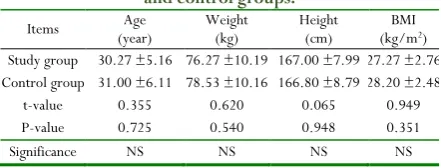
Table (1) represents the general characteristics of the study and control groups. Both groups were matched regarding mean age, weight, height, and BMI (P > 0.05).
Table 1: General characteristics of subjects in the study and control groups.
Items (year) Age Weight (kg) Height (cm) (kg/mBMI 2)
Study group 30.27 ±5.16 76.27 ±10.19 167.00 ±7.99 27.27 ±2.76 Control group 31.00 ±6.11 78.53 ±10.16 166.80 ±8.79 28.20 ±2.48
t-value 0.355 0.620 0.065 0.949
P-value 0.725 0.540 0.948 0.351
Significance NS NS NS NS
NS: Non-Significant
EDSS and MOCA scores
Median EDSS score was 4.00 in the study and control groups. Median MOCA values were 22.00 in the study group and control groups.
2. Static postural stability tests:
Overall balance index:
Within groups
A significant difference between pre- and post-treatment overall balance index was observed in the study group (P=0.0001), while a non-significant difference was found in the control group (P=0.334).
Between groups
A non-significant difference was found between both groups in the mean of overall balance index pre-treatment (P=0.973), while, there was a highly significant difference between both groups in post-treatment overall balance index (P=0.0001), being significantly lower in the study group. Table (2)
Table 2: Comparison of mean values of overall balance index pre- and post treatment between study and control
groups.
Items
Overall balance index
Pre-treatment Post-treatment Study group Control group Study group Control group Mean ±SD 6.50 ±1.00 6.47 ±1.30 3.70 ±0.75 6.53 ±1.25
Mean difference 0.03 2.83
t-value 0.034 7.963
P-value 0.973 0.0001
Significance NS HS
SD: standard deviation NS: non-significant H S: highly significant.
Anteroposterior (A-P) balance index:
Within groups
A significant difference was observed between pre- and post- treatment A-P balance index within the study group (P=0.0001), while a non-significant difference was found in the control group (P=0.989).
Between groups
A non-significant difference was found between both groups in mean A-P balance index pre-treatment (P=0.838), while, there was a highly significant difference between both groups in post-treatment mean A-P balance index (P=0.0001), being significantly lower in the study group. Table (3)
Table 3: Comparison of mean values of pre- and post-treatment A-P balance index between study and control
groups.
Items
A-P balance index
Pre-treatment Post-treatment Study group Control group Study group Control group Mean ±SD 6.17 ±1.04 6.09 ±1.07 3.35 ±0.82 6.07 ±1.03
Mean
difference 0.08 2.72
t-value 0.207 8.026
P-value 0.838 0.0001
Significance NS HS
SD: standard deviation NS: non-significant H S: highly significant.
Medial-lateral (M-L) balance index:
Within groups
A significant difference was detected between pre- and post-treatment M-L balance index within the study group (P=0.0001), and a non-significant difference within control group (P=0.986).
Between groups
Statistical analysis revealed a non-significant difference between both groups in mean M-L balance index pre-treatment (P=0.948), while, there was a highly significant difference between both groups in post-treatment mean M-L balance index (P=0.0001), being significantly lower in the study group.
Table 4: Comparison of mean values of pre- and post-treatment M-L balance index between both groups.
Items
M-L balance index
Pre-treatment Post-treatment Study group Control group Study group Control group Mean ±SD 6.11 ±1.12 6.08 ±1.08 3.37 ±0.72 6.00 ±1.00
Mean difference 0.03 2.63
t-value 0.066 7.995
P-value 0.948 0.0001
Significance NS HS
SD: standard deviation NS: non-significant H S: highly significant.
3. Berg balance scale scores:
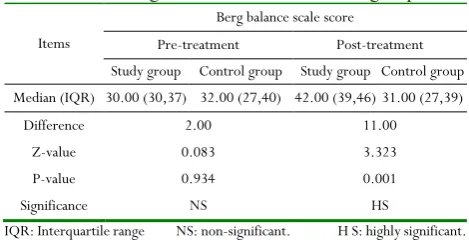
Statistical analysis by Wilcoxon-test revealed a significant difference between pre- and post-treatment scores of Berg balance test in the study group (P=0.0001), and a non-significant difference in the control groups (P=0.589).
Between groups
Statistical analysis by Mann-Whitney test revealed no significant difference between both groups in pretreatment scores of Berg balance test (P=0.934), while, there was a highly significant difference between both groups in mean score of Berg balance test post-treatment (P=0.001), being significantly high in the study group.
Table 5: Comparison of median values of pre- and post-treatment Berg balance test between both groups.
Items
Berg balance scale score
Pre-treatment Post-treatment Study group Control group Study group Control group Median (IQR) 30.00 (30,37) 32.00 (27,40) 42.00 (39,46) 31.00 (27,39)
Difference 2.00 11.00
Z-value 0.083 3.323
P-value 0.934 0.001
Significance NS HS
IQR: Interquartile range NS: non-significant. H S: highly significant.
Discussion
Performing a concurrent cognitive task while maintaining an upright posture in individuals with MS increase their postural
sway. [13] Studies have extensively mentioned the beneficial
effects of motor, dual-task training, for enhancing cognitive and
motor performance even in fall-prone population groups [14].
In the present study, there was a significant improvement in overall balance index post dual-task training in the study group and non-significant improvement in the control group. This finding was in accordance with previous studies done by Wollesen & Voelcker-Rehage [15] and Brown & Bennett ED [16],
which reported that training maneuvers were crucial for smoothening of various cognitive abilities and reducing cognitive-motor interference.
Bherer et al, 2005 [17] while reporting the beneficial effects of
dual-task training in fall-prone population groups suggested freeing up of cognitive resources meant for monitoring performance to be the primary reason. Müller and Blischke 2009
[18] suggested that the training allows modulation of
consciousness-dependent motor activities to be more automatic, thereby reducing dual-task costs. The change in modulation of motor activity has been suggested to allow automatization by “structural displacement”, where a shift in the operation control of motor planning and executive control occurs from higher
cognitive centers to basic non-cognitive centers [14].
The current study revealed significant improvement in A-P balance index post dual-task training within the study group, and a non-significant improvement in the control group, a finding
which agreed with Pellecchia (2005) [19] who found that dual task
was effective in improving the concurrent performance of postural and cognitive tasks.
In the present study, there was a significant improvement in M-L balance index post dual-task training in the study group, and a non-significant difference in the control group. This finding was
consistent with Negahban et al., 2011[20] and Prosperini et al.,
2015 [2] who reported beneficial effects of dual-task training on
postural stability of participants especially with poor balance capabilities.
Silsupadol et al.,2009 [21] interestingly affirmed the
enhancements obtained because of dual-task training toward the task integration hypothesis, which states better development of task coordination skills following practicing with two tasks
together. Ghai et al 2017 [14] reported similar benefits during
variable priority training and suggested that participants under variable priority conditions can learn to coordinate between two tasks during training. The authors supposed that the processing demand needed to perform a task was less when the attention was divided between two tasks.
The current study revealed significant improvement in Berg balance scores post dual-task training in the study group and non-significant improvement in the control groups. According to Hiyamizu et al
2012 [22] and Wollesen and Voelcker-Rehage, 2013 [15],
enhancements in cognitive performance might lead toward smoothening of cognitive activities while maintaining static and dynamic postures, resulting in preventing falls.
Training could have possibly allowed skill acquisition for the cognitive and motor task while making the use of reactive forces, which in turn has been shown to reduce active muscular contraction. The initial phase of learning is suggested to be more cognitively driven as compared to the later stages of learning, which in a dual-task training setting might get more fluent and independent, thus emphasizing the beneficial effects of dual-task training with variable priority for enhancing postural stability [14].
In view of the previous findings, it could be concluded that dual-task training is beneficial in improving postural control in MS patients with mild to moderate cognitive impairment. So, it is advisable to add cognitive task training to primary task (postural control activity) in the rehabilitation program of MS patients to improve functional outcome.
References
1. Mutluay F.K., Gurses H.N., and Saip S.: Effects of multiple
sclerosis on respiratory functions. Clinical Rehabilitation 19: 426_/432, 2005.
2. Prosperini L, Castelli L, Sellitto G, De Luca F, De Giglio
L, Gurreri F., Pozzilli C. Investigating the phenomenon of ‘‘cognitive-motor interference’’in multiple sclerosis by means of dual-task posturography. Gait & Posture. 2015; 41(3):780-5
3. Weier K, Penner IK, Magon S, Amann M, Naegelin Y,
4. Castelli L, De Luca F, Marchetti MR, Sellitto G, Fanelli F, Prosperini L. The dual task-cost of standing balance affects quality of life in mildly disabled MS people. Neurological Sciences. 2016; 37(5): 673-79.
5. Choi W, Lee G, Lee S. Effect of the cognitive-motor
dual-task using auditory cue on balance of surviviors with chronic stroke: A pilot study. Clinical rehabilitation. 2015; 29(8): 763-70.
6. Leone C, Patti F, Feys P. Measuring the cost of
cognitive-motor dual tasking during walking in multiple sclerosis. Mult Scler. 2015; 21(2):123-31.
7. Wonjae C., GyuChang L., Seungwon L.: Effect of the
cognitive-motor dual-task using auditory cue on balance of surviviors with chronic stroke: a pilot study. Clinical Rehabilitation Vol. 29(8) 763– 770, 2015.
8. Schmidt, R. A., & Lee, T. D. (1999). Motor control and
learning: a behavioral approach. Human Kinetics, Champaign.
9. Polman CH, Reingold SC, Banwell B, Clanet M, Cohen,
JA, Filippi M, et al. Diagnostic criteria for multiple sclerosis: 2010 revisions to the McDonald criteria. Annals of neurology. 2011; 69(2): 292-302.
10. Kurtezke JF. Rating neurological impairment in multiple
sclerosis: an expanded disability status scale (EDSS). Neurology. 1983; 33:1444-52.
11. Nasreddine ZS, Phillips NA, Bédirian V, Charbonneau S,
Whitehead V, Collin I, et al. The Montreal Cognitive Assessment, MoCA: a brief screening tool for mild cognitive impairment. Journal of the American Geriatrics Society. 2005; 53(4): 695-9.
12. Berg T. Berg balance scale. Archives of Physical Medicine
and Rehabilitation. 2009; 73: 2-5.
13. Wajda DA. Motl RW, Sosnoff JJ. Correlates of dual task
cost of standing balance in individuals with multiple sclerosis. Gait & Posture. 2014; 40: 352–6.
14. Ghai S, Ghai I, Effenberg AO. Effects of dual tasks and
dual-task training on postural stability: a systematic review and meta-analysis. Clinical Interventions in Aging. 2017;12: 557–77
15. Wollesen B, Voelcker-Rehage C. Training effects on
motor–cognitive dual-task performance in older adults. Eur Rev Aging Phys Act. 2014; 11:5.
16. Brown SW, Bennett ED. The role of practice and
automaticity in tem¬poral and nontemporal dual-task performance. Psychol Res. 2002; 66(1):80–9.
17. Bherer L, Kramer AF, Peterson MS, Colcombe S, Erickson
K, Becic E. Training effects on dual-task performance: are there age-related differences in plasticity of attentional control? Psychol Aging. 2005; 20(4):695.
18. Müller H, Blischke K. Grundlagen der Sport psychologie.:
[Basics of sports psychology]. Limpert Verlag, Wiesbaden. German. 2009.
19. Pellecchia GL. Dual-Task Training Reduces Impact of
Cognitive Task on Postural Sway, Journal of Motor Behavior. 2005; 37(3): 239-46
20. Negahban H, Mofateh R, Arastoo AA, Mazaheri M, Yazdi
MJ, Salavati M, Majdinasab N. The effects of cognitive loading on balance control in patients with multiple sclerosis. Gait Posture. 2011; 34(4): 479–84.
21. Silsupadol P, Shumway-Cook A, Lugade V, Van Donkelaar
P, Chou LS, Mayr U, Woollacott MH. Effects of single-task versus dual-task training on balance performance in older adults: a double-blind, randomized controlled trial. Arch Phys Med Rehabil. 2009; 90(3): 381–7.
22. Hiyamizu M, Morioka S, Shomoto K, Shimada T. Effects of