Ms. Rana Datta
Gupta College of Technological Sciences, Asansol-1, India E-mail: [email protected]
Address for correspondence
Access this article online www.japer.in
Effect of sub-chronic administration of
Pterospermum
acerifolium
(L) Willd on hematological parameters
INTRODUCTION
In the recent years, interests in the medicinal plants have increased considerably. Medicinal herbs are moving from fringe to mainstream use with a greater number of people seeking remedies and health approaches free from side effects caused by synthetic chemicals. There is a widespread acceptance of herbal remedies even in the developed countries, to complement conventional and allopathic medicine. Surge in recent use of herbal remedies may be attributed to elevated cost of modern medicine and ready and cheap availability of traditional herbal remedies. However, the most commonly used herbal formulae have no documented evidence on quality, safety and efficacy. [1]
The plant Pterospermum acerifolium Linn Willd (Family Sterculiaceae), common name Dinner plate tree (English) and Muchkunda (Hindi) is an ever green
tree distributed in tropical Asia and with very conspicuous presence in the lower hill forests of Darjeeling, South Sikkim province and Eastern parts of India. The leaves of the plant are used in traditional medicines for its haemostatic and wound healing properties. Preliminary pharmacological screening also shows the presence of anti-inflammatory, analgesic, antioxidant, antiulcer, wound healing and antipyretic properties in the leaves of the plants. [2-10]
Preliminary phytochemical screening has showed the presence of flavonoids, tannins, alkaloids and glycosides in ample amounts. Flavonoids like kaempferol, kaempferide, luteolin, steroids and triterpenoids like sitosterol, taraxerol, friedelin, sugars, and fatty acids have also been reported to be present in he leaves of the plant. [11-12]
Despite the wide spread evaluation of pharmacological profile of Pterospermum acerifolium by earlier researchers, less emphasize has been laid on toxicological profile of this plant, especially on repeated administration. Information about toxicological profile this plant is very important as it Leaves of Pterospermum acerifolium (L) Willd (Sterculiaceae) is widely used as hemostatic and antidiabetic in Indian traditional medicine. Little data is available on its toxicological profile. Present study was carried out to ascertain the hematological toxicity of methanolic extract of leaves of Pterospermum acerifolium (MEPA) leaves after 90 days repeated administration in Wistar albino rats, in accordance with OECD Guideline 408. After acute toxicity studies, in sub-chronic toxicity study MEPA was administered orally to rats at doses of 250, 500 and 1000 mg/kg/day for 90 consecutive days, and reversibility studies were carried out after 30 days. General clinical signs, mortality and hematological parameters were examined. MEPA does not cause mortality upon administration upto 2000mg/kg b.w. within the 14 days observation period, MTD of MEPA is more than 2000mg/kg b.w. (p.o.). Body weight changes were not significant in the 90 day study period. Compared to the control group there were no much changes in the hematological parameters in MEPA treatment rats. The lymphocyte percentage increased significantly (p<0.05) in the female rats receiving 1000 mg/kg p.o. MEPA. MEPA may induce thrombocytopenia in higher dose levels. However, the effects were reversible. Leaves of Pterospermum acerifolium is safe for sub chronic administration.
Keywords: Repeated, sub-chronic, hematological, toxicity, reversal.
ABSTRACT Rana Datta*1, Sankhadip Bose2
1Gupta College of Technological
Sciences, Asansol-1, India
2NSHM-Knowledge Campus, 124
B.L. Saha Road, Kolkata-53, India
provides a baseline to develop this plant further as a new and successful herbal medication. Evaluation of work of earlier researchers revealed that no significant documented evidence is there regarding the safety profile of the leaves of Pterospermum acerifolium Linn Willd. [11] Therefore the aim of the
present study was to investigate sub-chronic oral toxicity of leaves of Pterospermum acerifolium (L) Willd on hematological parameters in rodents (Wistar albino rats).
As a part of a safety evaluation of leaves of Pterospermum acerifolium (L) Willd, sub-chronic oral dose toxicity studies were conducted to investigate the potential toxicity after 90 days repeated oral dosing of leaves of Pterospermum acerifolium (L) Willd in Wistar albino rats by gavage. Also the potential for reversal of effects upon cessation of treatment for 30 days was studied. [12-13] The present study was carried
out in compliance with the Good Laboratory Practice (GLP) and Test Guidelines of the Organization for Economic Cooperation and Development (OECD 408).
[14]
2. MATERIALS AND METHODS 2.1. Plant material
The leaves of Pterospermum acerifolium (L) Willd were collected from Asansol, West Bengal, India in the month of September 2015. A herbarium sheet was prepared and authenticated by the Director, Botanical Survey of India, Howrah, West Bengal, India. A voucher specimen of the plant with assigned number CNH/II(289)/2015/Tech.II/331 was deposited in the institutional herbarium for reference purpose.
2.2. Preparation of extract
Fresh leaves of Pterospermum acerifolium (L) Willd were shade dried until a constant weight was obtained. Thereafter coarse powdered using a grinder. The air dried crushed leaves (500g) were soaked for 12 hr in Methanol (2L) at room temperature. The residue was extracted with hot Methanol under reflux 3 times (each 1000 ml) after vacuum filtration. The
extract was concentrated in Rotary evaporator and lyophilized, to yield approximately 12% (w/w/) of the residue, which was stored at 20ºC until use in a dessicator. The concentrate of Methanolic extract of Pterospermum acerifolium (MEPA) was suspended in 5% w/v Tween 80 to obtain desired concentrations before administration to experimental animals.
2.3. Experimental Animals
Wistar albino rats of both sexes (6 weeks old, weighing from 125 to 150 g) were selected after physical and behavioral veterinary examination from Institutional Animal House of Gupta College of Technological Sciences, Asansol, India. The rats were housed in poly-carbonate cages, each containing 5 rats: males and females separately. Bedding was change d twice a week to maintain hygiene. Commercial rat chow and water were provided ad libitum. All animals were reared at a room temperature of 20±2 °C, with 60±10% relative humidity and a 12h light/dark regime. This study was conducted in accordance with the internationally accepted principles for laboratory animal use and care. All experiments involving animals complies with the ethical standards of animal handling and approved by Institutional Animal ethics committee (955/A/06/CPCSEA). Before the experiments, all animals were acclimatized to the laboratory environments for at least 7 days.
2.4. Acute Toxicity Study
The evaluation of acute toxicity in a limit dose test was carried out using the procedures described by the Organization for Economical Cooperation and Development (OECD 420). [15] Since leaves of
Pterospermum acerifolium (L) Willd has been widely used as a traditional medicine, it was not anticipated to cause animal death following a single dose in the acute toxicity study. The highest dose of 2000 mg/kg was selected for this study. [15] Rats used for this
dose of 1ml/100 b.w. p.o. The animals were grouped into 4 with 5 rats/sex/group at random, and MEPA was administered by oral gavage at doses of 0, 500, 1000 and 2000 mg/kg body weight. The extract was administered orally using an intra gastric cannula16G, after prior fasting of 16–18h. Animals were observed individually during the first 30min, with particular care during the first 4h, daily until day 14 of the experiment, in order to collect signs and symptoms of toxicity. The observations were aimed at determining: death and time of occurrence of the signs and symptoms of toxicity including its onset and duration, changes in the skin, mucosal and eyes membranes; respiratory and circulatory systems, central and autonomic nervous system in somatomotor activity and behavior.
2.5. Sub-acute Toxicity Study
This study was performed in accordance with the Test Guidelines on 90 Days Repeated Dose Toxicity, OECD Guideline 408. [14] 5% Tween 80 was given to the
animals in the vehicle control group at a dose of 1ml/100 b.w. p.o. The animals were grouped into 4 with 5 rats/sex/group at random, and MEPA was administered by oral gavage at doses of 250, 500 and 1000 mg/kg/day for 90 consecutive days. Additionally, for reversibility phase studies 3 rats/sex/group at random were used, and and MEPA was administered by oral gavage at doses of 250, 500 and 1000 mg/kg/day for 90 consecutive days. After that they were administered normal saline for the remaining duration of 30 days. The extract was administered orally using an intra gastric cannula16G, after prior fasting of 16–18h. Toxic manifestations (such as tremor or convulsion) and mortality were recorded daily throughout the experiment. Body weight of rats in each group were determined and recorded before the commencement of treatment and at 7 days interval for the entire treatment duration. After the completion of treatment on the 90th day, rats
in each group were anaesthetized by the i.p. administration of 5ml/kg of a solution of 1%
chloralose in 25% urethane (w/v). Using a 21 G needle mounted on a 5 ml syringe plunger, blood samples were collected from each rat by cardiac puncture. The samples were collected into non heparinized and EDTA-containing tubes for hematological analyses. The following hematological parameters were evaluated: white blood cell count, lymphocyte%, monocyte %, neutrophil%, eosinophil %, and basophilic cell%, red blood cell count, hemoglobin concentration, hematocrit, mean corpuscular volume, mean corpuscular hemoglobin, MCH concentration, platelet count, prothrombin time, activated partial thromboplastin time. The same procedure stated above was applied at the end of the additional 30 days of cessation of P.acerifolium extract administration (reversibility study phase). [12,16]
2.6. Statistical Analysis
The values are expressed as mean±S.E.M, with n=5 (n=3 for reversibility phase studies). Statistical analysis was carried out using One-way Analysis of Variance (ANOVA) followed by Dunnett’s test to determine the significance of the results. P values <0.05 were considered as significant.
3. RESULTS AND DISCUSSION
In the present study, single dose oral administration of MEPA in male and female rats at 2000 mg/kg had no effect on mortality or body weight. Therefore, no acute toxicity was found in rats treated with MEPA and the approximate lethal doses for males and females were determined to be higher than 2000 mg/kg. [17] Clinical signs observed included hypo
3000-5000 mg/kg can be considered relatively safe.
[17-20]
During the 90 day treatment period, mortality was not observed in any of the MEPA treatment groups. Daily recording of external morphologic characteristics revealed no drastic changes in most of the treated animals. Two animals in 500 mg/kg group showed temporary loss of fur and three animals in 1000 mg/kg group showed skin peeling in the tail after 6 weeks of treatment that continued till the 90 day treatment period. In all other animals, the fur, skin, eyes, animal behavior, gait and posture, reactivity to handling and grip strength were recorded normal. No tremors, convulsions, mucus discharge, salivation and diarrhea were observed during the entire 90 day treatment period. The animals were active throughout and did not show any unusual behavior such as self mutilation, walking backward and so forth.
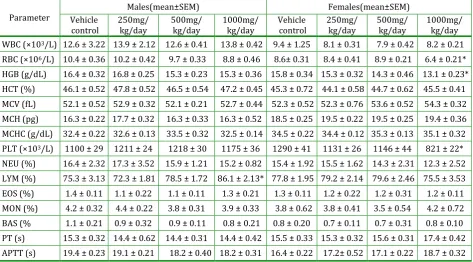
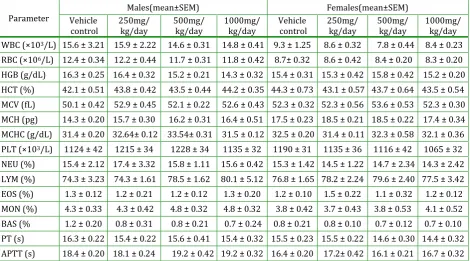
The haematological parameters (hematocrit, MCV, MCH, MCHC and WBC) showed no significant changes (P > 0.05) in the treated rats compared to the control rats (Table 1). All levels were in consistent physiological ranges within the study period. However, there was, in the haematological analysis, significant decrease (P < 0.05) in the RBC and hemoglobin levels in the female rats receiving treatment of 1000mg/kg b.w. Also the platelet count decreased significantly within the treatment period of 90 days. LYM% increased significantly (P < 0.05) for the male rats receiving treatment of highest dose levels. These statistical differences (i.e. increases and decreases) appeared to be biologically relevant and consistent within the group suggesting they were treatment related or the expression of the biological value of Pterospermum acerifolium. However the observed hematological anomalies got reversed after cessation of MEPA treatment after a period of 30 days (Table 2). This shows the alterations brought about by MEPA were transient, and the organism may recover once sub chronic treatment is ceased.
Food and water intake showed daily fluctuations within the control limit. Body weight changes were
also not significantly different compared to control group (Fig 1 and 2). Changes in body weight have been used as an indicator of adverse effects of drugs and chemicals. [14,21] Since, no significant changes were
observed in the general behavior, body weight and food intake of rats in the treated groups as compared to the control group after 90 day period of daily treatment. The observed decrease in body weight in both male and female rats in the highest dose group (1000 mg/kg bodyweight) might have resulted from an impaired nutrient absorption and assimilation due to gastric disturbance that may have occurred in all animals. However despite this observation, the treatment and control rats appeared uniformly healthy at the end of the experiment period. [22] This
suggested that at the sub-chronic oral doses administered, leaves of Pterospermum acerifolium had no effect on the normal growth of rats.
The haematopoietic system is one of the most sensitive targets for toxic compounds and an important index of physiological and pathological status in man and animal. [23] In this study, there was a
statistically significant treatment related decrease in platelet levels of rats in the high dose group when compared to the control group. This indicates that MEPA had an effect on the production of platelets or induced thrombocytopenia (reduction in the number of platelets in the blood), the latter normally being the first evidence of drug-induced toxic effects on haemopoiesis. [24] Additionally, with a decrease in the
platelet count there is an increased risk of bleeding.
[25] This may also be substantiated by significant
decrease of RBC count and hemoglobin levels in the female rats. However changes in PT and APTT were not significant. This may be due to the presence of phytoconstituents in the leaves of Pterospermum acerifolium, which may have caused cumulative toxicity in the treated animals.
In the reversibility studies the hematological parameters come back to normal, within normal physiological levels. [12,22,26] This shows that the
occurred on repeated administration at the highest dose levels gradually gets eliminated once MEPA treatment stops.
4. CONCLUSION
Our results have demonstrated that methanolic extract of leaves of Pterospermum acerifolium can cause alterations in hematological parameters on repeated sub-chronic administration for 90 days, but the parameters were within physiological range and reversible on cessation of treatment. Thus the extract may not be of toxicological concern at dose levels upto 1000 mg/kg body weight p.o. This study thus supports the use of leaves of Pterospermum acerifolium in traditional medicine.
ACKNOWLEDGEMENTS
The authors express their appreciation to Prof, Debesh Chandra Mazumder, Chairman Trinity trust, Asansol, India and to Dr. Kalyan Kumar Sen, Principal, Gupta College of Technological Sciences, Ashram More, Asansol for providing the resources and infrastructure to carry out the research work. The authors also thank the Director, Botanical Survey of India, Howrah, West Bengal, India for helping them with the identification and authentication of the plant. The authors express their gratitude to Mr. Bibek Laha, Asst Prof, Gupta College of Technological Sciences, Ashram More, Asansol for providing technical assistance to carry out the experimental work.
Table 1: Effects of Pterospermum acerifolium methanolic leaf extract on some haematological parameters in the main study
Parameter
Males(mean±SEM) Females(mean±SEM)
Vehicle
control 250mg/ kg/day 500mg/ kg/day 1000mg/ kg/day control Vehicle 250mg/ kg/day 500mg/ kg/day 1000mg/ kg/day WBC (×103/L) 12.6 ± 3.22 13.9 ± 2.12 12.6 ± 0.41 13.8 ± 0.42 9.4 ± 1.25 8.1 ± 0.31 7.9 ± 0.42 8.2 ± 0.21
RBC (×106/L) 10.4 ± 0.36 10.2 ± 0.42 9.7 ± 0.33 8.8 ± 0.46 8.6± 0.31 8.4 ± 0.41 8.9 ± 0.21 6.4 ± 0.21*
HGB (g/dL) 16.4 ± 0.32 16.8 ± 0.25 15.3 ± 0.23 15.3 ± 0.36 15.8 ± 0.34 15.3 ± 0.32 14.3 ± 0.46 13.1 ± 0.23* HCT (%) 46.1 ± 0.52 47.8 ± 0.52 46.5 ± 0.54 47.2 ± 0.45 45.3 ± 0.72 44.1 ± 0.58 44.7 ± 0.62 45.5 ± 0.41 MCV (fL) 52.1 ± 0.52 52.9 ± 0.32 52.1 ± 0.21 52.7 ± 0.44 52.3 ± 0.52 52.3 ± 0.76 53.6 ± 0.52 54.3 ± 0.32 MCH (pg) 16.3 ± 0.22 17.7 ± 0.32 16.3 ± 0.33 16.3 ± 0.52 18.5 ± 0.25 19.5 ± 0.22 19.5 ± 0.25 19.4 ± 0.36 MCHC (g/dL) 32.4 ± 0.22 32.6 ± 0.13 33.5 ± 0.32 32.5 ± 0.14 34.5 ± 0.22 34.4 ± 0.12 35.3 ± 0.13 35.1 ± 0.32 PLT (×103/L) 1100 ± 29 1211 ± 24 1218 ± 30 1175 ± 36 1290 ± 41 1131 ± 26 1146 ± 44 821 ± 22*
NEU (%) 16.4 ± 2.32 17.3 ± 3.52 15.9 ± 1.21 15.2 ± 0.82 15.4 ± 1.92 15.5 ± 1.62 14.3 ± 2.31 12.3 ± 2.52 LYM (%) 75.3 ± 3.13 72.3 ± 1.81 78.5 ± 1.72 86.1 ± 2.13* 77.8 ± 1.95 79.2 ± 2.14 79.6 ± 2.46 75.5 ± 3.53 EOS (%) 1.4 ± 0.11 1.1 ± 0.22 1.1 ± 0.11 1.3 ± 0.21 1.3 ± 0.11 1.2 ± 0.22 1.2 ± 0.31 1.2 ± 0.11 MON (%) 4.2 ± 0.32 4.4 ± 0.22 3.8 ± 0.31 3.9 ± 0.33 3.8 ± 0.62 3.8 ± 0.41 3.5 ± 0.54 4.2 ± 0.72 BAS (% 1.1 ± 0.21 0.9 ± 0.32 0.9 ± 0.11 0.8 ± 0.21 0.8 ± 0.20 0.7 ± 0.11 0.7 ± 0.31 0.8 ± 0.10 PT (s) 15.3 ± 0.32 14.4 ± 0.62 14.4 ± 0.31 14.4 ± 0.42 15.5 ± 0.33 15.3 ± 0.32 15.6 ± 0.31 17.4 ± 0.42 APTT (s) 19.4 ± 0.23 19.1 ± 0.21 18.2 ± 0.40 18.2 ± 0.31 16.4 ± 0.22 17.2± 0.52 17.1 ± 0.22 18.7 ± 0.32
Table 2: Effects of Pterospermum acerifolium methanolic leaf extract on some haematological parameters in the reversibility study
Parameter
Males(mean±SEM) Females(mean±SEM)
Vehicle
control 250mg/ kg/day 500mg/ kg/day 1000mg/ kg/day control Vehicle 250mg/ kg/day 500mg/ kg/day 1000mg/ kg/day WBC (×103/L) 15.6 ± 3.21 15.9 ± 2.22 14.6 ± 0.31 14.8 ± 0.41 9.3 ± 1.25 8.6 ± 0.32 7.8 ± 0.44 8.4 ± 0.23
RBC (×106/L) 12.4 ± 0.34 12.2 ± 0.44 11.7 ± 0.31 11.8 ± 0.42 8.7± 0.32 8.6 ± 0.42 8.4 ± 0.20 8.3 ± 0.20
HGB (g/dL) 16.3 ± 0.25 16.4 ± 0.32 15.2 ± 0.21 14.3 ± 0.32 15.4 ± 0.31 15.3 ± 0.42 15.8 ± 0.42 15.2 ± 0.20 HCT (%) 42.1 ± 0.51 43.8 ± 0.42 43.5 ± 0.44 44.2 ± 0.35 44.3 ± 0.73 43.1 ± 0.57 43.7 ± 0.64 43.5 ± 0.54 MCV (fL) 50.1 ± 0.42 52.9 ± 0.45 52.1 ± 0.22 52.6 ± 0.43 52.3 ± 0.32 52.3 ± 0.56 53.6 ± 0.53 52.3 ± 0.30 MCH (pg) 14.3 ± 0.20 15.7 ± 0.30 16.2 ± 0.31 16.4 ± 0.51 17.5 ± 0.23 18.5 ± 0.21 18.5 ± 0.22 17.4 ± 0.34 MCHC (g/dL) 31.4 ± 0.20 32.64± 0.12 33.54± 0.31 31.5 ± 0.12 32.5 ± 0.20 31.4 ± 0.11 32.3 ± 0.58 32.1 ± 0.36 PLT (×103/L) 1124 ± 42 1215 ± 34 1228 ± 34 1135 ± 32 1190 ± 31 1135 ± 36 1116 ± 42 1065 ± 32
NEU (%) 15.4 ± 2.12 17.4 ± 3.32 15.8 ± 1.11 15.6 ± 0.42 15.3 ± 1.42 14.5 ± 1.22 14.7 ± 2.34 14.3 ± 2.42 LYM (%) 74.3 ± 3.23 74.3 ± 1.61 78.5 ± 1.62 80.1 ± 5.12 76.8 ± 1.65 78.2 ± 2.24 79.6 ± 2.40 77.5 ± 3.42 EOS (%) 1.3 ± 0.12 1.2 ± 0.21 1.2 ± 0.12 1.3 ± 0.20 1.2 ± 0.10 1.5 ± 0.22 1.1 ± 0.32 1.2 ± 0.12 MON (%) 4.3 ± 0.33 4.3 ± 0.42 4.8 ± 0.32 4.8 ± 0.32 3.8 ± 0.42 3.7 ± 0.43 3.8 ± 0.53 4.1 ± 0.52 BAS (% 1.2 ± 0.20 0.8 ± 0.31 0.8 ± 0.21 0.7 ± 0.24 0.8 ± 0.21 0.8 ± 0.10 0.7 ± 0.12 0.7 ± 0.10 PT (s) 16.3 ± 0.22 15.4 ± 0.22 15.6 ± 0.41 15.4 ± 0.32 15.5 ± 0.23 15.5 ± 0.22 14.6 ± 0.30 14.4 ± 0.32 APTT (s) 18.4 ± 0.20 18.1 ± 0.24 19.2 ± 0.42 19.2 ± 0.32 16.4 ± 0.20 17.2± 0.42 16.1 ± 0.21 16.7 ± 0.32 The values are expressed as mean±S.E.M (n=3). Statistical analysis was carried out using One-way Analysis of Variance (ANOVA) followed by Dunnett’s test. Significant differences in each group versus the control were as follows: * P < 0.05. ** P < 0.01.
Fig. 1: Mean body weights of male rats administered daily (0, 250, 500 and 1000 mg/kg b.w.) doses of Pterospermum acerifolium methanolic leaf extract by gavage for 90 days(n=5).
REFERENCES
1. Pelkonen O., Xu Q., Fan T.P. Why is research on herbal medicinal products important and how can we improve its quality? J. Tradit. Complement. Med. 2004; 4 (1):1-7.
2. Harborne, J.B. Phytochemical Methods- A guide to modern techniques of plant analysis. 3rd ed. Chapman and Hall: New York, 1998.
3. Agarwal S.S., Paridhavi M. Herbal Drug Technology. 1st ed. University Press: Hyderabad, 2007.
4. Anonymous. Wealth of India, Raw Materials. Publication and Information Directorate: New Delhi, 1985.
5. Basu K.R., Basu B.D. Indian Medicinal plants. 2nd ed. Bishen Sing & Mahendra P Sing: New Delhi, 1987. 6. Agarwal, V.S. Drug Plants of India. Vol II. Kalyani
Publishers: New Delhi, 1964.
7. M.A., Jitendra J. Anti Inflammatory and Analgesic Activity of Bark Extract of Pterospermum acerifolium. Int. J. of Current Pharm. Res. 2009; 1(1): 32-37. 8. Sannigrahi S., Parida S., Patro V.J., Mishra U.S., Pathak
A. Antioxidant and Antiinflammatory potential of Pterospermum acerifolium. Int. J. Phar. Sc. Rev. and Res. 2010; 2(1) : 1-5.
9. Manna A.K., Jena J., Behera A.K., Roy D., Manna S., Karmakar S., Kar S. Effect of Pterospermum acerifolium bark extract on oxidative damages in the gastric tissue during alcohol induced ulceration. Int. J. Pharm. and Pharmaceutical Sc. 2009; 1(1): 51-59. 10. Senapati A.K., Giri R.K., Panda D.S., Satyanarayan S.
Wound healing potential of Pterospermum acerifolium wild. With induction of tumor necrosis factor - α. J. Basic Clin. Pharm. 2011; 2(4): 203-206. 11. Parida S., Patro V.J., Mishra U.M., Mohapatra L.,
Sannigrahi S. Anthelmintic potential of crude extracts and its various fractions of different parts of Pterospermum acerifolium Linn. Int. J. Phar. Sc. Rev. and Res. 2010; 1(2): 107-111.
12. Saboo S., Deore S.L., Khadabadi S.S., Deokate U.A. Evaluation of Antimitotic and Anticancer activity of the crude extracts of Pterospermum acerifolium willd leaves. Nig. J. Nat. Prod. and Med. 2007; 11: 75-78. 13. Chatterjee P., Chakraborty B., Nandy S., Dwivedi A.,
Datta, R. Pterospermum acerifolium Linn. : A comprehensive review with significant pharmacological activities. Int. J. of Pharm. & Life Sci. 2015; 3(2): 1453-1458.
14. Akindele A.J., Unachukwu E.G., Osiagwu D.D. 90 Days toxicological assessment of hydroethanolic leaf extract of Ipomoea asarifolia (Desr.) Roem. and Schult. (Convolvulaceae) in rats. Journal of Ethnopharmacology. 2015; 174: 582–594.
15. 15. Wang L., Li Z., Li L., Li Y., Yu M., Zhou Y., Lv X., Arai H., Xu Y. Acute and sub-chronic oral toxicity profiles of the aqueous extract of Cortex Dictamni in mice and rats. Journal of Ethnopharmacology. 2014; 158 (2): 207–215.
16. OECD Guidelines for the Testing of Chemicals, Section 4. Test No. 408: Repeated Dose 90-Day Oral Toxicity Study in Rodents. http://www.oecd- ilibrary.org/environment/test-no-408-repeated-
dose-90-day-oral-toxicity-study-in-rodents_9789264070707-en (07th August, 2016). 17. OECD Guidelines for the Testing of Chemicals,
Section 4. Test No. 420: Acute Oral Toxicity - Fixed
Dose Procedure.
http://www.oecd- ilibrary.org/environment/test-no-420-acute-oral-toxicity-fixed-dose-procedure_9789264070943-en (07th August, 2016).
18. Tahraoui A., Israili Z.H., Lyoussi B.http://www.sciencedirect.com/science/article/pii /S0378874110005179 - aff0005 Acute and sub-chronic toxicity of a lyophilised aqueous extract of Centaurium erythraea in rodents. Journal of Ethnopharmacology. 2010; 132(1): 48–55.
19. Loomis T.A., Hayes A.W. Loomi’s Essentials of Toxicology. 4th ed. Academic press: California, 1996. 20. Qin Y., Wu X., Huang W., Gong G., Li D., He Y., Zhao Y.
Acute toxicity and sub-chronic toxicity of steroidal saponins from Dioscorea zingiberensis C.H.Wright in rodents. Journal of Ethnopharmacology. 2009; 126: 543–550.
21. Eaton D.L., Klaassen C.D. Principles of toxicology. In: Klaassen C.D. Casarett and Doull’s Toxicology: The Basic Science of Poisons. 5th ed. New York: McGraw- Hill; 1996.
22. Tan P.V., Mezui C., Enow-Orock G., Njikam N., Dimo T., Bitolog P. Teratogenic effects, acute and subchronic toxicity of the leaf aqueous extract of Ocimum suave Wild (Lamiaceae) in rats. Journal of Ethnopharmacology. 2008; 115: 232–237.
ethanol extract from Lonicera japonica Thunb. Journal of Ethnopharmacology. 2006; 107: 370–373. 24. Raza M., Al-Shabanah O.A., El-Hadiyah T.M., Al-Majed
A.A. Effect of prolonged vigabatrin treatment on haematological and biochemical parameters in plasma, liver and kidney of Swiss albino mice. Scientia Pharmaceutica. 2002; 70: 135–145.
25. Mukinda J.T., Syce J.A.. Acute and chronic toxicity of the aqueous extract of Artemisia afra in rodents. Journal of Ethnopharmacology. 2007;112: 138–144. 26. Ortega Y.H. Safety assessment of a traditionally used
extract from leaves of Boldoa purpurascens. Journal of Ethnopharmacology. 2016; 192: 302–308.
27. Hilaly J.E., Israili Z.H., Lyouss B. Acute and chronic toxicological studies of Ajuva Iva in experimental animals. Journal of Ethnopharmacology. 2004; 91: 43–50.
28. Kuetea V., Manfouob R.N., Beng V.P. Toxicological evaluation of the hydroethanol extract of Tabernaemontana crassa (Apocynaceae) stem bark. Journal of Ethnopharmacology. 2010; 130: 470–476.
How to cite this article: Rana Datta, Sankhadip Bose; Effect of sub-chronic administration of Pterospermum acerifolium (L) Willd on hematological parameters; J. Adv. Pharm. Edu. & Res. 2016: 6(2): 6-13.