B R I E F R E P O R T
Open Access
Interactivity mitigates the impact of
working memory depletion on mental
arithmetic performance
Frédéric Vallée-Tourangeau
1*, Miroslav Sirota
2and Gaëlle Vallée-Tourangeau
3Abstract
Doing long sums in the absence of complementary actions or artefacts is a multistep procedure that quickly taxes working memory; congesting the phonological loop further handicaps performance. In the experiment reported here, participants completed long sums either with hands down–the low interactivity condition–or by moving numbered tokens–the high interactivity condition–while they repeated“the”continuously, loading the phonological loop, or not. As expected, interactivity and articulatory suppression substantially affected performance; critically, the effect of articulatory suppression was stronger in the low than in the high interactivity condition. In addition, an independent measure of mathematics anxiety predicted the impact of articulatory suppression on performance only in the low (not high) interactivity condition. These findings suggest that interactivity augmented overall or systemic working memory resources and diminished the effect of mathematics anxiety, underscoring the importance of characterizing the properties of the system as it is configured by the dynamic agent-environment coupling
Keywords:Interactivity, Mental arithmetic, Articulatory suppression, Working memory, Math anxiety, Systemic cognition
Significance
This paper examines the role of interactivity in mental arithmetic. Interacting with physical resources that con-figure an arithmetic problem creates a shifting dynamic problem presentation; these dynamic changes in the problem’s appearance may actually perform some of the necessary computations, above and beyond the compu-tations performed mentally by the agent. We examined the role of interactivity in mitigating the impact of depleted working memory resources (through articula-tory suppression) and mathematics anxiety on mental arithmetic performance. Depleting working memory re-sources lead to a predictable decrement in mental arith-metic performance; however, the deterioration was less severe when participants could interact with physical ar-tifacts that configured the problem. In addition, partici-pants’ level of mathematics anxiety moderated the impact of working memory depletion on performance, but only in a low interactivity task environment.
Mathematics anxiety and poor numeracy are comorbid. A consequence of mathematics anxiety is avoidance cop-ing; phobias give rise to behavioral patterns that elimin-ate or reduce exposure to the aversive stimulus. As a consequence, there are fewer opportunities to engage with mathematics and receive positive feedback which would weaken avoidance coping. Interacting with the physical presentation of a problem results in the dis-tribution of the computational and representational requirements of mental arithmetic across internal resources of the agent and environmental resources, augments the working memory capacity of the agent-environment system, enhances performance, and pro-duces a more positive experience. Pedagogical interactive task environments may counteract avoidance coping and increase exposure to mathematics.
Background
Different components of working memory are engaged in doing long sums without external aids or complemen-tary actions (Raghubar, Barnes, & Hecht, 2010). The exact involvement of these components depends on the complexity of the arithmetic task, the presentation * Correspondence:[email protected]
1Department of Psychology, Kingston University, Kingston-upon-Thames KT1
2EE, UK
Full list of author information is available at the end of the article
format and modality of presentation, as well as the agent’s level of mathematical competence (DeStefano & LeFevre, 2004). Take the task of adding a long series of single digit numbers presented visually all at once in a random pattern. Calculating the correct answer requires temporary storage and executive skills: interim totals are calculated and rehearsed sub-vocally, numbers tagged as having been added, others tagged as not, attention allo-cated to certain areas of the visual presentation or switched to others to identify what number or the easiest number to add next, and arithmetic knowledge retrieved from long-term memory to facilitate the identification of congenial subtotals. It is no surprise that loading the phonological loop in dual-task paradigms interferes with mental arithmetic that requires counting (Fürst & Hitch, 2000; Logie, Gilhooly, & Wynn, 1994).
Complementary actions and interactivity
The role of working memory in mental arithmetic is traditionally established with an experimental procedure that limits or prevents participants from modifying the problem presentation in working out an answer. In order to create an unadulterated window onto the processes implicated in mental arithmetic and to permit the clin-ical precision of their segmentation, simple problems de-void of content are presented in a manner that cannot be modified by the agent. However, once released from the confines of the cognitive psychologist’s laboratory, mental arithmetic is often situated (Lave, 1988) and nat-urally supported by a range of complementary actions, such as pointing, which is used to guide attention and bind elements in a functional sequence (Carlson, Avraamides, Cary, & Strasberg, 2007; Kirsh, 1995). Gesturing can also facilitate and speed up the pro-cessing of information. Using a dual-task paradigm, Goldin-Meadow, Nusbaum, Kelly, and Wagner (2001) showed that participants perform better at a secondary memory task when gesturing while explaining how they solved a math problem (the primary task). Thus, gesturing appears to free up cognitive resources.
Imagine, again, adding a long series of single digit numbers, however, this time, the numbers do not config-ure a static visual presentation, but rather adorn the face of wooden tokens creating a malleable physical configur-ation which participants can modify as they work on the problem. The calculation unfolds along a spatiotemporal itinerary wrought by the agent’s actions. These actions modify the problem presentation and in doing so the problem is restructured: added numbers can be physic-ally demarcated so they no longer exert attentional pull, and congenial interim totals (for example, 8 + 7) are identified and physically segregated, which shifts the affordances of what to do next and guides the agent to identify complementary subtotals (for example, 9 + 6)
that interlock to create easy-to-remember provisional sums (for example, 30), to improve efficiency and reduce error. The reconfiguration of the problem guides, in part, the allocation of attentional resources and strategy selection (Vallée-Tourangeau, 2013); dynamic changes in the problem’s appearance may actually perform some of the necessary computations, above and beyond the computations performed mentally by the agent (see Rumelhart, Smolensky, McClelland, & Hinton, 1986). Interactivity creates an agent-environment system. On the one hand, interactivity reduces the demands on the agent’s working memory resources, but on the other, the system’s overall working memory resources are augmented.
The present experiment
The present experiment employed a dual-task procedure to explore the impact of articulatory suppression in a mental arithmetic task. The task involved adding 11 sin-gle digit numbers presented either as a static configur-ation (a low interactivity condition) or as a set of number tokens that could be manipulated in calculating the answer (a high interactivity condition). Participants completed the task either with articulatory suppres-sion—by repeating aloud “the” continuously—or with-out. Past research findings led us to expect poorer performance with articulatory suppression, but better performance with interactivity. We hypothesized that if interactivity transforms and augments the working memory resources of the agent-environment system, the impact of articulatory suppression on performance should be mitigated in the high interactivity condition, such as to result in an interaction between the two fac-tors. Specifically, the performance advantage conferred by a high degree of interactivity should be greater with articulatory suppression than without.
Furthermore, we hypothesized a specific pattern of moderation effects. To this end, we profiled participants in terms of their: (i) basic arithmetic skills, (ii) level of mathematics anxiety, and (iii) executive function with an attention switching task. We used these concomitant vari-ables to confirm that they moderate the impact of sup-pression on mental arithmetic, and that their impact on the low and high interactivity conditions would differ. We expected all three variables to moderate the impact of suppression primarily in the low interactivity condition; if a higher degree of interactivity augments overall or systemic working memory resources, then participants’ performance would be more resilient and the moderating properties of these factors might be attenuated.
Methods
Participants
(45 females) participated in the experiment (Mage= 21.8,
SD= 4.0). We determined our sample size by an a priori set-up stopping rule of a sample size typically employed to detect an interactivity effect in previous experiments (for example, Allen & Tourangeau, 2016; Vallée-Tourangeau, 2013). In terms of sensitivity, such a sample size (assuming a 2 × 2 repeated measures ANOVA, α= 0.05, 1 – β= 0.80) would enable us to detect a medium-to-small effect of f= 0.16 for the main effects and a correlation of r= 0.23 for the mod-eration effects (assuming α= 0.05, 1 – β= 0.80, and one-tailed test).
Materials and measures Arithmetic task
Participants were invited to add a series of 11 single digits. For each sum the digits were arrayed in a random cloud pattern, and were presented either on a sheet of A4 or as identically arranged wooden tokens. The sums in the low interactivity condition were presented with numbers that were 1 cm high and 0.5 cm wide, each number framed in a circle that was 2.5 cm in diameter; the tokens employed in the high interactivity condition were 2 cm in diameter and the digit inscribed on the to-kens were 0.8 cm high and 0.4 cm wide. Participants were instructed to calculate the sum as quickly as they could and announce their answer to an experimenter. They did so either with their hands flat on the table top in front of them and were not allowed to use their fin-gers to count or point (low interactivity) or by moving the tokens about as they saw fit in producing an answer (high interactivity). Tracing paper templates of each of the sums presented in the low interactivity condition were created with holes for each number; these tem-plates were used to arrange the spatial layout of the number tokens in the high interactivity condition. The experimenter placed a screen in front of the work sur-face to block the participants’ view and prevent them from adding the numbers before the tokens were all po-sitioned; once the number tokens for a given sum were placed on the work surface, the paper template was lifted, the screen was removed and participants were in-vited to move the tokens to solve the problem. Latencies were measured from the time the screen was lifted and participants could see the display of tokens; in the low interactivity condition latencies were measured from the time the sheet of A4 was placed in front of the partici-pant. Experimenters used a stopwatch to measure la-tency to solution.
Performance on this arithmetic task was measured in terms of accuracy–percentage correct and absolute cal-culation error–solution latencies, and efficiency. Partic-ipants’ efficiency at calculating the sums was measured as the ratio of their accuracy–percentage correct–over
the resources invested in arriving at the answer. The lat-ter was operationalized as the proportion of time taken to announce an answer out of the maximum time taken to announce an answer as indexed by the average la-tency of the slowest quartile. A ratio of 1 or greater indi-cated efficient performance, whereas a ratio below 1 indicated inefficient performance.
Mathematics Anxiety Scale
Participants completed a 25-item Mathematics Anxiety Scale-UK (Hunt, Clark-Carter, & Sheffield, 2011). The questionnaire invited participants to imagine how anx-ious they would feel in certain situations (1 =“not at all” and 5 =“very much”), such as “Working out how much your shopping bill comes to”.
Basic arithmetic skill
Basic arithmetic skill was measured by having partici-pants complete as many of 45 simple expressions (such as 11−9 = ?) as they could in a 60-second period.
Executive function: shifting
The plus-minus task reported in Miyake, Friedman, Emerson, Witzki, and Howerter (2000) was employed to measure attention switching skills. With three different series of 30 double digit numbers, participants were instructed to add 3 to each in the first series, subtract 3 from each in the second series, and alternate between adding and subtracting 3 in the third series. The switch-ing cost was the difference in completion time for the third series minus the average completion time for the first two.
Procedure
Ten different sums of 11 single digits were created: none of the sums were the same and totals ranged from 57 to 80. From these, five were randomly selected and allo-cated to the low interactivity condition and the other five to the high interactivity condition for each partici-pant. Participants completed these five sums twice within each level of interactivity: Once with articulatory suppression, once without. The design employed was a 2 (interactivity – low, high) × 2 (articulatory suppres-sion–without, with) repeated measures.
preceded by a training task during which participants were asked to write successive subtractions of 3 starting from 100 for 1 minute while continuously repeating “the”. Participants experienced each interactivity condi-tion twice: once with articulatory suppression, once without. In the articulatory suppression conditions if more than 2 seconds elapsed without participants en-gaging in the secondary task, they were prompted to comply with the task. Finally, the presentation of each condition was separated by the completion of one of three tasks: the basic arithmetic skill test, the Mathematics Anx-iety Scale, or the attention switching task; the order of these three tasks was counterbalanced across participants. The Research Ethics Committee of Kingston University’s Faculty of Arts and Social Sciences conferred a favorable opinion on the research protocol.
Results
Mental arithmetic performance Percentage correct
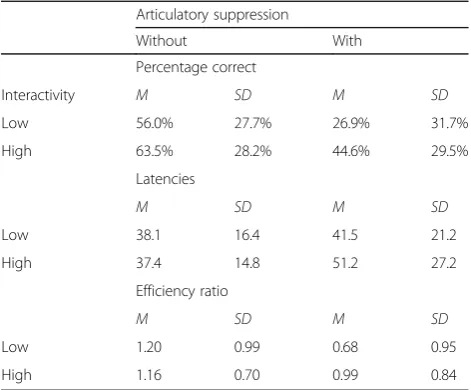
The mean percentages of correct additions in the four experimental conditions are reported in the top portion of Table 1. As expected, participants were better at pro-viding correct answers in the absence of articulatory suppression; however, performance was generally better in the high interactivity condition. In addition, the de-cline in performance with articulatory suppression ap-peared steeper in the low interactivity condition. A 2 × 2 repeated measures analysis of variance (ANOVA) sup-ported these impressions: the main effect of suppres-sion was significant, F(1, 51) = 60.1, p <.001, ηp2= .54, as was the main effect of interactivity, F(1, 51) = 13.6,
p= .001, ηp2= .21; the interaction was also significant,
F(1, 51) = 4.06, p= .049, ηp2= .07. Post-hoc t-tests con-firmed that while accuracy was higher in the high interactivity condition than in the low interactivity condition without suppression, the difference was not significant, t(51) =−1.75, p= .086; in turn, in the pres-ence of suppression, accuracy was significantly higher in the high interactivity condition than in the low interactivity condition,t(51) =−4.21,p<.001.
Absolute calculation error
The mean absolute calculation errors in the four condi-tions are plotted in Fig. 1. These data illustrate a sub-stantial effect of suppression, with larger deviations from the correct answers recorded with suppression than without. Errors were generally smaller in the high inter-activity condition and, more importantly, articulatory suppression appeared not to have as dramatic an impact on calculation accuracy in the high interactivity condi-tion. In a 2 × 2 repeated measures ANOVA the main ef-fects of suppression,F(1, 51) = 36.2,p<.001,ηp2= .42 and interactivity, F(1, 51) = 9.69, p= .003, ηp2= .16, were sig-nificant, as was the interaction,F(1, 51) = 6.02,p= .018,
ηp2= .11. Follow-upt-tests revealed that high interactiv-ity yielded somewhat lower but not significantly lower absolute calculation errors than low interactivity in the absence of suppression, t(51) = 1.31, p= .197. In turn, calculation errors were significantly lower in the high interactivity condition with articulatory suppression,
t(51) = 3.18,p= .003.
Solution latency
The mean solution latencies are reported in the middle portion of Table 1. In the absence of articulatory sup-pression, solution latencies were similar in the low and high interactivity conditions. Although the participants Table 1Mean (and SD) for the percentage correct, latency (s),
and efficiency ratio for the five sums
Articulatory suppression
Without With
Percentage correct
Interactivity M SD M SD
Low 56.0% 27.7% 26.9% 31.7%
High 63.5% 28.2% 44.6% 29.5%
Latencies
M SD M SD
Low 38.1 16.4 41.5 21.2
High 37.4 14.8 51.2 27.2
Efficiency ratio
M SD M SD
Low 1.20 0.99 0.68 0.95
were generally slower with articulatory suppression, they were slowest in the high interactivity condition. A 2 × 2 repeated measures ANOVA revealed a significant main effect of suppression, F(1, 51) = 16.4, p <.001, ηp2= .25, a significant main effect of interactivity,F(1, 51) = 11.5, p
<.001, ηp2= .19, as well as a significant interaction, F(1, 51) = 18.6, p <.001, ηp2= .27. In light of the significant interaction, subsequent ttests confirmed that latencies were similar in the two interactivity conditions in the absence of suppression, t(51) = 0.51, p= .613, but were significantly slower in the high interactivity condition,
t(51) =−4.69,p<.001.
Efficiency ratio
The mean efficiency ratios are reported in the bottom portion of Table 1: participants were much more cient in the absence of articulatory suppression, and effi-ciency declined sharply with suppression. However, in the high interactivity condition, participants’ efficiency ratio remained good even with articulatory suppression. A 2 × 2 repeated measures ANOVA supported these im-pressions: the main effect of suppression was significant,
F(1, 51) = 32.8, p <.001, ηp2= .39, but the main effect of interactivity was not, F(1, 51) = 2.61, p= .113, ηp2= .05; however, the interaction between suppression and level of interactivity was significant, F(1, 51) = 7.47, p= .009,
ηp2= .13. Post-hoc ttests indicated that participants’ effi-ciency at completing the task was not influenced by interactivity in the absence of suppression, t(51) = 0.43,
p= .666; however, participants were significantly more efficient completing the sums in the high interactivity condition with articulatory suppression, t(51) =−2.91,
p= .005.
Moderators of the impact of suppression on calculation error
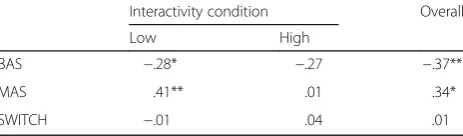
To test our moderation hypotheses we conducted a moderation analysis for within-subject design using or-dinary least square regression with difference scores, as proposed by Judd, Kenny, and McClelland (2001). This was a preferred solution for the current experiment with a sample size that is not optimal for a multilevel model-ling. Judd et al. (2001) suggested that the moderation in within-subject designs occurs when a concomitant vari-able (for example, basic arithmetic skill, math anxiety level) predicts differences in performance between two conditions. Thus we determined how these variables moderated the difference in performance with and with-out articulatory suppression within each level of inter-activity, and then by collapsing the level of interactivity. Table 2 reports the correlations between each of the concomitant variables and the difference in absolute calculation errors between the condition with articula-tory suppression and the condition without, when
interactivity level is low and high, and when collapsing over the two levels of interactivity (df= 50 for all correl-ation coefficients).
Basic arithmetic skill
Overall, the increase in absolute calculation error when collapsing across interactivity conditions was moderated by basic arithmetic skills, r=−.37, p= .007; that is, the higher the participants’arithmetic skill, the smaller the in-crease in calculation error with articulatory suppression. This relationship was observed in both the low, r=−.28,
p= .042, and high interactivity condition, r=−.27, p
= .056; the difference in the magnitude of the correla-tions between the two interactivity condicorrela-tions was not significant, Z= 0.053, p= .957.
Math anxiety
When collapsing the data over both interactivity condi-tions, levels of mathematic anxiety moderated the im-pact of articulatory suppression, r= .34,p= .014; that is, the higher the level of math anxiety, the higher the in-crease in calculation error with articulatory suppression. However, this overall pattern obscures a more interest-ing pattern across levels of interactivity. Thus, in the low interactivity condition math anxiety was a signifi-cant moderator of the increase in error with suppres-sion, r= .41, p= .003, but not in the high interactivity condition, r= .01, p= .951; the correlation was signifi-cantly more positive in the low interactivity than in the high interactivity condition,Z= 2.107,p= .035.
Attention switching
As the correlation coefficients reported in the bottom row of Table 2 indicate, scores on the attention switch-ing test did not moderate the increase in calculation error with articulatory suppression.
Discussion
This experiment explored how interactivity could mitigate the impact of a reduction in working memory resources through articulatory suppression on mental arithmetic performance. While mental arithmetic performance was Table 2Correlation between increase in absolute calculation error with suppression and the three concomitant variables
Interactivity condition Overall
Low High
BAS −.28* −.27 −.37**
MAS .41** .01 .34*
SWITCH −.01 .04 .01
always poorer with articulatory suppression, deterioration was always significantly greater when participants com-pleted the sums with their hands palm down on the table top. Crucially, interactivity attenuated the impact of a sec-ondary task that taxed the phonological loop, which re-duced participants’ ability to rehearse interim totals or plan counting strategies sub-vocally. The possibility of re-structuring the physical problem presentation over the course of the calculation ensured that the participants could reconfigure the environment in a manner that com-pensated for the reduction in internal working memory capacity. The combined resources of the agent coupled to a malleable environment in the high interactivity condi-tion did not soak up completely the resources deplecondi-tion caused by articulatory suppression since performance was affected by the secondary task, but it was sufficiently ro-bust to ensure efficient calculations.
It is important to acknowledge that different materials were employed in the low and high interactivity condi-tions. The size of the numbers was a little bigger and the number-background contrast was a little sharper in the low interactivity than in the high interactivity condition. It is not clear on the basis of the present data whether these differences acted to reduce the benefit of inter-activity, since in the absence of suppression the partici-pants’ accuracy only improved marginally in the high interactivity condition. Certainly, previous experiments that have used the same material in both low and high interactivity conditions have reported substantial effects of interactivity on performance (for example, Allen & Vallée-Tourangeau, 2016; Carlson et al., 2007); although we note that in the study of Carlson et al. the perform-ance improvement in a high interactivity condition was marginal with sums that were of the same length as those employed in the present experiment (viz., 11 num-bers long; see their Fig. 2, p. 753), but much more pro-nounced with longer sums. It is possible that the addition task was insufficiently demanding in the ab-sence of suppression for the benefit of interactivity to manifest significantly in terms of improved accuracy and reduced calculation error. As for the minor differences in materials across condition, the perceptual information probably varied with head movements and posture ad-justments as participants solved the additions. More im-portantly, the physical configuration of the problem changed in the high interactivity condition: thus, partici-pants’actions wrought changes in the physical configur-ation of the problem, changes that are contingent on the preceding state of the problem. We propose that a higher degree of interactivity elevates performance in part because it creates a dynamic problem configuration that not only lightens the load, but also leads to the cre-ation of congenial interim sums and to physically segre-gated categories of elements (such as those counted,
those yet to be counted). Thus different arithmetic strat-egies can be enacted with a malleable problem presenta-tion (Vallée-Tourangeau, 2013).
Keeping hands still in a task that naturally scaffolds on gestures and the use of fingers to anchor attention and binds elements to their functional roles (Carlson et al., 2007) probably requires some inhibitory control that, in turn, requires some executive capacity. However, it is important to note that Goldin-Meadow et al. (2001) found no difference in performance when participants were instructed not to gesture and when they naturally chose not to gesture in a gesture-allowed context. Thus, it is unlikely that preventing participants from using their hands co-opted executive capacity in a manner that offered a substantial explanation of the inferior arith-metic performance in the low interactivity condition. Pointing alone is a complementary action (Kirsh, 1995) that elevates performance in a variety of counting tasks (for example, Neth & Payne, 2011; Guthrie, Mayer, & Vallée-Tourangeau, 2014). A higher degree of interactiv-ity elevates performance; however, it is not possible to apportion the relative contribution of the changing problem configuration and complementary actions (such as pointing) to the performance improvement with the procedure employed in the present experiment. Finally, the present experiment cannot determine the contribu-tion of embodiment in the performance improvement in the high interactivity condition. A condition where par-ticipants direct an experimenter to move the tokens on their behalf while remaining still themselves, may help us better understand the role of embodiment. Such a control condition would not eliminate the participants’ sense of agency since they could still create a dynamic problem presentation, and they would still be coupled to the environment, albeit indirectly. To eliminate the agent-environment coupling as well as embodiment would require a yoked control condition where passive participants either watch a video of a successful partici-pant in a high interactivity condition or are presented with a still image of the final problem configuration of a participant who announced the correct answer. It is plausible to conjecture that such yoked participants may benefit from the changes in the initial physical configur-ation of the problem, recognize some or all of the emer-ging groupings, and see how these groupings can be combined to arrive at the answer. However, a partici-pant’s action and engagement with the task in the high interactivity condition may create a series of changes to the problem configuration that chart a singular and con-tingent spatiotemporal trajectory that benefits the par-ticipant qua agent much more than a passive observer. These remain important empirical questions.
by nearly 14 seconds on average (a 37% increase in la-tency). In contrast, latency across the low interactivity conditions increased by 3.4 seconds on average with ar-ticulatory suppression (a 9% increase in latency). At first, the latency data might suggest participants did not fully engage with the secondary task in the low interactivity condition, yet accuracy was down by 30% and absolute calculation errors were four times as large with articula-tory suppression in the low interactivity condition (see Fig. 1). Rather, what these relatively short latencies indi-cate was that the task was very hard in the low interactiv-ity condition with articulatory suppression: participants abandoned calculations more quickly in the low inter-activity condition than in the high interinter-activity condition and were more likely to guess the answer. It is interesting to note that participants’level of mathematics anxiety was a significant moderator of the impact of suppression on calculation error, but only in the low interactivity condi-tion. This suggests that participants anxious about math might have guessed more in the low interactivity condi-tion, reducing problem latency but also increasing error. This pattern has been previously reported in the math anxiety literature (for example, Ashcraft & Krause, 2007). Thus, in this simple arithmetic task, the reduction of internal working memory capacity through articulatory suppression had its most deleterious effect on participants with higher levels of math anxiety.
Participants’basic arithmetic skills moderated the im-pact of articulatory suppression, in both the low and high interactivity conditions. In turn, math anxiety mod-erated the impact of suppression only in the low inter-activity condition; this finding suggests that a higher degree of interactivity produced more resilient perform-ance irrespective of differences in anxiety. Finally, the attention switching scores did not moderate the impact of suppression on performance either in the low or high interactivity condition. To the extent that this task gauges participants’ability to switch their attention, we expected these scores to correlate positively with changes in per-formance as a function of suppression; they did not. A more precise measure of attention switching, perhaps using an automated task or a composite score from dif-ferent attention switching tasks, might offer a more informative window on how switching skills might moderate the influence of articulatory suppression on mental arithmetic.
Conclusions
Overall, we consider these moderation patterns to be quite revealing. Psychometric efforts to unveil the cogni-tive capacities and dispositions subserving performance in a domain must be interpreted relative to a context of reasoning. In the experiment reported here, the context varied in terms of the degree of interactivity it afforded
and the cognitive resources that could be deployed on the primary task. Math anxiety may be an important moderator of mental arithmetic performance (Ashcraft, 2002). There is much evidence to suggest that math anx-iety is associated with lower working memory capacity (Passolunghi, Caviola, De Agostini, Perin, & Mammar-ella, 2016); working memory resources may be further compromised by intrusive math-averse ideation while performing a math task (Ashcraft & Krause, 2007; Carey, Hill, Devine, & Szücs, 2016; Ramirez, Gunderson, Levine, & Beilock, 2013). Our findings demonstrate that allowing participants to interact with a malleable prob-lem presentation attenuates the impact of math anxiety on performance. A systemic perspective on cognition seeks to describe cognitive products and processes of a system configured by the dynamic coupling of an agent and his or her physical environment (Vallée-Tourangeau, Abadie, & Vallée-Tourangeau, 2015). In the present mental arithmetic task, interacting with the physical problem presentation transformed an agent’s ability to solve these problems. The resulting performance invites a characterization of the cognitive capacities of the system rather than of the agent.
Acknowledgements
We thank Emily Cox-Crowley, Lisa Guthrie, Alexandra Licudi, and Francesca Tromans for their help with the preparation of the experimental material as well as with the recruiting and running of the participants. We are also grateful for the excellent comments from two anonymous reviewers on a previous version of this manuscript.
Authors’contributions
FV-T conceived and designed the experiment and produced a first draft of all the sections of the paper. MS contributed to the statistical analyses, co-wrote the Results section, and critically revised the manuscript. GV-T critically revised the manuscript and offered rewrite suggestions for important intellectual content. All authors read and approved the final manuscript.
Competing interests
The authors declare that they have no competing interests.
Ethics approval and consent to participate
The Research Ethics Committee of Kingston University’s Faculty of Arts and Social Sciences conferred a favorable opinion on the research protocol.
Author details 1
Department of Psychology, Kingston University, Kingston-upon-Thames KT1 2EE, UK.2Department of Psychology, University of Essex, Wivenhoe Park, Colchester, Essex CO4 3SQ, UK.3Department of Management, Kingston University, Kingston-upon-Thames KT2 7LB, UK.
Received: 10 May 2016 Accepted: 3 November 2016
References
Allen, M., & Vallée-Tourangeau, F. (2016). Interactivity defuses the impact of maths anxiety in primary school children.International Journal of Science and Mathematics Education, 14, 1553–1566. doi:10.1007/s10763-015-9659-9. Ashcraft, M. H. (2002). Math anxiety: Personal, educational and cognitive
consequences.Current Directions in Psychological Research, 11, 181–185. doi:10.1111/1467-8721.00196.
Carey, E., Hill, F., Devine, A., & Szücs, D. (2016). The chicken or the egg? The direction of the relationship between mathematics anxiety and mathematics performance.Frontiers in Psychology, 6, 1987. doi:10.3389/fpsyg.2015.01987. Carlson, R. A., Avraamides, M. N., Cary, M., & Strasberg, S. (2007). What do the
hands externalize in simple arithmetic?Journal of Experimental Psychology Learning Memory and Cognition, 33, 747–756. doi:10.1037/0278-7393.33.4.747. DeStefano, D., & LeFevre, J. (2004). The role of working memory in mental
arithmetic.European Journal of Cognitive Psychology, 16, 353–386. doi:10.1080/09541440244000328.
Fürst, A. J., & Hitch, G. J. (2000). Separate roles for executive and phonological components of working memory in mental arithmetic.Memory & Cognition, 28, 774–782. doi:10.3758/BF03198412.
Goldin-Meadow, S., Nusbaum, H., Kelly, S. D., & Wagner, S. (2001). Explaining math: Gesturing lightens the load.Psychological Science, 12, 516–522. doi:10.1111/1467-9280.00395.
Guthrie, L. G., Mayer, J. K., & Vallée-Tourangeau, F. (2014). The hands that guide the thinking: Interactivity in mental arithmetic. In P. Bello, M. Guarani, M. McShane, & B. Scassellati (Eds.),Proceedings of the Thirty-sixth Annual Conference of the Cognitive Science Society(pp. 3014–3019). Austin: Cognitive Science Society.
Hunt, T. E., Clark-Carter, D., & Sheffield, D. (2011). The development and part validation of a UK scale for mathematics anxiety.Journal of Psychoeducational Assessment, 29, 455–466. doi:10.1177/0734282910392892.
Judd, C. M., Kenny, D. A., & McClelland, G. H. (2001). Estimating and testing mediation and moderation in within-subject designs.Psychological Methods, 6, 115–134. doi:10.1037/1082-989X.6.2.115.
Kirsh, D. (1995). Complementary strategies: Why we use our hands when we think. In J. M. Moore & J. L. Lehman (Eds.),Proceedings of the Seventeenth Annual Conference of the Cognitive Science Society(pp. 212–217). Mahwah, NJ: Lawrence Erlbaum Associates, Publishers.
Lave, J. (1988).Cognition in practice: Mind, mathematics and culture in everyday life. New York: Cambridge University Press.
Logie, R. H., Gilhooly, K. J., & Wynn, V. (1994). Counting on working memory in arithmetic problem solving.Memory & Cognition, 22, 395–410. doi:10.3758/ BF03200866.
Miyake, A., Friedman, N. P., Emerson, M. J., Witzki, A. H., & Howerter, A. (2000). The unity and diversity of executive functions and their contributions to complex frontal lobe tasks: A latent variable analysis.Cognitive Psychology, 41, 49–100. doi:10.1006/cogp.1999.0734.
Neth, H., & Payne, S. J. (2011). Interactive coin addition: How hands can help us think. In J. D. Moore & K. Stenning (Eds.),Proceedings of the Thirty-third Annual Conference of the Cognitive Science Society(pp. 279–284). Austin: Cognitive Science Society.
Passolunghi, M. C., Caviola, S., De Agostini, R., Perin, C., & Mammarella, I. C. (2016). Mathematics anxiety, working memory, and mathematics performance in secondary-school children.Frontiers in Psychology, 7, 42. doi:10.3389/fpsyg. 2016.00042.
Raghubar, K. P., Barnes, M. A., & Hecht, S. A. (2010). Working memory and mathematics: A review of developmental, individual difference, and cognitive approaches.Learning and Individual Differences, 20, 110–122. doi:10.1016/j. lindif.2009.10.005.
Ramirez, G., Gunderson, E. A., Levine, S. C., & Beilock, S. L. (2013). Math anxiety, working memory, and math achievement in early elementary school.Journal of Cognition and Development, 14, 187–202. doi:10.1080/15248372.2012. 664593.
Rumelhart, D. E., Smolensky, P., McClelland, J. L., & Hinton, G. E. (1986). Schemata and sequential thought processes in PDP models. In J. L. McClelland, D. E. Rumelhart, & the PDP Research Group (Eds.),Parallel distributed processing: Explorations in the microstructure of cognition, Vol. 2(pp. 7–57). Cambridge MA: MIT Press.
Vallée-Tourangeau, F. (2013). Interactivity, efficiency, and individual differences in mental arithmetic.Experimental Psychology, 60, 302–311. doi:10.1027/1618-3169/a000200.
Vallée-Tourangeau, G., Abadie, M., & Vallée-Tourangeau, F. (2015). Interactivity fosters Bayesian reasoning without instruction.Journal of Experimental Psychology: General, 144, 581–603. doi:10.1037/a0039161.
Submit your manuscript to a
journal and benefi t from:
7Convenient online submission
7Rigorous peer review
7Immediate publication on acceptance
7Open access: articles freely available online
7High visibility within the fi eld
7Retaining the copyright to your article