$9a
filliSTEli COPY
McGRAWHILL YEARBOOK OF
Science &
Technology
1996
Comprehensive coverage of recent events and research as compiled by
the staff of the McGraw-Hill Encyclopedia of Science & Technology
McGraw-Hill, Inc.
in
th
T
w
S
a
st
rz
t
th
t
O
E
w
ain
McGRAW-HILL YEARBOOK OF SCIENCE & TECHNOLOGY Copyright © 1995 by McGraw-Hill, Inc.
All rights reserved. Printed in the United States of America. Except as permitted under the United States Copyright Act of 1976, no part of this publication may be reproduced or distributed in any form or by any means, or stored in a database or retrieval system, without prior written permission of the publisher.
1 2 3 4 5 6 7 8 9 0 DOW/DOW 9 0 0 9 8 7 6 5 Library of Congress Cataloging in Publication data McGraw-Hill yearbook of science and technology. 1962- . New York. McGraw-Hill Book Co.
v. illus. 26 cm.
Vols. for 1962- compiled by the staff of the McGraw-Hill encyclopedia of science and technology.
1. Science—Yearbooks. 2. Technology— Yearbooks. 1. McGraw-Hill encyclopedia of science and technology.
Q1.M13 505.8 62-12028 Printed on acid-free paper.
e
2 wi
ISBN 0-07-051772-X
162 Irrigation (agriculture)
crucible induction melting. Also the VAR process and plasma arc cold hearth melting (PACHM) pro-cess have been used to melt titanium aluminides as well as MoSi2. Many applications of intermetallics require cast components. Casting methods include sand, investment, centrifugal, directional solidifica-tion, and near net shape methods.
Fine-grain wrought products are required in other applications. The commercial use of inter-metallics at competitive cost requires fabrication by conventional hot working operations. The pri-mary processing of cast ingots is feasible, but the requirement for hot working is more stringent than for commercial metallic alloys. The secondary pro-cessing of intermetallics is very difficult and varies from intermetallic to intermetallic.
Powder metallurgy offers the most flexibility in producing intermetallics. The problem of using powder metallurgy for this purpose is that these production methods often result in surface contam-ination of the powders. Each of the powder consol-idation methods for producing intermetallics from powders has processing difficulties. These methods are hot pressing, hot isostatic pressing, powder injection molding, extrusion, and explosive com-paction. The reaction synthesis process has been uniquely applicable for intermetallics and has been used to produce many different materials.
Secondary processing. Secondary steps such as machining and joining are critical in using these advanced materials for various applications, and extensive efforts are under way to develop these technologies. Innovative joining techniques such as friction weldin g. capacitor discharge welding, flash welding, laser welding, welding using the combus-tion synthesis concept. welding using microwaves and infrared waves. electron-beam welding. braz-ing. and diffusion bonding are under evaluation. A
variety of machining techniques. including elec-trodischarge machining, water-jet cutting, ultra-sonic machining, and laser cutting, are available to precision-machine complex geometries and con-tours. Conventional grinding, diamond drilling, and boring techniques have seen limited applications in machining TiAl alloys.
Intermetallic matrix composites. Intermetallic matrix composites have recently received consid-erable attention, and a variety of matrices and reinforcements have been examined to date. Rein-forcement type. volume fraction, size, shape, and distribution have been shown to affect microstruc-ture and mechanical properties. Several innovative approaches ranging from conventional techniques. such as mechanical alloying, to more exotic tech-niques. such as reactive consolidation and mag-netron sputtering, have been used to produce these composites. Process models are being formulated and coupled with state-of-the-art sensors technol-ogy to optimize parameters to produce composite materials of high integrity.
Issues related to reinforcement selection include availability, mismatch in thermal expansion
coeffi-cients, and chemical compatibility with the matrix. Significant advances in characterization have been made in continuously reinforced Ti 3A1-based alloys (SiC fibers in Ti3A1 + Nb alloys) and particulate-reinforced TiAI alloys (TiAl + TiB 2 particulates), in directionally solidified (DS) eutectics of NiAl, and in discontinuously reinforced MoSi2. In most cases,
the major emphasis has been on obtaining a desir-able balance between creep resistance and low-temperature fracture toughness. In this endeavor, micromechanical modeling has been used to iden-tify, understand, and quantify the critical material parameters that control these properties, thereby permitting microstructural design to obtain the desired combinations of these properties. Potential areas for future research include the need for viable machining and joining techniques and novel but reliable nondestructive evaluation methods.
For background information SEE ALLOY,- CER-MET; COMPOSITE MATERIAL; CRYSTAL STRUCTURE; HIGH-TEMPERATURE MATERIALS; INTERMETALLIC COMPOUNDS; WELDING AND CUTTING OF METALS in
the McGraw-Hill Encyclopedia of Science & Tech-nology.
K. Sharvan Kumar; Jeffrey Waldman
Bibliography. R. Darolia. NiAl alloys for high-temperature structural applications, J. Met.. 43(3): 44-49, 1991; E. P. George et al.. Ordered inter-metallics, Annu. Rev. Mater. Sci, 24:409-451, 1994; Y.-W. Kim. Ordered intermetallic alloys, pt. III: Gamma titanium aluminides, .1 Met., 46(7):30-39. 1994; J. H. Westbrook (ed.), Intermetallic Com-pounds, 1967.
Irrigation (agriculture)
Agricultural erosion research has focused primar-ily on rainfall-induced soil loss. but erosion losses associated with surface irrigation practices can be equally severe. Of the estimated 2.5 x 10⁸ hectares (6 x 10⁸ acres) irrigated worldwide, at least 60% are surface irrigated. In the Pacific Northwest. approx-imately 1.5 x 10' ha (3.7 x 10° acres) of the most erosive soils in the United States are surface irri-gated. Typically, 5.5-55 tons of soil per hectare per year (5-50 metric tons per acre per year) can be lost from furrow-irrigated fields, and three times that amount from near the furrow inlets at the upper end of fields.
ple and economical erosion prevention od that permits them to use familiar tillage and cultural practices. New technology employing -soluble polymers may provide such a method. technique involves the application of 10 ter (0.0013 oz/gal; 10 parts per million) of poly-lamide polymer to the furrow irrigation stream. al anionic-polyacrylamide applications have d mean soil loss from furrow-irrigated fields (80-99%), while net water infiltration into soil ed 15%. Treatment with polyacrylamide also oyes furrow tailwater (surface runoff) quality decreasing levels of phosphorus, nitrate, and
bio-cal oxygen demand.
Water-soluble polyacrylamide. The most success-polymer to date is a water-soluble anionic anic compound known as polyacrylamide AM). Anionic polyacrylamide is composed of 000 or more three-carbon molecular units linked o a single linear chain. Of the repeating units. % have the structure below. The remaining 18%
• H H C ; I
LH 0=C— NH2 n
similar, except the —NH 2 group is replaced by a ONa] ionic pair. This pair dissociates upon dis-lution, giving the polymer a moderate negative ge. The properties that enable polyacrylamide prevent soil erosion are its ionic charge type and nsity, water solubility, and very high molecular
ight (5-15 x 106 g
The ability of polymer manufacturers to synthe-size polyacrylamides with increasingly more effec-tive configurations and properties has improved significantly since their introduction to agriculture as soil-stabilizing amendments in the mid-1940s. torically, polymers were spread in the field and incorporated into the plow layer with tillage. The resulting well-aggregated field surface was signif-icantly more resistant to raindrop impact and con-centrated flow, which tend to break down soil aggregates, detaching soil particles, reducing infil-tration, and increasing runoff and erosion. Unfortu-nately the polymer application rates (250-500 kg/ha or 220-450 lb/acre) required to obtain acceptable results were not cost effective. New polymer tech-nologies apply only 0.5-3 kg/ha (0.45-2.7 lb/acre) polyacrylamide per application. At projected prices of $6.50-11.00 per kg. and total seasonal applica-tions of 1-7 kg/ha (0.9-6 lb/acre), polyacrylamide Can be economical for all but the lowest-valued irri-gated crops. Although new polyacrylamides are actually more effective agents, additional efficiency
of the current polyacrylamide application
technol-ogy results because polymer is applied in the irriga-bon water. Hence, only that part of the soil surface subject to erosive and seal-forming processes is treated (that is. the wetted furrow perimeter).
Environmental safety. At concentrations used in field application, anionic polyacrylamide is benign, having little or no toxic effect on humans and other mammals, aquatic vertebrates and invertebrates, or plant life. In the United States it has been listed by the Environmental Protection Agency as an acceptable drinking water additive and has gained a variety of approvals by the Food and Drug Ad-ministration for food additive applications. In soil, polyacrylamide acts like other naturally occurring, persistent forms of organic matter, degrading to water and carbon dioxide at a rate of approxi-mately 10% per year. At higher rates of polyacryl-amide application to soils (>25 mg/kg or 0.0033 oz/lb), research has shown some impacts on soil microorganism populations. although results have not been consistent or pronounced in the studies that have been completed. Much of the current research on polyacrylamide-amended irrigation water seeks to better understand its potential short- and long-term impacts in soil and aquatic systems.
In the United States, by law manufacturers must market only pure polyacrylamide products. The main concern is the manufacturing contaminant. acrylamide monomer, a known toxin. Its concentra-tion in marketed anionic polyacrylamide is strictly regulated (<0.05%). At these levels, acrylamide monomer is of little concern in soils or surface waters because it rapidly biodegrades, decompos-ing in a matter of days.
164
Irrigation (agriculture)
collide, polymer strands help bind the particles together in flocs. These flocs encounter and bind to other particles. The aggregating masses rapidly become so large that they settle out of suspension by a process known as flocculation.
Furrow Irrigation processes. Furrow erosion is controlled by two main factors, furrow stream hydraulics and soil characteristics. Velocity of the flow determines the amount of shear or drag forces available to detach soil particles. Velocity also determines the flow's sediment transport capacity, which along with sediment/aggregate size and den-sity characteristics determines the amount of detached soil that can be transported down the fur-row. The soil characteristics aggregate stability and soil cohesion determine to what degree soils are susceptible to flow shear force, and they also con-trol the characteristics of sediment and aggregate size distribution.
To understand how polyacrylamide acts to con-trol erosion, it is necessary first to consider the effects of rapid wetting and flow shear during irriga-tion of an erodible soil. Prior to irrigairriga-tion of a newly cultivated furrow, soils are typically very dry and cloddy, and the surface quite rough. Rapidly advancing water is quickly absorbed by soil, causing aggregates to slake and soil particles to disperse. Flow shear easily detaches dispersed soil particles and transports them down the furrow. The rough surface of the wetted furrow is smoothed as soil clods break down. Dislodged soil particles then fill surface cavities along the furrow perimeter. This smoothing increases the velocity and erosiveness of the furrow stream. Initially, infiltration is high and flow rate is low. Infiltrating water soon carries flow-suspended sediment into the soil, where it blocks soil pores and initiates formation of a slowly perme-able depositional layer, or surface seal. The seal reduces infiltration, and as a consequence runoff and soil losses increase.
The introduction of polyacrylamide into irriga-tion water, even at low concentrairriga-tions, has several impacts on furrow conditions. During initial wet-ting, polyacrylamide contacts and binds a 1-3-mm-thick (0.04-0.12-in.) layer of soil on the surface of furrow clods and along the wetted furrow perime-ter. Treated soil is more cohesive and stable, that is. more resistant to slaking, dispersion, and shear forces. Any fine soil particles in the furrow stream are flocculated and settle as aggregates. Together these processes produce a well-aggregated system. Consequently, surface roughness in the furrow is better maintained, and the depositional layer formed along the wetted perimeter is more porous. Thus, infiltration rates remain high and runoff rates are lower, and soil detachment is inhibited. Sedi-ment transport capacity of the flow is also reduced. because stream velocity is lower and the average aggregate in the system is larger and less easily transported. Polyacrylamide may also increase vis-cosity of flowing water, resulting in lower turbu-lence and smaller shear forces.
Application strategies. The mode of polyacryl-amide application can be altered simply by (1) vary-ing polyacrylamide concentration in the irrigation water; (2) changing the timing of application (at beginning of irrigation, only intermittently, or con-tinuously); (3) adjusting the length of application period relative to the time required for water to ini-tially traverse the dry furrow (furrow advance time); or (4) changing the form of polyacrylamide added to irrigation water (aqueous stock solution versus a directly introduced crystalline solid). For example, an initial high strategy applies a high dose of polyacrylamide only during early stages of an irrigation. An initial episodic strategy applies poly-acrylamide intermittently during the entire irriga-tion, but dosage rates are lower and individual application periods are shorter compared to the ini-tial high strategy. Another strategy is the continuous low, where polyacrylamide is applied throughout the irrigation but at very low concentration.
Initial high and initial episodic strategies are equally effective at controlling furrow soil loss in the initial treated irrigation, even though the total polyacrylamide applied for initial episodic was 50% of that applied for initial high. When initial high and continuous low strategies were compared. it was found that the continuous low treatment did not protect the furrow from the high loss of loose and easily detached soil particles that typically occurs early in an irrigation: as the irrigation pro-ceeded, the more stable soils remaining in the fur-row were more successfully protected. In contrast, the initial high treatment protected both loose and cohesive soil, and was clearly the more effective treatment for the given conditions. Compared to control furrows, it reduced soil loss by 93%, in con-trast to a 51% reduction for the continuous low application. A continuous or intermittent applica-tion strategy may be more effective under circum-stances in which flow shear is relatively high (for example, steeper slopes or high flow rates).
The initial high strategy is recommended. because it has been shown effective for a variety of soils and slopes. If polyacrylamide application is restricted to the furrow advance period, this method also minimizes the amount of polyacryl-amide lost in tailwater. (During a 10 mg/liter or 0.0013 oz/gal polyacrylamide application, tailwater contains an average 5-7 mg/liter or 0.0007-0.0009 oz/gal of polyacrylamide.) Although the initial episodic strategy may possibly be as effective, it has not been as thoroughly tested, and may be more difficult to implement in actual farming situations. Preliminary studies comparing initial high, poly-acrylamide solution and solid applications (10 mg/liter or 0.0013 oz/gal) indicate that they control soil loss equally well. The advantages and disadvan-tages of these methods are listed in the table.
mode locker
mirror / optical gain mirror
A
ents has been shown to vary among irriga-The effectiveness of polyacrylamide treat-ts is influenced by the properties of the er, the characteristics of polyacrylamide lication and of the field under treatment, the ture of irrigation and irrigation water, and the
mical and physical soil characteristics.
Further research is needed to determine how ors such as furrow soil properties. slope length. d inflow water quality influence anionic
poly-lamide efficacy in irrigated furrows.
For background information SEE EROSION; IRRI-TION (AGRICULTURE); POLYMER; SOIL in the McGraw-Hill Encyclopedia of Science & Tech-nology,
Rodrick D. Lentz
, Bibliography. F. W. Barvenik et al., Polymers in irri-gation water: Symposium, Soil Sci., 158(4):233-300, 1994; D. F. Cook et al., Polymer soil conditioners,
Soil Sci., 141(5):311-397, 1986; R. D. Lentz et al.. venting irrigation furrow erosion with small applications of polymers. Soil Sci. Soc. Amer. .1,
56:1926-1932. 1992: T. F. Tadros (ed.), Solid-Liquid Dispersions, 1987.
Laser
Ultrashort pulsed lasers, which generate light pulses between 1 femtosecond (10'
5
s) and 1 picosecond (10' s) in duration, have found a variety of applica-tions in engineering, chemistry, and physics. Light pulses from these sources can be manipulated to provide time-resolved measurements of ultrafast events, such as photochemical reactions. charge-carrier dynamics in semiconductors, or microcircuit , response times; these events occur in a time regime well beyond the capabilities of conventional elec-tronic instruments such as pulse generators and oscilloscopes. The technology of ultrashort laser pulse generation and manipulation will be exam-ined and current applications discussed.Ultrashort light pulses. Traditional measure-ments of fast dynamical events are performed by using high-speed electronic instrumentation such as oscilloscopes and transient digitizers. This instrumentation has evolved dramatically, yielding subnanosecond (<10-
u
s) performance. However, advances in laser technology have enabled the rou-tine generation of optical pulses with durations onthe order of 10 fs. The terminology ultrafast and ultrashort is used to refer to optical pulse dura-tions or physical phenomena which fall in the fem-tosecond to picosecond time regime.
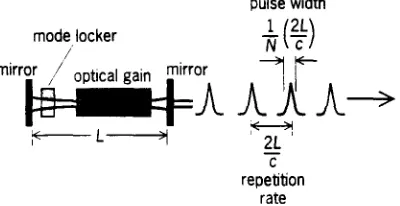
The generation of ultrashort laser pulses is made possible by mode locking. This technique is achieved by a device which modulates the loss (or gain) in a laser cavity in the time period required for a pulse to complete one round trip within a cavity of length L (Fig. 1). The effective genera-tion of very short duragenera-tion optical pulses requires that the laser cavity and gain medium be capable of supporting several thousand longitudinal cavity modes whose optical frequencies are separated by
g=
c/(2L), where c is the speed of light. The com-bination of many oscillating laser modes and the synchronous modulation of cavity loss results in a locking together of the phases of the cavity modes such that discrete laser pulses are emitted at an interval equal to the cavity round-trip time of 2L/c. The duration of these discrete pulses is inversely proportional to the number of longitudi-nal modes that are locked in constant relative phase. This mode-locking phenomenon provides a stable constructive and destructive interference between the otherwise randomly phased oscillat-ing cavity modes. resultoscillat-ing in a discrete series of ultrashort optical pulses.A dilemma arises concerning the measurement of ultrashort pulse durations. Typically, the temporal variation of laser output is monitored by means of electronic photodiodes connected to oscilloscopes, but conventional electronic instrumentation cannot measure a laser pulse of subpicosecond duration.
The technique of autocorrelation is utilized to infer information about such pulse widths. A short
L-->1
Fig. 1. Operation of mode-locked laser of cavity length, L,
supporting N longitudinal cavity modes. c = speed of fight.
Pulse width 1 la\
k
7/
AAA A-->
2L 7 repetition