Flame test LAB
Essential Question:
Fireworks—Ooh! Ahh! Why?
Atomic Emission and Electron Energy Levels
Problem:
Mr. Speight had several compounds lying out on his counter last night and an intruder broke into the vivarium and poured one of the compounds into a fish tank. One fish (Tungsten) has already died from this heinous act, but another (Avogadro) is still barely holding on to its’ life. In order to properly treat
Avogadro, Mr. S. needs to know which of the compounds it is that was placed in the tank. Some was spilled around the tank, and he collected a sample of it. He is certain that the compound is one of the chemicals listed in this lab because those are the compounds that he left lying out. Your job is to figure out what the unknown compound is so that the fish can be saved! You should use flame tests to solve this problem.
Background:
Have you ever wondered why a candle flame is yellow? The characteristic yellow of a candle flame comes from the glow of burning carbon fragments. The
carbon fragments are produced by the incomplete combustion reaction of the wick and candle wax. The electrons in an atom occupy different energy levels, as you know. When all of the electrons are at the lowest possible energy level they are said to be in the ground state. Electrons do not always stay in the ground state. Sometimes they can be promoted to a higher-energy electron shell. When a substance is heated in a flame, the atoms absorb energy from the flame. This promotes them to the higher-energy shell. When an electron is in a higher-energy shell it is said to be in an excited state (see figure).
state in a single step, emitting a photon in the process. Alternatively, an electron may drop back down to the ground state in series of smaller steps, emitting a photon(Photons are particles with energy but no mass) with each step. In either case, the energy of each emitted photon is equal to the difference in energy between the excited state and the state to which the electron relaxes. The energy of the emitted photon determines the color of light observed in the flame. The flame color may be described in terms of its wavelength, and Equation 1 maybe be used to calculate the energy of the emitted photon.
Equation 1 ∆E=
hc/λ
∆E is the difference in energy between the two energy levels in joules (J).
h is Planck’s constant (h=6.626 x 10⁻³⁴ J-sec)
c is the speed of light ( c =2.998 x 10 8 m/sec), and
λ (lambda) is the wavelength of light in meters. The wavelengths of visible light are given in units of nanometers (1 m = 1 x 10 -9 nm).
The color of light observed when a substance is heated in a flame varies from one substance to another. Because each element has a different spacing of electron energy levels, the possible electron transitions for a given substance are unique. Therefore, the difference in energy between energy levels, the exact energy of the emitted photon, and the corresponding wavelength and color are unique to each substance. As a result, the colors observed when a substance is heated in a flame may be used as a means of identification.
The Visible Portion of the Electromagnetic Spectrum
Visible light is a form of electromagnetic radiation. Other familiar forms of electromagnetic radiation include y-rays, X-rays, ultraviolet (UV) radiation, infrared (IR) radiation, microwave radiation, and radio waves. Together, all forms of electromagnetic radiation make up the electromagnetic spectrum. The visible portion of the electromagnetic spectrum is the only portion that can be detected by the human eye – all other forms of electromagnetic radiation are invisible.
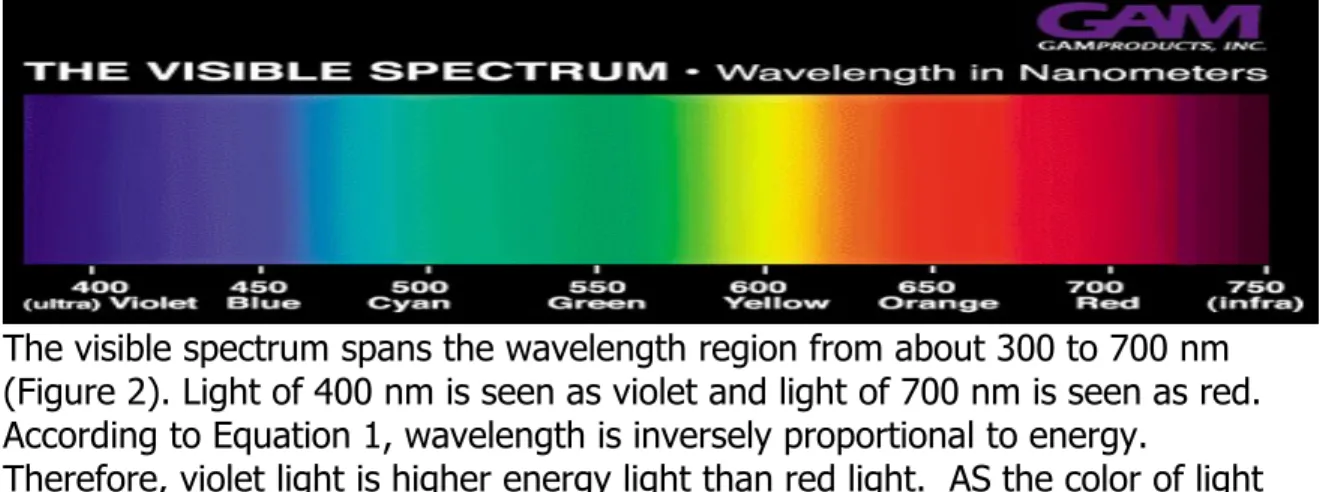
The visible spectrum spans the wavelength region from about 300 to 700 nm (Figure 2). Light of 400 nm is seen as violet and light of 700 nm is seen as red. According to Equation 1, wavelength is inversely proportional to energy.
Therefore, violet light is higher energy light than red light. AS the color of light changes, so does the amount of energy it possesses.
Table 1 lists the wavelengths associated with each of the colors in the visible spectrum. The representative wavelengths may be used as a benchmark for each color. For example, instead of referring to green as light in the wavelength range 500-600 nm, we may approximate the wavelength of a green light as 520 nm. An infinite number of shades of each color maybe observed.
Table 1 Representative
Wavelength, nm Wavelength Region,nm Color
410 400-425 Violet
470 425-480 Blue
490 480-500 Blue-green
520 500-560 Green
565 560-580 Yellow-green
580 580-585 Yellow
600 585-650 Orange
650 650-700 Red
Materials
Calcium chloride, CaCl2
Copper(II) chloride, CuCl2
Potassium chloride, KCl
Sodium chloride, NaCl Barium Chloride (BaCl2)
Magnesium Chloride (MgCl2)
Lithium Nitrate (LiNO3)
Strontium Nitrate (Sr(NO3)2)
Unknown metal chloride
Safety Precautions
Barium and Copper(II) chloride is highly toxic by ingestion; avoid contact with eyes, skin and mucous membranes. Lithium chloride is moderately toxic by ingestion and is a body tissue irritant. Fully extinguish the wooden splints by immersing them in a beaker of water before discarding them in the trash to avoid trash can fires. Wear chemical splash goggles,
chemical-resistant gloves, and a chemical-resistant apron. Wash hands thoroughly with soap and water before leaving and laboratory.
Beginning Ideas/Questions:
1. Fill in the blanks: When an atom absorbs energy, the electrons move from their ___________ state to an ______________ state. When an atom emits energy, the electrons move from a(n) __________________state to their ____________ state and give off _______________.
2. Is a flame test a qualitative test or quantitative test for the identity of an unknown? Explain.
Test: Read all directions before starting Observation: Make a DATA TABLE to
record all your observations
1. Put on safety goggles
2. Read through the procedure and make a
data table.
3. Go to one station and dip the soaked
end of ONE of the wooden splints in the flame.
3. Observe the color of the flame. Allow the splint to burn until the color fades. 4. Blow out the flame and lay on the
laboratory bench.
5. Record your observations for the flame color produced by the metal chloride salt in your Data Table.
6. Repeat Steps 2-5 for the other five metal chlorides salts. Record your observations for the flame color produced by each metal ion in the Data Table.
7. Perform a flame test on an unknown metal chloride and record its
characteristic color(s) in the Data Table 8. Throw ALL used wooden splint in the
Claims & Evidence: What is the identity of your unknown solution? How do you know? EXPLAIN.
Reading:
1. Use Table 1 in the Background section to record the approximate wavelength of
light emitted for each known metal ion in the Table below.
2. Convert each wavelength in the Table from nanometers to meters
(1nm = 10-9m). Show one sample calculation in the space below and record all
values in the Results Table.
3. Use Equation 1 from the Background section to calculate the average energy (ΔE)
corresponding to the observed flame color for each metal. Show one sample calculation in the space below and record all values in joules in the Results Table.
Metal/Flame
SAMPLE CALCULATIONs:
Reflection:
1. What evidence is there from your results that the characteristic color observed for each compound is due to the metal ion in each case? Describe and additional test that could be done to confirm that the color is due to the metal ion.
2. A glass rod was heated in a burner flame and gave off a bright yellow flame. What metal ion predominates in the glass rod?