TRANS Asian Research Journals
http://www.tarj.in 28
DO RETAIL STORES’ ATTRIBUTES INFLUENCE CUSTOMER
SATISFACTION IN INDIA?
SUSHIL KUMAR*, NIRAJ MISHRA**
*Assistant Professor, Department of Management, Waljat College of Applied Sciences,
Muscat, Sultanate of Oman. **Assistant Professor Department of Management Waljat College of Applied Sciences
Muscat, Sultanate of Oman.
ABSTRACT
Retail industry in India is witnessing a fast growth in almost all cities in India. Recent Indian Government decision of allowing the foreign investment in organized retailing in India will further lead to high growth. Attracting customers and retaining them become keys to success in increased industry competition. Retail store attributes play as important role in selection of a retail store by customers as well as in customer satisfaction. This study is an effort to examine the relationship between retail store attributes and customer satisfaction. Respondents were surveyed about their expectations and experiences with respect to ten dimensions of store attributes using a structured questionnaire using Mall Intercept Survey technique. Correlation and regression analysis were used for data analysis. The outcome of the analysis is establishment of relationship between store attributes and customer satisfaction.
KEYWORDS: Indian retail industry, store attributes, customer expectation, customer satisfaction.
_______________________________________________________________________
INTRODUCTION
TRANS Asian Research Journals
http://www.tarj.in 29
With high expectation of growing number of retail stores in coming few years in India, now, the Indian retail store customers are also expected to get opportunity to select the store of their own choice. Ghosh, Tripathi & Kumar (2009) found that the Indian retail industry’s significant growth is visible in the fast increase in number of supermarkets, departmental stores, and hypermarkets in the country. Ghosh et al. addressed issues related to store attributes and their relevance in the store selection process and emphasized that store attributes become one of the key issues influencing the choice of customers, and customers’ satisfaction. Sinha & Banerjee (2004) established the relation between the store attributes and the consumers’ motivation in selecting various store formats. Mittal & Mehta (2011) explored the factors influencing the shoppers of grocery stores in India with the help of six store attribute factors such as Store Ambience and Layout, Service and loyalty schemes, Price and Quality, One Stop Shopping, Convenience and Salesmen. Very recently, another research in context to store attributes carried out by Verma & Madan (2011). They identified the key store attributes, which have significant impact on store image of an apparel store in India.
In brief, increasing number of retail stores in India creating a competitive challenge for retailers. In view of it, the retailers are focusing more on offering services, which are suitable for the customers in order to attract and retain them. For retailers, store attributes are the tools to interact with customers and satisfy them. The proposed research study is based on investigating the key attributes of an organized retail store which lead to customers’ satisfaction. The purpose of this research study is to examine the relationship between store attributes and customer satisfaction in context with retail stores in India.
LITERATURE REVIEW
STORE ATTRIBUTES
Martineau (1958) was the first researcher to work on store attributes (Erdem, Oumlil, & Tuncalp, 1999). He described store attributes as factors responsible for store image formation. Further, he opined that the store image leads to create personality of the store in the mind of customers and customers’ decisions are influenced by the picture of the entire store. The image of the store is formed in customer mind by some store attributes like: Layout and Architecture, Symbols and Colours, Advertising, and Sales personnel matched with various patterns of consumer behaviour.
Through literature review, Kunkel & Berry (1968) understood that store image has increased notably in past decades but the rate of knowledge has not progressed accordingly. Kunkel et al. opined that a man selects a store for buying based his experiences while shopping in a store. Work in this area carried out by developing a behavioural concepts (influenced by societal and subculture norms) of store images (formed by 12 store attributes: Price of Merchandise, Quality of Merchandise, Assortment of Merchandise, Fashion of Merchandise, Sales personnel, Location convenience, other convenience factors, Services, Sales Promotion, Advertising, Store Atmosphere and reputation on Adjustments).
TRANS Asian Research Journals
http://www.tarj.in 30
Locational Convenience (35%), Merchandise Styling, Fashion (27%), Service, General (27%) and Salesclerk Services (27%).
There are studies related to store selection based on consumer perceptions, which are formed or influence by store attributes. Joyce & Lambart (1996) found that consumers’ perceptions about the store image are likely to be influenced by the types of stores visited repeatedly in past and attributes of these stores such as Color, Lighting, Signage, Clientele, Salespeople. Sinha & Banerjee (2004) tried to know the factors of retail store selection based on the consumers’ perception developed by visiting various types of stores and their observation about various services and physical parameter of these stores. Treblanche (1999) identified the determining factors of store attributes influencing consumer perception about a store as: Types of Customer, Store Location, Price levels, Services offered, Merchandising Mix, and Advertising and Physical facilities.
CUSTOMER SATISFACTION
Miller (1976) had an insight to the stores customers’ satisfaction in terms of customer discontent. This article primarily investigated the possibilities of identifying segments of discontented customers.
Westbrook (1981) used some range of non product related factors and identified eight variables Sales personnel, Store environment, Merchandising, Services, Product satisfaction, Store clientele, Value-price, and Special sales that may influence customer satisfaction and dissatisfaction. Among them he concluded that Sales persons, Store sales, Product satisfaction, Value price relationship, and Store environment were most influential variables of retail customer satisfaction.
Rogers (1998) investigated customer satisfaction of visitors to history museum stores in relation with customer demographic and nostalgia proneness. This research aimed at measuring the level of customer satisfaction, identifying the attributes responsible for satisfaction.
Priporas (2002) in his thesis viewed that customer satisfaction had been recognized as a major success factor in keeping and developing the clientele base. The purpose of this study was to explore relationship between store image and consumer satisfaction for a food retail sector amidst entrance of foreign retailers in Greece.
While, Ting & Chen (2002) looked the relationship between store attributes and customer satisfaction differently and viewed that though there were researches showing a linear relationship between quality attributes of a store and customer satisfaction, there might be a non-linear relationship between them. Ting et al. investigated in same line on hypermarket customers and found that most quality attributes and customer satisfaction is asymmetrical and non-linear.
RESEARCH AIMS AND HYPOTHESIS
TRANS Asian Research Journals
http://www.tarj.in 31
store attributes used in previous researches through literature review and investigating its relationship with customer satisfaction in context with retail stores in India.
The above said purpose led to the formulation of the following research hypothesis: Ha: Store attributes influence the customer satisfaction with the retail store.
The testing of this hypothesis will lead to know whether store attributes influence customer satisfaction and if yes, what are those store attributes influencing customer satisfaction.
NULL HYPOTHESIS
Ho: Store attributes do not influence the customer satisfaction with the retail store.
METHODOLOGY
The total number of 280 respondents was surveyed using Mall Intercept Surveys (Burns & Bush, 1998). Literature review suggests that for any survey related to measuring behavioral aspects of customer related to store, Mall Intercept Survey may be used to reduce the non-response. Mall Intercept Survey is collection of data from the respondents who are customers of the retail store and at the time of survey, customers are inside the store for purchasing (Burns & Bush, 1998).
Three large multiple supermarkets: Big Bazaar and Wal-Mart in National Capital Region, Wal-Mart in Chhattisgarh, and Big Bazaar in Ranchi were chosen for collecting data under mall intercept survey. A five point likert scale structured questionnaire was used to collect the data from respondents. Through this questionnaire, the respondents’ expectations and experiences were measured under ten dimensions of store attributes.
After thorough review of literature, ten dimensions of store attributes have been finally selected to consider in this research study summarized in following table 1.
TABLE: 1
LIST OF STORE ATTRIBUTES DIMENSIONS
Sl. Dimension of Store Attributes Sl. Dimension of Store Attributes
1. Range of Merchandise 2. Quality of the merchandise
3. Price of merchandise 4. Facilities and Services
5. In-store Convenience 6. Sales Personnel
7. Post-purchase Service 8. Store Atmosphere
9. Location Convenience 10. Sales Promotion schemes
TRANS Asian Research Journals
http://www.tarj.in 32
towards a retail store. And then, multiple regression analysis was used to establish the relation in terms of strength of relationship between store attributes and customer satisfaction.
DATA ANALYSIS: FINDINGS
Measuring customer satisfaction
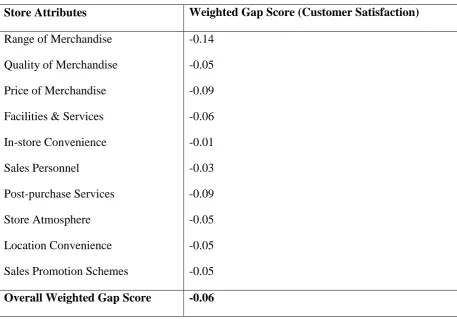
The weighted gap between perception and expectation with respect to attributes of the store is presented below as follows.
TABLE 2
RESPONDENTS’ SATISFACTION W.R.T. STORE ATTRIBUTES
Store Attributes Weighted Gap Score (Customer Satisfaction)
Range of Merchandise -0.14
Quality of Merchandise -0.05
Price of Merchandise -0.09
Facilities & Services -0.06
In-store Convenience -0.01
Sales Personnel -0.03
Post-purchase Services -0.09
Store Atmosphere -0.05
Location Convenience -0.05
Sales Promotion Schemes -0.05
Overall Weighted Gap Score -0.06
*Based on five-point Likert-scale
As evident from findings, gap score with every attribute is negative indicating customers have shown dissatisfaction in case of all attributes. The weighted gap score is calculated after considering the point allocated by the respondents to the attributes based on the importance they feel the attribute is. After treating the points allocated by respondents based on the importance they feel, values of the weighted gap scores are affected but with much lesser changes in their value. The least dissatisfaction value is of In-store Convenience (Weighted Gap = -0.01) followed by Sales Personnel (Weighted Gap = -0.03). Highest level of dissatisfaction is reported in case of Range of Merchandise (Weighted Gap = -0.14) followed by Post-purchase Services (Weighted Gap = -0.09).
TRANS Asian Research Journals
http://www.tarj.in 33
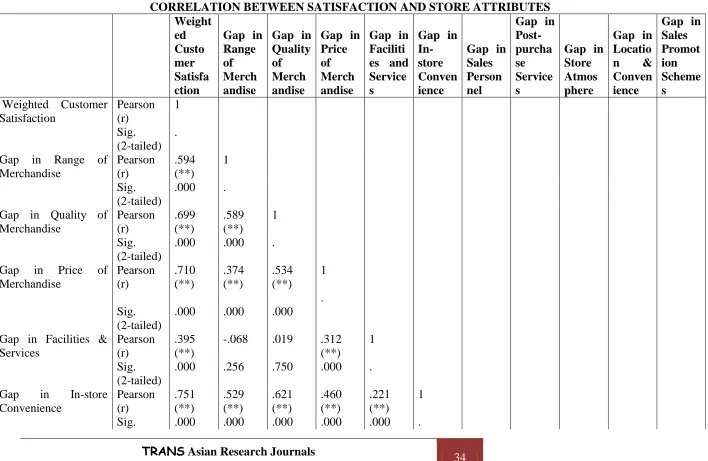
To test this hypothesis, Pearson’s correlation coefficient has been calculated and then regression analysis is used. Pearson’s r is calculated to find out the relation between variables and regression analysis is used to measure the slope of influence of retail attributes on customer satisfaction.
Pearson’s Correlation (r)
TRANS Asian Research Journals
http://www.tarj.in 34
TABLE 3
CORRELATION BETWEEN SATISFACTION AND STORE ATTRIBUTES
Weight ed Custo mer Satisfa ction
Gap in Range of Merch andise
Gap in Quality of Merch andise
Gap in Price of Merch andise
Gap in Faciliti es and Service s
Gap in In-store Conven ience
Gap in Sales Person nel
Gap in Post-purcha se Service s
Gap in Store Atmos phere
Gap in Locatio n & Conven ience
Gap in Sales Promot ion Scheme s
Weighted Customer Satisfaction Pearson (r) 1 Sig. (2-tailed) . Gap in Range of
Merchandise Pearson (r) .594 (**) 1 Sig. (2-tailed)
.000 . Gap in Quality of
Merchandise Pearson (r) .699 (**) .589 (**) 1 Sig. (2-tailed)
.000 .000 .
Gap in Price of Merchandise Pearson (r) .710 (**) .374 (**) .534 (**) 1 Sig. (2-tailed)
.000 .000 .000 .
Gap in Facilities & Services
Pearson (r)
.395 (**)
-.068 .019 .312 (**)
1 Sig.
(2-tailed)
.000 .256 .750 .000 .
TRANS Asian Research Journals
http://www.tarj.in 35
(2-tailed)
Gap in Sales
Personnel Pearson (r) .520 (**) .329 (**) .381 (**) .299 (**)
.099 .422 (**)
1
Sig.
(2-tailed)
.000 .000 .000 .000 .097 .000 .
Gap in Post-purchase Services
Pearson (r)
-.035 -.449 (**)
-.317 (**)
-.263 (**)
-.009 -.219 (**)
-.098 1 Sig.
(2-tailed)
.555 .000 .000 .000 .876 .000 .103 .
Gap in Store
Atmosphere
Pearson (r)
.094 -.256 (**)
-.159 (**)
.004 .152(*) -.134(*) -.285 (**) .508 (**) 1 Sig. (2-tailed)
.117 .000 .008 .951 .011 .025 .000 .000 .
Gap in Location & Convenience Pearson (r) .437 (**) .184 (**)
.146(*) .262 (**) .292 (**) .226 (**) .379 (**)
-.064 -.078 1 Sig.
(2-tailed)
.000 .002 .014 .000 .000 .000 .000 .284 .193 .
Gap in Sales
Promotion Schemes Pearson (r) .521 (**) .352 (**) .337 (**) .260 (**)
.099 .288 (**)
.193 (**)
.069 -.087 .047 1
Sig. (2-tailed)
.000 .000 .000 .000 .097 .000 .001 .251 .147 .435 .
TRANS Asian Research Journals
http://www.tarj.in 36
As found, the significance value in all cases is .000 (significance level = .01, 2-tailed), which is much lower than .05 except two cases that is post-purchase services and store atmosphere, where the value is higher than .05. The values in case of post-purchase services (Pearson
correlation = -.035, Sig. = .555) and in store atmosphere (Pearson correlation = .094, Sig. = .117) at significance level at .05, 2-tailed.
The output of this analysis can be interpreted as that except two attributes post-purchase services and store atmosphere; gap between perception and expectation with all other eight attributes are having relation with overall weighted customer satisfaction.
REGRESSION ANALYSIS
To further examine this relationship, a multiple regression analysis is conducted. Multiple regression analysis between perception and expectation gap for all 8 store attributes and total weighted customer satisfaction is used for finding out the slope of influence of store attribute on customer satisfaction. The two store attributes “post-purchase services” and “store atmosphere” have been excluded from further consideration in regression analysis as correlation analysis resulted no correlation of these two attributes with customer satisfaction. The analysis results are presented in following table 4.
TABLE 4
REGRESSION ANALYSIS BETWEEN CUSTOMER SATISFACTION AND STORE ATTRIBUTES
Model
Unstandardized Coefficients
Standardized
Coefficients t Sig.
B
Std.
Error Beta
1 (Constant) -.001 .001 -.473 .637
Gap in Range of
Merchandise .014 .001 .247 16.324 .000
Gap in Quality of
Merchandise .010 .001 .209 13.506 .000
Gap in Price of
Merchandise .013 .001 .261 19.255 .000
Gap in Facilities and
Services .007 .000 .173 14.297 .000
Gap in In-store
Convenience .010 .001 .257 17.702 .000
Gap in Sales Personnel .008 .001 .130 10.197 .000
TRANS Asian Research Journals
http://www.tarj.in 37
Gap in Location & Convenience
.009 .001 .152 12.977 .000
Gap in Sales Promotion
Schemes .010 .001 .173 14.413 .000
Dependent Variable: Total Weighted Gap in Expectation & Perception (Overall Customer Satisfaction)
As evident in above table, the p-values (significance) in all cases are much lesser than 0.05, indicating existence of significant relationship between the variables. As this analysis yielded a significant influence of store attributes on customer satisfaction, the following regression equation was produced.
WCS=(.014*GRM)+(.01*GQM)+(.013*GPM)+(.007*GFS)+(.01*GSC)+(.008*GSP)+(.009*G LC)+(.01*GPS)-.001
Where, WCS= Weighted Customer Satisfaction GRM= Gap of Range of Merchandise GQM= Gap of Quality of Merchandise GPM= Gap of Price of Merchandise GFS= Gap of Facilities & Services GCS= Gap of In-store Convenience GSP= Gap of Sales Personnel
GLC= Gap of Location Convenience GPS= Gap of Sales Promotion Schemes
The regression equation produced by the multiple regression analysis clearly indicates that there is a significant influence of satisfaction with store attribute on customer’s overall satisfaction with the store.
Hence, based on above analysis of data collected from the sample, the Null hypothesis (Ho: Store attributes do not influence the customer satisfaction with the retail store) is rejected. Thus, it is concluded that store attributes influence significantly the customer satisfaction with the retail store.
CONCLUSION
TRANS Asian Research Journals
http://www.tarj.in 38
The output of regression analysis showed that there was a significant and positive regression coefficient between 8 store attributes and customer satisfaction with all coefficients at p< .05. Hence, the Null hypothesis was rejected and was concluded that store attributes influence significantly the customer satisfaction with the retail store.
REFERENCES
GRDI (2009). Global Retail Development Index Finds Indian Retail Market Most Attractive. Retrieved from http://www.india-server.com/news/global-retail-development-index-finds-7676.html on 15th November, 2010.
Indian retail industry (2010). Retrieved from http://business.mapsofindia.com/india-retail-industry/ on 15th November, 2010.
Ghosh, Tripathi & Kumar (2010). Customer expectations of store attributes: A study of organized retail outlets in India. Journal of retail and leisure property, 9(1), 75-87.
Sinha, P. K., & Banerjee, A. (2004). Store choice behavior in an evolving market. International Journal of Retail & Distribution Management , 32 (10), 482-494.
Verma, H., & Madan, P. (2011). Factor analysing the store attributes to identify key components of store image. IJMMR , 2 (1), 1-21.
Mittal, R., & Mehta, N. (2011). Factors influencing the grocery store shoppers- A data
mining approach. International Journal of Research in Engineering & Applied Science, 1 (2), 1-17.
Martineau, P. (1958). The personality of retail store. Harvard Business Review , 36, 47-56. Erdem, O., Oumlil, A. B., & Tuncalp, S. (1999). Consumer values and the importance of store attributes. International Journal of Retail & Distribution Management , 27 (4), 137-144. Priporas, V. C. (2002). Store image and customer satisfaction. School of Agriculture, Food and Rural Development: University of Newcastle.
Rogers, M. L. (1998). An exploration of factors affecting customer satisfaction with selected history museum stores. Texas: Texas Tech University.
Ting, S.-C., & Chen, C.-N. (2002). The asymmetrical and non-linear effects of store quality attributes on customer satisfaction. Total Quality Management , 13 (4), 547-569.
Lindquist, J. D. (1974-75). Meaning of image: A survey of empirical and hypothetical evidence. Journal of Retailing , 50 (4), 29-38,116.
Kunkel, J. H., & Berry, L. L. (1968). A behavioral concepts of store image. Journal of Marketing , 32, 21-27.
TRANS Asian Research Journals
http://www.tarj.in 39
Treblanche, N. S. (1999). The perceived benefit derived from visits to a super regional shopping centre. South African Journal of Business , 30 (4), 141-156.
Miller, J. A. (1976). Store satisfaction and aspiration theory (A conceptual basis for studying consumer discontent). Journal of Retailing , 52 (3), 65-84.
Westbrook, R. (1981). Sources of customer satisfaction with retail outlets. Journal of Retailing , 57 (3), 68-85.