Vol.8 (2018) No. 6
ISSN: 2088-5334
Classification of Spatio-Temporal fMRI Data in the Spiking Neural
Network
Shaznoor Shakira Saharuddin
#, Norhanifah Murli
#, Muhammad Azani Hasibuan
*#
Faculty of Computer Science and Information Technology, Universiti Tun Hussein Onn Malaysia, 86400 Parit Raja, Johor, Malaysia. E-mail: [email protected] , [email protected]
*School of Industrial Engineering, Telkom University, 40257 Bandung, West Java, Indonesia
Abstract— Deep learning machine that employs Spiking Neural Network (SNN) is currently one of the main techniques in computational intelligence to discover knowledge from various fields. It has been applied in many application areas include health, engineering, finances, environment, and others. This paper addresses a classification problem based on a functional Magnetic Resonance Image (fMRI) brain data experiment involving a subject who reads a sentence or looks at a picture. In the experiment, Signal to Noise Ratio (SNR) is used to select the most relevant features (voxels) before they were propagated in an SNN-based learning architecture. The spatiotemporal relationships between Spatio Temporal Brain Data (STBD) are learned and classified accordingly. All the brain regions are taken from data with label star plus-04847-v7.mat. The overall results of this experiment show that the SNR method helps to get the most relevant features from the data to produced higher accuracy for Reading a Sentence instead of Looking a Picture.
Keywords— NeuCube; functional Magnetic Resonance Imaging (fMRI); feature selection; brain data classification; Spatio-Temporal Brain Data (STBD).
I. INTRODUCTION
The activities of human brain act as massive information processing machine. Over the years, the study of the human brain has wide attention from researchers in image processing. One of the most common approaches used in brain image understanding is the functional magnetic resonance imaging (fMRI) other that magnetic resonance imaging (MRI), electroencephalography (EEG), and positron emission tomography (PET). The spatio-temporal nature of fMRI data is used to comprehend the brain activities captured in time [1]. The tool has millions of data points mixed with complex structures in both space and time. However, only some data can be understood or processed using standard machine learning technique. Thus, to deal with massive and complex data points, a framework is required. Recently, spiking neural networks (SNN) framework can understand and learn fMRI and other spatio-temporal data in an environment known as NeuCube [2]. The SNN architecture of NeuCube is used to map, to learn and to understand the brain data. Also considered as first world environment development for the creation of Brain-Like Artificial Intelligence (BLAI) that includes applications across domains. It is founded on the latest neural network
models, called SNN [2]. In machine learning classification is used to classify the dataset into separate groups based on the features information. To get a valuable feature is very indeed a very challenging task. The features may be redundant, i.e. which may act as relevant features or not relevant. Irrelevant and redundant features affect the classification accuracy, causing over-fitting [3]. To solve this problem, the feature selection method is employed for picking the relevant features needed for the classification task. Feature selection might lessen the number of features and training time, and improve the classification performance [4]. Therefore, we present the SNR method for improving classification accuracy by examining the Star Plus dataset into a different group of samples. The remaining sections of this paper are organized in such a way that Section 2 describes NeuCube, Section 3 describes fMRI, Section 4 clarifies the experiment, Section 5 elaborates on the results, and finally, Section 6 discusses the conclusion of the works and recommendation for future enhancements.
II. MATERIAL AND METHOD
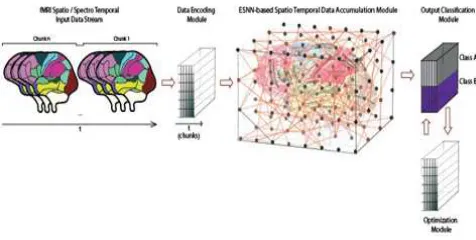
[5]. The architecture involves modeling the map; learning; and understanding the spatiotemporal brain data such as fMRI and EEG. NeuCube contains input encoding, NeuCube and output modules in which each of these modules is working in an integrated manner. Each module has different types of learning rules and neurons.
Figure 1 illustrates a total of 1.471 blue dots representing the NeuCube neurons shown. The left cyan dots (Figure 1) show the mapped fMRI data just in time before the initialization process while the yellow dots (Figure 2) show the mapped fMRI data after the initialization process.
Fig. 1 plotting illustrations of 1,471 neurons in NeuCube (represented with blue dots). Cyan dots represent fMRI data before initialization yellow dots represent the fMRI input data after initialization (right figure).
Fig. 2 plotting illustrations of 1,471 neurons in NeuCube (represented with blue dots). Yellow dots represent the fMRI input data after initialization.
Generally, NeuCube architecture can process and collect EEG and fMRI and also other types of spatiotemporal data for instance; image, weather, stroke, and also sounds dataset. By using fMRI data, NeuCube neurons will require a mapping technique to determine the fMRI data which are to measured neuron’s input.
In 2014 SNN architecture is developed to deal with an everyday life data by means of computational architecture that was named as NeuCube [6]. Based on spatiotemporal data (SSTD), the neuromorphic NeuCube architecture is used for a pattern recognition problem as well as signal
processing for prediction, discrimination and understanding of SSTD signals that include data encoding by which the source (e.g., stroke, brain, environment sites) is encoded through an encoder like Bens Spike Algorithm (BSA) or Address-Event Representation (AER) that converts the continuous data stream into individual spike trains. It also includes the unsupervised learning is executed using spike-timing-dependent plasticity (STDP) learning rule. Connections in the NeuCube is initialized using the “small-world” connection [7], evolved and later is captured as a spatiotemporal brain activity. Supervised learning is executed using dynamic evolving spiking neural networks (deSNN) classifier. During the learning, connections are evolved and trained; and further incrimination is also allowed for new samples and new classes introduced into the networks.
The learning of NeuCube model consists of two stages: unsupervised and supervised learning. The STBD gain access to the location in the Cube over time, as well as, will be calculated and initialized the weights of neurons’ connection throughout the stage of unsupervised learning. Whereas, during the supervised learning, the output from the unsupervised learning is broadcasted into the Cube that has been trained as well as to the output module. Neurons are interconnected between every neuron from the middle level to the highest level thus creating an environment for reinforcement learning [8]. Figure 3 shows the prevailing standard of NeuCube brain architecture. Other than fMRI data, the 3D eSNN architecture is also programmed to be able to map, learn as well as understand EEG, and other types of brain data. The architecture includes a module to encode the input data, the main NeuCube module, module to output the results and module of gene regulatory networks. All modules are working in an integrated manner with neurons and learning rules of different types.
A. Spiking Neural Networks
Fundamentally machine learning community knows SNN is different from the neural networks. SNNs work using spikes, which are separate events that take place at points in point, rather than constant values. In these neurons imitators, information transmission the biological neurons, for instance; through the specific effectiveness of spikes time or spikes structure. New learning algorithm has been developed which adjust the degree of biological plausibility to simplify knowledge in such networks
These spiking neurons is designated as the third generation neurons. As compared to the first-generation, spiking neurons behave as integrate and fire units and may or may not have a response. However, the internal state of spiking neurons will change over time making the neurons to be dynamic. At any instance of time, each postsynaptic neuron fires a spike when its internal state exceeds the threshold value. The spikes magnitude did not represent any information [10]. To implement the SNNs; the most important thing to consider is the behavior of neuron which should be the same as the real ones inside the human brain. In biology; dendrites, axons, and synapses are the three small parts of each neuron. Dendrites accept the signal from other neurons. Then they send it to the other related neurons. Synapse is the site where axon (presynaptic neuron) and dendrite (postsynaptic neuron) meet. The neuron body sums up the signals read by the dendrites; as a result, neuron generates a spike if it reaches the threshold value or else, it will go back to its original state. Many researchers have been used SNNs for the applications of coordinate transformations, object segmentation, and visual pattern recognition.
B. Functional Magnetic Resonance Imaging (fMRI)
This functional magnetic resonance imaging technique measures the brain activities that represent the interconnected relationship between activated neurons and their blood flow. In fMRI, the smallest unit that made up the entire image is known as voxels. These voxels are considered as features and are strengths of fMRI pictures that can reproduce the brain functional activities inside the several sections of the brain. Therefore, for the features classification, these values can be directly exploited [11].
fMRI can be utilized to visualize the hemodynamic reaction in connection to neuronal activities inside the particular brain section [12]. This hemodynamic reaction is demonstrated by the expanding measure of bloodstream to that specific certain neurons region. The oxyhemoglobin and deoxyhemoglobin attention are the changes in the elements of hemodynamic response in each brain tissue unit and in the rate of cerebral blood flow. Several fMRI techniques can be used to capture the functional signals produced by this hemodynamic response. Blood-oxygen-level-dependent (BOLD) is the most commonly used technique and is done by measuring the concentration of the oxyhemoglobin-deoxyhemoglobin element of the blood flow. The structural brain mapping, on the other hand, is provided by MRI and fMRI imaging technique shared with BOLD technique to produce brain images of a higher quality of excellent temporal as well as spatial information [13]. Besides that, fMRI produces a functional mapping of the brain by measuring the iron element within the oxygenated blood; while structural mapping is constructed using the blood vessels dilation physiological principle appearing into the activated regions of the brain. The brain mapping produced is used to evaluate neural activity changes caused by internal or external stimuli triggers [14]. Specifically, fMRI measures the oxygenated hemoglobin and deoxygenated hemoglobin ratios in the blood at many points of an individual with a control baseline. Neural activity is indicated by BOLD response measurements since it has been
widely accepted that local neural activity is affected by the blood oxygen level [15].
A new technique consisting of evolving spatiotemporal data machine (eSTDM) with evolving spiking neural networks (eSNN), which has been represented by the NeuCube architecture was introduced for visualization, dynamic learning, and classification of fMRI as spatiotemporal brain data [16]. This method includes several stages: (1) spatial coordinates mapping of fMRI data into a 3D cube of SNN (SNNc); (2) the modification of input data into spikes trains; (3) deep, unsupervised learning; (4) eSNN supervised; (5) optimization of parameters; and (6) 3D visualization and model interpretation [16]. Two standard problems and data are used from case studies such the fMRI data is collected while the subjects are: (1) reading positive or negative sentences for the first case study; and (2) reading a sentence or looking at a picture for the second case study. The affiliations between the dynamic spatiotemporal components are indicated by the learned connections in the SNNc projected from fMRI data sources which reveal new changes inside the brain functions for different case studies.
The proposed technique enables researchers to analyze the dynamic functional and structural relativity patterns of a learned SNN model; applicable for observing and understanding the brain activities using fMRI data, as well as the generation of suitable neuro-feedback to subjects for better brain functions.
For this paper [16], for instance; tracing the 3D SNN model connectivity allowed the researcher to catch prominent brain functional pathways evoked for language comprehension for the first time. An observation from fMRI data has revealed a robust spatiotemporal interaction between the left dorsolateral prefrontal cortex and left temporal while a subject is reading a negated sentence; producing a distinctive pattern from activities such as reading affirmative sentences or looking at a picture. Similarly, as compared to the conventional AI methods, the proposed NeuCube-based technique shows higher accuracy for classification. Therefore, it is effective to implement NeuCube-based models of fMRI data on better performance and low energy consumption neuromorphic platforms to apply on the applications for real-time.
In [8] an experiment has been conducted and has resulted in a novel clustering method for dynamic STBD on a case of fMRI. The method is based on NeuCube SNN architecture, where the spatiotemporal relationships between STBD streams are learned, and therefore creating clusters simultaneously. Spiking neurons are grouped as clusters inside the SNNc. For experimentation purposes, the researchers have used STAR/PLUS fMRI dataset and clusters are based on sentence polarities. Features are selected using Signal to Noise Ratio (SNR).
create the EEG data to be used for experiment environment. The proposed method is capable of classifying EEG data more accurately as compared to using the traditional machine learning and statistical methods, applicable for dose-related drug effects prediction. Additionally, the method applies to study the effects of treatment towards changes of functional brain activities, therefore bridging the gap of understanding the process which created EEG data; apart from being used for better understanding disease progression or aging process, and others.
C. Signal to Noise Ratio (SNR) as feature selection
Analyzing signal-to-noise-ratio (SNR) is a necessary part of determining a signal strength; where a higher the ratio signifies an easier level to detect a valid signal or extract useful information from the raw signal and vice versa. SNR can also be defined as the signal strength as a comparison to the background noise. The knowledge of this ratio has many critical applications in applied mathematics, analytical chemistry, electronics, and the geosciences. The test involving SNR classifies the illustration of the designs with a supreme variation in mean expression among two groups and lowest variance of expression within the individual group. Therefore, via using the statistics of SNR testing, the genetic features are being classified initially based on their expression levels in this process. Not to be confused with a ratio, SNR is the difference in decibels between the received signal and the background noise, where:
Signal to noise ratio= (µ1 +/µ2 )( σ1+ σ2) (1)
Where µ1 and µ2 represent the respective average expression values for two different class samples (Class 1 and Class 2); and σ1 and σ2 represent the respective standard
deviations.
In work by Doborjeh [8], NeuCube eSNN models have been used for cognitive fMRI spatiotemporal brain data learning, classification, and understanding; applying SNR as a feature selection technique of the data. The fMRI samples are trained with NeuCube to learn the spatiotemporal relationship between the data. The fMRI data segmentation weakness, however, need to be justified.
D. AER Data Encoding
Data can be converted into a train of spike using several data encoding methods. In this research, we make used of AER data encoding technique to encode the fMRI data into spikes. In AER data encoding, a spike will be generated from the input fMRI voxel activity patterns if the difference exceeds a certain threshold value; where the measurement depends on the type of the data (ecological, medical, or others) and different SSTD mapping will be formed as a result.
E. Dynamic evolving spiking neural networks (deSNN)
Both SDSP and Rank Order (RO) learning rules are utilized for training the deSNN algorithm [5]. Despite the RO-learning rule controls the preliminary association of weightage for a STPR of AER dataset, STDP/SDSP is used to adjust these connections in unsupervised training by
employing the drift parameter, D, which is created from subsequent spikes.
In RO-learning rule [17], the first incoming spikes’ order of the synapse is essential in which the significance of each input is formed according to the order of spikes approaching to that specific synapse. RO-learning rule benefits include one-pass fast learning and unsynchronised data entry. For every training trial, a neuron with the PSP maximum value has its efficient weight.
PSPmax = ∑modorder (j) Wj,t (2)
Wherever mod represents the inflection influence; j represents the index for the spike that arrives at synapse j, i; and wj,t represents the weight of the connected synapse;
order(j) represents the spike’s order at synapse j, i between all spikes reaching to neuron i from all m synapses. The value for order(j) of the first spike is 0 and its growths is based on the input spike order. The output spike is shaped by neuron i if the PSP(i, t) turn out to be higher than the threshold PSPTH(i). This threshold value is a fraction of C ∈
[0.1] of the maximum PSP, produced with a circulation of the training sample into the restructured weights.
PSPTH =C. PSPmax (3)
The association between weights are determined according to the next spikes’ order during the training of an input pattern to a classifier, [18]:
∆Wj,i (t) = mod order (j, i (t)) (4)
Fig. 4 deSNN training algorithm
the spike that arrives first in the synapse. Referring to (4), a new output neuron i is created and its synaptic weights Wj,i
to the input neurons are calculated as Wj,i (0) for every input
pattern. This limits the model for not being able to recognize complex spatiotemporal patterns of fMRI and EEG data. In these complex SSTD patterns recognition, spikes that arrive over time on the same synapse will be used to adjust the connection weights, thus the implementation of spike-time learning and dynamic synapse.
Once a synaptic weight Wj,i is initialized (according to the
initial spike reaching on synapse j), the synapse becomes dynamic and modifies its weight using the SDSP algorithm. The weight value will increase or decrease with a small value (positive/negative drift parameter) when a new spike reaches at this synapse at t time or when there is no spike. The deSNN training algorithm [19] is as in Figure 4.
F. The data
This study demonstrates and evaluates the selected feature selection, NeuCom Student software version 0.0919 has been used to select the best relevant features. The starplus dataset was used to study how neurons in the SNNc are classified. This study evaluates the performance of classification accuracy based on the spatiotemporal of the neuron’s activation when the subject is conducting a certain mental task: reading a sentence versus looking at the picture. After getting the best features, the data is loaded into NeuCube software to initialize and train the NeuCube and finalize it by using deSNN classifier to get the classification result.
1) Original fMRI Data Set (StarPlus)
StarPlus dataset publicly available is used for evaluating the performance of the proposed framework; which before has been used by many researchers [18]. The StarPlus is publicly accessible dataset which was initially collected by Marcel Just and Carnegie Mellon in University's CCBI [14]. According to Table 1, the entire condition labels of experiments are 0, 1, 2 and 3 which refers to Ignore, Rest, and Sentence is Not negated, and the Sentence is negated. The brains dimensions are acquired from 6 standard subjects and labeled as 04799, data-04820, data04847, data-05675, data-05680, and data-05710. For the preliminary test, data for a single subject data-04847 is selected and examined. 54 trials and every of which of the conditions is labeled for the experiment as follows:
TABLEI
EXPERIMENT CONDITIONS
Condition label Experiment Condition
0 Ignore
1 Rest (fixation)
2 Sentence is not negated
3 Sentence is negated
When the subject reads a sentence or looking at pictures, the brain activity patterns are captured differently depending on the picture or sentence polarity (pictures vs. sentences). In the experimental configuration, the representation of sentence and pictures are transformed, and the subject is
trained to memorize the picture while waiting for the sentence. For this configuration, the dataset is labeled as SentP (Sentence_Picture) and PicS (Picture_Sentence). Furthermore; in this experimentation, the dataset is separated into two-time series consistent to the two classes: Class 1, looking at the picture (PicS); Class 2, reading sentences (SentP). Only a part of the brain in each subject was snapped. The region of the data has been marked with 25 functionally called "Regions of Interest," or ROIs [14]. According to the related works in Section II, most of the researchers [6],[8],[9] have used Signal-to-Noise Ratio (SNR) to get the best feature for fMRI data. Therefore, this study will use SNR to select the most activated voxels from all regions.
2) The selected feature set of fMRI Data (StarPlus)
This dataset was created after some experiments to the subject that involves a set of trials. For an experiment in this study; the subject data-star plus-04847-v7.mat data was selected and tested 5 times for trial to analyze the result of each test. Since the default setting in the NeuCube is 20 sample, hence, most of the researchers [8],[9] have used 20 samples in their previous experiments and the maximum can be taken for experiments is 50 samples. Therefore, in this study, the simulations were divided into 2 groups of samples which are 20 samples and 50 samples with 55 snapshots and 4949 voxels in each sample. Figure 5 and 6 show the screenshot of an experiment for 20 and 50 samples.
Fig 5. Screenshot of experiment for 20 samples
III.RESULTS AND DISCUSSION
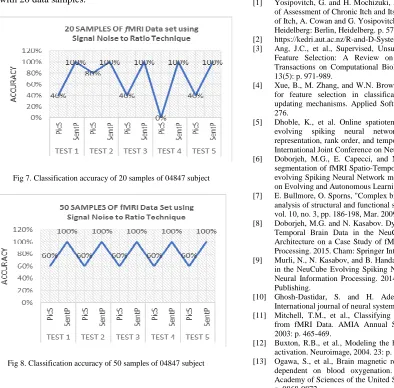
In this paper, we addressed the classification accuracy for fMRI StarPlus dataset for the subject of 04847 data and divided into two experiments involving twenty samples and fifty samples for each class; PicS vs. SentP. The experiments have been run total 50 times with the 5 tests (10 times per test) by using the same data obtained from SNR feature selection technique. For the experiment with 20 samples; classification accuracy of the class PicS was inconsistent while the class SentP achieved 100% accuracy for all 5 tests (see Figure 5). Whereas; for the group of 50 samples, the accuracy of class PicS was 60% while the class SentP achieved accuracy as same as the group of 20 samples which is 100% (see Figure 5). Therefore, according to the experimental results, the SNR feature selection technique produced high accuracy in SentP than PicS in all 5 tests. Figure 7 and Figure 8 show a simple illustration of the result obtained by the above experiments. The results achieved from this experiment demonstrate that using SNR as a feature selection technique for fMRI data gives high accuracy for reading the text but not well in identifying images. Based on the simulation results, it can be concluded that the performance of SNR is noteworthy in maximum data samples which is 50 samples because the SNR have more choice on selecting the most relevant features than it has with 20 data samples.
Fig 7. Classification accuracy of 20 samples of 04847 subject
Fig 8. Classification accuracy of 50 samples of 04847 subject
IV.CONCLUSION
The proposed method of this paper was implemented and tested on the Star Plus dataset and indicating that the feature selection technique can be useful in enhancing the classification accuracy. According to the presented results in section 4, in both group datasets consider that the fMRI dataset shows that the accuracy is inconsistent and low accuracy for the picture, while for the accuracy of the sentence is consistent and high. Thus, the results indicate a better outcome can be achieved by reducing the features into a small or few data point which can decrease complexity and increase accuracy. For the inconsistency accuracy for picture class, we plan to add other suitable feature selection technique such as particle swarm optimization that would help a better classification accuracy on both classes.
ACKNOWLEDGMENT
The authors would like to thank Ministry of Higher Education (MOHE), for granting GPPS Grant to support this research. The authors would also like to thank Universiti Tun Hussein Onn Malaysia (UTHM) for supporting this research. Thanks to an anonymous reviewer for valuable comments.
REFERENCES
[1] Yosipovitch, G. and H. Mochizuki, Neuroimaging of Itch as a Tool
of Assessment of Chronic Itch and Its Management, in Pharmacology of Itch, A. Cowan and G. Yosipovitch, Editors. 2015, Springer Berlin Heidelberg: Berlin, Heidelberg. p. 57-70.
[2] https://kedri.aut.ac.nz/R-and-D-Systems/neucube
[3] Ang, J.C., et al., Supervised, Unsupervised, and Semi-Supervised
Feature Selection: A Review on Gene Selection. IEEE/ACM Transactions on Computational Biology and Bioinformatics, 2016. 13(5): p. 971-989.
[4] Xue, B., M. Zhang, and W.N. Browne, Particle swarm optimization
for feature selection in classification: Novel initialization and updating mechanisms. Applied Soft Computing, 2014. 18: p. 261-276.
[5] Dhoble, K., et al. Online spatiotemporal pattern recognition with
evolving spiking neural networks utilizing address event representation, rank order, and temporal spike learning. In The 2012 International Joint Conference on Neural Networks (IJCNN). 2012.
[6] Doborjeh, M.G., E. Capecci, and N. Kasabov. Classification and
segmentation of fMRI Spatio-Temporal Brain Data with a NeuCube evolving Spiking Neural Network model. In 2014 IEEE Symposium on Evolving and Autonomous Learning Systems (EALS). 2014.
[7] E. Bullmore, O. Sporns, "Complex brain networks: Graph theoretical
analysis of structural and functional systems," Nature Rev. Neurosci., vol. 10, no. 3, pp. 186-198, Mar. 2009.
[8] Doborjeh, M.G. and N. Kasabov. Dynamic 3D Clustering of
Spatio-Temporal Brain Data in the NeuCube Spiking Neural Network Architecture on a Case Study of fMRI Data. In Neural Information Processing. 2015. Cham: Springer International Publishing.
[9] Murli, N., N. Kasabov, and B. Handaga. Classification of fMRI Data
in the NeuCube Evolving Spiking Neural Network Architecture. in Neural Information Processing. 2014. Cham: Springer International Publishing.
[10] Ghosh-Dastidar, S. and H. Adeli, Spiking neural networks.
International journal of neural systems, 2009. 19(04): p. 295-308.
[11] Mitchell, T.M., et al., Classifying Instantaneous Cognitive States
from fMRI Data. AMIA Annual Symposium Proceedings, 2003. 2003: p. 465-469.
[12] Buxton, R.B., et al., Modeling the hemodynamic response to brain
activation. Neuroimage, 2004. 23: p. S220-S233.
[14] Just, M. “StarPlus fMRI data,” [Online]. Available: http://www.cs.cmu.edu/afs/cs.cmu.edu/project/theo-81/www/. [Accessed 13 07 2014]
[15] Mitchell, T.M., et al., Learning to Decode Cognitive States from
Brain Images. Machine Learning, 2004. 57(1): p. 145-175.
[16] Kasabov, N.K., M.G. Doborjeh, and Z.G. Doborjeh, Mapping,
Learning, Visualization, Classification, and Understanding of fMRI Data in the NeuCube Evolving Spatiotemporal Data Machine of Spiking Neural Networks. IEEE Transactions on Neural Networks and Learning Systems, 2017. 28(4): p. 887-899.
[17] Thorpe, S. and J. Gautrais, Rank order coding, in Computational
neuroscience. 1998, Springer. p. 113-118.
[18] Hutchinson, R.A., et al., Modeling fMRI data generated by
overlapping cognitive processes with unknown onsets using Hidden Process Models. NeuroImage, 2009. 46(1): p. 87-104.