Exploring SMEs Performance through Market Orientation and Sensing Capability: PLS-SEM Modeling Approach
Dr. Saqlain Raza1, Dr. Saad Hassan2& Muhammad Arif Nawaz3
Abstract
The main objective of this study is to statistically examine the impact of Market Orientation (MO) and Sensing Capability (SC) towards Small and Medium Enterprises (SMEs) performance in the context of SMEs manufacturing sector of Punjab Pakistan. A survey questionnaire technique was adopted in which 321 usable questionnaires were obtained and used for data analysis. Owners/managers of SMEs manufacturing sector were respondents of this study. The measurement model and structural model analyses were applied by using advance Partial Least Square Structural Equation Modeling (PLS-SEM). The results demonstrated that market orientation has direct significant effect on sensing capability and also sensing capability has significant effect on SMEs performance. This study also established the mediating effect of sensing capability on the relationship between market orientation and SMEs performance. These findings suggest that market orientation and sensing capability play vital role to enhance SMEs performance. This study enhances the existing literature by connecting the gap and showing the importance of market orientation and sensing capability in manufacturing sector.
Key Words: Market Orientation, Sensing Capability, SMEs Performance Introduction
Small and Medium Enterprises (SMEs) represent a large as well as diverse important sector for economies. It is also observed that SMEs performance can be used for sustainable development of developing states. It is reported that SMEs make up over 90% of business worldwide and account for between 60% to 70% of worldwide employment (Raza, Minai, Zain, Tariq & Khuwaja, 2018). Moreover, SMEs also serve as source of employment generation (Mahmood & Hanafi 2013).
In case of developing nations, the role of SMEs is further enhanced and expanded as their economy is not dependent only on large Multinational Enterprises (MNEs). Developing countries depend on the performance of SMEs for the uplift and growth of their economy. Similarly, the economy of Pakistan also relies on performance of SMEs (Hussain, Si, Xie& Wang, 2010).
1
School of Business Management, University of Utara Malaysia 2
School of Business Management, University of Utara Malaysia
As far as Pakistan economy is concerned, SMEs represent more than 90% of total business establishments. These SMEs are accounting for 40% of annual gross domestic product (GDP) of the country and 35% of value added manufacturing (Razaet al., 2018). These figures show that SMEs contribute positively to the economic growth of the country which is true but the bitter reality is that small and medium enterprises are still not generating enough revenue especially in Pakistan (Hyder&Lussier, 2016). There are various factors contributing towards low performance comprise of unfavorable economic conditions, inconsistent public policies, mismanagement of valuable resources, scarcity of capabilities, lack of infrastructural support, financial constraints, mounting operating costs and corruption (Razaet al.,2018).
Most of the entrepreneurs and businessmen get disappointed after seeing a slow growth rate despite doing all the efforts. The truth is SMEs in Pakistan usually have a very short life; the businessmen have to put in an extra effort to survive the business (Zafar & Mustafa, 2017;Kureshi, Mann, Khan &Qureshi, 2009).
The important key factor that hinders the performance of SMEs is the inability to have a sustainable competitive advantage by marketing differentiated offerings. This marketing problem can cause firms to lose market share rapidly (Tanvir, Rizvi & Riaz, 2012).
According to Kotler (1994) marketing activities are important factor that influence the success of business. However, most SMEs do not place enough importance on in -depth market information but instead rely too much on intuition when estimating market potential (Van Dierman, Wie, Tambunan&Tambunan, 1998).). Consistent with the argument of Drucker (1954) to survive and succeed in the context of a global and competitive business environment, companies need to know their customers and the markets. They should be actively involved to combat market turbulence (Homaid, Minai& Al-Ansi, 2018). Further, sensing capability play vital role in order to enhance firm performance (Roberts & Grover, 2012; Day, 1994).
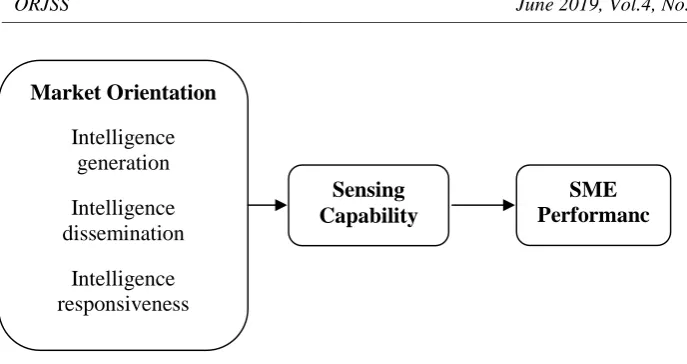
Keeping in view the importance of market orientation with respect to sensing capability, it is imperative to test empirically the mediating effects of sensing capability on the relationship between market orientation and SMEs performance in manufacturing sector of Punjab, Pakistan.
Literature Review
orientation is used to explain the implementation of marketing concept (Kohli&Jaworski, 1990). Market orientation is considered as complementary asset of the firm (Morgan, Vorhies& Mason, 2009). Review of the literature regarding market orientation mainly focused on customers and their needs. Scholars have clear orientation towards customers and how to respond to their needs and demands, but they focus on various firm elements (Homaid, Minai& Al-Ansi, 2018). Moreover, the definition provided by Kohli and Jaworski (1990) is the key definition of market orientation. Kohli and Jaworski (1990) defined market orientation as“the organization-wide generation of market intelligence pertaining to current and future needs of customers, dissemination of intelligence within an organization and responsiveness to it”. This study also followed Kohli and Jaworski (1990) definition of market orientation.
Kohli and Jaworski (1990), conceptualizes market orientation as a set of organizational behaviors which are necessary for creating superior value for customers and continuous superior organization performance. Kohli, Jaworski and Kumar (1993) propose the market orientation model which includes the three specific activities to operationalize market orientation namely, (i) intelligence generation, which refers to collecting information about the market; (ii) intelligence dissemination, which refers to how and to what extent the generated market intelligence is communicated across the organization so as to create a common understanding and unifying focus within the organization and (iii) responsiveness, which refers to the actions made by the firm to respond to the market conditions in terms of selecting target markets, developing products and services.
Mediating role of Sensing Capability
Sensing capability is viewed as “the firm’s ability to pursue, interpret, and to spot the environmental opportunities” (Nieves & Haller, 2014). Sensing capability is one of the important components of dynamic capabilities (Pavlou & EI Sawy, 2011).In the context of entrepreneurship understanding and sensing of opportunities and finding novel avenues for seizing the opportunities. It is important to coordinate and assemble the various elements for sensing the business prospects. This capability is about first sensing and then seizing the best opportunity. It is viewed that entrepreneurs come with new ideas and start a new firm or upgraded the existing products and services. In continuation, such actions are clearly entrepreneurial, but the functions of entrepreneurial management are rooted in dynamic capabilities for initiating the activities (Teece, 2007).
scope and technologies (Pavlou& EI Sawy, 2011). Consistent with the above argument, it is highlighted by Teece et al. (1997) that a firm ability to build and integrate elements to counter and control the rapid changes depends on firm ability to scan the environment, evaluate the situation of markets and rivals, and complete reconfiguration very fast to get advantages over market competitors. Further, Teece (2007) argued that in order to recognize and design new opportunities, a firm must constantly explore, scan and search across the markets and technologies in both local as well as international markets. He further argued that this activity is not limited to research, probing and re-probing technologies possibilities and customer needs but also to understand the talent demand, structural evolution of firms and markets, moreover suppliers and competitor’s responses.
Sensing capability is hierarchical component of dynamic capabilities (Pavlou & EI Sawy, 2011).Dynamic capabilities (DCs) are the firm’s strategic abilities by which owner/manager integrate, build and recombine firm resources in order to enhance the firm performance (Eisenhardt& Martin,2000). In addition, capabilities are served as a link for transforming firm resources into firm performance (Raza, Minai, ulHaq, Ismail & Zain, 2018; Wu & Wang, 2007). In this view, it is described that capabilities are considered as powerful mediator. The vast majority of the studies highlighted the mediating potential of capabilities (Hassan, Mei & Johari, 2017). In this regard, sensing capability is regarded as a transformer for converting resources (market orientation) into improved SMEs performance. In addition, this research model is guided and supported by Resource Based View (RBV).To this end, this study focus on mediating role of sensing capability on the link between market orientation and SMEs performance.
Based on the theoretical background and prior studies, the following hypotheses proposed to be tested.
H1: Market Orientation (MO) has a significant effect on sensing capability of manufacturing sector of Punjab, Pakistan.
H2: Sensing Capability (SC) has a significant effect on SMEs Performance of manufacturing sector of Punjab, Pakistan.
H3: Sensing Capability (SC) mediate significantly the relationship between Market orientation (MO) and SMEs Performance of manufacturing sector of Punjab, Pakistan.
Research Framework
Figure 1. Research Framework Data Collection
Present study aim to examine the effect of market orientation on SME performance through the mediation of sensing capability in manufacturing SMEs of Punjab, Pakistan. Data was collected from manufacturing SMEs comprising textile, sports, electrical & electronics, foods and beverages, chemicals, pharmaceuticals and surgical instrument manufacturing firms. Questionnaires were distributed to owner/mangers of 497 firms. Out of 497, only 345 questionnaires were returned. However, among 345, 24 questionnaires were rejected due to incomplete response thus, yielding an actual response rate of 64.58%.
To measure the variables of study a survey questionnaire developed by the previous researchers was followed. For market orientation, multidimensional scale comprising three dimensions having 10 items was adapted from the study Boso, Story & Cadogan (2013). Similarly, to measure sensing capability 4 item scale was adapted from the study of Pavlou & Saway (2011). Likewise, for SME performance an 8 item scale was adapted from the study of Spillan & Parnell (2006). To measure all the constructs five points reflective measurement likert scale ranging from strongly disagree to strongly agree was used in present study.
Results
Measurement Model
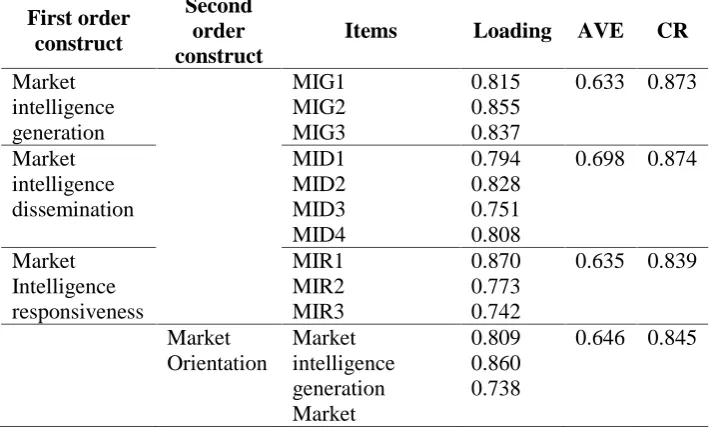
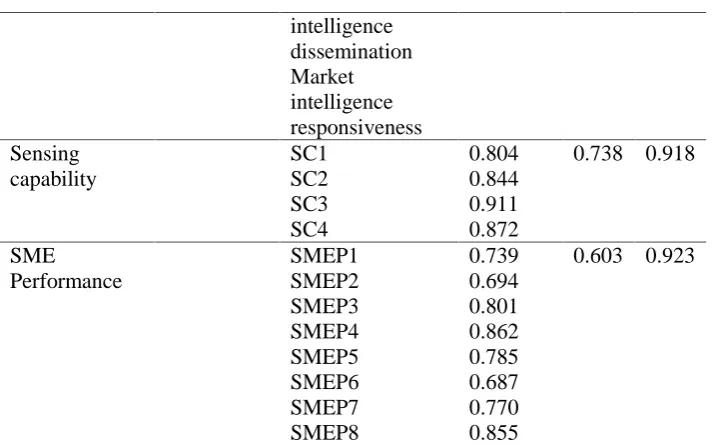
Partial least square structural equation modeling PLS-SEM was used for data analysis in the present study. To measure the validity and reliability of the reflective measures, convergent validity and composite reliability was evaluated. For all construct average variance explained (AVE) values reaches
Market Orientation Intelligence
generation
Intelligence dissemination
Intelligence responsiveness
Sensing Capability
SME Performanc
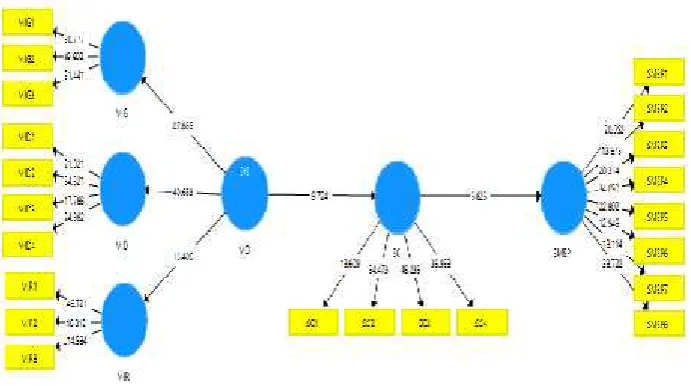
above then the threshold point 0.5. Similarly, composite reliability for construct ranges from 0.839 to 0.923. Figure 2 shows the measurement model of the study.
Figure 2: Measurement Model
Table 1. Measurement Model: Convergent Validity & Reliabilty First order
construct
Second order construct
Items Loading AVE CR
Market intelligence generation
MIG1 MIG2 MIG3
0.815 0.855 0.837
0.633 0.873
Market intelligence dissemination
MID1 MID2 MID3 MID4
0.794 0.828 0.751 0.808
0.698 0.874
Market Intelligence responsiveness
MIR1 MIR2 MIR3
0.870 0.773 0.742
0.635 0.839
Market Orientation
Market intelligence generation Market
0.809 0.860 0.738
intelligence dissemination Market intelligence responsiveness Sensing capability SC1 SC2 SC3 SC4 0.804 0.844 0.911 0.872 0.738 0.918 SME Performance SMEP1 SMEP2 SMEP3 SMEP4 SMEP5 SMEP6 SMEP7 SMEP8 0.739 0.694 0.801 0.862 0.785 0.687 0.770 0.855 0.603 0.923
The above mentioned table 1, depicts that all the variables of the study have average variance explained (AVE) is greater than cut off value of 0.50. Similarly, it also shows the loading of each item of all variables. Item loading for all variables ranges in between 0.694 to 0.911.
To test whether variables of the study are different sufficiently from
each other, discriminant validity by using Fornell & Larker’s (1980) criterion
method was employed. This method requires AVE of a construct to be larger than the square of its largest correlation with any construct. Below mentioned table 2, shows that our model met the requirement and all construct AVE are larger than the square of its largest correlation with any other construct.
Table 2. Discriminant Validity (Fornell & Larker, 1981 Method)
Construct MO SC SMEP
MO 0.654
SC 0.550 0.859
SMEP 0.381 0.429 0.776
Table 3. Hetrotrait Monotrait ration (HTMT)
Construct MO SC SMEP
MO
SC 0.623
SMEP 0.425 0.471
Structural Model
After evaluating the measurement model the next stage is to determine the structural model which is also known as the inner model that depicts the relationship between the constructs of the study. Figure 3 shows the structural model of the study.
Figure 3: Structural Model
Table 4. Hypotheses Testing
Hypotheses Std Beta
Std Error
T value
P
value Decision
Confidence interval 2.50% 97.50% MOSC 0.549 0.057 9.725 0.000 Supported 0.446 0.656 SCSMEP 0.424 0.062 6.828 0.000 Supported 0.301 0.539 MOSCSMEP 0.223 0.045 5.234 0.000 Supported 0.155 0.321 In order to determine the significance of structural model for relationship between the independent variables, mediating variable and dependent variable coefficient of determination R2 is used. Value of R2 describes collective effect of independent variable on the dependent variables (Hair et al., 2014). Values of R2 0.10 is considered as acceptable however, values 0.25, 0.50 and 0.75 are considered as low, moderate and high (Falk & Miller, 1992; Hair et al., 2011).
Table 5.Coefficient of determination R2and effect size f2
Hypotheses f2 Effect size R2
MOSC 0.432 Large 0.302
SCSMEP 0.220 Medium 0.108
Above Table 5, show that R2value in relation between market orientation and sensing capability is 0.302 which is substantial. Similarly, their effect size is 0.432 is consider as large. The R2value for the relationship between sensing capability and SME performance is 0.108 which is consider as low comparative to relationship between MO and SC. However, effect size f2 is considered as medium.
Discussion & Conclusion
The paper accounts for the study of market orientation and sensing capability in relation with the SME performance of the manufacturing sector of Punjab, Pakistan. A total of 321 useable samples were used for data analysis. After analyzing through advance Partial Least Square Structural Equation Modeling (PLS-SEM), findings of study confirm all the hypotheses. Market orientation (firm resource) has a significant positive effect on sensing capability which shows that resources lead towards the capabilities. Further, mediating role of sensing capability between market orientation and SME performance highlights that capabilities transform firm resources into performance enhancement. Sensing capabilities by utilizing the market intelligence counter and control the rapid changes in the market, evaluate the situation of markets and rivals, thus increase the existing performance and enables the firm to compete in the market.
References
Boso, N., Story, V. M., & Cadogan, J. W. (2013). Entrepreneurial orientation, market orientation, network ties, and performance: Study of entrepreneurial firms in a developing economy. Journal of Business
Venturing, 28(6), 708-727.
Day, G. S. (1994). The capabilities of market-driven organizations. Journal
of marketing, 58(4), 37-52.
Drucker, P. (1954). The principles of management. New York.
Eisenhardt, K. M., & Martin, J. A. (2000). Dynamic capabilities: what are they? Strategic management journal, 21(10-11), 1105-1121.
Hassan, S., Mei, T. S., & Johari, H. (2017). Mediating role of operational capabilities between intellectual capital and organizational performance: A proposed theoretical framework. Academy of Strategic Management
Journal, 16(3), 1-12.
Hair Jr, J., Sarstedt, M., Hopkins, L., & G. Kuppelwieser, V. (2014). Partial least squares structural equation modeling (PLS-SEM) An emerging tool in business research. European Business Review, 26(2), 106-121.
Hair Jr, J. F., Matthews, L. M., Matthews, R. L., & Sarstedt, M. (2017). PLS-SEM or CB-PLS-SEM: updated guidelines on which method to use. International Journal of Multivariate Data Analysis, 1(2), 107-123.
Homaid, A. A., Minai, M. S., & Al-Ansi, A. A. (2018). The effect of market and entrepreneurial orientation on the performance of microfinance institutions: The mediating role of learning orientation in the context of Yemen. Journal of Business and Retail Management Research, 12(3).
Hussain, I., Si, S., Xie, X. M., & Wang, L. (2010). Comparative study on impact of internal and external CFFs on SMEs. Journal of Small Business
& Entrepreneurship, 23(4), 637-648.
Hyder, S., &Lussier, R. N. (2016). Why businesses succeed or fail: a study on small businesses in Pakistan. Journal of Entrepreneurship in
Emerging Economies, 8(1), 82-100.
Kohli, A. K., &Jaworski, B. J. (1990). Market orientation: the construct, research propositions, and managerial implications. The Journal of
Kohli, A. K., Jaworski, B. J., & Kumar, A. (1993). MARKOR: A measure of market orientation. Journal of Marketing Research (JMR), 30(4), 467-477.
Kotler, P. (1994). Marketing management, analysis, planning,
implementation, and control, Philip Kotler.
Kureshi, N. I., Mann, R., Khan, M. R., & Qureshi, M. F. (2009). Quality management practices of SME in developing countries: a survey of manufacturing SME in Pakistan. Journal of Quality and Technology
Management, 5(2), 63-89.
Lindblom, A. T., Olkkonen, R. M., Mitronen, L., &Kajalo, S. (2008). Market-sensing capability and business performance of retail entrepreneurs. Contemporary Management Research, 4(3).
Mahmood, R., & Hanafi, N. (2013). Entrepreneurial orientation and business performance of women-owned small and medium enterprises in malaysia: competitive advantage as a mediator. International Journal of
Business and Social Science (IJBSS), 4(1), 82-90.
Mahmoud, M.A., Kastner, A., &Akyea, K. (2011). Market orientation as a
competitive tool: empirical evidence from ‘quartile one’ banks in Ghana. Journal of Financial ServicesMarketing, 16 (3/4), 316-34.
Morgan, N. A., Vorhies, D. W., & Mason, C. H. (2009). Market orientation, marketing capabilities, and firm performance. Strategic management
journal, 30(8), 909-920.
Nieves, J., & Haller, S. (2014). Building dynamic capabilities through knowledge resources. Tourism Management, 40, 224-232.
Pavlou, P. A., & El Sawy, O. A. (2011). Understanding the elusive black box of dynamic capabilities. Decision Sciences, 42(1), 239-273.
Raza, S., Minai, M. S., ulHaq, M. A., Ismail, A. I., & Zain, A. Y. M. (2018). Entrepreneurial Network Towards Small Firm Performance through
Dynamic Capabilities: The Conceptual Perspective. Academy of
Entrepreneurship Journal, 24(4), 1-9.
Roberts, N., & Grover, V. (2012). Investigating firm's customer agility and firm performance: The importance of aligning sense and respond capabilities. Journal of Business Research, 65(5), 579-585.
Spillan, J., & Parnell, J. (2006). Marketing resources and firm performance among SMEs. European management journal, 24(2-3), 236-245.
Tanveer, M. A., Rizvi, S., &Riaz, W. (2012). Declining market share of Pakistan in football industry. Asian Journal of Business and
Management Sciences, 1(11), 33-42.
Teece, D. J. (2007). Explicating dynamic capabilities: the nature and micro foundations of (sustainable) enterprise performance. Strategic
management journal, 28(13), 1319-1350.
Teece, D. J., Pisano, G., &Shuen, A. (1997). Dynamic capabilities and strategic management. Strategic management journal, 18(7), 509-533.
Van Dierman, P., Wie, T. K., Tambunan, M., &Tambunan, T. (1998). The
IMF reform agreements: Evaluating the likely impact on SMEs. Study report, The Asia Foundation, Jakarta.
Wu, L. Y., & Wang, C. J. (2007). Transforming resources to improve performance of technology-based firms: A Taiwanese Empirical Study. Journal of Engineering and Technology Management, 24(3), 251-261.
Zafar, A., & Mustafa, S. (2017). SMEs and its role in economic and socio-economic development of Pakistan. International Journal of