Copyright © The Author(s). All Rights Reserved. Published by American Research Institute for Policy Development DOI: 10.15640/jpesm.v6n2a7 URL: https://doi.org/10.15640/jpesm.v6n2a7
Assessing Affective Physical Literacy of Adolescents:
The Development of a Motivation and Confidence in Sport and Physical Activity Instrument
Trevor Bopp
1& Joshua D. Vadeboncoeur
2Abstract
There is a dramatic decline in sport participation rates as youth enter into adolescence. Subsequently, increases in physical inactivity are witnessed around this age. Educating youth toward becoming more physically literate has been reasoned to minimize the negative health outcomes associated with sedentary lifestyles. Recognized as the primary constructs comprising the affective domain of physical literacy, motivation and confidence play an integral role in one‟s lifecourse trajectory of healthy physical activity. Current assessments of affective physical literacy, of which there are few, have been met with mixed reviews for a variety of reasons (e.g., methodology, evaluative of performance or physical criteria, age or grade-level standards, pedagogically-based, etc.). In response, we sought to develop an assessment tool to provide a better understanding of one‟s affective physical literacy. Thus, the purpose of this study wasto develop an instrument toassess physical literacy affect within and outside of educational settings, inclusive of sport and physical activity spaces, for the subpopulation of adolescents. Additionally, we provide a detailed description of how the tool evolved into an 18-item questionnaire, assessing motivation and confidence across six dimensions (enjoyment, identity, socialization, self-improvement, belief in physical skills, and belief in cognitive abilities).
Keywords:Physical Literacy, Sport, Physical Activity, Motivation, Confidence
1. Introduction
The assessment and evaluation of one‟s level of physical literacy has proven to be challenging, divisive and not without criticism. There are several reasons for this, with the most evident and problematic being the lack of a clear and absolute conceptualization with definitive standards and expectations (Corbin, 2016;Edwards, Bryant, Keegan, Morgan,& Jones, 2017; Edwards et al., 2018; Giblin, Collins,& Button, 2014; Jurbala, 2015; Lounsbery& McKenzie, 2015; Robinson & Randall, 2017; Roetert & MacDonald, 2015; SHAPE America, 2014; Tremblay & Lloyd, 2010; Whitehead, 2013a, 2013b; Whitehead & Maude, 2016). Spengler and Cohen (2015) found that most countries concerned with physical literacy have developed their own definition and conceptual standards that reflect their respective cultural values and logics, resulting in a multitude of assessments, a lack of comparable data, and subsequent discrepancies in the interpretation of said data (Edwards et al., 2017; Giblin et al., 2014). Even within the same country, multiple physical literacy assessment tools have been developed with various goals (e.g., education, performance, participation) and constituents (e.g., educators, coaches, trainers) in mind (Robinson & Randall, 2017). A systematic review of physical literacy measurement studies led Edwards et al. (2017) to conclude that diverse and nontraditional approaches to understanding and assessing physical literacy might allow researchers to better understand its theoretical and holistic underpinnings, however, the integration of more empirical work situated within the various philosophical and nuanced definitions of physical literacy must also be considered.
Given it is difficult to manage what one cannot measure, and likewise, hard to measure what one cannot define (Aspen Institute, 2015; Farrey, 2017), any discussion on physical literacy must first begin with clearly identifying how it will be operationalized, what is to be measured and which definition will guide the direction of the study (Edwards et al., 2017; Green, Roberts, Sheehan, & Keegan, 2018).
1 Assistant Professor, Department of Sport Management, College of Health and Human Performance, University of Florida. P.O.
Box 118208, Gainesville, FL 32611-8208. E-mail: [email protected], 352-294-1663
It is in this vein that wedevelopedour instrument in accordance with two particulardefinitions of physical literacy. The more internationally recognized definition describes it “as the motivation, confidence, physical competence, knowledge and understanding to value and take responsibility for engagement in physical activities for life” (IPLA, 2017). This “Whiteheadian” definition has been found to be the most utilized amongst both qualitative and quantitative studies (Edwards et al., 2018) and has been adopted as Canada‟s physical literacy consensus statement (ParticipACTION et al., 2015). The second definition of physical literacy from which we develop our tool comes from the Society of Health and Physical Educators (SHAPE America). They reason physical literacy as a grade-level learning outcome in the National Standards for Physical Educators and define it as “the ability to move with competence and confidence in a wide variety of physical activities in multiple environments that benefit the healthy development of the whole person” (SHAPE America, 2014, p. 4).From these two conceptualizations of physical literacy,we are able to ascertain the importance of two particular affective constructs, motivation and confidence (see Edwards et al., 2018; ParticipACTION et al., 2015; Robinson & Randall, 2017; Whitehead, 2013b), toward becoming physically literate and positively engaging in a lifetime of physical activity.
Currently, there are but a few instruments that assess the constructs of motivation and confidencewhen positioned in the domain of physical literacy affect, and of those that are, even fewer are contextualized outside a physical education setting and cogitate physical literacy after the age of 12 (Edwards et al., 2017). This can be problematic given the potential for pedagogical standards and educational settings to influence assessmentssuch that they become focused more on normative scores and evaluation, rather than acknowledging individual achievements and progress (Green et al., 2018).Further, if physical literacy is to “serve as a unifying term to describethe overall outcome of quality physical education, physical activity, sport, and recreation programs” (Roetert & Jeffries, 2014, p. 39), as well as provide the theoretical and practical underpinnings for the “development of evidence-based programs andassessments” (p. 24) for all levels of sport (e.g., youth, recreation, amateur, elite), public health, and physical education (Corbin, 2016), then the operationalization of the term and subsequent instruments is paramount. To this end, we developed a tool intended to provide a better understanding of one‟s affective physical literacy, via the constructs of motivation and confidence, factoring both sport and physical activity.
Given the evolving and dynamic nature of said constructs, this tool will yield a snapshot of one‟s affective physical literacy, while also providing practical applications for individuals(e.g., coaches, administrators, parents, participants)in various sport and physical activity programs (e.g., educational, out-of-school, community, etc.). However, the intent is not to set standards and/or expectations regarding evaluative scores, as that may hinder advancing one‟s physical literacy towards positive outcomes (Robinson & Randall, 2017). Rather, this instrument is being developed for individuals, programs, and policy makers to better understand affective components of physical literacy (i.e., motivation and confidence) so as to advance more diverse and inclusive access and opportunities for lifetime engagement with sport and physical activity. Thus, the purpose of this study is threefold: 1) to develop an instrument that assesses physical literacy affect within and outside of educational settings, inclusive of sport and physical activity spaces; 2) to comprise said instrument with items established for the subpopulation of adolescents, ages 10-17; and 3) to provide a detailed description of how the tool was developed, both conceptually and methodologically.
2. Physical Literacy: Centering Adolescents and Physical Education
According to Durden-Myers et al. (2018), “engaging learners‟ interest through positive experiences will foster the motivation to take part in physical education and help establish a desire for life-long participation in physical activity,” to the extent that participants of varied physical activities will be provided opportunities to discover and solve problems as they continue to learn about and engage with movement (p. 267). As it specifically pertains to physical literacy within educational settings, the construct of motivation includes behaviors such as proactively “taking part in physical activity, applying [one‟s] self to physical activity tasks with interest and enthusiasm, and persevering through challenging situations in physical activity environments” (Green et al., 2018, p. 277). Likewise, confidence must be considered in relation to not only one‟s ability to progress in the learning of new activities and tasks, but also procuring an assurance that their respective experiences are worthwhile in nature (Green et al., 2018).
Taken together, physical literacy has been and continues to serve as a valuable construct within educational settings, both in terms of a pedagogical framework and as an outcome. Evidence-based data derived from proper assessment of physical literacy has been demonstrated to be a resource utilized to direct policy change for the betterment of physical education curricula and overall adolescent health outcomes (Tremblay & Lloyd, 2010). Likewise, we agree that further efforts toward collecting and providing evidence-based data must be made to aid vested stakeholders in sport and physical education settings (i.e., PE teachers, program administrators, coaches) to better address physical literacy affect; such that the motivation and confidence of adolescents are developed and henceforth fostered to keep them physically active and/or engaged in sport. Thus, our measurement tool bears each of these points in mind, particularly the sub-population of early adolescence (ages 10 to 14), given the increased dropout rates of youth sport participation around these ages (see Witt& Dangi, 2018).
It is here that we extend upon a growing literature base that demonstrates the transition to adolescence as being associated with a dramatic decline in both physical activity levels and sport participation (Bradley,McRitchie, Houts, Nader, & O‟Brien, 2011), the likes of which continue to manifest in middle to later adolescence (ages 14 to 18; Terzian & Moore, 2009) and even into adulthood (Barnekow-Bergkvist, Hedberg, Janlert, & Jansson, 1998). For instance, Sport &Fitness Industry Association (SFIA) data provided to the Aspen Institute revealed that “fewer than half of children ages 6 to 11 meet the U.S. Surgeon General‟s recommendation for engaging in at least 60 minutes of moderate physical activity most days of the week,” a stark reality that is further exacerbated by participatory factors such as gender, race and ethnicity, household income, and parental marital status (Aspen Institute, 2016, p. 6). Additional contributing factors to increased dropout rates at this age include a lack of enjoyment, perceptions of physical (in)competence, intrinsic pressures (e.g., stress, negative team dynamics), performance pressures (e.g., family, coach, peers), competing priorities, and physical factors, including physical maturation and injuries (Crane & Temple, 2015).
Due to these barriers to and reality concerning both the participation of youth in physical activity and sport, organizations such as the Aspen Institute‟s Project Play initiative have identified early adolescence as a particularly crucial time within which youth are either provided or precluded from the “ability, confidence, and desire to be physically active for life” (Aspen Institute, 2016, p. 8). Thus, we are in alignment with the assertion that “both health and performance are served if the preteen years are treated as a developmental zone, with activities that build physical literacy” (Aspen Institute, 2016, p. 9), the crux of which, we argue, rests in the affective domain of physical literacy, particularly given that both confidence and motivation play an integral role in one‟s life course trajectory of healthy physical activity.
3. Current Physical Literacy Measurement Tools
Given that physical literacy is a lifelong process and not an age-specific ideal, there is adearth of measurement tools that comprehensively account for the many and nuanced domains of physical literacy (affective, behavioral, physical, and cognitive) that offer an all-inclusive and continual approach to understanding and evaluating one‟s level of physical literacy, further complicating efforts to attain normalized, comparative data (Edwards et al., 2017).
Consequently, Corbin (2016) posed several critical questions regarding the validity and reliability of instruments, specifically concerned with a) the multidimensional nature of physical literacy, b) physical literacy as an enduring or transient outcome/goal, c) whether or not assessment standards be criterion-related or normative, and d) the extent to which the ability of the individual or the features of the environment should be accounted.Robinson and Randall (2017) echoed those sentiments, suggesting the difficulties of assessing an ever-evolving, socially constructed concept, as well as advocating for researchers, educators and practitioners to consider whether or not it is necessary, or even possible, to assess one‟s physical literacy. Regardless, because “general” tests of physical literacy might not adequately assess and account for its multidimensional nature, Corbin (2016) stressed the importance of considering specific characteristics as the catalyst for the development of assessment procedures. Thus, we focus our instrument on two core constructs of physical literacy affect: motivation and confidence (see Edwards et al., 2018; ParticipACTION et al., 2015; Robinson & Randall, 2017; Whitehead, 2013b). Given the two sources from which we determined the necessity to study motivation and confidence, we felt it only prudent that we discuss how they assess the affective constructs in the context of physical literacy.
SHAPE America (2014) incorporated physical literacy into its most recent iteration of the National Standards &Grade-level Outcomes for K-12 Physical Education, positioning it as a comprehensive term “conveying what we are trying to accomplish in physical education” (p. 4). More specifically, the physically literate individual can enjoy a lifetime of healthy physical activity through the five standards of: 1) demonstrating competency in a variety of motor skills and movement patterns, 2) applying of concepts, principles, strategies, and tactics related to movement and performance, 3) demonstrating the knowledge and skills to achieve and maintain a health-enhancing level of physical activity and fitness, 4) exhibiting responsible personal and social behavior that respects self and others, and 5) recognizes the value ofphysical activity for health, enjoyment, challenge,self-expression and/or social interaction (SHAPE America, 2014, p. 12). However, the assessment of physical literacy is largely based on skill and movement competence in accordance with grade-level criteria. Very little is done towards the assessment of a student‟s motivation and confidence regarding physical activity. This embodies Lundvall‟s (2015) concern that within an educational setting, one‟s level of physical literacy is likely to be considered with regards to their ability to perform and master movement competence and physical skills, rather than their holistic development towards a physically active lifecourse trajectory. Whitehead (2013b) suggests that in and of itself, mastery of movement skills does not result in physical literacy, nor does it enhance motivation towards an activity.
4. Assessing the Affective Constructs of Physical Literacy: An Overview
Fox (2010) noted that the individualized “self” can be best understood as a dynamic, yet distinct system that is in a consistent state of reaction and adjustment to life experiences. Comprised of cognitive, physical, and social domains, the self, when situated in the physical sense, is informed by both psychosocial correlates and self-perceptions, such as motivation and confidence (Crocker, Eklund, & Kowalski, 2000). Each of these affective domainsis integral to an individual‟s ability to procure and advance physical literacy across the life course, per the definitions on which this instrument is predicated (IPLA, 2017; SHAPE America, 2014). Much in the same manner that researchers continue to engage in active debate surrounding the differentiation between constructs of self-perceptions (see Horn, 2004), measurement tools have been constructed, tested, and re-evaluated to better understand and predict an individual‟s motivation and confidence within the physical activity and sporting contexts. Thus, what follows is an overview of the materialization of measurement tools for each construct (i.e., motivation and confidence), as well as the detailed validation of the means by which items were adapted.
4.1 Motivation
Predicated on the notion of self-determined motivation, the Physical Activity Enjoyment Scale (PACES; Kendzierski&DeCarlo, 1991) was constructed to assess the extent to which an individual experiences enjoyment during physical activity across the life course (e.g., children and adults) regardless of context (e.g., exercise or sport). Consequently, an individual‟s motivation to be physically active was assessed primarily through exercise (Exercise Motivation Scale [EMS]; Li, 1999) or general physical activity (Behavioural Regulation in Exercise Questionnaire [BREQ]; Mullan, Markland, &Ingledew, 1997), thus failing to account for motivation as it relates more pointedly to sport and sport settings.
However, in keeping with the tradition of self-determined motivation, Pelletier et al. (1995) expanded upon the tenets of self-determination theory (SDT) and developed a new measure of motivation that took into consideration an individual‟s motivation toward sport. The Sport Motivation Scale (SMS) was designed to provide a multi-dimensional measurement tool, grounded in SDT, which accommodated both the assessment and henceforth validated measurement of sport activity motivation. As noted by Pelletier, Rocchi, Vallerand, Deci, and Ryan (2013), researchers have utilized the SMS to examine sport motivation through more autonomous forms to predict positive outcomes such as affect (Ntoumanis &Standage, 2009) and self-esteem (Zamboni, Crawford, &Carrico, 2008), as well as non-autonomous antecedents such as determinants of athlete dropout (Pelletier, Fortier, Vallerand, &Briere,2001) and fear of failure in sport (Conroy, 2004).
Nevertheless, while the SMS has provided researchers with the means to propose meaningful implications for the physical and psychological well-being of sport participants, the scale is not without its limitations. Mallett, Kawabata, Newcombe, Otero-Forero, and Jackson (2007) suggested that the SMS was not fully representative of each of the constructs that comprise SDT, whereby they proposed a revised scale (SMS-6) that included a measure of extrinsic motivation (integrated regulation) and the contraction of intrinsic motivation subscales into a single measure. Likewise, Lonsdale, Hodge, and Rose (2008) introduced the Behavioural Regulation in Sport Questionnaire (BRSQ) as an alternative measure. Unlike the SMS-6, the BRSQ utilized a newly constructed set of items that were represented in two distinct forms: 1) the BRSQ-8 assessed extrinsic and intrinsic motivation, as well as amotivation, and 2) the BRSQ-6 made no distinction between intrinsic motivation types, instead choosing to curate a more general measure of intrinsic motivation.
As a result of questionable psychometric properties and theoretical inconsistencies among subscale items, Pelletier et al. (2013) revisited the SMS and constructed a revised measure (SMS-II) that streamlined intrinsic motivation to a single subscale and in turn, expanded the extrinsic motivation subscale to include integrated regulation. While both Pelletier et al. (2013) and Lonsdale, Hodge, Hargreaves, and Ng (2014) may contend that their respective scales best capture the context of what it means to participate in sport, both are in agreement that further work is needed to better examine the applicability and longevity of sport motivation measurement tools. Particularly, how they align with SDT, as well as consider motivation as a function of different cultural and sporting contexts.
4.2 Confidence
For instance, Ryckman, Robbins, Thornton, and Cantrell(1982) introduced the Physical Self-Efficacy Scale (PSES) as an early measurement scale of physical self-efficacy, but it would later be rendered a poor instrument as it failed to account for situation-specificity (Bandura, 1997) and conflated the construct with that of self-esteem (Feltz& Chase, 1998). Hu, McAuley, and Elavsky (2005) furthered this argument by submitting that although the constructs of self-efficacy and self-esteem are related conceptualizations of “self,” they are not isomorphic and as a result, should not be conflated in terms of measurement. While the PSES has been deemed to be a more accurate measure of self-esteem, it is also focused more broadly on physical ability, and by extension, activity.
Thus, Vealey (1986) developed a pair of measures that assessed the self-confidence of participants in the sporting context. The State Sport Confidence Inventory (SSCI) and the Trait Sport Confidence Inventory (TSCI) were constructed to account for “the goals that individuals strive for when they compete,” whereby confidence in sport should be “grounded in perceptions of ability, thus the competitive orientations should reflect an athlete‟s belief that attainment of a certain type of goal demonstrates competence and success” (p. 222). Vealey, Garner-Holman, Hayashi, andGiacobbi (1998), through their continued identification of sport confidence predictors,constructed the Sources of Sport Confidence Questionnaire (SSCQ), a multidimensional measure of sources of sport confidence that in its consideration of nine distinct sources, posits that “athletes gain self-confidence when they achieve their goals, engage in effective self-regulation of cognitions and behavior, and train and compete in a competitive climate that is supportive, challenging, comfortable, and motivating” (p. 76).
Taking a broader approach to scale development, Fox and Corbin (1989) introduced the Physical Self-Perception Profile (PSPP), a three-tiered hierarchical measure that assesses self-esteem and maintains confidence as a common thread through each of its four sub-domains of physical self-worth. While initially developed as an instrument to assess the “physical self” in relation to self-worth within late adolescent populations (e.g., college students), the PSPP has since been adapted to assess perceived self-confidence within early adolescent populations (e.g., Barnett, Ridgers, Zask, & Salmon, 2015; Whitehead, 1995). However, McGrane, Belton, Powell, Woods and Issatel (2015) argued that despite the efforts of Barnett el al. (2015), “a gap still remains as there is no instrument for adolescents measuring physical self-confidence in relation to specific skills” (p. 564). As such, they constructed a skill specific self-confidence assessment tool that assesses physical self-confidence among adolescents, specifically that of the relationship between self-confidence and adolescent fundamental movement skills (FMS). In a follow-up study (McGrane, Belton, Powell, &Issatel, 2017), McGrane and colleagues tested and confirmed the assessment tool, drawing upon McAuley and Gill (1983) and Bandura (1997) to underscore the need for future research to assess FMS proficiency, physical activity, and physical self-confidence in such a way as to gain a better understanding of how participation in physical activity might be informed by self-confidence.
5. Methodology and Results 5.1 Participants
After IRB approval was provided and county protocol followed, a questionnaire regarding the affective physical literacy constructs of motivation and confidence was distributed to students at two middle schools. The questionnaire was developed via consolidation of adapted items from various motivation and confidence scales. It was then transposed to Qualtrics, an online survey platform, and the link shared. Students were randomly selected to participate and of 400 students chosen, 373 opted to participate. Regarding the age of the participants, of the 343 who provided valid responses, 299 were aged either 11 (n = 98, 28.6%), 12 (n = 100, 29.2%), or 13 years (n = 101, 29.4%). The only other age group comprised of over 0.6% of the participants was the 14 year olds (n = 36, 10.5%). A similar number of participants (n = 340) provided their racial identity, of which 110 (29.5%) were African American and 108 (29%) were Caucasian. Of the remaining participants, 16.9% (n = 63) racially identified as other, with 9.7% (n = 36) identifying as Hispanic/Latino and 5.6% (n = 21)as Asian American. Two participants (0.5%) identified as Pacific Islander. Regarding the number of days per week the participants (n = 340) took part in sport and/or physical activity, 116 (34.1%) were active 4-5 days per week, nearly a third (n = 113, 33.2%) participated 6-7 days per week, just under a quarter (n = 76, 22.4%) were active 2-3 days per week, and 35 (10.3%) participated only one day or not at all during the week.
5.2 Motivation
1997), Physical Activity Enjoyment Scale (PAES) (Kendzierski&DeCarlo, 1991), and a Leisure Involvement scale (LI) (Chang & Gibson, 2015). The initial compilation of items resulted in 85 questions. After removing duplicate and unrelated questions, per subdimension(s), and adapting questions for adolescents aged 10-14 years old, the resultant list comprised 3510-point Likert scale questions specific to one‟s motivation to participate in sport and/or physical activity.
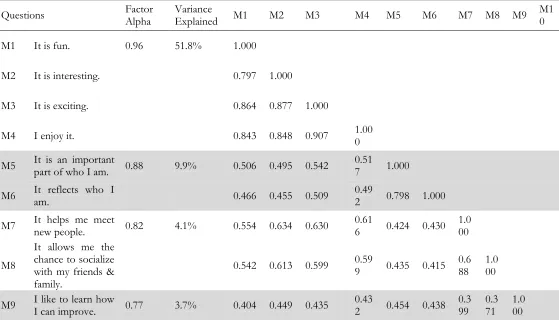
SPSS 25 was utilizedfor data reduction via principal component analysis (PCA). Results confirmed the data were suitable for a factor analysis, with a Kaiser-Meyer-Olkin Measure of Sampling Adequacy of .97, well above the suggested value of 0.6 (Pallant, 2016), and a significant Bartlett‟s Test of Sphericity (χ2 (595) = 11556.40, p < .001).Four dimensions accounting for 69.5% of the total variance were revealed. Scale items for each of the dimensions considered different motivations for participating in sport and/or physical activity: enjoyment (dimension one), identity (dimension two), socialization (dimension three), and self-improvement (dimension four). Enjoyment accounted for the most variance at 51.8%, followed by one‟s identity with a particular sport or physical activity explaining 9.9%. One‟s penchant for capitalizing on sport and/ or physical activity as a chance to socialize or improve one‟s self resulted in explaining 4.1% and 3.7% of the variance, respectively.
Of the 35 items, those that cross loaded at higher than .32 (Costello & Osborne, 2005)were deleted. Per Hair, Black, Babin, and Anderson (2014), “loadings ±.50 or greater are considered practically significant” (p. 115); thus, using this as a minimum threshold when interpreting results of the oblimin rotation we deleted items loading at .6 or below, resulting in 26 items. Reliability analyses were then run on the remaining items across the four dimensions. Dimension one (enjoyment) accounted for 12 of the 26 items and was reduced to four items with excellent internal consistency (.96). Dimension two (identity) was found to be in the range of good internal consistency (.88), having gone from nine to two items; as did dimension three (socialization), which had two items and an internal consistency of .82. Lastly, dimension four (self-improvement) decreased from three items to two, with an acceptable internal consistency of .77.Thus, the final motivation subscalewas completed with 10 items and a Cronbach alpha of .93(see Table 1).
Table 1
Items included in the instrument measuring Motivation, Inter-Item Correlation Matrix, Factor Alphas, and Variance Explained
Questions Factor Alpha Variance Explained M1 M2 M3 M4 M5 M6 M7 M8 M9 M10
M1 It is fun. 0.96 51.8% 1.000
M2 It is interesting. 0.797 1.000
M3 It is exciting. 0.864 0.877 1.000
M4 I enjoy it. 0.843 0.848 0.907 1.000
M5 It is an important part of who I am. 0.88 9.9% 0.506 0.495 0.542 0.517 1.000 M6 It reflects who I am. 0.466 0.455 0.509 0.492 0.798 1.000 M7 It helps me meet new people. 0.82 4.1% 0.554 0.634 0.630 0.616 0.424 0.430 1.000
M8
It allows me the chance to socialize with my friends & family.
0.542 0.613 0.599 0.599 0.435 0.415 0.688 1.000
M10 I like to learn new ways to play and
be active. 0.531 0.568 0.578
0.57
4 0.542 0.514 0.481 0.455 0.620 1.000 All items are measured on a 10-point Likert scale (1 = Do Not Agree At All; 10 = Completely Agree) and prefaced with the following instructions:
Please think about all the sports you play and your levels of physical activity, then rate to what extent you agree with the below statements. I participate in sport and/or physical activity because:
Note. Areas are shaded to distinguish between subdimensions.
5.3 Confidence
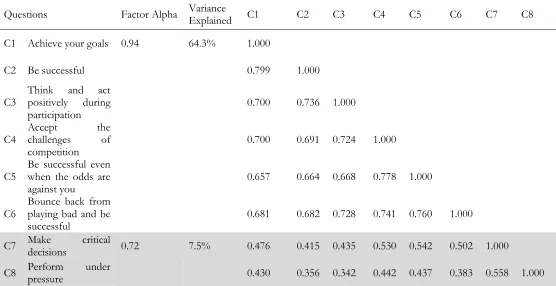
Items for the confidence subscale were adapted from the Trait Sport Confidence Inventory instrument (Vealy, 1986). The scale consists of 13 items which ask participants to think about their self-confidence as it relates to their sport and compare it to the most self-confident athlete they know. After adaptation, the instrument asked participants to consider how confident they feel when playing their sport or participating in physical activityacross 1410-point Likert scale questions. A PCA was run, confirming the data were suitable for factor analysis. The Kaiser-Meyer-Olkin Measure of Sampling Adequacy was .95 and Bartlett‟s Test of Sphericity was significant (χ2 (91) = 4229.58, p < .001). The PCA revealed two dimensions, accounting for 71.8% of the variance, with the first (belief in physical skills leading towards positive outcomes) and second (beliefin cognitive abilities) dimension explaining 64.3% and 7.5%, respectively. Results from the oblimin rotation revealed four items that loaded below the ideal cutoff of .7(Hair et al., 2014), which were deleted. Reliability analyses were run on the remaining 10 items, resulting in a final confidence scalewith eight items, across two dimensions, and a Cronbach alpha of .92. Internal consistency was excellent for dimension one (belief in physical skills leading towards positive outcomes) at .94 and acceptable for the second dimension (belief in cognitive abilities) at .72 (see Table 2).
Table 2
Items included in the instrument measuring Confidence, Inter-Item Correlation Matrix, Factor Alphas and Variance Explained
Questions Factor Alpha Variance Explained C1 C2 C3 C4 C5 C6 C7 C8
C1 Achieve your goals 0.94 64.3% 1.000
C2 Be successful 0.799 1.000
C3 Think and act positively during
participation 0.700 0.736 1.000
C4 Accept challenges the of
competition 0.700 0.691 0.724 1.000
C5 Be successful even when the odds are
against you 0.657 0.664 0.668 0.778 1.000
C6 Bounce back from playing bad and be
successful 0.681 0.682 0.728 0.741 0.760 1.000
C7 Make decisions critical 0.72 7.5% 0.476 0.415 0.435 0.530 0.542 0.502 1.000
C8 Perform pressure under 0.430 0.356 0.342 0.442 0.437 0.383 0.558 1.000
All items are measured on a 10-point Likert scale (1 = Not Confident; 10 = Very Confident) and prefaced with the
Answer the questions below based on how confident you feel when you are playing your sport or participating in physical activity. Please answer how you really feel, not how you would like to feel. How confident are you in your ability to...
Note. Areas are shaded to distinguish between subdimensions.
6. Discussion
The purpose of this study was to develop an assessment tool to provide sport and physical activity participants and administrators an efficient and effective tool to assess one‟s affective domain of physical literacy as situated in the constructs of motivation and confidence. The instrument was developed with an adolescentsample because it is at this age when dropout rates from sport and physical activity significantly increase (Crane & Temple, 2015; Witt & Dangi, 2018) and potentially direct youth towards a lifecourse trajectory void of or lacking in healthy physical activity (Barnekow-Bergkvist et al., 1998; Terzian & Moore, 2009).We feel that framing the questions in the context of sport and/or physical activity better aligns with the conceptualization(s), practical applications, and implications of affective physical literacy within the context of applied sport management and/or physical activity and education spaces.We accomplished this purpose with the development of an18-item questionnaire, spanning two constructs (motivation and confidence) across six dimensions (enjoyment, identity, socialization, self-improvement, belief in physical skills, and belief in cognitive abilities).By doing so, we are not making a value judgment on current physical literacy assessments; rather, we anticipate and aspire for this instrumentto serve as a supplement to sport and physical activity programs, coaches, managers, and participants outside of an educational setting. By doing this, we are avoiding the potential deterministic approach of performance and skill mastery (Lundvall, 2015), and instead recognize the affective domain of physical literacy as a contributing factor in one‟s lifelong journey towards healthy physical activity (Robinson & Randall, 2017).
As an antecedent to physical activity and sport participation, motivation encompasses factors ranging from physical competence to social acceptance to enjoyment (Stuntz& Weiss, 2010; Weiss & Williams, 2004). The final tally of motivation items comprising the scale was 10, across four dimensions, with high internal consistency.The four dimensions, being enjoyment, identity, socialization, and self-improvement, are straightforwardand make it easy to understand and interpret the results, allowing for sport and physical activity managers and administrators, as well as participants and policy makers, tomake appropriate adjustments or corrections accordingly. For instance, if a recreational league administers the assessment to its members and finds that they joined the league because they enjoy the sport, then the focus of games and practices can be planned more towards having fun. Conversely, if they find players to be more interested in self-improvement, they may consider modifying training regimens or practices to foster sport-specific skilldevelopment. If a sport-based youth development (SBYD) program wants to reach and retain more participants, they might benefit from knowing their local youth want to spend their time socializing and provide more opportunities to share stories, personally connect, and be inclusive through their sport and physical activity program offerings. Regardless, a suggested, if not expected, outcome of all physical activity, recreation, sport and SBYD programs can and should be to provide for and enhance youth and athlete development opportunities (Fraser-Thomas, Côté, & Deakin, 2005). Motivation is key to physical literacy, as it allows individuals to capitalize on their embodied abilities so as to enhance their quality of life (Whitehead, 2005, 2013a, 2013b), and thus, is a critical element of one‟s journey on an active lifecourse (IPLA, 2017).
In addition to its implications within the aforementioned affective elements of physical literacy, physical activity is linked to health-related outcomes such as healthy weight levels, physiological and psychological well-being, as well as cardiorespiratory and muscular fitness (see Barnett et al., 2016; CDC, 2011; DHHS, 2018).Regular physical activity has also been found to have positive effects on brain development (Esteban-Cornejo et al., 2017), academic competency (Esteban-Cornejo, Tejero-Gonzalez, Sallis, &Veiga, 2015), and behavior in school (CDC, 2018); in contrast to the detrimental impacts of low levels of physical activity, which can lead to missed school days and poor academic performance (Aspen Institute, 2015). As such,results from this instrument can guide educational policy makers towards curricula and school-based programming that educates and empowers youth to become more physically literate and experience not only the inherent benefits of physical activity, but also the supplemental and intangible outcomes associated with increased academic engagement and educational behaviors. Likewise, results can be utilized by programs to evaluate their current offering of sport or physical activities and determine if they are appropriately promoting and facilitating a lifetime commitment to being active. Given the decreasing rates of sport participation and physical activity, as well as increased health issues and sedentary lifestyles in the United States (Aspen Institute, 2016), it is critical to understand why adolescents may not be demonstrating more concern for the development and enhancement of their physical and mental well-being. Therefore, thistoolcan be helpful in evaluating long-term developmental outcomes associated with physical activity and sport programs.
This assessment is designed to be a snapshot of one‟s affective physical literacy in early adolescence (ages 10 to 14), the utility of which may allow for not only access to, but also opportunities for engagement with sport and physical activity across the lifecourse. As such, the ease of use and longitudinal application of the tool validates its practical importance to any sport, fitness, physical activity, recreation, or SBYD program. Affording users with the capability to consider motivation, across four subdimensions, and confidence, between two subdimensions, of both sport and physical activity is a unique contribution of this manuscript. As this instrument becomes more widely utilized to assess affective physical literacy among sport and physical activity participants, we expect it will be adapted and validated for participants and administrators of all skill-levels, abilities, knowledge and ages in a multitude of environments. This should afford participants, coaches, administrators, and policy makers the opportunity to better understand the affective domain of physical literacy (i.e., motivation and confidence) and enhance programming and daily interaction with sport and physical activity so as to facilitate and promote physical literacy.
7. Limitations
As with most studies, this one was not without limitations. Though the participant sample was diverse regarding both race and gender, being recruited from only two middle schools in the same county may limit generalizability to a greater population. The scoring of this new instrument could also prove a bit restrictive, as it does not align with any other sport and physical activity scales to which it can be compared. However, physical literacy is conceptualized as pertinent to an individual‟s journey, arguably not to be considered in regards to peers or other groups (Whitehead, 2013b). Regardless, the opportunity to parcel out scores pertaining to the core affective domains of physical literacy (i.e., motivation and confidence) is beneficial to better understanding one‟s particular psychosocial/emotional engagement with sport and physical activity. Lastly, a unique contribution is that the assessment considers motivation and confidence in both sport and physical activity. However, this can also serve as a limitation given the instrument‟s current inability to determine whether a participant‟s self-reported scores were in the context of sport, physical activity, or both. We recommend future iterations consider this potential hindrance.
References
Aspen Institute. (2015). Physical Literacy in the United States: A model, strategic plan, and call to action. Retrieved September 30 from
http://aspenprojectplay.org/sites/default/files/PhysicalLiteracy_AspenInstitute.pdfbandura
Aspen Institute. (2016). Sport for all, play for life: A playbook to get every kid in the game. Retrieved September 29
fromhttps://assets.aspeninstitute.org/content/uploads/2015/01/Aspen-Institute-Project-Play-Report.pdf?_ga=2.43945125.1828781204.1569807104-994970563.1569807104.
Bandura, A. (1986). Social foundations of thought and action: A social cognitive theory. Englewood Cliffs, NJ: Prentice-Hall.
Barnekow-Bergkvist, M., Hedberg, G., Janlert, U., & Jansson, E. (1998). Prediction of physical fitness and physical activity level in adulthood by physical performance and physical activity in adolescence – an 18-year follow-up study. Scandinavian Journal of Medicine and Science in Sports, 8(5), 299-308.
Barnett, L. M., Ridgers, N. D., Zask, A., & Salmon, J. (2015). Face validity and reliability of a pictorial instrument for assessing fundamental movement skill perceived competence in young children. Journal of Science and Medicine in Sport, 18(1), 98-102.
Barnett, L. M., Stodden, D., Cohen, K. E., Smith, J. J., Lubans, D. R., Lenoir, M., Livonen, S., Miller, A.D., Laukkanen, A., Dudley, D., Lander, N.J., Brown, H., & Morgan, P.J. (2016). Fundamental movement skills: An important focus. Journal of Teaching in Physical Education, 35(3), 219-225.
Bradley, R.H., McRitchie, S., Houts, R.M., Nader, P., & O‟Brien, M. (2011). Parenting and the decline of physical activity from age 9 to 15. International Journal of Behavioral Nutrition and Physical Activity, 8(33), 1-10. Canadian Assessment of Physical Literacy (2017). Manual for test administration (2nded.). Retrieved from
https://www.capl-eclp.ca/capl-manual/.
Canadian Sport for Life (2014). Physical literacy assessment in Canada. Retrieved from http://canadiansportforlife.ca/sites/default/files/resources/Physical%20Literacy%20Assessment%20in%20 Canada%20Final%20May%206%20-%202014.pdf.
Centers for Disease Control and Prevention (2011). The CDC guide to strategies to increase physical activity in the community. Retrieved from https://www.cdc.gov/obesity/downloads/PA_2011_WEB.pdf.
Centers for Disease Control and Prevention (2018). Healthy schools: Physical activity facts. Retrieved from https://www.cdc.gov/healthyschools/physicalactivity/facts.htm.
Chang, S., & Gibson, H. (2015). The relationships between four concepts (involvement, commitment, loyalty, and habit) and consistency in behavior across leisure and tourism. Tourism Management Perspectives, 13, 41-50. Conroy, D. (2004). The unique psychological meanings of multidimensional fears of failing. Journal of Sport &
Exercise Psychology, 26, 484-491.
Corbin, C. B. (2016). Implications of physical literacy for research and practice: A commentary. Research Quarterly for Exercise and Aport, 87(1), 14-27.
Costello, A.B., & Osborne, J.W. (2005). Best practices in exploratory factor analysis: Four recommendations for getting the most from your analysis. Practical Assessment, Research & Evaluation, 10(7), 1-9.
Crane, J., & Temple, V. (2015). A systematic review of dropout from organized sport among children and youth. European Physical Education Review, 21(1), 114-131.
Crocker, P. R. E., Eklund, R. C., & Kowalski, K. C. (2000). Children‟s physical activity and physical self-perceptions. Journal of Sports Sciences, 18, 383-394.
Department of Health and Human Services (DHHS, 2018). Physical activity guidelines for Americans (2nd ed). Washington, DC: U.S. Department of Health and Human Services.
Durden-Myers, E.J., Green, N.R., & Whitehead, M.E. (2018). Implications for promoting physical literacy. Journal of Teaching in Physical Education, 37, 262-271.
Edwards, L. C., Bryant, A. S., Keegan, R. J., Morgan, K., & Jones, A. M. (2017). Definitions, foundations and associations of physical literacy: a systematic review. Sports Medicine, 47(1), 113-126.
Edwards, L.C., Bryant, A.S., Keegan, R.J., Morgan, K., Cooper, S., & Jones, A.M. (2018). „Measuring‟ Physical Literacy and Related Constructs: A Systematic Review of Empirical Findings. Sports Medicine, 48(3), 659-682.
Esteban-Cornejo, I., Tejero-Gonzalez, C. M., Sallis, J. F., &Veiga, O. L. (2015). Physical activity and cognition in adolescents: A systematic review. Journal of Science and Medicine in Sport, 18(5), 534-539.
Esteban-Cornejo, I., Cadenas-Sanchez, C., Contreras-Rodriguez, O., Verdejo-Roman, J., Mora-Gonzalez, J., Migueles, J. H., Henriksson, P., Davis, C.L., Verdejo-Garcia, A., Catena, A., & Ortega, F. B. (2017). A whole brain volumetric approach in overweight/obese children: Examining the association with different physical fitness components and academic performance. The ActiveBrains project. NeuroImage, 159, 346-354.
Farrey, T. (2017). Sport for all: Play for Life. A vision worth pursuing. Keynote address given at 2017 North American Society for Sport Management in Denver, CO on Friday, June 2, 2017.
Feltz, D.L., & Chase, M.A. (1998). The measurement of self-efficacy and confidence in sport. In J. Duda (Ed.), Advancements in sport and exercise psychology measurement (pp. 65-80). Morgantown, WV: Fitness Information Technology.
Fox, K. R., & Corbin, C. B. (1989). The physical self-perception profile: Development and preliminary validation. Journal of Sport & Exercise Psychology, 11, 408–430.
Fraser-Thomas, J.L., Côté, J., &Deakin, J. (2005). Youth sport programs: an avenue to foster positive youth development, Physical Education and Sport Pedagogy, 10(1), 19-40.
Gardner, H. & Hatch, T. (1989). Multiple intelligences go to school: Educational Implications of the theory of multiple intelligences. Educational Researcher, 18(8), 4-10.
Giblin, S., Collins, D., & Button, C. (2014). Physical literacy: Importance, assessment and future directions. Sports Medicine, 44, 1177-1184.
Green, N.R., Roberts, W.M., Sheehan, D., & Keegan, R.J. (2018). Charting physical literacy journeys within physical education settings. Journal of Teaching in Physical Education, 37, 272-279.
Hair Jr., J.F., Black, W.C., Babin, B.J., & Anderson, R.E. (2014). Multivariate data analysis (7thed.). Essex, England: Pearson Education Limited.
Hays, K., Thomas, O., Maynard, I., &Bawden, M. (2009). The role of confidence in world-class sport performance. Journal of Sports Sciences, 27(11), 1185-1199.
Horn, T. S. (2004). Developmental perspectives on self-perceptions in children and adolescents. In M. R. Weiss (Ed.), Developmental sport and exercise psychology: A lifespan perspective (pp. 101-143). Morgantown, WV: Fitness Information Technology.
Hu, L., McAuley, E., &Elvasky, S. (2005). Does the physical self-efficacy scale assess self-efficacy or self-esteem? Journal of Sport & Exercise Psychology, 27, 152-170.
International Physical Literacy Association (IPLA, 2017). About. Retrieved from https://www.physical-literacy.org.uk/about/
Kendzierski, D., &DeCarlo, K. J. (1991). Physical activity enjoyment scale: Two validation studies. Journal of Sport & Exercise Psychology, 13, 50-64.
Li, F. (1999). The exercise motivation scale: Its multifaceted structure and construct validity. Journal of Applied Sport Psychology, 11, 97-115.
Lloyd, M., Colley, R. C., & Tremblay, M. S. (2010). Advancing the debate on 'fitness testing' for children: Perhaps we're riding the wrong animal. Pediatric Exercise Science, 22(2), 176-182.
Lonsdale, C., Hodge, K., & Rose, E. A. (2008). The behavioral regulation in sport questionnaire (BRSQ): Instrument development and initial validity evidence. Journal of Sport and Exercise Psychology, 30, 323-355.
Lonsdale, C., Hodge, K., Hargreaves, E. A., & Ng, J. Y. (2014). Comparing sport motivation scales: A response to Pelletier et al. Psychology of Sport and Exercise, 15, 446-452.
Lundvall, S. (2015). Physical literacy in the field of physical education - A challenge and a possibility. Journal of Sport and Health Science, 4, 113-118.
McAuley, B. E., & Gill, D. (1983). Reliability and validity of the physical self-efficacy scale in a competitive sport setting. Journal of Sport & Exercise Psychology, 5, 410–418.
McGrane, B., Belton, S., Powell, D., Woods, C. B., &Issartel, J. (2015). Physical self-confidence levels of adolescents: Scale reliability and validity. Journal of Science and Medicine in Sport, 19, 563-567.
McGrane, B., Belton, S., Powell, D., &Issartel, J. (2017). The relationship between fundamental movement skill proficiency and physical self-confidence among adolescents. Journal of Sports Sciences, 35(17), 1709-1714. Mallett, C., Kawabata, M., Newcombe, P., Otero-Forero, A., & Jackson, S. (2007). Sport motivation scale-6 (SMS-6):
A revised six-factor sport motivation scale. Psychology of Sport and Exercise, 8, 600-614.
Manzo, L. G., Silva, J. M., & Mink, R. (2001). The Carolina Sport Confidence Inventory. Journal of Applied Sport Psychology, 13, 260-274.
Mullan, E., Markland, D., &Ingledew, D. K. (1997). A graded conceptualization of self-determination in the regulation of exercise behavior: Development of a measure using confirmatory factor analytic procedures. Personality and Individual Differences, 23(5), 745-752.
Ntoumanis, N., &Standage, M. (2009). Motivation in physical education classes: A self-determination theory perspective. Theory and Research in Education, 7, 194-202.
Pallant, J. (2016). SPSS survival manual: A step by step guide to data analysis using SPSS (6thed.). Berkshire, England: Open University Press/McGraw-Hill.
Society of Physical Activity Promoters in Public Health (June, 2015).Canada‟s physical literacy consensus statement. Retrieved from http://physicalliteracy.ca/wp-content/uploads/2016/08/Consensus-Handout-EN-WEB_1.pdf
Passport for Life (2013). Living skills. Retrieved from https://passportforlife.ca/home/teachers-guide/passport-life-assessments/student-online-surveys/living-skills
Pelletier, L. G., Fortier, M. S., Vallerand, R. J., &Briere, N. M. (2001). Associations among perceived autonomy support, forms of self-regulation, and persistence: A prospective study. Motivation and Emotion, 25, 279-306.
Pelletier, L. G., Fortier, M. S., Vallerand, R. J., Tuson, K. M., Briere, N. M., & Blais, M. R. (1995). Toward a new measure of intrinsic motivation, extrinsic motivation, and amotivation in sports: The sport motivation scale (SMS). Journal of Sport & Exercise Psychology, 17, 35-53.
Pelletier, L. G., Rocchi, M. A., Vallerand, R. J., Deci, E. L., & Ryan, R. M. (2013). Validation of the revised sport motivation scale (SMS-II). Psychology of Sport and Exercise, 14, 329-341.
Robinson, D.R., & Randall, L. (2017). Marking physical literacy or missing the mark on physical literacy? A conceptual critique of Canada‟s physical literacy assessment instruments. Measurement in Physical Education and Exercise Science, 21(1), 40-55.
Roetert, E.P., & Jefferies, S.C. (2014). Embracing physical literacy. Journal of Physical Education, Recreation and Dance, 85(8), 38-40.
Ryan, R.M., Frederick, C.M., Lepes, D., Rubio, N. & Sheldon, K.M. (1997). Intrinsic motivation and exercise adherence. International Journal of Sport Psychology, 28, 335-354.
Ryckman, R. M., Robbins, M. A., Thornton, B., & Cantrell, P. (1982). Development and validation of a physical self-efficacy scale. Journal of Personality and Social Psychology, 42(5), 891.
Society of Health and Physical Educators (SHAPE America). (2014). National standards & grade-level outcomes for K-12 physical education. Champaign, IL: Human Kinetics.
Spengler, J.O., & Cohen, J. (2015). Physical literacy: A global environmental scan. Washington, DC: The Aspen Institute.
Stodden, D. F., Goodway, J. D., Langendorfer, S. J., Roberton, M. A., Rudisill, M. E., Garcia, C., & Garcia, L. E. (2008). A developmental perspective on the role of motor skill competence in physical activity: An emergent relationship. Quest, 60(2), 290-306.
Stuntz, C. P., & Weiss, M. R. (2010). Motivating children and adolescents to sustain a physically active lifestyle. American Journal of Lifestyle Medicine, 4(5), 433-444.
Terzian, M., & Moore, K. A. (2009). Physical inactivity in US adolescents: Family, neighborhood, and individual factors. Child Trends Research Brief. Publication# 2009-28.
Tremblay, M., &Llyod, M. (2010). Physical literacy measurement - The missing piece. Physical & Health Education Journal, 76(1), 26.
Vealey, R. S. (1986). Conceptualization of sport-confidence and competitive orientation: Preliminary investigation and instrument development. Journal of Sport Psychology, 8, 221–246.
Vealey, R. S., Garner-Holman, M., Hayashi, S. W., &Giacobbi, P. (1998). Sources of sport-confidence: Conceptualization and instrument development. Journal of Sport and Exercise Psychology, 20(1), 54-80. Weiss M. R., & Williams L. (2004). The why of youth sport involvement: A developmental perspective on
motivational processes. In M. R. Weiss (Ed.), Developmental sport and exercise psychology: A lifespan perspective (pp. 223-268). Morgantown, WV: Fitness Information Technology.
Whitehead, J. R. (1995). A study of children‟s physical self-perceptions using an adapted physical self-perception profile questionnaire. Pediatric Exercise Science, 7(2), 132-151.
Whitehead, M. (2005). Developing physical literacy. Unpublished paper presented at PE for Today‟s Children: Primary Physical Education Conference. Roehampton, England.
Whitehead, M. (2007). Physical literacy: Philosophical considerations in relation to developing a sense of self, universality and propositional knowledge. Sports Ethics and Philosophy, 1(3), 281-298.
Whitehead, M. (2013a). The history and development of physical literacy. Journal of Sport Science and Physical Education (Bulletin 65), 22-28.
Whitehead, M. (2013b). Definition of physical literacy and clarification of related issues. Journal of Sport Science and Physical Education (Bulletin 65), 29-34.
Witt, P.A., & Dangi, T.B. (2018). Why children/youth drop out of sports. Journal of Park and Recreation Administration, 36(3), 191-199.