105 Vol. 11, No. 1, 2016, 105-113
ISSN: 2279-087X (P), 2279-0888(online) Published on 12 February 2016
www.researchmathsci.org
On Pseudo regular Fuzzy Graphs
N.R.Santhi Maheswari1 and C.Sekar21
Department of Mathematics, G.Venkataswamy Naidu College, Kovilpatti-628502 Tamil Nadu, India. e-mail: [email protected]
2
Department of Mathematics, Aditanar College of Arts and Science, Tiruchendur-628216 Tamil Nadu, India. e-mail: [email protected]
Received 21 December 2015; accepted 10 January 2016
Abstract. In this paper, pseudo degree, pseudo regular fuzzy graphs and totally pseudo regular fuzzy graphs are defined. Comparative study between pseudo regular fuzzy graph and totally pseudo regular fuzzy graph is done. A necessary and sufficient condition under which they are equivalent is provided. Characterization of pseudo regular fuzzy graph in which underlying crisp graph is a cycle is investigated. Also, whether the results hold for totally pseudo regular fuzzy graphs is examined.
Keywords: 2-degree, average degree of a vertex in graph, regular fuzzy graph, totally regular fuzzy graph.
AMS Mathematics Subject Classification (2010): 05C12, 03E72, 05C72
1.Introduction
In this paper, we consider only finite, simple, connected graphs. We denote the vertex set and the edge set of a graph G by V (G) and E(G) respectively. The degree of a vertex v is the number of edges incident at v, and it is denoted by d(v). A graph G is regular if all its vertices have the same degree. The 2-degree of v [4] is the sum of the degrees of the vertices adjacent to v and it is denoted by t(v). We call ()
() , the average degree of v . A
graph is called pseudo-regular if every vertex of G has equal average degree [3].
Fuzzy set theory was first introduced by Zadeh in 1965 [17]. The first definition of fuzzy graph was introduced by Haufmann in 1973 based on Zadeh's fuzzy relations in 1971. In 1975, A. Rosenfeld introduced the concept of fuzzy graphs [8]. Now, fuzzy graphs have many applications in branches of engineering and technology.
2.Review of literature
106
irregular interval-valued fuzzy graphs [16]. Sunitha and Mathew discussed about growth of fuzzy graph theory [14].
Regular fuzzy graphs play a central role in combinatorics and theoretical computer science. These motivate us to define pseudo degree in fuzzy graphs and pseudo regular fuzzy graphs and discussed some of its properties. This paper deals with significant properties of pseudo regular fuzzy graphs.
3. Preliminaries
We present some known definitions and results for ready reference to go through the work presented in this paper.
By graph, we mean a pair G*=(V,E), where V is the set and E is a relation on V. The elements of V are vertices of G* and the elements of E are edges of G*.
Definition 3.1. 2-degree of v is defined as the sum of the degrees of the vertices adjacent
to v and it is denoted by t(v) [4].
Definition 3.2. Average degree of v is defined as ()
() , where t(v) is the 2-degree of v and
d(v) is the degree of v and it is denoted by da(v) [3].
Definition 3.3. A graph is called pseudo-regular if every vertex of G has equal
average-degree [3].
Definition 3.4. A Fuzzy graph denoted by G : (σ, µ) on the graph G* : (V,E): is a pair of functions (σ, µ), where σ : V → [0; 1] is a fuzzy subset of a set V and µ : V X V → [0; 1] is a symmetric fuzzy relation on σ such that for all u, v in V the relation µ(u, v) =µ(uv)≤ σ(u) Ʌσ(v) is satisfied, where σ and µ are called membership function [7].
Definition 3.5. Let G : (σ, µ) be a fuzzy graph on G*: (V,E). The degree of a vertex u is dG(u) =Σµ(uv), for uv∈ E and µ(uv) = 0, for uv not in E, this is equivalent to dG(u) = Σ µ(uv) , u≠v and uv∈E [7].
Definition 3.6. Let G : (σ, µ) be a fuzzy graph on G* : (V,E). If d(v) = k for all v ∈ V, then G is said to be a regular fuzzy graph of degree k [7].
Definition 3.7. The total degree of a vertex u is defined as td(u) = Σµ(uv) + σ(u) = d(u) + σ(u), uv ∈ E [9]. If each vertex of G has the same total degree k, then G is said to be a totally regular fuzzy graph of degree k or k-totally regular fuzzy graph [7].
4. Pseudo regular fuzzy graphs
In this section, we define pseudo degree, pseudo regular fuzzy graph and totally pseudo regular fuzzy graph and discussed about its properties.
107
Definition 4.2. Let G : (σ, µ) be a fuzzy graph on G* : (V, E). A pseudo (average) degree of a vertex v in fuzzy graph G is denoted by da(v) and is defined by da(v) = ()
∗(), where
dG*(v) is the number of edges incident at v.
Definition 4.3. Let G : (σ, µ) be a fuzzy graph on G* : (V,E). If da(v) =k, for all u in V; then G is called k- pseudo regular fuzzy graph.
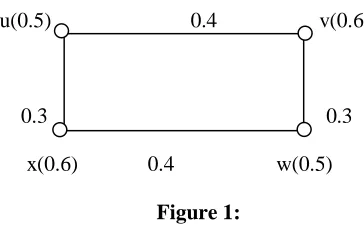
Example 4.4. Consider a fuzzy graph on G*(V, E).
u(0.5) 0.4 v(0.6)
0.3 0.3 x(0.6) 0.4 w(0.5)
Figure 1:
Here, d(u) = 0.7; d(v) = o.7; d(w) = 0.7; d(x) = 0.7 and dG*(u) = 2, for all u ϵ V. Now, u
is adjacent to v and x. So, da(u) =
()()
= 0.7. So, da(v) = 0.7, for all v ϵ V. Hence G
is o.7- pseudo regular fuzzy graph.
5 . Totally pseudo regular fuzzy graphs
Definition 5.1. Let G : (σ, µ) be a fuzzy graph on G*(V,E). The total pseudo degree of a vertex v is G is denoted by tda(v) and is defined as tda(v) = da(v) + σ(v), for all v ϵ V.
Definition 5.2. Let G be a fuzzy graph on G*(V,E). If all the vertices of G have the
same total pseudo degree k, then G is said to be a totally k- pseudo regular fuzzy graph.
Example 5.3. Consider a fuzzy graph on G*(V,E).
u(0.45) 0.4 0.1
v(0.5) 0.5 w(0.6) 0.2 x(0.4)
y(0.4)
108
Here, da(u)=0.45, da(v)=0.4, da(w)=0.3, da(x)=0.5, da(y)=0.5 and t da(u) = 0.9, for all u ϵ
V. So, G is totally 0.9 –pseudo regular fuzzy graphs.
Remark 5.4. A pseudo regular fuzzy graph need not be a totally pseudo regular fuzzy
graph.
Example 5.5. Consider a fuzzy graph on G*(V, E).
u(0.5) 0.2 v(0.6) 0.4 0.4
x(0.8) 0.2 w(0.7)
Figure 3:
The graph is 0.6-pseudo regular fuzzy graph. But tda(u)≠tda(v). Hence G is not a totally
pseudo regular fuzzy graph.
Remark 5.6. A totally pseudo regular fuzzy need not be a pseudo regular fuzzy graph.
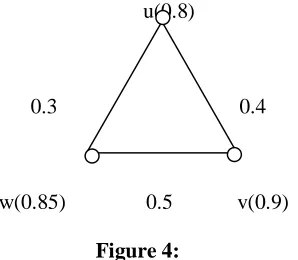
Example 5.7. Consider a fuzzy graph on G*(V, E).
u(0.8) 0.3 0.4
w(0.85) 0.5 v(0.9)
Figure 4:
The graph is totally 1.65 – pseudo regular fuzzy graph. But da(u) ≠ da(v). Hence G is not
a pseudo regular fuzzy graph.
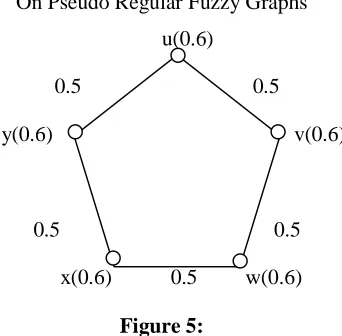
Remark 5.8. A pseudo regular fuzzy graph which is totally pseudo regular fuzzy graph.
109 u(0.6) 0.5 0.5 y(0.6) v(0.6)
0.5 0.5 x(0.6) 0.5 w(0.6)
Figure 5:
The graph is 1- pseudo regular fuzzy graph and totally 1.6- pseudo regular fuzzy graph.
Theorem 5.10. Let G:(σ, µ) be a fuzzy graph on G*(V, E). Then σ is a constant function if and only if the following are equivalent.
(i) G is a pseudo regular fuzzy graph. (ii) G is a totally pseudo regular fuzzy graph.
Proof. Assume that σ is a constant function. Let σ(u) = c, for all uϵV. Suppose G is a pseudo regular fuzzy graph. Then da(u) = k, for all uϵV. Now, tda(u) = da(u)+σ(u) = k+c.
Hence G is a totally pseudo regular fuzzy graph. Thus (i) ⟹ (ii) is proved. Suppose G is a totally pseudo regular fuzzy graph. Then tda(u) = k , for all uϵV ⟹ da(u)+σ(u) = k, for
all uϵV ⟹ da(u)+ c = k, for all uϵV ⟹ da(u) = k-c, for all uϵV. Hence G is a pseudo
regular fuzzy graph. Thus (ii) ⟹ (i) is proved. Hence (i) and (ii) are equivalent.
Conversely, suppose (i) and (ii) are equivalent. Let G be a pseudo regular fuzzy graph and a totally pseudo regular fuzzy graph. Then da(u) = k1 and tda(u) = k2 , for all
uϵV. Now tda(u) = k2 for all uϵV ⟹ da(u)+σ(u) = k2, for all uϵV ⟹ k1+σ(u) = k2, for all
uϵV ⟹ σ(u) = k2-k1, for all uϵV. Hence σ is a constant function.
Theorem 5.11. Let G:(σ, µ) be a fuzzy graph on G*(V, E). If G is both pseudo regular and totally pseudo regular fuzzy graph then σ is a constant function.
Proof. Assume that G is both pseudo regular and totally pseudo regular fuzzy graph.
Then da(u) = c and tda(u) = k , for all uϵV. Now, tda(u) = k ⟹ da(u)+σ(u) = k⟹ c+σ(u) =
k ⟹ σ(u) = k-c = constant. Hence σ is a constant function.
110 u(0.6) z(0.6) 0.3 0.1 0.2
v(0.6) x(0.4) 0.3 0.5 0.1 0.1 w(0.6) y(0.6)
Figure 6:
Here, σ is a constant function. But G is neither pseudo regular fuzzy graph nor a totally pseudo regular fuzzy graph.
Theorem 5.13. Let G:(σ, µ) be a fuzzy graph on G*(V, E), a cycle of length n. If µ is a constant function, then G is a pseudo regular fuzzy graph.
Proof. If µ is a constant function say µ (uv) = c; for all uv ϵ E. Then da(u) =2c, for all u ϵ V: Hence G is c- pseudo regular fuzzy graph.
Remark 5.14. Converse of the above theorem 5.13 need not be true.
Example 5.15. Fuzzy graph given in example 4.4 is a pseudo regular fuzzy graph. But µ
is not constant.
Theorem 5.16. Let G:(σ, µ) be a fuzzy graph on G*(V, E), an even cycle of length n. If the alternate edges have same membership values, then G is a pseudo regular fuzzy graph.
Proof. If the alternate edges have the same membership values, then
µ (ei) = {c1, if i is odd
c2 , if i is even.
If c1 = c2; then µ is a constant function. So, by above theorem G is a pseudo regular
fuzzy graph. If c1 ≠ c2; then dG(v) = c1 + c2 for all v ϵ V: So, tG(v) = 2c1+2c2 and
dG*(v) = 2. Hence G is a (c1 + c2 )-pseudo regular fuzzy graph.
Remark 5.17. The above theorem 5.16 does not hold for a totally pseudo regular fuzzy
graph.
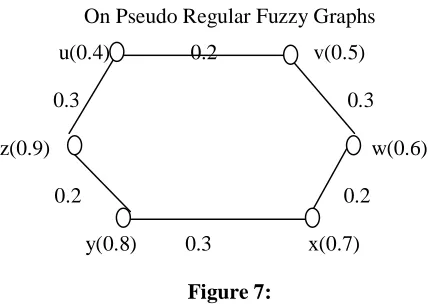
111
u(0.4) 0.2 v(0.5) 0.3 0.3 z(0.9) w(0.6)
0.2 0.2 y(0.8) 0.3 x(0.7)
Figure 7:
Hence alternate edges have the same membership values, but G is not a totally pseudo regular fuzzy graph.
Result 5.19. If v is a pendant vertex, then pseudo degree of v is the degree of the vertex
which is adjacent with v. (or) If v is a pendant vertex, then da(v)=dG(u), where u is the
vertex adjacent with v.
Theorem 5.20. If G is a regular fuzzy graph on G*(V,E), an r-regular graph, then da(v)=dG(v), for all v∈G.
Proof. Let G is a k-regular fuzzy graph on G*(V,E), an r-regular graph. Then dG(v)=k, for
all v∈G and dG *
(v)=r, for all v∈G. So, tG(v)=∑ (vi), where each vi (for i=1,2,. . . r) is
adjacent with vertex v⟹ tG(v)=∑ (vi)=r k. Also,
da(v)= ()
∗()⟹ da(v)= ()
⟹ da(v)=
⟹ da(v)= ⟹ da(v)= dG(v).
Theorem 5.21. Let G be a fuzzy graph on G*(V,E), an r-regular graph. Then G is pseudo regular fuzzy graph if G is a regular fuzzy graph.
Proof. Let G be a k-regular fuzzy graph on G*(V,E), an r-regular graph. ⟹ da(v)= dG(v),
for all v∈G. ⟹ da(v)=k, for all v∈G⟹ all the vertices have same pseudo degree k. Hence
G is k-pseudo regular fuzzy graph.
Theorem 5.22. Let G : (σ, µ)be a fuzzy graph such that G*(V, E) is anycycle of length n. If G is a pseudo regular fuzzy graph, then G is a fuzzy cycle.
Proof.
Case 1: Let G be a fuzzy graph on G*(V,E), an odd cycle of length n. Then by theorem 5.13, G is pseudo regular fuzzy graph only if µ is constant. Hence all edges have same membership values. So there does not exist unique edge uv such that µ(uv) = Ʌ{µ(xy) : xy ∈E} Hence G is a fuzzy cycle.
Case 2: Let G be a fuzzy graph on G*(V,E), an even cycle of length n.
112
Remark 5.23. The above theorem 5.23 does not hold for a pseudo totally regular fuzzy
graph.
Example 5.24. Consider a fuzzy graph on G*(V;E), a cycle on 6 vertices.
u(0.55) 0.2 v(0.6) 0.2 0.3 z(0.55) w(0.55)
0.3 0.1 y(0.6) 0.3 x(0.55)
Figure 8:
Here, G is totally 1- pseudo regular fuzzy graph. But there exist unique edge wx such that µ(wx) = Ʌ{ µ(xy) : xy ∈ E} = 0.1. Hence G is not a fuzzy cycle.
Theorem 5.25. A pseudo regular fuzzy graph on any cycle does not have fuzzy bridge. Proof.
Case 1: Let G be a fuzzy graph on G*(V,E), an odd cycle of length n. Then by theorem 5.13, G is pseudo regular fuzzy graph only if µ is constant. So, the removal of any edge does not reduce the strength of connectedness between any pair of vertices. Hence G has no fuzzy bridge.
Case 2: Let G be a fuzzy graph on G*(V,E), an even cycle of length n. Then by theorems 5.13 and 5.16, G is pseudo regular fuzzy graph only if µ is constant (or) alternate edges have same membership values. So, the removal of any edge does not reduce the strength of connectedness between any pair of vertices. Hence G has no fuzzy bridge.
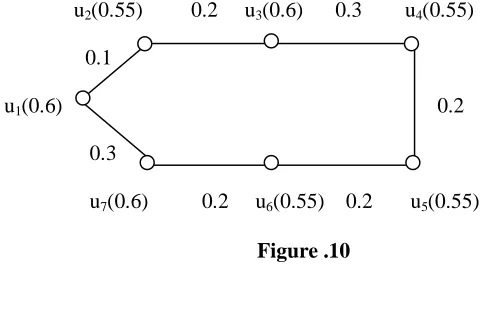
Remark 5.26. The above theorem 5.26 does not hold for pseudo totally regular fuzzy
graph.
Example 5.27. Consider a fuzzy graph on G*(V,E)
u2(0.55) 0.2 u3(0.6) 0.3 u4(0.55)
0.1
u1(0.6) 0.2
0.3
u7(0.6) 0.2 u6(0.55) 0.2 u5(0.55)
113
Hence G is totally 1-pseudo regular fuzzy graph. But the edge (u2u3) is a fuzzy bridge,
since µ(u2u3) = 0.2 and if we remove the edge, then we have µ(23) = Ʌ{µ(xy) : xy ∈E}=
0.1.
Acknowledgement: This work is supported by F.No.4-4/2014-15, MRP- 5648/15 of the
University Grant Commission, SERO, Hyderabad, India.
REFERENCES
1. M.Akram and Wieslaw A.Dudek, Regular bipolar fuzzy graphs, Neural Comput. and Applic., 21 (Suppl 1) (2012) S197- S205.
2. M.Akram and W.Dudek, Regular intuitionistic fuzzy graphs, Neural Computing and Application, DOI: 1007/s00521-011-0772-6.
3. A.Yu, M.Lu and F.Tian, On the spectral radius of graphs, Linear Algebra and Its Applications, 387 (2004) 41-49.
4. D.S.Cao, Bounds on eigenvalues and chromatic numbers, Linear Algebra Appl., 270 (1998) 1-13.
5. M.Tom and M.S.Sunitha, Sum distance in fuzzy graphs, Annals of Pure and Applied Mathematics, 7(2) ( 2014) 73-89.
6. A.Nagoor Gani and S.R.Latha, On Irregular Fuzzy graphs, Applied Mathematical Sciences, 6 (2012) 517-523.
7. A.Nagoor Gani and K.Radha, On regular fuzzy graphs, Journal of Physical Sciences, 12 (2008) 33–40.
8. A.Rosenfeld, Fuzzy graphs, In: L.A.Zadeh,K.S.Fu, M.Shimura, eds., Fuzzy sets and Their Applications, Academic Press (1975) 77-95.
9. N.R.Santhi Maheswari and C.Sekar, On (2, k)- regular fuzzy graph and totally (2,k)- regular fuzzy graph, International Journal of Mathematics and Soft Computing, 4(2) (2014) 59-69.
10. N.R.Santhi Maheswari and C.Sekar, On neighbourly edge irregular fuzzy graphs, International Journal of Mathematical Archive, 6(10) (2015) 224-231.
11. N.R.Santhi Maheswari and C.Sekar, On neighbourly edge irregular bipolar fuzzy graphs, Annals of Pure and Applied Mathematics, 11(1) (2016) 1-8.
12. N.R.Santhi Maheswari and C.Sekar, On m-neighbourly Irregular fuzzy graphs, International Journal of Mathematics and Soft Computing, 5(2) (2015) 145-153. 13. S.Samantha and M.Pal, Irregular bipolar fuzzy graphs, International Journal of
Application of Fuzzy Sets, 2 (2012) 91-102.
14. M.S.Sunitha and S.Mathew, Fuzzy graph theory: a survey, Annals of Pure and Applied Mathematics, 4(1) (2013) 92-110.
15. S.Mathew, M.S.Sunitha and Anjali, Some connectivity concepts in bipolar fuzzy graphs, Annals of Pure and Applied Mathematics,7(2) (2014) 98-108.
16. M.Pal and H.Rashmanlou, Irregular interval-valued fuzzy graphs, Annals of Pure and Applied Mathematics, 3(1) (2013) 56-66.