30
INTERNATIONAL JOURNAL OF ADVANCES IN ENGINEERING RESEARCH
SEGMENTATION IN COLOR IMAGE ON THE BASIS OF
MORPHOLOGICAL CLUSTERING
Vinay Thakur1,Chandni 2, Poonam Devi3
ECE,Sri Sai University
Abstract: By using classification in 3-D color space, we represent a method to segment color images. In the ordinary 3-D images, the cluster appears in its histograms do not fit in well-known statistical model. For this reason, we have a classifier that depends on mathematical Morphology, and mostly we use watershed algorithm. By this method we can show the expected color clusters accurately on various images. Lastly, to segment color images into logical regions, we accomplish a Markovian labeling that have the advantages of morphological classification results.
INTRODUCTION: In this review paper, we focus on segment of colour images by using different clustering methods in RGB spatial frequency components. We have several methods that are used parametric classifiers in these components and we assume that the individual cluster follow multivariate normal distributions [1]. Since this supposition can be evaluated in case of natural images, one can introduce non-parametric classifiers to analyze clusters [2]. The morphological classifiers are made up by a family of non-parametric classifiers. This type of classifiers states that by the analyses of histogram morphology, we can identify the clusters. For this purpose, RGB histograms are considered as 3-D images and the processing can be completed by mathematical morphology techniques[3]. In this paper, the watershed algorithm is connected with the original morphological classifier.This paper is organize as: In sect ion 2, ‗the states of the art of morphological classifiers‘. In section 3,‘classifications of watershed algorithm for colour images and their properties‘. In section 4, we show the segmentation results and we discuss some results in section 5. Lastly in section 6 we have the conclusion.
STATE OF THE ART OF MORPHOLOGICAL CLASSIFIERS
31
INTERNATIONAL JOURNAL OF ADVANCES IN ENGINEERING RESEARCH
G
0
labelling process is performed. Each cluster is then dilated in the feature space to enlarge its volume. In this method, as well as difference of Gaussians from the histogram and to threshold it. The resulting binary image of cluster cores is processed by a morphological closing and a connected component labelling is performed. Each component, i.e. each cluster, is then dilated to enlarge its volume in the feature space. At this stage of the method, as well as the two methods described above, one cannot give the level to every colour component, some colours of the original image in the colour space do not match to any cluster. Park et al. propose to assign each respective cluster a colour.The watershed algorithm is a morphological algorithm that gives a segmentation of images into basins where one basin is belongs to a local minima of an image and the crest values are the basin boundaries (so-called watersheds). Using this algorithm as a classifier was first suggested by Soille. The watershed algorithm leads due to the presence of local minima in the segmentation of colour space.
CLASSIFICATION WITH THE CONNECTED WATERSHED ALGORITHM
3.1. Method Description
This classification has four steps:Step 1.
The histogram H of the color image is calculated:to magnify the smallest clusters, a log function is applied,and then the reverse process is performed. This results the 3-D image H. Then for any color ‗c‘ we have,
H(1)(c)=M-log(1+H(c)),where M=max log(1+H(c)). The projection HR
(1)
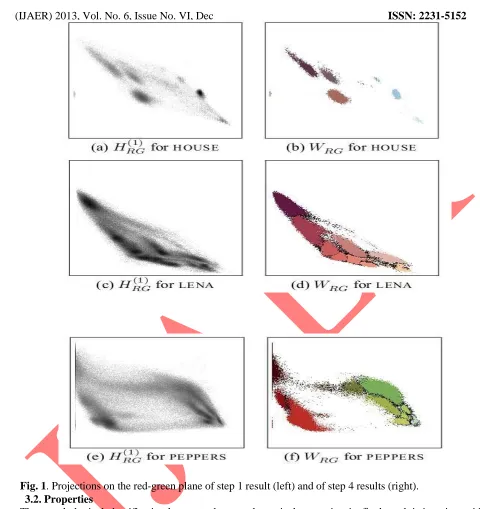
of H (1) on the red-green plane is shown for three initial color images (HOUSE, LENA,
(1)
and PEPPERS) in the left column of figure 1. High values in HRG
are de-picted by darker pixels.
Step 2. A 3-D Gaussian filter is applied to H(1) in order to smooth the color space data —we have empirically set to 9 the variance which gives us satisfactory results. The resulting 3-D image (of the color space) is H(2).
Step 3. Two operators remove the remaining local minima: first, a morphological closing with the 18- connectivity of structuring elements, then a cutting of very low values. The threshold of the letter operator is set to the median of non-zero values of H(2) and, since a log function has been applied during step 1, one is guaranteed not to suppress a significant cluster.
Step 4. Finally, we apply a connected version of the watershed algorithm [4]; ―connected‖ means that there is no boundary between the basins. The result is a partition of the RGB image: every color c has a label. Let us denote by W the resulting labeling.
The right column of figure 1 depicts for several initial color images the projections of the resulting W on the red-green plane, WRG. Let, l being a label,
H(r,g)(l) = ∑ H(r,g,b)
b,W(r,g,b)=l
lm(r,g) = arg max h(r,g)(l)
l‘m(r,g) = arg max h(r,g)(l). l, l≠lm(r,g)
The projections WRG aim at showing the most represented label for the colors (r, g, ∗) in W according to
the original color image contents. This label, lm(r, g), is depicted by a grey pixel in WRG (or by a color
pixel
if you have a color version of this paper). Last, a white pixel means that h(r, g)(lm(r, g)) < 5, i.e., that
there is about no pixel of the initial image with components (r, g, ∗); and a black pixel means that lm(r, g)
32
INTERNATIONAL JOURNAL OF ADVANCES IN ENGINEERING RESEARCH Fig. 1. Projections on the red-green plane of step 1 result (left) and of step 4 results (right).
3.2. Properties
The morphological classification has several strong theoretical properties: its final result is invariant with respect to the following transforms when applied onto H (if we neglect rounding errors).
• Applying an increasing function f: H0(c) = f( H(c) ) ⇒ W 0(c) = W (c). • Applying a linear transform L to colors:
33
34
INTERNATIONAL JOURNAL OF ADVANCES IN ENGINEERING RESEARCH
δ
FINAL SEGMENTATION
4.1 Non-contextual labelling
_ Let Wi , the i
th
basin of W denoted by ci , centre of color space in original image
_
Ci= 1 ∑
H(c)c Cardi cԑWi
Where cardi = ∑ H(c)
.
cϵ Wi
The segmentation S of the color image I for any image pixel(∞) is given as : S(x)=ci(x)
Where i(x) such that I(x)ϵWi(x)
(a)Original image (b)Non-Contextual Labelling
4.2. Markovian
labeling
To obtain a contextual segmentation, we assume that each basin Wi describes a class ωi in the RGB
space. The a priori probability of the class ωi is estimated by:
P (ωi) = cardi / ∑ j cardj.
The probability p(x|ωi) is modeled by a multivariate normal distribution whose parameters are set by
analyzing the restriction of the 3-D histogram H to the basin Wi:
P(x/wi) = exp — t
(I(x)-ci)∑i -1+
(I(x)-ci)
2√det∑i
Where ∑i= 1/cardi-1∑cϵWi H(c) t
(c-ci
)(c-ci).
We then perform the Iterated Condition Mode (ICM) al-gorithm [12] with the non-contextual labeling S as initial-ization. We use a simple Potts model to ensure getting regularized regions; with SM being the labeling of I, N8 be-ing the neighborhood corresponding to 8-connectivity, and δ being the Kronecker‘s
symbol, we set:
Upotts(x) = α
X
∑ SM (x0 )
35
INTERNATIONAL JOURNAL OF ADVANCES IN ENGINEERING RESEARCH
36
INTERNATIONAL JOURNAL OF ADVANCES IN ENGINEERING RESEARCH
(b)Markovian Segmentation SM
RESULTS
Figure 2 depicts the results of the non-contextual labelling (sub-figure (b)) and of the Markovian labelling (sub-figure (c)) on the PEPPERS colour image. As one can see, the objects are correctly segmented.We have obtained remarkable results with our method on many images. With the classical HOUSE image, an easy image for the classification in the colour space, the detection of cluster is performed as expected.
CONCLUSION
In this review paper, we have presented an automatic classification method which is based on mathematical morphology with the colour images. In this the watershed algorithm is worked as classifier. This method gives us very good results even in case of coloured images which are difficult to segment. But there is a disadvantage with this method, it is a time consuming and memory consuming.
REFERENCES
[1] W.H. Cho, S.Y. Park, and J.H. Park, ―Segmentation of color image using deterministic annealing EM,‖ in Proc. of the IEEE Intl. Conf. on Pattern Recognition, Barcelona, Spain, Sep. 2000, vol. 3, pp. 646–
649.
[2] D. Comaniciu and P.Meer,―Robust analysis of fea-ture spaces: Color image segmentation,‖Proc. of IEEE Conf. on Computer Vision and Pattern Recogni-tion, San Juan, Puerto Rico, June 1997, pp.
750–755.
[3] P. Soille, Morphological Image Analysis – Principles and Applications, Springer-Verlag, 1999.
[4] A. Bieniek and A. Moga, ―An efficient watershed algorithm based on connected components,‖ Pattern Recognition, vol. 33, no. 6, pp. 907–916, 2000.
[5] L. Vincent and P. Soille, ―Watersheds in digital spaces: an efficient algorithm based on immersion simula-tions,‖ IEEE Trans. on PAMI, vol. 13, no. 6, pp. 583– 598, 1991.
[6] K. Saarinen, ―Color image segmentation by a water-shed algorithm and region adjacency graph process-ing,‖ in Proc. of IEEE Intl. Conf. on Image Processing, Austin, TX, USA, Nov. 1994, vol. 3, pp.
1021–1025.
37
INTERNATIONAL JOURNAL OF ADVANCES IN ENGINEERING RESEARCH IEEE Intl. Conf. on Image Processing, Washington DC, USA, 1995, vol. 3, pp. 548–551.
[8] J.-G. Postaire, R.D. Zhang, and C. Lecocq-Botte, ―Cluster analysis by binary morphology,‖ IEEE Trans.
on PAMI, vol. 15, no. 2, pp. 170–180, 1993.
[9] R.D. Zhang and J.-G. Postaire, ―Convexity dependent morphological transformations for mode detection in cluster analysis,‖ Pattern Recognition, vol. 27, no. 1, 135–148, 1994.
[10] S.H. Park, I.D. Yun, and S.U. Lee, ―Color image seg-mentation based on 3-D clustering: Morphological ap-proach,‖ Pattern Recognition, vol. 31, no. 8, pp. 1061– 1076, 1998. [11] P. Soille, ―Morphological partitioning of multispectral images,‖ Journal of Electronic Imaging, vol. 5,
no. 3, 252–265, 1996.