
International Journal of Advances in Engineering Research
AUTONOMIC WIRELESS SENSOR NETWORKS
*Dr Umesh Sehgal, #Prabhjot
*Associate Professor,ARNI School of Computer Science,Arni University,Kathagarh [email protected]
#Prabhjot, M.Tech student Arni University,Kathgarh
ABSTRACT
Wireless ad hoc networks of sensor nodes are envisioned to be deployed in the physical environment to monitor a wide variety of real-world phenomena. Wireless sensor networks (WSN’s) are becoming popular in military and civilian applications such as surveillance, monitoring, disaster recovery, home automation and many others. Almost any sensor network application requires some form of self-configuration and autonomic functionality. Following IBM’s initiatives towards Autonomic computing many architectures and protocols for network self-organization and management have been proposed and being implemented.
The paper presents concept of Autonomic Computing with respect to Wireless Sensor Network. The paper introduces Wireless sensor network basics, design goals and challenges along with current and future applications. It articulates basic needs of incorporating autonomic computing principles into the design of Wireless Sensor Networks. The paper also outlines recent contributions to Autonomic network architectures, research projects, proposed architectures and routing protocols for Autonomic Wireless Sensor Networks.
INTRODUCTION
Wireless sensor networks have critical applications in the scientific, medical, commercial, and military domains. Examples of these applications include environmental monitoring, smart homes and offices, surveillance, and intelligent transportation systems. It also has significant usages in biomedical field. As social reliance on wireless sensor network technology increases, we can expect the size and complexity of individual networks as well as the number of networks to increase dramatically.
Wireless sensor networks are typically used in highly dynamic, and hostile environments with no human existence (unlike conventional data networks), and therefore, they must be tolerant to the failure and loss of connectivity of individual nodes. The sensor nodes should be intelligent to recover from failures with minimum human involvement. Networks should support process of autonomous formation of connectivity, addressing, and routing structures. Recent researches on Autonomic Networking can serve as basis for design of Autonomic Wireless Sensor Networks.
International Journal of Advances in Engineering Research
AUTONOMIC COMPUTING
Background
The dramatic increase in computing devices, increased computing capacity and complexity combined with popularity of internet resulted in phenomenal growth in heterogeneous networks and network applications. With this increasing system complexity, network management issues and communication protocols are reaching a level beyond human ability to manage and secure so the stability of current infrastructure, systems, and data is at an increasingly greater risk to suffer outages and general disrepair. Future network algorithms need to be adaptive, robust, and scalable with fully distributed and self-organizing architectures. Automation, self-protection and self management of wide spread networks may solve the problem till some extent.
As the concept of self management rooted up, the most direct inspiration one can think of was the autonomic function of the human central nervous system, where autonomic controls use motor neurons to send indirect messages to organs at a sub-conscious level. These messages regulate temperature, breathing, and heart rate without conscious thought. Observation and analysis of these complex adaptive systems found in nature became a major source of inspiration to design algorithms for self-managed, self-organized, self-configuring and self-protecting systems.
Taking inspiration from autonomic nervous system of the human body IBM created a foundation for autonomic systems by taking initiatives towards Autonomic Computing for relieving humans from the burden of managing computer systems which is growing enormously till the extent of unmanageability. [01]
Autonomic System
Autonomic System is a system which works independently on predefined policies and rules without any human interaction and manage and configure itself on its own based on predefined rules and gained knowledgs over the time. IBM has defined the following four functional areas for self management of Autonomic System: (Ref [03])
Self-Configuration: Automatic configuration of components. Self-Healing: Automatic discovery, and correction of faults.
Self-Optimization: Automatic monitoring and control of resources to ensure the optimal functioning with respect to the defined requirements.
Self-Protection: Proactive identification and protection from arbitrary attacks.
IBM Autonomic Computing architecture
International Journal of Advances in Engineering Research
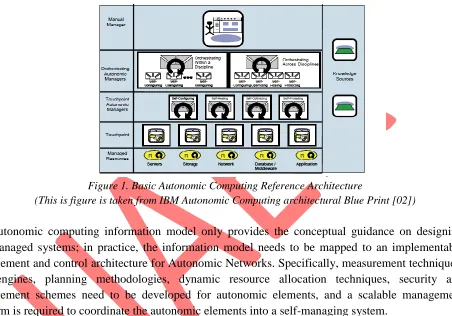
management interfaces, which exposes two types of hooks, sensors and effectors. The sensors are used by the AM to obtain the internal state of the MR, and the effectors are used by the AM to change the behavior of the MR. The AM enables self-management of the resource using a „„monitoring, analysis, planning, and execution‟‟ control loop, with supporting knowledge of the computing environment, management policies, and some other related considerations.
Figure 1. Basic Autonomic Computing Reference Architecture
(This is figure is taken from IBM Autonomic Computing architectural Blue Print [02])
The autonomic computing information model only provides the conceptual guidance on designing self-managed systems; in practice, the information model needs to be mapped to an implementable management and control architecture for Autonomic Networks. Specifically, measurement techniques, rule engines, planning methodologies, dynamic resource allocation techniques, security and management schemes need to be developed for autonomic elements, and a scalable management platform is required to coordinate the autonomic elements into a self-managing system.
WIRELESS SENSOR NETWORK
International Journal of Advances in Engineering Research
Figure 2. Basic Architecture Of Wireless Sensor Network. (Ref [04])
Each autonomic node in a sensor network is typically equipped with a radio transceiver or other wireless communications device, a processing unit which can be a small micro-controller, sensing unit, and an energy source, usually an alkaline battery. Sometimes, a mobilizer is needed to move sensor node from current position and carry out the assigned tasks. Since the sensor may be mobile, the base station may require accurate location of the node which is done by location finding system. The size of a single sensor node can vary from shoebox-sized nodes down to devices the size of grain of dust. [04]
Figure 3. Components of a Sensor Node (Ref [04])
Requirements and Design factors in Wireless Sensor Network–
International Journal of Advances in Engineering Research
source which can be a battery. The wireless sensor node being a microelectronic device, can only be equipped with a limited power source [04]. Over the remote inaccessible place with less human control and existence, power sources play critical role in survival of sensor nodes. Power source should be intelligently divided over sensing, computation, and communications phases as per requirement. Sensors can be hibernated when inactive. Lots of current researches are focusing on designing power-aware protocols and algorithms for wireless sensor networks. Recently, solar energy is also considered as an option for empowering remote sensor nodes which are exposed environment. 3. Network Efficiency and Data Aggregation: Flooding raw sensed data over the network can easily congest the network. Some critical applications like intruder detectors require urgent transmission and faster processing of data which may degrade performance and loose reliability due to congestion or latency in the network. Intelligent aggregation of sensed data and elimination of unwanted and redundant information and data compression can be a solution for efficient resource and energy utilization and congestion avoidance. Many algorithms like directed diffusion [06] are proposed to facilitate data aggregation and dissemination within the context of WSNs.
4. Intelligent Routing: In many applications, sensor nodes are moving nodes and can change place dynamically. Routing protocols must be adaptive to these changes and should be healing and self-configuring. The information should be persistent in spite of changes in network nodes. Low processing capacity of a node creates many challenges for routing packets throughout the neighbouring nodes intelligently. As discussed above, some applications may require a faster communication and instant response. Routing algorithms should be intelligent to choose minimum hop and minimum distance paths for data transfer. [07]
5. Management challenge – Managing the communication over heterogeneous networks is basic challenge in self-managed system because policies and communication protocols plan an important role in network communication. Also, it is necessary to balance the level of detail the network is providing to the client against the rate at which energy is being consumed while gathering the data. Clearly, it is preferable to have the network automatically do this tuning, rather than requiring manual intervention.
These basic requirements and design goals serve as challenge for current technology. Though current IP routing protocol exist and have significant applications in current networks and Internet, they do not satisfy complete design requirements in Wireless sensor networks because WSN nodes typically has limited computing capacities and less power. So WSN‟s require a different infrastructure and protocol stack which can be implemented using autonomic computing concept as we will discuss in next section.
WIRELESS SENSOR NETWORKS AND AUTONOMIC COMPUTING
International Journal of Advances in Engineering Research
As discussed above, there can be sensor nodes which are moving and can change their position dynamically or even leave the network coverage area. Therefore, a pre-programmed configuration for the network will not work. Self-configuring nodes can set up network connections, evaluate if there are any gaps in the WSN and replace a moved or dead node in the network. Since sensors can be deployed in an unattended area (e.g., forest and ocean) or physically unreachable area (e.g., inside a building wall), they are required to operate with the minimum aid from base stations or human administrators. Although majority of current sensor application have already considered this in their network design, there is still a need for WSN to have the ability to reconfigure and recover itself without too much human intervene, especially in inaccessible environment. [04, 05]
Sensor reading usually contains some noises; it may be a false positive due to malfunction of sensors. Sensors are required to collectively self-heal (i.e., detect and eliminate) false positives in their sensor readings instead of transmitting them to base stations. This can also reduce power consumption of sensors because data processing within the sensor incurs much less power consumption than data transmission does [10].
Sensor nodes are generally exposed to much harsher conditions than standard computing equipment, and are thus subject to energy depletion and incidental damage. Battery failure can result in lost sensor node. This leads to a gradual degradation of the network as individual nodes are lost. Network paths break and gaps appear in the coverage area. A WSN needs to adapt to the changes, recover from losses and be self-protected. This can be achieved by renegotiating network routes, monitoring voltage levels within sensor node, controlling each node by an agent or base station and upon failure activating redundant nodes to replace damaged ones, or by informing some higher-level entity which can provide assistance.
As discussed in requirements, maximum efficiency needs to be gained from the available energy as the available energy at each sensor node is limited. Sensing, Processing and data transfer phases require lot of energy so each node should be able to sense process and transfer data intelligently hence
self-optimization is an important trait for WSN protocols. Energy savings can be achieved by putting the nodes into a low power sleep mode, ready to be reactivated when the need arises. For example, sensors may decrease their duty cycles when there is no significant change in their sensor readings. This results in less power consumption in the sensors. Also, when neighboring sensors report environmental changes, a sensor may draw inference from the reports and increase its duty cycle to be more watchful for a potential local environmental change in the future. However, there exists a trade-off in that the computational cost of a globally-optimal solution such as this is often computationally intractable, whether by 8-bit nodes or 64-bit base-stations.
All basic WSN self-management principles comply with the concept of autonomic computing. So IBM autonomic computing principles can be applied to wireless sensor networks to get the desired functionality in vastly growing sensor network applications.
International Journal of Advances in Engineering Research
Given the diverse nature of these domains, it is essential that WSNs perform in a reliable and robust fashion. I believe, wireless sensor network has proved its usage in the future distributed computing environment. However, there are significant amount of technical challenges and design issues those needs to be addressed. One of the biggest challenges is the designing of efficient network management architecture to continuously support WSNs for providing services for various sensor applications. The unique features of WSNs make the design and implementation of such management architecture different enough from the traditional networks which can be satisfied by concept of Autonomic Computing. There is still no particular generic network management architecture so taking inspiration from IBMs Autonomic Computing concept and Biological neural network system many different research projects are currently being executed.
In this paper, we discussed concepts of Autonomic computing, Wireless Sensor Networks (WSN‟s). Design criteria for WSN and how it matches basic Autonomic principles. Then we overviewed few architectures and routing protocols suitable for WSN and ongoing research work of Autonomic communication and network management architectures which can be applied to WSNs. Finally, we summarized some of the WSN applications along with future usages.
REFERENCES
[01] P. Horn, “Autonomic Computing: IBMs Perspective on the State of Information Technology”, Oct. 2001. Available from the World Wide Web (WWW):
http://www.research.ibm.com/autonomic/
[02] IBM and autonomic computing, “An architectural blueprint for autonomic computing,” April 2003. Available from the WWW: http://www-03.ibm.com/autonomic/pdfs/ACwpFinal.pdf
[03] Kephart J, and Chess D, “The Vision of Autonomic Computing” Computer Magazine, IEEE, 2003. Available from WWW:
http://www.research.ibm.com/autonomic/research/papers/AC_Vision_Computer_Jan_2003.pdf
[04] I. Akyildiz, W. Su, Y. Sankarasubramaniam, and E. Cayirci, ”A survey on Sensor Networks,” IEEE Communications Magazine, vol. 40, Issue: 8, pp. 102-114, August 2002. Available from WWW: http://citeseer.ist.psu.edu/akyildiz02survey.html
[05] Yu Mengjie, Mokhtar H., Merabti M., “A Survey of Network Management Architecture in Wireless Sensor Network” Available from WWW: www.cms.livjm.ac.uk/senman/Papers/2006-093.pdf
International Journal of Advances in Engineering Research
[07] O'Hare G.M.P., O'Grady M.J., D. Marsh, Ruzzelli A. G. and TynanR. “Autonomic WirelessSensor Networks: Intelligent. Ubiquitous Sensing” Available from WWW:
www.cs.ucd.ie/csprism/publications/pub2006/ANIPLA06.pdf
[08] D. Marsh, R. Tynan, D. O‟Kane and G. M. P. O‟Hare, “Autonomic Wireless Sensor Networks,” Engineering Applications of Artificial Intelligence, vol 17-7, pp. 741-748, October 2004. Available from WWW: http://tinyoside.ucd.ie/publications/retrieve.php?publication=tynanAutonomic05.pdf
[09] Yu Cheng et al., “A generic architecture for autonomic service and network management”, Computer Communications (2006), doi:10.1016/j.comcom.2006.06.017. Available from WWW:
http://www.ece.iit.edu/~yucheng/YCheng_CompCom.pdf
[10] P. Boonma, P. Champrasert and J. Suzuki, "BiSNET: A Biologically-Inspired Architecture for Wireless Sensor Networks," In Proc. of the 2nd IEEE/IARIA International Conference on
Autonomic and Autonomous Systems (IEEE/IARIA ICAS), Santa Clara, CA, July 2006. Available from WWW: http://www.cs.umb.edu/~jxs/pub/icas-bisnet.pdf
[11] BISON: Biology-Inspired techniques for Self-Organization in dynamic Networks Project.
http://www.cs.unibo.it/bison/index.shtml
[12] Shen C, Pesch D, Irvine J.,”A Framework for Self-Management of Hybrid Wireless Networks Using Autonomic Computing Principles” In proceedings of the 3rd Annual Communication Networks and Services Research Conference (CNSR'05) - Volume 00. Available from WWW:
http://portal.acm.org/citation.cfm?id=1068503.1068711&coll=GUIDE&dl=GUIDE&CFID=94677 44&CFTOKEN=44832813
[13] Colan, M. Service-Oriented Architecture expands the vision of Web services, Part 1. June, 2004
[14] ANA: Autonomic Network Architecture Project. http://www.ana-project.org/
[15] Haggle Project. http://www.haggleproject.org
[16] CASCADAS project. http://www.cascadas-project.org
[17] Schwiebert L., Gupta S., Weinmann J., “Research Challenges in Wireless Networks of Biomedical Sensors” in proceedings of the 7th annual international conference on Mobile
computing and networking.Available from WWW: http://portal.acm.org/citation.cfm?id=381692
International Journal of Advances in Engineering Research
[19] Linnyer Beatrys Ruiz, J.M.S.N., Antonio A.F. Loureiro, “MANNA: A Management Architecture for Wireless Sensor Networks.” IEEE Communications Magazine, 2003. 41(2): p. 116-125. Available from WWW: http://www.lisha.ufsc.br/~lucas/docs/Ruiz-2003.pdf
[20] Davy S. et al. “Policy-Based Architecture to Enable Autonomic Communications”. Available from WWW:
http://techpubs.motorola.com/download/IPCOM000141400D/IPCOM000141400D.pdf
[21] Colan, M. Service-Oriented Architecture expands the vision of Web services, Part 1. June, 2004 Available from WWW: http://www-128.ibm.com/developerworks/library/ws-soaintro.html
[22] Gianni A., Di Caro, Frederick Ducatelle, Luca M. Gambardella, “BISON: Biology-Inspired techniques for Self-Organization in dynamic Networks” Available from WWW:
http://www.idsia.ch/~frederick/bison.pdf
[23] Wireless Sensor Networks Wiki. http://en.wikipedia.org/wiki/Wireless_sensor_network
[24] W. R. Heinzelman, J. Kulik, and H. Balakrishnan, "Adaptive Protocols for Information Dissemination in Wireless Sensor Networks," in proc. ACM MobiCom '99, Seattle, WA, 1999. Available from WWW:
http://www.cs.huji.ac.il/labs/danss/sensor/sensors/kulik_99adaptiveprotocols.pdf
[25] S. M. Hedetniemi, S. H. Hedetniemi, and A. Liestman, "A Survey of Gossiping and Broadcasting in Communication Networks," Networks, vol. 18, 1988.
[26] J. Kulik, W. R. Heinzelman, and H. Balakrishnan, "Negotiation base protocols for Disseminating Information in Wireless Sensor Networks," Wireless Networks, vol. 8, pp.
169-185, 2002. Available from WWW: http://citeseer.ist.psu.edu/kulik99negotiationbased.html
[27] C. Intanagonwiwat, R. Govindan, D. Estrin, J. Heidemann, and F. Silva, "Directed Diffusion for Wireless Sensor Networking," IEEE/ACM Transactions on Networking, vol. 11, pp. 2-16, Feb. 2003. Available from WWW: http://www.isi.edu/~johnh/PAPERS/Intanagonwiwat03a.pdf
[28] W. Heinzelman, A. Chandrakasan, and H. Balakrishnan, "Energy-Efficient Communication
Protocol for Wireless Micro-Sensor Networks," in Proc. of the 33rd Annual Hawaii International Conf. on System Sciences, pp. 3005- 3014, 2000. Available from WWW:
International Journal of Advances in Engineering Research
[29] S. Lindsey, C. S. Raghavendra, "PEGASIS: Power-Efficient Gathering in Sensor Information Systems," presented at Proc. of IEEE Aerospace Conference, Montana, 2002. Available from WWW:
http://ceng.usc.edu/~raghu/pegasisrev.pdf
[30] Y. Yu, R. Govindan, D. Estrin, "Geographical and Energy Aware Routing: A Recursive Data Dissemination Protocol for Wireless Sensor Networks," UCLA Computer Science
Department UCLA-CSD TR-01-0023, May, 2001. Available from WWW:
http://www.parc.com/zhao/stanford-cs428/readings/Networking/Estrin_geo-routing01.pdf
[31] Al-Obaisat Y, Braun R “On Wireless Sensor Networks: Architectures, Protocols, Applications, and Management” Auswireless Conference 2006. Available from WWW:
![Figure 2. Basic Architecture Of Wireless Sensor Network. (Ref [04])](https://thumb-us.123doks.com/thumbv2/123dok_us/8847621.1798855/4.612.70.551.220.552/figure-basic-architecture-wireless-sensor-network-ref.webp)
