Comparison of Seismic Performance of RC Flat
Slab with and without Drop Panel for Steel
Bracing
Dakshayani S Chaithra N
M. Tech. Scholar Assistant Professor
Department of Civil Engineering Department of Civil Engineering
Global Academy of Technology Global Academy of Technology
Ruchir A J Assistant Professor Department of Civil Engineering
CMR Institute of Technology
Abstract
One of the lateral load opposing frameworks in multi-storey structures is Steel brace frame. The resistance of the structure which enhances against horizontal forces by expanding its stiffness and stability is Steel bracing system in RC multi-storey building is conservative, simple to set up, involve less space and give obliged quality and inflexibility. Flat slab reinforced buildings have exhibit many dominances over conventional type of beam column building. However, the effectiveness of structure in flat slab construction is inferior in performance under earthquake loading. Flat slab requires the simple formwork which usually result in an economical construction. In present study, a G+9 storey building is analysed for seismic zone IV as per IS 1893: 2002 using ETABS software. Flat slab is used by providing drop panels and peripheral beam. For all models parameters are kept constant. The effect of the distribution of the steel bracing along with the flat slab RC frame on the seismic performance of the building is studied. The performance of the building is evaluated in terms of storey displacement, storey shear, story drifts and slab stresses. The percentage reduction in lateral displacement along X direction is tabulated. By providing drop panels the slab stress is reduced on structure compared to RC bare frame. Hence it is concluded that the use of steel bracing with flat slab in construction resists the lateral forces for many vulnerable conditions.
Keywords: Seismic Performance, Response Spectrum ANALYSIS, Steel Bracing, Flat SLAB, Drop PANEL
_______________________________________________________________________________________________________
I. INTRODUCTION
Earthquake is one of the most destructive natural calamities. It is termed as abrupt and transient motion of the earth’s crust, which originates below the surface of earth naturally. Earthquakes are caused due to the movement of the tectonic plates which are interconnected to each other, both in direction and magnitude, leads to an accumulation of strain, both at the plate boundaries and inside the plates.
At the plate or at the faults boundaries due to slips most earthquakes are produced. There are many records which show that the results which destroys many properties and loss of human lives which finally affects the national economy due to occurrence of earthquakes.
The land for housing demand is increasing due to increased population periodically. The only option is multi-storey buildings to fulfil the need of the land for housing and development of commercial offices.
The multi-storey buildings are highly susceptible to additional lateral loads due to earthquake and wind hence this type of development requires safety. As their action to lateral loads increases, the elevation of building increases. The necessity of the introduction of special measures to decrease the deformations in which multi-storey RC buildings undergoes excessive deformation.
Steel Brace and Flat Slab
For multi storey reinforced concrete these are the frequently used for hotels, hospitals, apartment houses and dormitories. In Flat slab the drawback is their lateral load resistance hence special features like steel brace can be provided for High rise constructions. – Flat slab can also be used by providing drop panels. Usually column patterns are on a rectangular grid and peripheral beam can be added. In flat slab structures the supporting columns loads are directly considered. Flat slab requires the simple formwork which usually result in an economical construction.
– Several previous studies show that the use of bracing in a building is highly efficient and economical method to resist lateral forces.
– The use of flat slab in construction of building has many advantages but it is not suitable for supporting brittle (masonry) portions.
– Use of drop panels reduces deflection by stiffening the flat slab from which slab stresses get reduced.
– To overcome some of the disadvantages of above point both bracing systems and flat slabs (with and without drop) has been combined in our present study.
Objective of the Study
– To compare the behavior of Framed RC structure with flat slab structure with drop panel and flat slab structure without drop panel.
– To study the performance level of flat slab structure when added with the steel bracing using linear dynamic analysis (response spectra method).
– To understand the behavior of FSWP (Flat Slab with Perimeter beam) with drop panel and with different bracings systems. – To study the behavior different bracing systems (i.e. X, V, Diagonal and inverted V bracings)
– To obtain the most effective bracing which resist the lateral loads among all the bracings considered.
– To study the results of lateral displacement, shear storey, storey drift and slab stresses of a flat slab structure assigned with steel bracing.
– To identify the most vulnerable building among the models considered for seismic action.
II. MATERIALS AND METHODS
Building Description
In our study four different types of bracing has been chosen i.e. X, V, inverted V and diagonal in the structure. The plan, floor to floor height, column size, peripheral beam, flat slab thickness, floor finish loads, wall loads, live loads and Response-spectra data remains same for all the models. The models consist of G+9 stories in which column spacing of5mis considered along both X and Y directions. For all models the column of size 900x900mm, peripheral beam of 500x500mm and steel bracing (ISMB 450) is kept constant. The Response Spectrum analysis is made for all the buildings using ETABS software.
Table – 1
The data is taken for the analysis is as follows:
Layout of plan 4bays x 4bays
Spacing of each bay 5m
Support condition Fixed
Height of each storey 3m
Grade of concrete 40 Mpa
Grade of reinforced steel Fe 500
Structural steel considered ISMB 450
Thickness of main wall 200mm
Column size 900mmx900mm
Peripheral Beam size 500mmx500mm
Flat slab thickness 125 mm
Floor finish load 1 kN/m2
Live load 3 kN/m2
Seismic Zone IV (Z=0.24)
Soil type II
Importance factor 1
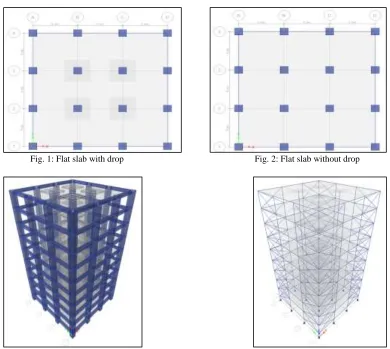
Fig. 1: Flat slab with drop Fig. 2: Flat slab without drop
Fig. 3: 3D Model of Flat structure with peripheral beam and drop panel. Fig. 4: Arrangement of bracing system.
III. RESULTS AND DISCUSSION
The present work took place to compare the dynamic response of buildings with bracings. Totally 15 models/structures are taken for dynamic analysis which includes Response Spectrum method. Code used is IS-1893 (part-I):2002 for Response Spectrum method from which storey shear, storey drift, slab stresses and storey displacement results for seismic zone-IV are obtained.
Fig. 5: Storey Displacement v/s type of bracing (drop panel) Fig. 6: Storey Displacement v/s type of bracing (without drop panel)
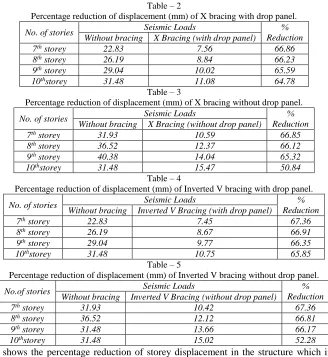
8th storey 36.52 12.37 66.12
9th storey 40.38 14.04 65.32
10thstorey 31.48 15.47 50.84
Table – 4
Percentage reduction of displacement (mm) of Inverted V bracing with drop panel.
No. of stories Seismic Loads %
Reduction Without bracing Inverted V Bracing (with drop panel)
7th storey 22.83 7.45 67.36
8th storey 26.19 8.67 66.91
9th storey 29.04 9.77 66.35
10thstorey 31.48 10.75 65.85
Table – 5
Percentage reduction of displacement (mm) of Inverted V bracing without drop panel.
No.of stories Seismic Loads %
Reduction Without bracing Inverted V Bracing (without drop panel)
7th storey 31.93 10.42 67.36
8th storey 36.52 12.12 66.81
9th storey 31.48 13.66 66.17
10thstorey 31.48 15.02 52.28
– The Table 2,3,4,5 shows the percentage reduction of storey displacement in the structure which indicates that for X and Inverted V bracing structure there is lesser reduction when compared with bare frame structure.
Fig 7: Storey Drift v/s type of bracing (drop panel) Fig. 8: Storey Drift v/s type of bracing (without drop panel)
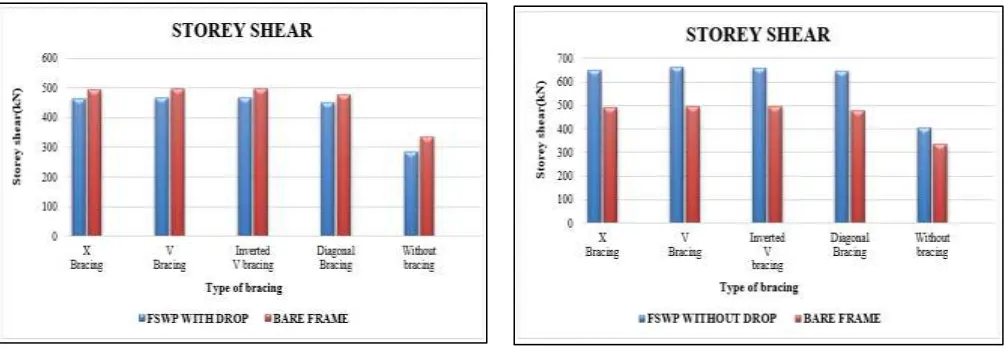
Fig. 9: Base Shear v/s type of bracing (drop panel) Fig. 10: Base Shear v/s type of bracing (without drop panel)
The Fig 9.,10 shows the variation of maximum storey shear v/s type of bracing along X direction and the comparison of Flat slab with perimeter beam (FSWP) with and without drop panel and RC bare frame. As seen above the base shear is maximum for V and inverted V bracing. It is observed that without bracing and flat slab without drop panel structure has less base shear value.
Shell Stresses
These are the shell elements considered in this study which is the internal stresses of the possible components of the structure. In that the components are as follows:
– S11: These are the direct stress (force per unit area) acting on the one negative and positive faces in the one axis direction. – S22: These are the direct stress (force per unit area) acting on positive and two negative faces in the two axis direction. – S12: These are the shearing stress (force per unit area) acting on the positive and one negative faces in the two axis direction
and action on the positive and negative two faces in the one axis direction.
Fig. 11: Shell stresses v/s type of bracing for S11 Fig. 12: Shell stresses v/s type of bracing for S22
– In this study, the inverted V and X braced frame shows minimum displacements and storey drift value when compared with V and diagonal braced frame, combined with flat slab along with drop panel.
– The percentage reduction of storey displacement in the structure is tabulated, indicates that for X and Inverted V bracing structure there is lesser reduction when compared with bare frame structure.
– Steel bracing increases the storey shear of the structure. This will be the estimate of maximum expected lateral force that a building can resist.
– Flat slabs with drop panels indicate reduction in slab stresses for S11, S12 and S22 when compared with RC bare frame. – Hence it is concluded that the use of steel bracing with flat slab in construction resists the lateral forces for many vulnerable
conditions.
REFERENCES
[1] AnujaWalvekar, H.S.Jadhav “Parametric Study of Flat Slab Building with and Without Shear Wall to Seismic Performance” Volume: 04, Apr-2015. [2] B.Anjaneyulu, K Jaya Prakash “Analysis and Design of Flat Slab by Using Etabs Software “International Journal of Science Engineering and Advance
Technology, Vol. 4 February-2016.
[3] EmaCOELHO, Paulo CANDEIAS, Giorgios ANAMATEROS “Assessment of the Seismic Behaviour of Rc Flat Slab Building Structures”. 13th World Conference on Earthquake Engineering Vancouver, B.C., Canada August 1-6, 2004.
[4] Mohammed Idrees Khan, Mr. Khalid Nayaz Khan .“Seismic Analysis of Steel Frame with Bracings using Pushover Analysis” International Journal of Advanced Technology in Engineering and Science Volume No.02, July 2014.
[5] Mohana H.S, Kavan M.R “Comparative Study of Flat Slab and Conventional Slab Structure Using ETABS for Different Earthquake Zones of India” International Research Journal of Engineering and Technology Volume: 02 June-2015
[6] Pradip S. Lande, Aniket B. Raut “Seismic Behaviour of Flat Slab Systems” Journal of Civil Engineering and Environmental Technology Volume 2, Number 10; April-June, 2015.
[7] Prof.Bhosle Ashwini Tanaji, Prof. Shaikh A. N “Analysis of Reinforced Concrete Building with Different Arrangement of Concrete and Steel Bracing system”. IOSR Journal of Mechanical and Civil Engineering Volume 12, (Sep. - Oct. 2015)
[8] R.P.Apostolska, G.S.Necevska-Cvetanovska, J.P.Cvetanovskaand N. Mircic “Seismic Performance of Flat-Slab BuildingStructural Systems”. The14thworld Conference on Earthquake Engineering October 12-17, 2008, Beijing, China
[9] R.S.More, V. S. Sawant, Y. R. Suryawanshi “Analytical Study of Different Types of Flat Slab Subjected to Dynamic Loading” International Journal of Science and Research Volume 4, July 2015
[10] Shachindra Kumar Chadhar, Dr.AbhaySharma“Seismic Behavior ofRc Building Frame with Steel Bracing System using Various Arrangements” International Research Journal of Engineering and Technology (IRJET) e-ISSN: 2395 -0056 Volume: 02 Issue: 05 | Aug-2015.
[11] Umesh.R.Biradar, ShivarajMangalgi “Seismic Response of Reinforced Concrete Structure by using Different Bracing Systems” International Journal of Research in Engineering and Technology, Volume: 03 Sep-2014