Secure Logistic Regression Based on
Homomorphic Encryption: Design and Evaluation
Miran Kim1, Yongsoo Song1,2, Shuang Wang1, Yuhou Xia3, and Xiaoqian Jiang1 1 University of California, San Diego, USA
{mrkim, yongsoosong, shw070,x1jiang}@ucsd.edu
2 Seoul National University, Republic of Korea
3 Princeton University, Princeton, USA
Abstract. Learning a model without accessing raw data has been an intriguing idea to the security and machine learning researchers for years. In an ideal setting, we want to encrypt sensitive data to store them on a commercial cloud and run certain analysis without ever decrypting the data to preserve the privacy. Homomorphic encryption technique is a promising candidate for secure data outsourcing but it is a very challenging task to support real-world machine learning tasks. Existing frameworks can only handle simplified cases with low-degree polynomials such as linear means classifier and linear discriminative analysis.
The goal of this study is to provide a practical support to the mainstream learning models (e.g. logistic regression). We adapted a novel homomorphic encryption scheme optimized for real numbers computation. We devised (1) the least squares approximation of the logistic function for accuracy and efficiency (i.e., reduce computation cost) and (2) new packing and parallelization techniques.
Using real-world datasets, we evaluated the performance of our model and demonstrated its fea-sibility in speed and memory consumption. For example, it took about 116 minutes to obtain the training model from homomorphically encrypted Edinburgh dataset. In addition, it gives fairly accurate predictions on the testing dataset. We present the first homomorphically encrypted logistic regression outsourcing model based on the critical observation that the precision loss of classification models is sufficiently small so that the decision plan stays still.
Keywords. Homomorphic encryption, approximate arithmetic, logistic regression, gradient descent
1 Introduction
Biomedical data are highly sensitive and often contain important personal information about individuals. In the United States, health care data sharing is protected by the Health In-surance Portability and Accountability Act [30], whereas biomedical research practitioners are covered under federal regulation governing the “Common Rule”, a federal policy that protects people who volunteer for federally funded research studies [26]. These policies set high standards on the protection of biomedical data and violations will lead to financial penalties and lost reputation. On the other hand, cloud computing, which significantly sim-plifies information technology environments, is the trend for data management and analysis. According to a recent study by Microsoft, nearly a third of organizations work with four or more cloud vendors [20]. The privacy concern, therefore, becomes a major hurdle for medical institutions to outsource data and computation to the commercial cloud. It is imperative to develop advanced mechanisms to assure the confidentiality of data to support secure analysis in the cloud environment.
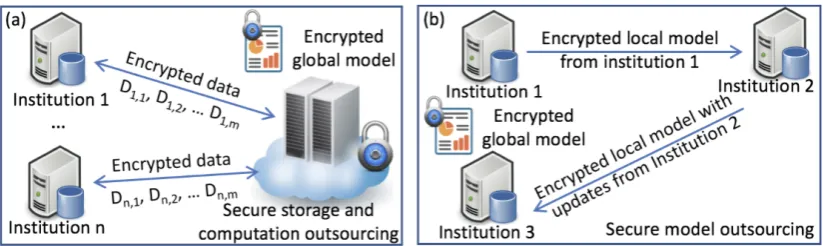
Fig. 1.Two secure models: (a) secure storage and computation outsourcing, (b) secure model outsourcing
vulnerabilities in sharing even the summary statistics; for example, the difference in mean age between a cohort ofnpatients and another cohort ofn−1 overlapped patients can reveal the actual age of a single patient.
Many medical decision-making systems rely on the logistic regression model [28, 9, 29]. However, to use them appropriately, we need to provide a sufficient sample, which requires a sample size calculation. Peduzzi et al. [25] suggested a simple guideline for a minimum num-ber of cases to include in the study: letp be the smallest of the proportions of negative or positive cases in the population andkthe number of covariates (the number of independent variables), then the minimum number of cases to include isN = 10·k/p. For example, one has three covariates to be included in the model and the proportion of positive cases in the population is 0.2 (20%). The minimum number of cases required is 10·3/0.20 = 150. For rare disease studies with many variables, it is even harder to collect enough samples from a single institution to meet this goal. We need to circumvent the privacy barriers to feed the model with more samples from different sources. As shown in Fig. 1, homomorphic encryp-tion (HE) techniques can support typical secure computaencryp-tions (e.g. secure outsourcing and secure multiparty computation) and mitigate the privacy risks by allowing all computation to be done in the encrypted format.
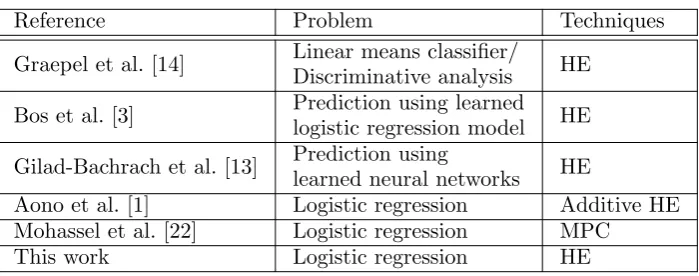
Graepel et al. [14] shed light on machine learning with homomorphically encrypted data. The article discussed scenarios that are appropriate and inappropriate to exercise machine learning with homomorphic encryption techniques. The authors provided two examples: lin-ear means classifier and linlin-ear discriminative analysis, which can be achieved by using low-degree polynomials in homomorphic encryption. However, these simple parametric models do not handle complex datasets well and they do not represent the mainstream machine learning technologies used in biomedical research [10, 21]. Additional work was carried out by Bos et al. [3] to demonstrate the feasibility of making a prediction on encrypted medical data in Microsoft’s Azure cloud. However, instead of learning from the data, this model only makes predictions using learned logistic regression models in a privacy-preserving manner. Similarly, a more recent work called CryptoNets applied trained neural networks to encrypted data only for the evaluation purpose [13]. Related works are summarized in Table 1.
Table 1.Research works in secure analysis
Reference Problem Techniques
Graepel et al. [14] Linear means classifier/ HE Discriminative analysis
Bos et al. [3] Prediction using learned HE
logistic regression model Gilad-Bachrach et al. [13] Prediction using HE
learned neural networks
Aono et al. [1] Logistic regression Additive HE
Mohassel et al. [22] Logistic regression MPC
This work Logistic regression HE
to conduct the stochastic gradient descent for solving logistic regression and neural network problems.
This method takes a completely different approach (garbled circuit and secret sharing vs homomorphic encryption) and the assumptions are widely different from ours (secure mul-tiparty computation vs secure outsourcing). There are several prominent challenges related to scalability and efficiency. Traditional methods cannot handle many iterations of multi-plications, which leads to a deep circuit and exponential growth in computational cost and storage size of the ciphertext. On the other hand, it is a nontrivial task to approximate cer-tain critical functions in machine learning models using only low-degree polynomials. Naive approximation may lead to big errors and makes the solutions intractable. Our framework proposes novel methods to handle these challenges and makes it possible to learn a logistic regression model on encrypted data based completely on homomorphic encryption.
2 Backgrounds
In this section, we introduce the setting of our problem, followed by the homomorphic en-cryption scheme.
2.1 Logistic Regression
Logistic regression is a widely used learning model in biomedicine [10]. Data for supervised learning consist of pairs (xi, yi) of a vector of co-variates xi = (xi1,· · · , xid) ∈ Rd and a
class labelyi fori= 1,· · · , n. We assume thatyi∈ {±1}for binary classification. The model
looks like:
Pr[yi|xi] =σ(yi·(1,xi)Tβ)
for the sigmoid function σ(x) = 1+exp(1 −x) where β = (β0, β1, β2,· · · , βd) are the model
parameters to be estimated. Training methods of logistic regression aim to find the optimal parameters β, which minimizes the cost (negative log-likelihood)
1 n
n
X
i=1
log(1 + exp(−yi·(1,xi)Tβ)).
2.2 Homomorphic Encryption for Approximate Arithmetic
is based on the hardness of ring learning with errors (RLWE) problem. The inherent limita-tion of these construclimita-tions is that they only support the arithmetic operalimita-tions over modular spaces so the required size of parameter for real number operations (i.e., no modular reduc-tion over plaintext space) is too large to be practically implemented. On the other hand, real-world applications such as statistical testing, neural networks, and machine learning do not require absolute precision and they are all to a certain degree approximate.
We adopted a special cryptosystem developed by Cheon et al. [6], which supports an
approximate arithmetic of encrypted messages. Different from existing methods, this
cryp-tosystem trades precision for efficiency so that the size of parameters does not grow too large (thus computationally feasible). The cryptosystem supports key generation, encryp-tion, decrypencryp-tion, addiencryp-tion, and multiplication operations. It also supports message packing and rotation, which are important to parallelize similar tasks.
The main idea is to consider an encryption noise (on the ciphertext for security) as a part of computation error occurring during approximate arithmetic. In other words, given a secret keysk, an encryptioncof a plaintextmsatisfies the equationhc, ski=m+e (modq) for some small errore.
We suppose that the underlying HE scheme is based on the RLWE assumption over the cyclotomic ring R=Z[X]/(XN + 1) for N being a power of two. Let us denote by [·]q the
reduction moduloq into the interval (−q/2, q/2]∩Zof the integer. We writeRq =R/qRfor
the residue ring ofRmodulo an integerq. The following is a description of the HE scheme [6].
• ParamsGen(λ): Given the security parameterλ, choose a power of two integerN, a
mod-ulus Q =q2, and a discrete Gaussian distribution χ. The RLWE problem of parameter (N, Q, χ) should achieve at least λ bits of security level for the semantic security of cryptosystem. Output params←(N, q, χ).
• KeyGen(params). Generate a polynomial s ∈ R by sampling its coefficient vector
ran-domly from a sparse distribution on {0,±1}N and set the secret key as sk ← (1, s).
Sample a polynomial auniformly at random fromRq and an error polynomialefromχ.
Set the public key as pk← (b, a) ∈ Rq× Rq whereb ← −as+e (modq). Let s0 ← s2.
Sample a polynomial a0 uniformly at random fromRQand e0 fromχ. Set the evaluation key as evk←(b0, a0)∈ RQ× RQ where b0← −a0s+e0+qs0 (modQ).
• Encpk(m). Sample a small polynomial v (with 0,±1 coefficients) and two error
polyno-mials e0, e1 from χ. Output the ciphertextv·pk+ (m+e0, e1)∈ Rq× Rq. • Decsk(c). For c= (c0, c1), outputm←c0+c1·s (modq0).
• Add(c,c0). Add two ciphertext and outputcadd ←c+c0 (modq0).
• Mult(c,c0). For two ciphertextsc= (c0, c1) andc0= (c00, c01), let (d0, d1, d2) = (c0c00, c0c01+ c1c00, c1c10) (mod q0). Output (d0, d1) +
j 1
qd2·evk
m
(modq0).
The native plaintext space is simply represented as the set of polynomials in R with coefficient less than q, but it can be understood as a vector of N/2-dimensional complex vector using an encoding/decoding method described in [6] (each factor is called aplaintext slot). The SIMD technique enables to parallelize both space and computation time as in BGV scheme [12]. Addition and multiplication inRcorrespond the component-wise addition and multiplications on the plaintext slots. In addition, we could get a shift of the plaintext slots, that is, ifcencrypts a plaintext vector (m1, m2, . . . , m`), we could obtain the encryption of the
shifted vector (mk+1, mk+2, . . . , m`, m1, . . . , mk). Let us denote the operation by Rot(c;k).
ciphertext byRS(c;r). It enables us to round the message and reduce the size of significand by removing some inaccurate least significant bits as in the floating-point arithmetic. Informally, we will say that the input ciphertext modulus is reduced by logr bits after this procedure where the binary logarithm will be simply denoted by log(·).
3 Secure Logistic Regression based on Homomorphic Encryption
Unlike linear regression, logistic regression does not have a closed form solution in most cases. As a result, we need to use nonlinear optimization methods to find the maximum like-lihood estimators of the regression parameters. The Newton-Raphson [34] and the gradient descent [4] are the most commonly used methods for training. Because the Newton-Raphson method involves matrix inversion and most HE schemes do not naturally support division or matrix inversion, it is difficult to evaluate the method with HE schemes. On the other hand, gradient descent does not require the division operation, and therefore, it is a better candidate for homomorphically encrypted logistic regression. Thus, we choose the gradient descent algorithm as the training method for logistic regression.
Let (xi, yi) ∈ Rd × {±1} be the supervised learning samples for i = 1,· · ·, n. If we
write zi = yi ·(1,xi) ∈ Rd+1, then the cost function for logistic regression is defined by
1
n
Pn
i=1log(1+exp(−zTi β)). Its gradient with respect toβis computed by−1n
Pn
i=1σ(−zTi β)·
zi. To find a local minimum point, the gradient descent method updates the regression
pa-rameters using the following formula untilβ converges:
β←β+α n
n
X
i=1
σ(−zTi β)·zi,
whereα is the learning rate.
3.1 Least Squares Approximation of the Sigmoid Function
Although the gradient descent method seems better suited than other training methods for homomorphic evaluation, some technical problems remain for implementation. In the preceding update formula, the sigmoid function is the biggest obstacle for evaluation, since the existing HE schemes only allow evaluation of polynomial functions. Hence the Taylor polynomials Td(x) =
Pd
k=0
f(k)(0)
k! x
k have been commonly used for approximation of the
sigmoid function ([3, 22]):
σ(x) = 1 2+
1 4x−
1 48x
3+ 1 480x
5− 17 80640x
7+ 31
1451520x
9+O(x11).
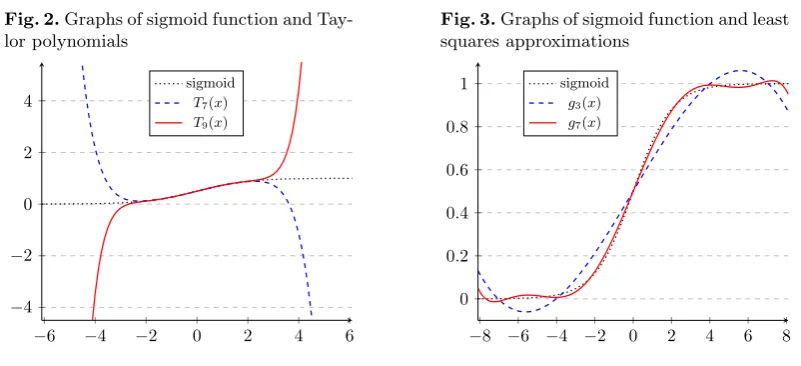
However, we observed the input values zTi β of the sigmoid function during iterations on real-world datasets and concluded that the Taylor polynomial T9(x) of degree 9 is still not enough to obtain the desired accuracy (see Fig. 2). The size of error grows rapidly as |x|
increases. For instance, we haveT9(4)≈4.44,T9(6)≈31.23, andT9(8)≈138.12. In addition, we have to use a higher degree Taylor polynomial to guarantee the accuracy of regression, but it requires too many homomorphic multiplications to be practically implemented. In summary, the Taylor polynomial is not a good candidate for approximation because it is
a local approximation near a certain point. Therefore, we adopted a global approximation
method that minimizes the mean squared error (MSE). For an integrable function f, its mean square over an interval I is defined by |1I|R
If(x)2dx, where |I| denotes the length of
I. The least squares method aims to find a polynomialg(x) of degreedwhich minimizes the MSE |1I|R
I(g(x)−f(x))
Fig. 2.Graphs of sigmoid function and Tay-lor polynomials
−6 −4 −2 0 2 4 6
−4
−2 0 2 4
sigmoid T7(x)
T9(x)
Fig. 3.Graphs of sigmoid function and least squares approximations
−8 −6 −4 −2 0 2 4 6 8 0
0.2 0.4 0.6 0.8
1 sigmoid
g3(x)
g7(x)
In our implementation, we used the degree 3 and 7 least squares approximations of the sigmoid function over the interval [−8,8], which contains all of the input values (−zTi β) during iterations. The least square polynomials are computed as:
g3(x) =a0+a1(x/8) +a3(x/8)3,
g7(x) =b0+b1(x/8) +b3(x/8)3+b5(x/8)5+b7(x/8)7,
where the coefficients vectors are (a0, a1, a3)≈(0.5,1.20096,−0.81562) and (b0, b1, b3, b5, b7)≈ (0.5,1.73496,−4.19407,5.43402,−2.50739). The degree 3 least squares approximation re-quires a smaller depth for evaluation while the degree 7 polynomial has a better precision (see Fig. 3).
3.2 Homomorphic Evaluation of Gradient Descent Algorithm
We will describe how to encode data and explain how to analyze logistic regression on encrypted data. To speed up the computation, we will use the packing mechanism to batch nslots and performnevaluations in parallel, wherenis the number of training data samples. We start with a useful aggregation operation across plaintext slots from the litera-ture [15, 7, 8]. Specifically, given a ciphertext representing a plaintext vector (m1,· · · , m`),
we introduce an algorithm (denoted by AllSum) that generates a ciphertext representing a value of P`
i=1mi in each plaintext slot. Assume that ` is chosen as a power-of-two
inte-ger. The cyclic rotation by one unit produces a ciphertext encrypting the plaintext vector (m2,· · ·, m`, m1). Then an encryption of the vector (m1+m2, m2+m3,· · · , m`+m1) is obtained by adding the original ciphertext. We repeatedly apply this method (log`−1) times with a rotation by a power of two, which generates the desired ciphertext: that is, every plaintext slot contains the same value of P`
i=1mi. The AllSum algorithm is explicitly
described in Algorithm 1.
Algorithm 1 AllSum(ct)
Input: Ciphertextct encrypting plaintext vector (m1,· · ·, m`)
Output: Ciphertext ctencrypting P`
i=1mi in each plaintext slot 1: fori= 0,1, . . . ,log`−1 do
2: Compute ct←Add(ct,Rot(ct; 2i))
3: end for
Let us assume that we are given n training data samples zi with (d+ 1) features. As
mentioned before, our goal is to securely evaluate the following arithmetic circuit:
β←β+α n
n
X
i=1
g(−zTi β)·zi, (1)
where g(x) denotes the approximating polynomial of the sigmoid function chosen in the previous subsection. We set the initialβ parameters as the zero vector for simplicity.
Because our cryptosystem only supports integer computation, all the elements are scaled by a factor of an integer p and then converted into the nearest integers for quantization. The client first receives the ciphertexts encrypting the vector p·zi from n users, and then
compromises them to obtain (d+1) ciphertextsct.zjforj= 0,1, . . . , d, each of which encrypts
the vectorp·(z1j,· · · , znj) of thej-th attributes using batching technique. Ifnis not a power
of two, the plaintext slots are zero padded so that the number of slots dividesN/2. Finally, these resulting ciphertexts (ct.z0,· · · ,ct.zd) are sent to the the server for the computation of
gradient descent.
The public server generates the trivial ciphertexts (ct.beta0,· · ·, ct.betad) as zero
poly-nomials in Rq. At each iteration, it performs a homomorphic multiplication of ciphertexts
ct.betaj andct.zj, and outputs a ciphertext encrypting the plaintext vectorp2(z1jβj, . . . , znjβj)
forj = 0,1, . . . , d. Then it aggregates the ciphertexts and performs the rescaling operation with a scaling factor ofpto manipulate the size of plaintext, returning a ciphertextct.ipthat represents a plaintext vector approximating top(zT1β, . . . ,zTnβ).
For the evaluation of the least squares polynomial g(x) at (−zTi β), we adapt the poly-nomial evaluation algorithm, denoted byPolyEval(·), suggested in [6]. Each coefficient of the polynomial should be scaled by a factor of pto be transformed into an integral polynomial. The output ciphertext ct.g contains p·g(−zTi β) in the i-th slot. Finally, the server per-forms a homomorphic multiplication of the ciphertextsct.gandct.zj,AllSumprocedure, and
rescaling by a factor ofbn
αe. These procedures generate the ciphertexts ct.grad0, . . . ,ct.gradd
corresponding to the entries of the gradient vector weighted by the learning rate and the sample size. Then it only needs to perform an addition with the model parameters β and the gradient vector over encryption, which yields a new ciphertext ct.betaj that encrypts
an approximation of the j-th scaled value of the gradient update in Equation 1. Our secure logistic regression algorithm is described in Algorithm 2.
Algorithm 2 Procedure of secure logistic regression algorithm
Input: Ciphertexts {ct.zj}0≤j≤d, a polynomialg(x), and number of iterationsIterNum 1: forj= 0,1, . . . , d do
2: ct.betaj ←0
3: end for
4: fori= 1,2, . . . ,IterNum do
5: ct.ip←RS(Pd
j=0Mult(ct.betaj,ct.zj);p)
6: ct.g←PolyEval(−ct.ip,bp·g(x)e)
7: for j= 0,1, . . . , d do
8: ct.gradj ←RS(Mult(ct.g,ct.zj);p)
9: ct.gradj ←RS(AllSum(ct.gradj);bn
αe)
10: ct.betaj ←Add(ct.betaj,ct.gradj)
11: end for
12: end for
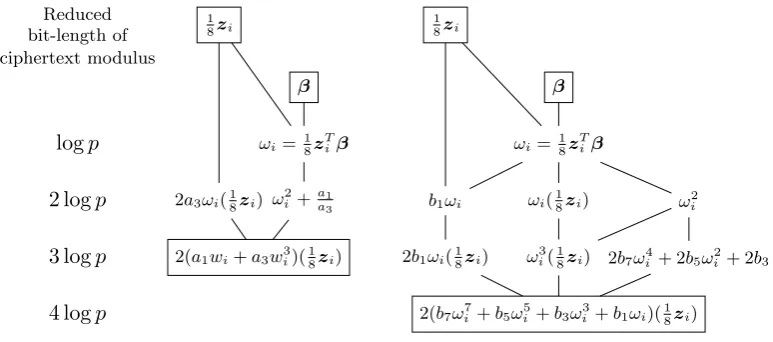
Fig. 4.Evaluation procedure of least squares approximations (2g(zT
iβ)−1)·(18zi) wheng(x) =g3(x) (left)
org(x) =g7(x) (right)
Reduced bit-length of ciphertext modulus
logp
2 logp
3 logp
4 logp
1 8zi
β
ωi= 18zTiβ
2a3ωi(18zi) ω2i+aa13
2(a1wi+a3w3i)(18zi)
1 8zi
β
ωi=18zTiβ
b1ωi ωi(18zi) ω2i
2b1ωi(18zi) ω3i(18zi) 2b7ω4i + 2b5ω2i + 2b3
2(b7ω7i+b5ω5i +b3ωi3+b1ωi)(18zi)
Our solution can compute the gradient descent algorithm securely; however, its direct implementation is not efficient and requires a total ciphertext modulus of logp·(dlog degge+ 3) +dlog(nα)ebits at each iteration. We further optimized this algorithm by manipulating the arithmetic circuit for the update term αnPn
i=1g(−zTi β)·zi and could reduce the ciphertext
modulus. We express the evaluation circuit as follows:
β←β+ 4α n
n
X
i=1
zi
8 − 4α
n
n
X
i=1
2g(zTi β)−1
·zi
8 . (2)
If the client generates encryptions of p(18zi) instead of pzi, the required bit length of
ciphertext modulus per iteration can be reduced. On the other hand, the server uses a pre-computation step to reduce the complexity of update equation: it performsAllSumprocedure and applies the rescaling operation with the scale factor ofb4nαeonct.zj for allj= 0,1, . . . , d.
As a result, we obtain a ciphertextct.sumjthat encrypts an approximate value of4αpn Pni=1 z8ij
in each plaintext slot. These ciphertexts will be stored during evaluation and used for update of thej-th component of weight vectorβ. In particular, the ciphertextsct.beta0,· · · ,ct.betad
corresponding to the entries βbecomesct.sum0,· · · ,ct.sumdat the first iteration.
Fig. 4 shows how to evaluate the arithmetic circuit (2g(zTi β)−1)·(18zi) when g(x) =
g3(x) or g(x) = g7(x). We take encryptions of pβ and p8zi as inputs of the algorithm to
minimize the number of required multiplications and depth. Consequently, the proposed method reduces the ciphertext modulus by 3 logp+dlog(4nα)e bits (or 4 logp+dlog(4nα)e
bits) wheng(x) =g3(x) (org(x) =g7(x), respectively).
4 Implementations
In this section, we explain how to set the parameters and present our implementation results using the proposed techniques.
4.1 How to Set Parameters
It follows from Section 3.2 that a lower-bound on the bit length of a fresh ciphertext modulus, denoted by logq, is as follows:
(
dlog(4nα)e+ (IterNum−1)(dlog(4nα)e+ 3 logp) + logq0 when g(x) =g3(x),
where IterNum is the number of iterations of the gradient descent algorithm and q0 is the output ciphertext modulus. The final ciphertext represents the desired vectorβbut is scaled by a factor of p, which means that logq0 should be larger than logp.
The security of the underlying HE scheme relies on the hardness of theRLWEassumption. We derive a lower-bound on the ring dimension as N ≥ λ+1107.2 ·logQ to get λ-bit security level from the security analysis of [12]. In other words, we will take the smallest integer N that is a power-of-two integer satisfying this inequality.
4.2 Implementation Details
Experimentation Environment. All the experiments were performed on an Intel Xeon running
at 2.3 GHz processor with 16 cores and 64GB of RAM, which is an m4.4xlarge AWS EC2 instance. In our implementation, we used a variant of a fixed-point homomorphic encryption scheme of Cheon et al. [6] withC++based Shoup’s NTL library [27]. Our implementation is publicly available atgithub [16].
Datasets. We develop our approximation algorithm using the Myocardial Infarction dataset
from Edinburgh [18]. The others were obtained from Low Birth Weight Study (lbw), Nhanes III (nhanes3), Prostate Cancer Study (pcs), and Umaru Impact Study datasets (uis) [19, 23, 24, 31]. All these datasets have a single binary outcome variable, which can be readily used to train binary classifiers like logistic regression. Table 2 illustrates the datasets with the number of observations (rows) and the number of features (columns), respectively. We utilized five-fold cross-validation (CV) that randomly partitions the original datasets into five folds with the approximately equal size; we used four subsets for learning (with the learning rateα≈1) and one subset for testing the trained model.
Table 2.Description of datasets
Dataset Number of observations Number of features
Edinburgh 1253 10
lbw 189 10
nhanes3 15649 16
pcs 379 10
uis 575 9
Parameters for the HE Scheme. In our implementation, each coefficient of the secret key
2Nlogq≈75 MB. The key generation takes about 56∼58 seconds and the encryption takes about 1.1∼1.3 seconds.
In Table 3, we evaluated our models performance based on average running time (en-cryption, evaluation, decryption) and storage (encrypted dataset size) in each fold.
Table 3.Experiment results of our HE-based logistic regression
Dataset Enc deg(g) Eval Dec Storage
Edinburgh 12s 3 131min 6.3s 0.69GB
7 116min 6.0s 0.71GB
lbw 11s 3 101min 4.9s 0.67GB
7 100min 4.5s 0.70GB
nhanes3 21s 3 265min 12s 1.15GB
7 240min 13s 1.17GB
pcs 11s 3 119min 4.4s 0.68GB
7 100min 4.5s 0.70GB
uis 10s 3 109min 5.1s 0.61GB
7 94min 4.3s 0.63GB
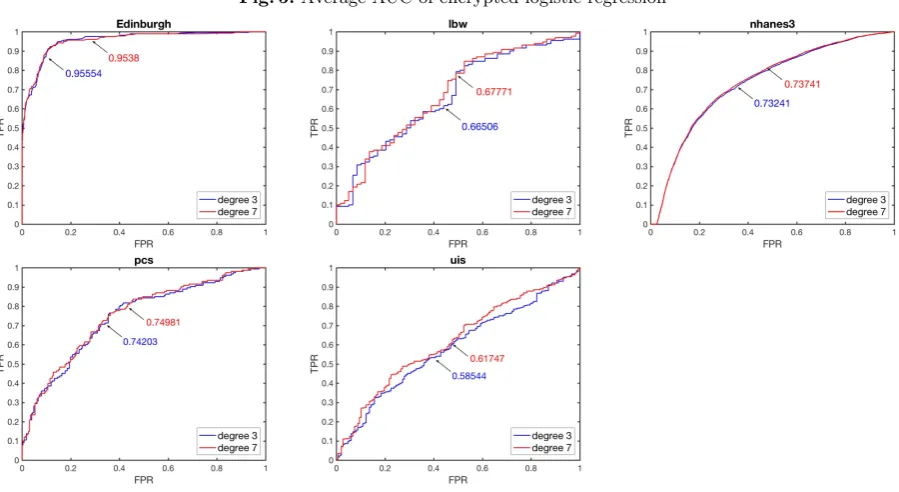
We used a popular metric, Area Under the ROC Curve (AUC), to measure the model’s classification performance where the true positive rate (TPR) is plotted against the false positive rate (FPR) at various thresholds. Fig. 5 plots the average AUC values from five-fold CV for datasets. The program was implemented by MATLAB 2017a.
Fig. 5.Average AUC of encrypted logistic regression
Table 4.Comparison of encrypted/unencrypted logistic regression
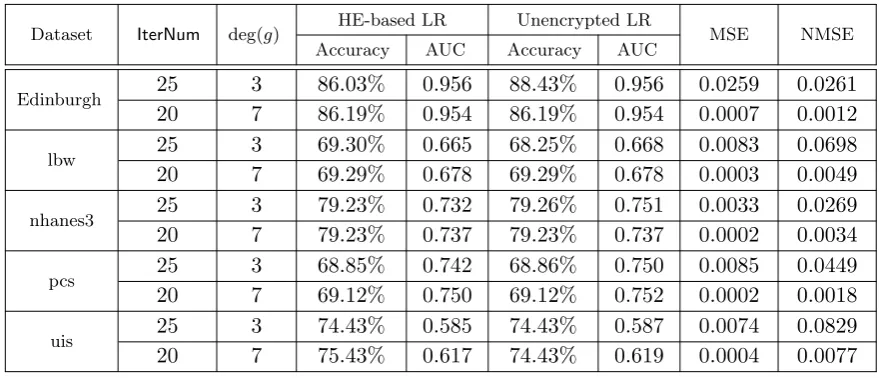
Dataset IterNum deg(g) HE-based LR Unencrypted LR MSE NMSE Accuracy AUC Accuracy AUC
Edinburgh 25 3 86.03% 0.956 88.43% 0.956 0.0259 0.0261
20 7 86.19% 0.954 86.19% 0.954 0.0007 0.0012
lbw 25 3 69.30% 0.665 68.25% 0.668 0.0083 0.0698
20 7 69.29% 0.678 69.29% 0.678 0.0003 0.0049
nhanes3 25 3 79.23% 0.732 79.26% 0.751 0.0033 0.0269
20 7 79.23% 0.737 79.23% 0.737 0.0002 0.0034
pcs 25 3 68.85% 0.742 68.86% 0.750 0.0085 0.0449
20 7 69.12% 0.750 69.12% 0.752 0.0002 0.0018
uis 25 3 74.43% 0.585 74.43% 0.587 0.0074 0.0829
20 7 75.43% 0.617 74.43% 0.619 0.0004 0.0077
In Table 4, we compared the produced models using our encrypted approach and unen-crypted logistic regression. In the unenunen-crypted cases, we used the original sigmoid function on the same training dataset with the same iteration numbers as the encrypted cases. For discrimination, we calculated the accuracy (%), which is the percentage of the correct pre-dictions on the testing dataset. For a more accurate comparison, we used the MSE that measures the average of the squares of the errors. We could also normalize it by dividing by the average of the squares of the (unencrypted) model parameters, called a normalized
mean-squared error (NMSE).
5 Discussion
5.1 Principal Findings
Our implementation shows that the evaluation of the gradient descent algorithm with the de-gree 7 least squares polynomial yields better accuracy and AUC than dede-gree 3. It is quite close to the unencrypted result of logistic regression using the original sigmoid function with the same number of iterations; for example, on the training model of Edinburgh dataset, we could obtain the model parametersβas follows:β= (−1.7086,0.0768,0.1119,0.3209,1.2033,0.3684, 0.9756,0.2020,0.2259,−0.1641), which can reach 86.19% accuracy and 0.954 AUC on the testing dataset. When using the sigmoid function on the same training dataset, the model pa-rametersβare (−1.6308,0.0776,0.1097,0.3155,1.1809,0.3651,0.9599,0.2083,0.2298,−0.1490), which give the same accuracy and AUC. On the other hand, as shown in Table 4, the MSE and NMSE values of degree 7 are closer to zero, which inspires us that the polynomial approximation of that degree is fairly accurate for logistic regression.
model parameters obtained from encrypted/unencrypted evaluations was less than 2−11. This means that we can precisely compute at least most significant 11 bits after the radix point of the model parameters and this approximate vector is accurate enough to achieve a good performance in testing data samples.
5.2 Limitations
There are still a number of limitations in the application of our evaluation model to an arbitrary dataset. First of all, the use of HE yields the overheads in computation and storage. The size of dataset should be limited for practical evaluation, but this is not a big problem since there have been significant improvements in the existing HE schemes. The development of HE technology will achieve much better practical performance in our protocol.
Another issue arises from the polynomial approximation. We suggested the least squares method on a certain interval [−8,8], but the precision of result can increase by managing approximation error from wider range inputs. Finally, our model is based on fixed hyper parameters that should be decided before starting of the evaluation. It would be highly beneficial if we could detect convergence of the loss function in the training process and support early stop instead.
6 Conclusions
This paper presents the first effective methodology to evaluate the learning phase of logis-tic regression using the gradient descent method based on HE. We have demonstrated the capability of our model across the experiments with different biological datasets. In partic-ular, our solution can be applied to a large-scale dataset, which shows the feasibility of our approach.
Acknowledgements
The authors would like to thank Kristin Lauter for helpful discussions and suggestions. The authors would also like to thank Andrey Kim for extensive assistance with the code for the homomorphic encryption scheme. We also thank anonymous JMIR Medical Informatics reviewers for their careful reading of the paper and diligent comments.
The work of M. Kim, S. Wang, and X. Jiang was supported by the Patient-Centered Outcomes Research Institute (PCORI) under contract ME-1310-07058, the National Insti-tute of Health (NIH) under award number R01HG008802, R01GM114612, R01GM118574, R01GM118609, R21LM012060, and U01EB023685. Y. Song was supported by the National Research Foundation of Korea (NRF) Grant funded by the Korean Government (MSIT) (No.2017R1A5A1015626).
References
1. Y. Aono, T. Hayashi, L. Trieu Phong, and L. Wang. Scalable and secure logistic regression via homo-morphic encryption. InProceedings of the Sixth ACM Conference on Data and Application Security and Privacy, pages 142–144. ACM, 2016.
2. J. W. Bos, K. Lauter, J. Loftus, and M. Naehrig. Improved security for a ring-based fully homomorphic encryption scheme. InCryptography and Coding, pages 45–64. Springer, 2013.
3. J. W. Bos, K. Lauter, and M. Naehrig. Private predictive analysis on encrypted medical data. Journal of biomedical informatics, 50:234–243, 2014.
5. Z. Brakerski, C. Gentry, and V. Vaikuntanathan. (leveled) fully homomorphic encryption without boot-strapping. In Proceedings of the 3rd Innovations in Theoretical Computer Science Conference, pages 309–325. ACM, 2012.
6. J. H. Cheon, A. Kim, M. Kim, and Y. Song. Homomorphic encryption for arithmetic of approximate numbers. In Advances in Cryptology–ASIACRYPT 2017: 23rd International Conference on the The-ory and Application of Cryptology and Information Security, Hong Kong, China, December 3-7, 2017, Proceedings, Part I, pages 409–437. Springer, 2017.
7. J. H. Cheon, M. Kim, and M. Kim. Search-and-compute on encrypted data. InInternational Conference on Financial Cryptography and Data Security, pages 142–159. Springer, 2015.
8. J. H. Cheon, M. Kim, and M. Kim. Optimized search-and-compute circuits and their application to query evaluation on encrypted data.IEEE Transactions on Information Forensics and Security, 11(1):188–199, 2016.
9. E. Dietz. Application of logistic regression and logistic discrimination in medical decision making. Bio-metrical journal, 29(6):747–751, 1987.
10. S. Dreiseitl and L. Ohno-Machado. Logistic regression and artificial neural network classification models: a methodology review. Journal of biomedical informatics, 35(5):352–359, 2002.
11. J. Fan and F. Vercauteren. Somewhat practical fully homomorphic encryption. Cryptology ePrint Archive, Report 2012/144, 2012. https://eprint.iacr.org/2012/144.
12. C. Gentry, S. Halevi, and N. P. Smart. Homomorphic evaluation of the aes circuit. In Advances in Cryptology–CRYPTO 2012, volume 7417, pages 850–867. Springer, 2012.
13. R. Gilad-Bachrach, N. Dowlin, K. Laine, K. Lauter, M. Naehrig, and J. Wernsing. Cryptonets: Applying neural networks to encrypted data with high throughput and accuracy. InInternational Conference on Machine Learning, pages 201–210, 2016.
14. T. Graepel, K. Lauter, and M. Naehrig. ML confidential: Machine learning on encrypted data. In International Conference on Information Security and Cryptology, pages 1–21. Springer, 2012.
15. S. Halevi and V. Shoup. Algorithms in HElib. InAdvances in Cryptology–CRYPTO 2014, pages 554–571. Springer, 2014.
16. HELR. Implementation of secure logistic regression based on homomorphic encryption.https://github. com/K-miran/HELR, 2017.
17. W. Jiang, P. Li, S. Wang, Y. Wu, M. Xue, L. Ohno-Machado, and X. Jiang. WebGLORE: a web service for Grid LOgistic regression. Bioinformatics, 29(24):3238–3240, 2013.
18. R. Kennedy, H. Fraser, L. McStay, and R. Harrison. Early diagnosis of acute myocardial infarction using clinical and electrocardiographic data at presentation: derivation and evaluation of logistic regression models. European heart journal, 17(8):1181–1191, 1996.
19. lbw. lbw: Low birth weight study data in logisticdx: Diagnostic tests for models with a binomial response. https://rdrr.io/rforge/LogisticDx/man/lbw.html, 2017.
20. Microsoft. Hosting and cloud study 2016. http://download.microsoft.com/download/9/4/1/ 941D4C3D-5093-4468-BE11-FB18E4FBD199/Cloud%20and%20Hosting%20Trends%20-The%20Digital% 20Revolution,%20Powered%20by%20Cloud.pdf, 2016.
21. R. Miotto, F. Wang, S. Wang, X. Jiang, and J. T. Dudley. Deep learning for healthcare: review, oppor-tunities and challenges. Briefings in Bioinformatics, page bbx044, 2017.
22. P. Mohassel and Y. Zhang. SecureML: A system for scalable privacy-preserving machine learning. IEEE Symposium on Security and Privacy, 2017.
23. nhanes3. Nhanes iii data in logisticdx: Diagnostic tests for models with a binomial response. https: //rdrr.io/rforge/LogisticDx/man/nhanes3.html, 2017.
24. pcs. Prostate cancer study data in logisticdx: Diagnostic tests for models with a binomial response. https://rdrr.io/rforge/LogisticDx/man/pcs.html, 2017.
25. P. Peduzzi, J. Concato, E. Kemper, T. R. Holford, and A. R. Feinstein. A simulation study of the number of events per variable in logistic regression analysis. Journal of clinical epidemiology, 49(12):1373–1379, 1996.
26. D. Rousseau. Biomedical research: Changing the common rule by david rousseau — ammon & rousseau translations.https://www.ammon-rousseau.com/changing-the-rules-by-david-rousseau/, 2017. 27. V. Shoup. Ntl: A library for doing number theory. https://shoup.net/ntl/, 2010.
28. E. R. Skinner, G. O. Barnett, D. E. Singer, A. G. Mulley, R. A. Lew, S. A. Stickler, M. M. Morgan, and G. E. Thibault. The use of logistic regression in diagnostic and prognostic prediction in a medical intensive care unit. InProceedings of the Annual Symposium on Computer Application in Medical Care, volume 1, page 222. American Medical Informatics Association, 1980.
29. E. W. Steyerberg, M. J. Eijkemans, F. E. Harrell Jr, and J. D. F. Habbema. Prognostic modeling with logistic regression analysis: in search of a sensible strategy in small data sets. Medical Decision Making, 21(1):45–56, 2001.
31. uis. Umaru impact study dat in logisticdx: Diagnostic tests for models with a binomial response. https: //rdrr.io/rforge/LogisticDx/man/uis.html, 2017.
32. S. Wang, X. Jiang, Y. Wu, L. Cui, S. Cheng, and L. Ohno-Machado. Expectation Propagation LOgistic REgression (EXPLORER): distributed privacy-preserving online model learning. Journal of biomedical informatics, 46(3):480–496, 2013.
33. Y. Wu, X. Jiang, J. Kim, and L. Ohno-Machado. Grid Binary LOgistic REgression (GLORE): building shared models without sharing data.Journal of the American Medical Informatics Association, 19(5):758– 764, 2012.