The Open Journal of Occupational Therapy
Volume 3Issue 1Winter 2015 Article 3
1-1-2015
An Exploration of Volition: Caregiver Perceptions
of Persons with Dementia
Christine Raber
Shawnee State University, [email protected]
Mikel Stone
Shawnee State University, [email protected]
Follow this and additional works at:https://scholarworks.wmich.edu/ojot
Part of theOccupational Therapy Commons
This document has been accepted for inclusion in The Open Journal of Occupational Therapy by the editors. Free, open access is provided by ScholarWorks at WMU. For more information, please [email protected].
Recommended Citation
An Exploration of Volition: Caregiver Perceptions of Persons with
Dementia
Abstract
The purpose of this study was to understand what formal caregivers know about the volition of older adults with moderate dementia. A qualitative approach was used at one assisted living facility. Semi-structured interviews were conducted with formal caregivers to gain their perceptions of residents’ volition or motivation for occupation. Volition of resident participants was assessed using the Volitional Questionnaire (VQ). Caregiver interviews and resident VQ’s were analyzed using van Manen’s phenomenological approach to examine their congruence with regard to the volitional abilities of residents. Thematic analysis yielded two broad themes: (a) Caregivers possess varying layers of insight regarding the volitional abilities of the older adults with dementia, and (b) caregivers develop a script regarding the volitional abilities of the older adults with dementia. Caregivers possess knowledge about volitional abilities of older adults with dementia. Further research is needed to understand how these perceptions affect their care-giving behaviors.
Keywords
motivation, dementia, caregivers, occupational therapy
Cover Page Footnote
The authors express their deepest gratitude to all of the participants involved in the study, and for the gift of exceptional mentorship, particularly from Dr. Gary Kielfhofner. The contributions of Sally Abbott-Dennis are also gratefully acknowledged.
Credentials Display
Christine Raber, PhD, OTR/L
Mikel Stone, MOT, OTR/L
Copyright transfer agreements are not obtained by The Open Journal of Occupational Therapy (OJOT). Reprint permission for this Applied Research should be obtained from the corresponding author(s). Click
Background
Currently, an estimated 5.2 million
Americans are living with Alzheimer’s disease
(Alzheimer’s Association, 2013), and the rate of
Alzheimer’s disease and related dementias (ADRD)
is growing, with an estimated 34 million people
having some form of dementia in 2009 (Wimo,
Winblad, & Jönsson, 2010). ADRD is defined as a
condition characterized by a wide range of
cognitive deficits, marked by memory impairment
accompanied by language disturbance; difficulty
with motor performance; inability to recognize or
identify objects; and/or problems with planning,
organizing, or sequencing (American Psychological
Association, 2000). Given the projected growth of
the older adult population to 71.5 million by 2030
(Older Americans, 2012), the prevalence of ADRD will also increase.
Individuals with ADRD experience
challenges, such as cognitive decline and a
decreased ability to engage independently in valued
occupations (Warchol, 2006). People living with
dementia become progressively restricted in their
performance of daily activities, leading to the need
for increased assistance from others in response to
their functional losses (Holst & Hallberg, 2003).
The progressive nature of ADRD often places
increased demands on the family members of the
care recipient (Lewis, Hepburn, Narayan, & Kirk,
2005), such as assistance with activities of daily
living (ADLs), increased need for supervision, and
provision of a safe environment. Because of these
increased care demands, residential care is often the
only option for many families, and assisted living
et al., 2005a). Estimates indicate that individuals
diagnosed with dementia account for 34% to 68%
of ALF residents (Kang, Smith, Buckwalter,
Ellingrod, & Schultz, 2010). In ALFs, residents
typically have their own apartment and formal
caregivers provide support and assistance in
self-care, instrumental activities of daily living, leisure,
and productive occupations.
Since individuals with ADRD rely on others
to support their engagement in occupation, details
regarding their life stories are critical for planning
and providing daily care (Gitlin, Winter, Dennis,
Hodgson, & Hauck, 2010; McKeown, Clarke, &
Repper, 2006). Investigation into formal
caregivers’ perceptions of the abilities of persons
with dementia is limited, but since the experience of
dementia is different for each individual,
individualized care that is attentive to each person’s
unique experience is recommended. Older adults
with ADRD often experience feelings of loss and
frustration because of decreased opportunities to
engage in preferred occupations, and caregivers’
actions may either enhance or detract from the
individual’s participation in daily activities (Holst &
Hallberg, 2003).
Dementia also creates declines in
communication skills that often affect the ability to
make choices regarding engagement in preferred
occupations. Breakdowns in communication affect
the relationship between the caregiver and the
person with dementia, leaving the caregiver to make
assumptions about the person’s choices (Small,
Geldart, & Gutman, 2000). Caregivers’
occupational engagement. Individuals with ADRD
often experience a compromised ability to
independently engage in activities of their own
choosing (Kolanowski, Buettner, Litaker, & Yu,
2006). Many formal caregivers may unintentionally
promote disengagement by “doing for” the person,
and at times, may exclude individuals with
dementia from activities due to behaviors perceived
as problematic (Kolanowski et al., 2006).
Individually designed activities, however, can help
decrease challenging behaviors and agitation.
When activities were specifically designed to meet
three factors—interests, cognitive abilities, and
physical abilities—nursing home residents with
dementia demonstrated positive affect, greater
engagement, and greater ability in the activities
(Kolanowski, Buettner, & Moeller, 2006),
illustrating the caregivers’ potential positive impact
in supporting occupational participation.
Accuracy of caregivers’ judgment of the
abilities of persons with dementia may be
questionable, creating potential concerns about
strategies that support engagement in occupation. It
has been suggested that caregivers of persons with
ADRD may misjudge the functional abilities of
those in their care (Argüelles, Loewenstein,
Eisdorfer, & Argüelles, 2001). For example,
performance assessments of community-dwelling
individuals with ADRD and their primary
caregivers indicated that caregivers often
overestimated the abilities of the person in
functional tasks, such as telling time, money-related
tasks, brushing teeth, and eating with utensils.
In dementia care, there is a growing trend
toward use of a person-centered care (PCC)
approach (Brooker, 2007), which focuses on
supporting personhood by enabling the person’s
abilities rather than focusing on the disability
caused by dementia. Caregiver approaches and skill
sets are essential to effective use of PCC, and rely
on caregivers’ understanding of the intrinsic
qualities of personhood, such as the person’s
history, prior occupations, interests, and values.
Gitlin et al. (2010) highlighted the influence of the
care environment, along with the caregiver-client
relationship, on the ability of community-dwelling
older adults with ADRD to perform in a
goal-directed manner and to engage in occupations. In
addition, a study by McKeown, Clarke, Ingleton,
Ryan, & Repper (2010) demonstrated that an
understanding of the life story of individuals with
dementia is a central tenet of dementia care. PCC
approaches underscore the important dynamic that
exists between a caregiver’s understanding of a
person’s abilities and preferences, and the
environmental and social contexts that support the
fullest capabilities of people with dementia.
A significant aspect of personhood in
dementia care is volition, or motivation for
occupation (Raber, Teitelman, Watts, & Kielhofner,
2010). Volition, a Model of Human Occupation
construct (Kielhofner, 2008), refers to one’s unique
values, interests, and personal causation that elicit
motivational responses for meaningful occupation.
Choice and preference in daily occupations are
occupational engagement at all levels (Kielhofner,
2008). Values include intrinsic thoughts and
feelings about what is important to the person
(Kielhofner, 2008). Interests are defined as aspects
of life that one finds enjoyable or fulfilling and
include individual preferences, while personal
causation includes the person’s perception of his or
her abilities and effectiveness in using those
abilities (Kielhofner, 2008). Cognitive dysfunction
affects expression of volition, since “volition is an
ongoing process and is determined by what has
been learned from past experiences” (de las Heras,
Llerena, & Kielhofner, 2003, p. 9). Volition
involves making interpretations and judgments
about the environment and acting on them. Those
with cognitive impairments will make volitional
judgments and interpretations and act on the
environment based on their current abilities (de las
Heras et al., 2003).
The experience of ADRD plays a large role
in volitional behavior, since the disease process
changes the ability to communicate likes, dislikes,
and interests, as well as the ability to process
environmental cues and stimuli, leaving others in
the person’s world to recognize and interpret
volitional behavior (Raber et al., 2010). Therefore,
the social environment exerts a significant impact
on volitional expression. Since ADRD results in
decreased communication skills, decreased
initiation of activities, and decreased processing of
cues from the environment, caregivers need to be
especially in tune with the volitional behavior of
persons with dementia (Teitelman, Raber, & Watts,
2010). Caregiver behaviors that can support
volition include noticing volitional behavior,
interpreting what the person may be trying to
communicate through behavior, and responding
appropriately and effectively. Expressions of
volition are seen in an individual’s preferences and
are often exhibited behaviorally more frequently
than verbally in people with dementia (Raber et al.,
2010).
It is apparent that caregivers have a
significant charge in the provision of care and
support for older adults with ADRD. Providing
support for people with ADRD involves more than
simply doing for the person, and encompasses
promoting engagement in everyday occupations.
Practice Guidelines from the Alzheimer’s
Association (Tilly & Reed, 2006) promote the use
of a person-centered approach in dementia care, in
which life stories are understood and paired with
knowledge of the person’s preferences and their
functional ability, and represent the standard of
practice for which caregivers and dementia care
programs should strive. One challenge that persons
with dementia face in formal care environments,
such as assisted living, is staff perceptions of
residents’ functional abilities, their capacity to make
choices, and their ability to express preferences
about their everyday activities. The area of
caregivers’ perceptions about residents’ preferences
and abilities has not been adequately explored and
described, and limited research exists about
caregivers’ understanding and knowledge of
Therefore, the purpose of this qualitative
study was to gain insight into the experiences of
ALF formal caregivers regarding their
understanding of the volitional abilities of persons
with ADRD for whom they provide care. Since
formal caregivers play an intrinsic role in
supporting abilities and choices for persons living
with dementia, investigating the lived experiences
of caregivers provides information about their
understanding of the volitional abilities of
individuals with dementia. The guiding research
question was: What insights do formal caregivers
have about the volitional abilities of individuals
with ADRD in the assisted living environment?
Method
Van Manen’s phenomenological approach
(van Manen, 1990) guided development of the
research question, sampling, data collection, and
data analysis, and was selected to facilitate
understanding of the subjective, lived experience of
the formal caregivers providing care for ALF
residents with ADRD. This phenomenological
approach is considered a type of hermeneutic, or
interpretative, approach (Finlay, 2009), and as such,
the phenomenon was explored through reflection,
journaling, and thematic analysis of collected data
(van Manen, 1990).
Participants
Ethical approval for the study was provided
by Shawnee State University’s Institutional Review
Board. The administration of a memory support
ALF in the Midwestern United States approved the
study and provided access to the potential
participants. Staff members and legally authorized
representatives (LAR) of residents provided consent
to participate in the study and residents assented to
participation.
Purposive sampling (Creswell, 2003) was
used to recruit all participants. Inclusion criteria for
staff participants were employment in the memory
care unit for a minimum of four months and
willingness to participate. For resident participants
to be included in the study, they were required to
have a diagnosis of some form of dementia in the
moderate stage, as well as to be a resident of the
facility for at least four months. Moderate dementia
was defined using criteria from the Global
Deterioration Scale (Reisberg, Ferris, de Leon, &
Crook, 1982), which includes major difficulty in
initiating, persisting, and completing ADLs, IADLs,
social participation, and leisure interests due to the
progression of dementia. Investigators collaborated
with the program manager to identify staff and
resident participants who met the inclusion criteria.
During the study period, there were 19
residents living in the facility, and 10 met the
inclusion criteria. The ALF was part of a
continuing care retirement community and 18 staff
members worked in this area at the time of the
study. Of the 10 residents who met the inclusion
criteria, the program manager identified seven
potential residents for the study, and investigators
approached their family members about the study.
Three LARs provided consent for their family
member to participate. Ten day and evening shift
approached to participate. Seven of these staff
members agreed to join the study. The program
manager’s role was limited to identifying potential
participants and approaching them (staff member or
the LAR of residents) using an Institutional Review
Board-approved script to seek permission to provide
their contact information to the investigators. After
receiving permission to contact potential
participants, investigators conducted the recruitment
process without program manager input. Staff
participant consent forms contained specific
language protecting the participants’ information
from disclosure to the employer in any form,
including choice to participate in the study.
IRB-approved assent forms were used with
resident participants after their LARs provided
consent, and investigators also gained verbal assent
during each encounter with the resident participants.
Three resident participants, two men and one
woman, were included in the study. ALF staff
participants included one activity director, four
resident helpers, two nurses, and an activity director
from a local adult day program, which one resident
participant attended daily. His participation in the
day program was identified and the activity director
from this day program was invited to participate in
the study as investigators decided her experiences
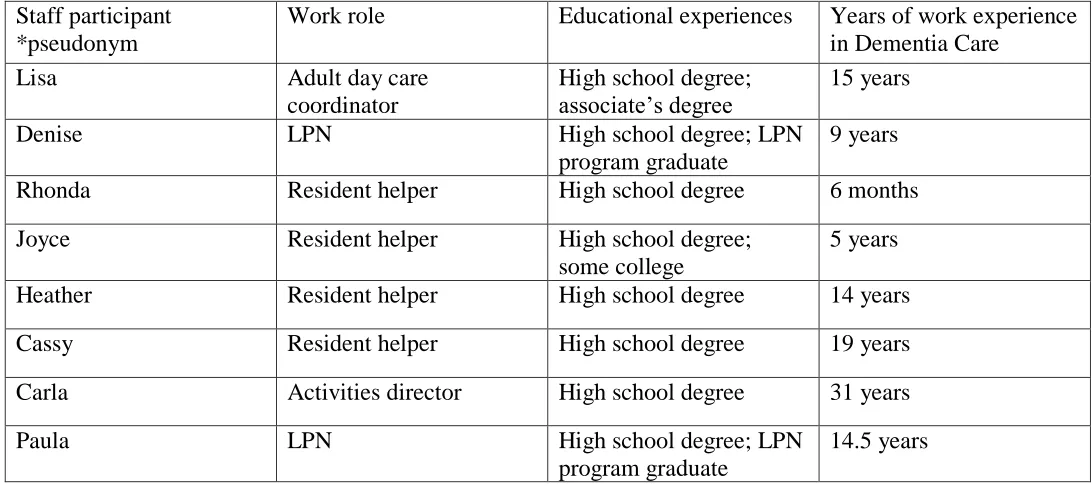
would provide an additional perspective. Table 1
offers selected information about resident
participants, and Table 2 provides general
information about staff participants. Pseudonyms
are used for all participants.
Table 1
Resident Participant Information
Resident participant *pseudonym
Demographic information
Selected preferences and background information
Number of observations rated using VQ, and number of raters
Jane Never married,
no children
Liked playing the piano Nurse
Teacher
Always wore skirts/dresses Routinely had her hair done
Banged walker on floor when upset
4 (2 raters for all sessions)
John Married, with
children
Spouse in same facility, but not in ALF section
Upset when unable to speak to wife on phone due to her illness
Attended vespers and made a point of speaking to minister before and after service
Liked specific chair in living room
6 (one rater)
Jack Married, with
children
Attended adult day program daily Soda jerk as a young man
Liked specific dress on a daily basis
Table 2
Staff Participants’ Educational and Work Experience
Staff participant *pseudonym
Work role Educational experiences Years of work experience
in Dementia Care
Lisa Adult day care
coordinator
High school degree; associate’s degree
15 years
Denise LPN High school degree; LPN
program graduate
9 years
Rhonda Resident helper High school degree 6 months
Joyce Resident helper High school degree;
some college
5 years
Heather Resident helper High school degree 14 years
Cassy Resident helper High school degree 19 years
Carla Activities director High school degree 31 years
Paula LPN High school degree; LPN
program graduate
14.5 years
Instrumentation
Three data collection methods were used:
background interviews with the activity director
about resident participants; administration of the
Volitional Questionnaire with resident participants;
and interviews with staff participants that explored
the ways in which their experience of working with
resident participants related to their perceptions of
resident participants’ volition. Instrumentation used
was the Volitional Questionnaire (VQ) (de las
Heras, Geist, Kielhofner, & Li, 2007) and the
semi-structured interviews with the activity director and
staff participants. To provide information to guide
documentation of VQ observations, one interview
for each resident participant was conducted with the
activity director prior to completing the VQ and
staff participant interviews. These three interviews
yielded background information about each
resident’s likes, dislikes, and interests. Following
completion of the VQ, interviews were conducted
with each staff participant, which focused on their
experiences with and perceptions of resident
participants’ volition.
The VQ is an observational assessment that
rates motivation for occupation and the impact of
the environment on motivation (de las Heras et al.,
2007). Fourteen items are scored using a four-point
scale with ratings of passive, hesitant, involved, and
spontaneous. Rating items reflect the individual’s
volitional behavior, versus the individual’s success
with the task at hand, and individuals are rated
during typical daily activities selected by the
therapist in three to five sessions (de las Heras et al.,
2007). The VQ assesses volition in people who
have significant limitations in cognition, verbal or
what motivates them (de las Heras et al., 2007). It
is a valid measure of the construct of volition across
a variety of environments (Chern, Kielhofner, de las
Heras, & Magalhaes, 1996), and has demonstrated
acceptable inter-rater reliability (Li & Kielhofner,
2004).
To facilitate consistency between
investigators during interviewing, two interview
guides were developed for each type of interview
(background interviews with the activity director to
guide VQ observations and interviews with staff
participants). Concepts of volition and examples of
behaviors indicative of volition were used in staff
participant questions in order to facilitate expression
of their experience of perceiving residents’ volition
while working with them. Table 3 provides sample
interview questions. Guided questioning was
chosen as a method of obtaining information, as it
allowed formal caregiver participants the
opportunity to discuss their lived experience in the
role of caring for participants with dementia, and
afforded investigators the opportunity to probe for
further information. Before use in this study,
investigators piloted the activity director interview
guide at a nursing facility with its activity staff and
the formal caregiver interview guide was piloted at
a separate ALF with its staff. Both interview guides
were then revised using feedback from each pilot
site. Investigators were trained in interviewing
strategies prior to conducting interviews with
participants.
Table 3
Sample Questions
Background interviews with activity director Interviews with staff participants
What do you feel (resident) is interested in?
What does (resident) like or enjoy?
In your experience with (resident), how does s/he
show curiosity?
In what ways have you experienced (resident)
expressing pleasure and enjoyment during his/her
day?
The activity director script allowed
investigators to glean basic information about each
resident participant in order to plan VQ
observations. These background interviews were
focused on eliciting descriptions of resident
participants’ general daily routines and their likes,
dislikes, and interests. The activity director also
identified times of day for both optimal engagement
and ability, and times that were more challenging
for each resident participant. Investigators then
arranged observation sessions to complete the VQ
participants’ VQ ratings were completed prior to
interviewing staff participants. Information about
the number of investigators completing the VQ, in
addition to the number of sessions observed, is
included in Table 1. The VQ provided a snapshot
of resident participants’ volition at the time of the
study. Investigators observed resident participants
as they were involved in daily activities; VQ
observations did not include private activities, such
as bathing, dressing, and toileting. Investigators
were trained by the principal investigator to
administer the VQ accurately and consistently,
which involved the learning process outlined in the
VQ manual, supervised practice, and competency
check-offs prior to VQ use in the field.
The interview guide for the staff participant
interviews was grounded in the 14 VQ items,
reflecting the volitional continuum of exploration,
competency, and achievement (de las Heras et al.,
2003). Exploration is the most basic demonstration
of volition, indicating that one desires to interact
with the environment by showing curiosity or
interest in his or her surroundings, followed by
competency, which demonstrates one’s attempt to
act on the environment (de las Heras et al., 2003).
The highest level of volitional behavior is
achievement, in which there is an attempt to master
a skill and respond to challenges presented by the
environment (de las Heras et al., 2003). The
primary focus of staff participants’ interviews was
to elicit information about their experiences with
and perceptions of resident participants’ volition.
All interviews were recorded and transcribed by a
transcriptionist, who signed a confidentiality
agreement. Finally, each investigator wrote field
notes after every contact with all participants during
data collection. Investigators were trained in the
process of writing field notes using practice
sessions with feedback from the principal
investigator prior to entering the field, and field
notes were discussed during peer debriefing
sessions.
Data Analysis
To ensure authenticity, rigor was addressed
through the use of field notes (written immediately
following each resident participant and staff
participant contact), member checks of interviews,
regular peer debriefing, and triangulation of data.
Consistent with qualitative inquiry procedures, field
notes were collected to describe contextual data that
occurred during the VQ and interview contacts.
Member checks consisted of providing interview
transcripts to staff participants for their review to
verify accuracy of the transcript and provide the
opportunity to add any additional thoughts. Three
of the eight staff participants offered additional
input to their interviews. Face-to-face discussions
of data collection occurred weekly with all
researchers throughout the data collection process.
The reflexive process of recording field notes,
reviewing member checks, and conducting peer
debriefing (Creswell, 2003) allowed investigators to
document overall impressions of staff participant
interviews and resident participant contacts. The
reflexive process was also used to bracket
and identify their impact on the analysis, as well as
aiding investigators in refining interviewing
techniques during the study.
Three interviews with the activity director,
the resident VQ data, and eight staff interviews
were analyzed using van Manen’s methods (1990).
Thematic analysis was undertaken, which van
Manen refers to as the process of reflective inquiry,
in order to “interpret the aspects of meaning or
meaningfulness that are associated with this
phenomenon”(van Manen, 2011, Methods and
Procedures section, para. 2). Reflective inquiry
focused on identifiable patterns of behaviors that
expressed the phenomenon, namely perceptions of
resident participants’ volition. HyperResearch
software (2009) enabled researchers to code,
retrieve, and build themes based on gathered data.
Codes were established that identified staff
participants’ experiences and perceptions of
resident participants’ past and current interests and
preferences. Analysis of the codes and patterns that
emerged was used to develop the themes that
portrayed the phenomenon of caregiver insight into
the volitional abilities of resident participants. Data
saturation was reached when no new information
was found.
The process of coding was iterative and
guided by van Manen’s (1990) analytic process of
isolating thematic statements in which three
approaches can be used: holistic, selective, and
detailed. In the coding layer of analysis, the
researchers chose to use the selective approach, in
which the reading of the text focuses on the
question, “What statement(s) or phrase(s) seem
particularly essential or revealing about the
phenomenon or experience being described?” (van
Manen, 1990, p. 93). This question was used as an
anchor to guide coding and thematic analysis.
Writing and rewriting the themes, also advocated by
van Manen, assisted in shaping and articulating the
major themes that reflected the experience of
understanding resident participants’ volition.
Results
Two major themes emerged from the data
analysis and revealed variations in staff
participants’ insights and their articulation of the
volitional abilities of the resident participants.
Patterns of these variations were then consolidated
into the study themes, which are presented below.
Theme one: Varying layers of insight. The first theme was identified as: Staff participants possess
varying layers of insight regarding the volitional
abilities of the older adults with ADRD for whom
they care. During interviews, the staff participants
shared experiences and reflections focused on the
ways in which knowledge about volitional ability is
formed from daily observations, the resident’s
history, and what other staff members say about the
resident. Interviews with staff participants yielded
high frequencies of caregiver knowledge about
resident preferences, residents’ expression of
emotions, and residents’ daily routines. Each of these areas of knowledge represents key aspects of
volition as they contribute to, or support, a person’s
self-efficacy and values. Varying layers of insight,
caregivers shared about their understanding of
resident participants’ volition, which is represented
in the following descriptions.
In regards to knowledge of preferences, staff
participants articulated information about what the
resident participants liked to eat, how and where
they liked to spend their time, with whom they
enjoyed spending time, and their overall preferences
about their daily routines, which was often
consistent with the activity director’s brief
narratives about each resident participant. Staff
participants often commented on experiences,
things, and situations the resident participants
disliked. One staff participant discussed the
clothing that Jack preferred, while another staff
member discussed how Jane liked to wear her hair
and the clothing she liked to wear. Cassy stated,
“You always see her in a dress. I’ve never seen her in slacks.”
Staff participants were especially articulate
when discussing the emotions of resident
participants. Staff participants stated they
recognized and understood resident participants’
emotions by focusing in on facial expressions and
gestures. Heather reported that she could tell how
John was feeling by watching his facial expressions.
He would become mad at other residents when they
sat in a chair in the living room that he perceived
was his, and his facial expression reflected this
emotion. Likewise, Denise reported that when Jane
banged her walker on the floor, she was
communicating that she was angry. Carla also said
of Jane, “When she goes to the beauty shop on
Tuesdays, she comes back, she just kind of struts
and feels better about herself.” Heather shared that
when John talked with his wife, “he sits ram rod
straight when he gets on the phone . . . he’s very
attentive to everything she has to say.” Heather
commented that John’s mood after speaking with
his wife “was almost thoughtful. Kind of like lost in his own thoughts.”
Staff participants frequently expressed
insight regarding resident participants’ daily
routines. Daily routine in this assisted living
environment was typically consistent, as seen in
regular meal and activity schedules, but Cassy
identified various minute aspects of John’s daily
routine:
While we’re getting his stuff ready
for his teeth and stuff, and then he
just about knows about the time we
get done (getting ready). Then he
gets up and starts walking toward the
bathroom. So we can give him his
bath (or) whatever we’re doing for
him. And . . . it’s his teeth first . . .
and then he knows when it’s time to
get back up.
She later stated that she was unsure if other staff
followed the same routine with John.
Heather stated, “John talks on the phone to
his wife after dinner every day.” When discussing a
situation in which John could not speak to his wife
on the phone due to her illness, causing an
was very upset that whole evening after that.” She
reported that he asked about his wife twice that
evening, which he did not typically do when they
had their regular phone conversation. In addition,
Heather discussed that John frequently attends the
vespers activity and initiates interactions with the
minister stating, “he always makes sure to talk to
him (the minister) before and after the service.”
Educational differences among staff
participants appeared to play a role in the varying
levels of knowledge each possessed about resident
participants. Five staff participants in the study did
not have formal education beyond high school. The
highest level of education received by one of the
eight staff participants was an associate’s degree.
However, all staff participants received continuing
education through their employer and/or were
credentialed in their respective fields. Staff
participants’ educational backgrounds were
reviewed to examine patterns between education
and staff participants understanding of volition in
the resident participants. For example, Lisa
appeared to articulate an understanding of Jack’s
volition with fewer prompts to express these
insights. The main difference investigators found
with Lisa in comparison to the other staff
participants was her reported ability to incorporate
and adapt meaningful occupations into Jack’s daily
routine.
While Lisa finished a two-year degree, her
total years of experience with the population was
fewer than other staff participants in the study. In
addition, she worked at an adult day program and
not at the ALF. According to Lisa, the philosophy
of the adult day program emphasized front-loading
their program with family interviews to gain insight
into the values of the older adults in the program.
She was able to identify changes in Jack’s abilities
and environmental influences on his behavior. For
instance, when asked for her perceptions about
Jack’s apparent frustration with bingo, Lisa shared:
When he first came, he would play
bingo some, you know. Um, and
what we do . . . anyone that needs
assistance we’ve put them by the
caller . . . or we have a couple clients
that like to help each other and
they’re very good at it. Um, but it
got to be where he, um, he . . .
wanted to kinda do it his own way . .
. which we don’t mind but we have
other confused clients that um, or
one with short term loss, who felt
like she needed to remind him how
to play. . . . And the two of them ride
the bus together and she is kind of
bossy . . . anyhow, and, so if
anybody down here was going to uh,
trigger a behavior, you know, so . . .
we try not to put him by her.
Another prominent difference between Lisa and the
other staff participants in this study was her ability
to articulate past roles of the person, such as Jack’s
role as a soda jerk and his former worker role,
knowing little about his past roles. This knowledge
illustrates possible differences between the two
facilities in the processes used for sharing
background stories of participants.
Participants expressed varying levels of
knowledge about volition and all interviews
reflected a range of sources from which they gained
their understanding about the resident’s volitional
abilities, which included observation, the resident’s
family, and other staff. During interviews, staff
participants often made statements about a resident
participant’s volitional abilities, but they often said
it was difficult to expand upon the information and
explicitly identify the source of their knowledge.
For instance, Joyce knew that Jane was from out of
state, but she did not know from what state she had
moved. Investigators also observed that staff
participants had varied understandings about
resident participants’ life stories. When
investigators probed Joyce about how she came to
understand certain aspects of Jane’s self-care
routine, she reported, “It’s just what I’ve been told .
. . because that’s what the day shift girl told me.”
Staff participants also expressed a range of
perceptions about the resident participants’ abilities
and often overestimated what the person could do
during daily living tasks in the assisted living
environment. The importance of deciphering where
and how this knowledge is obtained can assist
caregivers in assessing the accuracy of their
knowledge. In most interviews, staff participants
did not identify that their knowledge of the
resident’s volition was consistently from a single
source, such as a supervisor, their observations of
daily routine, or history gathered from family or
other staff members. Staff participants frequently
said they used different resources to gain
information about the resident participants. For
instance, Lisa obtained a majority of information
from an interview with family, whereas Carla
identified information coming from observation and
her history of working with Jack for six years.
Investigators noted that staff participants
had differing levels of understanding about resident
participants’ life stories. For instance, Heather
stated that John “was in the Armed Forces but I’m
not sure which branch . . . I think it was Army.”
Cassy was also unsure of Jack’s previous work life:
“I don’t know if he was an engineer or a plumber or electrician but he’s always, ‘I’ve gotta get this done
for the guys before we can go for another job,’ so he
may have been something to do with contracting.”
Last, Carla stated, “I’m actually not sure what he
done for a living but um . . . it seems like to me it
had something to do with accounting or something.”
Despite the ALF staff participants’ seemingly vague
understanding of resident participants’ past roles
and life stories, they were often able to describe the
immediate needs of the residents.
Theme two: Using scripts. Theme two was
framed as: Staff participants develop and use scripts
about the older adults with ADRD for whom they
care. Staff participants frequently used a type of sharing that investigators identified as “scripts” in
descriptions of their experiences with and
defined by investigators as the oral narratives used
regularly by staff participants when talking about
their experience of knowing the person in their care.
These oral narratives summarized the daily routines,
preferences, and emotions of resident participants,
typically in a brief fashion. Use of scripts, or oral
narratives, provided staff participants with a means
of articulating the volitional abilities of resident
participants and supported ease of communication
between staff participants. This phenomenon is
further explored in two particular aspects of
participants’ use of scripts: 1) Staff participants’
culture of care supports the development of scripts,
and 2) scripts can lead to a unidimensional
perspective about resident participants.
While staff participants were able to provide
insights about the resident participants, their
knowledge often appeared to be static, or
unchanging in relation to the disease process, and
was typically shared using a brief, repeated set of
statements about the person. Scripts often included
statements about preferences (i.e., likes and dislikes
of resident) in addition to interpretations of
behaviors, such as, “she always bangs her walker
when she’s mad.” In this ALF’s culture of care,
regular sharing of information is expected among
formal caregivers and scripts enable caregivers to
pass information on to each other in a condensed
fashion. This practice is also common in hospital
environments, as seen during shift change when
staff members arrive for the next shift and are
provided with a quick oral exchange of how each
patient was doing during the previous shift. While
not formalized as a practice in this work
environment, staff participants’ training in the
medical model sustained this skill, as noted in staff
participants’ communication style. To illustrate,
Joyce offered this script:
He will sit out in the lobby area and
he likes to do activities, such as the
ball playing, and he’ll do some word
games, balloon badminton, and he
will join in simple word games. He
likes a snack after activities. Um . . .
he likes music activities. He really
enjoys kids coming in. Um . . . In
the summer time and spring, he likes
to sit on the patio.
Joyce shared that she told other staff this same
information, which offers one example of using an
oral script to communicate resident preferences to
other team members. Common scripts were used
across staff participants to describe resident
participants. For example, all staff participants
consistently described Jane as a “helper,” John was
described as “territorial,” while Jack was labeled a
“wanderer.” The use of single words or labels to
describe the resident was a common feature of
scripts used by staff participants in this study.
The phenomenon of scripting was noted
with staff participants using narrative-like responses
when discussing resident participants’ preferences.
Scripts often had a unidimensional perspective, as
the scripts frequently focused on one facet of the
person. Unidimensional is defined as “possessing
the most superficial aspects of something”
(“Unidimensional,” 2008). This definition
resonated with the majority of staff participants’
narratives regarding resident participants’ volitional
abilities, including resident interests, preferences,
and staff beliefs about residents’ abilities. Staff
participants using a unidimensional perspective
tended to focus on one area of past interest or skill,
and frequently did not observe possible changes in
interests or how to support past interests in a new
way. For example, Jane enjoyed playing the piano
and she was known for her piano skills. All staff
participants interviewed regarding Jane discussed
how they encouraged her to play the piano. VQ
ratings revealed that this resident became nervous
while playing the piano and this anxiety appeared
related to her declining ability to perform at her
previous skill level. In all VQ situations,
investigators noted a behavioral change that
reflected subtle distress and decreased volition
when she faced a challenging task. This change of
behavior, however, was not observed nor explored
by staff participants. Another example of a
unidimensional staff perspective was observed
when staff labeled Jack as someone who tended to
wander and that he was often seen going in and out
of rooms. Carla stated, “He tends to wander more
and you have a harder time getting him away from
the door.” This was considered unidimensional
since staff could not offer an explanation for this
behavior; rather, only acknowledged the behavior as
a problem that staff needed to address.
Discussion
Understanding caregivers’ perceptions of
volitional abilities of persons with ADRD is
important for occupational therapy practitioners
working in dementia care and providing ancillary
support to staff members. Findings from this study
illustrated staff participants’ understanding of
resident participants’ daily routines, preferences,
and emotions. To share this information, staff
participants typically developed an oral script or a
short narrative that outlined a person’s likes and
dislikes. Data for scripts came from different
sources and varied in the manner in which they
were communicated among staff. While staff
participants shared information amongst one
another about resident participants’ volitional
abilities, scripts were frequently developed and
expressed by staff participants using a
unidimensional perspective of resident participants.
VQ observations of resident participants revealed
subtleties of volitional behavior that was rarely
noted by staff participants. However, staff
participants typically were able to state general
interests of resident participants and their
preferences about objects in the environment. In
addition, this study noted gaps and discrepancies in
staff participants’ knowledge of resident
participants’ past roles and life stories, thereby
potentially resulting in missed opportunities for
engagement in meaningful occupations.
Holst and Hallberg (2003) discuss that the
person with ADRD has difficulty reaching out to
self. The use of life story resources for caregiver
reference and reflection with the person with
dementia may prove to increase the caregivers’
understanding of past life roles, preferences and
interests, as well as dislikes. Understanding
routines and preferences influence caregivers’
insight into the person’s lived experience, which
can be used to support volition. The critical role of
others in validating personhood and personal
causation has been observed as an essential
volitional support (Raber et al., 2010). Findings of
the current study highlight gaps between caregivers’
insights and reported support of volition, which
emphasizes a need to create more effective bridges
between caregiver perceptions and caregiver
actions.
Clinical Implications
Zimmerman et al. (2005a) emphasized that
specialized dementia care training should include all
domains of dementia care. Specialized staff
training to understand the nuances of volition
communicated through behavior is an important
factor to add to these domains. Memory care
facilities should consider training workers in
methods that encourage activity participation as it
relates to change in the resident’s abilities (Tilley &
Reed, 2006; Zimmerman, et al., 2005b). Several
staff participants of the study expressed that they
are unsure about how to support the volitional
abilities of Jane in regards to progression of the
disease. While Jane previously identified strongly
with playing the piano, the disease process was
affecting her ability to play at her previous skill
level. Staff continued to encourage Jane’s playing
of the piano, even though her skill level had
diminished, as the perception of the staff
interviewed was that playing the piano was still an
important activity to Jane. VQ observations
revealed Jane’s apprehension about playing the
piano and her uncertainty about engagement in this
previously important occupation.
Since ADRD creates declining and
noticeable differences in the abilities of persons
with dementia, recognizing motivation for
occupation, or volition, is often challenging.
Caregivers may focus more on lack of ability, rather
than a person’s desire to engage in occupations.
Person-centered care tenets posit that all behavior is
communication for persons with ADRD, and many
behaviors are often a major challenge for any
caregiver (Teitelman et al., 2010). The findings of
this study suggest that caregiver scripts are often
focused on a static conceptualization of resident
abilities and interests, which may limit
understanding of the dynamics of volition for
persons with dementia. Openness to a dynamic,
changing perspective of the person living with
dementia can more effectively support volition, and
therefore, engagement in meaningful occupations
(Raber et al., 2010). As abilities diminish,
caregivers need to provide an alternate means for
the person with dementia to pursue interests. For
example, as Jane’s experience in this study
illustrates, instead of continued support of her past
interest of playing the piano, it may have been more
occupation using modifications, such as
conversations about playing the piano, listening to
classical music, looking at past photos of herself
while playing the piano, or having her sit with and
assist someone who was playing the piano.
In this study, varying levels of education had
minimal influence on the caregivers’ expressions of
their insights into residents’ volitional abilities.
However, Lisa, the staff participant with the most
formal education, expressed Jack’s volitional
abilities in a clearer and more concise manner, and
she explicitly articulated the importance of
understanding the person’s past in order to better
understand what motivates them. In addition,
without prompting, Lisa shared specific examples
about ways to create an environment that minimized
challenging behaviors. Across all staff participants,
individual variations in communication skills and
style were illustrated, which may have a potential
impact on the way in which information is being
shared among team members. Identifying
communication styles among team members could
support sharing of life stories with more depth and
include each team members’ nuanced view.
Limitations
Limitations of this study include the small
sample size, limited range of staff participants, and
the use of only one memory care facility. A larger
sample of formal caregivers in a range of memory
care facilities would contribute to increased
representativeness of findings. Additionally,
observations of caregiving actions and behaviors
would add further depth and address the gap
between staff reports and caregiving actions, which
would also provide the opportunity to better target
training needs. Finally, time constraints for
conducting interviews could have limited the
amount of data obtained, and follow-up interviews
may have provided further insights from staff
participants regarding their understanding of
resident participants’ volition.
Recommendations for Further Research
To further explore the findings of this study,
future research should be undertaken focusing on
caregivers’ use of person-centered care approaches
that support volition and the use of strategies to
increase engagement in meaningful occupations.
Studies that integrate specific aspects of volition
into life story work as a key component of caregiver
education could expand understanding about how
caregivers use information about likes, dislikes,
preferences, daily routines, and past and current life
roles, in their care approaches. Another possible
avenue of investigation may be to specifically
examine the types and quality of scripting that
caregivers use and observe the ways in which these
scripts impact caregiver behavior. Each of these
approaches could further advance knowledge about
the optimal volitional supports necessary to promote
meaningful engagement in occupations for persons
with dementia.
Conclusion
Findings from this study illustrate the ways
staff participants expressed understanding of
resident participants’ daily routines, preferences,
understanding of volition through the use of scripts
supports some aspects of the life story of people
with dementia. Results reflect a potential gap in
caregiving practices and highlight the importance of
a multidimensional approach to providing care that
supports the life story, and therefore volition, of
people with dementia. Occupational therapy
interventions that support a person’s volition may
facilitate increased use of remaining abilities, which
underscores the need to incorporate information
about volition into caregiver training. Training that
focuses on sharing volitional and life story
information to support a multidimensional approach
to developing and using dynamic caregiving scripts
has the potential to positively impact engagement in
daily activities and quality of life for people living
References
Alzheimer’s Association. (2013). 2013 Alzheimer’s disease facts & figures. Alzheimer’s &
Dementia, 9(2),1-68. Retrieved from
http://www.alz.org/downloads/facts_figures_2013.pdf
American Psychological Association. (2000). Diagnostic and statistical manual of mental disorders (Rev. 4th ed.) Washington, DC: American Psychological Association. Argüelles, S., Loewenstein, D. A., Eisdorfer, C., & Argüelles, T. (2001). Caregivers’
judgments of the functional abilities of the Alzheimer’s disease patient: Impact of
caregivers’ depression and perceived burden. Journal of Geriatric Psychiatry and Neurology, 14(2), 91-98. http://dx.doi.org/10.1177/089198870101400209
Brooker, D. (2007). Person-centered dementia care: Making services better. London: Jessica Kingsley Publishers.
Chern, J., Kielhofner, G., de las Heras, C. G., & Magalhaes, L. C. (1996). The volitional
questionnaire: Psychometric development and practical use. American Journal of Occupational Therapy, 50(7), 516-525. http://dx.doi.org/10.5014/ajot.50.7.516
Creswell, J. W. (2003). Research design: Qualitative, quantitative and mixed methods approaches. (2nd Ed.). Thousand Oaks, CA: Sage.
de las Heras, C. G., Geist, R., Kielhofner, G., & Li, Y. (2007). User’s manual for the volitional
questionnaire. Chicago, IL: The Model of Human Occupation Clearinghouse,
Department of Occupational Therapy, College of Applied Health Sciences, University of
Illinois at Chicago.
de las Heras, C. G., Llerena, V., & Kielhofner, G. (2003). User's manual for remotivation process: Progressive intervention for individuals with severe volitional challenges. Chicago, IL: The Model of Human Occupation Clearinghouse, Department of
Occupational Therapy, College of Applied Health Sciences, University of Illinois at
Chicago.
Finlay, L. (2009). Exploring lived experience: Principles and practice of phenomenological
research. International Journal of Therapy and Rehabilitation, 16(9), 474-481.
http://dx.doi.org/10.12968/ijtr.2009.16.9.43765
Gitlin, L. N., Winter, L., Dennis, M. P., Hodgson, N., & Hauck, W. W. (2010). Targeting and
nonpharmacological intervention. Journal of the American Geriatrics Society, 58(8), 1465-1474. http://dx.doi.org/10.1111/j.1532-5415.2010.02971.x
Holst, G., & Hallberg, I. R. (2003). Exploring the meaning of everyday life, for those suffering
from dementia. American Journal of Alzheimer’s Disease & Other Dementias, 18(6),
359-365. http://dx.doi.org/10.1177/153331750301800605
HyperRESEARCH (2009). HyperRESEARCH (2.8.3) [Computer software]. Randolph,
MA: ResearchWare, Inc.
Kang, H., Smith, M., Buckwalter, K. C., Ellingrod, V., & Schultz, S. K. (2010). Anxiety,
depression, and cognitive impairment in dementia-specific and traditional assisted living.
Journal of Gerontological Nursing, 36(1), 18-30.
http://dx.doi.org/10.3928/00989134-20091204-01
Kielhofner, G. (2008). Model of human occupation: Theory and application (4th ed.). Baltimore: Lippincott Williams & Wilkins.
Kolanowski, A., Buettner, L., Litaker, M., & Yu, F. (2006). Factors that relate to activity
engagement in nursing home residents. American Journal of Alzheimer’s Disease & Other Dementias, 21(1), 15-22. http://dx.doi.org/10.1177/153331750602100109
Kolanowski, A., Buettner, L., & Moeller, J. (2006). Treatment fidelity plan for an activity
intervention designed for persons with dementia. American Journal of Alzheimer’s Disease & Other Dementias, 21(5), 326-332
http://dx.doi.org/10.1177/1533317506291074
Lewis, M. L., Hepburn, K., Narayan, S., & Kirk, L. N. (2005). Relationship matters in dementia
caregiving. American Journal of Alzheimer’s Disease & Other Dementias, 20(6), 341-347. http://dx.doi.org/10.1177/153331750502000609
Li, Y., & Kielhofner, G. (2004). Psychometric properties of the volitional questionnaire.
The Israel Journal of Occupational Therapy, 13, E85-E98.
McKeown, J., Clarke, A., Ingleton, C., Ryan, T., & Repper, J. (2010). The use of life story work
with people with dementia to enhance person-centred care. International Journal of Older People Nursing,5(2), 148–158.
http://dx.doi.org/10.1111/j.1748-3743.2010.00219.x
Systematic literature review. Journal of Advanced Nursing, 55(2), 237-247.
http://dx.doi.org/10.1111/j.1365-2648.2006.03897.x
Older Americans 2012: Key indicators of well-being. (2012). Retrieved from
http://www.agingstats.gov/agingstatsdotnet/main_site/default.aspx
Raber, C., Teitelman, J., Watts, J. H., & Kielhofner, G. (2010). A phenomenological study of
volition in everyday occupations of older people with dementia. The British Journal of Occupational Therapy, 73(11), 498-506.
http://dx.doi.org/10.4276/030802210X12892992239116
Reisberg, B., Ferris, S. H., de Leon, M. J., & Crook, T. (1982). The Global Deterioration Scale
for assessment of primary degenerative dementia. American Journal of Psychiatry,
139(9), 1136-1139.
Small, J. A., Geldart, K., & Gutman, G. (2000). Communication between individuals with
dementia and their caregivers during activities of daily living. American Journal of Alzheimer’s Disease and Other Dementias, 15(5), 291-295.
http://dx.doi.org/10.1177/153331750001500511
Teitelman, J., Raber, C., & Watts, J. H. (2010). The power of the social environment in
motivating persons with dementia to engage in occupation: Qualitative findings. Physical and Occupational Therapy in Geriatrics, 28(4), 321-333.
http://dx.doi.org/10.3109/02703181.2010.532582
Tilly, J., & Reed, P. (2006). Dementia care practice recommendations for assisted living residences and nursing homes. Washington, DC: Alzheimer's Association.
Unidimensional. (2008). In Merriam-Webster online dictionary. Retrieved from
http://www.merriam-webster.com/dictionary/unidimensional
van Manen, M. (1990). Researching the lived experience: Human science for an action sensitive pedagogy. Albany, NY: State University of New York.
van Manen, M. (2011). Thematic reflection. Retrieved from
http://www.phenomenologyonline.com/inquiry/methods-procedures/
Warchol, K. (2006). Facilitating functional and quality-of-life potential: Strength-based
assessment and treatment for all stages of dementia. Topics in Geriatric Rehabilitation, 22(3), 213-227. http://dx.doi.org/10.1097/00013614-200607000-00004
Estimates for 2009. Alzheimer’s & Dementia: The Journal of the Alzheimer’s Association, 6(2), 98-103. http://dx.doi.org/10.1016/j.jalz.2010.01.010
Zimmerman, S., Sloane, P. D., Williams, C. S., Reed, P. S., Preisser, J. S., Eckert, J. K., . . .
Dobbs, D. (2005a). Dementia care and quality of life in assisted living and nursing
homes. The Gerontologist, 45, 133-146. http://dx.doi.org/10.1093/geront/45.suppl_1.133
Zimmerman, S., Williams, C. S., Reed, P. S., Boustani, M., Preisser, J. S., Heck, E., & Sloane,
P. D. (2005b). Attitudes, stress, and satisfaction of staff who care for residents with