RESEARCH
Published by the
Iranian Chemical Society
Anal. Bioanal. Chem. Res., Vol. 3, No. 2, 279-286, December 2016.
Magnetic Solid Phase Extraction and Removal of Five Cationic Dyes from Aqueous
Solution Using Magnetite Nanoparticle Loaded Platanusorientalis Waste Leaves
E. Madrakian, E. Ghaemi and M. Ahmadi*
Faculty of Chemistry, Bu-Ali Sina University, Hamedan, Iran(Received 9 July 2016, Accepted 21 October 2016)
This paper reports the synthesis of a magnetic adsorbent for wastewater treatment purposes. In this regard, platanusorientalis waste leaves were chosen as a cheap material for preparing a magnetic adsorbent by loading magnetite nanoparticles on it. The synthesized adsorbent was characterized using scanning electron microscope and X-ray diffractometer. The synthesized adsorbent was used for magnetic solid phase extraction and removal of five cationic dyes including methyl violet (MV), methylene blue (MB), malachite green (MG), crystal violet (CV), and neutral red (NR) from aqueous solution as a model application. Different important factors affecting the adsorption process were optimized and the results showed that under the optimized conditions (pH 10 for CV, MV, MB and MG; pH 6 for NR; adsorbent dosage, 20 mg; agitation time, 25 min) efficient removal of the investigated dyes (adsorption capacities of 89.28-133.33 mg g-1) is achievable using the synthesized adsorbent. Furthermore, the reusability experiments showed that the adsorbent can be reused at least ten cycles without any significant loss in its sorption behavior.
Keywords: Magnetic solid phase extraction, Adsorption, Removal, Cationic dyes, Magnetite nanoparticle loaded platanusorientalis leaves
INTRODUCTION
Wastewater treatment has been always an important challenge for mankind regarding increasing the number of hazardous compounds which are daily inserted to the water resources. Dyes are an important family of water contaminants which are subjected to wastewater treatment studies not only because of undesirable change of pure water properties (i.e. its color) but also their toxicity (in some cases) to threaten human health and other living organisms in the environment [1-4]. Dyes are widely used in the textile and dyestuff industries. Effluents from these industrial facilities are typically of high organic contents and color strength. Therefore, research and work on dye removal from wastewater samples are necessary to develop efficient, fast, cost-effective, and facile methods.
Nowadays, some methods have been proposed for dye removal purposes such as adsorption [5,6], degradation
*Corresponding author. E-mail: [email protected]
work, in this paper, POLP is loaded with magnetic nanoparticles to enable the adsorbent separation using an external magnetic field.
This paper reports the application of magnetite nanoparticles loaded POLP to remove methyl violet (MV), methylene blue (MB), malachite green (MG), crystal violet (CV) and neutral red (NR) from aqueous solutions using magnetic solid phase extraction technique (MSPE) at which the sorbent is separated from the sample using an external magnetic field. In this regard, fallen leaves were collected, pretreated, and modified with magnetite nanoparticles to produce the magnetic adsorbents. Then, the adsorbent was successfully utilized for removal of the investigated cationic dyes.
EXPERIMENTAL
Chemicals
All chemicals were of analytical reagent grade available from Merck Company (Darmstadt, Germany) and were used as received. Stock solutions of the dyes were prepared by dissolving the powder in double distilled water (DDW). Working solutions, as the experimental requirements, were freshly prepared from the stock solution for each experimental run. 0.01-0.1 M HCl and NaOH solutions were used for pH adjustment of the working solutions. Fallen platanusorientalis leaves were collected from the locally available plant in Bu-Ali Sina University, Hamedan, Iran. The leaves were collected from 10 different trees and mixed before the pretreatment procedure. Scheme 1 shows the structures of the investigated dyes.
Apparatus
The morphological properties of the synthesized magnetic material were investigated using a scanning electron microscope (SEM, VEGA, TESCAN, Czech Republic). The crystal structure of the synthesized material was determined by an X-ray diffractometer (XRD) at ambient temperature using CuKa radiation (model: 38066 RIVA, d/G.Via M. Misone, 11/D (TN) ITALY). Metrohm model 713 pH-meter was used for pH measurements. A single beam UV-mini-WPA spectrophotometer was used for determination of dye concentrations in the solutions. A 40 ± 5% KHz ultrasonic water bath (DSA 100-SKr-Korea) was
used for the synthesis of the magnetic material.
Preparation of Magnetite Nanoparticles Loaded
POLP (MNPs-POLP)
The collected leaves were washed with DDW water for several times to remove all the dirt particles. It was then boiled with distilled water at 80 ºC for 1 h and then washed with DDW water until the washing water contained no color and dried in an oven at 100 ºC for 2 h. The dried material was then crushed and sieved (with a stainless steel strainer (100 µm) and almost 40% of the crushed material (POLP) was retained) and stored in a bottle [21]. MNPs-POLP was synthesized using a newly developed co-precipitation method. At first, Fe2+ and Fe3+ ions were adsorbed on dispersed POLP, and then magnetite nanoparticles were formed and immobilized on the POLP surface by increasing the solution pH using ammonium hydroxide solution (32%, w/w). Typically, FeCl3.6H2O (0.11 g) and
(NH4)2Fe(SO4)2.6H2O (0.35 g) were dissolved in 20 ml
DDW water (solution A). On the other hand, POLP (0.1 g) was dispersed in 200 ml DDW water by sonication for 30 min (solution B). Then, solution A was added to solution B dropwise in 5 min, and the mixture was stirred for 30 min at 90 °C. After that, the mixture pH was adjusted at 11 using ammonium hydroxide solution to form the magnetite nanoparticles. The mixture was kept stirring for 4 h, then the magnetic materials (MNPs-POLP) were separated using an external magnetic field (neodymium magnet), washed using DDW water and ethanol (3 consecutive times), and dried at 100 ºC for 2 h.
MSPE
Procedure
for
the
Dye
Removal
Experiments
Magnetic Solid Phase Extraction and Removal of Five Cationic Dyes/Anal. Bioanal. Chem. Res.,Vol. 3, No. 2, 279-286, December 2016.
540 and 614 nm for CV, MV, MB, NR, and MG, respectively).The removal percent (%Re) was determined using the following equation:
( ) 100
Re %
0
0
C
C
C t (1)
where C0 and Ct represent the initial and final (after
removal) concentrations of the dyes in mg l-1, respectively.
RESULTS AND DISCUSSION
The synthesized magnetic material was characterized using SEM and XRD measurements. Then, different parameters that could potentially affect the dye removal efficiency by the MNPs-POLP (i.e. solution pH, MNPs-POLP dosage, and agitation time) were optimized. Finally, under the optimized conditions, adsorption isotherms studies were conducted.
Characterization of the Synthesized MNPs-POLP
Figure 1 shows the SEM images of the pretreated POLP and magnetite nanoparticles loaded POLP (MNPs-POLP). As shown, after loading the materials with magnetite nanoparticles, the surface morphology of the material is slightly changed (inset of Fig. 1b). It can be concluded that the magnetization of the material could affect its properties as an adsorbent to some extent. This point will be discussed in the next sections.
The XRD pattern of the synthesized magnetic material is presented in Fig. 2. The XRD pattern of the synthesized MNPs-POLP (Fig. 2b) shows diffraction peaks indexed to (2 2 0), (3 1 1), (4 0 0), (4 2 2), (5 1 1), (4 4 0) and (5 5 3) reflection characteristics of cubic spinel phase of magnetite (JCPDS powder diffraction data file no. 79-0418), revealing that the resultant magnetic material has been successfully loaded by mostly magnetite nanoparticles [23].
MSPE Procedure Optimization
The POLP contains hydroxyl and carboxylic acids functional groups from pectin, cellulose, and lignin in the material composition [22]. These groups can interact with the investigated dyes through electrostatic interactions and hydrogen bonding forces by different degrees according to the solution pH. Therefore, the effect of solution pH on the adsorption properties of the adsorbent was investigated. Also, effects of the adsorbent dosage and agitation time were investigated. Furthermore, in order to evaluate adsorption efficiency, isotherm studies were conducted and adsorption capacity for each dye was calculated. It is notable that preliminary removal experiments showed that after loading the material by the magnetic nanoparticles, adsorption efficiencies in some cases slightly decreased (the results are not shown), however, the application of the magnetic material was still reasonable because of easy separation of the magnetic material and deleting the need for high-speed centrifugation.
Effect of pH. Solution pH is a very important parameter when the interaction between two species including acidic/basic functional groups is under study. In this study, four cationic dyes (i.e. MV, MB, MG and CV) and a weak cationic dye (i.e. NR) were investigated. It could be predicted that the interaction of the strong cationic dyes with carboxylate groups of the adsorbent at basic pHs would
lead to the high adsorption capacities of the dyes by the adsorbent. In the case of NR, the above-mentioned interaction can be significant at a specific pH range which the dye molecules are positively charged and the carboxylic acid groups of the adsorbent are still deprotonated. As it can be seen in Fig. 3, these predictions were to some extents right and the optimum pH for the strong cationic dyes was obtained as 10. It can be concluded that the electrostatic interactions are dominated for adsorption of the investigated strong cationic dyes by the MNPs-POLP.
In the case of NR, as can be seen, the removal efficiency is maximum at pH = 6. This shows that there is a balance between two effects in the case of NR. The primary amine group of NR can be protonated at acidic pHs but at strong acidic conditions the carboxylic groups of the adsorbent cannot be deprotonated. On the other hand, at basic pHs, although the adsorbent is negatively charged, the dye molecules are not positively charged. Therefore, lack of the electrostatic attraction forces at strong acidic and basic mediums is responsible for the obtained results.
Effect of the adsorbent dosage. The effect of variation of the adsorbent amount on the removal of the investigated dyes by MNPs-POLP was studied in the range of 5-100 mg at the optimum pHs for each dye with initial concentration of 10 mg l-1 (total volume of 20 ml and agitation time of 45 min). For all of the investigated dyes, the removal efficiencies were increased by increasing the adsorbent dosage up to 15 mg and then tend to be steady (the related data are not shown). Thus, the dose of adsorbent was fixed at 20 mg for the subsequent experiments. The observed trend is due to the presence of more adsorption sites by increasing the adsorbent amount leading to uptake more molecules from solution in high doses at a fixed agitation time[1,3,4].
Magnetic Solid Phase Extraction and Removal of Five Cationic Dyes/Anal. Bioanal. Chem. Res.,Vol. 3, No. 2, 279-286, December 2016.
more than 98% .
Adsorption Isotherm Studies
The capacity of the adsorbent is an important factor that determines the amount of sorbent required to quantitatively remove a specific amount of the analyte from the solution. The sorption data could be extracted from equilibrium isotherm models, and the model could help in ascertaining
/
the designing of single batch sorption system. For measuring the adsorption capacity of the MNPs-POLP, the absorbent was added into the investigated dyes solutions at various concentrations, and the suspensions were stirred at room temperature, followed by the magnetic separation of the absorbent. Then, the data were fitted to Freundlich and Langmuir adsorption isotherms.
The Freundlich isotherm is applicable for both
Fig. 1. The SEM images of the (a) POLP, and (b) MNPs-POLP (the insets are the same images with higher magnification).
0 200 400 600 800 1000 1200 1400
10 20 30 40 50 60 70 80
In
te
n
si
ty
,
a
.u
2ө, degree
(400) (422)(511) (440)
(553) (311)
(220) (b)
(a)
monolayer (chemisorption) and multilayer (physisorption) adsorptions and is based on the assumption that the adsorbate is adsorbed onto the heterogeneous surface of the adsorbent [24]. The linear form of Freundlich equation is expressed as:
e f
e C
n k
q ln 1
ln (2)
where KF and n are Freundlich isotherm constants related to
the adsorption capacity and adsorption intensity,
30 40 50 60 70 80 90 100 110
2 3 4 5 6 7 8 9 10 11 12
%
R
e
Initial pH
MV Cv MB MG NR
Fig. 3. The effect of solution pH on the adsorption efficiency of the investigated dyes by the MNPs-POLP (conditions: volume, 20 ml; concentration, 10 mg l-1; agitation time, 45 min; adsorbent dosage, 30 mg).
0 20 40 60 80 100 120 140
0 50 100 150 200
q
e, m
g
g
-1
C
e, mg L
-1MG
NR
MB
CV
MV
Magnetic Solid Phase Extraction and Removal of Five Cationic Dyes/Anal. Bioanal. Chem. Res.,Vol. 3, No. 2, 279-286, December 2016.
respectively, and Ce is the equilibrium concentration.
The Langmuir isotherm assumes monolayer adsorption on a uniform surface with a finite number of adsorption sites [25]. Once a site is filled, no further sorption can take place at that site. As such the surface will eventually reach a saturation point where the maximum adsorption of the surface will be achieved. The Langmuir equation may be written as:
e m m L e e C q q K q
C 1 1
(3)
where qm is the maximum adsorption capacity of the
substrate (mg of the analyte per g of the adsorbent), and KL
is a constant representing the strength with which the analyte is bound to the adsorbent.
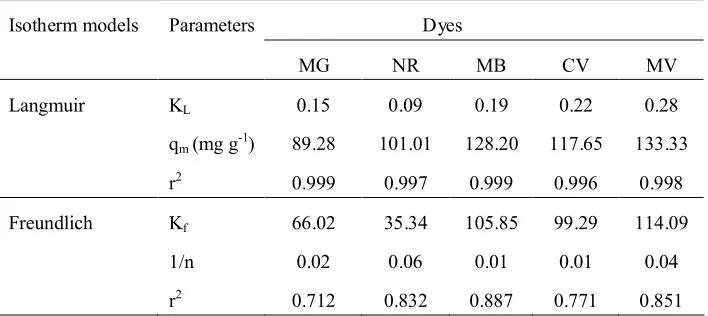
The equilibrium adsorption data (Fig. 4) was fitted to the Langmuir and Freundlich isotherm models by linear regression. The resulting parameters are summarized in Table 1.
The higher correlation coefficient obtained for the Langmuir model (r2 > 0.99) indicates that the experimental data are better fitted into this model, and adsorption of the investigated dye molecules on MNPs-POLP is more compatible with Langmuir assumptions, i.e., adsorption takes place at specific homogeneous sites within the adsorbent. The Langmuir model is based on the physical hypothesis that the maximum adsorption capacity consists
of a monolayer adsorption, that there is no interaction between adsorbed molecules, and that the adsorption energy is distributed homogeneously over the entire coverage surface. This sorption model serves to estimate the maximum uptake values where they cannot be reached in the experiments. According to the results (Table 1), the maximum adsorption capacities were 133.33, 128.20, 117.65, 101.01 and 89.28 mg g-1 for MV, MB, CV, NR, and MG, respectively.
Desorption and Reuse Studies
In order to evaluate the possibility of regeneration and the reuse of the adsorbent, desorption experiments were performed. Different eluents including methanol, ethanol, acetic acid solution (0.1 M), and hydrochloride acid solution (0.01 M) were used to regenerate the adsorbent. To this end, 2.0 ml of the eluent was added to 20 mg of the dye-loaded MNPs-POLP in a beaker. Then, the adsorbent was collected magnetically from the solution, and the concentration of the desorbed dyes in the desorbed solution was measured spectrophotometrically. The results (not shown) showed that methanol could efficiently desorb the adsorbed analytes and used for regeneration of the adsorbent. It is notable that the equilibrium of desorption was achieved within about 10 min, which was fast, similar to the adsorption equilibrium. After elution of the adsorbed dyes, the adsorbent was washed with DDW and vacuum dried at 25 ºC overnight and reused for the dye removal. The reusability of the
Table 1. The Isotherm Parameters for the Adsorption of the Investigated Dyes onto MNPs- POLP at Room Temperature
Dyes Isotherm models Parameters
MG NR MB CV MV
Langmuir KL
qm (mg g-1)
r2 0.15 89.28 0.999 0.09 101.01 0.997 0.19 128.20 0.999 0.22 117.65 0.996 0.28 133.33 0.998
Freundlich Kf
sorbent was at least ten cycles without any significant loss in its sorption behavior. Therefore, the MNPs-POLP can be regarded as a reusable and economical sorbent for dye removal purposes.
CONCLUSIONS
A magnetic solid phase extraction procedure for wastewater treatment using magnetite nanoparticles loaded platanusorientalis waste leaves as the magnetic adsorbent is developed in this work. The adsorbent was synthesized using a simple method, and utilized for the removal of five cationic dyes from aqueous solution. After optimizing the important factors affecting the adsorption process, the results showed that fast, cost-effective, simple in handling, and in the same time, efficient removal of the investigated dyes is achievable using the synthesized adsorbent.
REFERENCES
[1] T. Madrakian, A. Afkhami, M. Ahmadi, H. Bagheri, J. Hazard. Mater. 196 (2011) 109.
[2] O. Duman, S. Tunç, T.G. Polat, B.K. Bozoğlan, Carbohydr. Polym. 147 (2016) 79.
[3] T. Madrakian, A. Afkhami, N.R. Jalal, M. Ahmadi, Sep. Sci. Technol. 48 (2013) 2638.
[4] T. Madrakian, A. Afkhami, H. Mahmood-Kashani, M. Ahmadi, J. Iran. Chem. Soc. 10 (2013) 481. [5] V.K. Gupta, R. Kumar, A. Nayak, T.A. Saleh, M.A.
Barakat, Adv. Colloid Interface Sci. 193-194 (2013) 24.
[6] W. Peng, H. Li, Y. Liu, S. Song, J. Mol. Liq. 221 (2016) 82.
[7] T. Madrakian, A. Afkhami, R. Haryani, M. Ahmadi, RSC Adv. 4 (2014) 44841.
[8] A.K. Sarkar, A. Saha, A. Tarafder, A.B. Panda, S. Pal, ACS Sustain. Chem. Eng. 4 (2016) 1679. [9] F.I. Hai, K. Yamamoto, F. Nakajima, K. Fukushi, J.
Membr. Sci. 389 (2012) 67.
[10] F.I. Hai, K. Yamamoto, F. Nakajima, K. Fukushi, Water Res. 45 (2011) 2199.
[11] X. Huang, Y. Zhao, B. Gao, S. Sun, Y. Wang, Q. Li, Q. Yue, J Taiwan Inst. Chem. Eng. 64 (2016) 173. [12] A.K. Verma, R.R. Dash, P. Bhunia, Environ.
Manage. 93 (2012) 154.
[13] J. Mittal, V. Thakur, A. Mittal, Ecol. Eng. 60 (2013) 249.
[14] H. Shayesteh, A. Rahbar-Kelishami, R. Norouzbeigi, Desalin. Water Treat. 57 (2016) 12822.
[15] R. Ahmad, J. Hazard. Mater. 171 (2009) 767. [16] J. Mittal, D. Jhare, H. Vardhan, A. Mittal, Desalin.
Water Treat. 52 (2014) 4508.
[17] L. Zhang, H. Zhang, W. Guo, Y. Tian, Appl. Clay Sci. 93-94 (2014) 85.
[18] R. Kumar, R. Ahmad, Desalination 265 (2011) 112. [19] S. Neupane, S.T. Ramesh, R. Gandhimathi, P.V.
Nidheesh, Desalin. Water Treat. 54 (2015) 2041. [20] H. Gan, H. Zhang, J. Cai, H. Jin, K. Zhang, Desalin.
Water Treat. 57 (2016) 15241.
[21] T. Madrakian, A. Afkhami, M. Ahmadi, Spectrochim. Acta A 99 (2012) 102.
[22] M. Peydayesh, A. Rahbar-Kelishami, J. Ind. Eng. Chem. 21 (2015) 1014.
[23] T. Madrakian, M. Ahmadi, A. Afkhami, M. Soleimani, Analyst 138 (2013) 4542.
[24] H. Freundlich, W. Heller, J. Am. Chem. Soc. 61 (1939) 2228.