
RP-HPLC method development and validation of doxycycline in bulk and tablet formulation
8
0
0
Full text
(2) Jeyabaskaran. M, et. al / Int. J. of Pharmacy and Analytical Research Vol-3(4) 2014 [397-404] spectrophotometry [10-14], fluorimetry [15], 16 establishment of impurities profile by HPLC [ ] and estimation of drug content in bulk and pharmaceutical dosage forms by HPLC was reported [17-20]. The liquid chromatographic method for the determination of DOXY is the choice of some pharmacopoeias [2-4]. We here in report a simple, rapid and reliable RP-HPLC for the estimation of DOXY in bulk and pharmaceutical dosage forms.. kinetics of doxycycline has been reportedly altered in patients receiving drugs which induce hepatic metabolism. DOXY is 40% of dose slowly excreted in the urine, although more excreted by this route if the is made alkali. However, the majority of a dose of DOXY is excreted in the faeces following chelation in the intestine[5]. Literature review reveals that few analytical methods were evoked for the estimation of DOXY by spectrophotometry[6,7-9], visible OH. O. OH. O. O NH2 OH. H. H. H3C. OH H3C. N CH3. Fig:1. Structure of doxycycline (RT). The flow rate was maintained at 1.0 mL min-1, EXPERIMENTAL with a run time of 6 min. the mobile phase was filtered REAGENTS AND MATERIALS by using 0.45µ filter and it was degassed by sonication Pure standard of DOXY (99.6%) was obtained as gift prior to use. All determinations were made at ambient sample from Ranboxy Pharma Ltd, New Delhi. HPLC temperature. The eluent was detected at 268nm. grade acetonitrile (Rankem, avantor chemicals, gujarat), HPLC grade water, potassium dihydrogen phosphate, Triethylamine, and ortho phosphoric acid were obtained from Merck specialities pvt ltd, Mumbai, TETRADOX tablets (Randoxy (Stancare) pharma ltd), high precision weighing balance (wensar instruments, hyderabad), micro pipette (in labs,10-100 µl) were employed in the study. All the glassware employed in the work cleaned with hot water followed acetic anhydride then acetone and dried in hot air oven whenever required. Working environment was maintained in between 20oC ±2.. HPLC APPARATUS AND CHROMATOGRAPHIC CONDITIONS The analysis was performed on Waters 2695 HPLC system with Waters2996 Photodiode Array detector. Data acquisition was performed by using Empower 2 software. Altima, C18 column (150 x 4.6mm, 5µ) was used as stationary phase. Injections were performed by the manual injector with 10µl. Different mobile phases were tested in order of their polarity to find out the best conditions for the separation of doxycycline. The selected mobile phase Acetonitrile and Potassium Dihydrogen Phosphate buffer of 0.1% (pH 3.1) in the ratio of 40:60%v/v gave acceptable retention time. PROCEDURE RECOMMENDED PREPARATION OF MOBILE Potassium Dihydrogen Phosphate Buffer (0.1% of KH2PO4) and acetonitrile taken in the ratio 60:40 (v/v) were employed as a mobile phase.. PREPARATION OF STOCK SOLUTION A stock solution was prepared by accurately weighed and transferred 10mg of DOXY working standards into a 10ml clean dry volumetric flask, add 7ml of diluent (Water and acetonitrile 50:50), sonicated for 30 minutes and make up to the final volume with diluents. From the above stock solution, 1ml was pipette out into a10ml volumetric flask and then make up to the final volume with diluent.. CONSTRUCTION OF LINEARITY The concentrations of analyte were prepared from the stock solution by taking suitable volume (0.25 – 1.5 ml) and diluted up to 10 ml to get the desired concentrations for linearity in the range of 25 – 150µg/ml.[21,22] the prepared solutions were filtered through 0.45µm membrane filter and each of the dilutions was injected three times into the column. The. www.ijpar.com. ~ 398~.
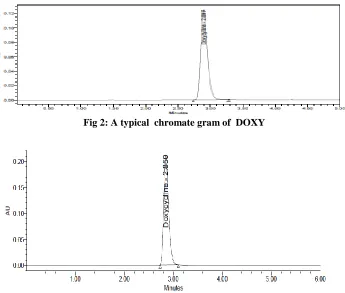
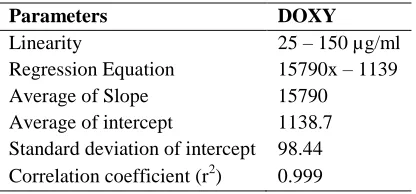
(3) Jeyabaskaran. M, et. al / Int. J. of Pharmacy and Analytical Research Vol-3(4) 2014 [397-404]. calibration curve for DOXY was constructed by plotting the mean peak area (Y-axis) against the concentration (X-axis). It was found to be linear in the concentration range 25-150µg/ml with good correlation in between concentration and mean peak area.. ASSAY 20 tablets were weighed and the contents were removed to obtain the average weight powder. A sample of the powder claimed to contain 100mg of active ingredient, was mixed with 70ml of diluent. The mixture was allowed to stand with intermittent. sonication to ensure complete solubility of drug. Further the volume made up with diluent and the resulting solution was passed through 0.45µm membrane filtered. From the filtered stock solution of 1mg/ml an aliquot of this solution (0.2ml) was transferred to a volumetric flask and made up to a sufficient volume with diluent to get desired concentration of 20µg/ml. The prepared dilution was injected three times into the column to obtain chromatogram. From that peak area, the drug content in the tablet was quantified. [23,24]. Fig 2: A typical chromate gram of DOXY. Fig:3.Chromatogram showing the assay of Doxycycline marketed dosage form (TETRADOX tablets).. RESULTS The present RP-HPLC method for the quantification of DOXY in bulk and pharmaceutical dosage forms, revealed as simple, rapid, accurate and precise method with significant shorter retention time of 2.897.min. The linearity for the detection of DOXY was 25150µg/ml with (R2 = 0.999; y = 15790x + 1138.7) the coefficients of variation based on mean peak area for three replicate injections were found to be 0.999. Results were shown in table-1 and statistical data of. calibration curves were shown in table-2. The intraday and inter day variations of the method were determined using five replicate injections analyzed on the same day and next day over a period of 24 hours.[ 21] The result revealed the precision with %RSD of 0.7999 and 1.3, respectively for intraday and inter day. Results were shown in table-3. To ensure the reliability and accuracy of the method, the recovery studies were carried out by adding a known quantity of drug with pre-analyzed sample and contents were reanalyzed by. www.ijpar.com. ~ 399~.
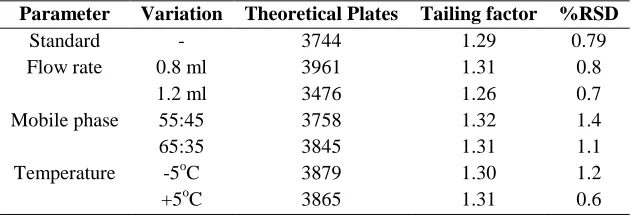
(4) Jeyabaskaran. M, et. al / Int. J. of Pharmacy and Analytical Research Vol-3(4) 2014 [397-404]. the proposed method.[21,27] Accuracy was evaluated by injecting the solution about three times, at three different concentrations equivalent to 50%, 100% and 150% of the active ingredients, by adding a known amount of DOXY standard to a sample of known concentration and calculating the recovery of DOXY with RSD (%) and recovery for each concentration.[23,24] The mean % recoveries were in between 99.13 – 101.997% and were given in table- 4. The assay for the marketed tablets of TETRADOX tablets was established with present chromatographic condition developed and it was found to be more accurate and reliable. The average drug content was found to be 100.31 of the labeled claim and no interfering peaks were found in chromatogram, indicating that the estimation of drug free from inference of excipients. [23,24] The results were shown in table – 5. To know reproducibility of the method system suitability test was employed to establish the parameters such as tailing factors, theoretical plates, limit of detection and limit of quantification and values were shown in table-6. Ruggedness of the method (intermediate precision) was estimated by preparing six Dilutions of the DOXY as per the proposed method and. each dilution injected into column. The results were shown in table -7. Robustness of the proposed method was estimated by changing mobile phase composition from buffer: acetonitrile (60:40) v/v to buffer: acetonitrile 65:35 (v/v), changing the flow rate from 1ml to 1.2 ml/min, changing the temperature (+ 5oc) and system suitability parameters were found to be within acceptable limits.[29] Results were shown in table-8 and indicating that the test method was robust for all variable conditions. Hence the method was sufficiently robust for normally expected variations in chromatographic conditions. The ruggedness and robustness for the method was performed as per ICH guidelines. Limit of detection (LOD) and quantification (LOQ), the limits of detection and quantification were calculated by the method based on the standard deviation (σ) and the slope (S) of the calibration plot, using the formulae LOD = 3.3σ/s LOQ=10 σ/s.[ 30,31] The specificity test of the proposed method demonstrated that the excipients from tablets do not interfere in the drug peak. Furthermore, well shaped peaks indicate the specificity of the method.[28] The typical chromatograms of DOXY standard and tablet dosage form were shown in figure 2,3.. Table 1 Concentration Vs Mean Peak Area Concentration (µg/ml) 25 50 75 100 125 150 Regression Equation Correlation coefficient(r2). Mean peak area 382469 793523 1182415 1591981 1974592 2356741 y = 15790x - 1139 0.999. Table 2 Statistical Data of Calibration Curves of DOXY Parameters Linearity Regression Equation Average of Slope Average of intercept Standard deviation of intercept Correlation coefficient (r2). www.ijpar.com. ~ 400~. DOXY 25 – 150 µg/ml 15790x – 1139 15790 1138.7 98.44 0.999.
(5) Jeyabaskaran. M, et. al / Int. J. of Pharmacy and Analytical Research Vol-3(4) 2014 [397-404] Table 3; Precision of method Parameters (n=6) Mean Peak Area Standard deviation %RSD. Intraday 1498511 11987.29 0.7999. Interday 1492636 19422 1.3. Table 4: Recovery Study of Method % of drug Added Amount Present Mean amount found (n=3) (µg) 100 50 50 50.68+ 0.31 100 100 100 100.34 + 0.07 100 150 150 149.41 + 0.71 Average mean % recovery = 100.31, Standard deviation = 0.8511, %RSD = 0.8484 Standard of Drug (µg). Mean % recovery 101.17 100.34 99.496. Table 5: Estimation of amount of DOXY Brand name of Tablet TETRADOX. Label claim (mg) 100. Amount of drug estimated (mg) 99.87. Mean amount 99.87+ 0.32. Table 6: System suitability Parameters Parameters Retention time (min) Theoretical plates Tailing factor Linearity Range (µg/ml) Limit of Detection (LOD) (µg/ml) Limit of Quantification (LOQ) (µg/ml) Relative standard deviation (RSD). DOXY 2.897 3677 1.28 25 - 150 0.02 0.06 0.999. Table 7: Ruggedness of method S.No Analyst - 1 Analyst - 2. Labeled Claim (mg) 100 100. Amount estimated (mg) 99.87 100.31. Mean + S.D 99.87 + 0.32 100.31 + 0.85. %RSD 0.32 0.848. Table 8: Robustness of method Parameter Standard Flow rate Mobile phase Temperature. Variation 0.8 ml 1.2 ml 55:45 65:35 -5oC +5oC. Theoretical Plates 3744 3961 3476 3758 3845 3879 3865 www.ijpar.com. ~ 401~. Tailing factor 1.29 1.31 1.26 1.32 1.31 1.30 1.31. %RSD 0.79 0.8 0.7 1.4 1.1 1.2 0.6. %RSD 0.32.
(6) Jeyabaskaran. M, et. al / Int. J. of Pharmacy and Analytical Research Vol-3(4) 2014 [397-404]. DISCUSSION The development of HPLC methods for the determination of drugs has received considerable attention in recent years because of their importance in the quality control of drugs and drug products.[ 25,26] The goal of this study was to develop and validate a RP-HPLC method for the estimation of DOXY in bulk and pharmaceutical commercial preparations. The main objective of method development was to determine the drug content present in the formulation and its % purity. The chromatographic conditions like mobile phase composition, flow rate was optimized and the method was developed, validated success fully. The selected mobile phase system gave a single sharp peak without interfering peaks. Initial development of the method various mobile phases were tried to get sharp peak, finally buffer: acetonitrile in the ratio of 60:40 (v/v) was selected which gave a single sharp peak with retention of 2.897 min and tailing factor 1.28. Commercial marketed formulation of DOXY was analyzed for its contents and % of content was calculated. The proposed method was found to be simple, rapid, economic and accurate and the method was applicable to routine laboratory analysis. The. method was validated statistically for various parameters like standard deviation, % relative standard deviation, slope and intercept. The proposed method was following linearity in the concentration range of 25-150 µg/ml and obeys the beers lamberts law and above 25-150 µg/ml the linear plot showing deviation from beers law. Every concentration was injected into chromatographic system about three times and peak areas were noted. Greater reproducibility was obtained for calibration plots and it was determined by calculating the slope, intercept and %RSD for each standard plot. The method was found to be robust as there was no significant change in the peak area and retention time. The system suitability tests were performed to asses the quality performance of the method. The method was found to be more specific, robust and rugged and most suitable for routine analysis.. CONCLUSION The proposed method was simple, accurate and sensitive HPLC method for the estimation of DOXY in bulk and pharmaceutical dosage forms.. REFERENCES [1] [2] [3] [4]. British pharmacopoeia, the stationary office Ltd, London, 2001, 526-527. Indian pharmacopoeia, Ghaziabad: the Indian pharmacopoeial commoission, Vol –I, 1996, 274-75. United states pharmacopoeia, Rockville MD, the united states pharmacopoeial convention, Vol –II, 2000, 611. Hardman JG, Limbard LE, Gilman AG, Goodman and Gilman’s The pharmacological basis of Therapeutics, 10th edition, 2001, 2045. [5] Rang HP, Dale MM, Ritter JM and Moore PK, Pharmacology, 5 th edition, 2003, 643. [6] Salinas F, Berzas Nevado JJ, Espinosa A, Determination of oxytetracycline and doxycycline in pharmaceutical compounds, urine and honey by derivative spectrophotometry, analyst 1989, 1141 -1145. [7] Lopez Paz JL, Martinez Calatayud J, J Pharm Biomed Anal 11, 1993, 1093. www.ijpar.com. ~ 402~.
(7) Jeyabaskaran. M, et. al / Int. J. of Pharmacy and Analytical Research Vol-3(4) 2014 [397-404]. [8] Mahrous MS, Abdel-Khalek MM, Talanta, 31, 1984, 289. [9] Abdel-Khalek MM, Mahrous MS, Talanta, 30, 1983, 792. [10] Lopez PJL, Martinez CJ - Copper carbonate as a solid bed reactor for spectrophotometric determination of doxycycline and oxytetracycline in an unsegmented continuous flow assembly, J Pharma Biomed Anal, 11, 1993, 1093 -1098. [11] Saha U, Sen AK, Das TK, Bhowal SK – Spectrophotometric determination of tetracyclines in pharmaceutical preparations with uranyl acetate. Talanta 37, 1990, 1193 -1196. [12] Chandra YS, Rao VS, Murthy PSR, Siva CY, Suryanarayana Rao V – Determination of hostacycline and doxycycline using thorium (IV) as spectrometric reagent, Indian J Pharm Sci, 58, 1996, 157 – 159. [13] Mahrous MS, Abdul-Khalek MM – Spectrophotometric determination of phenothiazines, tetracyclines and chloramphenicol with sodium cobaltinitrile, Talanta, 31, 1984, 289 – 291. [14] Suranic SM, Mitic SS, Miletic GZ, Pavlovic AN, Naskovic – Djokic D – Determination of Doxycycline in pharmaceuticals based on its degradation by Cu(II)/ H2O2 reagent in aqueous solution , J Anal Chem, 64, 2009, 231 – 237. [15] Van den Bogert C, Kroon AM – Fluorometric determination of tetracyclines in small blood and tissue sample, J Pharm Sci 70, 1981, 186 -189. [16] Skulason S, Ingolfsson E, Kristmundsdottir T – Development of a simple HPLC method for separation of doxycycline and its degradation products J Pharm Biomed Anal, Nov 24;33(4), 2003, 667 -672. [17] Fiori J, Grassigi G, Filippi P, Gotti R, Cavrini V – HPLC- DAD and LC- ESI-MS analysis of doxycycline and related impurities in doxipan mix, a medicated premix for incorporation in medicated feedstuff, Journal of Pharmaceutical and Biomedical Analysis, 37(5), 2005, 979 – 985. [18] Axisa B, Naylor AR, Bell PRF, Thompson MM – Simple and Reliable method of doxycycline determination in human plasma and biological tissues, Journal of Chromatography B, biomedical Sciences and Applications, 744(2), 2000, 359 – 365. [19] Hoogmartens J, Khan NH, Vanderhaeghe H, Van der Leeden AL, Oosterbaan M, Veld –Tulp GL, Plugge W, Van der Vlies C, Mialanne D, Melamed R, J Pharm Biomed Anal 7, 1989, 601. [20] Dihuidi K, Kucharski MJ, Roets E, Hoogmartens J, Vanderhaeghe H, J Chromatogr A 325, 1985, 413. [21] Ramesh PJ, Basvaiah K, Tharpa K, Basavaiah Vinay K, Revanasiddappa KD – Development and validation of RP-HPLC method for the determination of doxycycline hyclate in spiked human urine and pharmaceuticals, Journal of Pre-clinical and Clinical Research, Vol 4, No.2, 2010, 101 – 107. [22] Snezana SM, Gordana ZM, Danijela AK, Naskovic –Dokic DC, Biljana BA, Ivana DR – A rapid and reliable determination of doxycycline hyclate by HPLC with UV detection in pharmaceutical samples, Journal of the Serbian Chemical Society, 73 (6), 2008, 665 – 671. [23] Amit Kumar, Sanju Nanda and Rajiv Chomwal – Spectrophotometeric methods for determination of doxycycline in tablet formulation, International Journal of Pharm Tech Research, Vol.2 No.1, 2010, 599-602. [24] Ramesh PJ, Basvaiah K, Divya MR, Rajendraprasad N, Basavaiah Vinay K – Titrimetric and spectrophotometric determination of doxycycline hyclate using bromate – bromide, methyl orange and indigo carmine, Chemical Industry & Chemical Engineering Quarterly, 16 (2), 2010, 139- 148. [25] Chandrashekar N, Patel HR, Karvekar MD, Suresh BAR – Simultaneous estimation of aceclofenac, paracetamol and tizanidine in their combined dosage forms by spectrophotometric and RP-HPLC method, J Anal Biomed Tech, 2, 2011, 123. [26] Sonawane LV, Bari SB, - Development and validation of RP- HPLC method for the simultaneous estimation of amoxicillin trihydrate and bromihexine hydrochloride from oily suspension , Pharm Anal Acta, 1, 2010, 107. [27] Haider M – Development and validation of a stability indicating HPLC method for the estimation of butamirate citrate and benzoic acid in pharmaceutical products, J Chromatograph Separate Techniq, 2, 2011, 111. [28] Liu Y , Hou S, Wang L, Tang S – Development and validation of a liquid chromatography method for the analysis of paramomycin sulfate and its impurities, J Anal Bioanal Tech, 1, 2010, 102.. www.ijpar.com. ~ 403~.
(8) Jeyabaskaran. M, et. al / Int. J. of Pharmacy and Analytical Research Vol-3(4) 2014 [397-404]. [29] Fayyed MK, Misha AK, Yousef Al- Musaimi OI – Effect of temperature, Wavelength, pH, Ion pair reagents and organic modifires concentration on the elution of cystatin C, Stability of mobile Phase, J Anal Bioanal Tech, 1, 2010, 103. [30] Salvi VS, Sathe PA, Rege PV – Determination of tinidazole and ciprofloxacin hydrochloride in single formulation tablet using differential pulse polarography, J Anal Bioanal tech, 1, 2010, 110. [31] Rao BU, Nikalje AP – Determination of glipizide, glibeniamide and glimeperide in a tablet dosage form in the presence of Metformin hydrochloride by ion pair – reversed phase liquid chromatographic technique, J Anal Bioanal Tech, 1, 2010, 105. *******************. www.ijpar.com. ~ 404~.
(9)
Figure
Related documents
The addition of apixaban to antiplatelet therapy in high-risk acute coronary syndrome patients did not significantly reduce ischemic events but did increase the number of
• The cattle that showed clinical signs before day 16 (early cases) stayed for a long time in the herd, and were culled only after a few days, while cattle that became sick later
This study lends credence to previous work that showed that factors such as perceived fit, perceived individual learning support, perceived usefulness, confirmation, and
Keywords: Customer churn prediction, Churn in telecom, Machine learning, Feature selection, Classification, Mobile Social Network Analysis, Big data.. © The
Para lo cual se cumplirán los siguientes objetivos específicos: Determinar la composición corporal (masa visceral, masa ósea, % grasa, % agua corporal total) mediante
This paper is organized as follows: Section “Affine processes on R d 0 ” reviews affine processes and Section “Affine LIBOR models with multiple curves” presents an overview
Keywords: Cardiac surgery, Postcardiotomy cardiogenic shock (PCS), Extracorporeal membrane oxygenation (ECMO), Intra-aortic balloon pumping (IABP), Concurrent initiation,
of ten individual journeys of purpose to find spiritual meaning in work, but of.. innumerable others who join in and benefit from those who see their
