Iranian Rehabilitation Journal, Vol. 8, No. 12, December 2010
This paper has been prepared on the ground of a student research project
Original Article
Reliability of the Persian version of Canadian Occupational
Performance Measure for Iranian elderly
population
Atashi Neda, Aboutalebi Shahram
Assistant Professor, Uuniversity of Social Welfare and Rehabilitation Sciences, Pediatric
Neurohabilitation Research Center, Tehran, Iran.
Heidari Mohammad
*Master of occupational therapy, university of Social Welfare and Rehabilitation Sciences,
Department of occupational therapy, Tehran, Iran
Hosseini Seyyed Ali
Assistant professor, Department of Occupational theraphy, University of Social Welfare and
Rehabilitation Sciences, Tehran, Iran
Objectives: The value of the client-centered approach for treating patients with various disabilities has been increasingly acknowledged. The aim of this study was to determine the test-retest reliability of the Persian version of the Canadian Occupational Performance Measure (COPM) as an individual outcome measure among Iranian elderly population.
Method: In this cross-sectional study, 60 older clients who fulfilled the inclusion criteria were randomly selected and underwent the measurements. Based on the performing procedure of the COPM, participants were asked to identify their most important problems within activities of daily living (ADL) and then; to score them according to the amount of ability and satisfaction they experience during those activities. All participants were assessed twice, with seven days interval. The correlations between data obtained from two assessments were calculated for ability and satisfaction sections separately using Pearson
coefficiency. Results: Data analysis showed that there are good correlation between mean scores of two assessments in both ability (rp=0.80, Pvalue<0.05) and satisfaction (rp=0.84, Pvalue<0.05) sections. Conclusion: Results obtained from this study enhance the value of the COPM as an individual outcome measure and suggest that Persian version of the COPM has adequate test-retest reliability in selected older populations.
Keywords: Test-retest Reliability, Canadian Occupational Performance Measure, elderly
Introduction
The older population has been continuously growing in many countries including Iran [1-4]. This imposes ethical and economical costs to the governments and health care Systems [2-3, 5]. The incidence of many disabling such as neuromuscular diseases, musculoskeletal disorders and sensory impairments is associated with aging [5].
The role of occupational therapists for management of aging-associated conditions is now well-established [6-7]. It has shown that persistent engagement in meaningful activities can be helpful for elderly people [6-7]. However, recognizing the real sources of disability rather than primary symptoms is necessary to set appropriate therapeutic goals and strategies, especially in older population that sometimes their actual needs and viewpoints are ignored [5, 8-11]. In other words, the focus in occupational therapy practice is moving to greater
about its psychometrics properties exists in the current literature especially those about its reliability [22-24]. Also, since the COPM is used for evaluation over the time, it is necessary to examine its test-retest reliability to ensure therapists about consistency of outcome measured over time [16-17]. The aim of the study was to investigate the test-retest reliability of the COPM among Iranian elderly population.
Materials and Methods
Participants
In this cross-sectional study sixty outpatient clients diagnosed as various medical conditions, selected randomly as the sample among those who were members of West Clubs of Tehran Senile Cultural House. Inclusion criteria were: being over 60 years old, no difficulty in speaking and understanding the Persian language, having no serious cognitive impairments (Mini-Mental Status Exam score>22), and perceiving limitations at least in two activities of daily living. All subjects signed a written consent approved by medical ethic committee of the University of Social Welfare and Rehabilitation Sciences.
Procedure
As the standard procedure [16,25], the COPM was conducted through a semi-structured interview between examiner and client. In the first step, clients were asked to identify their up to five most self-perceived problems within activities of daily living, including: self-care, productivity and leisure times. In this step, examiner completely explained the process of the test as well as gave clients some examples of activities within each area. After that, clients rated their identified problems based on their importance by a 10-point scale (1 indicate the least important and 10, the most important). In the next step, clients rated the identified problems based on both self-perceived ability (how much they are able to perform those specific activities) and satisfaction (how much satisfactory felt performing those specific activities) separately in a 10-point scale like earlier step. In the ability part, 1 and 10 indicated minimum and maximum ability respectively, to perform identified activities. Similarly, in the satisfaction part, 1 and 10 indicated minimum and maximum satisfaction felt performing identified activities. After completion of this step, scores of ability and satisfaction were multiplied separately by
this way, each client had two separate scores which ranged from 1 to 100. Individual's score in each part were added together independently for the identified problems and then divided by the number of total rated activities to provide scores that could be used for comparison across time.
To investigate the test-retest reliability of this version of COPM, all subjects were assessed twice at seven days interval. A single examiner performed the test for all subjects for first and second assessments. Clients received no intervention between two occasions.
Data analysis
Statistical calculations were performed using software package SPSS for windows, version 16.0. As the conventional statistical procedures, the significance level was set at α = .05 for all analyses. To determine the consistency of identified problems between two occasions, the number of problems which was the same in two sessions was divided by the total number of identified problems in the first assessment for each client. Thus, there was one score for each client which range from 0 to 1. Then, the mean scores obtained by this manner considered as the consistency of problems identified through the COPM.
The test-retest reliability of the COPM was established in the ability and satisfaction sections separately. In order to determine the test-retest reliability of COPM in each section, Pearson coefficiency was used.
Results
Of the 60 clients who underwent the measurement at the first session, two participants stated that their medical conditions have changed by the seven days at reassessment; therefore they were excluded from the study and data analysis performed for remained 58 clients. Total time spent for administrating the COPM for each client at each session ranged between 15 and 25 minutes and generally administrating the COPM was easy according to examiner.
The mean age of the participants was 69±6.71 which range from 60 to 83 and the ratio of the male/female was 41.7 / 58.3.
problems in activities of daily living at the first assessment and 231 at reassessment. At the both sessions the number of identified problems ranged between 2 and 5. Although broad range of problems was recorded by participants, all of them fell generally in three main categories including self-care (57℅), productivity (26℅), and leisure times (17℅).
Among total 225problems identified as the priorities at the first assessment, 184 items repeated at the second session and the mean score, observed for consistency of identified problems between two sessions was 78℅. However, the sequence of the identified problems in the second assessment was not similar to first assessment in all cases; the rates of similarity observed for first to fifth identified priorities were as follow respectively: 76%, 66%, 74%, 74%, and 50%.
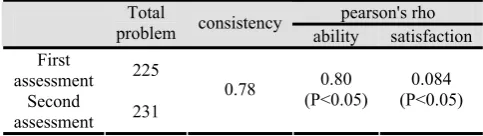
The correlation coefficient of ability scores for two assessments was 0.80 (Pvalue<0.05). In the satisfaction section, correlation coefficient for two recorded scores was 0.084 (Pvalue<0.05). These observations are summarized in table 1.
Table 1. Consistency of identified problems and correlation coefficient for ability and satisfaction section between two sessions
pearson's rho satisfaction ability
consistency Total
problem
225 First
assessment 0.084
(P<0.05) 0.80
(P<0.05) 0.78
231 Second
assessment
Discussion
This study was run to determine that if the Persian version of COPM has appropriate test-retest reliability when used in Iranian older population; if so, the value of COPM as a helpful tool for use in client-centered approach would be increased.
It is suggested that scales used for the clinical purposes should have reliability coefficients ≥0.80 or even ≥0.90 [26]. Based on this information, we found that consistency of COPM was moderate for identified problems (ranged from 50% to 78%), while good reliability of the COPM was found regarding performance and satisfaction scores (rp=0.80 for performance and rp=0.84 for satisfaction scores). Therefore, our results support previous studies that pointed to test-retest reliability of the COPM is moderate for the item pool, but is good for the performance and satisfaction scores [18, 20, 27-29].
These observations can be explained by pointing to the belief that overall performance and satisfaction is related to some aspects of quality of life and well-being [28, 30-33]; Therefore, the way in which clients score themselves depend mostly on their general health statuses that unlikely change after few days without certain interventions. On the other hand, since the COPM interview itself initiates the problem-solving process [28, 34], the way in which clients rated their perceived problems considering their priority could be influenced after first interview. In other words, an increased level of insight might cause the clients to rate their problems in a different way at reassessment [28]. Therefore, paying attention to dynamic nature of human-being, it is expectable that after first interview clients consider some aspects of everyday life which already were ignored [18]. The semi-structured design of the COPM may also lead clients sometimes to overestimate or underestimate their problems [15, 28]. These reasons can explain why moderate consistency was found for problems identified through COPM within one week.
The broad variation of problems identified by the clients in this study advocates the perspective that considers individual differences regarding physical, social and environmental factors in therapeutic goal-setting even for same diagnoses [22, 35-37]. However, to eliminate the influence of the different environmental factors on final results, all clients assessed in their place of residence where were same and identical in both sessions.
Conclusion
Based on our results, the Persian version of COPM can be used as a reliable tool for detecting changes in client-perceived problems with ADL in selected older populations. Therefore, the study confirms the value of COPM as a flexible and helpful individual outcome measure for various types of diagnoses.
Acknowledgment
We acknowledge the Occupational Therapy Department of University of Social Welfare and Rehabilitation Sciences, Iran, for financial support of this study.
References:
1. Manton KG, Corder LS, Stallard E. Estimates of change in chronic disability and institutional incidence and prevalence rates in the US elderly population from the 1982, 1984, and 1989 National Long Term Care Survey. The Journal of Gerontology 1993;48(4):S153.
2. Manton KG. Changing concepts of morbidity and mortality in the elderly population. The Milbank Memorial Fund Quarterly Health and Society 1982;183-244.
3. Shrestha LB. Population aging in developing countries. Health affairs 2000;19(3):204.
4. Tajvar M, Arab M, Montazeri A. Determinants of health-related quality of life in elderly in Tehran, Iran. BMC Public Health 2008;8(1):323.
5. Atwal A, Owen S, Davies R. Struggling for occupational satisfaction: Older people in care homes. The British Journal of Occupational Therapy 2003;66(3):118-24. 6. Taddei S, Galetta F, Virdis A, Ghiadoni L, Salvetti G,
Franzoni F, et al. Physical activity prevents age-related impairment in nitric oxide availability in elderly athletes. Circulation 2000;101(25):2896.
7. Steultjens EMJ, Dekker J, Bouter LM, Jellema S, Bakker EB, van den Ende CHM. Occupational therapy for community dwelling elderly people: a systematic review. Age and ageing 2004;33(5):453.
8. Clark J, Rugg S. The importance of independence in toileting: The views of stroke survivors and their occupational therapists. The British Journal of Occupational Therapy 2005;68(4):165-71.
9. Fricke J, Unsworth C. Time use and importance of instrumental activities of daily living. Australian Occupational Therapy Journal 2001;48(3):118-31.
10. Maitra KK, Erway F. Perception of client-centered practice in occupational therapists and their clients. The American Journal of Occupational Therapy 200.٢٩٨:(٣)۶٠;۶
11. Lund ML, Tamm M, BrSnholm IB. Patients' perceptions of their participation in rehabilitation planning and professionals' view of their strategies to encourage it. Occupational Therapy International 2001;8(3):151-67. 12. Whiteneck GG. Measuring what matters: key rehabilitation
outcomes. Archives of Physical Medicine and Rehabilitation 1994;75(10):1073-6.
13. Cardol M. Handicap questionnaires: what do they assess? Disability & Rehabilitation 1999;21(3):97-105.
14. Phipps S, Richardson P. Occupational therapy outcomes for clients with traumatic brain injury and stroke using the Canadian Occupational Performance Measure. The American Journal of Occupational Therapy 2007;61(3):328.
15. Wressle E, Marcusson J, Henriksson C. Clinical utility of the Canadian Occupational Performance Measure--Swedish version. Canadian journal of occupational therapy Revue canadienne d'ergothqrapie 2002;69(1):40.
16. Law M, Baptiste S, McColl M, Opzoomer A, Polatajko H, Pollock N. The Canadian Occupational Performance Measure: an outcome measure for occupational therapy.
17. Kjeken I, Dagfinrud H, Uhlig T, Mowinckel P, Kvien TK, Finset A. Reliability of the Canadian Occupational Performance Measure in patients with ankylosing spondylitis. The Journal of Rheumatology 2005;32(8):1503. 18. Eyssen I, Beelen A, Dedding C, Cardol M, Dekker J. The reproducibility of the Canadian Occupational Performance Measure. Clinical rehabilitation 2005;19(8):888.
19. Wressle E, Samuelsson K, Henriksson C. Responsiveness of the Swedish version of the Canadian occupational performance measure. Scandinavian Journal of Occupational Therapy 1999;6(2):84-9.
20. Carswell A, McColl MA, Baptiste S, Law M, Polatajko H, Pollock N. The Canadian Occupational Performance Measure: a research and clinical literature review. Canadian journal of occupational therapy Revue canadienne d'ergothqrapie 2004;71(4):210.
21. McColl MA, Law M, Baptiste S, Pollock N, Carswell A, Polatajko HJ. Targeted applications of the Canadian Occupational Performance Measure. Canadian journal of occupational therapy Revue canadienne d'ergothqrapie 2005;72(5):298.
22. Dedding C, Cardol M, Eyssen ICJM, Beelen A. Validity of the Canadian Occupational Performance Measure: a client-centred outcome measurement. Clinical rehabilitation 2004;18(6):660.
23. Sewell L, Singh SJ. The Canadian Occupational Performance Measure: is it a Reliable Measure in Clients with Chronic Obstructive Pulmonary Disease? The British Journal of Occupational Therapy 2001;64(6):305-10. 24. Petty LS, McArthur L, Treviranus J. Clinical report: use of
the Canadian Occupational Performance Measure in vision technology. Canadian journal of occupational therapy Revue canadienne d'ergothqrapie 2005;72(5):309.
25. Law M, Baptiste S, Carswell A, McColl M, Polatajko H, Pollock N. Canadian Occupational Performance Measure (manual). 3rd ed. Ottawa: CAOT Publications; 1998. 26. Moore DJ, Palmer BW, Patterson TL, Jeste DV. A review
of performance-based measures of functional living skills. Journal of psychiatric research 2007;41(1-2):97-118. 27. Cup EHC, REIMER WJM, Thijssen MCE, VAN KM.
Reliability and validity of the Canadian Occupational Performance Measure in stroke patients. Clinical rehabilitation 2003;17(4):402-9.
28. Persson E, Rivano-Fischer M, Eklund M. Evaluation of changes in occupational performance among patients in a pain management program. Journal of Rehabilitation Medicine 2004;36(2):85-91.
29. Pan AW, Chung L, Hsin Hwei G. Reliability and validity of the Canadian Occupational Performance Measure for clients with psychiatric disorders in Taiwan. Occupational Therapy International 2003;10(4):269-77.
30. Robertsson O ,Dunbar MJ. Patient satisfaction compared with general health and disease-specific questionnaires in knee arthroplasty patients* 1. The Journal of arthroplasty 2001;16(4):476-82.
comparisons of care units. International Journal for Quality in Health Care 2001;13(5):385.
32. Rahmqvist M, Bara AC. Patient characteristics and quality dimensions related to patient satisfaction. International Journal for Quality in Health Care 2010;22(2):86.
33. Westaway MS, Rheeder P, VAN ZYL, DANIE G, SEAGER JR. Interpersonal and organizational dimensions of patient satisfaction: the moderating effects of health status. International Journal for Quality in Health Care 2003;15(4):337.
34. H_jberg AL, Steffensen BF. Developing and maintaining of user-defined personal competencies among young adults with congenital physical disability. Developmental Neurorehabilitation 2008;11(3):225-35.
35. de Oliveira CB, de Medeiros IR, Frota NA, Greters ME, Conforto AB. Balance control in hemiparetic stroke patients: main tools for evaluation. Journal of Rehabilitation Research and Development 2008;45:1215-26.
36. Horak FB. Postural orientation and equilibrium: what do we need to know about neural control of balance to prevent falls? Age and ageing 2006;35(suppl 2).
37. Grol R, Wensing M, Mainz J, Ferreira P, Hearnshaw H, Hjortdahl P, et al. Patients' priorities with respect to general practice care: an international comparison. Family practice 1999;16(1):4.
38. Bodiam C. The use of the Canadian Occupational Performance Measure for the assessment of outcome on a neurorehabilitation unit. The British Journal of Occupational Therapy 1999;62(3):123-6.
39. Grossman SA, Sheidler VR, Swedeen K, Mucenski J, Piantadosi S. Correlation of patient and caregiver ratings of cancer pain. Journal of Pain and Symptom Management 1991;6(2):53-7.