Complementiser Phrase:
The Case of English Wh-Embedded Clauses
Ali Akbar Jabbari
Associate Professor, Yazd University, Iran
Ali Akbar Ariamanesh M.A. in TEFL, Yazd University, Iran
Received: August 2, 2014; Accepted: May 12, 2015
Abstract
English main-clause wh-questions form complementiser phrases with wh-words preposed to spec-C position. This is because English wh-words, as verb-complements originally, are strong enough to trigger wh-movement and auxiliary inversion. Persian EFL learners encounter an over-differentiation problem regarding the acquisition of auxiliary inversion rule in English standard questions. Once they have acquired the rule, the learners are very likely to overgeneralize it to English indirect or embedded questions. The present study aimed to discover Persian EFL learners' knowledge of wh-embedded clauses, specifically, when producing them orally. To this end, 48 Persian EFL learners at tertiary level took part as participants. An oral reproduction test of English wh-embedded clauses, a translation task, and a grammaticality judgment test containing wh-embedded clauses were used as instruments to collect data. The results revealed that the lower intermediate learners had problems in producing and reproducing correct wh-embedded clauses. Similarly, some problems were detected in the grammaticality judgment test. Difficulties were also observed with the intermediate and upper-intermediate learners. The major finding was obtained in the oral reproduction test where there was no significant difference among three proficiency groups of learners regarding the correct use of English wh-embedded clauses. The recent finding confirms the need for more work on Persian EFL learners' oral language production with an emphasis on wh-embedded clauses.
Keywords: complementiser phrase, auxiliary inversion, Wh-embedded clause, overgeneralization
INTRODUCTION
Complementiser Phrase (CP) is a phrase headed by a complementiser position which can be filled by a wh-word or an auxiliary verb (Radford, 2004). When there is auxiliary inversion in an interrogative structure, the auxiliary fills the C position (head) of CP; and the wh-word, if used, precedes the auxiliary and fills the Specifier (spec) position of CP. English is such a language in which questions either with or without wh-words usually need auxiliary inversion (except to wh-subject questions). Therefore, CP is headed by a C position which is filled by either a complementiser or a preposed auxiliary, plus a TP complement (Radford, 2006). The recent points can be summarized as follows. CP: C [comp. or aux.] + TP
1. Will you come?
As it can be seen, question (1) operates Auxiliary Inversion in which there is the movement of T (head) position of TP into C (head) position of CP. In this regard, Chomsky (1995) states that C is strong in main clause questions, so, it has to be filled by attracting the auxiliary verb to C position (T to C movement). Consequently, when there is auxiliary inversion in an interrogative structure, the auxiliary fills the C position (head) of CP; and the wh-word, when used, precedes the auxiliary and fills the Specifier (spec) position of CP.
2. What did you eat?
3. A cat chased a mouse.
What did the cat chase? (Movement happens, so, aux-inversion is needed)
4. A cat chased a mouse.
What chased a mouse? (No movement happens, so, no need for aux-inversion)
Chomsky (2000) explains that the movement of wh-words to head or specifier position of CP is a kind of merging. He suggests that the interpretable feature of wh-phrase is merged with the uninterpretable feature on head C. In order to justify the movement of wh-phrases, Chomsky asserts that the head of CP has an EPP (extended projection principle) which makes it compulsory for the head (or specifier when there is auxiliary inversion) position of CP to be filled. Therefore, EPP triggers wh-movement. Later, Chomsky (2005) asserts that the mechanism by which wh-words move to specifier position of CP is due to the Edge Feature of complementiser (C) position. In English main clause questions, C carries an edge feature and forms a specifier before CP. Also, in wh-main clauses, the tense feature on C attracts the auxiliary verb and consequently auxiliary inversion happens. Similarly, Radford (2006) confirms that the edge feature on interrogative C attracts wh-word into specifier position of CP. As a result, in English main clause questions usually both wh-movement and auxiliary inversion happen. In the case of wh-embedded clauses, however, the interrogative word does not carry a tense feature; hence, auxiliary inversion is not needed. Therefore, wh-embedded clauses contain wh-movement without auxiliary inversion. In the recent case, C contains an edge feature to cause wh-movement to C position, but not a tense feature to cause auxiliary inversion. Also in this regard, Radford (2005) exemplifies a sentence like I know where you are going and explains that the underlined part is a complement clause which does not need auxiliary inversion. It is easy to explain that a complement clause, which usually comes after the main verb of the sentence, completes the meaning of the verb and then the whole sentence in an affirmative sense. Obviously, there is no room for auxiliary inversion in the recent case. If we want to look at the issue from another perspective, it is worth noting to introduce Rizzi (1997) when he asserts that English wh-main clauses form Focus
(embedded) clauses form Force phrases which are not strong enough to cause auxiliary inversion.
An interesting point is that Persian language allows interrogative clauses with wh-words in different positions (Farshidvard, 2003). In other words, the word-order pattern of Persian interrogative structures is not as rigid as that of English. For example, in Persian we have:
5. Ali koja raft-
ø
?Ali where went-3rd sg? Where did Ali go? 6. Koja rafte budid?
Where gone were you? Where had you gone? 7. Pedar raft-
ø
koja?Father went-3rd sg where? (Echo question) Where did father go?
Another noticeable point is that English wh-words, either in direct (main clause) questions, indirect (subordinate clause) questions or declarative sentences, are used in the same lexical forms. In other words, English wh-words have fixed forms whereas Persian question-words are not all the time in the same forms. That is to say, some Persian question words have different forms when used in questions and declarative sentences (including initial position in non-question structures).
8. Koja Mikhahid beravid? Where want-you to-go? Where do you want to go?
9. Man Jaei ke miravid ra dust nadaram.
I where that go-you OM like-not-I. (OM stands for object marker)
I don't like where you are going to.
Note that Persian question word 'Koja' (where) cannot be used in a declarative sentence like (9). However, most Persian question words can be used in the same lexical forms both in direct and indirect questions.
10.Chera Ali narahat ast-
ø
? Why Ali upset is-3rd sg? Why is Ali upset?11.Midani chera Ali narahat ast-
ø
?Do you know why Ali is upset?
Since Persian question-words are usually used in the same lexical form in most direct and indirect questions (Farshidvard, 2003; Lazard, 1992, among others), it seems that the main problem facing the acquisition of English wh-embedded clauses by Persian EFL learners is related to auxiliary inversion. The rule is obligatory in English, but it does not exist in Persian. Consequently, it can be stated that some cross-linguistic differences between English and Persian are, at least, effective in the acquisition of English wh-clauses generally, and wh-embedded clauses specifically. In short, it seems that there are few studies in the literature which exactly deal with the acquisition of the mentioned clauses by Persian EFL learners. Therefore, this study is an attempt to look into the issue with an emphasis on the production of such structures in various task types. However, it should be pointed out that looking at the premise through a contrastive analysis perspective is far above the scope of this study. Hence, the rationale behind the present study is to investigate the acquisition of the mentioned clauses by Persian L2 learners of English meticulously, and to discover various factors which are influential in this regard.
LITERATURE REVIEW
Functional Features of English Wh-Clauses
In line with the main inquiries in the present study, it is useful to take a look at Haddican, Holmberg, Tanaka and Tsoulas (2012) who explain the difference between English wh-main and subordinate clauses from a functional perspective. Consider the following examples (12 & 13).
12.Who did John see?
13.I wonder who John saw.
the meaning of embedded clauses changes. He concludes that wh-embedded questions do not need auxiliary inversion since they are mainly declarative in meaning.
Wh-Words and Embedded Root Phenomenon
In another part of their attempt in relation to wh-clauses, a roughly strange grammatical issue is raised up by Haddican et al. (2012) where they introduce Embedded Root Phenomenon. According to their explanations, English allows some wh-clauses in the form of embedded direct questions. They claim that the following structures (14 &15) are grammatical since the general context of the structure is a wh-question. In other words, the wh-headed part is embedded but not subordinated.
14.How old is she did he say? 15.Where did John go do you think?
Furthermore, Haddican et al. (2012) explain that English allows such questions (14 & 15) only with a limited number of verbs such as say, ask,
think, believe, suppose, etc. Although it sounds worth of analysis, the so-called embedded root phenomenon is not dealt with here since the general structure of the wh-embedded clauses introduced in (14) and (15) are basically different from our main study of wh-embedded subordinate clauses.
English Wh-Echo Questions
English also enjoys the specific use of Echo questions when the wh-word remains in verb-complement position.
16.You are eating what?
interrogative word. In example (17), 'what' has filled the Spec-position of CP.
17.What are you eating?
Acquisition of English Wh-Embedded Clauses
In relation to the issue of wh-clauses in general and the acquisition of English wh-embedded clauses in particular, some experimental studies have been conducted in the recent decades. Selectively, some of these studies are introduced along with their results aiming to shed some light on the main impetus behind the present study.
Westergaard (2003) concentrated on the acquisition of word-order of wh-questions in English and Norwegian. The researcher claims that since there is no auxiliary inversion in Norwegian language, the Norwegian L2 learners of English usually overgeneralize the rule to English wh-embedded clauses. Moreover, Westergaard asserts that some factors such as wh-element, verb and subject of the sentence are effective too.
Schulz (2006) worked on the acquisition of English complex questions by German and Japanese English learners. She concludes that the errors observed in the acquisition of English complex questions (including wh-embedded clauses) stem from interlanguage stage. To make it clear, Schulz states that the detected errors in the mentioned field are due to lack of proficiency in the target language which can be obviated by gaining more and more proficiency in English.
Pozzan and Quirk (2011) investigated the role of syntactic features of L1 in the second language learners' production of English main and embedded clause questions. They conclude that L1 is not a primary factor in the acquisition of the mentioned structures. Moreover, Pozzan and Quirk found that the learners had more inversion errors with wh-embedded clauses than yes/no wh-embedded clauses.
Ambridge, Rowland, Theakston and Tomasello (2006) studied different inversion errors made by native English children. They focused on the difference between wh-subject and non-subject questions and the overgeneralization of auxiliary inversion to wh-subject questions (where the wh-word replaces the subject of the sentence without any movement). Although their study is not related to wh-embedded clauses, it becomes interesting when the issue of auxiliary inversion and the overgeneralization of this rule is what that matters.
In summary, it seems that each of the afore-mentioned studies has paid specific attention to just one, or at most two aspects of the acquisition of English wh-clauses. Therefore, the present study tries to present a more detailed survey pertaining to English wh-embedded clauses with an emphasis on the factors which play a role in the acquisition of such clauses by Persian EFL learners.
PURPOSE OF THE STUDY
The main impetus for conducting the present study was to examine the knowledge of Persian L2 learners of English on Wh-embedded clauses, specifically, when producing such structures orally. It is reminded that Persian learners of English at lower levels of proficiency encounter the problem of auxiliary inversion in direct questions. The problem might be more outstanding when a wh-word precedes the inverted auxiliary to form a wh main-clause question. Yet, after exposing to more English input which results in more proficiency normally, learners' problems will decrease to a reasonable degree. Having mastered English wh-main clause questions and the rules behind wh-subordinate clauses, Persian EFL learners usually continue to apply auxiliary inversion to English wh-embedded clauses subconsciously. Not surprisingly, the problems are frequently observed when learners are using the target language orally. In this regard, the present study is aimed at investigating the acquisition of English wh-embedded clauses by Persian EFL learners. For this purpose, we tried to consider all major factors which cause variability in learners' language related to English wh-embedded clauses. In short, the following questions are addressed in this study:
1. Is the type of auxiliary a significant factor in the acquisition of English wh-embedded clauses?
3. What is the role of proficiency in the acquisition of English wh-embedded clauses?
4. What is the difference between written and oral performance of the learners on wh-embedded clauses?
METHOD
Participants
Forty-eight Persian EFL learners at undergraduate (BA) level were randomly selected as the participants. By administering the frequently-used Oxford Quick Placement Test, the participants were put into three proficiency groups. We divided the students in lower intermediate, intermediate, and upper intermediate groups based on their correct answers in the above-mentioned test. Accordingly, 18 students fell in the lower intermediate group (scores bet. 28 to 32), 17 students in the intermediate group (scores bet. 33 to 37); and 13 students (scores bet. 38 to 42) were classified as upper intermediate. It is clear that the students whose scores were out of the afore-mentioned scope were discarded accordingly.
Instrumentation
After classifying the participants based on their general proficiency, three instruments were given to the participants to collect the required data. The data-collection instruments in the present study including oral reproduction, translation, and grammaticality judgment were administered in the following form and sequence. Regarding the validity of the instruments, all sentences used in the three tests (including the original sentences in the translation test) were extracted from Longman and Oxford dictionaries. That was to make sure about the internal validity of the instruments. Moreover, each instrument was pilot-tested with a group of similar learners for any potential problem which might endanger the instruments' validation.
Oral Reproduction Test
doing so, the participants were forced to produce some wh-embedded clauses. In the cases that a participant produced a wh main-clause question (as it was in the original conversation), he/she was given an opening phrase (e.g. The boy asked …….?) to show that an indirect question must be produced. According to Cronbach alpha coefficient, the internal consistency of this test came out to be .58, which shows a good reliability index.
Translation Test
The second instrument used in this study was in the form of translation. Twenty-one translation items in the body of seven conversations, which were used in the first task, were given to the participants. It is notable that the context of the conversations was in English but the structures which were to be translated into English were naturally in Persian. Therefore, the participants had to produce the English translation of some wh-embedded clauses. For this test, the Cronbach alpha coefficient was .89, which shows a high internal consistency.
Grammaticality Judgment Test
Finally, the third instrument (the grammaticality judgment test) was carried out to assess the participants' grammatical comprehension of English wh-embedded clauses. In the recent task, there were included 32 items with 7 different English wh-words embedded grammatically or ungrammatically in the body of longer questions or statements. There were also eight distractors in the GJT. This test showed a high internal consistency of .88.
Data Collection
judgment test was administered. This specific order was used in the hope that the participants, possibly, would not realize the main problem under investigation. To this end, such an order was pursued so as to elicit natural information not affected by the cues provided in the instruments. Clearly, the judgment task which provided both grammatical and ungrammatical wh-embedded clauses was carried out at the end to prevent the so-called Halo effect.
The wh-words which were used in the present study are: what, who, when, where, which, why & how. Meanwhile, auxiliaries such as to be, do / does and modal auxiliaries (can, should, may …..) were used in the three data collection tasks. It should be stated that all participants took part in all the three tests in order to compare the obtained data across proficiency groups.
Data Analysis
After administering the data-collection instruments in the above-mentioned form and sequence, the performance of the participants regarding their knowledge of English wh-embedded clauses was analyzed. For this purpose, a One-Way Repeated Measures ANOVA was run to analyze the results of the three instruments. This specific procedure was carried out since there was a between-group independent factor; i.e., proficiency with three levels; and, all participants were exposed to some different conditions (within-group variable). In the data collection process, translation and grammaticality judgment tasks followed the oral reproduction task. Nevertheless, in the after-coming parts we begin the analyses by presenting the results of the second and third instruments followed by those of the first instrument; i.e. the oral reproduction test.
Translation Test
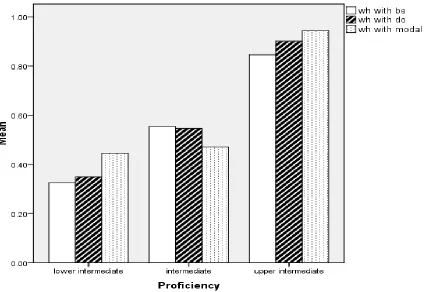
.28). However, the interaction effect between auxiliary type and proficiency was not significant (p = .09). Meanwhile, in this test, proficiency was detected as a significant factor (p = .000) with a very large effect size (eta squared = .72). Figure (1) depicts some of the results mentioned here.
Figure 1: Mean scores with different auxiliaries across proficiency in translation test
embedded in questions. Besides, proficiency was a significant factor (p = .000) with a very large effect size (eta squared = .73). An interesting result regarding sentence type was that the upper intermediate students had the same mean score for wh-embedded clauses in both statements and questions (mean score = .86). The recently mentioned result was not obtained for the other two groups of participants.
Grammaticality Judgment Test (GJT)
Figure 2: Mean scores with different auxiliaries across proficiency in GJT
In the grammaticality judgment task, it was also concluded that, generally, the participants had better performance on wh-embedded clauses in statements than questions (mean scores .57 & .50 respectively). Yet, the results revealed that the sentence type was not significant in this test (p = .053). And again, proficiency played a significant role (p = .000) with a very large effect size (eta squared = .78).
This data collection instrument was carried out in order to disclose the mastery of the participants, in three proficiency groups, on the oral production of English wh-embedded clauses. The same method of analysis, like those of the previous analyses, was applied to summarize the results of the third test; that is, the oral reproduction test. Repeated Measures ANOVA showed that the participants had the total mean of (.25) when focusing on the oral production of wh-embedded clauses with 'to be' auxiliaries. The mean score was (.42) for wh-embedded clauses with auxiliary 'do' while it was (.39) in the case of 'modal' auxiliaries. It was found that the mean scores in the oral test were considerably lower than their counterparts in the other two tests. The results also showed that the auxiliary type was a significant factor (p = .004) with a moderately large effect size (eta squared = .22). However, the interaction effect between proficiency and auxiliary type was not significant (p = .760). The noticeable outcome of the analysis was about the role of proficiency, the between-group factor, where it came out not to be significant (p = .105). Based on the results obtained from Post Hoc Tests, none of the paired comparisons between proficiency groups were significant.
Table 1: Cross comparison between proficiency groups in the oral test
(I) Proficiency (J) Proficiency
Mean Difference
(I-J)
Std.
Error Sig.
95% Confidence Interval
Lower Bound
Upper Bound
lower intermediate
intermediate -.0530 .06027 .656 -.1991 .0931
upper
intermediate -.1364 .06487 .101 -.2936 .0208
intermediate lower
intermediate .0530 .06027 .656 -.0931 .1991
upper
intermediate -.0834 .06566 .420 -.2425 .0758
upper intermediate
lower
intermediate .1364 .06487 .101 -.0208 .2936
Figure (3) presents a graphical summary of some of the results obtained in the oral reproduction test.
Figure 3: Mean scores with different auxiliaries across proficiency in oral test
Furthermore, the sentence type was not a significant factor in the oral task (p = .161).
Comparison among the Three Tasks
In this section, the general performance of the participants across the three instruments is compared and contrasted. To this end, the general mean scores of the participants obtained from their performance on wh-embedded clauses with three auxiliary types in three test occasions (written translation, oral reproduction, & grammaticality judgment) were compared. By doing so, it was found that the participants had mean scores (.48), (.54), and (.25) with 'to be' auxiliaries in translation, grammaticality judgment, and oral reproduction tests respectively. The values were (.62), (.56), and (.42) for the three tests where auxiliary 'do' (including does) was used. For the three tests applied in the order explained above, the mean scores were observed as (.61), (.58), and (.39) in the case of 'modal ' auxiliaries. According to Multivariate Tests, the test type (i.e. translation, grammaticality judgment &, oral reproduction) was a significant factor (p = .000) with a very large effect size (eta squared = .73). The interaction effect between proficiency and test type was also significant (p = .001) having a large effect size (eta squared = .38). Accordingly, proficiency played a significant role (p = .000) with a very large effect size (eta squared = .79).
Figure 4: Mean scores with different auxiliaries in oral and written tasks
Figure (4) depicts clearly that the performance of the participants is poorer when wh-embedded clauses are to be produced in oral than written form. It should also be reminded that the difference between participants' written and oral performance was significant according to the results of repeated measure ANOVA (p = .000), with a very large effect size (eta squared = .70).
RESULTS
administered on three proficiency groups of Persian EFL learners. The collected data were then analyzed meticulously to find the answers to the pre-determined study questions. In the following parts each of the study questions is dealt with separately by referring to the results obtained in the previous section.
Research Question One
The first research question was: Is the Type of Auxiliary a Significant Factor in the Acquisition of English Wh-Embedded Clauses? The statistical results of this study proved that the type of auxiliary used in wh-embedded clauses is a significant factor which plays an important role in the correct production or recognition of such clauses. In the three tests applied here, auxiliary type (including be, do, & modal) played a significant role where the lowest mean score in the three tests belonged to wh-embedded clauses with 'to be' auxiliaries. It shows that 'to be' auxiliaries are more susceptible to unnecessary inversion in wh-embedded clauses. Another notable point is that in the grammaticality judgment test the auxiliary type, though significant, was not as effective as in the other production-based tests (translation & oral reproduction). This claim is backed by the moderate effect size of auxiliary type obtained by statistical computations in the grammaticality judgment task. Consequently, one can suggest that auxiliary-type is a significant factor in the production of wh-embedded clauses more than their recognition.
Research Question Two
The second research question was: Is there any Difference between Acquiring Wh-Embedded Clauses in Questions and Statements? An embedded wh-structure, by its very nature, must be inserted in the body of another longer structure which can be either a statement or question. The results of our analyses revealed that only in the translation test the sentence-type was a significant factor. In the mentioned test, the participants had significantly better performance on wh-clauses embedded in statements than in questions. For instance, it is possible to infer that structure (18) is more likely to be produced than structure (19).
Although in the grammaticality judgment and oral reproduction tests the sentence type was not a significant factor, in both tests the total mean score of clauses embedded in statements was slightly higher than wh-clauses embedded in questions.
Research Question Three
The third research question was: What is the Role of Proficiency in the Acquisition of English Wh-Embedded Clauses? The general proficiency level of the participants, which was determined based on their performance in Oxford Quick Placement Test, put them into three groups of lower intermediate, intermediate, and upper intermediate. The results obtained in the present study showed that proficiency was a significant factor in translation and grammaticality judgment tests with a very large effect size in both tests. Nevertheless, proficiency did not operate as a significant factor in the oral reproduction test where there were no noticeable differences between the three groups of participants. From a psycholinguistic perspective, we can argue that when second language learners are struggling to construct simultaneously the content and form of their speech, usually they focus on content more than form. A good support for this claim is probably what Kaplan (2010, p. 68) suggests as
limited capacity model which says when learners are considering other problems in oral language production, it is very difficult for them to focus on form. Meanwhile, if learners are not fully proficient in L2 oral production, usually the basic grammatical points, like auxiliary inversion, are more observed by the speakers than the fact that auxiliary inversion is unnecessary in wh-embedded clauses. To sum up, global proficiency in English language seems to play a significant role in the acquisition of English wh-embedded clauses. However, as argued above, its significance fluctuates in different task types according to the mental processes associated with each task.
Research Question Four
participants in the written tasks was far better than their performance in the oral task. Similarly, it was confirmed that the channel of output (performance) of the participants, written or oral, plays a significant role. Probably, a part of justification for the generalization in this part is similar to those points explained in the previous part. Generally speaking, it is clear that when dealing with wh-embedded clauses in written form, the learners have more processing time compared to when producing such clauses orally. In this regard, the role of stress and anxiety should not be neglected so far as L2 learners usually become stressful when producing the target language orally. Therefore, it can be concluded that the mistakes of performance not the errors of competence may account for the lower accuracy of the participants with oral production of wh-embedded clauses.
DISCUSSION
In the preceding section, the most salient outcomes of this study with regard to the study questions were presented. The obtained results were reasonably strong enough to answer our pre-determined questions which formed our main impetus to do this research. But as a matter of fact, the external validity of this study is the extent to which the results are generalizable to other similar contexts. The most important and challenging point goes towards the participants on whom this study was conducted experimentally. In this regard, we explained that the participants were randomly selected amongst college students who were studying English as a foreign language at BA level. Undoubtedly, each group of language learners has specific characteristics but the important point is that our participants were randomly selected and then classified in different proficiency groups based on their performance in Oxford Quick Placement Test.
phonetic form (PF) phase. In the case of Persian yes/no questions, either the rising intonation (or punctuation in written form) of the sentence, or the addition of particle 'Aya' (whether) to the beginning of the sentence shows that the sentence is interrogative. In the latter case, the question-maker particle 'Aya' is believed to fill the head-position of CP during PF phase. Moreover, Persian questions with question-words are primarily
In-Situ which means no movement happens in the formation of such questions. Similarly, since there is no syntactic operation in logical form (LF) phase for the production of Persian questions with question-words, these questions also seem to be formed in the PF phase. In contrast, both yes/no and wh-headed questions in English are formed during the LF phase as auxiliary inversion and wh-movement are needed prior to the PF phase. Hence, in line with Westergaard (2003), the role of learners' L1 can be traced in conjunction with the acquisition of English wh-clauses.
As to the obtained outcomes, the type of auxiliary used in wh-embedded clauses was concluded to be a significant factor in the acquisition of such structures in English. A question may be brought up about some other auxiliaries like have / has which were not tested in this study. The answer is that auxiliaries have / has (also had) are used in perfect structures with past participle forms which have more structural load on the participants. It means that when they are struggling with the correct production of PP forms, the participants are inevitably more negligent of wh-embedded clauses as well as the important issue of auxiliary inversion. Generally speaking, this study revealed that English auxiliary-inversion rule plays a crucial role in the acquisition of wh-embedded clauses by Persian EFL learners. Considering that proficiency turned out to be a significant factor based on the results of this study, we can conclude that most of the problems observed with our participants stem from interlanguage stage. The recent claim correlates with what Schulz (2006) claimed saying that many deviant wh-embedded forms produced by L2 learners will be obviated after exposing to more English wh-embedded clauses and getting more proficiency in L2.
When dealing with oral and written wh-embedded clauses, the participants were found to have far better mean scores in the written tests than the oral one. Here, one reason is that when learners are trying to be more fluent and automated in their L2 oral production, they are more vulnerable to making mistakes as they become less accurate. In line with the recently mentioned point is Anderson (1983; cited in Ellis, 2008) noting that learners' errors become more apparent when trying to produce more efficient and fluent pieces of information through L2.
CONCLUSION AND IMPLICATIONS
In this study, we addressed the acquisition of English wh-embedded clauses by Persian EFL learners at different proficiency levels. The main impetus for conducting such an investigation was to understand how well Persian learners can cope with such English clauses which are frequently used in both written and oral texts produced by Native speakers of English. The results obtained in the present study suggest that the type of auxiliary used in wh-embedded clauses is an important factor which may contribute to variation in learners' performance. In this regard, 'to be' auxiliaries seem to be more problematic for Persian EFL learners than other auxiliary types like do/does or modal auxiliaries. This problem has probably its roots in the fact that 'to be' auxiliaries exist inside the clause even before applying the inversion rule; but, do/does auxiliaries are added into the clause for doing inversion. Compared to modal auxiliaries, 'to be' auxiliaries look less odd when inverted in wh-embedded clauses; and consequently, learners do not pay much attention to ungrammatical inversion of 'to be' auxiliaries in wh-embedded clauses.
model, Levelt illustrates that oral language production is a parallel-processing challenge in which the speaker's concentration is divided into at least three parts: message generation, grammatical and phonological encoding, and articulation. There is no doubt, therefore, that second language speakers' job is more demanding in this regard. Obviously, it is vital for both English language teachers and learners to focus more on wh-clauses in general and wh-embedded clauses in particular in the oral language production. An important point frequently referred to in the literature is that the acquisition of English grammatical rules as declarative knowledge, though necessary, is not enough. Similarly, Ellis (2008) asserts that declarative knowledge can change into procedural knowledge through sufficient practice. What sounds important is the degree to which the learners can convert their declarative knowledge into procedural knowledge by which, in the case of this study's topic, they can use wh-embedded clauses more correctly and subconsciously in their oral productions. To this end, more exposure to the target language forms containing the afore-mentioned clauses as well as more practice through interactions seem to be among the most effective measures.
Bio-data
Ali A. Jabbari is an associate professor of applied linguistics at Yazd University. He received his degree from Durham University, England, in 1999. He is interested in SLA of syntax and phonology.
Ali A. Ariamanesh is an MA holder in TEFL. He received his degree from Yazd University, Iran, in 2011. Since then, he has been teaching English courses at university level. His areas of interest include SLA, second language research and assessment.
References
Ambridge, B., Roland, C., Theakston, A., & Tomasello, M. (2006). Comparing different accounts of inversion errors in children's non-subject wh questions: 'What experimental data can tell us?'. Journal of Child
Language 33(3), 519-557.
Cheng, L. (1997). On the typology of wh-questions. New York: Garland Publishing.
Chomsky, N. (2000). Minimalist inquiries: The framework. In R. Martin, D. Michaels, & J. Uriagereka (Eds.), Step by step: Essays in minimalist syntax
in Honour of Howard Lasnik (pp. 89-155). Cambridge, Mass.: MIT Press.
Chomsky, N. (2005). Three factors in language Design. Linguistic Inquiry,
36(1), 1-22.
Ellis, R. (2008). The study of second language acquisition. New York: Oxford University Press.
Farshidvard, Kh. (2003). Dastur-e Mofassal-e Emruz (Comprehensive
Grammar of Today). Iran, Tehran: Sokhan Publishers.
Haddican, W., Holmberg, A., Tanaka, H., & Tsoulas, G. (2011). English wh-slifting as an embedded root phenomenon. Submitted. research. ncl. ac. uk. Kaplan, R. B. (2010). The Oxford handbook of applied linguistics. New York:
Oxford University Press.
Kumagami, M. (2006). Two types of strategies: The acquisition of English wh-questions by Japanese learners. The Kyushu University Papers in
Linguistics, 27, 37-60.
Lazard, G. (1992). A grammar of contemporary Persian. California: Mazda Publishers.
Levelt, W. J. M. (1989). Speaking. Cambridge, MA: MIT Press.
Montague, R. (1974). Syntax and semantics of questions. Yale university press. Pozzan, L. and Quirk, E. (2011). Asking questions in L2 English: An elicited
production study. Applied Psycholinguistics, 1-51.
Radford, A. (2004). Minimalist syntax: Exploring the structure of English. London: Cambridge University Press.
Radford, A. (2006). Minimalist syntax revisited. London: Cambridge University Press.
Radford, A., Atkinson, M., Britain, D., Clahsen, H., & Spencer, A. (1999).
Linguistics: An introduction. Cambridge: Cambridge University Press.
Rizzi, L. (1997). The fine structure of the left periphery. In L Haegeman (Ed.),
Elements of grammar (pp. 281-337). Dordrecht: Kluwer.
Schulz, B. (2006). Wh-scope marking in English interlanguage grammars: Transfer and processing effects on the second language acquisition of
complex wh-questions. Published Ph.D. dissertation. Hawaii University.
Westergaard, M. (2003). Item-based vs. rule-based learning: The acquisition of
word order in wh questions in English and Norwegian. University of