Iranian Rehabilitation Journal, Vol. 13, Issue 4, Winter 2015
Original Article
Working Memory Training in Children with Mild Intellectual
Disability, Through Designed Computerized Program
Mona Delavarian*
University of Tehran, Tehran, Iran
Behrouz Bokharaeian,
Complutense University of Madrid, Madrid, Spain
Farzad Towhidkhah,
Amirkabir University of Technology, Tehran, Iran
Gholam Ali Afrooz
University of Tehran, Tehran, Iran
Objectives: The aim of this research is designing a computerized program, in game format, for working memory training in mild intellectual disabled children.
Methods: 24 students participated as test and control groups. The auditory and visual-spatial WM were assessed by primary test, which included computerized Wechsler numerical forward and backward sub-tests, and secondary sub-tests, which contained three parts: dual visual-spatial test, auditory test, and a one-syllable word recalling test.
Results: The results showed significant differnces between working memory capacity in the intellectually disabled children and normal ones (p-value <0.00001). After using the computerized working memory training, Visual-spatial WM, auditory WM, and speaking were improved in the trained group. The mentioned four tests showed significant differences between pre-test and post-test. The trained group showed more improvements in forward tasks. The trained participant’s processing speed increased with training.
Discussion: According to the results, comprehensive human-computer interfaces and the aplication of computer in children training, especially in traing of intellectual disabled children with impairements in visual and auditory perceptions, could be more effective and vaulable.
Key words: Working memory training, Computer based rehabilitation, Mild intellectual disability, Designed computerized program
Submitted: 19 September 2015 Accepted: 10 November 2015
Introduction
Working memory (WM) is the limited capacity storage system which maintains and manipulates the information over the short periods of time (1). Although there isn’t a unified opinion about the role it plays in different cognitive activities, it is assumed that working memory plays a critical role in cognitive processing. Although this memory has an important role on information processing and influences different cognitive activities such as school cognitive tasks, yet there is not any common idea about it (2). WM may be affected by some physiological conditions as aging and stress, as well as some disorders like ADHD and intellectual
Iranian Rehabilitation Journal 69 total score of word list, word list delayed recall,
digits backwards and letter-number sequencing tests. Van der Molen et al., showed the improvement of Short Term Memory (STM), arithmetic score and story recall score in adaptive and non-adaptive WM trained groups (7, 8). In addition, their non-adaptive training group showed improvement in visual-spatial WM capacity. In 2015, it was proved that one of the reasons of poor improvement in European mental retarded children is non-availability of proper education(9).
Besides the researches that only focus on WM training in normal persons, there are some evidences on WM training in IDs. In general, ID is a generalized disorder characterized by significantly impaired cognitive functioning and deficits in two or more adaptive behaviours. Historically, it has been defined as an Intelligence Quotient (IQ) score under 70. There are four types of ID: Mild (IQ about 50-69), moderate (IQ about 35-49), severe (IQ about 20-34), and profound (IQ below 20) intellectual disability (10). One research about the role of WM in intellectual disability shows that general working memory is closely related to intelligence in these children (11). They showed distinct profiles in WM which were significantly related to academic skills (e.g. reading, writing and mathematics) and comprehension. Buckley (2008) indicated that memory training activities may be effective for children with Down syndrome that have specific impairments in verbal WM (12). Conners et al. (2001) showed that WM training in Down syndrome children can improve auditory WM (13). Walter et al (2009) expressed that WM is affected in intellectual disabled children (14). They suggested that there is a relationship between working memory and fluid intelligence. Van Der Molen et al. claimed that they are pioneers in showing the effect of training on WM in mild to borderline intellectually disabled adolescents (15). There are also some researches that demonstrated changes in various parts of brain during the WM training period (1,3,11,16,17). Despite the mentioned studies, there are also few researches that showed no remarkable effect on WM training. In One of them which was the largest trial to date (3) in 11,430 volunteers aged between 18 and 60, which had completed the course, general cognitive abilities such as memory, reasoning and learning were not improved.
It seems that there is no unique opinion about the effects of WM training, but according to some researches, consistency and high attention during
training may lead to better results (14). The authors designed a WM training program in game framework for mild intellectual disabled students. The game was confirmed by several specialists in exceptional child psychology and child psychiatrists. In this study, we investigated the effect of this training program on verbal and auditory working memories. We tried to motivate the children to participate in our research; for example, training sessions were chosen in the best time of the day (13).
Methods
The participants included 12 male mild mental retarded students (IQ between 50 and 69 with the average of 63.3) whom participated in winter and spring 2014. Seven children were trained in WM training sessions during 4 weeks and the remaining subjects were assigned for control group, whom received only the routine school programs. Students’ abilities such as visual, auditory and hand movement problems were checked by school physiotherapist and those who had one of these problems were removed from the study. The students were 9 to 14 years old with the average of 11.7. The average age for trained and control group were 12.1 and 11.3, respectively, and all of them were in second and third grade of elementary School. None of the participants had Down syndrome. Except 2 of the subjects, who had been referred to special school, other participants had studied in special school from beginning of education. Moreover, 12 normal students were participated just in assessments, as control group. They were between 10 and 15 years and were students of normal schools.
recalling the last word of that sentence. Dual auditory test had two parts. In the first part, one sentence was pronounced loudly and 4 seconds was determined for response time. In the second part of the test, two sequential sentences were pronounced and 6 seconds were allowed as response time. Dual visual-spatial test included determining equality of two simple shapes that were shown after each other. Another part of this test was memorizing the position of one specified point in the computer monitor; 4 seconds were determined for watching and 4 seconds as response time. The fourth test was a one-syllable word recalling test, composed of remembering 4 one syllable words from 10 fix predefined words. Then the participant was asked to remember the pronounced words. Before starting this test, all of the words were pronounced and explained for the participants.
For attention level measurement, the teacher asked the students to fill out the attention questionnaire before and after the course. Wechsler WM test was fully computerized but the answers of other tests were recorded in well-designed forms and tables. For auditory WM test, the voice of a 30 year old man was recorded. All the recorded voices were edited by voice editing software and noises and empty spaces were removed from files and exact time of each file was measured. Before test administration, participants were asked about their sleep and mental conditions. In each test, examiner described the test to participants, and gave them some examples for practice purposes. All tests were done at 8:30 to 11:30 AM. In this research the net platform of training software was used as a windows application. Some game-like techniques were applied to the software environment, especially in some parts of training software, to attract the children. The tasks were designed in an adaptive manner: each of them started in an easy level (low WM capacity) with two successful trials. Then, the students were allowed to follow the next level which needed more WM capacities.
Working memory training sessions were carried out by supervision of an educated psychologist in the school. All children’s activities were entered automatically into the software. Training was done for 4 weeks consisting twenty sessions of thirty minutes exercises. The average of the training time was 580 minutes for each participant. The training sessions were carried out between 8 to 12 A.M. in a quiet room. At the end of each session, children received gifts for encouragement. The training
process involved five steps as follows: Step 1: A 4 by 4 square was shown to all participants. The sub-squares lit up and down randomly which lasted 1000 ms. Students were asked to click the turned on squares at the forward and backward order in which they were lit up and down. Step 2: A 4 by 4 rotating square was shown to the participants. Some parts of this square turned on and off randomly and then the whole square was rotated 90 or 180 degrees, and after the rotation, the student was asked to click the turned on squares at the forward and backward order in which they were lit up and down. Step 3: Some numbers were pronounced by the computer. The interval time was 2000 ms. One graphical keyboard with one-digit number was shown to the participants. Finally, the participants were asked to click the pronounced digits at the forward and backward order they were heard. Step 4: In this task, some Persian alphabetic characters were pronounced by the computer and one graphical keyboard with Persian characters was shown to the participants on a monitor. The participants were asked to click the characters in the specified order. Step 5: In this step, two pseudo-words were pronounced and participants were asked to determine the similar characters between these words. The above mentioned modules were designed by ourselves and verified by three experts. Based on their comments, some modifications were done on the trainee software. The trainee’s assesments were concluded after one pre-test,and two post-tests ;one immediatly after ending the training period and the other one week later. There was also one pretest and one post test for control group.
Regarding the number of trainees and control subjects in this research, we used a case study approach and non-parametric methods in analyzing the data. We used Wilcoxon sign rank test for analyzing the data since it didn’t need any assumptions about normal distribution of data and subjects. Also, we combined the two trainee’s post-tests with each other and built an average post-test for each subject. Based on the WM measurements in all of the participants, we used paired t-test for analyzing the significance of WM capacity in normal and mild mental retard children.
Results
Iranian Rehabilitation Journal, Vol. 13, Issue 4, Winter 2015
Iranian Rehabilitation Journal 71
Fig 1. A comparison between WM capacity scores in normal and ID students based on Wechsler WM
The WM assessment results of the 2 of the trainees, as the examples, based on Wechsler test in one pre-test and post-pre-tests are shown in figure (2) and final
results including all trainees can be investigated through table (1).
Fig 2. WM assessment results based on Wechsler test in one pre-test and post-tests for the first and second trainees
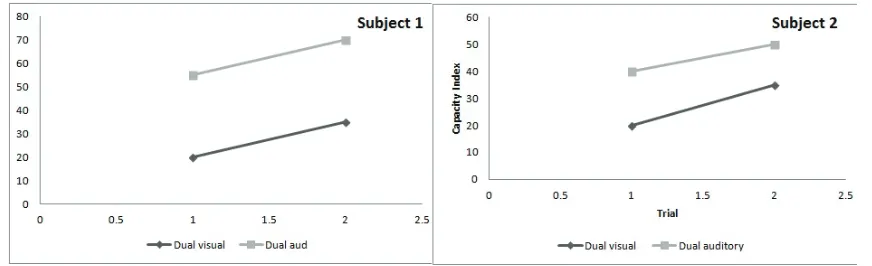
The Pre-test and post-test results of visual- spatial and auditory dual task assessments of 4 of the trainees, as the examples, are shown in figure (3)
and final results including all trainees can be investigated through table (1).
Iranian Rehabilitation Journal, Vol. 13, Issue 4, Winter 2015
As it could be understood from the results, during
the working memory training, both in visual-spatial and auditory WM, speaking had significant
improvement in the trained group compared to the control group (Table 1).
Table 1. Asymptotic significance of seven WM tests based on Wilcoxon signed ranks test for trained and control groups. Control
Trained WM Test
0.39 0.095
Wechsler Auditory_forward
0.28 0.32
Wechsler_Auditory_Backward
0.32 0.015
Wechsler_Visual_forward
0.08 0.128
Wechsler_Visual_Backward
0.25 0.045
Dual_Auditory
0.44 0.03
Dual_Visual
0.2 0.019
Word_recall
Moreover, four of the tests showed significant differences between pre-test and post-tests due to P-values less than 0.05 and the three remained tests were not significant at all. The control group didn’t show any significant differences in all tests. Based on our results (table 1), the trained group showed more improvements in forward tasks compared to the backward, since probably the students played these tasks more as they were easier and more interesting. The best improvement was observed in Wechsler visual forward test, since the children seemed more interested in visual modules compared to auditory, based on the software reports. According to the visual measurements, the trained participant’s processing speed increased during the training and the students could perform tasks more rapidly. They showed better ability in the phonological loop performance and faster eye movement.
Discussion
It is assumed that 1 to 2% of every society’s population have intellectual disability (18). Mild intellectual disabled children are one of the major groups who seem to have major deficiencies in their working memory (15). In this study, the trainee participants who undertook the working memory training sessions performed better in their WM assessments after the training sessions, compared to the control group. Our results are consistent with some of the previous studies. For example, Buckley indicated that memory training activities may be effective for Down syndrome children with verbal working memory deficiency (12). Conners et al. showed that WM training in Down syndrome children can improve auditory working memory (13). Van Der Molen et al. discussed the effect of training on WM in mild to borderline intellectually disabled adolescents (15). On the other hand, some researches do not agree with these findings. For
example in the largest trial to date (13) in 11,430 volunteers, which had completed the training course, general cognitive abilities including memory, reasoning and learning were not improved.
Based on these results, successful WM training should have a complete training module containing all parts of the working memory. Also our research showed that the degree of difficulty and the type of WM training modules should be determined based on intelligence of the participants. All except one of the trained children showed better performance in their post-tests, compared to pre-tests. The only subject who had no progress was the child who had the best IQ among all of the participants (IQ=71). Although we tried to force the students not to use any strategies to memorize numbers, it seemed that more intelligent children were more capable to extract and apply shortcut strategies for memorizing the elements. We conclude that more intelligent children have less interest for doing practices, because the tests seem to be boring and harder to concentrate for them (14). These findings were confirmed by less motivation of more intelligent children to complete the training period. We can conclude that more complex and more attractive tasks like story games, pleasant graphical characters, dual tasks, as well as competitive mechanisms between participants and finally portraying their progress charts are needed for more intelligent children.
Iranian Rehabilitation Journal 73 be suitable options. It seems that implementation of
working memory training games in special schools of intellectual disabled students, with supervision of expert teachers, may be remarkably effective on improvement of working memory and learning abilities. This suggestion is worth to be investigated in such schools.
Conclusion
In this study a computerized program was designed for working memory training in mild intellectual disabled children. The program was in game format.
The auditory and visual-spatial WM were assessed with computerized Wechsler numerical forward and backward sub-tests, dual visual-spatial test, auditory test, and a one-syllable word recalling test. The results show the efficacy of this program in improvement of visual-spatial WM, auditory WM, and speaking.
Acknowledgment
The authors wish to thank all the people who participated in this study.
References
1. Takeuchi H, Sekiguchi A, Taki Y, Yokoyama S, Yomogida Y, Komuro N, et al. Training of working memory impacts structural connectivity. The Journal of neuroscience. 2010;30(9):3297-303.
2. Titz C, Karbach J. Working memory and executive functions: effects of training on academic achievement. Psychological research. 2014;78(6):852-68.
3. Klingberg T, Fernell E, Olesen PJ, Johnson M, Gustafsson P, Dahlström K, et al. Computerized training of working memory in children with ADHD-a randomized, controlled trial. Journal of the American Academy of Child & Adolescent Psychiatry. 2005;44(2):177-86.
4. Buschkuehl M, Jaeggi SM, Hutchison S, Perrig-Chiello P, Däpp C, Müller M, et al. Impact of working memory training on memory performance in old-old adults. Psychology and aging. 2008;23(4):743-53.
5. Mezzacappa E, Buckner JC. Working memory training for children with attention problems or hyperactivity: A school-based pilot study. School Mental Health. 2010;2(4):202-8. 6. Smith GE, Housen P, Yaffe K, Ruff R, Kennison RF,
Mahncke HW, et al. A cognitive training program based on principles of brain plasticity: Results from the Improvement in Memory with Plasticity-based Adaptive Cognitive Training (IMPACT) Study. Journal of the American Geriatrics Society. 2009;57(4):594-603.
7. Van der Molen M, Van Luit J, Jongmans M, Van der Molen M. Verbal working memory in children with mild intellectual disabilities. Journal of Intellectual Disability Research. 2007;51(2):162-9.
8. Van der Molen M, Van Luit J, Van der Molen M, Klugkist I, Jongmans M. Effectiveness of a computerised working memory training in adolescents with mild to borderline intellectual disabilities. Journal of Intellectual Disability Research. 2010;54(5):433-47.
9. Salvador-Carulla L, Martínez-Leal R, Heyler C, Alvarez-Galvez J, Veenstra MY, García-Ibáñez J, et al. Training on intellectual disability in health sciences: the European perspective. International journal of developmental disabilities. 2015;61(1):20-31.
10.Nietzel M, Wakefield J. American Psychiatric Association Diagnostic and Statistical Manual of Mental Disorders. Contemporary psychology. 1996;41:642-51.
11.Numminen H, Service E, Ahonen T, Korhonen T, Tolvanen A, Patja K, et al. Working memory structure and intellectual disability. Journal of intellectual Disability research. 2000;44(5):579-90.
12.Buckley S. It is time to take memory training seriously. Down Syndrome Research and Practice. 2008;12(2):105-6. 13.Conners F, Rosenquist C, Taylor L. Memory training for
children with Down syndrome. Down Syndrome Research and Practice. 2001;7(1):25-33.
14.Walter E, Mazaika P, Reiss A. Insights into brain development from neurogenetic syndromes: evidence from fragile X syndrome, Williams syndrome, Turner syndrome and velocardiofacial syndrome. Neuroscience. 2009;164(1):257-71.
15.Van der Molen M, Henry L, Van Luit J. Working memory development in children with mild to borderline intellectual disabilities. Journal of Intellectual Disability Research. 2014;58(7):637-50.
16.Olesen PJ, Westerberg H, Klingberg T. Increased prefrontal and parietal activity after training of working memory. Nature neuroscience. 2004;7(1):75-9.
17.Calero MD, Navarro E. Cognitive plasticity as a modulating variable on the effects of memory training in elderly persons. Archives of Clinical Neuropsychology. 2007;22(1):63-72.