VOLUME 39, ARTICLE 30, PAGES 855
,
870
PUBLISHED 11 OCTOBER 2018
https://www.demographic-research.org/Volumes/Vol39/30/ DOI: 10.4054/DemRes.2018.39.30
Descriptive Finding
Love. Break up. Repeat: The prevalence and
stability of serial cohabitation among West
German women and men born in the early 1970s
Nicole Hiekel
Barbara E. Fulda
© 2018 Nicole Hiekel & Barbara E. Fulda.
This open-access work is published under the terms of the Creative Commons Attribution 3.0 Germany (CC BY 3.0 DE), which permits use, reproduction, and distribution in any medium, provided the original author(s) and source are given credit.
1 Introduction 856
2 Data and sample 857
3 The prevalence of repeated cohabitation 858
4 Educational differences in cohabitation experience 859
5 Union stability and routes of exit from first, second, and
higher-order cohabiting unions 848
6 Conclusion 864
Love. Break up. Repeat:
The prevalence and stability of serial cohabitation among
West German women and men born in the early 1970s
Nicole Hiekel1
Barbara E. Fulda2
Abstract
BACKGROUND
Serial cohabitation is of growing scientific relevance as more and more people experience the formation and dissolution of multiple unmarried cohabitations.
OBJECTIVE
Knowledge on the prevalence and stability of serial cohabitation outside the US context is limited. We provide unprecedented estimates on serial cohabitation on a West German cohort born in the early 1970s.
METHODS
We analyze 1,461 women and 1,121 men from the Pairfam study aged between 35 and 45 from birth cohorts 1971, 1972, and 1973 in West Germany who ever resided with a partner. Educational differences by cohabitation order are studied using one-way ANOVA. In multiple decrement life table analysis, we examine the stability of cohabitation of different order during the first five years of relationship. Two possible exit routes from unmarried cohabitation are analyzed: union dissolution and marriage.
RESULTS
Serial cohabitation is not related to educational attainment. The vast majority of cohabiting unions end within five years, more frequently by marriage than dissolution. Among three-and higher-order cohabitations marriage is less frequent. They do not differ from lower-order cohabiting unions regarding dissolution incidence.
1 University of Cologne, Institute of Sociology and Social Psychology, Cologne, Germany and Netherlands
CONCLUSIONS
Serial cohabitation is a minority experience in the cohort studied. Unlike in the United States, serial cohabitation is equally prevalent in all educational strata. Cohabitation is a stepping-stone towards marriage for the vast majority of cohabiters.
CONTRIBUTION
Having cohabited more than once does not imply a rejection of the institution of marriage or reflect unwillingness to enter potentially stable and committed unions. Most cohabiters opt for marriage although it takes two turns in some cases.
1. Introduction
Unmarried cohabitation is part and parcel of Europe’s demographic landscape. A growing proportion of people postpone marriage because they choose to cohabit before marrying their partner, and some forgo marriage altogether. Increasingly, cohabiting unions involve joint children (Sobotka and Toulemon 2008). At the same time, the proportion of first cohabiting unions that ended in dissolution has increased across cohorts, particularly in western and northern European countries, where the societal diffusion of unmarried cohabitation has further proceeded (Hiekel 2014). Serial cohabitation – that is, experiencing the formation and dissolution of multiple unmarried cohabitations – is thus of growing scientific relevance as more people enter more than one relationship in their lifetimes, while no longer being confined to marriage as the type of union they choose (Poortman and Lyngstad 2007). As a result of growing partnership instability and frequent repartnering, today we observe a diversity in people’s partnership biographies that is unprecedented and fundamentally different from the firm sequencing of early and stable marriage with children that dominated people’s life courses during the ‘Golden Age of Marriage’ (Dommermuth and Wiik 2014; Jalovaara and Fasang 2017).
same time, life courses characterized by serial cohabitation were found to be associated with higher levels of childlessness in Finland (Jalovaara and Fasang 2017) and Norway (Hart 2018). Bukodi (2012) furthermore shows that serially cohabiting men are a selective group of individuals experiencing unstable work histories.
We extend the current state of European research on serial cohabitation by providing unprecedented estimates on serial cohabitation for women and men from West Germany, born between 1971 and 1973. We examine the prevalence and stability of unmarried cohabitation of different orders. We continue by examining possible routes of exit, namely the transition to first marriage or the dissolution of the relationship. We answer three research questions: (1) How prevalent are cohabitations of first, second, or higher order among West German women and men? (2) How do these patterns differ by socioeconomic (i.e., education) status? (3) How stable are first, second, and higher-order cohabiting unions during the first five years of their relationship, and how prevalent is the transition to marriage or separation, respectively?
We focus on West Germany due to Germany’s historical demographic East-West divide (Fulda 2016; Klüsener and Goldstein 2016; Kreyenfeld, Konietzka, and Walke 2011). West Germany is an interesting case of study as it is likely that serial cohabitation patterns differ significantly from both the United States and the Nordic countries. Unlike the United States, where 42% of women born in the 1970s reported zero cohabitation experience when interviewed in the 2000s, unmarried cohabitation has become the majority experience (80%) of West German men and women born in the 1970s starting their first union (Hiekel 2014). Similar to the United States, but different from the Nordic countries, cohabitation and marriage are clearly distinguishable in their social function in West Germany, where marriage, rather than unmarried cohabitation, is considered a symbol of high interpersonal commitment to a long-term relationship, and children are much more likely to be born to married parents (Köppen 2011).
2. Data and sample
We analyze data from the Panel of Intimate Relationships and Family Dynamics (pairfam, release 8.0, 2008–2016), which collects detailed information on union and fertility behavior of women and men of three birth cohorts (1971–1973, 1981–1983, or 1991–1993), combining retrospective data (from age 16 onward) and prospective data (from the year 2008 onward). The data is gathered annually. Panel stability between waves 7 and 8 is high (93.3%) (TNS Infratest Sozialforschung 2016).
histories until individuals were at least 35 years old at their last interview. We thus present analyses on 1,461 women and 1,121 men who were between 35 and 45 years old when they were last observed and who had at least once resided with a spouse or partner. The age range of ten years is due to panel attrition: Not all respondents participated until the last interview in 2016. We counted the number of residential unions they ever experienced, which sometimes ended in first marriage. Of course, we also took into account individuals who moved in with only their spouse without any period of unmarried cohabitation. Due to markedly different demographic behavior of same-sex couples (Andersson et al. 2006) and their different legal rights(i.e., same-sex marriage was legally impossible in Germany until 2017), we only consider heterosexual unions. As we are furthermore interested in serial cohabitation with different partners, we did not take into account breakups with the same partner and counted these partnerships as one cohabitation.
3. The prevalence of repeated cohabitation
Figure 1 presents the prevalence of cohabitation experience in our sample. The left panel refers to women and men who eventually entered first marriage. Among them, only a minority (15%) reported to have had no cohabitation experience prior to first marriage. The majority (71%) married their first cohabiting partner. In our sample, 13% of all women and 12% of all men married their second cohabiting partner, and 2% reported three or more cohabiting relationships prior to first marriage. As we focus on cohabitation experience prior to first marriage, we excluded 290 cohabiting unions in which the respondent had previously experienced a divorce. Including these unions (results not shown) would increase the proportion of women (men) with two cohabitation experiences from 13% to 19% (12% to 17%) and the proportion of women and men with three and more cohabitation experiences from 2% to 5%.
Figure 1: Cohabitation experience of West German women and men aged between 35 and 45 from birth cohorts 1971–1973 who have ever entered a coresidential union
Data: pairfam 8.0.
4. Educational differences in cohabitation experience
Earlier studies on the US and British contexts found that serial cohabitation is more widespread among disadvantaged sections of the population (Bukodi 2012; Lichter and Qian 2008). We are now interested in studying the occurrence of serial cohabitation by educational level. Dommermuth and Wiik (2014), for example, presume that couples’ lower living costs provide an explanation for why socially disadvantaged individuals quickly decide to move in together with a new partner after a breakup. Quick repartnering, however, often entails higher chances of a(nother) future breakup. Furthermore, the emergence of unmarried cohabitation may have led to selection of individuals into serial cohabitation by educational background (Perelli-Harris et al. 2017). 1 4 .8 7 0 .8 6 7 .6 1 2
.8 19.5
2
.1 1
2
.8
Ever married women (%) Never married women (%) 0 1 2 3+
1 4 .6 7 0 .9 7 1 .2 1 2
.1 21.2
2
.4 7.1
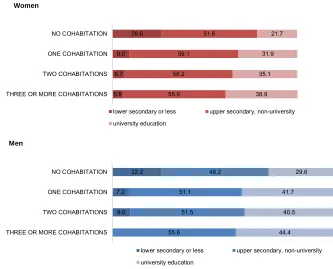
To determine if similar conclusions can be drawn for the West German context, we conducted a one-way ANOVA to determine if women and men with different numbers of cohabitation experiences also systematically differed in terms of educational attainment. We conducted a Tukey post-hoc test to identify which groups significantly differed from each other. We measured individual educational attainment at the last point of observation among individuals aged between 35 and 45. Respondents were classified into four groups: no cohabitation experience, and one, two, and three or more cohabitations experiences. Unlike findings presented in Figure 1, here we analyze respondents who ever experienced an unmarried cohabitation and respondents who entered a first marriage jointly, and we present findings in Figure 2.
Figure 2: Percentage distribution of educational attainment by cohabitation experience of West German women and men born between 1971 and 1973 reported at age 35–45
Data: pairfam 8.0.
5.6 6.7 9.0 26.6 55.6 58.2 59.1 51.6 38.9 35.1 31.9 21.7
THREE OR MORE COHABITATIONS TWO COHABITATIONS ONE COHABITATION NO COHABITATION
Women
lower secondary or less upper secondary, non-university university education 8.0 7.2 22.2 55.6 51.5 51.1 48.2 44.4 40.5 41.7 29.6
THREE OR MORE COHABITATIONS TWO COHABITATIONS ONE COHABITATION NO COHABITATION
Men
We find, first, that the group who attained lower secondary education (or less) is largest among women and men who directly married their first partner. Second, women and men with cohabitation experience had more frequently obtained university education than women and men without any cohabitation experience. Yet, the groups of cohabiters with different relationship parity do not differ significantly in their educational attainment.
5. Union stability and routes of exit from first, second, and
higher-order cohabiting unions
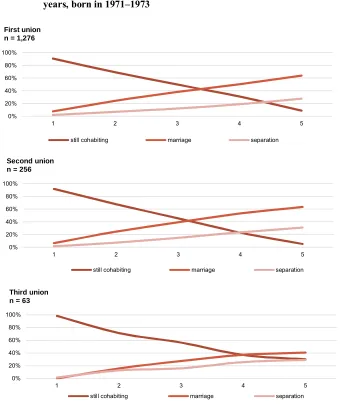
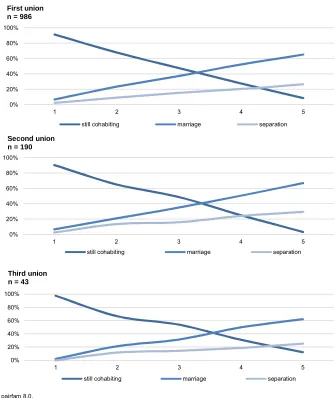
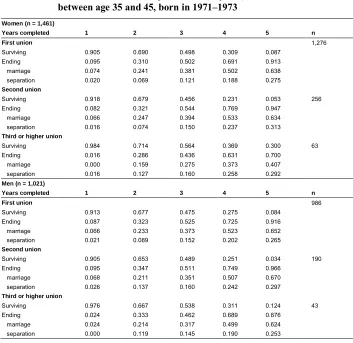
We finally analyzed how many unmarried cohabitations of different parity ended within the first five years of their relationship and the prevalence of two possible routes of exit: marriage or separation. We used information on the start and end date of 2,262 first, 446 second, and 106 third or higher-order unions. Figure 3 (women) and Figure 4 (men) show the result of a multiple decrement life table estimation comparing the chances of survival of women’s and men’s first, and (if applicable) second, and third or higher-order cohabiting union, as well as the cumulative incidences of marriage or separation during the first five years of union duration. These findings can also be found in Table A1 in the appendix. Do we observe differences in the stability and outcome of lower and higher order cohabitations?
Figure 3: Multiple decrement life table estimates of cohabitation outcome by duration (in years) and order, for women aged between 35 and 45 years, born in 1971–1973
Data: pairfam 8.0. 0% 20% 40% 60% 80% 100%
1 2 3 4 5
First union n = 1,276
still cohabiting marriage separation
0% 20% 40% 60% 80% 100%
1 2 3 4 5
Second union n = 256
still cohabiting marriage separation
0% 20% 40% 60% 80% 100%
1 2 3 4 5
Third union n = 63
Figure 4: Multiple decrement life table estimates of cohabitation outcome by duration (in years) and order, for men aged between 35 and 45 years, born in 1971–1973
Data: pairfam 8.0. 0% 20% 40% 60% 80% 100%
1 2 3 4 5
First union n = 986
still cohabiting marriage separation
0% 20% 40% 60% 80% 100%
1 2 3 4 5
Second union n = 190
still cohabiting marriage separation
0% 20% 40% 60% 80% 100%
1 2 3 4 5
Third union n = 43
Third or higher-order unions show different patterns of stability and exit routes, but it should be noted that these results are based on a small sample. The proportion of women in third or higher-order unions who proceeded to marriage within five years was lower compared to first and second order unions (around 40%). The proportion of individuals who dissolved their union was comparable to lower parity unions (around 30%), resulting in an overall greater proportion of women still cohabiting in a third or higher-order union after five years. For men, we find similar results. In contrast to women in a third or higher-order union, the proportion of men’s unions that were still intact after five years was about half the proportion of women’s (12%). Men who transitioned from a third or higher-order cohabitation during the first five years did so twice as frequently via the route of marriage than via dissolution (62% vs. 25%). It has to be noted that the analyses for men were based on an even smaller sample (42 men vs. 63 women).
6. Conclusion
This study fills a void in the literature by providing unprecedented estimates on the prevalence and stability of serial cohabitation for a cohort of West German women and men aged between 35 and 45 in 2016. It reveals the following three main findings: First, a majority of individuals experiences one unmarried cohabitation, yet only a minority of West German women and men experience several unmarried cohabitations. Given the small share of individuals with more than two cohabitation experiences, we propose to use the term ‘repeated cohabitation’ in future research. The term ‘serial cohabitation’ has been coined by US family demographers and, in our view, suggests that a significant number of individuals experiences three or more unmarried cohabitations in their lifetime. This assumption has so far been contradicted by empirical evidence in any country context studied.
Second, the positive educational gradient for cohabitation identified for many European countries also applies to West Germany, but we find no evidence for further selection into partnership biographies comprising more than one cohabitation experience based on education.
at the same time a lower transition rate to marriage. Dissolution patterns of third or higher-order cohabiting unions were almost identical to lower parity unions.
The presented evidence on serial cohabitation in the West German context suggests important differences to findings in the predominant US-based literature on serial cohabitation and moreover extends estimates on serial cohabitation to men. Unlike in the United States, where concerns about the growing prevalence of higher-order unmarried cohabitation dominate the scientific debate around increasingly complex partnership biographies, in a West German cohort of men and women born in the 1970s, cohabitation represented an important stepping stone to marriage, if not with the first, then with the second partner. At the same time, repeated cohabitation was observed in higher percentages among never-married women and men but did not emerge as a clear alternative to entering only one stable resident union. In that respect, our demographic exercise on the prevalence, stability, and routes of exit from repeated cohabitation contributes to family scholars’ broad understanding of increasingly complex partnership biographies in different country contexts. At the same time, cohabitation experience prior to marriage has become almost universal.
References
Andersson, G., Noack, T., Seierstad, A., and Weedon-Fekjær, H. (2006). The demographics of same-sex marriages in Norway and Sweden. Demography
43(1): 79–98.doi:10.1353/dem.2006.0001.
Bukodi, E. (2012). Serial cohabitation among men in Britain: Does work history matter? European Journal of Population 28(4): 441–466. doi:10.1007/s10680-012-9274-1.
Cohen, J. and Manning, W.D. (2010). The relationship context of premarital serial cohabitation.Social Science Research 39(5): 766–776.doi:10.1016/j.ssresearch. 2010.04.011.
Dommermuth, L. and Wiik, K.A. (2014). First, second or third time around ? The number of co-residential relationships among young Norwegians. Young 22(4): 323–343.doi:10.1177/1103308814548103.
Fulda, B.E. (2016). The diversity in longitudinal partnership trajectories during the transition to adulthood: How is it related to individual characteristics and regional living conditions? Demographic Research 35(37): 1101–1134. doi:10.4054/DemRes.2016.35.37.
Hart, R.K. (2018). Union histories of dissolution: What can they say about childlessness? European Journal of Population. doi:10.1007/s10680-018-9464-6.
Hiekel, N. (2014). The different meanings of cohabitation across Europe: How cohabiters view their unions and differ in their plans and behaviors. Amsterdam: Amsterdam University Press.
Jalovaara, M. and Fasang, A.E. (2017). From never partnered to serial cohabitors: Union trajectories to childlessness. Demographic Research 36(55): 1703–1720. doi:10.4054/DemRes.2017.36.55.
Kennedy, S. and Ruggles, S. (2014). Breaking up is hard to count: The rise of divorce in the United States, 1980–2010. Demography 51(2): 587–598. doi:10.1007/ s13524-013-0270-9.
Klüsener, S. and Goldstein, J. (2016). The long-standing demographic East-West-divide in Germany.Population, Space and Place 22(1): 5–22.doi:10.1002/psp.1870. Köppen, K. (2011). Marriage and cohabitation in western Germany and France.
Kreyenfeld, M., Konietzka, D., and Walke, R. (2011) Dynamik und Determinanten nichtehelicher Mutterschaft in Ost- und Westdeutschland [Dynamic and determinants of nonmarital motherhood in eastern and western Germany]. In: Brüderl, J., Castiglioni, L., and Schumann, N. (eds.). Partnerschaft, Fertilität und intergenerationale Beziehungen: Ergebnisse der ersten Welle des Beziehungs- und Familienpanels [Partnership, fertility and intergenerational relationships: Findings from the First Wave of the German Family Panel].
Würzburg: Ergon Verlag: 155–174.
Lichter, D.T., Turner, R., and Sassler, S. (2010). National estimates of the rise in serial cohabitation. Social Science Research 39: 754–765. doi:10.1016/j.ssresearch. 2009.11.002.
Lichter, D.T. and Qian, Z.C. (2008). Serial cohabitation and the marital life course.
Journal of Marriage and Family 70(4): 861–878.doi:10.1111/j.1741-3737.2008. 00532.x.
Perelli-Harris, B., Mynarska, M., Klaerner, A., and Vignoli, D. (2014). Towards a new understanding of cohabitation: Insights from focus group research across Europe and Australia. Demographic Research 31(34): 1043–1078. doi:10.4054/ DemRes.2014.31.34.
Poortman, A.-R. and Lyngstad, T.H. (2007). Dissolution risks in first and higher order marital and cohabiting unions. Social Science Research 36(4): 1431–1446. doi:10.1016/j.ssresearch.2007.02.005.
Sobotka, T. and Toulemon, L. (2008). Changing family and partnership behaviour: Common trends and persistent diversity across Europe. Demographic Research
19(6): 85–138.doi:10.4054/DemRes.2008.19.6.
TNS Infratest Sozialforschung (2016).Beziehungen und Familienleben in Deutschland (2015/2016) Welle 8. Munich: TNS Infratest Sozialforschung. http://www. pairfam.de/fileadmin/user_upload/redakteur/publis/Dokumentation/Methodenber ichte/pairfam_Methodenbericht_W8.pdf.
Appendix
Table A-1: Cohabitation experience of West German women and men between age 35 and 45 from birth cohorts 1971–1973 who have ever entered a coresidential union
Women (n = 1,461)
Number of cohabitations Never married women (n = 210) Ever married women (n = 1,251)
0 – 14.79
1 67.62 70.18
2 19.52 12.84
3+ 12.86 2.16
Men (n = 1,021)
Number of cohabitations Never married men (n = 198) Ever married men (n = 923)
0 – 14.63
1 71.72 70.86
2 21.21 12.13
3+ 7.09 2.39
Table A-2: Multiple decrement life table estimates of women’s and men’s cohabitation outcome by duration (in years), for women and men between age 35 and 45, born in 1971–1973
Women (n = 1,461)
Years completed 1 2 3 4 5 n
First union 1,276
Surviving 0.905 0.690 0.498 0.309 0.087 Ending 0.095 0.310 0.502 0.691 0.913 marriage 0.074 0.241 0.381 0.502 0.638 separation 0.020 0.069 0.121 0.188 0.275 Second union
Surviving 0.918 0.679 0.456 0.231 0.053 256 Ending 0.082 0.321 0.544 0.769 0.947
marriage 0.066 0.247 0.394 0.533 0.634 separation 0.016 0.074 0.150 0.237 0.313 Third or higher union
Surviving 0.984 0.714 0.564 0.369 0.300 63 Ending 0.016 0.286 0.436 0.631 0.700
marriage 0.000 0.159 0.275 0.373 0.407 separation 0.016 0.127 0.160 0.258 0.292 Men (n = 1,021)
Years completed 1 2 3 4 5 n
First union 986
Surviving 0.913 0.677 0.475 0.275 0.084 Ending 0.087 0.323 0.525 0.725 0.916 marriage 0.066 0.233 0.373 0.523 0.652 separation 0.021 0.089 0.152 0.202 0.265 Second union
Surviving 0.905 0.653 0.489 0.251 0.034 190 Ending 0.095 0.347 0.511 0.749 0.966
marriage 0.068 0.211 0.351 0.507 0.670 separation 0.026 0.137 0.160 0.242 0.297 Third or higher union
Surviving 0.976 0.667 0.538 0.311 0.124 43 Ending 0.024 0.333 0.462 0.689 0.876
marriage 0.024 0.214 0.317 0.499 0.624 separation 0.000 0.119 0.145 0.190 0.253