VOLUME 40, ARTICLE 31, PAGES 897
-
932
PUBLISHED 11 APRIL 2019
https://www.demographic-research.org/Volumes/Vol40/31/ DOI: 10.4054/DemRes.2019.40.31
Research Article
Job insecurity and parental well-being:
The role of parenthood and family factors
Doris Hanappi
Oliver Lipps
This publication is part of the Special Collection on “The New Roles of Women and Men and Implications for Families and Societies,” organized by Guest Editors Livia Sz. Oláh, Rudolf Richter, and Irena E. Kotowska.
© 2019 Doris Hanappi & Oliver Lipps.
This open-access work is published under the terms of the Creative Commons Attribution 3.0 Germany (CC BY 3.0 DE), which permits use, reproduction, and distribution in any medium, provided the original author(s) and source are given credit.
1 Introduction 898
2 Background and hypotheses 900
2.1 Job insecurity and well-being 900
2.2 Partner job insecurity and well-being 902
2.3 Job insecurity, childrearing demands, and well-being 903
3 Data source and method 906
3.1 Data and sample 906
3.2 Measures 907
3.3 Analytical strategy 910
4 Results 913
4.1 Job insecurity and well-being 913
4.2 Job insecurity, childrearing demands, and well-being 916
5 Concluding discussion 917
6 Acknowledgements 921
Job insecurity and parental well-being:
The role of parenthood and family factors
Doris Hanappi1 Oliver Lipps2
Abstract
BACKGROUND
The consequences of job loss for subjective well-being are widely known. Yet, the subjective well-being of parents who fear that they might lose their jobs has received much less attention.
OBJECTIVE
We analyze how changes in job insecurity are associated with parental subjective well-being. We further provide insight into the impact of parenthood and varying childbearing demands, as well as potential accumulative dynamics.
METHODS
Using data from the Swiss Household Panel (SHP) (2000–2016; N = 7,167), we apply fixed-effects models to estimate deviations of well-being from the individual-specific mean. Our analytic sample comprises a total of 43,276 person years.
RESULTS
We replicate the overall well-being response surrounding the experiences of job insecurity and unemployment, and we provide evidence for variation in subjective well-being over the parental life-cycle.
CONCLUSIONS
The divergence in the well-being responses around raising a newborn or infant versus older children may affect fertility timing and the optimal number of children to have. The results also reveal gender-specific effects and hint at the new role of women in paid labor, but they indicate that the ‘old’ role of men as breadwinners has not changed dramatically.
1 University of California, Berkeley, USA. Email:[email protected].
2 Swiss Centre of Expertise in Social Sciences (FORS), c/o University of Lausanne, Bâtiment Géopolis,
CONTRIBUTION
We suggest that how people cope with job insecurity and unemployment depends on individual characteristics and less so on the joys or challenges of parenthood. This is consistent with the fertility behavior that emerged in developed countries during the second demographic transition.
1. Introduction
Since the 1970s, economic recession has fueled unemployment rates and people’s fear of losing their jobs. This insecurity has been reflected in quality of life estimates that show its impact on a large portion of the working population (OECD Better Life Index 2015). It is thus not surprising that there has been substantial scholarly interest regarding the relationship between job insecurity and individual health and well-being (Lucas et al. 2004; Berth, Foerster, and Braehler 2004; Greenhalgh and Rosenblatt 2010; Sverke, Hellgren, and Näswall 2006; Kinnunnen et al. 1999; Virtanen et al. 2013; Georgellis et al. 2008; Krause 2010; Knabe and Rätzel 2011; Oesch and Lipps 2013). However, many of these studies assume that all individuals who experience job insecurity encounter the same problems, which include repercussions of the resulting mental burden and problems relating to the ensuing lack of social integration and participation (De Witte, Pienaar, and De Cuyper 2016). An additional vital stress factor that has received insufficient scholarly attention is having dependent children and limited social or material support. As a response to the fact that during times of job insecurity most people still decide to have children but fewer of them, policy discussion has started to focus on the reasons for the negative consequences of that insecurity, and work–family demands (European Commission 2006; Vienna Institute of Demography 2016).
influenced by personal experiences of parenthood (De Witte 2007; De Witte, Pienaar, and De Cuyper 2016; Sverke, Hellgren, and Näswall 2006; Virtanen et al. 2013). Recent demographic research has touched on the potential effect of pre-parenthood lifestyle on changes in subjective well-being. For example, Roeters, Mandemakers, and Voorpostel (2016) predict that educated and hard-working women who become mothers will be surprised by the demands of childrearing, and the perception of giving up certain lifestyles may lower their well-being rather than increase it.
An extension of the original theory of the conservation of social resources posits that social support provides a major resource pool outside of those resources endowed to the self from others (e.g., high self-esteem, sense of mastery), and this pool enables further resource development and resource security (Hobfoll, Freedy, and Geller 1990). We apply this theory by examining how partners’ resources (or, in the case of job insecurity, lack of resources) and access to external care can influence well-being. We examine whether an increase in partner job insecurity is associated with an increased decline in well-being, which can indicate accumulated stress. Finally, we assess whether people transitioning to parenthood have increased declines in well-being as a response to job insecurity, which may indicate limits that children impose on activities of resource accumulation.
In this article we analyze how changes in the experience of job insecurity are associated with subjective parental well-being, using 17 waves of the Swiss Household Panel (SHP) (N = 3,717 men and 3,450 women, 2000–2016). We use fixed-effects regression techniques, which allow us to control for unobserved heterogeneity and identify any selection bias of those experiencing job insecurity and parenthood. We account for changes in the intensity and cumulated experience of job insecurity, given that previous studies found stronger declines in well-being when insecure employment conditions were severe and lasted for a long time (Clark et al. 2008; Oesch and Lipps 2013). In this study, job insecurity means ‘cognitive’ job insecurity, which denotes employed persons’ assessment of how secure they consider their job to be. Further, we account for unemployment status, because it has been found to affect a person’s well-being due to a lack of social integration, material hardship, and people’s more negative assessment of their ability to find alternative similar jobs (Anderson and Pontusson 2007; cf. for similar applications of this notion Esser and Olsen 2011; Erlinghagen 2007).
countries has shown that in Switzerland childlessness is more common and has a weak negative impact on psychological well-being (Huijts, Kraaykamp, and Subramanian 2013). Third, welfare state support for parents is limited, and work–family reconciliation policies are scarce (Bertozzi and Gilardi 2008), which lowers the benefits expected from parenthood. While the introduction of paid maternity leave in 2005 was a significant improvement in family policies, Switzerland’s leave scheme remains minimal. Employed and self-employed women are paid 14 weeks’ maternity leave at 80% of their prior earnings and are entitled to two additional weeks of unpaid leave. At present, Switzerland is the only European country in which men have no access to any kind of statutory leave (Moss and Deven 2015). In addition, for many Swiss families parenthood incurs a substantial loss of income because childcare for infants and toddlers is limited, which often leads to mothers leaving the labor market to take care of their children (Gauthier 2008; Dienel 2002).
2. Background and hypotheses
2.1 Job insecurity and well-being
Hobfoll’s (1989) COR theory associates job insecurity with substantial falls in levels of well-being because it defines job insecurity as a condition that severely threatens individual employment and related resources, including privilege and status. A further consequence is that employees may not try to overcome this threat by investing time in other work-related resources, as there is no guarantee of success. Instead, they may attempt to compensate by resorting to personal (non-work-related) resources. This defensive, self-protective dynamic also consumes energy in the form of worry and stress, thus decreasing resources, creating strain for the employee, and reducing well-being (Vander Elst et al. 2012; Mauno, Cheng, and Lim 2017). It also raises the question of which individuals are most strongly affected (Bonoli 2017): A key aspect of why some individuals are more capable of coping with job insecurity is access to certain fundamental resources. Healthier and younger individuals cope better with job insecurity and thus show higher levels of well-being than older and less healthy people (Myrskylä and Margolis 2014).
According to the set point theory of happiness, any change in well-being is, however, transitory (Diener et al. 1999). The set point theory of happiness implies that changes in job security only temporarily affect well-being, because people quickly adapt back to their individual level of well-being. A large part of how individuals adapt depends on their social and biological endowments, and life events may change this level only temporarily. Brickman and Campbell coined the term “hedonic treadmill” in 1971, implying that people adapt to their life circumstances, improvements do not result in real benefits, and worsened conditions do not yield permanent lower levels of well-being. Every individual is assumed to have a predefined well-being level to which he or she returns as time goes by. In this vein, several studies support the prediction that objective circumstances appear to have a limited effect (Lykken and Tellegen 1996; Diener et al. 1999; Kahneman, Diener, and Schwarz 1999; Easterlin 2001; Diener, Inglehart, and Tay 2013).
They find that within a ten-year window, with unemployment in the middle, the well-being of both men and women tends to reduce before and after the unemployment spell and then decreases further within the subsequent four years, thus showing, at best, limited habituation. Berth, Foerster, and Braehler (2004) analyze a Saxon Longitudinal Study and further find that repeatedly unemployed people are significantly more dissatisfied, even if currently re-employed. Lucas et al. (2004) use 15 waves of the German Socioeconomic Panel and show that unemployment alters the set point of life satisfaction because individuals do not entirely return to their prior levels of subjective well-being. Past job insecurity and accumulated job insecurity seem additionally detrimental and accentuate the contemporaneous correlation between job insecurity and well-being. Consistent with prior literature using longitudinal designs (Clark et al. 2008), Knabe and Rätzel (2011) document similar results in their study of the scarring effect of unemployment. Furthermore, repeated spells of unemployment and subjective job insecurity have been associated with lower levels of well-being (Berth, Foerster, and Braehler 2004; Ferrie et al. 2002). Finally, evidence suggests that there is an anticipation response to a job loss (De Cuyper and De Witte 2006) because discharged workers’ psychological symptoms are most significant during the period preceding the actual redundancy. These results are in line with research by Clark et al. (2008), showing anticipation effects among men and women in response to being laid off in the near future.
2.2 Partner job insecurity and well-being
account for family factors over time instead of just comparing individuals experiencing job insecurity with those who are not. If this does not happen the analysis will be biased by genetic factors, personality, or other unobserved or difficult-to-measure fixed characteristics such as career orientation and extroversion, which may be associated with subjective well-being (Okbay et al. 2016).
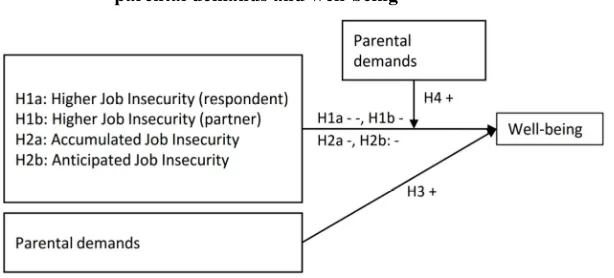
Consistent with the above arguments and evidence of the various correlations between subjective job insecurity and unemployment, we expect that increases in perceived job insecurity correlate with a significant decline in current well-being (H1, Contemporaneous Effects Hypothesis). We label these base expectations Hypothesis H1a, predicting changes in the respondent in response to higher perceived job insecurity, and Hypothesis H1b, predicting (weaker) changes in the partner in response to higher perceived job insecurity. Furthermore, we expect to find intertemporal correlations between job insecurity, unemployment, and subjective well-being (H2, Intertemporal Effects Hypothesis). First, we expect accumulated periods of respondents’ perceived job insecurity to correlate with a greater decline in current well-being. The more experiences of job insecurity individuals accumulate, the more their well-being will decline (H2a, predicting accumulative effects). Finally, we expect that the anticipation that one’s job will be less secure or lost in the near future will be associated with lower subjective well-being (H2b, predicting anticipation effects).
2.3 Job insecurity, childrearing demands, and well-being
Moreover, Michalos in his “goal theory” (2017) defines parenthood as an important life goal and indicator of personal success, which conveys social recognition, personal growth, esteem, and satisfaction.
Cross-sectional research that builds on these theories has found mixed results regarding the association between having children and well-being (Kohler, Behman, and Skytthe 2005; Billari 2009; Aassve, Goisis, and Sironi 2012; Nomaguchi 2012; Nelson, Kushley, and Lyubomirsky 2014; for a special issue on parental happiness see Kohler and Mencarini 2016). Whereas some studies have found a positive well-being effect (Kohler, Behman, and Skytthe 2005; Myrskylä and Margolis 2014), others have reported a negative effect (Evenson and Simon 2005), including reduced parental leisure time (Roeters, Mandemakers, and Voorpostel 2016) and an increase in reported time conflict (Pailhé and Solaz 2012) and emotional distress (Matysiak, Mencarini, and Vignoli 2016). Recent studies have led to a consensus that the impact of parenthood on well-being is contingent upon factors such as socioeconomic status (Myrskylä and Margolis 2014) and the age and number of children (Kohler, Behman, and Skytthe 2005; Stutzer and Frey 2010; Nomaguchi 2012; see also Nelson, Kushley, and Lyubomirsky 2014). Several recent longitudinal studies analyze individuals’ well-being over time. Clark et al. (2008) study well-being before and after birth using the German Socioeconomic Panel and show that the well-being of both men and women tends to increase before and up to the time of birth and then decreases to pre-birth levels. Clark and Georgellis (2013) and Angeles (2010) use the British Household Panel to examine whether the happiness of new parents evolves to fit their new circumstances, and Myrskylä and Margolis (2014) consider long-run trajectories of parents’ well-being, which they find vary significantly by age at parenthood and parity, and less by socioeconomic status.
The arguments above lead us to expect that people caring for a newborn or infant experience substantial benefits from parenthood (H3, Childrearing Demands Hypothesis); hence we provide empirical support for prior evidence on the positive effect of having young children. Because empirical evidence on the effect of additional children on well-being suggests no effect or a negative effect, we may find no further positive effects of having additional or older children.
parental demands results in increased vulnerability and stress. This hypothesis predicts that job insecurity will have a greater impact on well-being if times of rising parental demands coincide with increased job insecurity: The threat of a job loss may render parents more vulnerable to experiencing stress from combining childrearing with working, which overshadows the benefits of interacting with their children. In the Swiss context, fathers would possibly suffer more, as they still face greater expectations regarding the fulfillment of their income-provider role, while women are increasingly expected to fulfill their caretaker role (Qian and Sayer 2016). By contrast, individuals who enjoy stable employment, an employed partner, or external childcare face fewer difficulties coping with job insecurity. Thus, they are more likely to benefit from parenting and may not experience a decline in their subjective well-being after having a (subsequent) child.
We investigate the possibility that parenthood and caring for a newborn or infant moderate the impact of perceived job insecurity and unemployment on well-being. The challenges may be more difficult for individuals who experience high levels of job insecurity. These individuals are most likely to experience a heavy mental burden and role overload if they are raising additional or older children, while benefits from raising newborns and infants may buffer the negative effect of insecure paid employment (H4, Interaction Hypothesis). Our four hypotheses on the linkage between job insecurity, childbearing demands, and well-being are represented graphically in Figure 1 (arrows are labeled and correspond to our hypotheses).
Figure 1: Schematic representation of the relationship between job insecurity, parental demands and well-being
investigating whether the main job insecurity (unemployment) effect and the possible moderating effect of parental demands can be explained by taking individuals’ time-varying parental demands and use of external childcare into account.
Our expectations are tested by estimating separate models for men and women, because Switzerland is a country characterized by limited welfare support for parents and limited family–work policies, which favors women taking part-time work. This results in strong occupational gender segregation, which may mean more precarious employment for the female workforce (Buchman and Charles 1995; Widmer and Ritschard 2009). Therefore, the role of employment conditions and individual resources may be especially pronounced, and gender differences are expected.
3. Data source and method
3.1 Data and sample
We use data from the Swiss Household Panel (SHP), which has been surveyed annually since 1999 (Tillmann et al. 2016). As a nationally representative longitudinal data set that simultaneously measures life satisfaction, family structure, employment situation, and job insecurity, the SHP is well suited to address the questions raised in this study.
Because information necessary for the analysis was only collected from 2000 onward, only data from the 2000–2016 waves were used. The data contains enough waves to have sufficient variation in variables to model within-individual changes using fixed-effects models. Most variables have a within-standard deviation that is more than half as large as the between-standard deviation. We only included observations for which information on all explanatory and control variables (including current and anticipated job insecurity) was available and restricted the sample to adults at risk of becoming parents of (additional) children (in other words, we included women aged between 20 and 45 years and men aged between 20 and 50 years in the first reporting wave). We also use the information regarding having minor children at home, which approximates childrearing demands. We do not distinguish biological children from other children in the home because all children in a household generate additional benefits and burdens and thus likely impact well-being. However, we note that most of the children were indeed biological.
III) (Tillmann et al. 2016). The re-interview rate at the household level was between 78% (SHP II in 2006) and 94% (SHP I in 2010, 2013, and 20153). Moreover, we have
63,011 age-eligible respondent years between 2000 and 2016 with 62,990 non-missing dependent variable respondent years (well-being) and in 56,107 respondent years a non-missing main independent variable (job insecurity), i.e., currently in the labor force (working or unemployed). After subtracting those respondent years with no valid job insecurity in the subsequent year and after excluding some few missing values on the other independent variables there are 43,276 respondent years left as the analysis sample.
The 7,167 individuals in the analysis sample were observed for 7.0 years on average. In the year of the first interview, 88.6% of women and 86.8% of men lived without babies and infants (aged 0 to 2 years) in the household, and 79.0% of women and 76.9% of men remained without any throughout the observation period. In the year of the first interview, 53.5% of women and 56.5% of men reported job insecurity, and during the observation period 8.7% of women and 5.2% of men were unemployed at least once.
3.2 Measures
Our dependent variable to measure well-being was the respondents’ level of life satisfaction. Life satisfaction refers to a cognitive judgmental process based on a global assessment of a person’s quality of life, according to his or her own selected criteria (Diener et al. 1999). Many studies have focused on depression and other psychological disorders as the major outcomes of the additive strains of job insecurity and parenthood. By focusing on life satisfaction, we expected to advance understanding of the broader consequences of work and parental strain, given that parental status differences in life satisfaction not only indicate the presence or absence of negative consequences due to parenthood but also show positive effects (Pollman-Schult 2014). For example, the finding that certain combinations of work strain are associated with higher levels of depression (Frone, Russell, and Cooper 1997) does not reveal whether parenthood could buffer the negative impact of job insecurity and thus be related to higher levels of life satisfaction: Such studies find either negative or no consequences and do not capture positive consequences such as the effect of the joy of parenthood on well-being. We also assumed that both job insecurity and parenthood might affect well-being in different ways to depression. For instance, parents benefit emotionally from having children, and this benefit might affect mood and emotions more than is evident in their actual reports on depression. Hence, the concept of life satisfaction enables us to
capture strain from job insecurity as well as any emotional and social benefit from having children.
The life satisfaction variable in the SHP is based on a question to respondents regarding how satisfied they are at present with their lives as a whole. The response scale ranges from 0 (completely dissatisfied) to 10 (completely satisfied). The variable’s distribution is shown in Table 1. To estimate linear models we treat the ordinal well-being scale as if it were a cardinal variable, as several studies provide evidence that whether one assumes cardinality or ordinality leads to identical findings (Clark et al. 2008; Ferrer-i-Carbonell and Frijters 2004).
Table 1: Descriptive statistics of the variables used in the analysis, by parental status
SHP (2000–2016 excl. leads) sample in labor force; women 1st wave: 20–45 years old, men 1st wave: 20–50 years old
Variable Mean Min Max
Satisfaction with life 7.97 0 10
Male 0.52 0 1
Year 2008.3 2000 20154
Has partner (not living together) 0.08 0 1
No partner 0.14 0 1
Age (in years) 42.52 20 66
French or Italian speaking 0.31 0 1
OECD-equivalized post-government income 66,764 21,277 1,495,374
Some job insecurity 0.50 0 1
Severe job insecurity 0.11 0 1
Unemployed 0.02 0 1
Health 3.11 0 4
Youngest child in HH aged under 3 0.10 0 1
Youngest child in HH aged 3–6 0.11 0 1
Youngest child in HH aged 7–17 0.31 0 1
Other child in HH 0.49 0 1
Decade (dummy 2010–2014) 1.45 1 2
Regional unemployment rate 3.81 1.5 7
Note: We define Decade = 0 as 2000 to 2009 (reference) and Decade = 1 as 2010 to 2016. The acronym HH refers to Household. N = 43,276 person-year observations, 7,167 individuals.
The main explanatory factors of life satisfaction in the present study were cumulated job insecurity, current job insecurity, partner’s job insecurity if applicable, job insecurity in the subsequent year, age of the youngest child in the household, being a parent of additional children, and if present job insecurity interacted with being a parent. In accordance with Greenhalgh and Rosenblatt’s (2010) review, job insecurity was considered a subjective experience by differentiating between adults who felt secure (0), quite secure (1), a bit insecure (2), or very insecure (3) in the SHP. Due to
small numbers, we combined categories 2 and 3. These categories were the same for cumulated job insecurity reported, job insecurity in the subsequent year, and partner job insecurity. As for the partner, we added whether he or she had no job insecurity, a partner out of the labor force being the reference.
Job insecurity was not asked about during times of unemployment. For better coherence, we modeled job insecurity as a categorical variable with four categories: (0) employed, job very secure (reference category); (1) employed, job quite secure; (2) employed, job a bit or very insecure; and (3) unemployed. The modeling of anticipation and habituation effects required creating three separate lead dummies for job insecurity in the year after a respondent reported. We analyzed whether job insecurity effects become stronger or weaker with the duration of exposure by including cumulated effects of job insecurity. In addition, we included effects from partner’s unemployment. The age of the youngest child in the household was indicated by dummy variables distinguishing moments in the family cycle: Higher scores were obtained by less time-consuming childrearing activities. Given that the subsequent multivariate analysis (see the next section, Analytical Strategy) is based on within-individual fixed-effects, the predictors of life satisfaction are transitions between different stages of parenthood. Because infants and toddlers are more dependent on their parents than preschoolers and schoolchildren, and some parents in the sample underwent other transitions – from raising toddlers to pre-school children and from raising pre-school children to children of school age – we created the following categories: (1) fathers and mothers transitioning from not having a child at home to raising “a child aged 0–2 years in the household”; (2) those transitioning from raising a child aged 0–2 years in the household to raising a child of ages 3–6 years; and (3) those transitioning from raising a child of ages 3–6 years to raising older children (including an empty nest); nonparents were our reference group. We noted that we assumed that parents’ stress remains the same with children from age 7 on, independent of whether the children live at home or not, which is in line with research documenting that the parental role remains important to parental well-being even after the nest is empty (White and Edwards 1990). In addition, we included whether fathers and mothers were the parent of a second or a further child. We interacted job insecurity and being a parent to test the accentuating or alleviating effect of having children on the negative consequences of job insecurity.
we controlled for the equivalent household income. With the help of an equivalence scale, heterogeneous incomes were transformed into comparable incomes according to the number and age of household members in order to capture reduction in households’ available income due to increased family size. In the present study the modified OECD equivalence scale was used, which weights the first adult (of at least 15 years of age) with 1.0, additional adults with 0.5, and children (under 15 years of age) with 0.3.
In addition, because scholars have shown that workers may adapt to job insecurity more easily when surrounding unemployment is high (e.g., Oesch and Lipps 2013), we included controls for yearly regional unemployment rates. Models were further controlled by decade, having a partner but not living together, living together with a partner (reference: living together with a partner), and the seven major regions (NUTS-2; decade and contextual controls are not shown in the tables). Since studies have found that employment and family factors influence well-being differently according to gender (Pollman-Schult 2014), we estimated separate models for men and women.
Descriptive statistics for life satisfaction and the explanatory variables are provided in Table 1.
3.3 Analytical strategy
Estimating the effect of job insecurity by using ordinary least squares (OLS) regression is likely to yield biased results. Amongst other reasons, this is due to unobserved character traits that may affect well-being, here captured in our measure of life satisfaction, as well as the perception of job insecurity and the decision to have children. In other words, more-satisfied people may choose better jobs and enter into parenthood on the basis of unobserved factors that also affect life satisfaction. This bias can be substantially limited by estimating fixed-effects (FE) models (Winkelmann and Winkelmann 1998) in which only within-subject variation is used to estimate the regression parameters, thereby controlling for all observed and unobserved stable respondent characteristics (Allison 2009). In an FE model the individual-specific mean of each variable is subtracted from its value in each time period; therefore, the FE estimator depends on intra-individual change and excludes time-invariant unobserved heterogeneity. Our final model is as follows:
Yit = β0 + β1JIit + β2partJIit + β3cumJIit + β4JIit+1 + β5YCit + β6MCit + β7OCit
+ β8SCit + β9(linJIit*Parentit) + β10ECit + Xitβ11 + ϵit
where Yit denotes (deviations of) life satisfaction (from the individual-specific mean) of
Insecurity JIit denotes a categorical variable measuring current job insecurity (some worries, strong worries, or unemployed), while we include cumulative (cumJIit) job insecurity (the sum from the first to the current observation period) and lead (JIit+1) job insecurity to capture duration (scarring) and anticipation effects on life satisfaction on top of the current effect (JIit). For example, the sum of the coefficients of cumJIit = 1
and JIit = 1 measures duration effects (i.e., cumulated effects from enduring job
insecurity), while the coefficient of cumJIit = 1 alone (with JIit = 0) measures scarring
effects. The current job insecurity of the partner is included in the same manner (partJIit), the exception being that this variable includes an additional dummy (partner with no job insecurity); the reference is a partner not in the labor force. Moreover,YCit
accounts for having a child aged under three in the home,MCit accounts for the fact that the youngest child in the home is between 3 and 6 years, andOCit accounts for the fact that the youngest child in the home is older than 6 years. SCit accounts for having additional children in the home (“second plus children”). For example, to measure effects from one child in the home aged under three years and an additional child older than 6 years, YCit = 1 and SCit = 1 (and MCit = OCit = 0), while the presence in the home of two children aged between 3 and 6 years is denoted byYCit = 0 and SCit = 1 (and MCit = 1 and OCit = 0). Finally, to test whether other transitions have an effect on how parents experience job insecurity we interact JIit (linearly measured:linJIij) with a transition to becoming a parent that is expressed byParentit. The variableECit measures whether there is an external person (other than the parents) present to take care of children. The termX expresses all control variables such as health status, partnership status, equivalent household income, regional unemployment rate, major regions, decade, and age.
FE regression models resolve two major problems encountered with cross-sectional pooled OLS regression models. First, regressing changes in life satisfaction onto changes in job insecurity eliminates unobserved time-invariant heterogeneity such as that based on personality traits that might influence both life satisfaction and the probability of experiencing job insecurity and having children. Clark, Knabe, and Rätzel (2010) demonstrate the importance of taking into account unobserved time-invariant heterogeneity using FE estimates of life satisfaction among unemployed individuals. Secondly, and in accordance with previous research (Oesch and Lipps 2013; Pollman-Schult 2014), modeling changes in life satisfaction rather than levels of life satisfaction reduces bias due to persistent over-reporting of satisfaction. As a consequence of these advantages, FE modeling has become the standard for longitudinal analyses of life satisfaction.
in Vaisey and Miles (2017).5 The first assumption of FE models is that selection into
parenthood and levels of job insecurity (the ‘treatment’ variables) are based on unobserved factors rather than on previous values of being. For example, well-being may be both the result of becoming a parent and the cause of becoming a parent. In the latter case, controlling for stable respondent characteristics alone does not prevent the effect of previous values of current well-being through becoming a parent “leaking through” (Vaisey and Miles 2017: 53) into the estimate of the effect of becoming a parent. The second assumption of FE models is that the underlying time trajectories of well-being are the same regardless of the values the parenthood or job insecurity dummies take.
For the first assumption (treatment selection assumption [tsa]), we tested whether selection into the treatments (job insecurity, unemployment, and parenthood) was a function of the unobserved fixed effect and not of the immediate previous wave’s outcome (well-being). To test for this endogeneity, we tested whether the previous wave’s well-being had an effect on the probability of being treated net of the more informative proxy for the unobserved fixed effect of the outcomes of both previous waves. If this is the case, the data is not consistent with the assumption of a zero effect of the previous wave’s well-being on this selection. We tested tsa for the four most important treatment dummies (two job insecurity dummies, unemployment, and parenthood), separately by men and women (results not shown). While both previous waves’ well-being had an effect (5%) on all eight treatment dummies, the previous wave’s well-being alone only had net effects on severe job insecurity for men and unemployment for women. In these cases the FE estimates need to be interpreted with care.
As for the second assumption (equal trajectories assumption), we tested if ‘treated’ and ‘untreated’ cases have the same underlying time trajectory prior to treatment, using Allison’s (2009) hybrid model as a baseline. Specifically, we tested whether respondents with different average levels of the treatment dummies had different time trajectories. Of the eight interaction coefficients (two genders with four treatment dummies each), none was significant at the 5% level, indicating that the assumption of equal time slopes before treatment is tenable.
5 We planned to test for the causal order assumption as well, but we encountered the same problems as Vaisey
4. Results
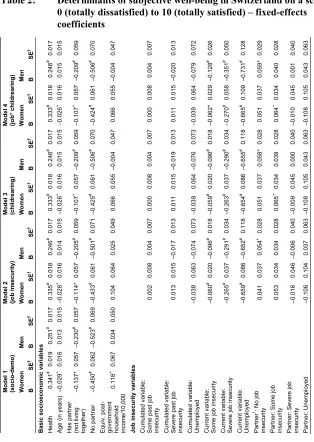
The effects of job insecurity on well-being are reported in Table 2. We developed estimates for four models, beginning with health status, age, partnership status, and equivalent household income (Model 1) before successively adding, first, cumulated job insecurity, current job insecurity, partner’s job insecurity, and leads of the three levels of job insecurity (Model 2); childrearing demands (Model 3); and finally interacting contemporary job insecurity and becoming a parent (Model 4).
4.1 Job insecurity and well-being
Table 2: Determinants of subjective well-being in Switzerland on a scale from 0 (totally dissatisfied) to 10 (totally satisfied) – fixed-effects
coefficients
Model 1 (so
cio
-demo)
Model 2 (jo
b in
security
)
Model 3 (childrearing) Model 4 (jo
b* childrearing) Women Men Women Men Women Men Women Men B SE † B SE † B SE † B SE † B SE † B SE † B SE † B SE † Basic socioeconomic v ariable s Heal th 0.341 # 0.019 0.251 # 0.017 0.335 # 0.018 0.246 # 0.017 0.333 # 0.018 0.246 # 0.017 0.333 # 0.018 0.246 # 0.017
Age (in ye
ars) –0.02 9 + 0.016 0.013 0.015 –0.02 8 + 0.016 0.014 0.015 –0.02 6 + 0.016 0.015 0.015 –0.02 6 + 0.016 0.015 0.015 Has par tner (no t li vi ng toget her) –0.13 7* 0.057 –0.23 0 # 0.057 –0.11 4* 0.057 –0.20 5 # 0.059 –0.10 7 + 0.057 –0.20 9 # 0.059 –0.10 7 + 0.057 –0.20 9 # 0.059 No par tner –0.45 0 # 0.062 –0.52 3 # 0.069 –0.43 3 # 0.061 –0.50 1 # 0.071 –0.42 5 # 0.061 –0.50 6 # 0.070 –0.42 4 # 0.061 –0.50 6 # 0.070 Equi v. pos t-gover nm ent house hold incom e/1 0,000 0.118 + 0.067 0.034 0.050 0.104 0.064 0.025 0.049 0.066 0.055 –0.00 4 0.047 0.066 0.055 –0.00 4 0.047 Job insecur ity v ariable s Cu m ul ated va riable : So m e past job insecur ity 0.002 0.008 0.004 0.007 0.000 0.008 0.004 0.007 0.000 0.008 0.004 0.007 Cu m ul ated va riable : Severe p ast job insecur ity 0.013 0.015 –0.01 7 0.013 0.011 0.015 –0.01 9 0.013 0.011 0.015 –0.02 0 0.013 Cu m ul ated va riable : Unem pl oyed –0.03 8 0.063 –0.07 4 0.073 –0.03 9 0.064 –0.07 6 0.073 –0.03 9 0.064 –0.07 9 0.072 Curr ent var iable: So m e job i nsecur ity –0.06 0 # 0.020 –0.09 6 # 0.018 –0.05 9 # 0.020 –0.09 6 # 0.018 –0.06 2* 0.029 –0.12 8 # 0.026 Curr ent var iable:
Severe job i
nsecur ity –0.26 5 # 0.037 –0.29 1 # 0.034 –0.26 3 # 0.037 –0.29 0 # 0.034 –0.27 0 # 0.058 –0.35 1 # 0.050 Curr ent var iable: Unem pl oyed –0.65 9 # 0.086 –0.65 2 # 0.118 –0.65 4 # 0.086 –0.65 5 # 0.118 –0.66 5 # 0.109 –0.73 1 # 0.128 Partner
1: No job
Table 2: (Continued)
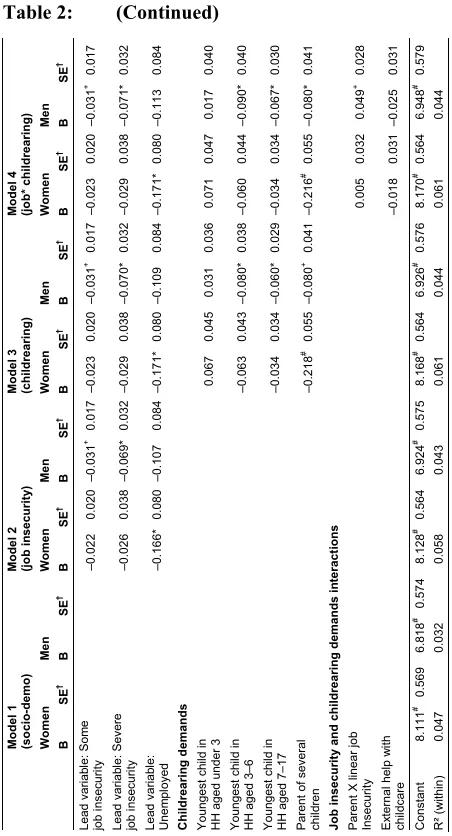
Note: # P<.01; *P<.05; +P<.1. Note: In all regressions, regions (major regions), regional unemployment rate and survey decades are controlled. N observations (SHP 2000–2016) for sample in labor force; women 1st wave: 20–45 years old, men 1st wave: 20–50 years old (excl. leads): 3,450 women (20,682 person-year observations), 3,717 men (22,594 person-year observations).† Robust standard errors, which correct for clustering of observations across waves of our panel data.
Model 1 (so
cio
-demo)
Model 2 (jo
b in
security
)
Model 3 (childrearing) Model 4 (jo
b* childrearing) Women Men Women Men Women Men Women Men B SE † B SE † B SE † B SE † B SE † B SE † B SE † B SE † Lead variab le: Som e job i nsecuri ty –0.02 2 0.020 –0.03 1 + 0.017 –0.02 3 0.020 –0.03 1 + 0.017 –0.02 3 0.020 –0.03 1 + 0.017 Lead variab le: Severe job i nsecuri ty –0.02 6 0.038 –0.06 9* 0.032 –0.02 9 0.038 –0.07 0* 0.032 –0.02 9 0.038 –0.07 1* 0.032 Lead variab le: Unem pl oyed –0.16 6* 0.080 –0.10 7 0.084 –0.17 1* 0.080 –0.10 9 0.084 –0.17 1* 0.080 –0.11 3 0.084 Childrearin g d emands Youngest ch ild in HH aged under 3 0.067 0.045 0.031 0.036 0.071 0.047 0.017 0.040 Youngest ch ild in HH aged 3 –6 –0.06 3 0.043 –0.08 0* 0.038 –0.06 0 0.044 –0.09 0* 0.040 Youngest ch ild in HH aged 7 –17 –0.03 4 0.034 –0.06 0* 0.029 –0.03 4 0.034 –0.06 7* 0.030 Parent of several chil dren –0.21 8 # 0.055 –0.08 0 + 0.041 –0.21 6 # 0.055 –0.08 0* 0.041 Job insecur
ity and childrearing demands in
teract
ions
Parent
X linear job
Finally, Model 2 also tested anticipation/lead effects and found some empirical evidence in support of H2b, though again the effects were only significant for future unemployed women and men with some (p < .1) or severe job insecurity. Lead effects of severe job insecurity on well-being are similar in size to the effects from some current job insecurity. Our coefficients point in the same direction as those reported by De Cuyper and De Witte (2006), who document that discharged workers display major psychological symptoms of stress during the period preceding actual redundancy.
Overall, subjective perceptions about work are very powerful in shaping how men and women evaluate their lives. The net difference between those in secure and those in insecure employment amounts to about 0.25 to 0.30 in Switzerland on a scale that ranges from 0 to 10, which is almost half of the loss in well-being due to becoming unemployed.
4.2 Job insecurity, childrearing demands, and well-being
In a next step we tested the childrearing demands hypothesis (H3), which posits that the transition to raising a child aged two years or less has an impact on the way people evaluate their lives (Model 3 in Table 2). Our results confirm that both fathers and mothers who transition to raising children aged 0–2 years evaluate their lives more positively than nonparents, though only insignificantly. For example, the well-being level of women with a child of age two years or less exceeds that of childless women by 0.067 points; for fathers this difference is 0.031 points. Although strict reference to the p-values in Model 3 suggests rejection of hypotheses H3, we want to emphasize that this might be due to small sample sizes for gender-specific analyses and that, especially for women, our fixed-effects models point to a positive association between well-being and raising a child of two years or less.
child strongly decreases the well-being of mothers. A second child also decreases the well-being of fathers, but only insignificantly (p < .1).
In a final step we examined the interaction hypothesis (H4), which asks whether becoming a parent alleviates or accentuates the negative impact of job insecurity on well-being. We tested how current concerns about job insecurity and current unemployment (as a linear variable) affected childless individuals who transitioned to parenthood. Our findings from Model 4 suggest that transitioning to parenthood and having increased job insecurity at the same time has a positive effect on well-being, though again insignificantly (men: p < .1). For robustness, we also tested the job insecurity categories that interacted with becoming a parent (not shown in Table 2) and the results confirm these findings: When transitioning to parenthood, men show a negative (p < .05) effect with no or some job insecurity worries and no effect with severe worries or when unemployed. This may show that for men, raising a newborn or infant slightly alleviates the burden of worrying about job insecurity. Interaction coefficients for other age groups were statistically insignificant. Finally, we accounted for the availability of external childcare help and the hours of external childcare, but we found no significant effects on subjective well-being whatsoever (not shown in Table 2).
5. Concluding discussion
In times of economic recession, the negative-well-being consequences of job insecurity, unemployment, and parental demands might result in most families deciding to have fewer children, which could be an important driver of low fertility. In this article we replicated the overall well-being response to the experiences of job insecurity and unemployment highlighted by other authors (Berth 2004; Lucas et al. 2004; Sverke, Hellgren, and Näswall 2006; Greenhalgh and Rosenblatt 2010; Kinnunnen et al. 1999; Virtanen et al. 2013; Georgellis et al. 2008; Krause 2010; Knabe and Rätzel 2011; Oesch and Lipps 2013). First, we documented how subjective well-being differs greatly according to intensity and whether cumulated, current, or future job insecurity is being considered. Second, we examined variation in subjective well-being in relation to changes in childrearing demands, which is important because the joys and challenges of parenthood depend on the age of the child and on parity progression. Finally, we found that differing demands over the parental life cycle (raising a newborn or infant, a pre-school and a pre-school-age child, etc.) do not moderate variation in well-being during periods of job insecurity.
This is the basic theory of the conservation of resources (COR) (Hobfoll 2001). This theoretical framework is useful to social scientists in understanding how the subjective experience of changes in employment status and stability can affect the quality of life. Our results confirm previous evidence that increased job insecurity decreases well-being (e.g., De Cuyper and De Witte 2006; Clark et al. 2008; Blanchflower 2001; Winkelmann and Winkelmann 1998; Reisel and Probst 2010; Sverke et al. 2010; Burchell, Ladipo, and Wilkinson 2005) and that this is strongest for entry into unemployment and for newly experienced severe job insecurity. Perhaps the negative response to unemployment is strongest because the experience is real, or perhaps the (future and current) threat of job loss has a weaker impact because the actual outcome might be different. Independent of the mechanism, these results align with quantitative evidence suggesting that both unemployment and a severe threat of job loss are critical for individuals’ well-being (Clark et al. 2008). These results confirm De Cuyper and De Witte’s (2006) argument that even the mere threat of future job loss leads to a decline in actual well-being. An increasing decline in well-being with higher job insecurity may stifle personal growth and inhibit making important family decisions such as investing in education or having additional children.
whose partners are not in the labor force, although the figures suggest a small negative effect for women. This implies that stable employment comes with status, privileges, and certain social benefits that make people satisfied with their life, while the absence of such employment is experienced as stressful (Bertozzi and Gilardi 2008).
The divergence in well-being responses related to raising a newborn or infant versus older children may affect fertility timing and the number of children to have. Parents’ experiences of parental demands, and the constraints on human capital accumulation (Becker 1981) and on people’s time (Pailhé 2009; Roeters, Mandemakers, and Voorpostel 2016) that these generate, may make them less likely to progress to higher parity. We found that the strongest drop in well-being occurs when parents transition from raising a newborn or infant to raising a toddler, thereby confirming a series of studies which found similar age-related effects of children (e.g., Kohler, Behman, and Skytthe 2005; Myrskylä and Margolis 2014) The fact that coefficients are sometimes insignificant may be due to small sample sizes for gender-specific analyses.
Similar to the analysis by Keizer and Schenk (2012), we found little empirical evidence for parenthood having a moderating role on well-being. In particular, the transition to parenthood did not significantly moderate our results regarding the link between job insecurity and subjective well-being, nor did the results vary by the demands across the parental life cycle. Nevertheless, the coefficients suggest that raising a newborn or infant may alleviate the negative effect of job insecurity on well-being. In addition, separate tests by insecurity category show that the threat of job loss and actual unemployment may affect the transition to parenthood less in men who experience severe worry about becoming unemployed or who end up becoming unemployed.
Our results regarding job insecurity, subjective well-being, and the role of parenthood cover the period 2000–2016, which partially overlaps with an era of fertility postponement. However, our results should not be interpreted as documenting that subjective well-being is the driving force behind fertility, as fertility has been relatively low and stable, thus making it difficult to analyze the contribution of subjective well-being to fertility behavior relative to other factors. Instead, our results provide an alternative way of understanding theories of low fertility by demonstrating that the subjective well-being response of people to conditions of job insecurity and childrearing to some degree predicted the fertility behavior that emerged after the second demographic transition.
Our study has limitations. First, the measure of job insecurity from this dataset provides no information on psychological stress due to concerns regarding finding a new job. This suggests the need for a thorough investigation in future research of the unemployed and their concerns regarding re-entering the labor market. Second, using smaller regions rather than large regions as controls would have been preferable. Family policies may differ locally rather than by (language) region. Smaller regional units could be useful for differentiating between locally implemented family policies and the coverage of public childcare facilities. Currently the number of observations is too low to warrant such a strategy. Finally, our coefficients are as expected but often yield no significant results, which is most probably due to the small sample size and the relatively short duration our respondents stayed in the survey. As fixed-effects models use only within-variances, longer panels and more respondents would be more informative. Also, there is some trade-off between our model and simpler models with many fewer variables and hypotheses, since we estimate lead-effects and thus do not use the last observation of all other variables.
6. Acknowledgements
References
Aassve, A., Goisis, A., and Sironi, M. (2012). Happiness and childbearing across Europe. Social Indicators Research 108(1): 65–86. doi:10.1007/s11205-011-9866-x.
Allison, P.D. (2009). Fixed effects regression models. Thousand Oaks: Sage. doi:10.4135/9781412993869.
Anderson, C.J. and Pontusson, J. (2007). Workers, worries, and welfare states: Social protection and job insecurity in 15 OECD countries. European Journal of Political Research 46(2): 211–235.doi:10.1111/j.1475-6765.2007.00692.x. Angeles, L. (2010). Children and life satisfaction.Journal of Happiness Studies11(4):
523–538.doi:10.1007/s10902-009-9168-z.
Baranowska, A. and Matysiak, A. (2011). Does parenthood increase happiness? Evidence for Poland. Vienna Yearbook of Population Research 9: 307–325. doi:10.1553/populationyearbook2011s307.
Barnett, R.C., Marshall, N.L., and Pleck, J.H. (1992). Men’s multiple roles and their relationship to men’s psychological distress. Journal of Marriage and the Family 54(2): 358–367.doi:10.2307/353067.
Becker, G. (1981).A treatise on the family. Cambridge: Harvard University Press. Bengtson, V.L., Elder, G.H., and Putney, N.M. (2005). The life course perspective on
ageing: Linked lives, timing, and history. In: Johnson, M.L., Bengtson, V.L., Coleman, P., and Kirkwood, T. (eds.). The Cambridge handbook of age and ageing. Cambridge: Cambridge University Press: 493–501.
Berth, H., Foerster, P., and Braehler, E. (2004). Arbeitslosigkeit,
Arbeitsplatzunsicherheit und Lebenszufriedenheit: Ergebnisse einer Studie bei jungen Erwachsenen in den neuen Bundesländern.Sozial- und Präventivmedizin
50(6): 361–369.doi:10.1007/s00038-005-3166-7.
Bertozzi, F. and Gilardi, F. (2008). The Swiss welfare state: A changing public-private mix? In: Béland, D. and Gran, B. (eds.). Public and private social policy. Basingstoke: Palgrave Macmillan: 207–227.doi:10.1057/9780230228771_10. Billari, F.C. (2009). The happiness commonality: Fertility decisions in low-fertility
Björklund, A. and Eriksson, T. (1998). Unemployment and mental health: Evidence from research in the Nordic countries.International Journal of Social Welfare
7(3): 219–235.doi:10.1111/j.1468-2397.1998.tb00286.x.
Blanchflower, D.G. (2001). Unemployment, well-being, and wage curves in Eastern and Central Europe. Journal of the Japanese and International Economies
15(4): 364–402.doi:10.1006/jjie.2001.0485.
Blossfeld, H.P., Klijzing, E., Mills, M., and Kurz, K. (2005).Globalization, uncertainty and youth society. London: Routledge.
Bonoli, G. (2017). Labour market and social protection reforms in international perspective: Parallel or converging tracks? London: Taylor and Francis. doi:10.4324/9781315251004.
Brickman, P. and Campbell, D. (1971). Hedonic relativism and planning the good science. In: Appley, M.H. (ed.). Adaptation level theory: A symposium. New York: Academic Press: 287–302.
Buber-Ennser, I. and Hanappi, D. (2018). Household position, parenthood, and adult self-reported health: Cross-sectional and longitudinal evidence from the Austrian Generations and Gender Survey. In: Doblhammer, G. and Gumà, J. (eds.). A demographic perspective on gender, family and health in Europe. Frankfurt: Springer: 155–191.doi:10.1007/978-3-319-72356-3_8.
Buchmann, M. and Charles, M. (1995). Organizational and institutional factors in the process of gender stratification: Comparing social arrangements in six European countries. International Journal of Sociology 25(2): 66–95. doi:10.1080/ 15579336.1995.11770109.
Burchell, B., Ladipo, D., and Wilkinson, F. (2005). Job insecurity and work intensification. London: Routledge.
Carroll, N. (2007). Unemployment and psychological well-being. The Economic Record83(262): 287–302.doi:10.1111/j.1475-4932.2007.00415.x.
Clark, A., Knabe, A., and Rätzel, S. (2010). Boon or bane? Others’ unemployment, well-being and job insecurity. Labour Economics 17(1): 52–61. doi:10.1016/ j.labeco.2009.05.007.
Clark, A.E. and Oswald, A.J. (1994). Unhappiness and unemployment.The Economic Journal104(424): 648–659.doi:10.2307/2234639.
Clark, A.E., Diener, E., Georgellis, Y., and Lucas, R.E. (2008). Lags and leads in life satisfaction: A test of the baseline hypothesis.The Economic Journal118(529): F222–F243.doi:10.1111/j.1468-0297.2008.02150.x.
Dannefer, D. (2003). Cumulative advantage/disadvantage and the life course: Cross-fertilizing age and social science theory.The Journals of Gerontology Series B: Psychological Sciences and Social Sciences 58(6): 327–337. doi:10.1093/ geronb/58.6.S327.
De Cuyper, N. and De Witte, H. (2006). The impact of job insecurity and contract type on attitudes, well-being and behavioural reports: A psychological contract perspective. Journal of Occupational and Organizational Psychology 79(3):
395–409.doi:10.1348/096317905X53660.
De Witte, H. (2007). Job insecurity: Review of the international literature on definitions, prevalence, antecedents and consequences. SA Journal of Industrial Psychology 31(4): 1–6.doi:10.1002/smi.2584.
De Witte, H., Pienaar, J., and De Cuyper, N. (2016). Review of 30 years of longitudinal studies on the association between job insecurity and health and well-being: Is there causal evidence? Australian Psychologist 51(1): 18–31. doi:10.1111/ ap.12176.
Di Tella, R., MacCulloch, R.J., and Oswald, A.J. (2001). Preferences over inflation and unemployment: Evidence from surveys of happiness. The American Economic Review91(1): 335–341.doi:10.1257/aer.91.1.335.
Dienel, C. (2002). Familienpolitik: Eine praxisorientierte Gesamtdarstellung der Grundlagen, Handlungsfelder und Probleme [Family policy: A pragmatical introduction to premises, policies and problems]. Weinheim: Juventa.
Diener, E., Inglehart, R., and Tay, L. (2013). Theory and validity of life satisfaction scales. Social Indicators Research 112(3): 497–527. doi:10.1007/s11205-012-0076-y.
DiPrete, T.A. and Eirich, G.M. (2006). Cumulative advantage as a mechanism for inequality: A review of theoretical and empirical developments.Annual Review of Sociology 32: 271–297.doi:10.1146/annurev.soc.32.061604.123127.
Dolan, P., Peasgood, T., and White, M. (2012). Do we really know what makes us happy? A review of the economic literature on the factors associated with subjective well-being. Journal of Economic Psychology 29(1): 94–122. doi:10.1016/j.joep.2007.09.001.
Easterlin, R.A. (2001). Income and happiness: Towards a unified theory.The Economic Journal111(473): 465–484.doi:10.1111/1468-0297.00646.
Elder, G.H., Johnson, M.K., and Crosnoe, R. (2003). The emergence and development of life course theory. In: Mortimer, J.T. and Shanahan, M.J. (eds.).Handbook of the life course. New York: Springer: 3–19.doi:10.1007/978-0-306-48247-2_1. Erlinghagen, M. (2007). Self-perceived job insecurity and social context: A multi-level
analysis of 17 European countries. European Sociological Review24(2): 183– 197.doi:10.1093/esr/jcm042.
Esser, I. and Olsen, K.M. (2011). Perceived job quality: Autonomy and job security within a multi-level framework.European Sociological Review28(4): 443–454. doi:10.1093/esr/jcr009.
European Commission (2006). The demographic future of Europe: From challenge to opportunity (Unit E.1). Luxembourg: Office for Official Publications of the European Communities.
Evenson, R.J. and Simon, R.W. (2005). Clarifying the relationship between parenthood and depression. Journal of Health and Social Behavior 46(4): 341–358. doi:10.1177/002214650504600403.
Ferrer-i-Carbonell, A. and Frijters, P. (2004). How important is methodology for the estimates of the determinants of happiness? The Economic Journal114(497): 641–659.doi:10.1111/j.1468-0297.2004.00235.x.
Ferrie, J.E., Shipley, M.J., Stansfeld, S.A., and Marmot, M.G. (2002). Effects of chronic job insecurity and change in job security on self reported health, minor psychiatric morbidity, physiological measures, and health related behaviours in British civil servants: The Whitehall II study. Journal of Epidemiology and Community Health56(6): 450–454.doi:10.1111/j.1468-0297.2004.00235.x. Friedman, D., Hechter, M., and Kanazawa, S. (1994). A theory of the value of children.
Frijters, P., Johnston, D.W., and Shields, M.A. (2011). Life satisfaction dynamics with quarterly life event data.The Scandinavian Journal of Economics113(1): 190– 211.doi:10.1111/j.1467-9442.2010.01638.x.
Frone, M.R., Russell, M., and Cooper, M.L. (1997). Relation of work–family conflict to health outcomes: A four-year longitudinal study of employed parents.Journal of Occupational and Organizational Psychology 70(4): 325–335. doi:10.1111/ j.2044-8325.1997.tb00652.x.
Gauthier, A.H. (2008). Comparative Family Policy Database: Version 3 [electronic resource]. Den Haag and Rostock: Netherlands Interdisciplinary Demographic Institute and Max Planck Institute for Demographic Reseach. https://www. demogr.mpg.de/cgi-bin/databases/FamPolDB/index.plx.
Georgellis, Y., Gregoriou, A., Healy, J., and Tsitsianis, N. (2008). Unemployment and life satisfaction: A non-linear adaption process. International Journal of Manpower 29(7): 668–680.doi:10.1108/01437720810908956.
Girardin, N., Bühlmann, F., Hanappi, D., Le Goff, J.-M., and Valarino, I. (2016). The transition to parenthood in Switzerland: Between institutional constraints and gender ideologies. In: Grunow, D. and Evertsson, M. (eds.).Couples’ transitions to parenthood: Analysing gender and work in Europe. Cheltenham: Edward Elgar: 146–170.doi:10.4337/9781785366000.00017.
Greenhalgh, L. and Rosenblatt, Z. (2010). Evolution of research on job insecurity.
International Studies of Management and Organization 40(1): 6–19. doi:10.2753/IMO0020-8825400101.
Hanappi, D., Bernardi, L., Ryser, V.-A., and Le Goff, J.-M. (2017). Changes in employment uncertainty and the fertility intention–behavior link: An analysis based on the Swiss Household Panel Data. European Journal of Population
33(3): 381–407.doi:10.1007/s10680-016-9408-y.
Hellgren, J., Sverke, M., and Isaksson, K. (1999). A two-dimensional approach to job insecurity: Consequences for employee attitudes and well-being. European Journal of Work and Organizational Psychology 8(2): 179–195. doi:10.1080/ 135943299398311.
Hobfoll, S.E. (2001). The influence of culture, community, and the nested-self in the stress process: advancing conservation of resources theory.Applied Psychology
50(3): 337–421.doi:10.1111/1464-0597.00062.
Hobfoll, S.E., Freedy, J.R., and Geller, P. (1990). Conservation of social resources: Social support resource theory. Journal of Social and Personal Relationships
7(4): 465–478.doi:10.1177/0265407590074004.
Huijts, T., Kraaykamp, G., and Subramanian, S. (2013). Childlessness and psychological well-being in context: A multilevel study on 24 European countries.European Sociological Review 29(1): 32–47.doi:10.1093/esr/jcr037. Jahoda, M. (1982). Employment and unemployment: A social-psychological analysis.
Cambridge: Cambridge University Press.
Jürges, H. (2007). True health vs response styles: Exploring cross-country differences in self-reported health. Health Economics 16(2): 163–178. doi:10.1002/ hec.1134.
Kahneman, D., Diener, E., and Schwarz, N. (1999). Well-being: Foundations of hedonic psychology. New York: Russell Sage.
Keizer, R. and Schenk, N. (2012). Becoming a parent and relationship satisfaction: A longitudinal dyadic perspective.Journal of Marriage and Family 74(4): 759– 773.doi:10.1111/j.1741-3737.2012.00991.x.
Keizer, R., Dykstra, P.A., and Poortman, A.-R. (2010). The transition to parenthood and well-being: The impact of partner status and work hour transitions.Journal of Family Psychology 24(4): 429–438.doi:10.1037/a0020414.
Kinnunen, U., Mauno, S., Natti, J., and Happonen, M. (1999). Perceived job insecurity: A longitudinal study among Finnish employees.European Journal of Work and Organizational Psychology8(2): 243–260.doi:10.1080/135943299398348. Klandermans, B. and van Vuuren, T. (1999). Job insecurity: Introduction. European
Journal of Work and Organizational Psychology 8(2): 145–153. doi:10.1080/ 135943299398294.
Knabe, A. and Rätzel, S. (2011). Scarring or scaring? The psychological impact of past unemployment and future unemployment risk. Economica 78(310): 283–293. doi:10.1111/j.1468-0335.2009.00816.x.
Kohler, H.-P., Behrman, J.R., and Skytthe, A. (2005). Partner + children = Happiness? The effects of partnerships and fertility on well-being. Population and Development Review31(3): 407–445.doi:10.1111/j.1728-4457.2005.00078.x. Krause, A. (2010). The effect of unemployment on life and satisfaction. An analysis for
Switzerland in its cultural diversity [electronic resource]. Bonn: Institute of Labor Economics. http://www.iza.org/conference_files/ReDisWeBe2010/krause _a5647.pdf (accessed February 21, 2014).
Levy, R., Widmer, E., and Kellerhals, J. (2002). Modern family or modernized family traditionalism? Master status and the gender order in Switzerland. Electronic Journal of Sociology 6(4).
Lucas, R.E., Clark, A.E., Georgellis, Y., and Diener, E. (2004). Unemployment alters the set point for life satisfaction. Psychological Science 15(1): 8–13. doi:10.1111/j.0963-7214.2004.01501002.x.
Lykken, D. and Tellegen, A. (1996). Happiness is a stochastic phenomenon.
Psychological Science7(3): 186–189.doi:10.1111/j.1467-9280.1996.tb00355.x. Matysiak, A., Mencarini, L., and Vignoli, D. (2016). Work–family conflict moderates
the relationship between childbearing and subjective well-being. European Journal of Population 32(3): 355–379.doi:10.1007/s10680-016-9390-4.
Mauno, S., Cheng, T., and Lim, V. (2017). The far-reaching consequences of job insecurity: A review on family-related outcomes.Marriage and Family Review
53(8): 717–743.doi:10.1080/01494929.2017.1283382.
Merton, R. (1968). The Matthew Effect in science: The reward and communication systems of science are considered. Science 159(3810): 56–63. doi:10.1126/ science.159.3810.56.
Michalos, A.C. (2017). Multiple discrepancies theory (MDT). In: Michalos, A.C. (ed.).
Development of quality of life theory and its instruments. New York: Springer: 39–95.doi:10.1007/978-3-319-51149-8_3.
Moss, P. and Deven, F. (2015). Leave policies in challenging times: Reviewing the decade 2004–2014. Community, Work and Family 2. doi:10.1080/13668803. 2015.1021094.
Myrskylä, M. and Margolis, R. (2014). Happiness: Before and after the kids.
Nauck, B. (2007). Value of children and the framing of fertility: Results from a cross-cultural comparative survey in 10 societies. European Sociological Review
23(5): 615–629.doi:10.1093/esr/jcm028.
Nelson, S.K., Kushlev, K., and Lyubomirsky, S. (2014). The pains and pleasures of parenting: When, why, and how is parenthood associated with more or less well-being?Psychological Bulletin140(3): 846–895.doi:10.1037/a0035444.
Nomaguchi, K.M. (2012). Parenthood and psychological well-being: Clarifying the role of child age and parent-child relationship quality. Social Science Research
41(2): 489–498.doi:10.1016/j.ssresearch.2011.08.001.
OECD Better Life Index (2015). Better Life Index [electronic resource]. Paris: OECD. http://www.oecdbetterlifeindex.org (accessed April 11, 2016).
OECD Employment Protection Legislation (2016). OECD/IDB Database [electronic resource]. Paris: OECD.https://www.oecd.org/employment/protection (accessed April 11, 2016).
Oesch, D. and Lipps, O. (2013). Does unemployment hurt less if there is more of it around? A panel analysis of life satisfaction in Germany and Switzerland.
European Sociological Review29(5): 955–967.doi:10.1093/esr/jcs071.
Okbay, A., Baselmans, B.M., De Neve, J.-E., Turley, P.A., Nivard, M.G., Fontana, M.A., and Derringer, J., et al. (2016). Genetic associations with subjective well-being also implicate depression and neuroticism. Nature Genetics48: 624–633. doi:10.1038/ng.3552.
Pailhé, A. (2009). Work‒family balance and childbearing intentions in France, Germany and the Russian Federation. In: United Nations (ed.).How generations and gender shape demographic change: Towards policies based on better knowledge. Geneva: United Nations: 57–82.
Pailhé, A. and Solaz, A. (2012). The influence of employment uncertainty on childbearing in France: A tempo or quantum effect? Demographic Research
26(1): 1–40.doi:10.4054/DemRes.2012.26.1.
Philipov, D. (2009). The effect of competing intentions and behaviour on short-term childbearing intentions and subsequent childbearing. European Journal of Population25(4): 525–548.doi:10.1007/s10680-009-9197-7.
Pollmann-Schult, M. (2014). Parenthood and life satisfaction: Why don’t children make
people happy? Journal of Marriage and Family 76(2): 319‒336.