SYNTHESIS OF HIGHLY SELECTIVE NANO-STRUCTURED FUNCTIONALIZED SBA-15 METFORMIN
PAL-LADIUM COMPOSITE CATALYST IN PARTIAL HYDROGENATION OF ALKYNES
REZA KIA KOJOORI *
,11 Department of chemistry, Faculty of Science, East Tehran Branch, Islamic Azad University, Tehran, Iran
ABSTRACT
In this research, a heterogeneous Nano-Structured functionalized SBA-15 metformin palladium composite catalyst is reported for the selective hydrogenation of alkynes. In the first place, A series of the heterogeneous mesoporous SBA-15 metformin palladium catalyst were prepared and afterwards the condition and the ratio of used materials were optimized to give rise a suitable high performance catalyst. The final nano-structured catalyst was characterized by X-ray powder diffraction, BET surface area, FT-IR spectrophotometer, Scanning electron microscopy (SEM) and Transmission electron microscopy (TEM) and served in partial hydrogenation of different alkynes, with high selectivity and high yield. The liquid phase hydrogenation was conducted under mild condition of room temperature and atmospheric pressure. The reactions were monitored every half an hour by gas chromatography and all of them were completed during 4-6 hours. The products were characterized by 1H-NMR, 13C-NMR, FT-IR, and Mass Spectrometry (MS) that strongly confirmed the (Z)-double bond configuration of produced alkenes.
This prepared catalyst is competitive with the best palladium catalysts known for the selective liquid phase hydrogenation of alkynes and can be easily recovered and regenerated with keeping high activity and selectivity over multiple cycles with a simple regeneration procedure.
Keywords: partial hydrogenation; selective; mesoporous silica; nano composite; alkynes; alkenes.
1. INTRODUCTION
Highly selective heterogeneous catalysis is very crucial for extending of
sustainable catalyst. Thus, the catalysts with new design to achieve highly product selectivity are strongly desirable1-2. These catalysts are preferred to ap
-ply because of being recyclable and feasible use of them on fixed bed reactors. Therefore, development of new heterogeneous catalytic system with unique
feature of selectivity control in a certain reaction is a main plan of modern chemistry.
Partial hydrogenation of a carbon-carbon triple bonds to double bonds is a very important synthetic reaction with high utilization both in the laboratory and on the industrial scale for the synthesis of fine and specialty chemicals3-4.
In recent years, application and designing of highly selective catalyst for partial
hydrogenation of alkynes has attracted more attention by virtue of its impor -tance in synthesis of intermediate products5-9.
The Lindlar catalyst (the Pd on the CaCO3 poisoned with lead (II) acetate)
was the first instance of highly selective supported metal catalyst for liquid phase partial hydrogenation of alkynes to alkenes by utilizing of a suitable surface modifier basic compound such as quinoline. The role of lead in this
catalyst is a dopant to promote the selective hydrogenation of alkynes to
cis-al-kenes while quinoline is applied to slow the reaction rate of the subsequent hy -drogenation of the desired cis-alkenes to alkanes, so that achieving a very high selectivity to cis-alkenes3. Because of the undesirable toxic lead compounds
and the soluble additive, consequently, it is necessary to develop new alterna -tive greener heterogeneous catalysts for this type of selec-tive catalytic reaction.
The design of a new catalyst with suitable features can be accessed by perception the basic mechanisms that result to the selective partial reduction of alkynes to alkenes over palladium catalysts, however, those are not yet fully explored. Nevertheless, much development has been achieved recently, includ
-ing find-ing the key roles of surface10-11, the amount and type of palladium
hy-dride species12-13, as well as the effect of surface modifier or additional metal
dopants14-16.
Selectivity either be controlled by thermodynamic or kinetic effects. Ther
-modynamic effects include changing the relative binding properties of the al
-kynes over alkenes whereas kinetic effects includes altering the relative rates of hydrogenation. The different experiments show that kinetic effects are less
important than thermodynamic effects, as the rates of reduction of alkynes to alkenes and alkanes have nearly the same order of magnitude. Selectivity is
indispensably governed by thermodynamic effects, i.e. the adsorption strength of different unsaturated C-C bond on the active sites of metal.
Selectivity can be largely influenced by applying surface modifiers that adsorb stronger alkenes than alkynes to the surface17. Modifiers are compounds
containing N or S atoms for liquid phase hydrogenation of alkynes. Therefore, development of new catalytic systems with suitable activity and selectivity that are easily separable and recyclable, is the case that draws attention of many
researchers18-22. These catalytic systems include mesoporous silica supported
Pd nanoparticles 23-25.
In this work, functionalized SBA-15 metformin palladium composites are used to play three roles, the first is to promote the reacting of the incorporated
Pd through the chelating metformin sites, furthermore, the improved dispersion
capability of the nanoparticles and last but not least, introducing a separable, recyclable, and reusable catalyst which shows an immobilized catalyst on the surface to facilitate catalyst recovering. Contrary to cases where the organic base modifier requires removal26, in this research, the metformin modifier rep
-resents an important role in adjusting the selectivity of the catalyst.
The final catalyst was applied in the selective hydrogenation of different alkynes. The results approved that the heterogeneous catalytic reaction was highly selective for selective partial hydrogenation of alkynes to Z-alkenes (scheme 1).
Scheme 1. Selective partial hydrogenation of alkynes to Z-alkenes
2. EXPERIMENTAL
2.1. Chemical materials and characterization
All chemicals were purchased from Merck except Pluronic123, metformin hydrochloride and palladium acetate which were obtained from Aldrich. Trans
-mission electron microscopy (TEM) images were performed using a Philips CM300 operated at 100 kV electron beam accelerating voltage. Scanning elec
-tron microscopy (SEM) measurements were obtained using a KYKY-EM3200. X-ray powder diffraction data of the synthesized catalysts were collected on a Philips XPERT diffractometer using nickel filtered Cu Karadiation k= 1.5406 Å. BET surface area analysis was carried out on a Micromeritics TriStar 3000
apparatus. Infrared spectra were prepared on a TENSOR 27 FT-IR spectro
-photometer, Bruker Corporation. 1H and 13C-NMR spectra were recorded on a
Brucker Advance spectrophotometer (250 MHz) in CDCl3. The mass spectra
were recorded on a Finnigan-MAT-8430EI-MS spectrometer at 70 eV; in m/z (rel. %).
2.2. Preparation of functionalized SBA-15/metformin nanoparticles
The synthesis of mesoporous SBA-15 was performed according to a well-known procedure 27. A 100 ml round-bottom flask were introduced succes
-sively 50 ml of dried toluene, 1.00 gr of SBA-15 and 0.6 gr (2.99 mmol) of 3-chloropropyltrimethoxysilane. The mixture was refluxed for 24 h under an
inert atmosphere of anhydrous N2, filtered and washed subsequently with tolu
-ene, dichloromethane and methanol, dried under reduced pressure at 80 oC for
In the same another flask, to a solution of 1.00 g (5.86 mmol) of metformin hydrochloride in 30 ml acetonitrile, 0.25 gr (6.12 mmol) NaOH was added. The solution was stirred for 1 hour. Then 1.00 gr (6.03 mmol) KI and 1.00 gr of as-prepared 3-chloropropyl functionalized SBA-15 were added to the mixture and kept under reflux for 1 h, filtered and washed with distilled water and dried
at 80 oC under reduced pressure to afford 0.9 gr of metformin- functionalized
mesoporous SBA-15 nanoparticles.
2.3. Preparation of functionalized SBA-15/ metformin/ palladium (II) catalyst
0.5 gr functionalized SBA-15 with sillylchloropropyl and metformin was poured in 100 ml flask and then 10 ml acetone added to it. The mixture was stirred and 110 mg Pd(OAc)2 (0.49 mmol) added to the corresponding mixture
and this mixture allowed to stir 24 h in room temperature. After that, the mix
-ture was filtered and rinsed by acetone and dried THF twice. Then the solid was dried at 80˚C under reduced pressure oven for 3 h. The resulted brownish catalyst was obtained and its structure characterized by FT-IR.
2.4. Partial hydrogenation of alkyne to corresponding alkene by func-tionalized SBA-15/ metformin/ palladium catalyst
100 mg prepared catalyst mixed with 100 cc methanol was poured into the flask and 20 mmol alkyne was added to this mixture. Hydrogenation set is filled with H2 in atmospheric pressure and hydrogenating was continued for 5
h. Progress of reaction was followed each 0.5 h by gas chromatography. After the completion of reaction and disappearing of starting alkyne that took 4-6 h, crude product was filtered. The filtrate was evaporated at low pressure by rotary evaporator. The products were characterized by 1H-NMR, 13C-NMR,
FT-IR, MS, that strongly approved the (Z)-double bond configuration of pro
-duced alkene. The results of all experimental data associated with analysis; IR,
1HNMR, 13C-NMR and Mass Spectrum are presented in the following:
2a) phenyl ethylene, IR (KBr) cm-1 : 1630 (C=C), 908, 991 (OOP =CH);
1H-NMR (CDCl
3), δ: 5.18 (dd, J=10.2 Hz, 2.1 Hz, 1H), 5.61 (dd, J= 16.8 Hz,
J= 2.1 Hz, 1H), 6.65 (dd, J= 16.8 Hz, J= 10.2 Hz, 1H), 7.33 (t, J=7.5 Hz, 1H), 7.40 (t, J= 7.5 Hz, 2H), 7.60 (d, J=7.5 Hz, 2H), 13C-NMR (CDCl
3): 137.9,
136.1, 128.6, 128.5, 127.9, 114.3. MS m/z: 104 (100, M+), 103 (41), 78 (35),
51 (17), 50 (7), 39 (6).
2b) 2-propen-1-ol, IR (KBr) cm-1 : 3350 (OH), 3080 (=CH), 1645 (C=C),
920 (OOP =CH); 1H-NMR (CDCl
3), δ: 1.95 (s, OH), 4.15 (d, J= 6.2 Hz, 2H),
5.10 (dd, J= 16.8 Hz, J=2.1 Hz, 1H), 5.40 (dd, J= 10.2 Hz, J= 2.1 Hz, 1H), 6.10 (ddt, J= 16.8 Hz, J=10.2 Hz, J=6.2 Hz, 1H), 13C-NMR (CDCl
3): 60.2, 115.7,
138.2. MS m/z: 58 (23, M+), 57 (100), 39 (28), 31 (41), 29 (25), 27 (23).
2c) (Z)-2-buten-1-ol, IR (KBr) cm-1 : 3350 (OH), 3082 (=CH), 1658
(C=C), 670 (OOP =CH); 1H-NMR (CDCl
3), δ: 2.05 (d, J= 6.4 Hz, 3H), 3.65
(s, OH), 4.18 (d, J= 6.2 Hz, 2H), 5.64 (td, J=10.9 Hz, J=6.2 Hz, 1H), 5.70 (qd, J=10.9 Hz, J=6.4 Hz, 1H), 13C-NMR (CDCl
3) 11.6, 57.9, 125.9, 130.6. MS
m/z: 72 (33, M+), 57 (100), 43 (23), 41 (24), 39 (29), 31 (21), 29 (29), 27 (25).
2d) 3-buten-1-ol, IR (KBr) cm-1 : 3360 (OH), 3080 (=CH), 1641 (C=C),
990, 915 (OOP =CH); 1H-NMR (CDCl
3), δ: 2.32 (td, J= 7.1 Hz, J=6.2 Hz, 2H),
2.76 (s, OH), 3.65 (t, J=7.1 Hz, 2H), 5.10 (dd, J=10.0 Hz, J=2.1 Hz, 1H), 5.13 (dd, J=16.8 Hz, J=2.1 Hz, 1H), 5.81 (ddt, J=16.8 Hz, J=10 Hz, J=6.2, 1H), 13
C-NMR (CDCl3) 37.1, 61.6, 117.2, 135.0. MS m/z: 72 (7, M+), 42 (100), 31 (67).
2e) 3-buten-2-ol, IR (KBr) cm-1 : 3390 (OH), 3080 (=CH), 1650 (C=C),
980, 922 (OOP =CH); 1H-NMR (CDCl
3), δ: 1.27 (d, J= 6.8 Hz, 3H), 2.06 (s,
OH), 4.29 (qd, J= 6.8 Hz, J= 6.2 Hz, 1H), 5.07 (dd, J= 10 Hz, J= 2.1 Hz, 1H), 5.21 (dd, J= 16.8 Hz, J= 2.1, 1H), 5.90 (ddd, J=16.8 Hz, J=10 Hz, J= 6.2 Hz,
1H), 13C-NMR (CDCl
3) 23.0, 68.8, 113.6, 142.6. MS m/z: 72 (3, M+), 71 (14),
57 (100), 43 (73), 29 (24), 28 (4).
2f) (Z)-2-buten-1,4-diol, IR (KBr) cm-1 : 3337 (OH), 3025 (=CH), 1660
(C=C), 690 (OOP =CH); 1H-NMR (CDCl
3), δ: 2.90 (s, 2OH), 4.30 (d, J= 6.2
Hz, 4H), 5.70 (t, J= 6.2 Hz, 2H), 13C-NMR (CDCl
3) 44.0, 130.0. MS m/z: 70
(38), 57 (100). 42 (95) 31 (55).
2g) propenoic acid, IR (KBr) cm-1 : 2400-3400 (COOH), 3070 (=CH),
1705 (C=O), 1636 (C=C), 1245, 1297 (C-O), 987 (OOP =CH); 1H-NMR
(CDCl3), δ: 5.75 (dd, J= 16.8 Hz, J= 2.1 Hz, 1H), 6.22 (dd, J= 16.8 Hz, J=10.2
Hz, 1H), 6.50 (dd, J= 10.2 Hz, J= 2.1 Hz, 1H), 11.50 (s, CO2H), 13C-NMR
(CDCl3): 127.5, 134.1, 170.4. MS m/z: 72 (95, M+), 55 (97), 45 (32), 27 (100).
2h) (Z)-ethylen-dicarboxylic acid, IR (KBr) cm-1 : 2400-3400 (COOH),
3070 (=CH), 1705 (C=O), 1635 (C=C), 1220, 1265 (C-O), 950 (OOP =CH);
1H-NMR (CDCl
3), δ: 6.28 (s, 2H), 11.03 (s, 2CO2H), 13C-NMR (CDCl3) 130.0,
166.5. MS m/z: 116 (2, M+), 99 (30), 72 (100), 45 (67), 26 (45).
2i) (Z)-1,2-diphenylethylene, IR (KBr) cm-1 : 1600 (C=C), 700 (OOP
=CH), 1H-NMR (CDCl
3), δ: 6.56 (s, 2H), 7.30 (t, J= 7.5 Hz, 2H), 7.45 (t, J=
7.5 Hz, 4H), 7.72 (d, J= 7.5 Hz, 4H), 13C-NMR (CDCl
3): 127.4, 127.9, 128.5,
128.6, 137.5. MS m/z: 180 (100, M+), 179 (92), 178 (50), 165 (38), 89 (12),
77 (7).
2j) 1-pentene, IR (KBr) cm-1 : 3080 (=CH), 1645 (C=C), 910, 990 (OOP
=CH), 1H-NMR (CDCl
3), δ: 0.91 (t, J=8 Hz, 3H), 1.43 (qt, J=8 Hz, J=7.1 Hz,
2H), 2.02 (td, J=7.1 Hz, J=6.2 Hz, 2H), 4.93 (dd, J=10.2 Hz, J=2.1 Hz, 1H), 4.97 (dd, J=16.8 Hz, J=2.1 Hz, 1H), 5.81 (tdd, J=16.8 Hz, J=10.2 Hz, J=6.2 Hz,
1H), 13C-NMR (CDCl
3) 13.7, 22.3, 36.1, 114.4, 139.0. MS m/z: 70 (39, M+), 55
(65), 42 (100), 29 (21), 27 (18).
2k) (Z)-2-pentene, IR (KBr) cm-1 : 3015 (=CH), 1667 (C=C), 700 (OOP
=CH), 1H-NMR (CDCl
3), δ: 0.96 (t, J= 8.0 Hz, 3H), 1.60 (d, J= 6.2 Hz, 3H),
2.04 (qd, J= 8.0 Hz, J= 6.2 Hz, 2H), 5.15 (td, 11.2 Hz, 6.2 Hz, 1H), 5.64 (dq, J= 11.2 Hz, J= 6.2 Hz, 1H), 13C-NMR (CDCl
3): 12.6, 14.2, 20.2, 123.1, 132.6. MS
m/z: 70 (39, M+), 55 (100), 42 (42), 29 (20).
2l) 1-hexene, IR (KBr) cm-1 : 3080 (=CH), 1642 (C=C), 912 (OOP =CH),
1H-NMR (CDCl
3), δ: 0.90 (t, J= 8.0 Hz, 3H), 1.07 (m, 2H), 1.50 (m, 2H), 2.06
(td, J= 7.1 Hz, 6.2 Hz, 2H), 4.92 (dd, J= 10.0 Hz, J= 2.1 Hz, 1H), 4.96 (dd, J= 16.8, J=2.1 Hz, 1H), 5.80 (ddt, J= 16.8 Hz, J= 10.0 Hz, J=6.2 Hz, 1H), 13
C-NMR (CDCl3): 14.0, 22.4, 31.3, 33.7, 114.2, 139.2. MS m/z: 84 (29, M+), 69
(24), 56 (100), 42 (72), 41 (95), 29 (19).
2m) 1-octene, IR (KBr) cm-1 : 3075 (=CH), 1644 (C=C), 991 (OOP =CH),
1H-NMR (CDCl
3), δ: 0.87 (t, J= 8.0 Hz, 3H), 1.04-1.53 (m, 8H), 2.02 (dt, J= 7.2
Hz, J= 6.2 Hz, 2H), 4.91 (dd, J= 10.2 Hz, J= 2.1, 1H), 4.97 (dd, J= 16.8 Hz, 2.1 Hz, 1H), 5.77 (ddt, J= 16.8 Hz, J= 10.2 Hz, J= 6.2 Hz, 1H), 13C-NMR (CDCl
3):
14.1, 22.7, 28.9, 29.1, 31.9, 33.9, 114.1, 139.2. MS m/z: 112 (20, M+), 83 (34),
70 (86), 54 (99), 43 (100), 29 (35).
2.5. Catalyst recovering and regeneration
After completion of the reaction, the catalyst was filtered, rinsed with suf
-ficient methanol and dried under vacuum at room temperature. Then the re
-sulted powder was transferred into a flask and the system was purged with pure
nitrogen for 15 minutes.
3. RESULTS AND DISCUSSION
3.1. Synthesis and characterization of functionalized SBA-15/Metfor-min/Pd (II)
The schematic pathways for the synthesis of catalyst are depicted in Scheme 2a and 2b.
Scheme 2b. The pathway for the synthesis of functionalized mesoporous SBA-15/Metformin/Pd (II).
SBA-15/Metformin was prepared according to the reported method28.
Then, palladium acetate was added to SBA-15/Metformin in acetone and the mixture was stirred for 24 h at room temperature to obtain SBA-15/Metformin/ Pd(II). Synthesized catalyst has been characterized by FT-IR, XRD spectra and SEM and TEM images. The SEM micrograph of the catalyst is shown in Fig. 1. This figure shows agglomeration of spherical particles in the range of 50 to 60 nm (Figure 1).
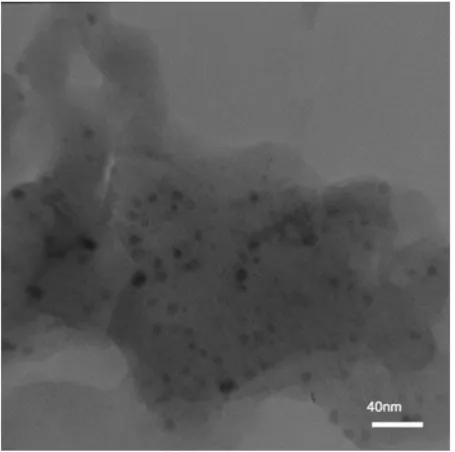
Figure 1. SEM image of modified SBA-15/metformin/palladium catalyst TEM image of catalyst clearly shows the activated sites of Pd particles trapped in metformin net in the size range of 5-15 nm (Figure 2).
The successful attachment of metformin and subsequent coordination of Pd (II) ions within the mesoporous SBA-15 material can be achieved by em
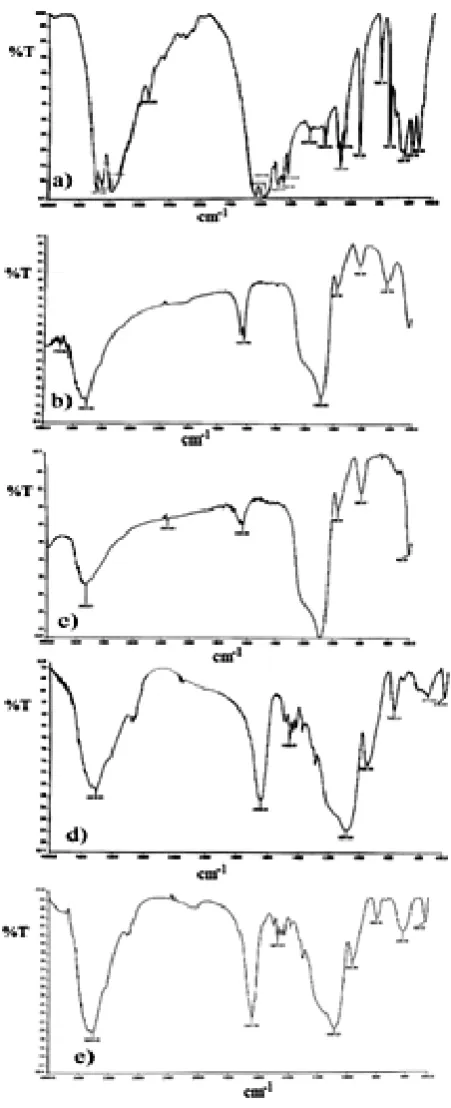
-ploying of FT-IR spectroscopy. Fig. 3 shows the FT-IR spectra obtained for (a) Metformin hydrochloride (Metformin.HCl), (b) Parent SBA-15, (c) Function
-alized SBA-15, (d) Function-alized SBA-15/Metformin and (e) Function-alized SBA-15/Metformin/Pd (II).
Curve (a) shows the FT-IR spectrum of Metformin.HCl and signals ap
-peared at 1568 and 1634 cm−1 are attributed to the presence of C=N stretching vibrations29. The signals appeared at 3150–3400 cm−1 region can be assigned to the N-H stretching of C=N-H group on metformin30. The unmodified SBA-15
spectrum in curve (b) shows the typical silica bands associated with the main inorganic backbone, the signals appeared at 1000 and 1200 cm−1 are assigned to asymmetric stretching of Si-O-Si, the peak at 1620 cm−1 is related to the bend -ing vibration of water bonded to the inorganic backbone and signal appeared at
3430 cm−1 can be assigned to O-H stretching frequency of Si-O-H groups and/ or water in atmosphere and within porous sample. The functionalized SBA-15 spectrum in curve (c) shows the similar bands like as prepared SBA-15. In curves (d) and (e), the broad band at 1050-1250 cm−1 is related to asymmetrical stretching bond of Si-O-Si bridges, being indicative of the existence of a silica material and an apparent signal in 965 cm-1 that is ascribed to stretching bond of
Si-OH31. Moreover, a broad signal in the range of 3150-3413 cm-1 approved the
existence of free surface OH and absorbed water on the surface of catalyst and the peaks in 1465 cm-1 and 1641 cm-1 are attributed to C-N and C=N stretching
bond respectively.
Figure 2. TEM image of modified SBA-15/metformin/palladium catalyst
The significant difference in FT-IR spectra of Metformin.HCl and SBA-15/Metformin (curves (a) and (d)) was the shift of C=N stretching frequencies from 1568 and 1634 cm−1 to broad band in 1646 cm−1, due to the removal of HCl when metformin is attached to the silica surface. On the other hand, the metal–ligand coordination30,32 presumably leads to a shift of these two peaks
again to lower frequencies (1568 and 1634 cm−1). This shift can be observed in compare with curves (d) and (e) in Fig. 3. On the whole, the aforementioned observations confirmed the immobilization of Pd(II) ions on the surface of SBA-15/Metformin.
The XRD pattern of catalyst shows no specific signals due to conversion of crystalline form of catalyst to amorphous morphology caused by encaging of Pd into the surface structure by eliminating of signals which were observed in three distinct diffraction peaks in low 2θ region before treating with Pd(OAc)2
solution (Fig 4a and 4b).
BET specific surface areas of SBA-15 and modified SBA-15 by metformin were measured in 1050 and 445 m2/g respectively. This result shows that the
surface area of treated sample with metformin is dramatically reduced. The surface area of palladium treated functionalized SBA-15/metformin sample slightly changed and finally reached to 440 m2/g. It can be concluded that pal
-ladium mostly trapped by metformin instead of the void pores of SBA-15. To assume that prepared catalyst hydrogenates different alkynes with highly selectivity to only (Z)-isomer of corresponding alkenes (scheme 1) and for confirming this theory, more than 10 different alkynes were treated by this
catalyst in hydrogenation reaction and unanimously results, approved proposed
assumption. Structure of reduced product characterized by FT-IR and 1H NMR, 13CNMR and MS spectra that were clearly in agreement with the corresponding
Figure 3. FT-IR spectra for samples of (a) Metformin hydrochloride, (b) Parent SBA-15, (c) Functionalized SBA-15, (d) Functionalized SBA-15/ Metformin and (e) Functionalized SBA-15/Metformin /Pd(II) catalyst.
Figure 4a. XRD spectrum of SBA-15
Figure 4b. XRD spectrum of Functionalized SBA-15/metformin /Pd(II)
catalyst
Reactions were completed during 4-6 h and the configuration of resulted products were determined as a cis alkenes. For example, the 1H NMR spectrum
of 2i exhibits one singlet for the same two olefin protons in 6.5 ppm that is in agreement with (Z)-structure for stilbene. Aromatic protons appeared in the region between 7-7.5 ppm with expected pattern for mono substituted benzene. FT-IR spectrum of resulted product clearly approved the conversion of triple bond to Z-isomer of double bond by strong peak appeared in 1600 cm-1 instead
of signal for trans isomer that usually shifted to lower frequencies because of its better conjugation system interaction.
3.2. Catalyst regenerating and recycling
Leaching of palladium species from the catalyst support is one of the most commonplace issues for deactivation of catalyst in liquid phase reactions33-35.
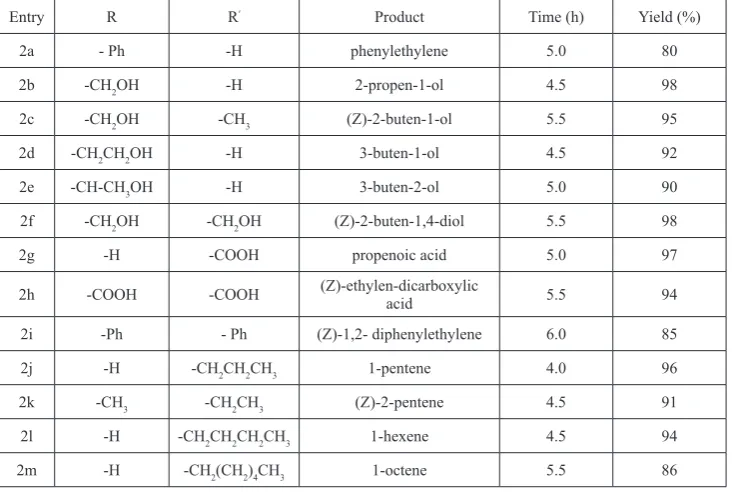
Table 1.The yields for the partial hydrogenation of alkynes using functionalized Si-SBA-15/metformin/ Pd(II) catalyst
Entry R R′ Product Time (h) Yield (%)
2a - Ph -H phenylethylene 5.0 80
2b -CH2OH -H 2-propen-1-ol 4.5 98
2c -CH2OH -CH3 (Z)-2-buten-1-ol 5.5 95
2d -CH2CH2OH -H 3-buten-1-ol 4.5 92
2e -CH-CH3OH -H 3-buten-2-ol 5.0 90
2f -CH2OH -CH2OH (Z)-2-buten-1,4-diol 5.5 98
2g -H -COOH propenoic acid 5.0 97
2h -COOH -COOH (Z)-ethylen-dicarboxylic acid 5.5 94
2i -Ph - Ph (Z)-1,2- diphenylethylene 6.0 85
2j -H -CH2CH2CH3 1-pentene 4.0 96
2k -CH3 -CH2CH3 (Z)-2-pentene 4.5 91
2l -H -CH2CH2CH2CH3 1-hexene 4.5 94
2m -H -CH2(CH2)4CH3 1-octene 5.5 86
Table 2.Yields for partial hydrogenation of diphenylacetylene to
(Z)-1,2-diphenylethylene using fresh and used functionalized SBA-15/metformin/
palladium catalysts.
Catalysts Time (h) Yield (%)
Functionalized SBA-15/
metformin/palladium (fresh) 6 85
Functionalized SBA-15/ metformin/palladium (used)
(first time) 6 83
Functionalized SBA-15/ metformin/palladium(used)
(second time) 6.5 80
Functionalized SBA-15/ metformin/palladium (used)
(third time) 6.5 82
4. CONCLUSION
In summary, we introduced a novel catalyst for selective partial hydrogenation of alkynes to (Z)-alkenes in good yield. The current method
presents a simple and useful synthetic process for partial hydrogenation of
alkynes because of the following advantages: (1) easily recycling of catalyst, (2) environmentally benign, (3) highly selectivity and (4) readily to prepare.
REFERENCES
1. P. T. Witte, M. de Groen, R. M. de Rooij, P. Donkervoort, H. G. Bakermans, J. W. Geus, Stud. Surf. Sci. Catal. 175, 135, (2010)
2. N. Semagina, L. Kiwi-Minsker, Catal. Lett. 127, 334, (2009)
3. A. Molnar, A. Sarkany, M. Varga, J. Mol. Catal. A 173, 185, (2001) 4. M. Crespo-Quesada, F. Cardenas-Lizana, A. L. Dessimoz, L.
Kiwi-Minsker, ACS Catal. 2, 1773, (2012)
5. R. N. Shiju, V. V. Guliants, Appl. Catal. A: Gen. 356, 1, (2009) 6. F. P. D. Silva, L. M. Rossi, Tetrahedron 70, 3314, (2014)
7. S. M. T. Ohkubo, T. I. A. Kume, T. Maegawa, Y. Monguchi, H. Sajiki, J. Molecular Catalysis A: Chemical307, 77, (2009)
8. Y. L. Y. Motoyama, K. Tsuji, S. H. Yoon, I. Mochida, H. Nagashima,
Chem. Cat. Chem. 4, 778, (2012)
9. H. Sajiki, S. Mori, T. Ohkubo, T. Ikawa, A. Kume, T. Maegawa, Y. Monguchi, Chem.-Eur. J. 14, 5109, (2008)
10. C. W. A. Chan, K. Y. Tam, J. Cookson, P. Bishop, S. C. Tsang, Catal. Sci. Technol. 1, 1584, (2011)
11. D. Teschner, J. Borsodi, A. Wootsch, Z. Revay, M. Havecker, A. Knop-Gericke, S. D. Jackson, R. Schlogl, Science 320, 86, (2008)
12. Z. Re, A. Knop-gericke, R. Schlogl, D. Torres, P. Sautet, J. Phys. Chem. C
114, 2293, (2010)
13. M. Garcia-Mota, B. Bridier, J. Perez-Ramirez, N. Lopez, J. Catal. 273, 92,
(2010)
14. M. Garcia-Mota, J. Gomez-Diaz, G. Novell-Leruth, C. Vargas-Fuentes, L. Bellarosa, B. Bridier, J. Perez-Ramirez, N. Lopez, Theor. Chem. Acc. 128,
663, (2010)
15. B. Bridier, N. Lopez, J. Perez-Ramirez, Dalton Trans. 39, 8412, (2010) 16. D. Mei, M. Neurock, C. M. Smith, J. Catal. 268, 181, (2009)
17. S. G. Kwon, G. Krylova, A. Sumer, M. M. Schwartz, E. E. Bunel, C. L. Marshall, S. Chattopadhyay, B. Lee, J. Jellinek, E. V. Shevchenko, Nano
letters 12, 5382, (2012)
18. A. Mastalir, Z. Kiraly, G. Szollosi, M. Bartok, J. Catal. 194, 146, (2000) 19. A. Mastalir, T. Szabo, Z. Kiraly, I. Dekany, Catal. Commun. 17, 104,
(2012)
20. K. H. Lee, B. Lee, K. R. Lee, M. H. Yi, N. H. Hur, Chem. Commun. 48,
4414, (2012)
21. A. Mastalir, Z. Kiraly, J. Catal. 220, 372, (2003) 22. S. D. Jackson, L. A. Shaw, Appl. Catal. A 134, 91, (1996) 23. A. Papp, A. Molnar, A. Mastalir, Appl. Catal. A 289, 256, (2005) 24. N. Marin-Astorga, G. Pecchi, T. J. Pinnavaia, G. Alvez-Manoli, P. Reyes,
J. Mol.
Catal. A 247, 145, (2006)
25. R. J. White, R. Luque, V. L. Budarin, J. H. Clark, D. Macquarrie, J. Chem. Soc. Rev. 38, 481, (2009)
26. D. Li, C. Wang, D. Tripkovic, S. Sun, N. M. Markovic, V. R. Stamenkovic,
ACS Catal. 2, 1358, (2012)
27. J. Wang, S. Zheng, Y. Shao, J. Liu, Z. Xu, D. Zhu, J. Colloid Interface Sci.
349, 293, (2010)
28. A. Alizadeh, M. M. Khodaei, D. Kordestani, A. H. Fallah, M. Beygzadeh, Microporous Mesoporous Mater. 159, 9, (2012)
30. M. Zhu, L. Lu, P. Yang, X. Jin, Acta Crystallogr. E. 58, 272, (2002) 31. S. Gunasekaran, R. K. Natarajan, V. Renganayaki, S. Natarajan, Indian, J.
Pure Appl. Phys. 44, 495, (2006)
32. D. Y. Zhao, J. L. Feng, B. F. Chmelka, G. D. Stucky, J. Am. Chem. Soc.
120, 6024, (1998)
33. K. Kohler, R. G. Heidenreich, J. G. E. Krauter, J. Pietsch, Chem. Eur. J. 8,
622, (2002)
34. N. T. S. Phan, M. Van Der Sluys, C. W. Jones, Adv. Synth. Catal. 348,
609, (2006)
35. D. Astruc, Inorg. Chem. 46, 1884, (2007)
ACKNOWLEDGEMENTS