209 Available online at www.ijiere.com
International Journal of Innovative and Emerging
Research in Engineering
e-ISSN: 2394 – 3343 p-ISSN: 2394 – 5494
Mobile Visual Search: Memory Efficient
Image Database
Manisha K. Damade, Ruchira A. Kulkarni, Shahista Bano
TE, Computer Science & Engineering, SSGBCOET, Bhusawal, India.ABSTRACT:
Mobile visual search (MVS) systems discriminate things in the user’s local situation, get back interesting and important information about the things, and overlie the information in the mobile device’s viewfinder. Mobile visual search systems contrast images against a database for object appreciation. Low-latency MVS systems can be
construct with local features and memory-efficient image databases.Compact global signatures can be valuable for
fast database updates and caching because small amounts of data require to be transmitted, transferred, and stored. Keywords:-Mobile Visual Search, Bag of visual words residual, on device image retrieval, tree histogram coding, inverted index coding.
I. INTRODUCTION
Visual-based mobile image search aims to provide a link between the physical and digital worlds by making the visual surroundings of the user “searchable” and objects in visual proximity “clickable”. Providing the advantage of easy and fast querying, this type of search is rapidly gathering popularity in various applications. The efficient combination of the phone’s sensors with image recognition technology makes mobile image search more than a simple shift from PC search to mobile. In this study they examine twelve existing mobile image search services with the aim of identifying the technologies and business models being used in them and analyzing likely future developments in this field from a technological and socioeconomic perspective.
Mobile visual search (MVS) systems recognize objects in the user’s local environment, retrieve interesting and important information about the objects, and overlay the information in the mobile device’s viewfinder. Figure 1 shows a typical example of an MVS system. The system recognizes outdoor buildings, overlays the address and phone number of each building, and shows the building’s location on a map of the local neighborhood.
Figure 1: Mobile visual search (MVS) system
For accurate object recognition in MVS, images captured by the device’s camera are compared against a database of labeled images. A near-real-time response is desired to provide seamless and continuous augmentation. Existing MVS systems typically query a database hosted on a remote server and can achieve a low latency, around 1 second, when the network connection is fast and when the server is highly responsive. However, slow transmissions over a wireless network or congestion on a busy server can severely degrade the user experience.
210 updates. Ideally, when server and network conditions improve, these compact signatures can be transmitted to a remote server for expanded queries against a remote database.
In this article, they present four methods recently developed for constructing a compact database from local image-based features and compare their retrieval performances: tree histogram coding (THC), [1] inverted index coding (IIC),[2] residual enhanced visual vector (REVV),[3] and scalable compressed fisher vector (SCFV).[4] Both THC and IIC use compression techniques in conjunction with a bag-of-visual-words histogram to generate compact and discriminative global image signatures. These two methods require the storage of a codebook in the mobile device’s memory and decoding of compressed signatures during a query. In contrast, compact REVV and SCFV signatures are generated from bag-of-visual-words residuals. While achieving the same high-level retrieval performance as THC and IIC, REVV and SCFV utilize a much smaller codebook and perform comparisons directly in the compressed domain. They also present several new improvements to REVV and utilize them in an on-device image retrieval system for the Android platform that achieves low recognition latencies and is parsimonious in its memory usage. An on-device retrieval framework becomes increasingly attractive as processor speeds and memory capacity of available mobile devices rapidly improve.
II. IMAGE CONTENT RECOGNITION
Although it is common practice among mobile image search companies not to disclose many details concerning the utilized technology, they can safely assume that image content identification is usually accomplished using one or more of the following approaches:
Nearest neighbor based approach. Using content-based image retrieval techniques the query image is matched with one or more very similar images content. The assumption that very similar images depict the same content, the information returned as a response to the client’s request is the information associated with the matched image(s). Nearest neighbor is the most scalable approach for image content[9] identification and is currently adopted by the majority of existing applications. However, it requires the indexing of a significantly large number of images with known content before starting to produce meaningful results;
Object recognition based approach. Using the principles of pattern recognition a model is learned for every object. The query image is examined by all available models and the objects with higher confidence are considered to be depicted in the image. Object recognition is the most flexible approach for linking between the physical and digital world, but the typical rates for correct object recognition in unconstraint environments are still inadequate to support a general purpose mobile image search application. Moreover, given the high training cost for learning the object recognition models, this approach is only applicable in constraint domains with a limited number of objects;
Watermarking based approach. Using encryption techniques that rely on the statistical characteristic of the image at pixel level, a content identifier is embedded into the digital image before it is made public. Then, when the server receives the watermarked image as query, a watermark detection mechanism is used to decrypt the content identifier and retrieve the relevant information from a database. The watermarking based approach is favored in cases where the recognition robustness is a critical factor of the application. However, the major drawback of this approach is that content identification cannot be performed on images that have not been watermarked, which makes it applicable only in cases with full control over the distributed content.
Human computation based approach. Some of the existing applications for mobile image search use human annotators to facilitate the identification of image content when the automatic detection mechanisms fail[9].
III. ON-DEVICE IMAGE RETRIEVAL
Figure shows an on-device image retrieval and augmentation pipeline designed for low latency MVS. First, the motion of objects between viewfinder frames is analyzed to detect periods of low motion, when the user is most likely to be interested in the viewfinder’s contents. In each identified low-motion interval, the feature-rich key frames are automatically selected by maximizing the expected number of local features. Then, local features such as scale-invariant feature transform (SIFT) [5] or speeded-up robust features (SURF) [4] are extracted from the selected frames.
211 Figure 2: On-device recognition and augmentation pipeline for a mobile visual search system.
Lastly, relevant augmentations are drawn for the recognized objects in the viewfinder based on the retrieved information.
Given such tight constraints on RAM capacity, generating a compact visual database is critically important. A compact database representation will provide the following major capabilities:
More images can be indexed in the database, increasing the image search range.
Multiple databases can be stored in RAM, allowing MVS systems to search for multiple classes of objects. Each database can be quickly loaded into RAM from the storage card.
A memory-efficient database is faster to search because fewer memory accesses are required to complete each query.
Each of the four methods discusses attempts to build compact visual databases.
IV. BAG-OF-VISUAL-WORDS HISTOGRAMS
Many popular image retrieval systems are based on bag-of-visual-words histograms. A codebook of visual words is generated from a sample set of local feature descriptors. For good retrieval performance, the codebook must contain a large number of visual words, for example, from 100,000 to 1 million. To create such a large codebook, hierarchical k-means clustering can be employed, [8] and the output of the hierarchical divisive clustering process is known as a vocabulary tree, which is a tree structured vector quantizer.
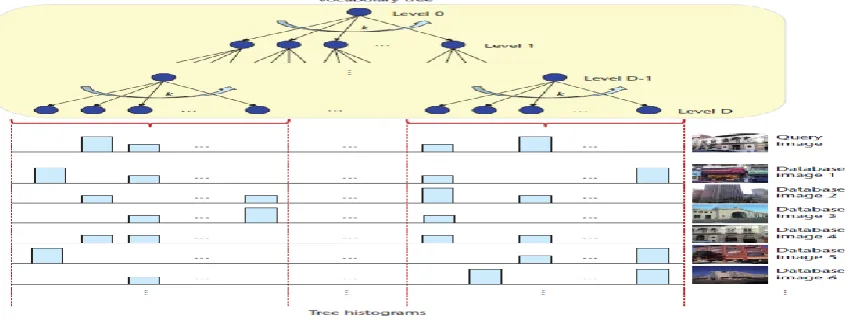
A vocabulary tree with depth D and a branch factor k has kD leaf nodes at the bottom level D, as depicted in Figure 3. After quantizing all feature descriptors for an image to the nearest leaf nodes using a greedy search, [8] the resulting tree histogram acts as a global image signature. For the tree parameters k =10 and D = 6, there are 1 million leaf nodes.
Figure 3: Vocabulary tree and the associated tree histograms for a set of images.
Storing a vocabulary tree with 1 million leaf nodes requires approximately 64 to 128 Mbytes of RAM on a mobile device, depending on the dimensionality of some popular feature descriptors.. Storing the tree histograms efficiently in memory is possible with tree histogram coding (THC) [1] or inverted index coding (IIC). [2] THC takes a direct approach to compressing the tree histograms, and IIC first transforms the tree histograms into an inverted index structure and then compresses the index. Both methods require some selective decompression during a query
A. TREE HISTOGRAM CODING
212 Figure 4: Encoding the tree histogram for an image with tree histogram coding (THC)
On the one hand, an arithmetic coder (AC) can be used to encode the runs and quantized counts to levels that are close to the respective information theoretic entropy limits. Then entropy coders that compress data into Byte-aligned code words [8] offer much faster decoding than AC, at the cost of slightly lower coding efficiency. For low-latency MVS, it is usually preferable to use a byte-aligned entropy coder to achieve low decoding delays while still maintaining a high compression ratio.
B. INVERTED INDEX CODING
An inverted index enables fast computation of the similarity scores between the query and database tree histograms. Figure 5 shows the inverted lists for two leaf nodes in a vocabulary tree. For each leaf node, the associated inverted list contains the identifiers (IDs) of all images with at least one feature descriptor visiting the leaf node and the counts of how often the images have visited. Because only a small fraction of the database images visit each leaf node, the length of an inverted list is much smaller than the size of the database, which is a key property that enables fast score computation. A memory-efficient representation of the index is achievable using IIC.[2] Assume the image IDs are sorted in increasing order—for example, i1;1 < i1;2 < … < i1;N1 for IDs in the first list.
Figure 5: Encoding the inverted index associated with a vocabulary tree with inverted index coding (IIC).
V. BAG-OF-VISUAL-WORDS RESIDUALS
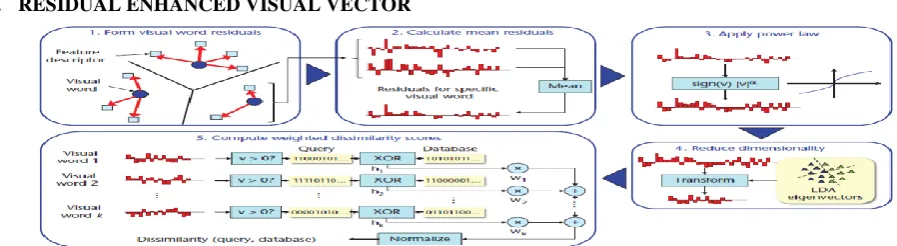
In contrast to the bag-of-visual-words histograms discussed previously, a new trend in image retrieval is generating compact and discriminative bag-of-visual-words residuals. [3, 8] The residual representation also uses a codebook of visual words, but it is typically of a much smaller size (128 to 256 visual words).
A. RESIDUAL ENHANCED VISUAL VECTOR
Figure 6. Pipeline for generating and comparing residual enhanced visual vector (REVV) signatures.
213
B. COMPRESSED SCALABLE FISHER VECTOR
Figure 7: Pipeline for generating and comparing scalable compressed fisher vector (SCFV) signatures.
Recently introduced, the SCFV is also a global signature based on visual word residuals. SCFV signatures are generated by the pipeline depicted in Figure 7, which has similarities to the pipeline for generating REVV signatures. First, the local feature descriptors are transformed by a power law that reduces the detrimental influence of peaky components. Second, each descriptor vector is reduced in dimensionality using principal component analysis (PCA). Next, the PCA-projected descriptors are quantized using a Gaussian mixture model (GMM). Then, the residual vectors are binarized depending on the sign of each component. Finally, weighted correlations between the query signature and database signatures are computed to generate a ranked list of database candidates.
VI. CONCLUSION
I have conclude that, Low-latency MVS systems can be constructed with local features and memory-efficient image databases. On-device image retrieval enables object recognition with low processing delay and without any potentially adverse effects from poor network conditions or server congestion. The compact and discriminative bag-of-visual-words residuals can be created with a small codebook, enabling an effective, easy-to-deploy image retrieval pipeline.
ACKNOWLEDGEMENT
We feel great pleasure in submitting this Seminar on “MEMORY EFFICIENT IMAGE DATABASES FOR MOBILE VISUAL SEARCH”. We wish to express true sense of gratitude towards our Seminar guide, Prof. L. D. Panjwani who at very discrete step in study of this Seminar contributed her valuable guidance and help to solve every problem that arose.
We would wish to thank our H.O.D., Prof. D. D. Patil for opening the doors of the information towards the realization of this Seminar.
Most likely we would like to express my sincere gratitude towards our family for always being there when we needed them the most. With all respect and gratitude, we would like to thank all the people, who have helped me directly or indirectly. We owe our all success to them.
REFERENCES
[1] D. Chen, Bernd Girod, “Tree Histogram Coding for Mobile Image Matching,” Proc. IEEE Data Compression Conf., IEEE CS, 2009, pp. 143–152.
[2] D. Chen, Bernd Girod, “Inverted Index Compression for Scalable Image Matching,” Proc. IEEE Data Compression Conf., IEEE CS, 2010, p. 525.
[3] D. Chen, Bernd Girod, “Residual Enhanced Visual Vector as a Compact Signature for Mobile Visual Search,” Signal Processing, vol. 93, no. 8, 2012, pp. 2316–2327.
[4] H. Bay, “Speeded-Up Robust Features (SURF),” Computer Vision and Image Understanding, vol. 110, no. 3, 2008, pp. 346–359.
[5] D. Nister and H. Stewenius, “Scalable Recognition with a Vocabulary Tree,” Proc. IEEE Conf. Computer Vision and Pattern Recognition (CVPR), IEEE CS, 2006, pp. 2161–2168.
[6] V.N. Anh and A. Moffat, “Inverted Index Compression Using Word-Aligned Binary Codes,” Information Retrieval, vol. 8, no. 1, 2005, pp. 151–166.
[7] F. Perronnin, “Large-Scale Image Retrieval with Compressed Fisher Vectors,” Proc. IEEE Conf. Computer Vision and Pattern Recognition (CVPR), IEEE CS, 2010, pp. 3384–3391.
[8] David M. Chen, Bernd Girod, “Memory efficient Image Databases for Mobile Visual Search”, Proc. IEEE Conf. Computer Version and Pattern Recognition (CVPR), IEEE CS, 2014, pp. 14-23.