Iranian Chemical Society
Anal. Bioanal. Chem. Res., Vol. 1, No. 1, 20-28, June 2014.
Preconcentration and Speciation of Chromium Using Dispersive Liquid-Liquid
Microextraction; Application to Milk and Different Water Samples
M. Adibmehr
a,
H. Bagheri Sadeghi
a,* and Sh. Dehghan Abkenar
ba
Department of Chemistry, Islamic Azad University, Tehran Central Branch, Tehran , Iran
bDepartment of Chemistry, Islamic Azad University, Savadkooh Branch, Mazandran, Iran
(Received 29 May 2013, Accepted 12 January 2014)
A simple and rapid microextraction procedure based on dispersive liquid-liquid microextraction (DLLME) was developed for determination and speciation of trace amounts of chromium (Cr) by flame atomic absorption spectrometry (FAAS). In the proposed approach, chloroform and methanol were used as extraction and dispersive solvents. A new Schiff's base ligand, bis(2-methoxy benzaldehyde) ethylene diimine was used as complexing agent. Effect of extraction solvent, disperser solvent, the volume of extraction and disperser solvent, pH of the aqueous solution and extraction time on extraction procedure were investigated and optimized. Under the optimum conditions, the calibration graph was linear in the range of 1-50 µg l-1 with a limit of detection of 0.7 µg l-1. The relative standard deviation (RSD%) was 2.7% (n = 7) for Cr(III). The relative recoveries of spiked samples were between 98% and 102% and preconcentration factor (PF) was 20. The proposed method is a simple, fast, accurate, highly stable and selective and was applied for determination of chromium in milk and water samples with satisfactory results.
Keywords: Chromium, Dispersive liquid-liquid microextraction, Flame atomic absorption spectrometry, Speciation
INTRODUCTION
The environmental pollution by heavy metals has become a public and scientific concern, because they risk human health and biological systems. The toxicological and biological characteristics of chromium are related to its chemical forms. Cr(III) is the essential nutrition and has important role in transferring sugar, protein and fat [1,2], while Cr(VI) is toxic to human and living organisms and very carcinogenic [3-5]. Chromium enters to the environment by industrial activities such as leather tanning [soluble Cr(III)], manufacturing catalysts, pigments [insoluble Cr(VI)], fungicides, the ceramics and glass industry, photography, electroplating [soluble Cr(VI)], corrosion control, anti-algae agents, antifreeze, cement, copier servicing, production of high-fidelity magnetic audio
*Corresponding author. E-mail: [email protected]
tapes, tattooing, textile manufacturing, welding of alloys or steel, and wood preservatives (i.e. Acid Copper Chromate) [6] or environmental sources such as airborne emissions from chemical plants and incineration facilities, cement dust, contaminated landfill, effluents from chemical plants, asbestos lining erosion, road dust from catalytic converter erosion and asbestos brakes, tobacco smoke, topsoil rocks and corrosion of the pipes with inhibitators [7]. Therefore, determination and speciation of chromium in environmental samples are of great importance.
In CPE ,the extracted analyte cannot be injected directly because of the surfactant (rich phase) high viscosity and in Homogeneous liquid–liquid extraction (HLLE), acid and salt are utilized which cause exothermic reactions, so they are replaced with Liquid-phase microextraction(LPME) method which minimizes the volume of organic solvent, time and expense. LPME is classified to Single-drop microextraction (SDME), Dispersive liquid-liquid microextraction (DLLME), Hollow-fiber liquid-phase microextraction (HF-LPME), Solid drop microextraction (SDLPME), and Directly-suspended droplet microextraction (DSDME) [17]. SDME is limited by rate of stirring which cause dislodgment of drop and HF-LPME has some disadvantages such as, pre-conditioning of membrane and the memory effects when membranes are reused [18], while DLLME is simple, easy to operate, low cost, high recovery and utilizes low consumption of toxic organic solvents.
Different analytical methods are used for recognizing chromium such as, flame atomic absorption spectrometry (FAAS) [19], inductively coupled plasma-atomic emission spectrometry (ICP-AES) [20], inductively coupled plasma-optical atomic emission spectrometry (ICP-OES) [21] inductively coupled plasma-mass spectrometry (ICP-MS) [22], electro thermal-atomic absorption spectrometry (ET-AAS) [23], electrochemistry [24,25], fluorometry [26], chemiluminescence [27]. These methods can easily detect the total amount of chromium but they cannot distinguish between Cr(III) and Cr(VI). FAAS is one of the most extensively used techniques due to its low cost and great simplicity. A preconcentration and separation method is necessary in order to improve the sensitivity and selectivity of FAAS.
DLLME was first introduced in 2006 by Assadi and coworkers [28]. This method is based on ternary system, where the mixture of disperser solvent such as methanol (CH3OH), tetrahydrofuran (THF), acetone (CH3COCH3), acetonitrile (CH3CN) and extraction solvent such as chloroform (CHCl3), carbon disulfide (CS2), carbon tetrachloride (CCl4), tetra chloroethylene (C2Cl4), chlorobenzene (C6H5Cl) at a few micro liter is injected into the aqueous sample in order to form a cloudy solution. The interest target is extracted to the extraction solvent and deposit after centrifugation [29]. DLLME can be combined with different techniques such as solidification of floating
organic droplet (DLLME-SFO), Solid-phase extraction SPE) and Supercritical fluid extraction (DLLME-SFE) [30]. Up to now, there are only three articles that utilize DLLME procedure to determine chromium [23,31,32].
The Schiff's bases make selective and stable hydrophobic complexes with transition metal ions because of their special structure. They have unique properties and reactivity. Also they are used as spectrophotometric reagents or as ionophore in electrochemical sensors [33]. Bis(2-methoxybenzaldehyde) ethylene diimine is a new Schiff's base ligand which makes a selective complex with Cr(III). Whereas Cr(VI) is unable to form a complex with Schiff's base ligand, because it does not have any unpaired electron or empty orbital. Consequently ligand charge transfer does not occur.
Regarding to above mentioned topics, our strategy is based on three steps: 1) solvent extraction, 2) preconcentration, 3) speciation. As will be described later, speciation of two oxidation states of Chromium was performed in order to distinguish them. In this procedure DLLME and FAAS were combined to determine the trace amount of chromium in environmental water, wastewater, and milk samples with satisfactory results.
EXPERIMENTAL
Apparatus
A Shimadzu atomic absorption spectrometer (Model AA-680G) was used for determination of chromium. The instrumental parameters were adjusted according to the manufacturer’s recommendations. A Metrohm pH meter (model; 713, Switzerland) was used for pH measurements. Test tubes with conical bottom were used as extraction and centrifuging vessel in order to trap and remove the sediment phase. A 100 µl micro syringe (Hamilton model CH-7402 Switzerland) was used to collect the sediment organic phase. A centrifuge (centurion scientific Ltd., model: 1020D) was used to accelerate the sedimentation of the rich phase in the process of microextraction.
Reagents and Solutions
in double distilled water. A stock standard solutions of Cr(III) and Cr(VI) (1000 µg ml-1) were prepared by dissolving the appropriate amount of Cr(NO3)3·9H2O and K2Cr2O7 ,respectively, and the working standard solutions were prepared daily by a stepwise dilution of the stock solution with distilled water. Carbonate buffer (pH 10) was used for pH adjustment. A 0.05 M solution of sodium hydrogen carbonate (NaHCO3) was prepared by dissolving the appropriate amount in double distilled water then NaOH wasadded until desired pH obtained. A solution of 0.001 M Na2SO3 was prepared by dissolving appropriate amount of sodium sulfite in double distilled water. A solution of 1.0 × 10⁻² M bis(2-methoxybenzaldehyde) ethylene diimine was prepared by dissolving 0.0296 g of ligand in 10 ml chloroform. Laboratory glassware were kept overnight in 10% nitric acid solution and rinsed 3times with double deionized water prior to use.
Synthesis of Schiff’s Base [(CH3)2Salen]
For synthesis of Schiff's base, 0.3 g Ethylene diamine was dissolved in 40 ml ethanol. The resulted solution was transferred into a 250 ml three necked flask under reflux, then 1.36 g of 2-methoxybenzaldehyde in 30 ml ethanol was added in dropwise manner to above solution, which was kept reacting for 60 min. After it was cooled to the room temperature, it was filtered and recrystallized with ethanol. Finally it was vacuum dried for 12 h. Elemental analysis of bis(2-methoxybenzaldehyde) ethylene diimine gave the following percentages: Analytical Calculated for C18H20N2O2: C, 72.95%; H, 6.80%; N, 9.54%; O, 10.71%. Found: C, 72.86%; H, 6.73%; N, 9.52%; O, 10.89%. This hydrophobic ligand is very stable and has high solubility in
methanol. Oxygens and nitrogens act as σ-donor and π
-acceptor in reaction with chromium. In acidic medium nitrogens are protonated [19].
Sample Preparation
Preparation of water samples. The River water samples were collected from Chamran River (Shiraz, Iran). The water sample must not be acidified before storage because this would change the chemical species. Therefore all the samples were analyzed as soon as possible. All samples were collected in clean polyethylene bottles.
Preparation of milk sample. Non-fatted long life liquid
cow’s milk (Shirin Asal) was purchased from the local market. For determination of chromium, a 0.5 ml sample and 5.0 ml of HNO3 was heated in the glass beaker to dryness. After the sample was cooled, 3.0 ml of H2O2 (30%) was added and heated to obtain nearly 0.5 ml sample solution. After cooling down the sample to room temperature, it was diluted to 50 ml with deionized water [34,35].
Preparation of waste water sample. Wastewater sample was collected from electroplating workshop (Shiraz, Iran).The wastewater sample was filtered through 0.45 μm
membrane filter. 10 ml of the filtered sample was poured into a 25 ml flask and 1 ml concentrated nitric acid (65%) and 4 ml perchloric acid (70%) was added. The solution was left until digestion was complete (a cloudy solution appeared). In order to redissolve the residue, 10 ml of 0.5 M HCl was added. The resultant solution was filtered and diluted with deionized water in 50 ml volumetric flask [24].
General Procedure for DLLME
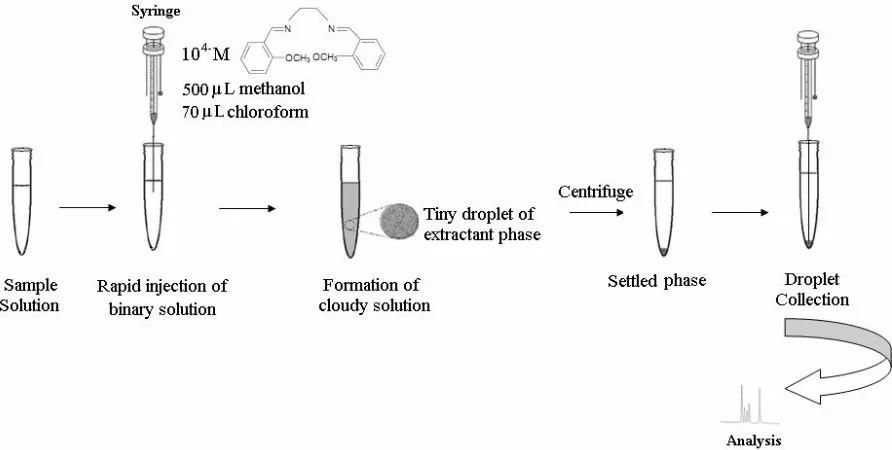
A 10 ml sample solution containing Cr(III) was adjusted to pH = 10 with 1mL carbonate buffer in a glass tube with a conical bottom. Then, a mixture containing 500 µl methanol (disperser solvent), 70 µl chloroform (extraction solvent) containing 1.0 × 10⁻⁴ M of bis (2-methoxybenzaldehyde) ethylene diimine (complexing agent) was rapidly injected into the sample solution by using 1.0 ml syringe. As a result, a cloudy solution was obtained. In this stage, the Cr-Schiff's base ligand complex was extracted into fine droplets
of chloroform and the solution was then centrifuged for 3 min at 3000 rpm. The extraction phase (~30 µl) was removed by using a micro-syringe and 0.5 ml of HNO3 0.1 M in ethanol was added to it. The final solution was aspirated into the flame of AAS. Total chromium was
determined after the reduction of Cr(VI) to Cr(III) by 10-3 M sodium sulfite for about 30 min, Cr(VI) concentrations were obtained as the respective difference between total chromium and Cr(III). Figure 1 shows a scheme of the DLLME procedure.
RESULT AND DISCUSSION
Effect of pH
dependent on different processes such as hydrolysis, complexation, redox and adsorption reactions. Stability of a complex and extraction of Cr(III) is highly dependent on pH. The effect of pH on the DLLME extraction was studied over the pH range of 3-13. At low pH protons can compete with the metal for the coordination sites of the ligand, and in basic media of sample solution displacement reaction and more stable complex formation like [Cr(OH)4-] and Cr(OH)
3 can occur. At pH 10, the highest absorbance was obtained (Fig. 2), because selective hydrophobic complex was formed between complexing agent and Cr(III). Therefore pH 10 was selected for further studies.
Effect of Complexing Agent Concentration
The effect of different concentrations of bis(2-methoxybenzaldehyde) ethylene diimine on the recovery of Cr(III) was examined. Based on the results shown in Fig. 3, The optimum concentration of the chelating agent was found to be 1 × 10⁻⁴ M. Lower concentrations of the ligand was not enough to react with chromium and the excess of the ligand dissolves the hydrophobic metal-chelate and saturates the organic solvent.
Effect of Extraction Time
Extraction time is defined as the interval time between
Fig. 2. Effect of pH on extraction efficiency. Sample volume, 10 ml; Cr(III), 50 µg l-1;
complexing agent, 10-4 M; extracting solvent, 70 µl (chloroform); disperser solvent, 0.5 ml
(methanol); dilution solvent (ethanol).
the injection of binary solution and beginning of centrifuge. This effect was examined in the range of 1-5 min. The obtained results showed that extraction procedure was time independent. It is verified that an infinite large surface is
Fig. 3. Optimization of concentration of Schiff,s base ligand. Sample volume, 10 ml; Cr(III), 50 µg l-1; pH, 10; extracting solvent, 70 µl (chloroform); disperser solvent, 0.5 ml (methanol); dilution solvent (ethanol).
developed between extraction solvent and aqueous phase after the formation of cloudy solution. An extraction time of 1min was adopted throughout the experiments.
Effect of Type and Volume of the Extraction Solvent
The suitable extraction solvent should meet some requirements such as higher density than water, low solubility in water, nonvolatile, high extraction capability of the interested compounds. Different extraction solvents have different solubility. Therefore, 70 µl CHCl3, 50 µl CS2, 40 µl CCl4, 35 µl C2Cl4, 40 µl C6H5Cl were studied as extraction solvent to get fixed amount of sediment phase. Chloroform is able to form a well stable cloudy solutions and it was rapidly produced. It was chosen for the present experiment due to the higher solubility of complexing agent. Results showed that chloroform has the maximum extraction efficiency, selectivity and hydrophobicity.
The preconcentration factor is strongly dependent on the volume of the sediment chloroform phase. Various volumes of chloroform, 70, 80, 90, 100 and 110 µl were used as extraction solvent. It was observed that the extraction
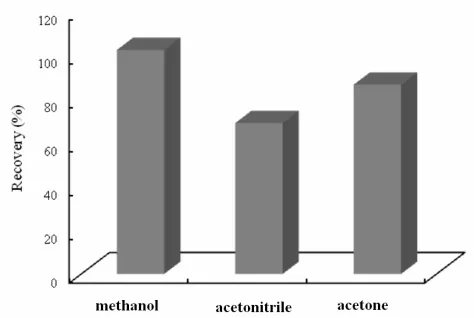
Fig. 4. Effect of the type of disperser solvent on extraction efficiency Sample volume, 10 ml; Cr(III), 50 µg l-1; pH, 10; extracting solvent, 70 µl (chloroform); dilution solvent, (ethanol).
efficiency was decreased by increasing the volume of chloroform. This is because the small volume of disperser solvent faces the large volume of extraction solvent and therefore the formations of tiny droplets are reduced. Based on these observations, 70 µl chloroform was used for further experiments.
Effect of Type and Volume of Disperser Solvent The disperser solvent has influence on the formation of the cloudy solution and the infinite interface produced increases the mass transfer procedure. Disperser solvent must be miscible in sample solution and extraction solvent. 500 µl of CH3OH, CH3COCH3 and CH3CN were tested as disperser solvents. Methanol showed the highest signal, more stable cloudy solution and more compatibility with aqueous solution (Fig. 4).
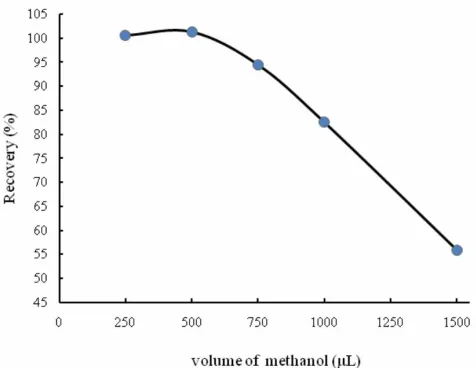
Fig. 5. Effect of the volume of disperser solvent on the extraction efficiency Sample volume, 10 ml;
Cr(III), 50 µ g l-1; pH, 10; extracting solvent (chloroform), dilution solvent (ethanol), sediment phase volume, 30 µl.
Table 1. Effect of Interfering Ions on the Recovery of 50 µg l-1 Cr(III) in Water Samples Using DLLME-FAAS
Interference Tolerance limita
Na+, K+, Ca2+, Mg2+ 1000
Al3+, Fe3+ 100
Cd2+, Zn2+, Pb2+, Co2+, Ni2+, Cu2+ 100
a
Tolerance limit is defined as the ratio of interfering ion concentration to the analyte ion concentration.
the solubility of the analyte in aqueous solution was increased (Fig. 5). Methanol and chloroform was the suitable couple for this study.
Interferences
The effect of other ions on the extraction of Cr(III) in
the presence of various amounts of interfering ions was examined. In order to demonstrate the selectivity of the proposed method, the interfering ions such as: Na+, K+ ,Mg2+, Ca2+, Al3+, Fe3, Pb2+, Zn2+, Cd2+, Co2+, Ni2+, Cu2+ were examined. Of course, the high concentration of chromium can decrease this competition effect. To observe these effects, various salts with different concentrations
were added to each sample solution containing 50.0 μg l‒1 of
Cr(III). An ion was considered as interfere when its presence caused more than 5% variation in the absorbance of the sample. The results demonstrate that the chromium was quantitatively extracted and coexisting ions did not interfere in the chromium extraction process (Table 1).
Selection of the Diluting Agent
Volume of sediment phase depends on the volume of organic solvent, sample solution and the solubility of extraction solvent. An appropriate diluting agent should have some characteristic such as: good burning characteristics, not having a low-boiling point, compatibility with direct injection into FAAS. Methanol and ethanol were examined as diluting agents. Ethanol showed better absorbance and more compatibility with FAAS. Finally, the diluting agent was acidized with nitric acid in order to persuade dissociation of analyte ions complexes and further releasing of Cr into solution. Therefore, 0.5 ml of HNO3 0.1 M in ethanol was chosen to dilute the settled phase [36,37].
Selection of Reducing Agent
In order to examine the effect of reducing agents, Na2SO3 (1 × 10⁻³ M) [21] and ascorbic acid (10% W/V) [38,39] were chosen as reducing reagents to reduce Cr(VI) to Cr(III). An efficiency of 100% was obtained by Na2SO3, while a reduction of 67% was observed when ascorbic acid solution was used. Therefore Na2SO3 was selected for the following experiments.
Figures of merits
detection was 0.7 µg l-1. The limit of quantification was found to be at the 2.3 μg l-1 level. The relative standard deviation (R.S.D.) for seven replicate measurements was 2.7. Preconcentration factor which was calculated as the ratio between the volume of the aqueous phase and the final
volume was about 20.
Analytical Applications
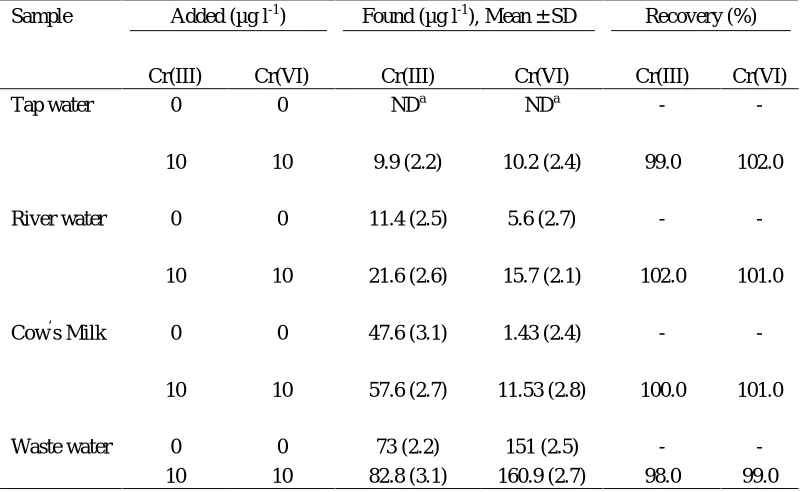
The accuracy of the proposed method was investigated with known amounts of Chromiumions. The recoveries of Cr(III) from samples spiked with 10 µg l-1 Cr(III) were also studied. The analytical results are presented in Table 2. As could be seen, the recoveries of Cr(III) for the three spiked samples were in the range of 98-102%. Three replicate measurement was carried out on each sample (n = 3). These results indicate the applicability and efficiency of the developed procedure for determination of Cr(III).
Comparison of DLLME Method with other Methods
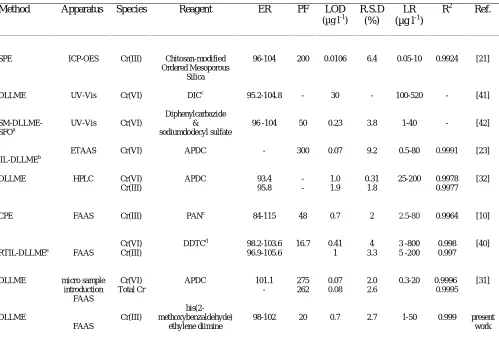
Table 3 compares the characteristic data of the proposed
method with other preconcentration methods for Cr(III) reported in literature. The detection limit and preconcentration factor of the proposed method is comparable to those reported methods with only 10 ml of the sample solution.
CONCLUSIONS
This work has been demonstrated combination of DLLME with FAAS provides a novel route for determination and speciation of chromium in real samples. In this method, the sample preparation time as well as the consumption of the toxic organic solvents is minimized without affecting the sensitivity of the method. The main advantages of this method were: low toxicity, simplicity, low cost, high sensitivity, and rapid analysis time. The Schiff’s base ligand was successfully used as complexing agent for preconcentration of Cr(III) in presence of other coexisting ions. The presented method was applicable for determination of Chromium in environmental water, milk and wastewater with satisfactory results.
Table 2. Determination of Cr(VI) and Cr(III) in Water, Milk and Waste Water Samples (Results of Recoveries of Spiked Samples are for Three Replicate Determinations)
Added (µg l-1) Found (µg l-1), Mean ± SD Recovery (%)
Sample
Cr(III) Cr(VI) Cr(III) Cr(VI) Cr(III) Cr(VI)
0 0 NDa NDa - -
Tap water
10 10 9.9 (2.2) 10.2 (2.4) 99.0 102.0
0 0 11.4 (2.5) 5.6 (2.7) - -
River water
10 10 21.6 (2.6) 15.7 (2.1) 102.0 101.0
0 0 47.6 (3.1) 1.43 (2.4) - -
Cow’s Milk
10 10 57.6 (2.7) 11.53 (2.8) 100.0 101.0
0 0 73 (2.2) 151 (2.5) - -
Waste water
10 10 82.8 (3.1) 160.9 (2.7) 98.0 99.0
a
ACKNOWLEDGEMENTS
The financial support from Islamic Azad University, Tehran Central Branch, Iran is gratefully acknowledged.
REFERENCES
[1] R.A. Anderson, Sci. Total Environ. 86 (1989) 75. [2] D. Mohan, C.U. Pittman Jr., J. Hazard. Mater. 137
(2006) 762.
[3] A. Heilig, Encyclopedia of Toxicology, Elsevier,
Amsterdam, 2005, p. 600.
[4] K.P. Lee, C.E. Ulrich, R.G. Geil, H.J. Trochimowicz, Sci. Total Environ. 86 (1989) 83.
[5] SH.C.S. Gad, Sci. Total Environ. 86 (1989)149. [6] V. Gómez, M.P. Callao, Anal. Chem. 25 (2006)
1006.
[7] www.atsdr.cdc.gov/csem/chromium/.
[8] P.G. Krishna, J.M. Gladis, U. Rambabu, T.P. Rao, G.R. Naidu, Talanta 63 (2004) 541.
[9] T. Minami, Y. Sohrin, L. Ueda, Anal. Sci. 21 (2005) 1519.
Table 3. Comparison of Characteristic Data of the Proposed Method such as: Recovery (ER), Preconcentration Factor (PF), Limitation of detection (LOD), RelativeStandard Deviation (RSD), Linear Range (LR), Regression (R2) with other Previous Techniques for Determination of Chromium
Method Apparatus Species Reagent ER PF LOD
(µg l-1)
R.S.D (%)
LR (µg l-1)
R2 Ref.
SPE DLLME SM-DLLME-SFOa IL-DLLMEb ICP-OES UV-Vis UV-Vis ETAAS Cr(III) Cr(VI) Cr(VI) Cr(VI) Chitosan-modified Ordered Mesoporous Silica DICc Diphenylcarbazide & sodiumdodecyl sulfate APDC 96-104 95.2-104.8 96 -104 - 200 - 50 300 0.0106 30 0.23 0.07 6.4 - 3.8 9.2 0.05-10 100-520 1-40 0.5-80 0.9924 - - 0.9991 [21] [41] [42] [23]
DLLME HPLC Cr(VI)
Cr(III)
APDC 93.4
95.8 - - 1.0 1.9 0.31 1.8
25-200 0.9978
0.9977 [32] CPE RTIL-DLLMEe DLLME DLLME FAAS FAAS micro sample introduction FAAS FAAS Cr(III) Cr(VI) Cr(III) Cr(VI) Total Cr Cr(III) PANc DDTCd APDC bis(2-methoxybenzaldehyde) ethylene diimine 84-115 98.2-103.6 96.9-105.6 101.1 - 98-102 48 16.7 275 262 20 0.7 0.41 1 0.07 0.08 0.7 2 4 3.3 2.0 2.6 2.7 2.5-80 3 -800 5 -200 0.3-20 1-50 0.9964 0.998 0.997 0.9996 0.9995 0.999 [10] [40] [31] present work a
[10] P. Liang, H. Sang, J. Hazard. Mater. 154 (2008) 1115.
[11] G.D. Matos, E.B. dos Reis, A.C.S. Costa, S.L.C. Ferreira, Microchem. J.92 (2009) 135.
[12] M.S. El-Shahawi, S.S.M. Hassan, A.M. Othman, M.A. Zyada, M.A. El-Sonbati, Anal. Chim. Acta 534 (2005) 319.
[13] Y.K. Agrawal, K.R. Sharma, Talanta 67 (2005) 112. [14] A. Beni, R. Karosi, J. Posta, Microchem. J. 85 (2007)
103.
[15] T.H. Ding, H.H. Lin, C.W. Whang, J. Chromatogr. A 1062 (2005) 49.
[16] Ş. Tokalıoglu, S. Arsav, A. Delibas, C. Soykan,
Anal. Chim. Acta 645 (2009) 36.
[17] C. Mahugo-Santana, Z. Sosa-Ferrera, M.E. Torres-Padron, J.J. Santana-Rodríguez, TrCA-Trends Anal. Chem. 30 (2011) 731.
[18] S. Dadfarnia, A.M. Haji Shabani, Anal. Chim. Acta 658 (2010) 107.
[19] F. Shemirani, S. Dehghan Abkenar, A.A.
Mirroshandel, M. Salavati-Niasari, R.R. Kozani, Anal. Sci. 19 (2003) 1453.
[20] P. Liang, Q. Ding, Y. Liu, J. Sep. Sci. 29 (2006) 242.
[21] C.H. Dahui, H. Man, H. Chaozhang, H. Bin, At. Spectrosc. 29 (2008) 165.
[22] Y.C. Sun, C.Y. Lin, S.F. Wu, Y.T. Chung, Spectrochim. Acta, part B. 61 (2006) 230.
[23] H. Chen, P. Du, J. Chen, S. Hu, Sh. Li, H. Liu, Talanta 81 (2010) 176.
[24] J.K. Kiptoo, J.C. Ngila, G.M. Sawula, Talanta 64 (2004) 54.
[25] P. Kuban, V. Kuban, Electrophoresis 24 (2003) 1397.
[26] M. Hosseini, H. Bagheri Sadeghi, M. Rahimi, M. Salavati-Niasari, S. Dehghan Abkenar, K. Alizadeh,
M.R. Ganjalie, Electroanalysis 21 (2009) 859.
[27] D. Yuan, D. Fu, R. Wang, J. Yuan, Spectrochim. Acta, Part A 71 (2008) 276.
[28] M. Rezaee, Y.Assadi, M.R. Milani Hosseini, E. Aghaee, F. Ahmadi, S. Berijani, J. Chromatogr. A. 1116 (2006) 1.
[29] X.H. Zang, Q.H. Wu, M.Y. Zhang, G.H. Xi, Z. Wang,Chinese. J. Anal. Chem. 37 (2009) 161. [30] M. Rezaee, Y. Yamini, M. Faraji, J. Chromatogr. A
1217 (2010) 2342.
[31] P. Hemmatkhah, A. Bidari, S. Jafarvand, M.R. Milani Hosseini, Y. Assadi, Microchim. Acta 166 (2009) 69.
[32] L.-Y. Ying, H.-L. Jiang, S.-C. Zhou, Y. Zhou. Microchem. J. 98 (2011) 200.
[33] M.S. Hosseini, F. Belador, J. Hazard. Mater. 165 (2009) 1062.
[34] A. Afkhami, T. Madrakian, M. Abbasi-Tarighat, Food Chem. 109 (2008) 660.
[35] H. Abdolmohammad-Zadeh, G.H. Sadeghi, Anal. Chim. Acta 649 (2009) 211.
[36] M.A. Farajzadeh, M. Bahram, B. Ghorbani Mehr, J. Å. Jönsson, Talanta 75 (2009) 832.
[37] S.R. Yousefi, F. Shemirani, Anal. Chim. Acta 669 (2010) 25.
[38] R.M. Cespón-Romero, M.C. Yebra-Biurrun, M.P. Bermejo-Barrera, Anal. Chim. Acta 327 (1996) 37.
[39] P. Liang, J. Li, At. Spectrosc. 26 (2005) 89. [40] S. Wen, J. Wu, X. Zhu, J. Mol. Liq. 180 (2013) 59.
[41] M. Alexovič, I.S. Balogh, J. Škrlíkováa, V. Andrucha, Anal. Methods 4 (2012) 1410.