MATLAB IMPLEMENTATION OF SPECTRUM SENSING METHODS IN COGNITIVE RADIO
Prof.Abhijeet A.Chincholkar *1, Ms.Chaitali H.Thakare 2 1M.E. Digital Electronics, JCOET Yavatmal, India.
2UG Student, B.E.EXTC Engg. Dept .JCOET, Yavatmal, India.
*Correspondence Author: [email protected]
Keywords
:
Cognitive Radio, Feature Detection, Energy Detection, Reconfiguration.
Abstract
This paper aims to research and focus on spectrum sensing in Cognitive Radio which is a recently introduced technology. It helps to increase the spectrum efficiency in cognitive radio. Increasing efficiency of the spectrum usage is a need of an intrinsic result of rapidly increasing wireless users and also the conversion of voice oriented applications to multimedia applications. Static allocation of the frequency spectrum does not needs to current wireless technology where as a dynamic spectrum usage is required for wireless networks. Cognitive radio is considered as a promising candidate to be employed in such systems as they are aware of their operating environments and having ability to adjust their parameters. Cognitive radio can sense the available spectrum and detect the idle frequency bands. The secondary users can be allocates those bands which are not used by primary users. In order to avoid this interference in between primary user by secondary user spectrum sensing is to be needed. There are several spectrum sensing techniques proposed in literature for cognitive radio based systems. This work approaches for energy detection and Cyclostationary feature detection based spectrum sensing systems for cognitive radios in wireless communication channels.
Introduction
Wireless communication systems have been widely and successfully deployed all over the world. Day by day, upper layer protocols demand high speed wireless access with very low delay requirements for applications in data, voice, video and other high bandwidth usage multimedia applications. However, radio spectrum band available to serve wide variety of all these emerging applications is strictly limited. Regulatory bodies licensed radio spectrum, implementing strict limitations on operators and
manufacturers protecting radio resource and licensed users. This command and control nature of regulations limits access of radio resource which is more important problem than physical scarcity of spectrum. Further it is discovered that, some frequency bands are largely underutilized most of the time or partially occupied, even in revenue rich urban areas. Cognitive radio was proposed a mechanism for efficient use such a free bands by exploiting its availability by cognitive users.
In order to complete these cognitive tasks in cognitive radio network, CU must perform additional tasks than normal wireless user. Detection of spectrum holes is called spectrum sensing. Spectrum sensing aims to determine spectrum availability and presence of licensed users. Such major task to perform by CUs, Recent literature proposes three techniques to detect presence of spectrum holes that are Energy Detection and Cyclostationary feature detection. Energy detection compares the signal energy received in a certain frequency band to properly set decision threshold. If signal energy lies above threshold, band is declared to be busy. Otherwise band is supposed to be idle and could be accessed by CR users. Another detection method used in literature is Cyclostationary feature
detection which depends on fact that modulated signals are generally coupled with sine wave carriers, pulse trains, repeating
periodicity in wide sense. This periodicity trend is used for analyzing various signal processing tasks such as detection, recognition and estimation of received signals.
Cognitive Radio
Cognitive Radio is a system model for wireless communication. It is built on software defined radio which an emerging technology is providing a platform for flexible radio systems, multiservice, multi-standard, multiband, reconfigurable and
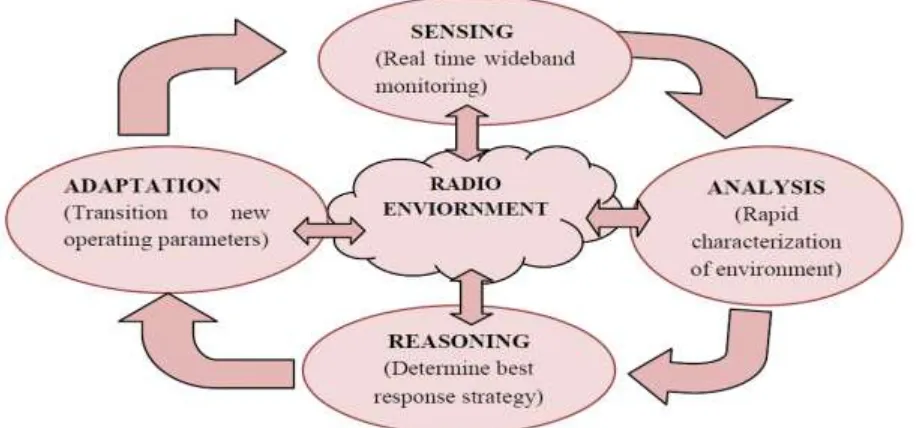
reprogrammable by software for Personal Communication Services. It uses methodology of sensing and learning from environment and adapting to statistical variations in real time. Network or wireless node changes its transmission or reception parameters to communicate efficiently anywhere and anytime avoiding interference with licensed or unlicensed users for efficient utilization of radio spectrum. Cognitive modules in transmitter and receiver must work in a harmonious manner which is achieved feedback channel connecting them. Receiver is enabled to convey information on performance of forward link to transmitter. Thus CR by necessity is an example of feedback communication system. Cognitive Radio System Classified according to operational area. Cognitive Radio classified in multiband system which is supporting more than one Frequency band used by a wireless standard (e.g., GSM 900, GSM 1800, GSM 1900), a multi-standard system that is supporting more than one Standard which works within one standard family (e.g. UTRA FDD, UTRA-TDD for UMTS) or across different networks (e.g., DECT, GSM, UMTS, WLAN), multi-service system which provides different services (e.g. telephony, data, video streaming) and multi-channel system that supports two or more independent transmission and reception channels at same time.
Figure 1:- General Cognitive Radio Cycle
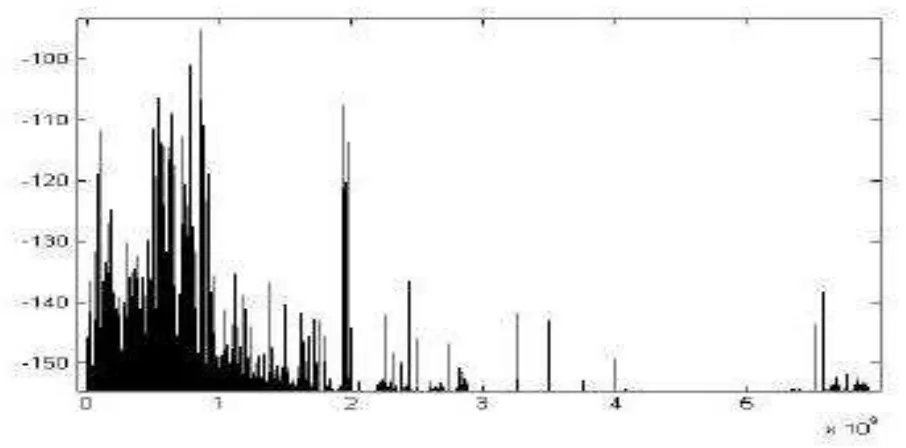
In future rapid growth of wireless communications, many exciting technologies exist that will require more spectrum. In recent days large portion of radio spectrum is not used for significant periods of time. Thus, lot of spectrum holes in frequency bands are not utilized these frequencies in all times by license owner. Figure shows very low utilization of spectrum from 3-6 GHz.
Most of unlicensed spectrums are heavily accessed by users and have high spectrum utilization according to possibility of open access. Observations lead to key idea where spectrum utilization can be drastically increased by allowing secondary users to access spectrum holes that are unutilized by primary user at certain time and space. Cognitive radio has been proposed to achieve such dynamics. Cognitive radio senses spectral environment over wide frequency band and exploits this information to opportunistically provide wireless links that can best meet demand of user, but also of its radio environments.
Figure 2:-Utilization of Spectrum from 3-6 GHz
Spectrum Sensing
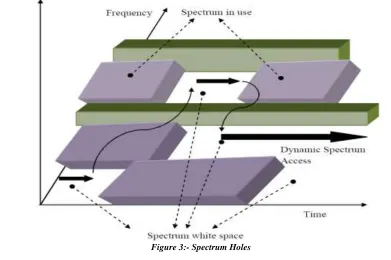
Spectrum sensing for cognitive radio is still ongoing development and technique for primary signal detection. Most distinguished features of cognitive radio networks is having ability to switch between radio accesses technologies, transmitting in different parts of radio spectrum as idle frequency band slots arise. Cognitive radio network are assumed to be secondary users will also need to coexist with primary users, which have right to use spectrum and thus must have not guarantee to interfere by secondary users. Fundamentally, spectrum sensing device gives general idea on medium over entire radio spectrum. This allows cognitive radio network to analyze all degrees of freedom (time, frequency and space) to predict spectrum usage. Spectrum sensing is based on a well-known technique called signal detection. Signal detection described as method for identifying presence of signal in noisy environment. Spectrum sensing is major task which is performed by cognitive radio as shown in figure it gives awareness about present spectrum usage by monitoring primary users in particular geographical location and frequency bands. This enables detection of present spectrum holes in available frequency range.
A) Spectrum Sensing Analysis
Through spectrum sensing analysis, CR can detect spectrum white space as illustrated in Figure 2 i.e., a portion of frequency band that is not being used by primary users, and utilizes spectrum. When primary users start using licensed spectrum again, CR can detect their activity through sensing, to prevent from harmful interference by secondary user.
B) Spectrum management and handoff
After recognizing spectrum white space by sensing, spectrum management and handoff function of CR enables secondary users to choose best frequency band and hop among multiple bands according to time varying channel characteristics to meet various Quality of Service (Qi’s) requirements. For instance, when primary user reclaims his/her frequency band, secondary user that is using licensed band can direct his/her transmission to other available frequencies, according to channel capacity determined by noise and interference levels, path loss, channel error rate, holding time, and etc.
C) Spectrum allocation and sharing
In dynamic spectrum access, secondary user may share spectrum resources with primary users, other secondary users, or both. Hence, good spectrum allocation and sharing mechanism is critical to achieve high spectrum efficiency. Since primary users own spectrum rights, when secondary users co-exist in a licensed band with primary users, interference level due to secondary spectrum usage should be limited by a certain threshold. When multiple secondary users share a frequency band, their access should be coordinated to alleviate collisions and interference.
Cyclostationary Sensing
Most challenging task in designing and implementation of cognitive radio is spectrum sensing. By using spectrum sensing, cognitive radios can adapt themselves to eternal wireless spectrum environment. An effective method used for signal detection is Cyclostationary sensing. A modulated radio signal is considered as Cyclostationary process and statistical properties of a
Cyclostationary process vary periodically over time. Autocorrelation function is cyclic processes with a periodicity T. If we consider a signal from primary user as:
X (t) = s (t) + n (t)…………Equation 1
Where n(t) represents additive white Gaussian noise, while s(t) is transmitted signal, then s(t) has some visible and distinct properties which can be exploited by sensing Cyclostationary properties, for example, by differentiating it from noise. These
properties are: carrier frequency, modulation type, symbol duration and so on. Auto- correlation and mean function of received signal x(t), is periodic signal with period T, where T is expressed as reciprocal of carrier frequency. Spectral correlation and auto
correlation functions can be used to extract weak signals from noise. They can be used to find out presence or absence of random signal in presence of other signals having different modulation schemes. Spectral correlation function is special characteristics exhibited by modulated signal. This can be used for various signal processing tasks like detection, classification and synchronization. Especially for signals under during and interference, whereas autocorrelation function is cross correlation of signal with itself.
Commonly, analysis of stationary random signal is done using autocorrelation function and power spectral density as mathematical tool. However, Cyclostationary signals reflect correlation between distinct spectral components because of periodicity, so analogy of autocorrelation function is implemented to define spectral correlation function. In Cyclostationary spectrums different data length can be taken. It will be easier to detect signal of primary users which use longer transmission length rather than using shorter transmission lengths. Main purpose of spectral correlation function is to separate noise energy from modulated signal.
A) Cyclostationary Feature Detection
Step 1: First take Fourier of received signal by using ‘fft’ function. R=fft(r)
Step 2: Multiple r with complex exponential. As multiplication with complex exponential in time domain is equivalent to frequency shift in frequency domain.
XT=r.*exp (j*2*pi *shfT);
Step 3: Correlate XT with R XY=xcorr (XT, R); Average over time T: Pt= fft (XY).*conj (fft (XY))
Step 4: On experimental basis when results at low and high SNR are compared then threshold is set to 1<λ<5.
Step 5: Finally output of integrator, pt is compared with a threshold value λ to decide whether primary user is present or not.
Step 6: Now if primary user is present then we can find features of primary signal like operating frequency and modulation technique. Flow chart and procedural steps gives us idea of overall process, which yields required results for Cyclostationary feature detection when implemented in MATLAB Simulink, MATLAB Simulink provides an environment for designer in which physical system can modeled to evaluate results. Following steps shows designing steps of building blocks of Cyclostationary feature detection.
Energy Detection
The simplest detection technique for spectrum sensing is Energy Detection. Energy detector measures the energy received from primary user during the observation interval. If energy is less then certain threshold value then it declares it as spectrum hole. Let r(t) is the received signal which is generated by primary user Simulink model, now this we have to pass from energy detector. The procedure of the Energy Detector is as follows.
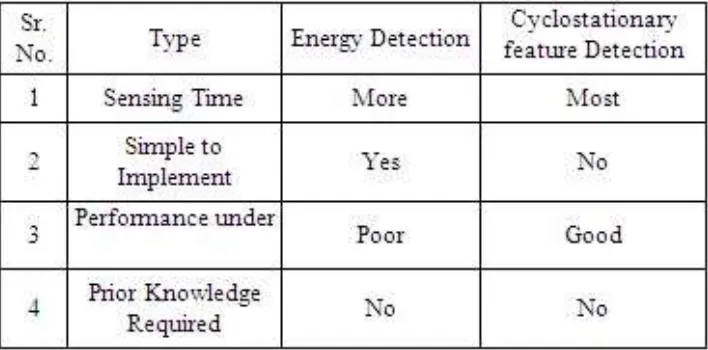
Comparison Of Transmitter Detection Techniques
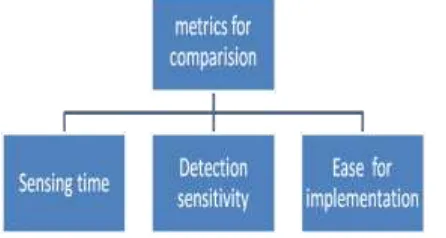
Now consider some metrics on the basis of which we can compare transmitter detection techniques. There are three metrics on the basis of which we can compare these techniques.
A) Sensing Time
During communication cognitive radio continuously sense radio environment for spectrum holes and CR can’t transmit and sense at same time. Therefore we need sensing time as small as possible.
Comparing Energy Detector and Cyclostationary feature detection, Cyclostationary feature detection requires longer sensing time to achieve good results.
Cyclostationary Feature Detection is also non-coherent technique which makes it superior to Matched Filtering and energy detection. Cyclostationary Feature Detection technique is computationally very complex and it takes long observation time for sensing.
B) Detection Sensitivity
Energy detector is better under noisy environment. Major drawback of energy detector is that it is unable to differentiate between source of received energy i.e. it cannot distinguish between noise and primary user. So this makes it susceptible technique when there are uncertainties in background noise power, especially at low SNR.
Cyclostationary is unable to detect primary user but energy detector still detect it. When there is no primary user present even then energy detector detects primary user at low SNR, which makes energy detector unreliable technique under low SNR values. Hence, when we have no prior knowledge about primary user’s waveform then best technique is Cyclostationary feature detection.
C) Ease for implementation
Advantage of energy detector is low cost and simple to implement, which makes it good candidate for spectrum sensing in cognitive radio networks. Cyclostationary Feature Detection is also very complex technique which takes high cost and high computational complexity.
Minimized Sensing Time For Detection
To minimize sensing time, if prior knowledge about primary user’s waveform is known at receiver end then under good SNR we can sense spectrum accurately by using matched filter. But if prior knowledge of primary user is not known then we should consult with energy detector for detection of primary user. In this case computation time is increased to achieve reliability. Further if energy detector doesn’t give accurate result then Cyclostationary feature detection comes into play. In this case it takes too much computation time to achieve reliability. This is worst case of this algorithm. Best case for this algorithm is that if matched filter provides indication about presence or absence of primary user.
Conclusion And Future Work
This work helps to detect primary users in cognitive radio networks. It also fulfill requirement of a spectrum sensing system and its real time processing and ability for decision making. The proposed methodology has been implemented in MATLAB. Its implementation can be done on FPGA kit or DSP processor.
First all the transmitter detection techniques are compared on the basis of three metrics: Sensing Time, Detection Sensitivity and ease of implementation. By comparing these techniques it is concluded that Cyclostationary feature detection gives best results but take long computation time as compared to spectrum sensing technique.
Most of the researchers work on spectrum sensing which is mainly focused on reliable sensing to meet the regulatory requirements. One of the important areas for the research is to focus on user level cooperation among cognitive radios and system level cooperation among different cognitive radio networks to overcome the noise level uncertainties. Another area for research is cross layer
communication in which spectrum sensing and higher layer functionalities can help in improving quality of service (QoS).
References
1. Marcos E. Castro,“Cyclostationary detection for OFDM in cognitive radio systems”University of Nebraska-Lincoln,
2. Mahmood A. Abdulsattar and Zahir A. Hussein –“Energy detection technique for spectrum sensing in cognitive radio: a survey” International Journal of Computer Networks & Communications September
2012,[email protected]
3. Allen Ginsberg, Jeffrey D. Poston, and William D. Horne-“ Experiments in Cognitive Radio and Dynamic Spectrum Access
using An Ontology-Rule Hybrid Architecture”The MITRE Corporation McLean, whorne}@MITRE.org.
4. Dr. Mary Ann Ingram –“Smart Antenna Research Laboratory” Guillermo Acosta August, 2000.
5. Peltola J. (2007) –“Distributed Spectrum Sensing for a Cognitive Ultra Wideband System. University of Oulu, Department of
Electrical and Information Engineering.
6. Vesa Turunen1, Marko Kosunen1, Sami Kallioinen2, Aarno Pärssinen2, “ Spectrum Sensor Hardware Implementation Based
on Cyclostationary Feature Detector”.
7. David A. Clendenen “A software defined radio testbed for research in dynamic spectrum access” Purdue University Fort Wayne, Indiana.
8. Xiaolong Li –“Simulink-based Simulation of Quadrature Amplitude Modulation(QAM) system” Indiana State University
9. Tevfik Yucek and Huseyin Arslan-“A Survey of Spectrum Sensing Algorithms for Cognitive Radio Applications”.
11. Samson sequeira-“energy based spectrum sensing for Enabling dynamic spectrum access in Cognitive radios”.
12. H. Urkowitz Energy detection of unknown deterministic signals Proceedings of The IEEE, vol.55, no.4, pp. 523- 531, April 1967.
13. J. Mitola III Cognitive radio integrated agent architecture for software defined Radio Ph.D. thesis, KTH Royal Institute of technology, Stockholm, Sweden, 2000.
14. By Artem Tkachenk –“Testbed Design for Cognitive Radio Spectrum Sensing Experiments .
15. Reuters Business Wires; “Sharing Digital Dividend Spectrum Could Boost French Economy by an Extra EUR25bn” Tue
May 27, 2008.
16. Zamat, H; Nassar, C.; “Introducing Software Defined Radio to 4GWireless: Necessity, Advantage, and Impediment
,”Journal of Communication and Networks.2002 .
17. Mahmood A. Abdulsattar and Zahir A. Hussein-“energy detection technique for Spectrum sensing in cognitive radio: a survey” International Journal of Computer Networks & Communications (IJCNC) Vol.4, No.5, September 2012.
18. S. Ziafat, W. Ejaz, and H. Jamal, “Spectrum sensing techniques for cognitive radio networks: Performance analysis,” 2011
IEEE MTT-S International Microwave Workshop Series on Intelligent Radio for Future Personal Terminals, pp. 1-4, 2011. 19. "Sensing techniques for cognitive radio,” White paper, SCC 41-P1900.6, 15th April 2009.
20. ECE4305: Software-Defined Radio Systems and Analysis Getting Started with MATLAB, Simulink, USRP2 Hardware and