IJBCP
International Journal of Basic & Clinical Pharmacology
Original Research Article
Bioequivalence study of two oral amoxicillin formulations (Biocillin®
and Atcomox 87%®) in broiler chickens
Mohamed Aboubakr*, Mohamed Elbadawy
INTRODUCTION
Amoxicillin is stable in the gastro-intestinal tract and has higher absorption than naturally occurring penicillins when administrated orally. Amoxicillin is widely used antibiotic in human and veterinary medicine for the treatment of respiratory, gastrointestinal, urinary and skin bacterial infections due to its pharmacological and
pharmacokinetic properties.1 Amoxicillin is used in many
domestic and food animals, including cats, dogs, pigeons, horses, broiler chickens, pigs, goats, sheep, pre-ruminating calves (including veal calves) and cattle. In dogs and cats, amoxicillin is used in respiratory and urinary infections and in soft tissue wounds caused by
Gram-positive and Gram-negative pathogenic bacteria.2
In poultry, amoxicillin is used for the treatment of susceptible infections of the alimentary, urogenital and
respiratory tracts.3 It is rapidly and completely absorbed
from the G.I. tract after oral administration in chicken.4
Pharmacokinetic studies are used to discover the fate of drug in the body. Knowledge of the route of removal, metabolic paths and the degree of efficiency are vital informations for the right dosage, which protects the
body against potential drug toxicity.5,6
The bioavailability and bioequivalence studies play an important role in determining therapeutic efficacy to register the generic drug products according to the Food
and Drug Administration (FDA) regulations.7
Bioavailability is defined as the rate and extent to which ABSTRACT
Background: The present study was designed to assess the comparative bioequivalence of Biocillin® and Atcomox87%® in healthy broiler chickens after oral administration of both products in a dose of 20 mg amoxicillin base/kg.b.wt.
Methods: Twenty-four broiler chickens were divided into two groups. The first group was designed to study the pharmacokinetics of Biocillin®, while the 2nd group was designed to study the pharmacokinetics of Atcomox87%®. Each broiler chicken in both groups was injected intravenously with 20 mg amoxicillin pure standard/kg.b.wt. After 15 days both groups taken orally Biocillin® and Atcomox87%®, respectively. Blood samples were obtained from the wing vein and collected immediately before and at 0.08, 0.16, 0.25, 0.5, 1, 2, 4, 8, 12 and 24 hours after a single intravenous or oral administration.
Results: Amoxicillin in both products obeyed a two compartments open model following I.V. injection. The disposition kinetics of Biocillin® and Atcomox87%® following oral administration of 20 mg amoxicillin
base/kg.b.wt. revealed that the maximum blood concentration [Cmax] were 10.79
and 10.30 μg/ml and attained at [tmax] of 0.90 and 0.86 hours, respectively. The
mean systemic bioavailability of amoxicillin in Biocillin® and Atcomox 87%® after oral administration in healthy chickens was 64.15 and 65.54%, respectively.
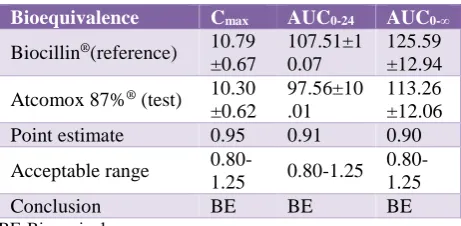
Conclusions: Atcomox 87%® is bioequivalent to Biocillin® since the ratios of Cmax, AUC0-24 and AUC0-∞ (T/R) were 0.95, 0.91 and 0.90 respectively. These are within the bioequivalence acceptance range. Biocillin® and Atcomox87%® are therefore bioequivalent and interchangeable.
Keywords: Amoxicillin, Bioequivalence, Chickens DOI: http://dx.doi.org/10.18203/2319-2003.ijbcp20171654
Department of Pharmacology, Faculty of Veterinary Medicine, Benha University, Egypt
Received: 28 February 2017
Accepted: 28 March 2017
*Correspondence to:
Dr. Mohamed Aboubakr, Email:
[email protected] u.eg
an active drug ingredient is absorbed and becomes
available at the site of drug action. In case of bioequivalence it is defined as statistically equivalent bioavailability between two products at the same molar dose of the therapeutic moiety under similar experimental
conditions.7,8 The drug products are said to be
bioequivalent if they are pharmaceutical equivalents or pharmaceutical alternatives and if their rate and extent of absorption do not show a significant difference
statistically according to the FDA regulations.7
The aim of this study is to evaluate bioequivalence of two
oral amoxicillin soluble powders (Biocillin® and
Atcomox 87%®) after oral administration of a single dose
in broiler chickens.
METHODS
Drugs
• Biocillin®: is manufactured by Bela Pharm GmbH and
Co.KG, Germany. It is dispended as oral soluble powder. Each 1gm contains 1000 mg amoxicillin trihydrate (equivalent to 87% of amoxicillin base) and it was used as reference product.
• Atcomox 87%®: is manufactured by ATCO Pharma
Co, Egypt, as oral soluble powder. Each 1gm contains 1000 mg amoxicillin trihydrate (equivalent to 87% of amoxicillin base) and it was used as test product. Pure standard of amoxicillin was obtained as pure powder (99%) from (Sigma Aldrich Chemical Co., St. Louis, USA).
Broiler chickens and experimental design
Twenty-four healthy broiler chickens (40-45 days old and weighing 2-2.40 kg) were obtained from Benha private poultry farm, Egypt. They were kept individually in cages, within a ventilated, heated room (20˚C), and 14 hours of day light. They received a standard commercial ration free from any antibiotics for 15 days before starting the experiment to insure complete clearance of any anti-bacterial substances from their bodies. Water
was offered ad-libitum.
Bioequivalence study
Broiler chickens were used to study the bio-equivalence
of Biocillin® and Atcomox 87%® after oral
administration. Broiler chickens were divided into two
groups. The 1st group (12 broiler chickens) was used to
study the pharmacokinetics of Biocillin®. The 2nd group
(12 broiler chickens) was used to study the
pharmacokinetics of Atcomox 87%®. Each broiler
chicken in both groups was injected intravenously with 20 mg amoxicillin pure standard/kg.b.wt. Broiler chickens were left for 15 days to ensure complete excretion of amoxicillin from their bodies. Broiler
chickens in the 1st group were administered orally
(intra-crop) with Biocillin® in a dose of 20 mg amoxicillin
base/kg.b.wt, while broiler chickens in the 2nd group were
administered orally with Atcomox 87%®.
Blood samples
Blood samples were obtained from the wing vein (1 ml) and collected in test tubes immediately before and at 0.08, 0.16, 0.25, 0.5, 1, 2, 4, 8, 12 and 24 hours after a single intravenous or oral administration (groups 1 and 2). Samples were centrifuged at 3000 rpm for 10 minutes and the obtained sera were used for the estimation of amoxicillin concentration. The serum samples were stored at-20˚C until analysis, and the assay was performed within a week of obtainment.
Analytical procedure
Rapid agar-diffusion assay for the quantitative
determination of amoxicillin in small volumes of blood
by using Micrococcus luteus (ATCC 9341).9
Fresh stock solutions of amoxicillin at 1,000μg/ml were made up in 0.1 M phosphate buffer (pH 6.0) for each set
of assays. About 1 ml of the suspension of Micrococcus
luteus (was added to 100 ml agar at 55-60oC. The mixture
was shaken thoroughly till complete mixing of the test organism with agar. Petri dishes (20 cm x 20 cm) were used; about 25 ml of inoculated medium were poured to each dish by using sterile cylinder. After complete solidification, six wells were made on the surface of inoculated agar using stainless steel cylinder. The wells of each plate were filled with the serum sample. The
plates were incubated at 37 oC for 16-18 hours. The
diameter of each inhibition zone was measured. The calibration curves of serum were prepared with different concentrations between 0.25 and 100 μg/mL using blank chicken’s serum. Thereafter, the diameters of inhibition zones were measured with the aid of a transparent rule to the nearest millimeter. Each sample was replicated three times and analyzed similarly. The plot of amoxicillin serum concentrations versus diameters of inhibition zone was linear with a correlation coefficient of 0.987. Serum concentrations of amoxicillin were determined by comparing the zone of inhibition diameters with the standard curve.
The absence of interfering endogenous compounds was demonstrated in antibacterial-free plasma obtained at time 0 (pretreatment) which showed no visible zone of inhibition around the impregnated disks. The limit of quantification (LOQ) defined visually as the smallest amount of drug that still produced a clearly distinguishable inhibition zone around the edges of amoxicillin contained pores on nutrient agar media was 0.25 μg/ml.
Pharmacokinetics and statistical analysis
various pharmacokinetic variables using a compartmental
and non-compartmental analysis using computerized program, WinNonline 4.1 (Pharsight, USA). The peak
concentrations, Cmax and time to peak, Tmax were obtained
from the serum concentration-time data directly. The areas under the serum concentration of amoxicillin time
curves from time 0 to the last sample collected (AUC0-24)
were calculated using linear trapezoidal method.10 While
AUC0-∞ was derived from AUC0-24 + AUC24-∞, where
AUC24-∞ = C24/ß. For bioequivalence evaluation, the
ratios of Cmax (T/R), AUC0-24 (T/R) and AUC0-∞ (T/R)
were calculated. Values within the bioequivalence acceptable range at 90% confidence interval, 0.80-1.25 were considered for accepting the null hypothesis of bioequivalence between the reference and the test
brands.11,12
RESULTS
[image:3.595.312.544.129.287.2]The mean pharmacokinetic parameters of amoxicillin in after intravenous administration of 20 mg amoxicillin base/kg.b.wt. in broiler chickens are shown in Table 1.
Table 1: Mean (X ± S.E) pharmacokinetic parameters of amoxicillin pure standard following intravenous administration of 20 mg amoxicillin/kg.b.wt. in broiler
chickens (n = 12).
Parameter Unit Group 1 Group (2)
Co μg ml-1 81.28±7.73 81.21 ± 7.82
α h-1 3.07 ± 0.15 3.09 ± 0.18
β h-1 0.08 ± 0.01 0.10 ± 0.01
t1/2(α) h 0.22 ± 0.02 0.22 ± 0.02
t1/2(β) h 8.05 ± 0.35 6.71 ± 0.33
AUC μg ml
-1h-1
195.75 ± 18.41
172.79 ± 17.92
AUMC μg ml
-1h-2
1755.83 ± 87.46
1343.39 ± 88.31
MRT h 8.96 ± 0.42 7.77 ± 0.45
CL L kg-1
h-1
0.10 ± 0.002
0.11 ± 0.003
Vdss ml kg-1 916.43 ±
75.23
899.81 ± 76.03
C° concentration at zero-time (immediately after single IV injection); α, β; hybrid rate constants representing the slopes of distribution and elimination phases after IV injection, respectively; T0.5(α) distribution half-life after IV injection; T0.5(β) elimination half-life after IV administration; AUC; area under serum concentration-time curve; AUMC area under moment curve; MRT mean residence time; Vdss volume of distribution at steady state; Cl total body clearance.
The systemic bioavailability (F %) was 64.15 and 65.54%
for Biocillin® and Atcomox 87%®, respectively.
Amoxicillin in both groups after intravenous
administration could be described in a two compartments open model. Intravenous administration in a dose of 20 mg/kg.b.wt. revealed an excellent volume of distribution (916.43 and 899.81 ml/kg for both groups, respectively,
calculated by steady state [Vdss] method. The mean blood
[image:3.595.50.285.392.572.2]concentrations-time profile (μg/ml) of amoxicillin in both groups after intravenous administration of 20 mg amoxicillin/ kg.b.wt. in broiler chickens are shown in Figure 1.
Figure 1: Semilogarthimic plot showing the serum concentrations-time profile of amoxicillin in Group 1
(○) and Group 2 (▲) following intravenous administration of 20 mg amoxicillin pure standard/kg.b.wt. in broiler chickens (n = 12).
The mean pharmacokinetic parameters of amoxicillin in
Biocillin® and Atcomox87%® after oral administration of
20 mg amoxicillin base/kg.b.wt. in broiler chickens are shown in (Table 2).
Table 2: Mean (X ± S.E) pharmacokinetic parameters of amoxicillin in biocillin® and atcomox 87%®
following oral administration of 20 mg amoxicillin/kg.b.wt. in broiler chickens (n = 12).
Parameter Unit
Biocillin® Group (1) (Reference)
Atcomox 87%® Group (2) (Test)
Kab h-1 4.10 ± 0.15 4.22 ± 0.16
Kel h-1 0.078 ± 0.005 0.079 ± 0.004
t1/2(ab) h 0.168 ± 0.01 0.164 ± 0.01
t1/2(el) h 8.82 ± 0.34 8.70 ± 0.31
Cmax μg ml-1 10.79 ± 0.67 10.30 ± 0.62
tmax h 0.90 ± 0.06 0.86 ± 0.04
AUC
μg
ml-1h
-1
125.59 ±
12.94 113.26 ± 12.06
AUMC
μg
ml-1h
-2
1506.69 ±
85.27 1325.97 ±84.08
MRT h 11.99 ± 0.83 11.70± 0.75
F % 64.15 ± 5.98 65.54 ± 5.73
kab; Kel absorbtion and elimination rate constant after oral
administration; T0.5(ab) absorbtion half-life after oral
administration; T0.5(el) elimination half-life after oral
administration; Cmax maximum plasma concentration; Tmax time
to peak plasma concentration; F (bioavailability); fraction of drug absorbed systemically after oral injection.
0.1 1 10 100
0 2 4 6 8 10 12 14 16 18 20 22 24
Co
n
ce
n
tratio
n
s
(µg
/m
l
)
[image:3.595.312.545.482.767.2]The disposition kinetics of amoxicillin in Biocillin® and
Atcomox 87%® following oral administration of 20 mg
amoxicillin base/kg.b.wt. revealed that the maximum
blood concentration [Cmax] were 10.79 and 10.30 μg/ml
and attained at [Tmax] of 0.90 and 0.86 hours,
respectively. The mean serum concentrations of
amoxicillin in Biocillin® and Atcomox87%® following
[image:4.595.51.285.188.342.2]oral administration of 20 mg amoxicillin base/kg.b.wt. in broiler chickens were shown in Figure 2.
Figure 2: Semilogarthimic plot showing the serum concentrations-time profile of amoxicillin in Biocillin® (○) and Atcomox87%® (■) following oral administration of 20 mg amoxicillin/kg.b.wt. in broiler
chickens (n = 12).
The mean ratio of Cmax and AUC of the tested and
reference formulations were within bioequivalence range and summarized in Table 3.
Table 3: Bioequivalence between biocillin® (reference) and atcomox87%® (test) formulations.
AUC0-∞
AUC0-24
Cmax
Bioequivalence
125.59 ±12.94 107.51±1
0.07 10.79
±0.67
Biocillin®(reference)
113.26 ±12.06 97.56±10
.01 10.30 ±0.62
Atcomox 87%® (test)
0.90 0.91
0.95 Point estimate
0.80-1.25 0.80-1.25
0.80-1.25 Acceptable range
BE BE
BE Conclusion
BE-Bioequivalence
DISCUSSION
The biphasic time–concentration curve indicates a two-compartment open model, coinciding with the previously obtained data for amoxicillin pharmacokinetics in
chicken.4 This described kinetic behaviour is similar to
the previously described in other species as in cows,
mare, horse, sheep and goat.4
The objective of the present study was to investigate the pharmacokinetics of amoxicillin in the chicken. This
information becomes important when considering the potential use of amoxicillin as a therapeutic agent in chickens. The pharmacokinetics of amoxicillin in the chicken followed a two-compartment open model in view of the bi-exponential decline of plasma amoxicillin concentrations; this kinetic disposition was similar to that described previously in man, cows, mares, horses, dogs,
and sheep and goats.13-18 Following intravenous
administration, the disappearance of the drug from the plasma of chickens was characterized by an initial rapid
distribution phase (t0.5α)0.22 h for both groups; followed
by a slower elimination phase (t0.5β) 8.05 and 6.71 h for
both groups, respectively. The results indicate that amoxicillin distributed more quickly after intravenous
dosing. After the IV dose of 20 mg/kg, the (t0.5β) observed
for amoxicillin in chickens was substantially greater than that reported for pigeons, dogs, sheep and goats, cows, buffalo calves, horses and humans where the range of
reported values for (t0.5β)is 45 min for pigeon and sheep
to 2 h for buffalo calves.18-20 This could be due to
differences in protein binding, biotransformation and excretion of the antibiotic. Earlier studies on the excretion of amoxicillin have demonstrated that this drug is eliminated mainly via urine and bile in other species of
domestic animals.21 Amoxicillin is not highly bound to
human plasma proteins, the degree of binding being 17 to
18%.22 In any event, the longer (t
0.5β) of amoxicillin in
chickens is a reflection of the clearance value (0.10 and 0.11 L/h/kg for both groups, respectively) which is lower than those reported for other species.
The effectiveness of a drug is partly dependent on its formulation, route of administration and metabolic
pattern.23 These factors determine the plasma
concentration-time profile of the drug. Following administration of a single oral dose (20 mg/kg b.w) of amoxicillin formulations to healthy broiler chickens, therapeutic concentration was achieved 5 minutes’ post administration in all the chickens. The concentration was detected up to 24 hours in the serum of chickens given
the (Biocillin® as a reference product and Atcomox 87%®
as a tested product).
The area under the curve (AUC) estimation, using the method of trapezoids, is the critical step in the calculation of pharmacokinetic estimations using non-compartmental
analysis.24 The AUC, after PO administration, was
largely different than after the IV study. The AUC after PO administration was lower than IV route. Since AUC in our calculation reflects the access of drug to the animal's circulation or “bioavailability,” the PO data reflects incomplete absorption from the gastrointestinal tract in the 24 h after administration. The bioavailability, indicates that the drug is incompletly absorbed by this route which is useful to act locally on clostridial infection in chickens. The fact that bioavailability is less than 100% may reflect some "first pass" metabolism in the liver or binding of some drug to intestinal contents, such
as divalent cations.25 Nevertheless, the levels of drug in
the serum, and the bioavailability, both suggest that the 0.01
0.1 1 10 100
0 2 4 6 8 10 12 14 16 18 20 22 24
Co
n
ce
n
tratio
n
s
(µg
/m
l)
[image:4.595.52.283.504.617.2]PO route of administration is capable of producing
therapeutically useful drug levels in many situations, even when given at the same dose as IV treatments. It should be emphasized that our bioavailability calculations are only estimates, since we used different groups of birds rather than a crossover design. We found that the fragile veins of the chicken collapse easily and this limits the number of times samples can be taken. Using different groups of chickens in pharmacokinetic studies
has been reported by others.26
The pharmacokinetics of amoxicillin following oral administration was studied because this was seen as a therapeutic route of administration likely to be employed by the veterinary practitioner in chickens. When given orally, amoxicillin was rapidly but incompletely absorbed from the gastrointestinal tract. The oral bioavailability
determined here (64.15 and 65.54% for Biocillin® and
Atcomox 87%®, respectively), was lower than that
observed in humans (75 to 93%;, higher than that determined for ruminating calves (35%; and similar to that calculated for pigeons (20 to 67%, amoxicillin
formulation-dependent.13-22,27,28
In birds, the anatomy and digestive physiology are different from ruminant and other mammalian species, and thus the systemic availability of a drug and values of the disposition parameters may vary widely among the species. In the present study, although oral bioavailability of amoxicillin was not complete, plasma amoxicillin concentrations of potential therapeutic value were obtained
Bioequivalence study is a test to assure the clinical
efficacy of a generic versus brand drugs.7 Bioequivalence
refers to a comparison between generic formulations of a drug, or a product in which a change has been made in one or more of the ingredients or in the manufacturing
process, and a reference dosage form of the same drug.23
This study shows that the bioequivalence ratio for mean
Cmax, AUC0-24, and AUC0-∞ (T/R) of Atcomox 87%®
versus the reference products (Biocillin®) were 0.95, 0.91
and 0.90 respectively.
These values were within the recommended range at the
level of 90% confidence interval, 0.80-1.25.29 The two
formulations of doxycycline oral tested in this experiment could therefore be considered bioequivalent.
CONCLUSION
Based on the above pharmacokinetic and statistical results that calculated in the current study, we concluded that Atcomox 87%® which manufactured by ATCO Pharma Co, Egypt, was bioequivalent to Biocillin® which manufactured by Bela Pharm GmbH and Co.KG,
Germany and both products can be used as
interchangeable drug in veterinary medicine practice especially in poultry.
ACKNOWLEDGMENTS
Author would like to thank Prof. Dr. Ashraf Elkomy (Department of pharmacology, Faculty of Veterinary Medicine, Benha University, Egypt).
Funding: No funding sources Conflict of interest: None declared
Ethical approval: The study was approved by the Institutional Ethics Committee
REFERENCES
1. Sousa JC. Manual de antibióticos antibacterianos.
Fernando Pessoa University, Oporto, Portugal. 2005;219-21.
2. Pfizer. Clavamox® for cats and dogs. Available
from:
http://animalhealth.pfizer.com/sites/pahweb/US/EN/P roducts/Documents/AIF0504022.pdf
3. APVMA. Vetrimoxin 50 Soluble Powder. Available
from:
http://www.apvma.gov.au/advice_summaries/40946. pdf.
4. Anadón A, Martinez-Larranaga MR, Diaz MJ,
Bringas P, Fernandez MC, Martinez MA, et al. Pharmacokinetics of amoxicillin in broiler chickens. Avian Pathology. 1996;25:449-58.
5. Anfossi P, Zaghini A, Grassigli G, Menotta S,
Fedrizii G. Relative oral bioavailability of
microgranulated amoxicillin in pigs. J. Vet. Pharmacol. Ther. 2002;25;329-34.
6. Naoaki M, Kumiko K, Fusao K, Eiko K, Peter V.
Isolation and characterization of Campylobacter, Helicobacter, and Anaerobiospirillum strains from a puppy with bloody diarrhea. Vet. Microbiol. 2002;87:353-64.
7. Chen ML, Shah V, Patnaik R, Adams W, Hussain A,
Conner D. Bioavailability and bioequivalence: An FDA regulatory overview. Pharmaceutical Res. 2001;18:1645-50.
8. Toutain, PL, Bousquet-Melou A. Bioavailability and
its assessment. J. Vet. Pharmacol. Therap.
2004;27:455-66.
9. Arret B, Johnson DP, Kirshbaum A. Outline of
details for microbiological assays of antibiotics: second revision. J Pharm Sci. 1971;60(11):1689-94.
10. Baggot JD. The physiological Basis of veterinary
clinical pharmacology. 1st ed. Blackwell, London;
2001.
11. EMEA. Guidelines for the conduct of bioequivalence
studies for veterinary medicinal products,1-11.
Available from:
http://www.emea.eu.int/pdfs/vet/ewp/001600en.pdf.
12. EMEA. The European Agency for Evaluation of
Medicinal Products. Questions and Answers on Bioavailability and Bioequivalence Guidance; 2006.
13. Spyker DA, Rugioski RJ, Vann RL, Obrien WM.
Pharmacokinetics of amoxicillin: dose dependence
administration. Antimicrobial Agents and
Chemotherapy. 1977;11:132-41.
14. Rutgers LJE, Van M. Effect of the injection site on
the bioavailability of amoxycillin trihydrate in dairy cows. Journal of Veterinary Pharmacology and Therapeutics. 1980;3:125-32.
15. Wilson WD, Spensley MS, Baggot JD, Hietala SK.
Pharmacokinetics and estimated bioavailability of amoxicillin in mares after intravenous, intramuscular, and oral administration. American Journal of Veterinary Research. 1988;49:1688-94.
16. Montesissa C, Carli S, Sonzogni O, Garlappi R.
Pharmacokinetics of sodium amoxicillin in horses. Research in Veterinary Science. 1988;44:233-6.
17. Ten Voorde G, Broeze J, Hartman EG, Van Gogh H.
The influence of the injection site on the bioavailability of ampicillin and amoxycillin in beagles. Veterinary Quarterly. 1990;12:73-79.
18. Craigmill AL, Pass MA, Wetzlich S. Comparative
pharmacokinetics of amoxicillin administered
intravenously to sheep and goats. Journal of
Veterinary Pharmacology and Therapeutics.
1992;15:72-7.
19. Dorresein GM, Van Gogh H, Rinzema JD, Buttelaar
MN. Comparative study of ampicillin and
amoxycillin after intravenous, intramuscular and oral administration in homing pigeons (Columba livia). Research in Veterinary Science. 1987;42:343-8.
20. Khanifor HN, Srivastava AK, Paul BS, Malik JK.
Kinetic disposition and biodistribution of amoxycillin in Bubalis bubalis. Zentralblatt für Veterinärimedizin A. 1986;33:212-8.
21. Palmer GH, Bywater RJ. Bioavailability of
semisynthetic penicillins in the bovine.
Pharmacologie et Toxicologie Vétérinaires, les Colloques de l'INRA. 1982;8:439-42.
22. Brogden RN, Heel RC, Speight TM, Avery GS.
Amoxycillin injectable: a review of its antibacterial
spectrum, pharmacokinetics and therapeutic use. Drugs. 1979;18:169-84.
23. Alvinerie M, Lcoste E, Sutra JF, Chartier C. Some
pharmacokinetic parameters of Eprinomectin in goats following pour-on Administration. Vet. Res. Comm. 1999;23:449-55.
24. Rowlan M, Tozer TN. Clinical Pharmacology:
Concepts and Applications. 2nd ed. Philadelphia: Lea and Febiger. 1989;479-83.
25. Baggot JD. Principles of Drug Disposition in
Domestic Animals: The Basis of Veterinary Clinical Pharmacology. Toronto: WB Saunders. 1977;1-238.
26. Conzelman GM, Babish JG, Davidson JN, Mcmillan
RA, Copelan DD. Pharmacokinetics of
1-cyclopropyl-6-fluoro- 1,4-dihydro-4-oxo- 7-(4-ethyl- I -piperazyl)-3-quinolonecarboxylic acid (Bay Vp 2674) in chickens. Proc West Pharmacol Soc. 1987;30:393-5.
27. Dorresein GM, Rinzema JD, Buttelaar MN. Tissue
distribution of amoxycillin after oral and
intramuscular administration to pigeons (Columba Ovia). Avian Pathology. 1986;15,663-76.
28. Soback S, Bor A, Kurtz B, Paz R, Ziv G.
clavulanate-potentiated amoxycillin: in vitro antibacterial activity and oral bioavailability in calves. Journal of
Veterinary Pharmacology and Therapeutics.
1987;10:105-13.
29. U.S. Food and Drug Administration. Guidance for
industry: bioavailability and bioequivalence studies for orally administered drug products. U. S. Food and Drug Administration, Washington, DC; 2003.