Iranian journal of educational Sociology
(Interdisciplinary Journal of Education)Available online at: http://www.iase-idje.ir/
Volume 2, Number 1, April 2019
Presenting the Islamic Social Responsibility Model with an Emphasis
on Good governance with an Interpretative Structural Modeling
Approach (Case Study)
Hadi radee1,Hossein Habibi Tabar22,Zeinolabedin Amini sabegh3, Ehsan Sadeh4
1. Ph.D. Student, Department of Administration, Faculty of Humanities, Saveh Branch, Islamic Azad University, Saveh, Iran. 2. Assistant Professor, Department of Education, Faculty of Humanities, Saveh Branch, Islamic Azad University, Saveh, Iran. 3. Assistant Professor, Department of Administration, Faculty of Humanities, Saveh Branch, Islamic Azad University, Saveh, Iran. 4. Assistant Professor, Department of Administration, Faculty of Humanities, Saveh Branch, Islamic Azad University, Saveh, Iran.
Article history:
Received date: 28 February 2019 Review date: 12 March 2019 Accepted date: 25 May 2019
Abstract
Introduction: Social responsibility is defined as the voluntary efforts to eliminate or minimize the negative effects of business activities on stakeholders that are done by the organizations. The aim of this article is to present a model of Islamic social responsibility with an emphasis on good governance, with an interpretative structural modeling approach in the Ministry of Communications and Information Technology. Methodology: In this study, fuzzy screening technique and interpretive structural modeling (ISM), were used to identify the criteria and the relationship between the criteria. After studying the relevant literature review and interviewing with the managers of the Ministry of Communications and Information Technology. Findings: After analyzing the data, the variables were classified into eight different levels and were plotted according to the relations of the ISM graph. After analyzing, the variables were categorized into three groups: independent or key variables, communication variables and the dependent variables and no variables were included in the group of autonomous variables. Social responsibility in Islamic style was studied in five economic, social-political, ethical, legal, and altruism dimensions, and aspects of good governance from the scientific point of view under the five dimensions of participation, accountability, justice and equality, rule of law, and efficiency and effectiveness of the government. Conclusion: According to the results, the components of financial responsibility and economic security, attention to the benefit of society, citizens' participation, social accountability, law enforcement, equal rights, rule of law, respect for norms and values, and beliefs have high dependence and conductivity power. In the other words, the impact of these criteria is very high, and any small change on these variables causes the fundamental changes in the system.
Keywords:
Islamic Social Responsibility, Good Governance, Interpretative Structural Modeling
Please cite this article as: Radaee H, Habibi Tabar H, Amini Sabegh Z, Sadeh E. (2019). Presenting the Islamic Social Responsibility Model with an Emphasis on Good governance with an Interpretative Structural Modeling Approach (Case Study),
Iranian journal of educational Sociology. 2(1), 23-32.
Corresponding Author Email: [email protected]
1. Introduction
Theorists have looked at the concept of social responsibility in a variety of ways, and several definitions have been proposed by them in this area. Baney & Griffin considers the social responsibility as a set of tasks, and commitments that we must take to preserve, care and help the community in which we live (Baney & Griffin, 1992).
Social responsibility is defined as the voluntary effort to eliminate or minimize the negative effects of business activities on the stakeholders by the organizations. As one researcher states, in the modern world, the companies have been given greater freedom, but they are expected to take measures to promote the social responsibility, such as the protection of human rights (Samet & Jarboui, 2017: 34).
Robinson and Eilert believe that the social responsibility includes the features such as observing laws and norms, delaying demands, pre-action thinking, and organizing and prioritizing the assignments, which enables an individual to gain the ability to regulates his emotions and thoughts and takes responsibility for the choices he makes, as well as the individual and social consequences (Robinson & Ellret, 2018: 262).
Social responsibility in Islam relates to the notion of "enjoining good and forbidding wrong". According to the concept of social responsibility and since the organizations are a part of community and are responsible for the environment, in addition to improve the economic and social performance, it is required to promote the individuals' social standards (Aluchna, 612: 2010).
Today, organizations increasingly focus on issues related to social content and responsibilities in society, in fact, the organizations and companies are attempting to maximize their economic performance in order to meet the maximum profitability for the shareholders, on the other hand, they must consider the social responsibilities for the benefit of the community. The shareholders have a profound effect on the formation of board strategies through the General Assembly. In fact, shareholders need to have transparency, effectiveness and efficiency in the management section, so that they can have economic benefits and ensure long-term profitability of the company. On the other hand, they must demand the implementation of responsible social policies in their companies (Rodriguez-Fernandez, 2016: 138). Therefore, it can be said that the social responsibility has become an important part of the costs and performance of organizations over the past decade (Banerjee and Wathieu, 2017: 734).
Meanwhile, the social responsibility programs can be costly for organizations and companies, and can also create a competition for limited funding of organizations and companies for marketing activities such as product development and new advertising. (Bhardwaj et al., 2018: 206).
It can be said that today, the social responsibility is a common practice among the organizations and companies and plays a vital role in the economy in order to improve the ethical investment and the responsibility of organizations and companies towards their shareholders. Therefore, participation in social responsibility activities is now recognized as a necessity to ensure the sustainability of the organization (Darus et al., 2017: 959).
Meanwhile, one of the concepts that can play a crucial role in implementing of social responsibility is the concept of good governance. Indeed, in an effort to manage and implement such complex concepts, a complex and often contradictory set of actors has been used on a variety of scales; all of which are competing for solutions and policies. In this context, the term "good governance" has been constructed as an organizing framework for understanding these relationships as well as monitoring the development of new and old concepts (Devaney, 2016: 2).
Governance is a combination of tradition, values, and institutions that are used in a country, including the process of choosing, accountability, and replacing the state, the respect and rights of citizens, and the government's capacity to formulate and implement the policies. (Kaufman et al., 2010).
Good governance is a normative term that should be defined according to the context. Therefore, the need for localization of good governance is needed more than past. The idea of good governance in the
general sense, has been raised in Iran, however the prominent and stable feature of Iran's political system is "Islamism" of its government (Rahnavard and Abbaspour, 22: 2007).
In fact, good governance implies that there is always a better way to manage a country or organization. It refers to the fairness of the rules, their transparency, accountability, the participation of men and women, and so on (Valentin Negubo and Fouda, 2012: 435). This study first explores the components of Islamic social responsibility and good governance by studying the literature review and interviewing with the experts of the Ministry of Communications and Information Technology. Finally, five components for Islamic social responsibility and five components for good governance were considered.
2. Literature Review
Dadaishi Kalaie (2016), in his research showed that the accountability can be seen in both personal and social dimensions, and the principles and methods of education were deducted in four categories of responsibility to God, responsibility to self, responsibility to society and responsibility to the environment. Habibi et al. (2016), indicated that there are five essential dimensions in the university's social responsibility model, which include humanitarian, economic, legal, ethical and technological dimensions; technology accountability dimension was added in the organizational accountability dimension, for the first time, and 46 indices was also considered for that. Abedini and Ghafari Zenouzi (2016), in their research showed that the social responsibility influences human capital through organizational trust. The suggestion of this research to increase social responsibility was to use staff participation rather than to place organizationally prescribed rules and regulations regardless of employees' opinions and their involvement in the implementation of these rules. Organizational managers must understand the importance of responsible attention to the employees' health, community members, environments and tasks assigned to the organizational policy stage, and to educate the employees in order to institutionalize this issue in the organizational culture.
Bardwij et al. (2018), in their research entitled "When And Why Investing In Social Responsibility Can Have A Positive Or Negative Impact On The Company's Profitability?", concluded that there are two types of social responsibility: social responsibility related to ability and the field of company activity and social responsibility unrelated to the ability and the field of the company activity.
Banerjee and Wathieu (2017), in their research showed that the social responsibility is an alternative to product quality (for example, low-quality companies have more investment in social responsibility). The relationship between social responsibility and product quality is further expanding to the competitive markets. Specifically, in an oscillation in which the quality differentiation is evident enough, a high quality product with a low level of social responsibility is preferred and offered to the low-quality products.
Dorous et al. (2017), in their study concluded that the international financial institutions considered their social responsibility activities for internal development rather than solving the external problems. Therefore, for more social responsibility activities carried out by Islamic organizations to meet their social goals, alternative resources should be considered for the corporate social responsibility objectives.
Yusuf et al. (2016), in their research showed that the causal relationship between good governance and the citizens' trust and the interfacing effect of immoral actions has been confirmed. These findings can be useful for both research and policy. The findings emphasize the ethical modeling and changing the behavior of the public sector in Pakistan in particular, and thus opens the way for future studies to reflect the ethics and culture in good governance and citizen confidence.
Islamic Social Responsibility
Economic Social-political
Legal Ethical
Altruism
Financial responsibility and economic security
Control and fight against corruption
Contentment and avoiding the greed
Paying attention to the benefit of the
community Observance of
social justice
Citizens' participation
Social accountability
Political stability and nonviolence
The right to comment Compliance with
the law
Equal rights
Regulations quality
Rule of Law Respect to norms
and values
Beliefs
Social equality
Observe the social norms Kindness
Devotion
Enjoining good and forbidding
wrong
Environmental Protection
Good governance
Efficiency and
effectiveness Rule of Law
Justice and
Equality Accountability Partnership
The right to comment
Political freedom
Election
Media pluralism Transparency
Trust
Responsibility Regulations quality
Fairness
Equality of Regulations
Fair distribution
Rule of Law Fair enforcement
of law
Full protection of the individuals'
rights
Independent Judicial System
Responsibility Control of
corruption
The ability to compete globally
Political stability and lack of chaos
Judicial efficiency
Figure 1. Research theoretical framework
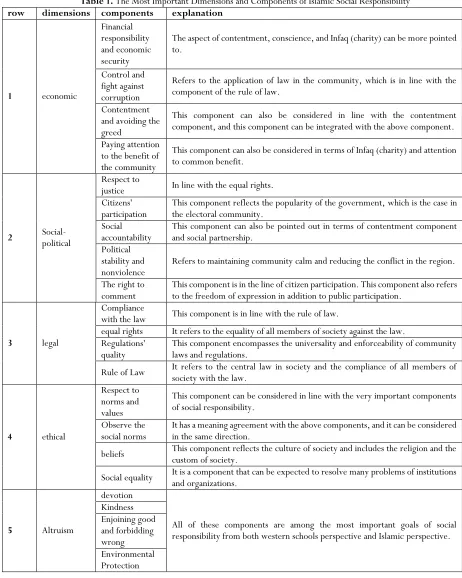
Table 1. The Most Important Dimensions and Components of Islamic Social Responsibility
row dimensions components explanation
1 economic
Financial responsibility and economic security
The aspect of contentment, conscience, and Infaq (charity) can be more pointed to.
Control and fight against corruption
Refers to the application of law in the community, which is in line with the component of the rule of law.
Contentment and avoiding the greed
This component can also be considered in line with the contentment component, and this component can be integrated with the above component. Paying attention
to the benefit of the community
This component can also be considered in terms of Infaq (charity) and attention to common benefit.
2 Social-political
Respect to
justice In line with the equal rights. Citizens'
participation
This component reflects the popularity of the government, which is the case in the electoral community.
Social accountability
This component can also be pointed out in terms of contentment component and social partnership.
Political stability and
nonviolence Refers to maintaining community calm and reducing the conflict in the region. The right to
comment This component is in the line of citizen participation. This component also refers to the freedom of expression in addition to public participation.
3 legal
Compliance
with the law This component is in line with the rule of law.
equal rights It refers to the equality of all members of society against the law. Regulations'
quality This component encompasses the universality and enforceability of community laws and regulations. Rule of Law It refers to the central law in society and the compliance of all members of society with the law.
4 ethical
Respect to norms and values
This component can be considered in line with the very important components of social responsibility.
Observe the
social norms It has a meaning agreement with the above components, and it can be considered in the same direction. beliefs This component reflects the culture of society and includes the religion and the custom of society.
Social equality It is a component that can be expected to resolve many problems of institutions and organizations.
5 Altruism
devotion
All of these components are among the most important goals of social responsibility from both western schools perspective and Islamic perspective. Kindness
Enjoining good and forbidding wrong Environmental Protection
Finally, the ultimate goal of this research is to provide a model of Islamic social responsibility in the Ministry of Communications and Information Technology with an emphasis on good governance to answer the following questions: 1) what is the difference between the Islamic perspective and the western perspective on Islamic social responsibility? 2) What are the dimensions of Islamic social responsibility with the good governance approach in the Ministry of Communications and Information Technology? 3) What are the components of Islamic social responsibility with the good governance approach in the Ministry of Communications and Information Technology? 4)
3. Methodology
The present research was substantially non-experimental (non-experimental) that was conducted at descriptive (analytical) level. This study was a theoretical-applied one in terms of goal, and a surveying one in terms of method. Given the fact that the present study was a mixed type (qualitative-quantitative), in the first section, a comparative study was conducted on the subject, and then an interview was carried out on the investigations and the identified components. In the quantitative section of the research, the ISM technique were used in this research for the classification and prioritization and examining the relationship between variables, and the identified components. 5 components and 21 sub-components were identified as the sub-components for Islamic social responsibility.
4. Findings
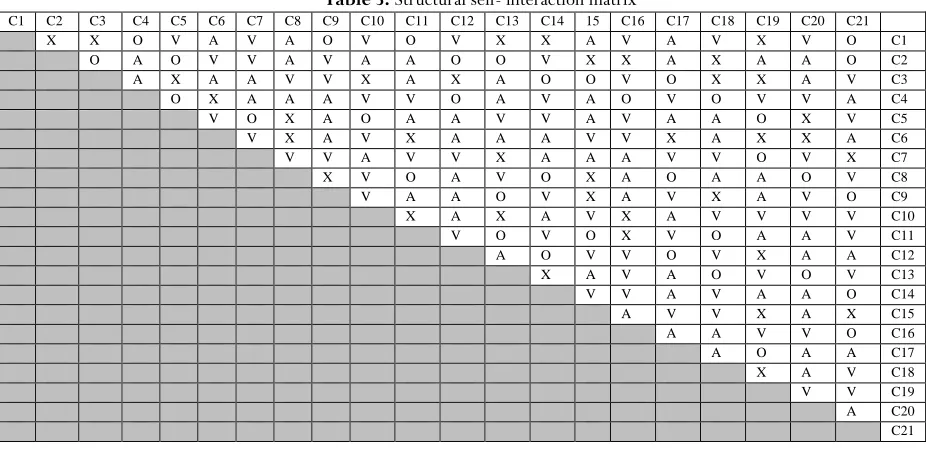
The formation of the Structural Self-Interaction Matrix (SSIM): The symbols of table 2 were used to determine the type of relationship.
Table 2. Conceptual relations in the formation of the structural self-interaction matrix Concept of symbol
symbol
i leads to j (the agent of the row i is the ground to reach the column j) V
j leads to i (the agent of the row j is the ground to reach the column i). A
There is a two-way relationship between i and j (both are mutually reinforcing). X
There is no relationship between two elements i and j.
O
In the first step, the structural self- interaction matrix was created using the respondents' opinion that was compiled in the table below.
Table 3. Structural self- interaction matrix
C21 C20 C19 C18 C17 C16 15 C14 C13 C12 C11 C10 C9 C8 C7 C6 C5 C4 C3 C2 C1 C1 O V X V A V A X X V O V O A V A V O X X C2 O A A X A X X V O O A A V A V V O A O C3 V A X X O V O O A X A X V V A A X A C4 A V V O V O A V A O V V A A A X O C5 V X O A A V A V V A A O A X O V C6 A X X A X V V A A A X V A X V C7 X V O V V A A A X V V A V V C8 V O A A O A X O V A O V X C9 O V A X V A X V O A A V C10 V V V V A X V A X A X C11 V A A O V X O V O V C12 A A X V O V V O A C13 V O V O A V A X C14 O A A V A V V C15 X A X V V A C16 O V V A A C17 A A O A C18 V A X C19 V V C20 A C21
Constructing the reachability matrix (RM): it is prepared with converting SSIM matrix symbols into numbers zero and one. The initial reachability matrix is prepared with following rules. The rules are simply expressed:
Table 4. How to Convert the Conceptual Relationships to Numbers?
i to j j to i
Conceptual Symbol 0 1 V 1 0 A 1 1 X 0 0 O
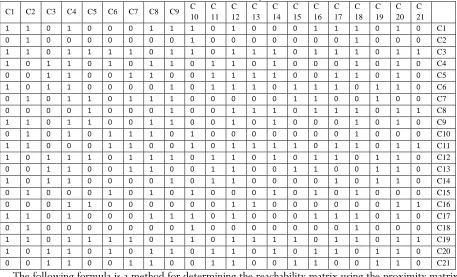
As described above, in step 2, the reachability matrix was constructed using the structural self-interaction matrix as presented in the table below.
Table 5. Reachability matrix
C 21 C 20 C 19 C 18 C 17 C 16 C 15 C 14 C 13 C 12 C 11 C 10 C9 C8 C7 C6 C5 C4 C3 C2 C1 C1 0 1 0 1 1 1 0 0 0 1 0 1 1 1 0 0 0 1 0 1 1 C2 0 0 0 1 0 0 0 0 0 0 0 1 0 0 0 0 0 0 0 1 0 C3 1 1 0 1 1 1 0 1 1 1 0 1 1 0 1 1 1 1 0 1 1 C4 0 1 0 1 0 0 0 1 0 1 1 0 1 1 0 1 0 1 1 0 1 C5 0 1 0 1 1 0 0 1 1 1 1 0 0 1 1 0 0 1 1 0 0 C6 0 1 1 0 1 1 1 0 1 1 1 0 1 0 0 0 0 1 1 0 1 C7 0 0 1 0 0 1 1 0 0 0 0 0 1 1 1 0 1 1 0 1 0 C8 1 1 0 1 1 1 0 1 1 1 0 0 1 0 0 0 1 0 0 0 0 C9 0 1 0 1 0 0 0 1 0 1 0 0 1 1 0 0 1 1 0 1 1 C10 0 0 0 1 0 0 0 0 0 0 0 1 0 1 1 1 0 1 0 1 0 C11 1 1 0 1 1 0 1 1 1 1 0 1 0 0 1 1 0 0 0 1 1 C12 0 1 1 0 1 1 0 1 0 1 1 0 1 1 1 0 1 1 1 0 1 C13 0 1 1 0 0 1 1 0 0 1 1 0 0 1 1 0 0 1 1 0 0 C14 0 1 1 0 1 0 0 0 0 1 1 0 1 0 0 0 0 1 1 0 1 C15 0 0 0 1 0 1 0 1 0 0 0 1 0 1 0 1 0 0 0 1 0 C16 1 1 0 0 0 0 0 0 1 1 0 0 0 0 0 0 1 1 0 0 0 C17 0 1 0 1 1 1 0 0 0 1 0 1 1 1 0 0 0 1 0 1 1 C18 0 0 0 1 0 0 0 0 0 0 0 1 0 0 0 0 0 0 0 1 0 C19 1 1 0 1 1 0 1 1 1 1 0 1 1 0 1 1 1 1 0 1 1 C20 0 1 1 0 1 1 0 1 0 1 1 0 1 1 0 1 0 1 1 0 1 C21 0 1 1 0 0 1 1 0 0 1 1 0 0 1 1 0 0 1 1 0 0
The following formula is a method for determining the reachability matrix using the proximity matrix: Step 1: A + I and the second step: M = (A + I) n; A, initial reachability matrix, I, identity matrix, and M, the final reachability matrix. The operation must be according to the Bolin Rule (1 = 1 * 1, 1 = 1 + 1).
Note: In this case, 1* includes the entries that are integrated according to the concept of transitivity in the table cells (2013). In step 3, it is needed to adapt the initial reachability matrix. This compatibility is added to the initial reachability matrix using secondary relationships that may not exist.
Table 6. The adapted initial reachability matrix
C 21 C 20 C 19 C 18 C 17 C 16 C 15 C 14 C 13 C 12 C 11 C
10 C9 C8 C7 C6 C5 C4 C3 C2 C1
Power of influence
C1 1 1 1* 1 1 1 1 1 1* 1 1 1 1 1 1* 1* 1 1 1* 1 1 21
C2 0 1 1* 1 1 1* 1 0 1 1* 1 1* 1 0 1 1* 0 1 1* 1 1* 17
C3 1 1 1 1 1 1* 1 1 1* 1* 1 1* 1 1 1 1 1 1 1 0 1 20
C4 1* 1 1 1 1* 1 1* 1 1 0 1* 1 1* 1 1* 1 1* 1 1 1 1 20
C5 1* 1 1 1* 0 1* 1* 1* 0 0 1 1* 1* 1* 1 1* 1* 1 1 1* 1 19
C6 1* 1* 1* 1 1* 1 1* 1* 0 1* 1* 1 1* 1* 1 1* 1 0 1* 1 1* 19
C7 1* 1 1 1* 1* 1 1 1 1* 1* 1* 1 1 1 1 1 1 1 1 1* 1 21
C8 1 1 0 1* 1 1 1 1* 1 1 1 1 1 1* 1 1* 1 1 0 1* 1* 19
C9 1 1 1* 1 1 1 1* 1* 1 1 1* 1 0 1 1* 1 1* 1 1* 1 1 20
C10 0 1 1* 1 1* 1* 0 1* 0 1 1* 1 1* 1* 1 1* 1* 1* 1* 1 1* 18
C11 1 1 1 1 1 1* 1 1 1 1 1 1 1 1* 1* 1 1 1 1 1 1 21
C12 1* 1 1 1 1 1* 1 1 1* 1 1 1 1 1 1* 1 1* 1* 0 1 1 20
C13 1* 1 1* 1 0 1 1* 1* 1* 1 1 1 1 1 1 1* 1* 1 1 1* 1 20
C14 1* 1 1* 1 1 1* 1* 1* 1* 1 1* 1 1 0 1* 1* 1* 1 1 1* 1 20
C15 1* 1* 1 1* 1 1 1 1 1* 1 1* 1 1* 1 1 0 1* 1* 1* 1 1* 20
C16 1 0 1* 1* 1* 0 1 1 1 1* 1 1* 1* 1* 1 1 1 1 1 1* 1* 19
C17 1 1 1* 1 1 1 1* 1* 1 0 1* 1* 1 1 1* 1* 1 1 1* 1 1 20
C18 1 1 1 1 1* 1* 0 1* 0 1 1* 1 1* 1* 1 1* 0 1 1* 1 1* 18
C19 1 1* 1 0 1 1* 1 1 1 1 1 1 1 1* 1 1 1 1* 1 1 1 20
C20 1 1* 1 1 1 1 1* 1 1* 1 1 0 1 1 1* 1 1* 0 1* 1 1 2190
C21 1* 1 1* 1 1 1 1 1* 1* 1 1 1* 1 1 1 1* 1* 1 0 1* 1 20
Level of Depe ndenc y
19 20 20 20 19 20 19 20 17 18 21 20 20 19 21 20 19 19 18 20 21
Now, in step 4, the levels of each variable according to the adopted reachability matrix should be obtained. Total of input, output and subscription variables were calculated. In each iteration, if the output variable is equal to the subscription variable, it would be an iteration at i-level. Then, in the iteration of the next row and column, the variable was deleted from the matrix and the calculations were performed again. The results are summarized as follows.
Table 7. Level and priority of variables
C21 C20 C19 C18 C17 C16 15 C14 C13 C12 C11 C10 C9 C8 C7 C6 C5 C4 C3 C2 C1
5 8 4 7 8 7 1 8 2 5 7 6 7 6 3 3 8 4 4 6 6
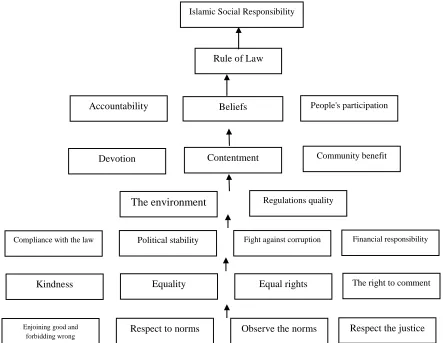
In the fifth step, the network of ISM interactions is drawn using the levels obtained from the criteria. If there is a relation between two variables i and j, it will be presented with an arrow. A final diagram has been created with elimination of extra modes and also using segmentation of the levels.
Beliefs Rule of Law
The environment Regulations quality
Fight against corruption
Political stability Financial responsibility
Compliance with the law
Community benefit
Contentment Devotion
Equal rights
Equality The right to comment
Kindness
Observe the norms
Respect to norms Respect the justice
Enjoining good and forbidding wrong
Accountability People's participation
Islamic Social Responsibility
Diagram 2. Network of Interaction Model (represents the level and priority of variables)
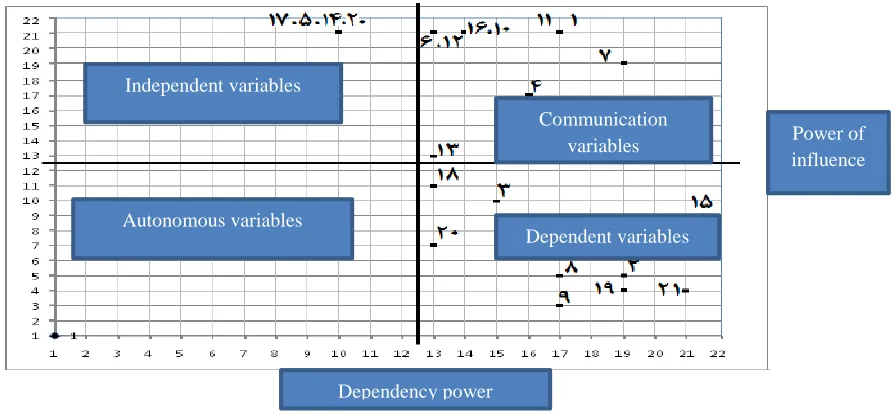
Analysis of penetration power and level of dependency: at this stage, the degree of dependency of the variables was obtained by collecting the inputs "1" in each row, the penetration power, as well as the sum of inputs "1" in each column. On this basis, the diagram of power of influence-dependency was drawn (2013).
Figure 3. The influence power and the dependency level
Accordingly, all the criteria are interface variables. These variables have high dependency and high guidance power. In other words, the impact of these criteria is very high, and any small change on these variables causes the fundamental changes in the system. Of course, the interface power of the criteria 7, 1 and 11 is more than the other criteria.
5. Discussion
According to the views of various philosopher, the discussion of legitimacy through social responsibility is one of the important issues for organizations and communities. Communities and as a consequence, organizations are seeking for the legitimacy in different ways, not because they are concerned about the current state of the society, but are seeking the profit and benefits of this legitimacy. Contrary to the existing views, in Islam, social responsibility towards the community based on the Qur'anic teachings is proposed as a divine duty, although it does not seem to be in the interest of the individual or organization and that society. Islam not only holds the person responsible for himself and God, but also considers the person responsible and committed in the community. In the course of one's life, man has to socialize with others. In this regard, the religion of Islam has assigned duties to individuals, which is the same social responsibility. Islam not only considers the person responsible for himself and God, but also considers the person responsible and committed in the community. The Holy Prophet (PBUH) states "all people in the community are responsible to each other". This paper focuses on the concepts and definitions of social responsibility in terms of economic, social-political, legal, ethical, and altruistic dimensions, as well as a good governance component in terms of participation, accountability, justice and equality, rule of law, and the efficiency and effectiveness of the state. Finally, across these theoretical studies, and the opinions of experts from the Ministry of Communications and Information Technology, the model of Islamic social responsibility was provided and presented. According to the results obtained by the interpretive structural modeling, for each dimension,
Autonomous variables Independent variables
Communication variables
Dependent variables
Dependency power
Power of influence
21 components were considered as the financial responsibility and economic security (c1), control and fight against corruption (c2), contentment and avoiding greed (c3), attention to community benefit (c4), respect the justice (c5), citizen participation (c6), social accountability (c7), political stability and nonviolence (c8), right to comment (c9), law enforcement (c10), equal rights (c11), quality of regulation (c12), rule of law (c13), respect for norms and values (c14), observe the social norms (c15), beliefs (c16), social equality (c17), devotion (c18) , kindness (c19), enjoining good and forbidding wrong (c20), and environment conservation (c21). According to the results, components c1, c4, c6, c7, c10, c11, c13, c14, and c16 are interface variables. These variables have high dependency and conductivity. In other words, the impact of these criteria is very high and any small change on these variables cause major changes in the system. Of course, the interface power of the variables c7, c1 and c11 is more than the other criteria.
References
Abedini Bijan, GhaffariZenouzi Mehrdad. (2016). "The Impact of Social Responsibility of Managers on Human Capital with the Intermediary of Organizational Trust", Industrial Engineering and Production Management Studies, Volume 2, Fluid 4, 88 to 99.
Aluchna, M. (2010). Corporate social responsibility of the top ten; examples taken from the Warsaw Stock Exchange. Social Responsibility Journal, 6(4), 611-626.
Azar A. (2013). Research in Soft Operations, Tehran: Publications of Industrial Management Organization.
Banerjee, Sumitro, Wathieu, Luc. (2017) “Corporate social responsibility and product quality: Complements or substitutes” International Journal of Research in Marketing, (2017), Vol.34, issue3.734–745.
Bhardwaj, P. Chatterjee, P. Dogerlioglu Demir. K. Turut, O. (2018). “When and how is corporate social responsibility profitable?” Journal of Business Research 84 (2018) 206–219.
Dadashi Kalayi, Fatemeh. (2016). Explaining Principles and Methods of Accountability from the Point of View of Islam and its Educational Signs, Master's Thesis, Mazandaran University, Faculty of Humanities
Darus, F. Ahmad Shukri, N. Yusoff, H. Ramli, A. Mohamed Zain, M. Abu Bakar, N. (2017). “Empowering social responsibility of Islamic organizations through Waqf” Research in International Business and Finance 42 (2017) 959–965.
Devaney, L. (2016) “Good governance? Perceptions of accountability, transparency and effectiveness in Irish food risk governance” Food Policy 62 (2016) 1–10.
Habibi Navid, VazifehDust Hossein, Jafari Parivash. (2016). Components of Social Accountability Promotion in Islamic Azad University, Volume 22, Number 2, Journal of Research and Planning in Higher Education.
Poduval, P. Pramod, V. Raj, J. (2015). “Interpretive Structural Modeling (ISM) and its application in analyzing factors inhibiting implementation of Total Productive Maintenance (TPM)”, International Journal of Quality & Reliability Management, Vol. 32 No. 3, pp.308-331.
Rahnavard Farajollah, Abbaspour Bagher. (2007). Good Governance and its Possibility of Implementation in Iran, Journal of Management Studies, Vol. 14, No. 55.
Robinson, S., & Eilert, M. (2018). The role of message Specificity in corporate social responsibility communication. Journal of Business Research, 90.
Rodriguez-Fernandez, M. (2016). “Social responsibility and financial performance: The role of good corporate governance, BRQ Business Research Quarterly (2016) 19, 137-151.
Samet, Marwa, Jarboui, Anis. (2017).” How does social responsibility contribute investment efficiency? Journal of Multinational Financial management (2017), vol.40, issue C,33-46.
SardarNia Khalili, Shakeri Hamid. (2014). Explaining good governance in Nahj al-Balaghah with a field-oriented approach, Journal of Legal Studies, Volume 6, No. 4.
Yousaf, M. Ihsan, F. Ellahi, A. (2016). “Exploring the impact of good governance on citizens' trust in Pakistan” Government Information Quarterly 33 (2016) 200–209.