Type II Diabetic Patients’ Illness Perception and Self-care Behaviour:
Does Comorbidity make any Difference?
Murugesan Manikandaprabu
1, Sundaramoorthy Jeyavel
11Department of Psychology, School of Social and Behavioural Sciences, Central University of Karnataka, Kalaburagi, India
Submitted: 17 September 2018
Accepted: 28 October 2018
Int J Behav Sci. 2018; 12(3): 114-124
Corresponding Author:
Murugesan Manikandaprabu: Department of Psychology, School of Social and Behavioural Sciences, Central University of Karnataka, Kalaburagi, India
E-mail: [email protected]
Abstract
Introduction: Earlier studies have shown that illness perception and self-care behaviour change based
on the existence of comorbidity / no comorbidity conditions. The present study investigates the role of comorbidity in Type II diabetic patients' level of personal control, treatment control, illness coherence and self-care behaviour in the Indian context.
Method: A cross-sectional survey was conducted among (N=303) type II diabetic patients in southern
India, of whom 43.56% reported having one comorbidity condition or more comorbid conditions. Participants’ illness perception has been assessed using Illness Perception Questionnaire-Revised (IPQ-R) and self-care behaviour has been assessed through Diabetic Self-Care Management Questionnaire (DSMQ).
Results: Patients with no comorbid conditions had higher beliefs of personal control, treatment
controland illness coherence, and also showed better self-behaviour than their counterparts. Patients with comorbidity conditions perceived diabetes as a chronic disease and seemed to have more consequences in their lives. They also tend to be emotionally affected and to have a lower belief of personal control, treatment control and illness coherence. Besides this, self-care behaviour was also found to be significantly different based on the patients' level of personal control, treatment control and illness coherence beliefs between diabetics who had comorbidity and those with no comorbidity conditions.
Conclusion: Significant difference in self-care behaviour of patients with comorbidity indicates the
necessity of interventions to enhance their self-care behaviour to manage their diabetes as well as their comorbid conditions.
Keywords: Type II Diabetic Mellitus in India, Illness Perception, Self-care Behaviour, Comorbidity
Introduction
Deviations in symptoms and complications are common features of diabetes and these can significantly alter the patients’ perceptions and experiences. However, very limited consideration has been given to understand the variance of illness perceptions in comorbid / no comorbid conditions [1, 2]. There was plenty of empirical research that examined patients’ belief of illness and its influence on their cognitive, emotional & behavioural responses to their condition [2, 3, 4]. Such investigations have been incorporated by several theoretical frameworks, among the most common being the Common Sense Model of illness representations. The common sense model articulates that experience of many/range of symptoms of diabetes by patients may drive them to adopt coping strategies and evaluate coping measures [5].
management of their illness [6]. In order to control their glucose level and also to prevent macro complications such as heart disease, kidney disease and foot ulcers, they must follow the guidelines recommended by physicians (diet adherence, being physically active, monitoring blood glucose level and the visit of physicians).
In this context, diabetes control beliefs are found to have a significant impact on self-care behaviours of the patients including exercise, diet and physician contact [5, 1]. However, examining diabetic patients’ cognitive and behavioural responses about their illness indicated that many diabetics under estimate the seriousness of their diabetic condition and overestimate their capacity to control it and also showed limited engagement in the management. It may depend on considerable changes in their adjustments, symptoms, experiences, prior knowledge and provision of information and treatment [2].
Considering the importance of self-care behaviour among diabetic patients, the key role of illness perception and comorbidity can be clearly seen. In line with previous research, it could be expected that the dynamic experience of patients’ illness perception may notably effect self-care behaviour [2] with a special reference to Indian diabetic patients. Thus, the present study aimed to highlight the Type 2 Diabetic Mellitus (T2DM) patients’ self-care behaviour in terms of their (illness perception) personal control, treatment control, and illness coherence with reference to their comorbidity conditions.
Research Questions
1. Will illness perceptions differ based on patients’ comorbidity conditions?
2. To what extent does the self-care behaviour of Type 2 Diabetic Mellitus (T2DM) patients differ between comorbidity conditions?
3. Would the presence of comorbidity make any difference in their self-care behaviour with respect to patients’ level of illness perception?
Method
A cross-sectional study was carried out during the month of February and May’ 2017 at Madurai and Krishnagiri district of Tamil Nadu, India. Two-stage sampling procedures were applied and patients undergoing treatment from public and private hospitals were taken from both districts. A total of 303 T2DM patients were included in the study. Patients diagnosed with T2DM; understanding English or patients who could communicate in the Tamil language (semi-structured interview took place for them in Tamil), and who aged 20 and above were included in this study. Patients’ who were undergoing treatment for severe psychological (e.g., Dementia and Alzheimer) or physical illnesses (cancer, stroke) in accordance with their medical records were excluded from the study. Selected participants were informed about the study and its purpose. After obtaining their consent, they were asked to fill their sociodemographic/background information, Illness Perception Questionnaire-Revised and Diabetes Self Care Management Questionnaires. Ethical approval of this
study was granted by the institutional ethical committee. The tools used in this study were ensured with Cronbach’s alpha reliability test. The obtained results of the current study are presented as follows.
Illness Perception Questionnaire-Revised [5] was administered to assess the illness perception of T2DM. In the first section of the questionnaire, illness identity was measured to understand the range of symptoms experienced by the patients that attributed to diabetes (14 items, e.g., “fatigue and weight loss”, etc.) (α=0.595). In the second section, 38 items were included as the following subscales; timeline acute or chronic in which it measures the duration of the illness patients belief (α =0.839) (6 items, e.g., “My diabetes will last for a long time rather than a short period”); ‘Consequences’, refers to the beliefs of how diabetes affects a personal life and their closed ones (e.g., “My diabetes affects the way others see me”) (α =0.887); the dimension of ‘Personal control’ measures the extent an individual holds about his/her ability to control his/her condition (α =0.911). ‘Treatment control’ measures the extent of patients’ belief on his/her physician in terms of controlling their diabetes (e.g., nothing can be done for my diabetes” (α =0.916). ‘Illness coherence’ (diabetes does making any sense to me) (α =0.937); timeline cyclical (α =0.882) (4 items, e.g., I go through cycles in which my diabetes gets better and worse); emotional representation (α =0.930) (6 items, e.g., I get depressed when I think about my diabetes).
The final section of the questionnaire includes the causal attribution to their own diabetes that intends to measure in four different domains as; Psychological attribution (α =0.669) (6 items, e.g., My emotional state e.g., feeling down, lonely, anxious, empty); Risk factors (α =0.573) (5 items, e.g., smoking, alcohol) ; Immunity (α =0.698) (3 items, e.g., Altered immunity, A Germ or virus); and Accident or chance (α =0.263) (2 items. e.g., Accident or injury).
Self-Care Management Questionnaire for Diabetes[7] measures four aspects of self-care behaviour. In addition, the evaluation by patients’ overall self-care management perceived by patients was also measured. The rating scale ranged from (0-3), as, 3-applies to me very much, 2-3-applies to me a considerable degree 1-applies to me some degree and 0-does not apply to me. Glucose monitoring: e.g., “I monitor my blood sugar levels with care and attention” (5 items, α=0.821); physician contact: e.g., “I keep all doctors’ appointments recommended for my diabetes treatment” (3 items, α=0.793); diet adherence: e.g., “The food I select to eat makes it easy to achieve optimal blood sugar levels” (4 items, α=0.485); physical activity: e.g., “I do regular physical activity to attain optimal blood sugar levels” (3 items, α=0.840).Overall self-care management perceived by patients: e.g., “My diabetes self-care is poor” (1 item: it is a self-evaluation by patients in terms of their self-care management activities in the last 8 weeks).
Comorbidity:
problem) 2) kidney disease (nephropathy) 3) heart problem (cardiovascular disease) 4) foot ulcers (Limb amputation) 5) sexual problem 6) none of them (no comorbidity). For analysis purpose, it was dichotomized into comorbidity (1) and no comorbidity (2).
Background variables:
The study included several socio-demographic variables such as the participants’ age, gender, educational level (uneducated, primary schooling, high schooling, higher secondary, undergraduate, postgraduate and PhD/others), illness duration, and type of hospital (public/private hospital).
Data analysis:
The participants’ profile was divided into two segments with respect to their presence and absence of comorbidity conditions. Comparisons aimed to explore whether illness perceptions’ sub-domains differ on the basis of comorbidity of the patients. Presence of comorbidity and self-care behaviour was also compared using independent sample t-test.
Grouping conditions were framed under three major sub-domains of IPQ-R (Personal control, Treatment control and Illness Coherence) i.e., Low/ Higher beliefs of personal control, treatment control and illness coherence with comorbidity/ without comorbidity. After grouping based on their comorbid conditions, the data were analysed with one way ANOVA followed by Tukey’s
Honest Significant difference post hoc test for all
significant groups. Data were analysed using SPSS v 20
and ρ <0.05 was considered as significant.
Results
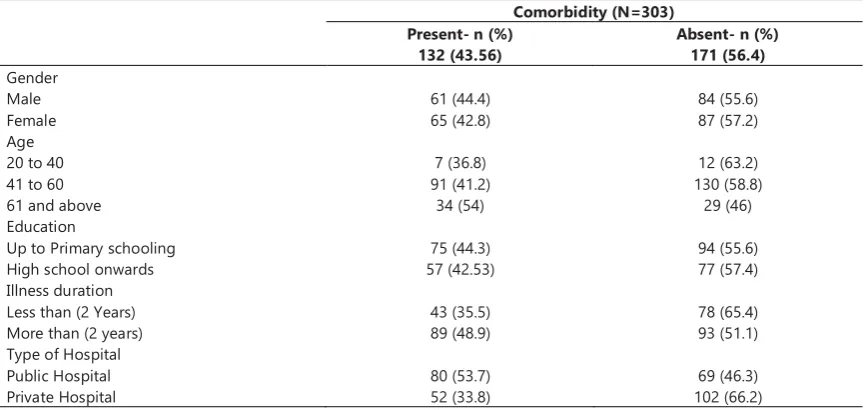
Table 1 indicates the characteristics of the participants with respect to their comorbidity conditions.
It can be observed from table 2 that most of the participants reported that apart from diabetes, T2DM patients also suffer from retinopathy (69 patients, 22.8%), and followed by foot ulcers (21 patients, 6.9%). Overall, 132 participants reported that they had one or more than one illness related to their diabetes (range 1-5).
Table 3 shows the results obtained from the ‘t’test which indicates that patients with comorbidity conditions have been experiencing more symptoms as compared to the patients without comorbidity. Patients with comorbidity tend to believe that their illness would exit for a longer time and it also has serious consequences than people without comorbidity. Subsequently, it may also affect their personal control and treatment control. They also believed that diabetes is an unpredictable condition (cyclical) and that they are unable to understand their illness. They also believed that their illnesses had been caused by stress or worry heredity and was actually due to bad luck.
Table 1. Profile of the participants
Comorbidity (N=303) Present- n (%)
132 (43.56)
Absent- n (%) 171 (56.4) Gender
Male 61 (44.4) 84 (55.6)
Female 65 (42.8) 87 (57.2)
Age
20 to 40 7 (36.8) 12 (63.2)
41 to 60 91 (41.2) 130 (58.8)
61 and above 34 (54) 29 (46)
Education
Up to Primary schooling 75 (44.3) 94 (55.6)
High school onwards 57 (42.53) 77 (57.4)
Illness duration
Less than (2 Years) 43 (35.5) 78 (65.4)
More than (2 years) 89 (48.9) 93 (51.1)
Type of Hospital
Public Hospital 80 (53.7) 69 (46.3)
Private Hospital 52 (33.8) 102 (66.2)
Table 2. Participant’s comorbidity conditions related to diabetes as perceived by patients
Distributions of Comorbidity (N=303) Frequency (n) Percentage (%)
None of Any 171 56.4
Retinal problem 69 22.8
Heart problem 9 3
Sexual problem 6 2
Kidney Disease 3 1
Retinal problem & Foot Ulcers 14 4.6
Retinal problem & Kidney Disease 2 0.7
Retinal problem & Heart problem 1 0.3
Retinal problem, Heart problem and Foot Ulcers 3 1
Heart problem & Foot Ulcers 1 0.3
Retinal problem, Kidney Disease and Foot Ulcers 1 0.3
Kidney Disease, Foot Ulcers and sexual problem 1 0.3
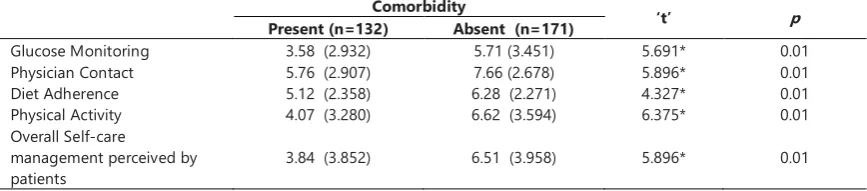
As it can be seen in table 4, patients without comorbidity more often tend to follow treatment regimens compared to people with comorbidity conditions.
Table 5 indicates the results obtained from the preliminary analysis of one way ANOVA. We could infer the significant difference in the combinations of low and high personal control with comorbidity/no comorbidity in all the dimensions of self-care behaviour. The major differences are as follows; personal control (Low, High) and comorbidity (Yes, No) conditions with respect to glucose monitoring F= 309.088, (df=3), p<0.0001;
physician contact F=63.042, (df=3), p<0.0001; diet
adherence F= 30.706, (df=3), p<0.0001; physical activity
F=52.106, (df=3), p<0.0001; and overall self-care
management perceived by patients F=68.499, (df=3), p
<0.0001.
In order to make sure about the significant group, the Tukey post hoc test was performed. The results revealed that patients with high personal control without comorbidity conditions were better in glucose monitoring and physician contact compared to the patients with low and high personal control with comorbidity at p<0.01 level. Glucose monitoring of the low personal control without comorbidity was significantly lower than the high personal control with comorbidity group at p<0.01 level. In diet adherence, high personal control without comorbidity group was significantly higher than low personal control with comorbidity as well as high personal control with comorbidity group at p<0.01 level.
Physical activity and overall self-care management was significantly higher in the low personal control without comorbidity compared to low personal control with
comorbidity conditions at p<0.01 level. High personal control without comorbidity were higher compared to low personal control with comorbidity and high personal control with comorbidity at p<0.01 level. Low personal control without comorbidity conditions was significantly lower compared to high personal control with comorbidity conditions at p<0.01 level.
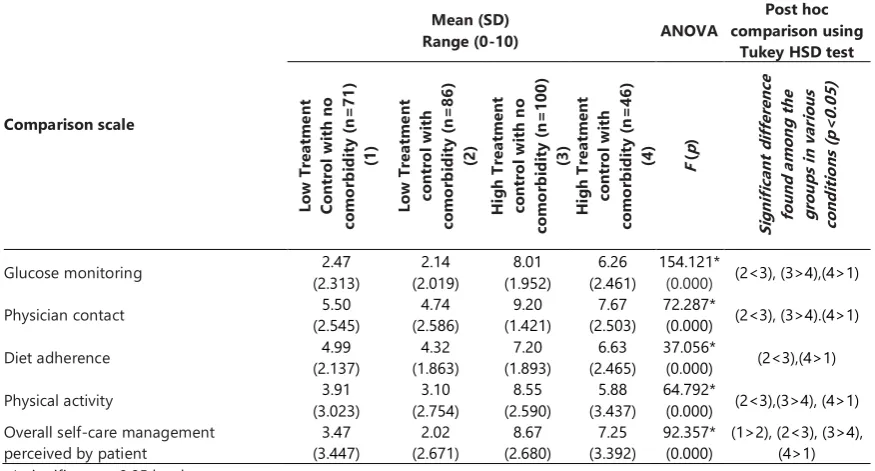
As it can be seen in table 6, all the sub-dimensions of self-care behaviour significantly differ between the combinations of treatment control (Low, High) and comorbidity (Yes, No) groups; glucose monitoring F=154.121 (df=3) at p <0.0001; physician contact F=72.287 (df=3) at p <0.0001; diet adherence F=37.056 (df=3) p <0.0001; physical activity (F=64.792) (df=3) p <0.0001; and overall self-care management perceived by patients F=92.357 (df=3) at p <0.0001.
Table 6, also provides the idea of the significant groups as followed; glucose monitoring, physician contact and physical activity were significantly higher in the group of high treatment control without comorbidity compared to low and high treatment control of comorbidity conditions group at p<0.05 level. In addition to that, low treatment control without comorbidity was significantly lower than high treatment control with comorbidity conditions at p <0.05.
Diet adherence is significantly higher in the group of high treatment control without comorbidity conditions compared to low treatment control with comorbidity conditions. Also, low treatment control without comorbidity was significantly lower compared to the group of high treatment control with comorbidity conditions at p<0.05.
Table 3. Comparison of illness perception of T2DM patients with respect to their comorbidity (mean (SD))
Comorbidity ‘t’
p
Present (n=132) Absent (n=171)
Identity 5.00 (2.367) 3.54 (2.107) 5.652* 0.01
Timeline Acute or Chronic 23.46 (5.410) 22.96 (4.321) 0.889 0.37
Consequences 23.43(5.303) 19.19 (6.885) 5.857* 0.01
Personal control 19.23 (6.985) 22.71 (6.258) 4.560* 0.01
Treatment control 16.67 (5.271) 19.51 (5.082) 4.749* 0.01
Illness coherence 16.77 (6.112) 19.84 (5.820) 4.464* 0.01
Timeline cyclical 14.24 (4.033) 11.34 (4.916) 5.504* 0.01
Emotional representation 19.55 (6.601) 15.49 (7.137) 5.074* 0.01
Psychological attribution 13.79 (4.510) 12.51 (4.290) 2.505* 0.01
Risk fact 20.74 (6.031) 20.57 (5.690) 0.259 0.79
Immunity 7.42 (2.955) 7.91 (3.053) 1.404 0.16
Accident or chance 3.97 (1.828) 3.98 (1.767) 0.061 0.95
*-significant at 0.05 level
Table 4. Self-care behaviour of T2DM patients, presence of comorbidity (mean (SD))
Comorbidity
‘t’ p
Present (n=132) Absent (n=171)
Glucose Monitoring 3.58 (2.932) 5.71 (3.451) 5.691* 0.01
Physician Contact 5.76 (2.907) 7.66 (2.678) 5.896* 0.01
Diet Adherence 5.12 (2.358) 6.28 (2.271) 4.327* 0.01
Physical Activity 4.07 (3.280) 6.62 (3.594) 6.375* 0.01
Overall Self-care
management perceived by patients
3.84 (3.852) 6.51 (3.958) 5.896* 0.01
Overall, self-care management was significantly higher in the group of low treatment control without comorbidity compared to low treatment control with comorbidity conditions p<0.05 level. High treatment control without comorbidity was significantly higher compared to the groups of low treatment control with comorbidity and high treatment control with comorbidity p<0.05 level. High treatment control with comorbidity conditions was significantly higher than the low treatment control
without comorbidity conditions at p<0.05.
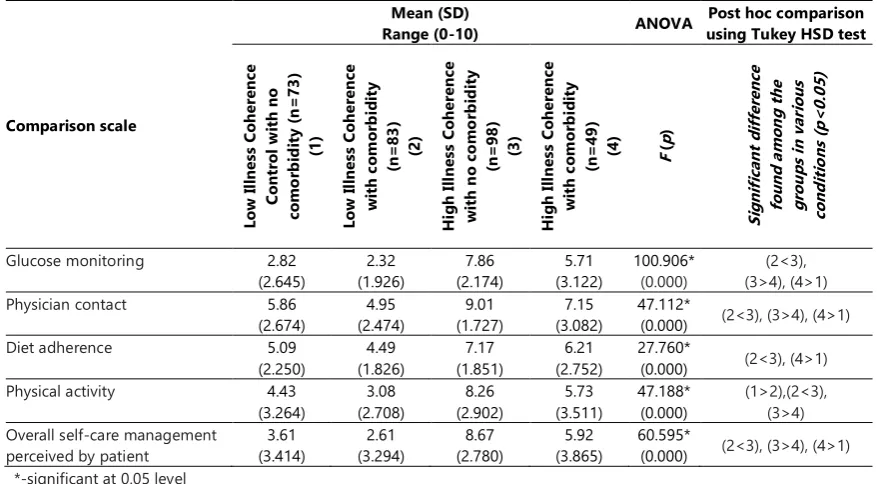
Table 7 shows that low and high illness coherence with comorbidity and without comorbidity significantly differed in the functions of all self-care behaviours. Glucose monitoring F= 100.906 (df= 3), physician contact F= 47.112 (df=3), diet adherence F= 27.760 (df=3), physical activity F= 47.188 (df=3), and overall self-care management perceived by patient F= 60.595 (df=3), p < 0.0001.
Table 5. Comparisons of Self-care behaviour in four conditions of personal control and presence of comorbidity with ANOVA & Tukey
HSD post hoc test
Comparison scale
Mean (SD)
Range (0-10)
ANOVA
Post hoc comparison using Tukey HSD test Lo w P er so na l C ont ro l w it h no co m o rb id it y (n = 71 ) (1 ) Lo w p er so na l c ont ro l w it h co m o rb id it y (n = 81 ) (2) H ig h pe rs ona l c ont ro l w it h no co m o rb id it y (n = 100 ) (3) H ig h pe rs ona l c ont ro l w it h co m o rb id it y (n = 51 )
(4) F (p
) Si gni fi ca nt d if fe re nc e fo und am on g th e gr oup s in va ri ous co nd it io ns (p < 0.0 5)
Glucose monitoring (1.941) 2.19 1.63 (1.096) 8.21 (1.610) 6.67 (2.166) 309.088* (0.000) (2<3), (3>4), (4>1)
Physician contact (2.573) 5.57 4.78 (2.523) 9.15 (1.500) 7.33 (2.807) 63.042* (0.000) (2<3), (3>4), (4>1)
Diet adherence (2.127) 5.01 4.41 (1.925) 7.18 (1.921) 6.26 (2.551) 30.706* (0.000) (2<3),(4>1)
Physical activity (3.191) 4.27 2.98 (2.571) (2.863) 8.29 (3.560) 5.79 52.106* (0.000) (1>2), (2<3), (3>4), (4>1)
Overall self-care management perceived by patient
3.66
(3.526) 2.18 (2.942) 8.53 (2.855) 6.47 (3.676)
68.499* (0.000)
(1>2), (2<3), (3>4), (4>1) *-significant at 0.05 level
Table 6. Comparisons of self-care behaviour in four conditions of treatment control and presence of comorbidity groups with ANOVA &
Tukey HSD post hoc test
Comparison scale
Mean (SD)
Range (0-10) ANOVA
Post hoc comparison using
Tukey HSD test
Lo w T re at m ent C ont ro l w it h no co m o rb id it y (n = 71 ) (1) Lo w T re at m ent co nt ro l w it h co m o rb id it y (n = 86 ) (2) H ig h Tr ea tm ent co nt ro l w it h n o co m o rb id it y (n = 100 ) (3) H ig h Tr ea tm ent co nt ro l w it h co m o rb id it y (n = 46 )
(4) F (p
) Si gni fi ca nt d if fe re nc e fo und a m on g th e gr ou ps in va ri ous co nd it io ns (p < 0.0 5)
Glucose monitoring (2.313) 2.47 (2.019) 2.14 (1.952) 8.01 (2.461) 6.26 154.121* (0.000) (2<3), (3>4),(4>1)
Physician contact (2.545) 5.50 (2.586) 4.74 (1.421) 9.20 (2.503) 7.67 72.287* (0.000) (2<3), (3>4).(4>1)
Diet adherence (2.137) 4.99 (1.863) 4.32 (1.893) 7.20 (2.465) 6.63 37.056* (0.000) (2<3),(4>1)
Physical activity (3.023) 3.91 (2.754) 3.10 (2.590) 8.55 (3.437) 5.88 64.792* (0.000) (2<3),(3>4), (4>1)
Overall self-care management perceived by patient
3.47 (3.447) 2.02 (2.671) 8.67 (2.680) 7.25 (3.392) 92.357* (0.000)
Table 7. Comparisons of self-care behaviour in four conditions of illness coherence and presence of comorbidity groups with ANOVA & Tukey HSD post hoc test
Comparison scale
Mean (SD)
Range (0-10) ANOVA
Post hoc comparison using Tukey HSD test
Lo w Il lne ss C oh er enc e C ont ro l w it h no co m o rb id it y (n = 73 ) (1) Lo w Il lne ss C oh er enc e w it h co m or b id it y (n= 83 ) (2) H ig h Ill ne ss C oh er enc e w it h n o co m o rb id it y (n= 98 ) (3) H ig h Ill ne ss C oh er enc e w it h co m or b id it y (n= 49 )
(4) F (p
) Si gni fi ca nt d if fe re nc e fo und a m on g th e gr ou ps in va ri ous co nd it io ns (p < 0.0 5)
Glucose monitoring 2.82
(2.645) 2.32 (1.926) 7.86 (2.174) 5.71 (3.122) 100.906* (0.000) (2<3), (3>4), (4>1)
Physician contact 5.86
(2.674) 4.95 (2.474) 9.01 (1.727) 7.15 (3.082) 47.112*
(0.000) (2<3), (3>4), (4>1)
Diet adherence 5.09
(2.250) 4.49 (1.826) 7.17 (1.851) 6.21 (2.752) 27.760*
(0.000) (2<3), (4>1)
Physical activity 4.43
(3.264) 3.08 (2.708) 8.26 (2.902) 5.73 (3.511) 47.188* (0.000) (1>2),(2<3), (3>4) Overall self-care management
perceived by patient
3.61 (3.414) 2.61 (3.294) 8.67 (2.780) 5.92 (3.865) 60.595*
(0.000) (2<3), (3>4), (4>1) *-significant at 0.05 level
Tukey post hoc test revealed that glucose monitoring and physician contact was significantly higher in patients of high illness coherence without comorbidity conditions than the other two groups of low and high illness coherence with comorbidity conditions at the p<0.05 level of significance. In addition, high illness coherence with comorbidity conditions was significantly higher in glucose monitoring and physician contact than low illness coherence without comorbidity at the p<0.05 level.
Diet adherence was significantly better in the group of high illness coherence without comorbidity than low illness coherence with comorbidity conditions at the level of p<0.05. At the same time, high illness coherence with comorbidity conditions was significantly higher than low illness coherence without comorbidity condition at p<0.05 level.
Physical activity was significantly better in the group of low illness coherence without comorbidity conditions than low illness coherence with comorbidity condition at p<0.05 level. This is while, high illness coherence without comorbidity was significantly even better than low illness coherence with comorbidity conditions as well as high illness coherence with comorbidity conditions at p<0.05 level.
Overall, self-care management was significantly higher in the group of high illness coherence without comorbidity conditions than the low illness coherence with comorbidity conditions and high illness coherence with comorbidity condition at p<0.05 level. In addition to that, the high illness coherence with comorbidity conditions was significantly higher than the low illness perception without comorbidity conditions at p<0.05 level.
Discussion
The present study aimed to investigate the role of Type
2 Diabetic Mellitus (T2DM) patients’ illness representation
as well as self-care behaviour with respect to the presence and absence of comorbid conditions. Almost half of the participants were suffering from comorbidities related to diabetic mellitus. Male participants reported having more comorbidity conditions than females. High comorbidity among men could be attributed to the risk factors like consumption of alcohol and smoking. An onset of comorbidity conditions observed mostly at the age of sixty and above with the average illness duration of more than six years. Patients’ who were illiterate and had minimum education (up to primary schooling) showed more complications than people who had a higher educational background. This was partly supported by previous studies which had indicated that people with low literacy levels are more likely to be affected by the high prevalence of diabetes [8,9]. Similar to this finding, Thailand type II diabetic patients with low education have also reported the experiencing more fluctuating symptoms and higher consequences of diabetes [10, 11]. Education has also been recognized as one of the predictors of mortality risk in T2DM [7]. These findings indicate the necessity of educating or spreading awareness about the T2DM among the sufferers to help them in managing their illness effectively.
It has been noticed that the patients who are in the initial phase or those who have been recently diagnosed with diabetes (less than 2 years) are least likely to report the presence of comorbidity conditions than the patients with chronic nature (more than 2 years). Patients with more numbers of comorbidity were depending on public hospitals as their treatment choice compared to private hospitals as the treatment costs are much higher in private hospitals.
also greater than a recent study conducted at Malappuram hospitals, Kerala [12]. In the present study few comorbid conditions were also reported like foot ulcer, kidney disease, heart problem and sexual issues. The findings of the present study are consistent with the
Overall, patients without any comorbidity reported as they experience relatively few symptoms; perceived diabetes as a chronic, but not a very serious condition with low impact (emotionally) on their daily routine. In addition, they strongly believe in their own self. Actually, they could control their condition with the help of medical treatments and understanding their illness.. Whereas, patients’ with comorbidity conditions reported they were encountering more symptoms; believed that this illness condition had a serious impact on their lives; and they were also less likely to control themselves either by self-management or medical treatments. These findings also support an idea that patients with diabetes-related comorbidity are less likely to believe in treatment choices [1, 14].
Patients’ self-care behaviour has been assessed eight weeks prior to the participation of the study. Findings revealed that patients with the absence of comorbid conditions were most likely to follow the regular blood glucose monitoring; visit their doctor as suggested; follow the dietary regimens; be physically active and also satisfied with their self-care activities. This result is partly contradicted to a recent study which indicated that exercise engagement was more in patients with complications [1]. However, patients without comorbidity could be able to do better physical activities than patients with comorbid conditions. Yet, it depends on what extent he/she values in doing it so.
Besides comparing the patients’ presence and absence of comorbidity, this study also tried to understand how self-care management varies among the different levels of illness perception (personal control, treatment control and illness coherence). It was revealed that regular glucose monitoring and physician contact were significantly higher in patients having higher personal control without comorbidity than other patients. Even though there is a significant decrease in glucose monitoring, physician contact, diet adherence, physical activity and overall self-care management perceived by patients with comorbid patients, it is significantly higher than patients who have low personal control with comorbidity. This indicates the need for special care to patients with the comorbid condition in our public health system.
Patients who believed high treatment control and without comorbid conditions were most likely to follow significantly higher treatment regimens than other groups. They also follow the regular monitoring of glucose; keep visiting physicians as they are supposed to; take the specific food which is needed; are physically active and also have the belief in better self-care management to control their illness. It is clearly demonstrating their belief in their health providers’ treatment which could control their conditions. These findings are partially consistent with the previous research findings that perceived the effectiveness of the treatment that predicted the physical activity and dietary behaviour [3, 4, 15].
Patients with high illness coherence and without comorbidity seem to have better self-care behaviour than
patients with high illness coherence and with comorbid conditions. These findings are also similar to past studies among heart disease patients. Actually, those who had a better understanding of their illness were able to perform required self-care activities [16].
Conclusion
Taken together, the present study emphasizes the importance of patients having a higher belief in personal control, treatment control and illness coherence. Patients with higher illness perception seem to do better self-care activities than the lower group patients. In addition, self-care activities tend to be reduced when patients suffer from comorbid conditions. Thus, it is learnt through the present study’s findings that in order to have better self-care behaviour, patients must have a positive pattern of illness perception.
To our knowledge, this study could be the first attempt of grouping the illness perceptions’ major dimensions with respect to comorbidity conditions related to diabetes which has been targeted in the high prevalent (Tamil Nadu) state of India [17] and adding a new insight for the need of health-promoting activities in this ground. Due to the cross-sectional nature of the research design, findings may limit the cause and effect relationships among the variables.
In further studies, there is a vital need for conducting tailored interventional activities on personal control, treatment control and illness coherence with comorbidity patients for enhancement of self-care behaviour among T2DM. Also, the present study was in line with self-reported measures by patients in reference to the complications of diabetes. Future studies could include patients’ medical reports to ensure the complications reported by patients. Besides this, longitudinal studies also need to be conducted to confirm the variations in the self-care behaviours with reference to their comorbid conditions and patients’ level of illness perception. Higher comorbidity in patients taking treatment in ‘public hospitals’ can be further explored to identify the cause and to design remedial measures by the Government.
Acknowledgement
Heartfelt thanks to the participants who took part in this study and also to the concerned health department authorities of public and private hospitals for their support throughout the research.
References
1. A. L. van Puffelen, M. J. W. M. Heijmans, M. Rijken, G. E. H. M. Rutten, G. Nijpels, and F. G. Schellevis, “Illness perceptions and self-care behaviours in the first years of living with type 2 diabetes; does the presence of complications matter?,” Psychol. Heal., vol. 30, no. 11, pp. 1274–1287, 2015.
2. A. Searle, M. A. Wetherell, R. Campbell, C. Dayan, J. Weinman, and K. Vedhara, “Do patients’ beliefs about type 2 diabetes differ in accordance with complications: An investigation into diabetic foot ulceration and retinopathy,” Int. J. Behav. Med., vol. 15, no. 3, pp. 173–179, 2008.
4. S. E. Hampson, R. E. Glasgow, and D. J. Toobert, “Personal Models of Diabetes and their Relationships to Self-Care Activities,” Heal. Psychol., vol. 9, no. 5, pp. 632–646, 1990. 5. R. Moss-Morris, J. Weinman, K. Petrie, R. Horne, L. Cameron,
and D. Buick, “The revised Illness Perception Questionnaire (IPQ-R),” Psychol. Heal., vol. 17, no. 1, pp. 1–16, 2002. 6. T. Bodenheimer Lorig, K., Holman, H., Grumbach, K., “Patient
self-management of chronic disease in primary care,” J. Am. Med. Assoc., vol. 288, no. 19, pp. 2469–2475, 2002.
7. A. Schmitt, “The Diabetes Self-Management Questionnaire ( DSMQ ): Development and evaluation of an instrument to assess diabetes ... The Diabetes Self-Management Questionnaire ( DSMQ ): development and evaluation of an instrument to assess diabetes self-care activities,” Health Qual. Life Outcomes, vol. 11, no. 1, p. 1, 2013.
8. J. Hwang and C. Shon, “Relationship between socioeconomic status and type 2 diabetes: Results from Korea National Health and Nutrition Examination Survey (KNHANES) 2010-2012,” BMJ Open, vol. 4, no. 8, 2014.
9. M. Tang, Y. Chen, and D. Krewski, “Gender-related differences in the association between socioeconomic status and self-reported diabetes,” Int. J. Epidemiol., vol. 32, no. 3, pp. 381–385, 2003.
10. W. Boonsatean, I. D. Rosner, A. Carlsson, and M. Östman, “The Influences of Income and Education on the Illness Perception of Thai Adults with Type 2 ception and Self-Management Diabetes,” J. Diabetes Metab. Disord., vol. 3, no. 3, p. 017, 2016. 11. J. F. Elgart et al., “Association between socioeconomic status, type 2 diabetes and its chronic complications in Argentina,” Diabetes Res. Clin. Pract., vol. 104, no. 2, pp. 241–247, 2014. 12. M. R. Km, A. Anandhasayanam, S. Kannan, and M. S. Noon,
“Prevalence of Co-morbidities in Type 2 Diabetes Mellitus Patients, the Awareness Level and the Impact of Pharmacist’s Patient Education Program,” Int. J. Pharma Res. Rev. IJPRR, vol. 4, no. 45, pp. 11–20, 2015.
13. H. F. Jelinek et al., “Clinical profiles, comorbidities and complications of type 2 diabetes mellitus in patients from United Arab Emirates,” BMJ Open Diabetes Res. Care, vol. 5, no. 1, p. e000427, 2017.
14. I. M. Stratton, “Association of glycaemia with macrovascular and microvascular complications of type 2 diabetes (UKPDS 35): prospective observational study,” Bmj, vol. 321, no. 7258, pp. 405–412, 2000.
15. R. E. Glasgow, S. E. Hampson, L. A. Strycker, and L. Ruggiero, “Personal-model beliefs and social-environmental barriers related to diabetes self-management,” Diabetes Care, vol. 20, no. 4, pp. 556–561, 1997.
16. H. Goodman, A. Firouzi, W. Banya, M. Lau-Walker, and M. R. Cowie, “Illness perception, self-care behaviour and quality of life of heart failure patients: A longitudinal questionnaire survey,” Int. J. Nurs. Stud., vol. 50, no. 7, pp. 945–953, 2013. 17. R. M. Anjana, R. Pradeepa, D. Ph, M. Deepa, M. Datta, and V.