209
Analysing efficiency of
vertical transfer light pipe in medium depth building
Monireh Kazemi,
1Dr. Mohsen Bina
21- M.A. graduated student of Facualty Of Architecture and Urbanism, Jundi-Shapur University Of Technology, Dezful, Iran
2- Assistant Professor Facualty Of Architecture and Urbanism, Jundi-Shapur University of Technology, Dezful, Iran
ARTICLE INFO
Received: 2019.08.07 Received in revised form: Accepted: 2019.11.20 Available online:
Keywords: DGS
Vertical light pipe Daylight Office Intensity Uniformity
A B S T R A C T
Light is one of the comfort factors in the environment, which unwittingly has a direct impact on the human beings. An environment without natural light can gradually cause illness. Light energy accounts for 25% of energy consumption, therefor it has a main rank in studies.
As Shiraz is a southern city withconsiderable sunny days in a year, illuminance of this source can be studied more exactly equipment and convenient ways can be recognized in order to reach efficient use.
First of all, the documents analyzed in an analytical-describtive method. Then, the studied issue had been observed in a sample place, and analyzed by the simulation. At last, a type of light guidance system had been used in order to offer the efficient light.Vertical light pipe has been analyzed, in order to provide the quality and quantity of office illuminance in medium depth plan building. Analysis Autodesk Ecotect 2010 version had been used for modeling and Radiance Control Panel for light analyze.
The simulation results of the determined office room, had shown some issues such as, light dazzlement, light concentration and light reduction in the different hours of a day of the special months in a year. The findings suggest that, it’s possible to use sunlight for sufficient illumination by using DGS3, such as a lightpipes if daylighting process would be revised in the glare and illumination distribution in the different times. It also, offers that the light pipes can be used in the other types of buildings.
1. Introduction
At the end of twenty-century industry
technologies had been emerged, biological environment and energy crisis had been introduced as main matter in human communities, which can indirectly have effects on greenhouse gas level. Architecture is not separated from this emergent phenomenon, because the energy usage amount in buildings has a great effect on the biological environment. [26] In the other side, the issues like combusting fossil fuels had been led to methods being developed in energy conversion technologies and energy management techniques. [5]
1[email protected] 2 [email protected]
3Dayligth guidance system
Light is vital for forming activity, direction finding, beauty, making sense and emotion in spaces, motivating, completing emergent functions. [28] Actually natural light is a response to provide visual comfort and reducing energy consume in building. [29] Additionally convenient light in the duration of a day, have positive effect on efficiency and wariness of employees, while most of them don’t experience natural light in the length of the daytime. Work space is also vital in psychological and body comfort view, because of the time length that people spend in it. Although sunlight is always needed for natural light in buildings, the amount of needed illuminance for each building should be determined according to the building type and weather conditions, because of converting the distributed light to heat at last, [7] and according to standards and formula for calculation and estimating the amount of needed light. [6]Natural light is an essential factor because of its role in indoor activities and visual connection between interior and exterior environments. [17]
Different studies had demonstrated that daylight guidance systems [8] provide healthy environment and psychological benefits, in addition to illuminate deep-plan buildings and increase efficiency in energy consumption, where daylight transfering is low from side windows. [3], [12] Moreover this technology is an efficient way to send light to areas in a building that, daylight exposure is limited in it. [2]Using light pipes,
can significantly reduce the daytime energy
consumption buildings throughout the country. As a result, electrical lighting usage will be reduced. Increasing the electric light usage lead occupants to pay their annaul extra bills and also extra energy usage that could be located instead of another emargant use. [15] Artificial lighting devices usage without sunlight and working situation at the environment for using daylight is neither healthy nor economical. Inorder to have a hormonic lighting device, and save energy, automatically illumination controller of the buildings can be used. [25], [27]
Obviously, electric light as an energy
consumption in a day is needed in the evening, but it is usually used during the day length. It’s the consequence of low rank design and ignoring sufficient windows. One of the alternatives that can improve the situation, are light-pipes, provide natural light for buildings if different annoying light factors would be considered. [15]If problems like lighting control would be solved,
4 DGS [8]
undoubtedly buildingoccupants prefer natural light and an exterior views. [16]
The first official prototype of light pipe had been submitted in 1881 by William Wheeler. He pointed that, past designs had been existed for light transfer within walled hallways and open spaces, in order to make second illuminance from a light source. Actually his invention couldn’t use daylight source. In 1980s, new materials with high reflection ratio like metal covers, had been constituted recent materials. [11]
Light losses modeling in bends were investigated by many researchers such as Saraiji et al. (1996) [24], Gupta et al. (2001) [1], and van Derlofske and Hough (2004) [9] for circular bend, Zhang and Muneer (2002) [31], Ellis et al. (2004) [23], Jenkins et al. [20] Daylight guidance systems4 [6] usually had been consisted of a light collection system (for harvesting daylight). One part is the light collectors that determine illuminance amount, a transfering part (that send the light over long distances into the building) and a part for distributing light. [10] Light distributing part uses clear or translucent distributer in order to distribute illumination evenly. Translucent type of that, has more light intensity, light penetration depth. Opaque distributer reduces 20% percentage of exit light. [11] Efficiency of a collector will be guaranteed when it would be studied by detailed monitoring during different times of each months in a year.
One of the initial type of light pipes patented in Norway was a model with a tubular light guide with a roof parabolic mirror for transportation of daylight. [20] After that, some changes were performed in the form or closure of the transparenting material such as Sutton’s model, an initial transparent closure and second closure in a form of a pipe. The body material of light pipe is metal or plastic with high reflection ratio.
Other prototype uses “a reflector located within the light-permeable chamber and mounted above the roof line. Even when strategically positioned along the path of the sun, the use of an above roof reflector blocks a significant portion of the sunlight, which would otherwise enter the system and illuminate the building if the reflector was not present.” [14]
211 commercial pipes adventured, that had different equipment according to different uses.
They had some changes in components, like
incorporating bends around building structural
components and new material like films used as transferring part. These components can harvest needed indoor illuminance, when it is distributing by light diffuser. After this progression, cone shape constituted with other shape that has a longer area concentrated on delivering instead of collecting energy.“Compared to previous parts of light pipe system, O'Neil's tubular skylight uses light tube of cone shape instead of straight column shape.”[31]
Az Shiraz is a southern city with a lot of sunny hours in a year [19], illuminance of this source can be studied more exactly, equipment and convenient ways be recognized in order to efficient use of that. In recent years, technologic building facilities had been adventured. However, using these technologies needs to guarantee efficiency of these facilities that guide us to analyze these phenomenons. One of the main problems that had been observed during analyze of initial light pipes, was the loss of reflection ratio that influences the restitution of the light transferring. The other problem observed, was extra illuminance that makes heat in hot months.
Initial light pipes couldn’t provide sufficient light in the first and last hours of occupancy time to solve these in this paper. Base on the mentioned drawbacks, the main objective of the present study was to simulate the performance of light tubes. Furthermore, the present study was used to anwser the following scientific questions:
- Does the light pipe have efficient illumination in a year at work times?
- What is the best diameter of the light pipe to work efficiently?
- How is the uniformity of light pipe in a light distribution?
2. Materials and Methods
2.1. Studied Room characteristics and location
It had tried to describe the issue by attending in the place by capturing the photos as an observation equipment. After that, the text had been presented by analytical discribtive method, then a simulation was done to analyze the existent situation and proof the problem. Providing efficient daylight and energy crisis had been mentioned as the main goal. At last , a second simulaion was done, inorder to analyse efficiency of vertical transfer light pipe in medium depth building. Analysis Autodesk Ecotect software (2010, version) had been used to model and Radiance Control Panel for light analyze. Illuminance of each space had been selected according to different illumination standard. The size of light pipe should be adjusted according to space size, and other light amount needed at the end of the room and location, directly have influence on the heat gained through lighting.
In the present study, vertical light pipe of Light way company has been analyzed, in order to provide the quality and quantity of office illuminance, in medium depth plan building. The room that had been considered in this research, is a room with the only southern side window in an official building.
The characteristics of this room had been shown in below figure. The analyzed room had been simulated in different alternatives. The first one is a room with the southern window light source, and the second one is a
Figure1: electric light, Iran national document center, shiraz. A sample to show light loss in medium office depth.
Figure2: room plan
room with two light source, which one of them is the light pipe, located on the ceiling and the second is the southern side window. According to the regulations consideration of constructions system, window’s area is maximum 20% of southern facade area.
There can be considering 70cd\m2 for each meter height. Light distribution is even by changing ceiling height. [13]
As mentioned before the room simulated was located in Shiraz, Iran. It’s latitude and longitude is 29.30 and 52.35 degrees. One of the main goals of lighting design with daylight, is to provide light uniformity in different parts of interior space. The illuminance entered from side window, usually is high near the window and very low at the end of the room. The main point in this field, according to evidences is that high illuminating in a part of a room cannot avoid turning on electric lamp in that room.
This is the light uniformity, which has effective role in this problem. Even in a sunny sky, low uniformity ratio can make a dark sense in a space. Actually, it has been tried to avoid shadows and unequally distribution of light, by using light pipes. One of the examples is great light contrast in different parts of the room and guide occupants using artificial light.
According to calculations, dimentions of the window has been defined 180*180m. The work surface height is 80cm, the roof height 3.70 meter, and 2.70 meter the height from the ground to false cieling. Reflection ratio of ceiling is 0.70, and walls and the ground are 0.56. In this simulation, material with high
reflection approximately 0.85 like mirror
characteristics has been used. In entering part, a glass with aluminum frame has been used by transfer ratio of 0.75. The exiting part of the transferring light pipe, also had been covered with wooden frame glass, that its transfer ratio is 0.73.
.
2.2 Chanelproperties/
Figure 5: Standard design of light-pipe as produced by Light Way model. [14]
3.Results
This paper proposes that, the type of light pipe acts well in hot months, and in other months, it’s below the sufficient intensity. It can sufficiently act in two
Figure4: daylight and electric light, Iran national document center, shiraz. A sample to show daylight loss in medium office depth
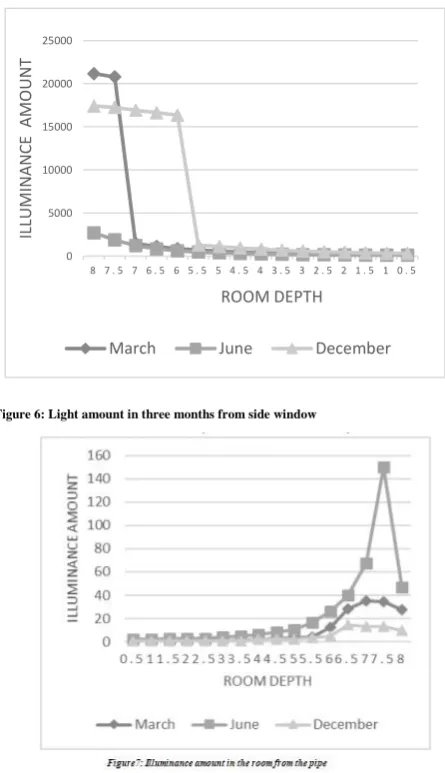
Figure 6: Light amount in three months from side window Flat roof with two roof decks
0 5000 10000 15000 20000 25000
8 7 . 5 7 6 . 5 6 5 . 5 5 4 . 5 4 3 . 5 3 2 . 5 2 1 . 5 1 0 . 5
IL
LUMI
N
A
N
CE
AMO
UNT
ROOM DEPTH
213
meter radius approximately for usual tasks. On the other side, by analyzing both sources in the room, it is clear that in some hours in different months, light intensity is higher than normal ranges, and it is annoying for occupants.
.1
3 .Quantity of illuminance
The quantity of illuminances had been concluded from simulation in a clear and sunny sky, and it had been analyzed in the southern façade on the height of work surface 80 centimeter. As it said before, this room has two light source, side window, and vertical light pipe.
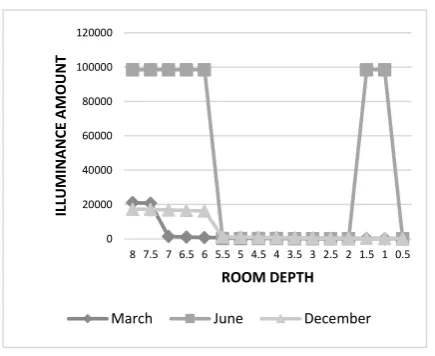
As it has shown in the data charts, sufficient illuminance had been provided in January, February, September, October, November, December, August, in the middle hours of the day. In the initial hours of the day,
Figure 8: room section Illuminance amount in three months from side window
Chart (1). Maximum illuminance amount on the work surface at the depth of 7meter (lux)
Month of the year
7 8 9 10 11 12 13 14 15 16March
98.16 51.32 93.79 121.53 143.82 172.96 155.04 13 3.51
108. 68
61 .12
April
35.44 55.59 78.22 107.54 137.39 134.50 123.61 10 1.84
74.4 8
55 .94
May
39.34 59.46 71.311 93.43 141.51 137.39 124.69 93.16 72.32 57.19June
41.71 50292.1 65924.3 77817.7 86778.2 98480.1 131.75 98.16 66589.7 51070.3
July
37.56 55.94 66.15 100.59 134.50 137.39 123.61 107.54 74.48 55.59August
32.03 56.24 79.24 102.78 121.46 165.1 131.96 106.77 80.27 57.41September
32.02 66.90 101.76 134.10 157.91 165.1 150.85 120.55 85.21 55.66October
32.86 80.27 127.78 177.56 200.98 216.77 103.19 160.65 103.19 53.53November
31.08 81.20 155.42 227.89 260.46 272.87 245.32 197.50 129.05 52.65December
26.88 67.82 162.41 148.43 288.59 292.63 291.48 231.17 143.21 66.01January
21.82 56.35 125.09 208.98 262.73 292.63 259.72 221.35 143.443 78.84February
22.86 63.25 111.57 165.63 193.38 198.45 198.45 178.16 126.92 75.060 20000 40000 60000 80000 100000 120000
8 7.5 7 6.5 6 5.5 5 4.5 4 3.5 3 2.5 2 1.5 1 0.5
IL
LU
M
INA
NC
E
A
M
OU
NT
ROOM DEPTH
illuminance is not sufficient but, gradually it had been provided by soaring the sun. In the other side, on 22th of June, illuminance of the space had been provided, while it made increasing in illuminance heat, that causes occupant discomfort and it should be considered.
3.2.Quality of illuminance
3.1. Light uniformity
Chart (2) Uniformity analyze on the work plane on the first desk at 12 ‘o clock in a year
D ec ember N o v embe r Octo b er S ep te mbe r a u g u st J u ly J u n e M a y A p ri l M a rc h Fe b ru a ry J a n u a ry 0.126 0.107 0.114 0.149 0.149 0.55 0.99 0.206 0.206 0.145 0.1269 0.1269
Analyzing light uniformity in different months showed that in the hot months like June and July, this factor is near the standards, but in other months they ‘re below acceptable ratio. Therefore, illuminance amount of light pipe, the workplace position, and window position should be reconsidered and changed.
Chart (3) Uniformity of whole room on the work plane at 12 ‘o clock in a year
According to the analysis extracted from simulations, problems like not having uniformity, glare, not having sufficient illuminance at the end depth of the room, not having sufficient sight, had been observed that can be solved with second light source and the changes in reflecting material.
It has been cleared that in different months, light pipe is efficient in January, April, May, July, September, and its efficiency has been increased, when it closes to midday times.
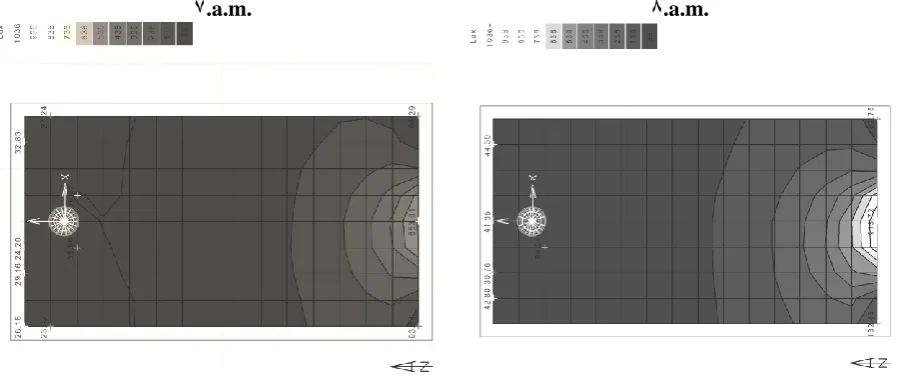
Figure (9) Illuminance distribution in office room plan in 1st of June (22th Khordad).
215
10.a.m.
9.a.m.
12.a.m.
11.a.m.
4.p.m.
3.p.m.
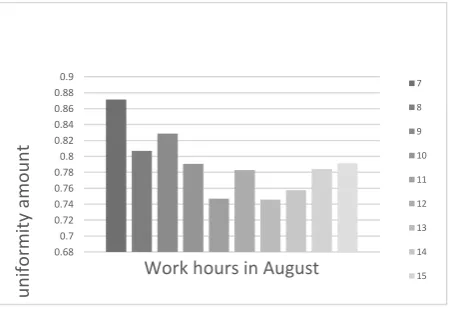
Also dispersed reflections at seven a.m. and four p.m. had been reported according to simulated plans, while analyzing the uniformity at the end of the room showed, low light intensity and low light uniformity for most points of the room had been observed, and normal range in August as a sample.
These defections should be considered to solve. In other times, light intensity is lower than considered light standard, except at 13‘o clock.
In the distribution matter, the results had shown that dispersed light had been diminished in October and
September, and it faces with concentration of light distribution in some months about 12 o’clock. Actually, in months such as June and July.
According to analyzed data of whole months through a year, in April, May and August, this light pipe cannot afford sufficient illuminance for usual tasks or clients waiting seats. It’s better to change the reflective materials in transferring part or change the system to get another result. It’s obvious that the room depth has direct effect on harvested illuminance at the end of the room. June is a month with maximum illuminance, that is higher than standards.
Although one pipe can provide sufficient illuminance for 4 meter width, but the illuminance is not enough at the end points of the room. Adding pipes can help us to reach standard illuminance of the space. Optimum distance can be gained by analyzing different length of the room. 10 ,8 ,6 meters room width is not supported by one pipe. Light distribution and light amount is below acceptable standards. The width more than 4 meter needs more than one pipe. Best destination tube and window, in the room with 8 meter width is 3 meter and should use more than 1 window in order to provide sufficient light in this width. The illuminance of the room with 10 meter width is not supported by two window illuminance.
5 -It has been analysed because of Highest range of uniformity in the analysis
Figure 10: Uniformity in Workhours in August5 at the depth of 7m in the room from the window.
0.68 0.7 0.72 0.74 0.76 0.78 0.8 0.82 0.84 0.86 0.88 0.9
u
n
if
o
rm
ity
a
m
o
u
n
t
Work hours in August
7
8
9
10
11
12
13
14
217
Studies showed that illuminance is not sufficient for 10 meter depth at 9 o’clock and 12 o’clock. The observed illuminance is below the officer and clients standard lights.
4.
ConclusionAs energy crisis building industry becomes one of the
effective parts of sustainable progress in
communities, it guides us to provide efficient light, by using lightpipes as daylight guidance system. Evidances show that the darkness of sidelight rooms in more than seven meter depth, and the electric lamps are being used. The quantity of illuminances is concluded from simulation in a clear and sunny sky, and it is analyzed in the southern façade on the height of work surface 80 centimeter. Dispersed reflections at seven a.m. and four p.m. on June 1st are observed from simulated plans, while analyzing the uniformity at the end of the room showes, low light intensity on the January1st at 7 a.m. is 21.82 lux and low light uniformity for most points of the room as a sample 1st of June with range of 0.003 unifromity for whole room, and normal range of uniformity in August as a sample. This light pipe cannot afford sufficient illuminance for usual tasks or clients waiting seats in all months through a year, except in April, May and August.
The light pipe provides a sufficient illuminance in January, February, September, October, November,
December, August at the 11, 12 a.m. In the 7, 8 a.m., the illuminance is not sufficient but, gradually it is provided by soaring the sun. In the other side, on 22th of June, illuminance of the space is provided, while it makes increasing in the illuminance heat that causes occupant discomfort, and it should be considered. As it infered from the text, 10, 8, 6 room width is not supported by one pipe. Light distribution and light amount is below acceptable standards. The width more than 4 meter needs more than one pipe. Best destination tube and window in the room with 8 meter width is 3 meter and should use more than one window in order to provide a sufficient light amount in this width.
Analyzing uniformity results of the light pipe in a sidelight room showes that, in the hot months like June and July this factor is near the standards, but in other months, they‘re below acceptable. It’s higher in spring and autumn. Therefore, daylighting process should be revised in the glare and illumination distribution in the different times.
4.1. Objective
In order to improve health and comfort in buildings, reducing energy demand and energy costs daylighting systems had been used. In this research, intensity and defections of effective factors like light sufficiency and uniformity
Figure 11: Illuminance of a room with 10 meter width on June 22th at 9 and 12 o’clock.
Figure 12: Illuminance of a room with 10-meter depth on June 22th at 9 and 12 o’clock.
950 850 750 550 450 250 150
550 450 350 250 150 750 650 550 450 350 150 50
had been compared and analyzed. Window size and position, contrast amount, light uniform distribution, annoying reflections, convenient color temperature, sufficiency of illuminance, are parts of these factors. According to simulations in the first level, matters like glare, light concentration, light insufficiency had been shown in some hours. In the second, simulation it had been tried to diminish glare by adding light pipe at the end of the room, increasing amount of light by reducing the destination between main and false ceiling. Findings suggest that this light pipes could also be used in other types of buildings, if the issues like glare and illumination distribution would be solved.
5.
Acknowledgment5.1. lightsufficiency
Working in different spaces needs enough light in the position of working tasks that affects visual comfort. This factor can be controlled by the amount of light that distributed through the light tubes. The signs that light loss can be concluded from in working space, are changing the work surface position to get more light, or moving the worker to get closer to the tasks.
Chart (4) standard illuminance for different places. [4]
Minimum
suggesting
Offices and department
200
500
Common works
1300
600
Writing machine and dictation space
2300
600
accountancy, accounting and indicator machine
3100
0
30
Archive
4
500
100
Drawing room
5200
500
Conference room
6150
500
Waiting and information room
7100
150
Stairs
850
150
common works
9100
200
shelves in vertical surface
1100
200
Study room
2300
500
Study desk
35.2. Light distribution
“To avoid complaints about non-uniform lighting, it is necessary to have limits on how much the illuminance on any single work surface is allowed to drop below the average. For any individual work surface, like a desk, the illuminance uniformity (the ratio of the minimum illuminance /average illuminance) should not be fewer than 0.7. U.R= M.L/A.L Most offices are furnished with many desks or workstations. To ensure different desks or workstations are perceived to be treated equally, “the
illuminance uniformity (minimum average
illuminance on the desks/ overall average
219
6.
Reference1.
Anurag Gupta, J. L. ( 2001, August 1). Design ofefficient lightpipes for illumination by an analytical approach. APPLIED OPTICS, 3640-3649.
2.
Baroncini, C., Boccia, O., Chella, F.and Zazzini, P., 2010. Experimental analysis on a 1:2 scale model of the double light pipe, an innovative technological device for daylight transmission. Sol. Energy 84, 296–307.3.
Boubekri, M. (2008). Daylighting, architecture and health : building design strategies.4.
building, c. a. (1382). thirteenth national building dicipline .5.
Canziani, R., Peron, F., & Rossi, G. (2004). Daylight and energy performances of a new type of light pipe. Energy and Buildings, 1163-1167.6.
DeKay, M., & Brown, G. (1393). Sun, Wind &Light: architectural design strategies, 2nded c2001. Tehran: Parham Naghsh.
7.
Foolady, V., BavagharZaimi, M., and Fatemah, J.(1392). Adaption comparison of contemprory and conventional iran architecture (case study of Shiraz khan school university and Saadi inital 15 class school in Shiraz). First national confrence of architecture,renovation, urbanism, sustainable biology environment. Community of biology environment evaluater of Hegmataneh.
8.
CIE, 2006. Technical Report: Tubular Daylight Guidance Systems Vienna, Austria, Commission Internationale de L’Eclairage: 75.9.
Derlofske, J. F., & A. Hough, T. (2004). Analytical model of flux propagation in light-pipe systems. Opt. Eng, 1503–1510.10.
Garcia-Hansen, V., Edmonds, I. (2015). Methodsfor the illumination of multilevel buildings with vertical. solar energy.
11.
Ghiabakloo, Z. (1394). Fundamentals of BuildingPhysics5, Daylighting. Tehran: lication,
Amirkabir University of technology Branch.
12.
Hamzah, T.R., Bhd, Y.S., Hansen, G., Edwards,I., Hyde, R., 2003. Light Pipes: An Innovation Design Device for Bringing Natural Daylight and Illumination into Buildings with Deep Floor Plan.
13.
Heydari, S. (1388). Architecture and illuminance.Tehran: Tehran university publication.
14.
Joseph, A. a. (1996). U. S. Patent No. 5,546,712. United States Patent and Trademark.15.
Jenkins, D., Muneer, T., & Kubie, J. ((2005)). A design tool for predicting the performances oflight pipes. School of Engineering, Napier University, Edinburgh EH105DT, UK, 485,492.
16.
Kennedy, D. M., Rourke, F. (2015).Experimental analysis of a scaled, multi aperture, light-pipe, daylighting system. Solar Energy.
17.
Li, D. H., K.W.Tsang, E., Cheung, K., and Tam,C. (2010). An analysis of light-pipe system via full-scale measurements. Applied Energy, 800-805.
18.
lighttubes lightway (2017). Retrieved fromlightway: http://
www.lightwaydaylight.co.uk/_files/lightway daylight
19.
Meteorology office of Farsprovince.Shiraz.(1395)
20.
Miroslav Kocifaj, F. K. (2010). Theoretical solution for light transmission of a bent hollow light guide. Solar Energy.21.
OBH, H. (1901). Apparatus for transmittingsunlight into basements or other. US patent no. 668,404.
22.
Peter Boyce, P. R. (2009). The SLL Lighting Handbook. Balham High Road, London: The Society of Light and Lighting.23.
Peter G. Ellis1, R. K. (2004). SIMULATION OFTUBULAR DAYLIGHTING DEVICES AND
DAYLIGHTING SHELVES IN
ENERGYPLUS. IBPSA-USA National
Conference (pp. 1-9). University of Illinois at Urbana-Champaign: National Renewable Energy Laboratory, Golden, CO.
24.
R.M. Nader Saraiji, R. M. (1995 ). Modeling Light Transfer through Optical Fibers for Illumination Applications. THE 1995 IESNA ANNUAL CONFERENCE (pp. 128-139). The Pennsylvania State University, University Park, PA.: Journal of the Illuminating Engineering Society.25.
Sertac¸, G., & Nazmi , E. (n.d.). Energy saving in lighting system with fuzzy logic controller which uses light-pipe. 172-176.26.
Shokriharati, A. (1394). Design of the movable facade in the way of controling sunlight in officebuildings. Mazandaran: University of
Mazandaran, arcitecture and art college.
28.
Steemers, K. (1994). Daylighting design: Enhancing energy efficiency and visual quality. Renewable Energy, 5(5-8), 950-958. Retrieved August 199429.
Wang, N., & Boubekri, M. (2009). A proposal for a behavioral approach to daylighting design. Light and Engineering, 79-87.30.
Zarei, S., and Ghiabakloo, Z. (1392). potential test of reducing the electric energy usage inofficial buildings of tehran by using solar facade.
3th Annual Clean Energy Conference
(ACEC2013). Kerman: supplementary education of Kerman university of industry and high technology .