OF
LETHAL MUTATIONS I N HABROBRACON’
GERTRUDE HEIDENTHAL Wellesley College, Wellesley, Massachusetts
Received November 17, 1 9 4
INTRODUCTION
H E PARASITIC wasp, Habrobracon, has been considered of special
T
value in connection with studies of dominant lethals because of its some- what exceptional method of breeding. I n “out-crosses,” now called three-allele crosses because they involve triple alleles a t the sex locus, all fertilized eggs develop into females, unfertilized ones into males (WHITING 1937a, 1940, 1943). It follows, then, that if a sperm bearing one or more dominant lethals fertilizes an egg, a potential female is lost. Statistically the result of an ap- preciable number of such events would be a depression in the number of fe- males. But the number of males should remain unaltered, since the frequency with which they occur is determined by the proportion of cases in which sperm fail to enter the eggs, and not, therefore, by the constitution of the sperm. Sex-ratios, then, would be expected to vary in accordance with the incidence of dominant lethal-bearing sperm produced by the father.Several authors have made use of the foregoing argument (STANCATI 1932;
BISHOP 1937; WHITING 1937b, 1938; MAXWELL 1938). The results of their ex- periments have agreed in showing that the numbers of females could be re- duced or even eliminated in three-allele crosses of females by males bearing sperm in which dominant lethals had been induced by X-radiation. WHITING’S
data indicated that a t dosages of about 10,000 r units, practically every sperm
contained a t least one dominant lethal change (number of F1=.07 per $2 per day). At lower dosages ( 2 5 0 0 r, 5000 r, 7500 r), the numbers of female progeny
per day varied inversely with increasing dosage.
The present work was undertaken with the purpose of supplementing the known data by securing larger numbers of progeny and estimates for dosages a t smaller intervals. This would allow the construction of a curve showing the relationship between dosage and mortality of females. The author is grateful to
l
k
P.w.
WHITING for proposing the project and for materials and helpful suggestions during the course of the work.METHODS AND RESULTS
The usual methods used in breeding Habrobracon are rather simple. One or several females are placed in a shell vial with five or six large, active cater- pillars of the Mediterranean flour moth, Ephestia kueniella Zeller. Within a few hours the females have stung the caterpillars, immobilized them, and fed
The work reported in this paper was made possible by a grant from the ROCKEFELLER FOUNDATION to the UNIVERSITY OF PENNSYLVANIA. The investigations were carried on in the Department of Zoology of the University aud at the MARINE BIOLOGICAL LABORATORY, Woods Hole, Massachusetts.
198 GERTRUDE HEIDENTHAL
upon their body fluids. Subsequently, the eggs are laid on the surface of the host, and development proceeds. But the yield of adult progeny depends upon a number of variables. The largest numbers of eggs are produced when the mothers are sufficiently young, the caterpillars large, the conditions of tem- perature fairly high (3oOC). Hatchability of the eggs of good stocks under favorable conditions is ninety or more percent. The yield of adult progeny, however, is ordinarily smaller. Wastage may be due partly to competition among the larvae for limited food supply and partly to detachment of eggs and larvae from their hosts. The latter commonly results when caterpillars have crawled to the top or sides of the vial prior to being stung. Losses can be reduced by a rather simple procedure involving the feeding of caterpillars which have already been stung and thus immobilized. The female wasps which are employed to sting the caterpillars are first sterilized by a dosage of 8-
10,000 r units of radiation to prevent contamination of the experimental cul-
tures by their eggs. The damage to ovaries and to any stored ova is so severe that oogenesis stops, and all but a few eggs which are laid soon after treatment are inviable.
The above considerations were taken into account because the study of sex ratios required the production of large numbers of progeny. It was already known that well fed, rather young females of good stock would lay 20 or more
eggs within a 24-hour period, and it was thought that under suitable condi- tions, a high proportion of these could be reared to maturity.
The purpose of the first experiments was to secure counts of the female and male adult progeny produced by females which had been out-crossed to irradi- ated males. Since the plan called for the use of 20 X-ray dosages, it was im-
possible to do all of the breeding work in a single experiment. Adequate num- bers were therefore secured by accumulating the data from seven smaller experiments. The practice adopted was to use only ten dosages a t a time and to space them a t intervals of 1,000 r beginning either with 500 or 1,000 r.
Such staggering of dosages from experiment to experiment would be expected to help in minimizing any systematic errors in the final results, I n only one of the seven experiments were data secured for each of the 20 dosages.
The actual technique in a given experiment maynow be described. Ten groups of haploid males of stock I were X-rayed a t intervals of 1000 r units, the lowest dosage in a given experiment being either 500 r or 1000 r, the highest
9500 r or 10,000 r, respectively. The conditions of radiation were kept as con-
stant as possible throughout the entire series of experiments: zoo kv, 2 5 ma, 21 cm S.T.D., inherent filter equivalent to 4 mm Al. The output ranged from
550 r to 880 r per minute.2 Within an hour or so following the treatment, each male was mated to a virgin female of wild type stock 33. Females were cul- tured individually in vials, each of which was supplied with s k i or seven “pre-stung” caterpillars. Transfer to new vials occurred every two days for a total egg-laying period of ten days. The adult progeny were counted soon after eclosion.
in Philadelphia, for kindly consenting to give the X-ray treatments.
The data and calculations secured a s a result of the first experiments are summarized in table I. Adult progeny were either females or azygous males.
No diploid males could arise because there was no possibility of homozygous diploid eggs, since stock I bears the sex alleles xg and xh, and stock 33, xe and x j . It can be seen from table I that among both the mated and unmated con- trols, the average number of adult progeny per female per day was about nine (8.85 for the unmated controls, and 6.59-kz.87 for the mated controls). The
TABLE I
Data and calculations on adult progeny counts secured in thejirst experiments.
__
TOTAL TOTAL $? $? Y E A N N O . ? $?
TREAT- MENT TO 8
TOTAL ? TOTAL $ EGG- MEAN $? $? MEAN $8
COUNT COUNT LAYING PER DAY PER DAY TOTAL MEAN NO.
DAYS PROGENY CONTROL $? $?
Unmated controls Mated controls Soor Iooor
I Soor 2000r 2500r 3000r 3500r 4ooor 4500r 5ooor 55oor 6000r 65oor 7ooor 7500r Rooor 85oor gooor 95-r Io,ooor 3111 1402 I754 I376 978 667 373 253 189 85 I09 54 32 18 I4 I4 5 9 I 2 2 I 3966 I355 1177 1263 1366 I215 1163 1068 I095 1076 940 1308 977 I093 1192
I 166 1055 1387 99' I317 1158 1105 448 472 344 380 334 368 314 244 302 344 344 310 314 324 306
2 84 316 352 290 334 292 308
8.85f .30
6.59f .23 2.87f .14
4.62f.17 3.32f.10
2.66f.14 3.28f.16
2 . 1 2 k . 1 2 3.70f.20 1.53k.11 4.38f.22 .83+ .07 3.63f . 2 2
6.29f.18 3.42f.22
4.12f.19 4.09k.22
. 6 1 f . O 5 3.52f.22 .2Sf.O3 2.73k.17 .31f.o6 2 . 5 8 f . 2 0
.17+-.03 3.15f.21 .1of.oz 3.48f.27
. o g f . o r 4.11f.26 .06f .02 3.77f . 2 2
.O4f . O I 3.34f . 2 1 . O I f . O I 3.94f . I 7
.o3f.o1 3.42f.22
.
00 3 . 7 8 f . 23.
00 3 . 7 8 f .27.O4f .01 3.93f .23
* 70 -54
.so
* 45 -37 .26 .18
.
I5 .08 .08*os
-03
-58
. 0 2
.
01.
01.
00.
01.
01 .oo .ooI .oo e98
.63 .70
* 40 * 32
-
23 -13-04 * 05 * 03 . I O
. 0 2 . 0 2
.OI
. O I
ratio of females to males among the mated controls was 3111: 1355 or 2.29: I.
Thus 7 0 percent of the total progeny was female. An inspection of the table shows that the mean number of. females per day decreased with increasing dosage in such a way that a t roughly 10,000 r virtually no females appeared. The corresponding percentage of females in the total progeny decreased from
7 0 to 0. But the occurrence of males per day was fairly stable (range=2.58
200 GERTRUDE HEIDENTHAL
the numbers of males per day. This matter will be discussed later in connection with another group of experiments.
The data of table I are summarized in a somewhat different way in figure I,
where percentage of female mortality is plotted against dosage in r units, Since the curve becomes nearly asymptotic a t 5000 r, it has not been extended
to include dosages of higher value. Figure I also shows three other curves
1w
m
c-
0
Dosage in roentgens
-
Adult wasps failing to emerge--
--- Drosophila eggs of Oregon R stock failing to hatch, (SONNENBLICK)---
Drosophila eggs of Oregon R stock failing to hatch (DEMEREC and FANO)---
Adult Drosophila of Oregon R stock failing to emerge (DEMEREC and FANO)FIGURE I.-The effects of increasing dosages of X-ray on the incidence of adult wasps, the hatchability of Drosophila eggs, and the incidence of adult Drosophila. (Redrawn from Sonnen- blick and from DEMEREC and FANO.)
taken from the work of SONNENBLICK (1940) and of DEMEREC and FANO
(1944), and redrawn for purposes of comparison with the curve for Habro-
to that secured for Habrobracon. Of more pertinent interest, perhaps, is a comparison of the curve for Habrobracon with that which reflects the per- centage of adult Drosophila which fail to eclose after irradiation. Here it may be seen that the correspondence in contour, although not exact, is sufficiently close to suggest that similar mechanisms may operate in the production of dominant lethals in the two animals.
Before proceeding with a discussion of the next experiments, it will be neces- sary to return to a consideration of table I . The data given there show two
points which require further comment. It has already been indicated that among the controls there was an average of about nine progeny per female per day. This value is known to be low in terms of the numbers of eggs which are laid ( 2 0 or more per day). It is evident, then, that in spite yf the care in feeding,
there must still have been a considerable wastage of eggs. Too low a food sup- ply was indicated by the fact that in vials containing the most progeny, the caterpillars were almost entirely consumed. Competition for food was thought to account for the relatively low numbers of males per day among the mated controls (2.87) compared to values secured for most experimental groups- that is, the t value for the significance of the difference between the mean number of males for the mated control group and for the azygous sons of fe- males mated to males treated with 3000 r=4.3. Fluctuations of this sort ap- peared to be sporadic and not associated with dosage. The question rose a s to whether such differences would persist if a technique were devised in which even a greater proportion of the eggs were brought to maturity.
A method which was designed to account for eggs, larvae, and adult progeny was finally developed. Haploid males of stock I were X-rayed and out-crossed
to virgin females of stock 33. Then each female was placed on a glass plate with one large, “pre-stung” caterpillar, and covered. Transfer to another cater- pillar was made every twlve hours for a period of five days. As soon as the eggs and later the larvae had been counted, the larvae were distributed on new caterpillars a t the rate of five or fewer per host. Host and larvae were then placed in glass vials and incubated a t about 30°C. Counts were made of adult progeny a short time after eclosion.
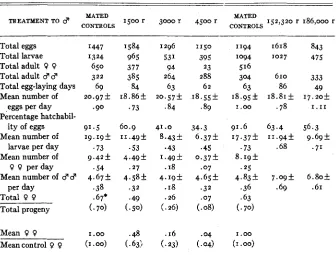
The data secured from experiments in which the new technique was em- ployed are summarized in table 2 . This represents the results of two experi- ments, one involving the three lowest dosages and conducted in Philadelphia, the other involving the two highest dosages and conducted a t Woods Hole? An examination of the table shows that among the mated controls, eggs ma- tured to eclosion a t the rate of 14.1 per day (9.4 0 +4.7 3 ) in the first experi- ment and 13.0 per day (8.2 9 +4.8 3) in the second experiment. Previous experiments had given a comparable value of about 9. Percentages of hatch- ability showed a steady decline from mated controls to 4500 r (91.5 to 34.3
2 0 2 GERTRUDE HEIDENTHAL
percent), although the mean numbers of eggs per day remained about con- stant for the d s e r e n t groups. The percentages of females among the total progeny and the percentage survival of females are closely paralleled by values derived from similar data of the first experiment. The most significant differ- ence between the data from the earlier and present experiments is in the num- bers of males per day. The more carefully controlled experiment gave very
TABLE 2
Data and calcdations on egg, larva and adult progeny counts secured in the second experiments.*
TREATMENT TO 8 MATED
CONTROLS 1500 r 3000 r
MATED
CONTROLS 152,320 r 186,000 r
Total eggs Total larvae Total adult 0 0
Total adult 8 d
Total egg-laying days Mean number of
eggs per day Percentage hatchabil-
ity of eggs Mean number of
larvae per day Mean number of
0 0 per day Mean number of 8 d
per day Total 0 0
Total progeny
1584 965
385 84 18.86f
.73 377
41 .o 8.43+
e43 1 . 4 9 f
.I8 4 . 1 9 f
.
I8 .26(. 26)
1150 395 23 288
62 I8.55+
9 89
1'94 I094
516 304 63 18.95f
I .oo
1618
1027
610 86 I8.8If
.78
843 475
333 49
1 7 . 2 0 f 1.11
56.3 9 . 6 9 f
.?I
6 . 8 0 5 .61
*
Values in parentheses copied from table I, for comparison,uniform values (4.19 to 4.67 per day) for all groups. This is the result expected but not satisfactorily attained in the earlier experiments.
indicated 3.12 males per day for unmated controls, 1.05 for mated controls,
and 2.b1 for out-crosses of virgin females bred to irradiated males.
The experiments with high dosage were carried out a t Woods Hole where high intensities are delivered by two water-cooled G.E. (XTP) tubes in op-
posed position. The output a t 182 kv, 25 ma, and distance equal to 9.5 cm,
was estimated a t 4480 r per minute. A t a distance of 14.4 cm, the output was
2400 r. Two experiments were performed. I n the first, a total dosage of 152,320
r was delivered a t a distance of 9.5 cm; in the second, 168,000 r a t 14.4 cm. Before proceeding with a discussion of the results obtained for high dosages, an unexpected observation should be mentioned. I n the first and all later attempts to give treatments a t high dosages, it was noticed that the wasps began to look “sluggish” after having received about I 25,000 r, although
precautions had been taken to eliminate effects due to heat (by fans and water coolers). If the treatment was stopped a t this dosage and the wasps returned to glass vials, a kind of recovery occurred. That is, a t the end of a few hours or less, a vigorous, normal activity was restored, and observed matings were rather easily secured, A t somewhat higher dosages, roughly 150,ooo r to
170,000 r, the “sluggishness” was more marked but the recovery good. A t
still higher dosages, 249,000 r and 300,000 r, recovery did not occur, although slight twitchings could be seen immediately after the treatment. The wasps which received 152,320 r and 168,000 r were nearly immobile after treatment. But within about four hours, they had recovered sufficiently to permit observed matings, and no deaths occurred within the following two days. Tests for sperm inactivation were made by counting the eggs, larvae, and adult progeny produced by the impregnated females throughout a period of eight egg-laying days. Control counts were made from comparable crosses of virgins of stock
33 by untreated males of stock I. The data are summarized in table 2.
A comparison of the data for the mated controls with those for the experi-
mental groups readily shows a significant difference between the means of adult male progeny ( t = 2.9 for the difference between 4.83f
.36 and 7.09+ .69, and t = 2.8 for the difference between 4.83 & .36 and 6.805.61). The relatively large values for the adult progeny were foreshadowed by a high rate of hatchability among the eggs (63.4 percent and 56.3 percent, as compared to 34.3 percent for a dosage of only 4500 r). I n fact, the rate of hatchability for very high dosages was about the same a s that for only 1500 r. Such percentages offer strong evidence that the high dosage of radiation had in some way interfered with the fertilization process.204 GERTRUDE HEIDENTHAL
there were no ipterference with the fertilization process. If sperm were inacti- vated, the calculated value would be too low, because unfertilized eggs are expected to be male.
The expected numbers of larvae for low dosages can also be calculated. Here the number of male larvae should equal the number of eggs laidX.33
X.92. The number of female larvae should be equivalent to: number of eggs
laid
X
.67X
.92X
R/2.02, where .67 represents the percentage of fertilized eggs, .92 the normal hatchability rate, 2.02/1 the ratio of adult females to malesamong controls, and R the ratio of adult females to males a t a given dosage. Calculations for the expected numbers of larvae are presented in table 3.
TABLE 3
A comparison of larvae obserued'and expected when treatment of the sperm is assumed to have no eject on the fertilizing capacity.
OBSERVED PERCENTAGE OF EXPECTED PERCENTAGE OF EGGS
LARVAE EGGS HATCHED LARVAE EXPECTED TO HATCH
TREATMENT TO 8
I Soor 965 61 954 60
3ooor 53' 41 553 43
45oor 395 34 381 33
152,320r 1 0 2 7 63 551 34
168 ,ooor 475 56 287 34
Here it may be seen that there is only a slight discrepancy between the num- bers of observed and expected larvae, for the three lowest dosages.'These dif- ferences may readily be accounted for on the basis of errors of sampling. But a t the two highest dosages, the differences are conspicuous. Sperm must have failed to enter the eggs in an appreciable number of cases (about 40 percent). One can only speculate as to whether the effect on the sperm was direct or by way of fluids in which they were suspended.
SUMMARY
Haploid males of the parisitic wasp, Habrobracon, were X-rayed with dos- ages ranging from 500 r to 10,000 r units and crossed to untreated females of
an unrelated stock. Diploid females are expected to rise from the fertilized eggs, haploid males from the unfertilized ones. The number of females per day decreased with increasing dosage. Dosage of roughly 10,000 r induced a t least
one dominant lethal in every sperm. The number of males per day remained relatively constant. Mortality of females when plotted against dosage gave a non-linear relationship.
Special techniques which allowed the counting of eggs and larvae, as well as adult progeny, indicated a decrease in hatchability and adult female prog- eny, a highly uniform number of males per day for dosages up to 4500 r. But the number of males for very high dosages, 152,320-168,000 r, showed a
LITERATURE CITED
BISHOP, D. W., 1937 Induction of dominant lethal effects by X-radiation in Habrobracon. Genetics 22: 452-456.
DEMEREC, M., and U. FANO, 1944 Frequency of dominant lethals induced by radiation in sperms of Drosophila melanogaster. Genetics 29: 348-360.
MAXWELL, JANE, 1938 Inactivation of sperm by X-radiation in Habrobracon. Biol. Bull. 74:
253-255.
SONNENBLICK, B. P., 1940 Cytology and development of the embryos of X-rayed adult Drosoph- ila melanogaster. Proc. Nat. Acad. Sci. 26: 373-381.
STANCATI, M. F., 1932 Production of dominant lethal genetic effects by X-radiation of sperm
in Habrobracon. Science 76: 197-198.
WHITING, P. W., 1937a Habrobracon as a means of testing the effectiveness of physical agents in causing mutations. Proc. Penna. Acad. Sci. 11: 50-52.
1937b A convenient test of physical agents as producers of dominant lethals. The Collecting Net (Woods Hole) 12: 120-130.
1938 The induction of dominant and recessive lethals by radiation in Habrobracon. Genetics
23: 562-572.
1040 Multiple alleles in sex determination of Habrobracon. J. Morph. 66: 323-355. 1943 Multiple alleles in complementary sex determination of Habrobracon. Genetics 28: