MULTI-OBJECTIVE OPTIMIZATION OF SUB-ASSEMBLIES DESIGN
TOWARDS STATIC MECHANICAL EQUILIBRIUM OF
SODIUM-COOLED FAST REACTOR CORE
Pierre Lamagnère1, Saied Dardour1, Romain Dos Santos1, Alexandre Freiermuth1, Michel Marqués1, Nadia Pérot1 and Nicolas Schmidt1
1
CEA Cadarache, DEN/DER/SESI, F-13108 Saint-Paul-lez-Durance, France
ABSTRACT
In the framework of Sodium-cooled Fast Reactors, core design studies are performed at CEA. A new methodology based on multi-objective optimization is proposed taking into account the geometrical uncertainties on sub-assemblies arising from manufacturing tolerances for core static mechanical equilibrium analysis. This methodology relies on feedback from past reactors, especially Phénix and Super-Phénix. As an example, the optimization is performed on a reduced number of parameters (distance across spacer pads, natural core restraint by radial neutron shielding sub-assemblies, pads axial position and stiffness).
The core thermo-mechanics code: HARMONIE V2 and the uncertainties platform: URANIE are used to define a first set of optimal features of the sub-assemblies. The core behaviour is analysed during nominal conditions, fuel handling operations and unprotected transients (i.e. with complete failure of all automatic shutdown systems).
First results tend towards to give priority to high pads flexibility in order to minimise friction between assemblies during handling operations. All assemblies, including radial neutron shielding sub-assemblies, should be equipped with spacer pads for core restraint requirements. The effect of pads axial position over the core static mechanical equilibrium is limited, but pads located close to the top of fuel pins favour the “pads effect” during an unprotected transient.
INTRODUCTION
The core design of Sodium cooled Fast Reactors uses sub-assembly ducts to support fuel elements. The positions of the core assemblies and their mechanical interaction have to be controlled owing to their effect on the core safety and performance, Briggs et al. (2014). The main operational constraints are related to core reactivity control, fuel handling and shutdown system reliability. As far as core assembly duct bowing due to thermal expansion, irradiation swelling and duct-to-duct interaction occurs during the reactor lifetime, a core restraint system is needed. In France, since Phénix and Super-Phénix, the core design relies on natural core restraint, Bernard (1979).
23rd Conference on Structural Mechanics in Reactor Technology Manchester, United Kingdom - August 10-14, 2015 Division IX (include assigned division number from I to X)
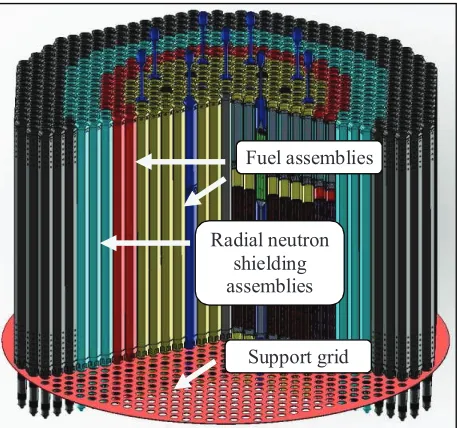
Figure 1. Schematic view of a fuel sub-assembly.
Figure 2. Schematic view of the arrangement of the assemblies on the support grid.
However, the core geometry has to be evaluated throughout the reactor lifetime to demonstrate the core safety and performance. The core thermo-mechanics code HARMONIE V2 has been developed to calculate static mechanical equilibrium of Phénix and Super-Phénix cores, Bernard et al. (1983). The results of the calculation are the evolution of the deformation of the assemblies and duct-to-duct interaction forces during normal operation, the handling forces during refuelling operation and the evolution of core geometry during loss of flow transient events. These results are then compared to the operational constraints defined above.
In this study, the HARMONIE V2 code has been applied to develop a new methodology to optimize the design of sub-assemblies towards static mechanical equilibrium. The objective of this methodology is to design the assemblies (inlet nozzle, spacer pads and hexagonal duct) and support grid (grid pattern and inter-assembly gap) in order that all the operational constraints are fulfilled taking into account the geometric uncertainties relevant to manufacturing tolerances.
Inlet nozzle Outlet
head
Spacer pads area
Hexagonal duct
Fuel assemblies
Support grid Radial neutron
In this paper, we first present the purpose and the input data of core static mechanical equilibrium analysis. Then, we describe how the effects of geometrical uncertainties arising from manufacturing tolerances are taken into account. Finally, the methodology developed to optimize the core design towards static mechanical equilibrium is presented.
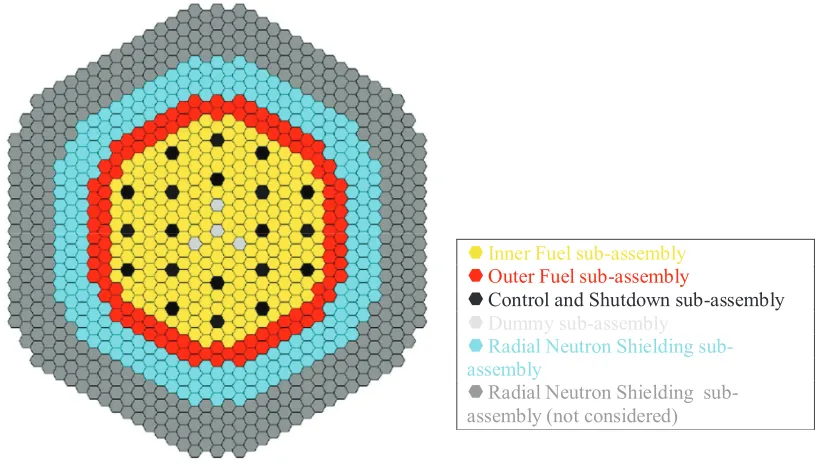
This new methodology has been applied in the framework of core design studies performed at CEA to calculate the static equilibrium of a CFV core concept. CFV core concept is an heterogeneous core based on the introduction of a sodium plenum zone, an absorbing zone in upper neutron shielding and an internal fertile zone in a specific core geometry that leads to a low total sodium void effect, Vénard et al. (2015). A schematic view of CFV core is shown in Figure 3.
¤Inner Fuel sub-assembly
¤Outer Fuel sub-assembly
¤Control and Shutdown sub-assembly ¤Dummy sub-assembly
¤Radial Neutron Shielding
sub-assembly
¤Radial Neutron Shielding
sub-assembly (not considered)
Figure 3. View of the sub-assemblies array of a natural restrained CFV core.
CALCULATION OF CORE STATIC MECHANICAL EQUILIBRIUM
The HARMONIE V2 code has been developed to calculate static equilibrium conditions in the sub-assemblies array of natural restrained liquid metal fast breeder reactors cores. This 3-D code takes into account the duct bowing due to thermal gradient and irradiation swelling gradient, the change of inter-assembly gap at spacer pads level due to thermal dilatation, irradiation swelling and creep and the duct-to-duct interaction (including elastic and irradiation creep bending and elastic distortion of spacer pads area due to interaction forces).
23rd Conference on Structural Mechanics in Reactor Technology Manchester, United Kingdom - August 10-14, 2015 Division IX (include assigned division number from I to X)
The following results have been selected to evaluate the operational constraints:
- Maximum deflection of control and shutdown sub-assemblies during normal operation,
- Maximum interaction forces and bending moments during normal operation (any type of assembly),
- Ratio of contacts between fuel sub-assemblies during normal operation (to evaluate the compactness of the core),
- Maximum deflection during handling operation,
- Maximum permanent deflection and elevation (irradiation swelling and creep deformations only) during handling operation,
- Maximum handling forces during handling operation,
- Radial expansion of the core during an ULOF transient (to evaluate the pads effect).
STATISTICAL ANALYSIS OF THE EFFECT OF GEOMETRICAL UNCERTAINTIES
The core static equilibrium is strongly dependent on the initial geometry of the individual sub-assemblies and the support grid. The main geometrical parameters having an impact on the core equilibrium are:
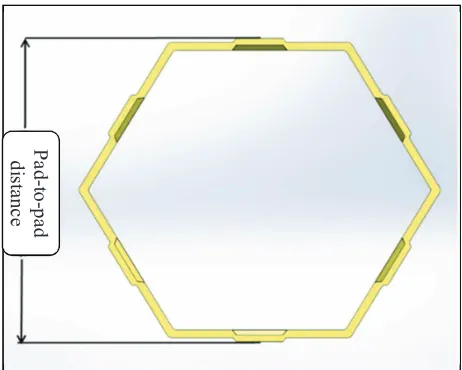
- The pad-to-pad distance shown in Figure 4,
- The position of each sub-assembly on the support grid,
- The initial deflection of each sub-assembly resulting from manufacturing tolerances, - The vertical tilt of each sub-assembly due to the gap at the nozzle connection.
In a first step we can consider that the initial deflection of each assembly is cancelled out by the vertical tilt. Unfortunately, as a result of statistical distributions of manufacturing processes, some uncertainty remains on the pad-to-pad distance and the position of each assembly on the support grid.
Figure 4. Schematic view of hexagonal duct with its stamped spacer pads.
Feedback from past manufacturing
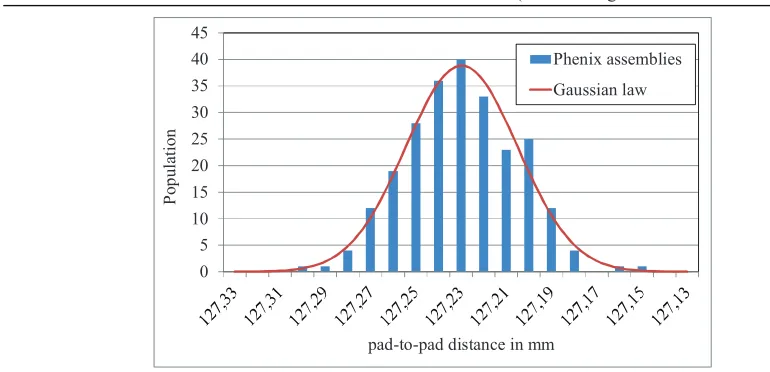
The statistical distribution of the pad-to-pad distance has been evaluated from feedback of the manufacturing of Phénix assemblies. The results presented in Figure 5 clearly show a Gaussian distribution of the parameter with a mean value close to the nominal value of 127.23 mm and a standard deviation of 0.025 mm. The same hypothesis is retained for the statistical distribution of pad-to-pad distance of the CFV core sub-assemblies.
P
a
d
-to
-p
ad
d
is
ta
n
c
Figure 5. Statistical distribution of pad-to-pad distance of Phenix assemblies.
The manufacturing tolerances for the position of the sub-assemblies on the support grid of Super-Phénix reactor were ± 0.5 mm from the theoretical triangular pattern. Without any direct measurement from past manufacturing, a uniform distribution based on the same range of deviation is supposed for CFV core support grid.
Development of numerical tool
A numerical tool has been developed to evaluate the effect of the uncertainties of pad-to-pad distance and position of each sub-assembly on the core equilibrium. This tool is based on URANIE framework developed by the CEA to capitalize all methods and algorithms about uncertainty and sensitivity in a same framework, Gaudier (2010). URANIE is based on the data analysis framework ROOT, an object-oriented computing system developed by CERN. The methodology developed for our application relies on the following steps:
- Automatic creation of HARMONIE V2 input data files by random sampling according to selected pad-to-pad and position distribution laws,
- Automatic HARMONIE V2 calculation during normal condition, handling operations and ULOF transient,
- Sorting of the output files to evaluate the operational constraints, - Statistical analyses of the results.
Effect of the geometrical uncertainties on core equilibrium
The results of this new methodology are illustrated in Figure 6 and 7 in the case of CFV core. We have plotted the distribution of 6000 HARMONIE V2 simulations taking into account the geometrical uncertainties of each sub-assembly. The distribution of the compactness of the core and the handling forces are compared to core equilibrium calculation in the hypothesis that the geometry of all sub-assemblies is nominal and in the hypothesis that the geometry of all sub-sub-assemblies equals the minimum or maximum manufacturing range (past methodology).
One can observe that the geometrical uncertainties cannot be neglected since the core equilibrium calculated with the hypothesis that the geometry of all the sub-assemblies is nominal might underestimate the handling forces by ~ 20%. Moreover, the calculated distribution range of operational constraints (core compactness and maximum handling forces here) is strongly reduced when the new methodology is used instead of the past one.
0 5 10 15 20 25 30 35 40 45
P
o
p
u
la
ti
o
n
pad-to-pad distance in mm
23rd Conference on Structural Mechanics in Reactor Technology Manchester, United Kingdom - August 10-14, 2015 Division IX (include assigned division number from I to X)
Figure 6. Statistical distribution of the ratio of contacts between fuel assemblies during normal operation.
Figure 7. Statistical distribution of the maximum handling forces during handling operation.
OPTIMIZATION OF SUB-ASSEMBLIES DESIGN
The previous results have pointed out that it is not obvious to fulfil at the same time core compactness and fuel handling operational criteria. A large pad-to-pad distance will induce a compact core but high handling forces while a smaller pad-to-pad distance will reduce the handling force and core compactness as well. Therefore it was found attractive to develop a methodology to optimize the design of the sub-assemblies towards static equilibrium.
Objectives of the optimization process
The multi-objective of the optimization process is to determine the best design of the sub-assemblies according to the following three cost functions:
Ϭ ϱϬ ϭϬϬ ϭϱϬ ϮϬϬ ϮϱϬ ϯϬϬ ϯϱϬ ϰϬϬ
ϱϬ͕ϬϬ ϱϱ͕ϬϬ ϲϬ͕ϬϬ ϲϱ͕ϬϬ ϳϬ͕ϬϬ ϳϱ͕ϬϬ ϴϬ͕ϬϬ ϴϱ͕ϬϬ ϵϬ͕ϬϬ ϵϱ͕ϬϬ
W
Ž
Ɖ
Ƶ
ůĂ
ƚŝ
Ž
Ŷ
ŽŵƉĂĐƚŶĞƐƐŽĨƚŚĞĐŽƌĞ;йͿ
ϲϬϬϬĐĂůĐƵůĂƚŝŽŶƐ
EŽŵŝŶĂůĐĂůĐƵůĂƚŝŽŶ
ŝƐƚƌŝďƵƚŝŽŶƌĂŶŐĞ;ƉĂƐƚŵĞƚŚŽĚŽůŽŐLJͿ
Ϭ ϮϬ ϰϬ ϲϬ ϴϬ ϭϬϬ ϭϮϬ ϭϰϬ ϭϲϬ ϭϴϬ ϮϬϬ
Ϭ Ϯ ϰ ϲ ϴ ϭϬ ϭϮ ϭϰ ϭϲ
W
Ž
Ɖ
Ƶ
ůĂ
ƚŝ
Ž
Ŷ
DĂdžŝŵƵŵŚĂŶĚůŝŶŐĨŽƌĐĞ;ŬEͿ
ϲϬϬϬĐĂůĐƵůĂƚŝŽŶƐ
EŽŵŝŶĂůĐĂůĐƵůĂƚŝŽŶ
- Core compactness (maximize the ratio of contacts between fuel sub-assemblies during normal condition),
- Handling forces (minimize highest handling force during handling operation), - Pads effect (maximize radial expansion of the core during an ULOF transient).
In addition some constraints on the maximum deformation of the sub-assemblies are imposed:
- Maximum deflection of control and shutdown sub-assemblies during normal operation (<10 mm), - Maximum deflection during handling operation (<15 mm),
- Maximum permanent deflection and elongation during handling operation (<20 mm).
The optimization is focused on a judicious selection of parameters impacting at the first order the mechanical equilibrium of the core. In a first step, four design parameters of the assemblies have been identified as essential:
- The nominal pad-to-pad distance of fuel sub-assemblies,
- The nominal pad-to-pad distance of radial neutron shielding sub-assemblies, - The axial position of spacer pads,
- The pads compliance, defined by the elastic distortion of spacer pads area due to six unit interaction forces acting equally on the six faces of the sub-assembly, Blanc et al. (2015).
As shown previously, the effect of geometrical uncertainties cannot be neglected. Therefore, a large number of computations taken into account manufacturing tolerances are launched. A set of optimal solutions are then obtained among them designer has to choose the best design.
Methodology for multi-objective optimization of sub-assemblies design
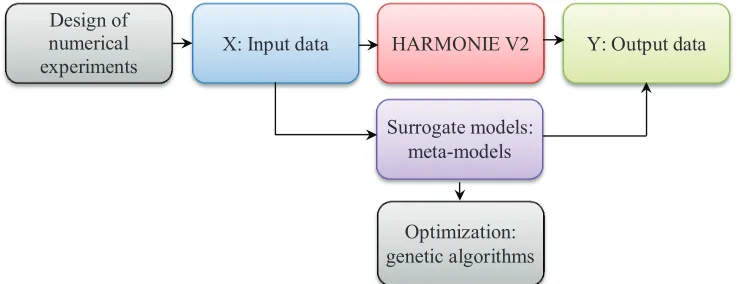
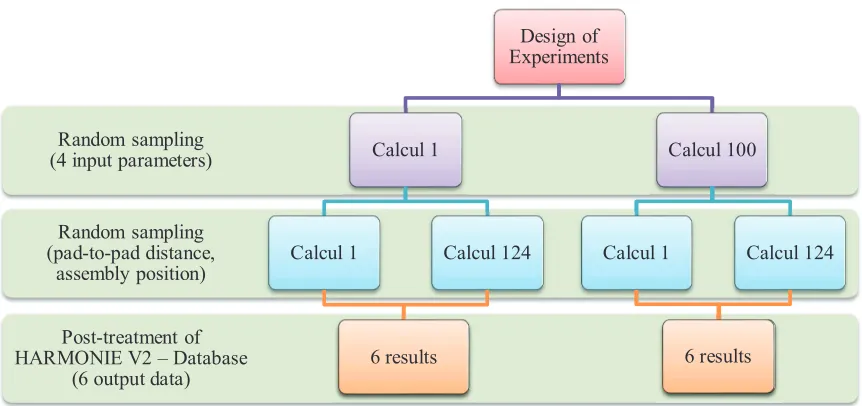
The methodology developed on URANIE platform is summarized in Figure 8. The first step of the optimization process is the design of numerical experiments. The objective of this step is to create a database by random sampling of the four input parameters. As far as geometric uncertainties are taken into account, numerous HARMONIE V2 simulations are required (see Figure 9). This process is excessively time consuming, therefore the size of the data base is necessarily reduced. As a consequence, surrogate models are created and validated to replace costly HARMONIE V2 simulations by equivalent artificial neural networks meta-models more convenient to perform a multi-objective optimization. Six meta-models have been created, one for each output data described above (3 cost functions and 3 constraints). The third step of the optimization process uses genetic algorithms to determine optimized configurations (i.e. the best sub-assemblies and core designs). An evolutionary algorithm named Vizir has been coupled to URANIE to solve this multi-objectives optimization problem, Do et al. (2009);
Figure 8. Scheme of the methodology of multi-objective optimization process. Design of
numerical experiments
X: Input data HARMONIE V2 Y: Output data
Surrogate models: meta-models
23rd Conference on Structural Mechanics in Reactor Technology Manchester, United Kingdom - August 10-14, 2015 Division IX (include assigned division number from I to X)
Figure 9. Scheme of the methodology to create the design of experiments.
The number of HARMONIE V2 simulations required to create one point of the design of experiments is defined according to Wilks’ formula, Wilks (1941). Wilks’ formula gives the number N of simulations to be performed in order to obtain an estimation of the value of a Į-percentile with a ȕ confidence level. For that, the N values of the considered output parameter are ordered: Y(1) < Y(2), …, < Y(N − 1) < Y(N). On the basis of this ranking, a sample size of 124 simulations is needed to determine the Į = 95% percentile with a ȕ = 95% confidence level at the third order (Y(N − 2)), de Crécy et al. (2008). The number of points of the design of experiments has been limited to 100 in this study to limit the overall calculation time.
Application of multi-objective optimization of sub-assemblies design
The results of the multi-objective optimization of sub-assemblies design towards static mechanical equilibrium of CFV core are presented in Figure 10. The blue lines link optima design configurations (named I1 to I4) to their corresponding cost functions and operational constraints (named Y1 to Y6). Each line can be considered as an optimized solution since a little modification of an input parameter will degrade one cost function or operational constraint. The range of the optimized parameters and their results is indicated in this figure.
We can observe that many configurations achieve the core static mechanical equilibrium requirements. However, the best design configurations refer to the highest values of pad compliance studied. As shown in Figure 10, optimum pad compliance (input parameter I3) lies between 6x10⁻⁴ and 10-3 mm/daN while the whole studied range was 3.5x10⁻⁵ to 10-3 mm/daN.
Figure 10 clearly shows two separated domains for optimum pad-to-pad distance of neutron shielding sub-assemblies (input parameter I1):
- A domain without any pad on the neutron shielding sub-assemblies,
- A domain with a pad-to-pad distance of radial neutron shielding close to the one of fuel sub-assemblies.
Post-treatment of HARMONIE V2 – Database
(6 output data) Random sampling (pad-to-pad distance,
assembly position) Random sampling (4 input parameters)
Design of Experiments
Calcul 1
Calcul 1
6 results
Calcul 124
6 results
Calcul 100
Calcul 1
6 results
Calcul 124
Based on the multi-objective optimization presented in Figure 10, the designer is able to choose a configuration leading to a compromise between the different performance criteria. Finally, the optimum design selected for CFV sub-assembly and core support grid is reported in Figure 11 (blue lines selected through the whole optimized solutions presented in Figure 10).
These solutions correspond to the same pad-to-pad distance for all types of sub-assemblies, high pad compliance and the lowest axial position studied for spacer pads (i.e. close to the top of the fuel pins). Such designs allow a good compromise between the performances considered: high core compactness, low maximum handling force and significant pads effect, and compliance with the operational constraints.
Figure 10. Optimal configurations of CFV sub-assembly and core support grid designs towards static equilibrium.
Figure 11. Optimized design of CFV sub-assembly and core support grid towards static equilibrium. Chosen configurations (blue lines) through the whole optimal configurations (green lines).
I1: Pad-to-pad distance of shielding assemblies (mm) I2: Pad-to-pad distance of fuel assemblies (mm)
I3: Pad compliance (mm/daN) I4: Pad axial position (mm) Y1: Core compactness (%) Y2: Handling force (daN) Y3: Pad effect (mm) Y4: Deflection of control and shutdown assemblies (mm) Y5: Deflection during handling operation (mm)
Y6: Permanent deflection (mm)
I1: Pad-to-pad distance of shielding assemblies (mm) I2: Pad-to-pad distance of fuel assemblies (mm)
I3: Pad compliance (mm/daN) I4: Pad axial position (mm) Y1: Core compactness (%) Y2: Handling force (daN) Y3: Pad effect (mm) Y4: Deflection of control and shutdown assemblies (mm) Y5: Deflection during handling operation (mm)
23rd Conference on Structural Mechanics in Reactor Technology Manchester, United Kingdom - August 10-14, 2015 Division IX (include assigned division number from I to X)
CONCLUSION
A new methodology has been developed to optimize the sub-assemblies and core designs towards static mechanical equilibrium of Sodium cooled Fast Reactors. The effect of the geometrical uncertainties arising from manufacturing tolerances on the operational constraints is taken into account through statistical analysis and computation.
Application to a CFV core concept led to recommendations on the design of spacer pads stamped on the sub-assemblies’ hexagonal duct in order to improve static mechanical equilibrium of the core. First results suggest that the following design options should be favoured:
- high pads flexibility in order to minimise handling forces during refuelling, - pads on neutron shielding sub-assemblies for core restraint requirements,
- spacer pads located close to the top of fuel pins to promote the pads effect during an unprotected loss of flow transient.
In a future work, additional objectives are planned to be assigned to the optimization process, related to core mechanical behaviour during seismic loadings or dynamic core compaction. Their consequences on the optimal design of the core will be studied.
REFERENCES
Bernard, A. (1979). “Calculation of equilibrium configurations of a hexagonal array of deformed subassemblies,” Proc. 5th Conference on Structural Mechanics in Reactor Technology, Berlin, Germany August 13-17, 1979.
Bernard, A., Masoni, P., Van Dorsselaere, J.-P. (1983). “Mechanical behavior of a fast reactor core. Application of the 3D codes to SUPER PHENIX 1,” Proc. 7th Conference on Structural Mechanics in Reactor Technology, Chicago, USA, August 22-26, 1983.
Blanc, V. et al. (2015). “Characterization, simulation and improvement of spacer pads mechanical behaviour for Sodium Fast Reactor fuel assemblies,” this conference.
Briggs, L., Grudzinski, J., Wigeland, R. (2014). “Sodium-cooled Fast Reactor Core Restraint System Design and Modeling Approaches,” Nuclear Engineering Division, Argonne National Laboratory, ANL-GIF-SO-2013-2.
de Crécy, A. et al. (2008). “Uncertainty and sensitivity analysis of the LOFT L2-5 test: Results of the BEMUSE programme,” Nuclear Engineering and Design 238 (2008) pp. 3561–3578.
Do, J.-M. et al. (2009). “Fuel loading pattern for heterogeneous EPR core configuration using a distributed evolutionary algorithm,” 2009 International Conference on Mathematics, Computational Methods & Reactor Physics (M&C 2009), Saratoga Springs, NY, 2009.
Gaudier, F. (2010). “URANIE: the CEA/DEN uncertainty and sensitivity platform,” Procedia – Social and Behavioral Sciences, vol. 2, issue 6, 6th International Conference on Sensitivity of Model Output, pp. 7660–7661.
Vénard, C. et al. (2015). “The ASTRID core at the midterm of the conceptual design phase (AVP2),” Proc. ICAPP 2015, Nice, France, May 03-06, 2015.