Lightweight AE and HASH in a Single Round
Function
Dingfeng Ye1,2, Danping Shi1,2, and Peng Wang1,2
1
State Key Laboratory of Information Security, Institute of Information Engineering, Chinese Academy of Sciences, China
2Data Assurance and Communication Security Research Center, Chinese Academy of
Sciences, China {ydf, dpshi, wp}@is.ac.cn
Abstract. To deal with message streams, which is required by many symmetric cryptographic functionalities (MAC, AE, HASH), we propose a lightweight round function called Thin Sponge. We give a framework to construct all these functionalities (MAC, AE, and HASH) using the same Thin Sponge round function. Besides the common security assumptions behind traditional symmetric algorithms, the security of our schemes depends on the hardness of problems to find collisions of some states. We give a class of constructions of Thin Sponge, which is improvement of the round function of Trivium and ACORN. We give simple criteria for determining parameters. According to these criteria, we give an example, which achieves all functionalities in a single round function and hence can be realized by the same hardware. Our algorithm is also efficient in software.
Keywords: Thin Sponge, lightweight, MAC, AE, HASH
1
Introduction
Authentication encryption (AE), message authentication code (MAC) and hash function are widely used in modern society. Recently various competitions such as eSTREAM, SHA-3, PHC and CAESAR are held to satisfy the need of more and more applications. Due to the rapid development of lightweight devices, requirements in different application scenarios are proposed, such as IoT, em-bedded system, smart card and wireless sensor node. In resource-constrained environment, if confidentiality, integrity and identity verification are required, and if all these functionalities are implemented by different circuits, it would violate the resource limits.We hope to find a solution which implements all the functionalities in a single small circuit.
stream cipher, MAC and AE with a single lightweight round function, similar functions are called Thin Sponge in this paper. However, construction of hash function is not addressed.
There are mainly two common constructions for hash functions. One is based on Merkle-Damg˚ard (MD)-structure, such as SHA-1[11], SHA-2[12] and MD5[13]. And the other is based on a sponge or sponge-like functions, such as Keccak[14], PHOTON[15], Quark[16], SPONGENT[17] and GLUON[18]. How-ever, the modular addition operation used in the MD-structure is not suitable to hardware, and the implementation of sponge functions relies on large hardware, which is very slow in lightweight hardware.
In this paper, we give a heuristic construction of hash function using the Thin Sponge function of an AE. For security, we give an analysis which leads to criteria for deciding parameters for a specific security level. Our analysis suggests that the security strength depends on 2 parameters which are not affected by Thin Sponge function. So our method gives a solution whose security level and assurance can be adjusted at application layer without affecting hardware im-plementation. In addition, we give an improved Thin Sponge construction over ACORN and give a concrete example.
Thin Sponge function is a lightweight function for processing bit stream as follows:
F :S× {0,1} →S
whereSis the state space. Here Thin meansFcan be realized by a small number (tens) of bit operations.
We present our constructions in the following framework. The first thing for setting all functionalities is to construct a MAC using Thin Sponge. Then AE can be heuristically obtained from MAC as in ACORN. To achieve our goal, we only need to construct HASH from AE.
First, we recall the method to construct MAC using Thin Sponge. – (k, IV)−−−→Init S0: use secret keykandIV to get initial stateS0. – (Si, mi)
F
−→Si+1: update state by Thin Sponge round functionF with mes-sage stream.
– RO(Sm) → T ag: use a random oracle RO to produce output of MAC,
where(and in the follows)Sm denotes state obtained fromS by processing
a message streamm.
The security strength of this MAC is determined by max
m̸=m′P r[S
m = Sm′] for
unknown randomS.
AE can be constructed by adding a non-linear filter functionGK on MAC state to generate key stream as Fig.(1). At the initialization step,S0is obtained asS0←S
0l
0 , where 0l is the all zero bit stream of lengthl, andl is the number
of rounds to repeat a sightly modified round function. The key stream bit k is fed back to the state.
(
S, m
)
F
S
k
GK
Fig. 1: AE round functionTAE
(
S, m
)
F
S
k
g
⊕
Buf f er
a
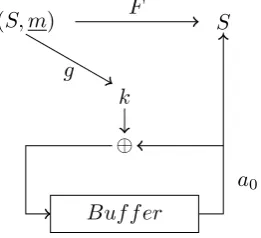
0Fig. 2: HASH round functionTHASH
buffer is a pipe used to temporarily store a segment of re-encrypted key stream, and its size is denoted by lB.
The actual message stream inputted to HASH round function isme, which is obtained by dividing original message into fixed-length (such as 32-bit) blocks and inserting some fixed-length constant blocks. The length of a valid message block and a constant block are respectively denoted bylmand lc, and the rate
of valid messages is denoted asρ= lm
lm+lc.
Heuristically, we guess that the security strength depends onlBandρ: bigger
lB and smallerρmeans stronger security.
The process of HASH is as follows:
– S0: use fixed random constant bits to fill the initial stateS0. – (Si,mei)
THASH
−−−−−→ Si: update state by HASH round function THASH with
– RO(Sm0e, mlength) → Dig: RO is a random oracle, Sm0e is the final state, and mlength is the length of message m. RO can be realized by iterating the round functionTHASH for enough number of rounds. In each round the
message bit is replaced bye⊕v, whereeis the middle bit of the buffer and v is a corresponding bit of the stream h obtained by repeating mlength: h=||∗[mlength], where [mlength] is seen as a bit stream of length 64. The security of this HASH is determined by the hardness of following prob-lem: to findm̸=m′of equal length satisfyingS0me =Sm0f′. Generally, the problem is defined by systems of equations. This kind of systems of equations are too complex for existing solvers. The only known method for solving this type of equations is differential cryptanalysis.
We consider a special kind of Thin Sponge functions where the security of MAC is easy to estimate. Denote
G× {0,1}−→ {H 0,1} H(G, m) =SB(G) +m,
G⊆S
S A
−→S
S7→AS.
Our Thin Sponge is defined asF(S, m) =AS+bβ, whereAis a linear trans-formation overS(considered as a linear space),SB is the S-box function taking several state bits to one output bit, where G denotes the subspace consisting of the input bits of the S-box, and β is the constant state determined by the positions whereb=H(G, m) embedded in.
The probability max
m̸=m′
P r[S0m=Sm
′
0 ] is determined by the number of active S-boxes of all valid differential trailsb={bi}i∈{0,1,2,...} such that 0b= 0, where
round function is just a linear function A, S-box is active if and only if its input Gis non-zero. Generally, the number of active S-boxes is smallest when
{bi}i∈{0,1,2,...} is the coefficients of the minimal polynomial ofA. In this case,
state difference sequence is called the characteristic sequence and we denote AG=|{i:Gi̸= 0}|, whereGi is input difference of S-box in thei-th round. To
give a MAC of λ-bit security, we just make AG > λ.
To give the GK function of the AE, we need another independent S-box SB′ :G−→ {0,1},and defineGK(S) =SB′(G) +s,wheresis some bit ofS.
A Concrete Construction
G={sjj 0, s
j
j1}j∈{0,1,...,3}⊆S andSB(G) = 1⊕
⊕3
j=0s
j j0 ·s
j
j1, wheres
j j0,s
j j1
are two bits from the j-th register. SB′ = 3
⊕
i0̸=i1i0=0 si0
t0 ·s
i1
t1, ti ∈ {j0, j1}, it is independent toSB except at 3 input difference values.
The main imporvements over ACORN are the follows. The shift operation in software is easier on 64-bit registers. The concatenation of the registers has more choices to make the characteristic polynomial of A is irreducible. The S-boxes we used are lighter.
An example is given by replacing the indexes with specific numbers in above description, where the hardness of collision problems for MAC and HASH are supposed to be 148 and 192 bits respectively, and the efficiency of AE is slightly better than ACORN. HASH runs in half speed of AE.
To summarize, our main contributions are as follows: – We give an improved construction of AE over ACORN.
– We give the construction from AE to Hash and heuristic criteria for security strength.
– According to the security criteria, we give an example, which achieves all functionalities with a single small hardware.
2
Notations
We use small letters for bits, underlined ′small letters′ for vector streams, sequences of bits etc. | · | for the number of elements in a set, + for Xor, · for And.
For any round function of the formT :S× {0,1} −→S, we denoteSmto be
the state obtained as follows:
S ←−T(S, mi),fori= 0,1, . . . ,
whereT is omitted if the context is clear.
3
MAC and AE
In this section, we give explicit construction of our Thin Sponge function, and its security analysis.
3.1 Description
Suppose the security level is 128-bit, our Thin Sponge function acts on a 256-bit stateS.
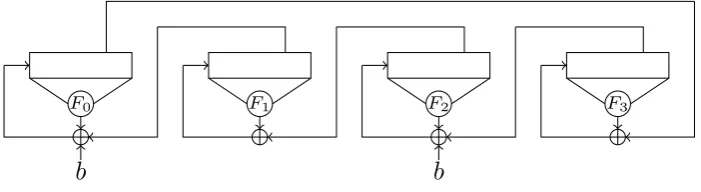
– S consists of four 64-bit LFSR registers {Sj}
j=0,1,2,3 as Fig.3 shows. Each register uses a linear feedback functionFj, j∈ {0,1,2,3}. The shift operation
is easier on 64-bit register. We writeSj=. . . , sj
−1, s
j
−2, . . . , s
j
– The concatenation of the registers is as follows: the four registers are con-catenated to a circle where one bit of each register is xored to the input of the next register, where the extracted position of registerj is denoted byuj.
– G={sjj0, sjj1}j∈{0,1,...,3}⊆S, andSB(G) = 1⊕
⊕3
j=0s
j j0·s
j
j1, wheres
j j0,s
j j1
are two bits of thej-th registerSj.SB′ = ⊕3 i0̸=i1,i0=0
si0
t0·s
i1
t1, ti∈ {j0, j1}.
F0 F1 F2 F3
b
b
Fig. 3:TM AC
In the following, we give the algebraic description of the algorithm. The state S can be seen as a vector of polynomials int−1, polynomials are seen as in the ringF2[t−1] mod ((t−1)64) or written asF2[t−1]/((t−1)64). Each linear feedback functionFj has a connection polynomial, denoted byfj∈F2[t]. For example, if Fj(S0j) =s
j
−32⊕s
j
−47⊕s
j
−64, then fj(t) =t32+t47+t64.
Then the linear transformationAis represented as a 4×4 matrix of polyno-mials intas follows:
P =
f0 tu1 0 0 0 f1 tu2 0 0 0 f2 tu3 tu0 0 0 f
3
.
AS=t−1·S+ [t−1·P·S]0. (1) where []0denotes the constant term(of degree 0).
The MAC round functionTM AC is:
S× {0,1} −→S
TM AC(S, m) =AS+ (SB(G) +m)β,
where
β=
1 0 1 0
To do differential cryptanalysis, the content of j-th register is denoted as a power series
Sj = ∑
i≥−64 sji ·ti.
DenoteSi (Sji) be thei-th state (j-th register state), that is
S=
S0 S1 S2 S3
, (2)
andSi= [S]i−1,i−2,...,i−64, i.e. terms of degree ranging fromi−1 toi−64. Input sequence is also denoted as
B=∑
i≥0 bi·ti,
wherebi=SB(Gi) +mi, Gi={s j i−j1, s
j
i−j2}j=0,1,2,3. Then our MAC can be described as
P·S+B·β=S, (3) which is
(P+I)·S=b·β. (4)
The round function in AE (initialization and finalization) is: TAE=AS+ (SB(G) +m)β+GK(S)β
′
,
where
β′=
0 1 0 1
.
3.2 Security Analysis
The security strengthλof this MAC is determined byδ= max
m̸=m′
P r[S0m=Sm0′]. That isλ=log2(1δ), which is supposed to beAG, the number of active S-boxes
in the characteristic sequence.
From Eq.(4),S can be expressed as follows:
S= (P+I) ∗·β·b
where (P +I)∗ is the adjoint matrix of (P +I), and det(P +I) = 3
∏
j=0 (1 +
fj) +t
3
∑ j=0
uj
is the characteristic polynomial ofA. Whenb= det(P+I), we get S= (P+I)∗·β, and
AG=|{i:Gi ̸= 0}|,
whereGi={s j i−j0, s
j
i−j1}j∈{0,1,...,3}
3.3 Deciding Parameters
We letfj have exactly 3 terms, i.e.fj =tϵ
j
0+tϵ
j
1+tϵ
j
2. We choose allϵj 0, ϵ
j
1, ϵ
j
2 to make that the weight of characteristic sequenceS is as large as we can achieve, and also the characteristic polynomial irreducible. Weight of the sequence is defined as the number of 1.
Then we choseGto be random positions and to makeAGas large as possible. For Example, if we let
– f0=t64+t33+t32, f1=t64+t36+t34, f2=t64+t42+t37, f3=t64+t56+t45. u0= 33, u1= 51, u2= 63, u3= 38.
– G={s0
−34, s0−35, s1−32, s1−40, s−233, s2−60, s3−49, s3−50}. – then we getAG=|{i:Gi̸= 0}|= 148.
4
HASH
4.1 Definition
The round function of HASH is as follows:
S×B× {0,1} →S×B
THASH(S, b′,me) = (AS+bβ+b′β′, b′+GK(S) +t−1b′),
where S andB denote respectively the state space of registers and buffer.B=
F2[t−1]/((t−1)lB), b′ =
lB∑−1
i=0
b′it−i∈B, b=SB(G) +m, be ′=b′lB−1.
Note that the register part ofTHASH is the same asTAE, except thatGK(S)
is replaced by b′Blength−1, and it goes to the buffer state as key stream for en-crypting buffer output, where the latter is an operation of the AE process.
We get the output of HASH by applying a random oracleRO: RO(Sm0e, mlength)→Dig,
wheremlength is the length of message stream.RO is realized by the iterating the round functionS←Seh. At this stage,me is replaced byeh=b′Blength
Finally we output the newest n bits of the buffer as the digest of HASH, wherenis the required length of HASH output.
In the message encoding phase, the original message stream m is divided into fixed-length blocksM0, M1, M2, . . ., and inserted some fixed-length constant blocksC0, C1, C2. . . to get the input string me, i.e.
ifm=M0||M1||M2||. . ., thenme =M0||C0||M1||C1||. . ..
In our example, we choseCi= 0 for alli.
4.2 Security Analysis
The security of HASH is reduced to the problem of finding collisions: to find m̸=m′ so thatS0me =Sm0f′. In general, the problem of finding collisions will be transformed into solving systems of equations. This kind of systems of equations are too complex for existing solvers. The only known method for solving this type of equations is differential cryptanalysis.
Differential cryptanalysis is a method to find a differential trail which has the smallest cost. A differential trail is a sequence pair (b, b′), which is the differential sequence that appears in the expression ofTHASH. A full valid trail is the one
that makes the whole state from 0 to 0. Note that b′ is decided by b and the output ofSB′(which must be 0 for inactive S-boxes). At stepi,bi is either the
output of SB or arbitrary, which we say the S-box is at constant position or message position respectively. The cost of a trail denoted the work factor to realize this trail, when the cost isq, we mean the work factor is 2q.
We can count the cost of a trail as follows: each active S-box at constant position increases the cost by two and each non-active S-box at message position decreases the cost by one. The cost of a differential trail is the maximum of costs of its all sub-trails.
4.2.1 An Upper Bound of Security Strength
In our HASH, the state is consisted of two parts, the register part and the buffer part. We consider the following trail which has 2 stages.
In the first stage, streamb (b′=0) is chosen as a small multiple of minimal polynomial ofA. The small multiple makes almost all the S-boxes active so that this sub-trail is valid. This stream makes register state zero, and makes buffer state containing a segment m′, where m′ is determined later. The number of active S-boxes in this sub-trail is about (lS −c1), where lS is the size of the
register state, andc1 is a small constant. According to previous subsection, the cost of this sub-trail is about
2·(lS−c1)·(1−ρ).
is
2·(lS
2)·(1−ρ).
After the first stage and a segment of zero input, we can make the input to the register is (b=m, b′ =m′), which makes it zero and at the same time clear-off the buffer contentsm′.
The cost of the whole trail is the maximum of the two,i.e. 2·(lS−c1)·(1−ρ).
This gives an upper bound of security strength of HASH.
We give an argument that it is also the lower bound. Consider trails which begin with zero state and end before the buffer output affects S-boxes, i.e.b′= 0. The length of these trails are lB+c2, where c2 is a constant (in our example, c2 > 64). In any valid trail the inactive S-boxes’ input forms a linear space, which is a subspace of the space generated by variables in b, where each bit is considered a variable. Each S-box gives a subspace of dimension 8, some of which overlap with other S-boxes, so we pretend that each S-box gives an independent subspace of dimension 4. The total space has dimension less than lB+c2, the
number of inactive S-boxes is less than lB+c2
4 and the number of active S-boxes is more than 34(lB+c2). As a result, the cost of the trail would be larger than
2(34 −ρ)(lB +c2). This suggests that our upper bound above is also a lower
bound iflB is large enough.
5
Example
5.1 MAC and AE
– Ais defined byf0=t64+t33+t32, f1=t64+t36+t34, f2=t64+t42+t37, f3= t64+t56+t45,u0= 33, u1= 51, u2= 63, u3= 38.
– S-box positionG={s0
−34, s0−35, s1−32, s1−40, s−233, s2−60, s3−49, s3−50}. – SB(G) = 1⊕s0−34·s0−35⊕s1−32·s−140⊕s2−33·s2−60⊕s3−49·s3−50,
SB′(G) =s0
−34·s2−60⊕s0−35·s3−50⊕s1−32·s3−49⊕s1−40·s2−33. – GK(S0) =s0
−32+SB
′
(G) withv=s0 −32.
– Security strength for MAC state collisionAG= 148. Initialization:The round function is
S←−AS+H(G, m)·β+GK(S)·β′, (6) where
β′=
0 1 0 1
At first, load the 128-bit key in right half of the four registers, and load constants in left half to getS, then
S←−SIV,
S←−S0512. 0512stands for 0-stream of length 512.
Processing Message:
S←Sm, where round function is
S←AS+H(G, m)β. Ciphertext:GK(S) +m
Finalization:
S ←S0512,
where the round function is the same as in the initiation stage. Then run the encryption stage for message 0128andT ag is the cipher text stream.
5.2 HASH
– lB = 1024, lm = lc = 32, ρ = 12. In this condition, the hardness of state
collision is supposed to be 192 bits.
– In the initialization process, load the registers and buffer with fixed random constants, which is generated by a pseudorandom number generator such as B.B.S.[19] under the seed 0.
– In theROstage, the number of rounds is set to be 1536.
5.3 Hardware
The hardware part could only treat 3 round functions MAC, AE initiation, register part of HASH and control logic for shifting between the 3-modes. These 3 round functions share almost the same circuit, so we can implement all these functionalities with a single small hardware.
References
1. Bellare, M., Kilian, J., Rogaway, P.: The security of the cipher block chaining message authentication code. Journal of Computer and System Sciences 61(3) (2000) 362–399
2. Iwata, T., Kurosawa, K.: OMAC: one-key CBC MAC. In: Fast Software En-cryption, 10th International Workshop, FSE 2003, Lund, Sweden, February 24-26, 2003, Revised Papers. (2003) 129–153
4. Dworkin, M.: SP 800-38C. Recommendation for Block Cipher Modes of Opera-tion: the CCM Mode for Authentication and Confidentiality. National Institute of Standards and Technology (2005)
5. Bellare, M., Rogaway, P., Wagner, D.A.: The EAX mode of operation.3017(2004) 389–407
6. McGrew, D.A., Viega, J.: The security and performance of the galois/counte mode of operation (full version). IACR Cryptology ePrint Archive2004(2004) 193 7. Krovetz, T., Rogaway, P.: The software performance of authenticated-encryption
modes. In: FAST Software Encryption - International Workshop, FSE 2011, Lyn-gby, Denmark, February 13-16, 2011, Revised Selected Papers. (2011) 306–327 8. Bellare, M., Canetti, R., Krawczyk, H.: Keying hash functions for message
authen-tication. In: Advances in Cryptology - CRYPTO ’96, 16th Annual International Cryptology Conference, Santa Barbara, California, USA, August 18-22, 1996, Pro-ceedings. (1996) 1–15
9. Alizadeh, J., Aref, M.R., Bagheri, N.: JHAE: A novel permutation-based authen-ticated encryption mode based on the hash mode JH. Cryptology ePrint Archive, Report 2014/193 (2014)https://eprint.iacr.org/2014/193.
10. Wu, H.: Acorn: A lightweight authenticated cipher (v3). (2016) https:// competitions.cr.yp.to/round3/acornv3.pdf.
11. NIST: Announcing the standard for secure hash standard. (1995) 12. NIST: Announcing the standard for secure hash standard. (2002)
13. Rivest, R.L.: The MD5 message-digest algorithm. RFC1321(1992) 1–21 14. BERTONI, G., DAEMEN, J., PEETERS, M., ASSCHE, G.V.: The keccak sha-3
submission. (2011)
15. Guo, J., Peyrin, T., Poschmann, A.: The PHOTON family of lightweight hash functions. IACR Cryptology ePrint Archive2011(2011) 609
16. Aumasson, J., Henzen, L., Meier, W., Naya-Plasencia, M.: Quark: A lightweight hash. In: Cryptographic Hardware and Embedded Systems, CHES 2010, 12th In-ternational Workshop, Santa Barbara, CA, USA, August 17-20, 2010. Proceedings. (2010) 1–15
17. Bogdanov, A., Knezevic, M., Leander, G., Toz, D., Varici, K., Verbauwhede, I.: spongent: A lightweight hash function. In: Cryptographic Hardware and Embedded Systems - CHES 2011 - 13th International Workshop, Nara, Japan, September 28 - October 1, 2011. Proceedings. (2011) 312–325
18. Berger, T.P., D’Hayer, J., Marquet, K., Minier, M., Thomas, G.: The GLUON family: A lightweight hash function family based on fcsrs. In: Progress in Cryp-tology - AFRICACRYPT 2012 - 5th International Conference on CrypCryp-tology in Africa, Ifrance, Morocco, July 10-12, 2012. Proceedings. (2012) 306–323