Herv´e Chabanne1,3, Julien Keuffer1,2, and Refik Molva2 1 Idemia, Issy-les-Moulineaux, France
2 Eurecom, Biot, France 3 Telecom ParisTech, Paris, France {herve.chabanne,julien.keuffer}@morpho.com
Abstract. The increasing use of machine learning algorithms to deal with large amount of data and the expertise required by these algorithms lead users to outsource machine learning services. This raises a trust issue about their result when executed in an untrusted environment. Verifiable computing (VC) tackles this issue and provides computational integrity for an outsourced computation, although the bottleneck of state of the art VC protocols is the prover time. In this paper, we design a VC protocol tailored to verify a sequence of operations for which existing VC schemes do not perform well onallthe operations. We thus suggest a technique to compose several specialized and efficient VC schemes with Parno et al.’s general purpose VC protocol Pinocchio, by integrating the verification of the proofs generated by these specialized schemes as a function that is part of the sequence of operations verified using Pinocchio. The result-ing scheme keeps Pinocchio’s property while beresult-ing more efficient for the prover. Our scheme relies on the underlying cryptographic assumptions of the composed protocols for correctness and soundness.
Keywords: verifiable computation, proof composition, neural networks
1
Introduction
1.1 Motivation
verify allNP computations [14]. In practice nevertheless, trade-offs have to be taken between expressiveness and functionality [34].
Due to the sequential nature of NNs, a simple solution would be to compute proofs for each part of the NN sequence. However, this solution would degrade the verifier performance, increase the communication and force the prover to send all the intermediate results. As a consequence, the prover would reveal the parameters of his NN, which are sensitive data.
The goal of this paper is the following: we consider a Neural Network per-forming classification, which means that it has already been trained and that its parameters are set and we want to define a VC system able to efficiently verify the NN, even if it has a large number of parameters. Following Valiant [32], we propose to compose proofs to address the verifiability of NNs. We reach generality and efficiency by a careful choice of the VC systems to compose. We develop our proposition in the case study of NN but we stress that our methods are general and can fit other use cases.
1.2 Problem Statement
Majority of applications involve several sequences of function evaluations com-bined through control structures. Assuring the verifiability of these applications has to face the challenge that the functions evaluated as part of these applications may feature computational characteristics that are too variant to be efficiently addressed by a unique VC scheme. For instance, in the case of an application that involves a combination of computationally intensive linear operations with sim-ple non-linear ones, none of the existing VC techniques would be suitable since there is no single VC approach that can efficiently handle both. This question is perfectly illustrated by the sample scenario described in the previous section, namely dealing with the verifiability of Neural Network Algorithms, which can be viewed as a repeated sequence of a matrix product and a non-linear activation function. For instance, a two layer neural network, denoted byg, on an inputx can be written as:
g(x) =W2·f(W1·x) (1)
HereW1andW2 are matrices andf is a non-linear function like the frequently chosen Rectified Linear Unit (ReLU) function x 7→ max(0, x). For efficiency, the inputs are often batched and the linear operations involved in the Neural Network are matrix products instead of products between a vector and a matrix. The batched version of (1) therefore is:
g(X) =W2·f(W1·X) (2)
whereX is a batch of inputs to be classified.
circuit (i.e. as an acyclic graph of computation over a finite field with an addition or a multiplication at each node, and where the circuit can be decomposed into layers, each gate of one layer being only connected to an adjacent layer). Nevertheless the second component of the neural network algorithm, that is, the ReLU activation function, does not lend itself to a simple representation as a layered circuit. [18] and [8] have proposed solutions to deal with non-layered circuits at the cost of very complex pre-processing resulting in a substantial increase in the prover’s work and the overall circuit size. Conversely, Pinocchio eliminates the latter problem by allowing for efficient verification of the non-linear ReLU activation function while suffering from excessive complexity in the generation of proofs for the products of large matrices (benchmarks on matrix multiplication proofs can be found in [34]).
This sample scenario points to the basic limitation of existing VC schemes in efficiently addressing the requirements of common scenarios involving several components with divergent characteristics such as the mix of linear and non-linear operations as part of the same application. The objective of our work therefore is to come up with a new VC scheme that can efficiently handle these divergent characteristics in the sub-components as part of a single VC protocol.
1.3 Idea of the Solution: Embedded Proofs
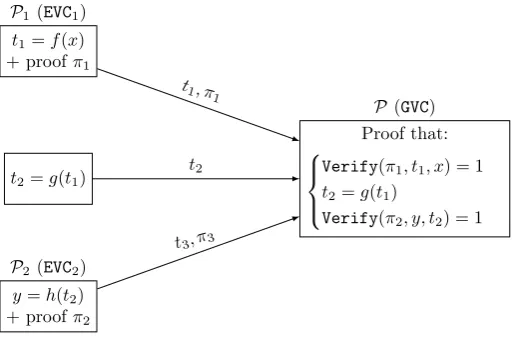
Our solution is based on a method that enables the composition of a general purpose VC scheme suited to handle sequences of functions with one or several specialized VC schemes that can achieve efficiency in case of a component func-tion with excessive requirements like very large linear operafunc-tions. Without loss of generality, we apply the method to a pair of VC schemes, assuming that one is a general purpose VC scheme, calledGVC, like Pinocchio [28], which can efficiently assure the verifiability of an application consisting of a sequence of functions, whereas the other VC scheme assures the verifiability of a single function in a very efficient way, like, for instance, a VC scheme that can handle large matrix products efficiently. We call this schemeEVC. The main idea underlying the VC composition method is that the verifiability of the complex operation (for which the GVC is not efficient) is outsourced to the EVC whereas the remaining non-complex functions are all handled by the GVC. In order to get the verifiability of the entire application by theGVC, instead of including the complex operation as part of the sequence of functions handled by the GVC, this operation is sep-arately handled by the EVC that generates a standalone verifiability proof for that operation and the verification of that proof is viewed as an additional func-tion embedded in the sequence of funcfunc-tions handled by the GVC. Even though the verifiability of the complex operation by the GVCis not feasible due to its complexity, the verifiability of the proof on this operation is feasible by the ba-sic principle of VC, that is, because the proof is much less complex than the operation itself.
t1=f(x)
+ proofπ1
t2=g(t1)
y=h(t2)
+ proofπ2
Proof that:
Verify(π1, t1, x) = 1
t2=g(t1)
Verify(π2, y, t2) = 1
t1, π1
t2
t3, π3
P1(EVC1)
P2(EVC2)
P (GVC)
Fig. 1.High level view of the embedded proofs
wheref andhare not suitable to be efficiently proved correct byGVCwhilegis. Note that we consider that g cannot be proved correct by any EVCsystems or at least not as efficiently as with the GVCsystem. The computation to verify is thereforey=h(g(f(x))). In our example, the functionsf, gandharef :X 7→ W1·X, h : X 7→ W2·X and g : X 7→max(0, X), where X, W1 and W2 are matrices andg applies the max function element-wise to the input matrixX.
In order to cope with the increased complexity off andh, we have recourse toEVC1 andEVC2that are specialized schemes yielding efficient proofs with such functions. πEVC1 denotes the proof generated by EVC1 on f, πEVC2 denotes the proof generated byEVC2onhandΠGVCdenotes the proof generated byGVC. For the sequential execution of functionsf,g andh, the final proof then is:
ΠGVC
VerifEVC1(πEVC1, x, t1) ?
= 1∧ g(t1) ?
=t2∧ VerifEVC2(πEVC2, t2, y) ? = 1
(3) where the inputs of theGV C system are respectively the computation ofgand the verification algorithms ofEVC1andEVC2systems, which output 1 if the proof is accepted and 0 otherwise.
The method can easily be extended to applications involving more than three functions and various specialized VC techniques likeEVCthat would be selected based on their suitability to the requirements of special functions provided that: 1. The verification algorithm for each EVC proof is compatible with the GVC
scheme.
2. The verification algorithm for each EVCproof should have much lower com-plexity than the outsourced computations (by the basic VC advantage). 3. TheEVCschemes should not be VC’s with a designated verifier but instead
prover of theEVCand the prover of theGVC. Otherwise, a malicious prover can easily forge a proof forEVCand break the security of the scheme. In the sequel of this paper we present a concrete instance of our VC compo-sition method using Pinocchio [28] as the GVCand an efficient interactive proof protocol, namely the Sum-Check protocol [24] as the EVC. We develop further this instance with a Neural Network verification example. We assume that the matrix involved in the products do not have the same sizes so there will be two instances of the Sum-Check protocol. Indeed, the Pinocchio system requires that the verification algorithms are expressed as arithmetic circuits in order to gen-erate evaluation and verification keys for the system. As the parameters of the verification algorithms are different, the two Sum-Check verification protocols are distinct as arithmetic circuits.
1.4 Related Works
Verifying computation made by an untrusted party has been studied for a long time. Theoretical solutions have been proposed: interactive proofs [19], prob-abilistically checkable proofs (PCP) [2], computationally sound proofs [25] or arguments [22]. Despite solving theoretically the problem, the implementation of these protocols would have been impossible or dramatically inefficient, either in time or space. A decade ago, Goldwasser et al. [18] proposed an efficient inter-active proof that, after some optimizations, led to a practical implementation by Cormode et al. [8], later refined by Thaler [31]. Quite at the same moment, Ishai et al. [21] proposed a particular PCP theorem that also led to an implementation by Setty et al. [30]. The next steps toward practical implementations of verifi-able computation were taken by Gennaro et al. with the definition of Quadratic Arithmetic Programs [14], an efficient way to encode circuit satisfiability. Build-ing on QAPs, Parno et al. [28] proposed Pinocchio, achievBuild-ing generality (the protocol can handle any type of computation), succinctness of the proof and possibility for the prover to supply private inputs. The latter property enables to produce proofs that are zero-knowledge succinct non-interactive arguments of knowledge (zk-SNARKs). Most of the subsequent works also built on QAPs either optimizing the cryptographic protocol embedding the QAPs [10, 4] or im-proving the expressiveness of the systems [7, 5, 33]. Leveraging the zk-SNARKs property of the proof, several applications of verifiable computation (VC) sys-tems have been proposed: a new cryptocurrency [3], an image authentication protocol [27] or a proposal to improve efficiency, privacy, and integrity of the X.509 public key infrastructure [11].
functions have unbounded derivative causes instability on the neural network training, as mentioned in [16]. A second disadvantage is the impossibility for the prover to hide some of his inputs, i.e. to prove a non-deterministic computation. As a consequence, the verifier and the prover of SafetyNets have to share the model of the neural network, namely the values of the matrices (e.g.W1andW2 in formula (1)). This situation is quite unusual in machine learning: since the training of neural networks is expensive and requires a large amount of data, powerful hardware and technical skills to obtain a classifier with good accuracy, it is unlikely that cloud providers share their models with users. In contrast, with our proposition the prover could keep the model private and nonetheless be able to produce a proof of correct execution.
Proof composition has been proposed by Valiant [32] and refined in the case of SNARKs by Bitansky et al. [6]. The implementation of SNARKs recursive composition has later been proposed by Ben-Sasson et al. in [5]. The high level idea of the latter proof system is to prove or verify the satisfiability of an arith-metic circuit that checks the validity of the previous proofs. Thus, the verifier should be implemented as an arithmetic circuit and used as a sub-circuit of the next prover. However, SNARKs verifiers perform the verification checks using an elliptic curve pairing and it is mathematically impossible that the base field has the same size as the elliptic curve group order. Ben-Sasson et al. therefore pro-pose a cycle of elliptic curves i.e. at least two elliptic curves where the verifier’s finite field of the first curve is the base field of the second curve, enabling proof composition. Although proofs can theoretically be composed as many times as desired, this method has severe overhead. Our method has a more limited spec-trum than Ben-Sasson et al.’s but our resulting system is still general purpose and enjoys the property of the GVC system, such as succinctness or efficiency for the prover. Furthermore, our proposal improves the prover time, replacing some part of a computation by sub-circuit verifying the sub-computation that can then be executed outside the prover.
1.5 Paper organization
The rest of the paper is organized as follows: we first introduce the building blocks required to instantiate our method in Section 2, then we state the details of a VC composition based on our method and using the selectedGVCandEVC schemes in Section 3, evaluate the efficiency of our scheme in Section 4, its security in Section 5 and conclude in Section 6.
2
Building blocks
2.1 GVC: Verifiable Computation based on QAPs
computation to verify has first to be represented as an arithmetic circuit, from which a QAP is computed. Using the representation based on QAPs, the cor-rectness of the computation can be tested by a divisibility check between poly-nomials. A cryptographic protocol enables to check the divisibility in only one point of the polynomial and to prevent a cheating prover to build a proof of a false statement that will be accepted.
Definition 1 (from [28]). A QAPQover fieldF contains three sets ofm+ 1
polynomials V ={(vk(x))},W ={(wk(x))},Y ={(yk(x))} fork∈ {0, . . . , m}
and a target polynomialt(x). LetF be a function that takes as inputnelements of F and outputs n0 elements and let us define N as the sum of n and n0. A
N-tuple (c1, . . . , cN) ∈ FN is a valid assignment for function F if and only if
there exists coefficients(cN+1, . . . , cm)such that t(x)divides p(x), as follows:
p(x) = v0(x) + m
X
k=1
ck·vk(x)
!
· w0(x) + m
X
k=1
ck·wk(x)
!
− y0(x) + m
X
k=1
ck·yk(x)
!
.
A QAPQ that satisfies this definition computesF. It has size mand its degree is the degree oft(x).
In the above definition, t(x) =Qg∈G(x−rg), where Gis the set of multiplica-tive gates of the arithmetic circuit and each rg is an arbitrary value labeling a multiplicative gate of the circuit. The polynomials in V, W and Y encode the left inputs, the right inputs and the outputs for each gate respectively. By defi-nition, if the polynomialp(x) vanishes at a valuerg,p(rg) expresses the relation between the inputs and outputs of the corresponding multiplicative gateg. An example of a QAP construction from an arithmetic circuit is given in [28]. It is important to note that the size of the QAP is the number of multiplicative gates in the arithmetic circuit to verify, which also is the metric used to evaluate the efficiency of the VC protocol.
VC protocol. Once a QAP has been built from an arithmetic circuit, a crypto-graphic protocol embeds it in an elliptic curve. The verification phase makes use of a pairing to perform the divisibility check and to ensure that the inputs of the computation were correctly incorporated and that the QAP has been computed with the same coefficientsck for theV, W and Y polynomials duringp’s com-putation. This results in a publicly verifiable computation scheme, as defined below.
Definition 2. Let F be a function, expressed as an arithmetic circuit over a finite field Fandλbe a security parameter.
– (EKF, V KF)←KeyGen(1λ, F): the randomized KeyGen algorithm takes as
input a security parameter and an arithmetic circuit and produces two public keys, an evaluation keyEKF and a verification keyV KF.
– (y, π)←Prove(EKF, x): the deterministicProvealgorithm, takes as inputs xand the evaluation keyEKF and computesy=F(x)and a proofπthaty
– {0,1} ←Verify(V KF, x, y, π): the deterministicVerifyalgorithm takes the
input/output(x, y)of the computationF, the proofπand the verification key
V KF and outputs1 if y=F(x) and0otherwise.
Security. The desired security properties for a publicly verifiable VC scheme have been defined in [14]:
– Correctness: for any functionF and any inputx:
P r
(EKF, V KF)←KeyGen(F,1
λ); (y, π)←Compute(EKF, x);
Verify(V KF, x, y, π) = 1
= 1
– Soundness: for any functionF and any probabilistic polynomial-time adver-saryA,
P r
(u, y, π)← A(EKF, V KF) :
F(u)6=y andVerify(V KF, u, y, π) = 1
6negl(λ)
– Efficiency: the cost ofVerifyis lower than the cost ofF.
Parno et al. [28] prove that their VC protocol is correct and sound if some knowledge of exponent assumptions [20] hold.
Costs. In QAP-based protocols, the proof consists of few elliptic curve ele-ments (e.g. 8 group eleele-ments in Pinocchio [28]) and has constant size no matter the computation to be verified: the verification is fast. Regarding the set-up phase, the KeyGen algorithm outputs evaluation and verification keys that de-pend on the function F, but not on its inputs. The resulting model is often called verifiable computation with pre-processing. The setup phase has to take place only once, the keys are reusable for later inputs and the cost of the pre-processing is amortized over all further computations. The bottleneck is due to the computations performed by the prover: for an arithmetic circuit ofN multi-plication gates, the prover has to compute O(N) cryptographic operations and O(Nlog2N) non-cryptographic operations.
2.2 EVC: Sum-Check Protocol
The Sum-Check protocol [24] enables to prove the correct evaluation of a multi-variate polynomialP defined over a finite field. Suppose thatP is a polynomial with n variables, defined over Fn and it has to be evaluated on
{0,1}n. Using the Sum-Check protocol, a proverP can convince a verifierV that he knows the value:
H = X
t1∈{0,1}
X
t2∈{0,1}
. . . X tn∈{0,1}
P(t1, . . . , tn) (4)
A direct computation performed by the verifier requires at least 2n evaluations while the Sum-Check protocol only requiresO(n) evaluations for the verifier.
The protocol is a public coin interactive proof withn rounds of interaction during which the prover computesn univariate polynomialsPi, i= 1. . . , n de-rived fromP. During each round, V generates a random field value thatP has to integrate in the computation of the nextPi. The consistency ofP’s answer is then checked with this value.Vis supposed to be able to computePin one point, namely in the point (r1, r2, . . . , rn), corresponding to the random challengesri he has sent toP during the rounds of the protocol.
Thenrounds of the protocol are summarized below:
– P computes the univariate polynomialP1claimed to be computed as follow: P1(x) =
X
t2∈{0,1},...,tn∈{0,1}
g(x, t2, . . . , tn) (5)
– P sendsH andP1 toV.
– V checks if P’s claim on P1 holds using:H =P1(0) +P1(1). If it does not,
Vrejects and the protocol stops. Otherwise,V chooses uniformly at random r1∈Fand sends it to P.
– P sendsV a univariate polynomialP2 and claims that: P2(x) =
X
t3∈{0,1},...,tn∈{0,1}
P(r1, x, t3, . . . , tn) (6)
– Vchecks ifP’s claim onP2holds using:P1(r1) =P2(0) +P2(1). If the claim does not hold, V rejects the response ad the protocol stops. Otherwise, V
picks another valuer2∈Funiformly at random and sends it toP The protocol goes on, until then-th round, where:
– P sends the univariate polynomialPn and claims that:
Pn(x) =P(r1, r2, r3, . . . , rn−1, x) (7)
– V picks a random valuern ∈Fand checks that Pn(rn) =P(r1, r2, . . . , rn). If the equality holds, thenV is convinced thatH =P1(0) +P1(1) and that H has been evaluated as in (4).
1. The protocol iscorrect, i.e. ifP’s claim aboutH is true,thenV accepts with probability 1
2. The protocol is sound, i.e. if the claim on H is false, the probability that
P can make V acceptH is bounded by nd/|F|, where n is the number of variables anddthe degree of the polynomial P.
Note that the soundness is here information theoretic: no assumption is made on the prover power. To be able to implement the Sum-Check protocol verification algorithm into an arithmetic circuit we need a non-interactive version of the pro-tocol. Indeed, Pinocchio requires the complete specification of each computation as input to its QAP generation process (see Section 2.1). Due to the interactive nature of the Sum-Check protocol, the proof cannot be generated before the ac-tual execution of the protocol. We therefore use the Fiat-Shamir transformation [12] to obtain a non-interactive version of the Sum-Check protocol that can be used as an input to Pinocchio. In the Fiat-Shamir transformation, the prover replaces the uniformly random challenges sent by the verifier by challenges he computes applying a public hash function to the transcript of the protocol so far. The prover then sends the whole protocol transcript, which can be verified recomputing the challenges with the same hash function. This method has been proved secure in the random oracle model [29].
2.3 Multilinear extensions
Multilinear extensions allow to apply the Sum-Check protocol to polynomials defined over some finite set included in the finite field where all the operations of the protocol are performed. Thaler [31] showed how multilinear extensions and the Sum-Check protocol can be combined to give a time-optimal proof for matrix multiplication.
LetFbe a finite field. For anyd-variate polynomialP, we denote by degi(P) the degree ofP in variablei. A n-variate polynomialP ismultilinear if: degi(P)6 1,∀i∈ {1, . . . , d}.
Definition 3. Let f :{0,1}d
→F be any function mapping the d-dimensional boolean hypercube toF. Ad-variate polynomialgoverFis said to be an extension
of f if:g(x) =f(x)∀x∈ {0,1}d.
A multilinear extension (MLE) of a functionf is a polynomial that is an exten-sion off and has degree at most 1 in each variable.
Theorem 1. Any function f :{0,1}d
→ {0,1}has a unique multilinear exten-sion overF.
We will hereafter denote by ˜f the MLE off. Using Lagrange interpolation, an explicit expression of MLE can be obtained:
Lemma 1. Let f : {0,1}d
→ {0,1}. Then f˜: Fd
˜
f(x1, . . . , xd) =
X
w∈{0,1}d
f(w)χw(x1, . . . , xd) (8)
whereχw is defined for all w= (w1, . . . , wd)as:
χw(x1, . . . , xd) = d
Y
i=1
(xiwi+ (1−xi)(1−wi)) (9)
2.4 Ajtai Hash Function
As mentioned in Section 1.2, our goal is to compute a proof of an expensive sub-computation with the Sum-Check protocol and to verify that proof using the Pinocchio protocol. The non-interactive nature of Pinocchio prevents from prov-ing the sub-computation with an interactive protocol. As explained in Section 2.2, we turn the Sum-Check protocol into a non-interactive argument using the Fiat-Shamir transform [12]. This transformation need a hash function to sim-ulate the challenges that would have been provided by the verifier. The choice of the hash function to compute challenges in the Fiat-Shamir transformation here is crucial because we want to verify the proof transcript inside the GVC system, which will be instantiated with the Pinocchio protocol. This means that the computations of the hash function have to be verified by the GVC system and that the verification should not be more complex than the execution of the original algorithm inside theGVCsystem. For instance the costs using a standard hash function such as SHA256 [26] would be too high: [3] reports about 27,000 multiplicative gates to implement the compression function of SHA256. Instead, we choose a hash function which is better suited for arithmetic circuits, namely the Ajtai hash function [1] that is based on the subset sum problem as defined below:
Definition 4. Let m, nbe positive integers and q a prime number. For a ran-domly picked matrixA∈Zn×m
q , the Ajtai hashHn,m,q:{0,1}m→Znq is defined
as:
∀x∈ {0,1}m, H
n,m,q=A×x modq (10)
As proved by Goldreich et al. [17], the collision resistance of the hash function relies on the hardness of the Short Integer Solution (SIS) problem. Ajtai hash functions have first been used in verifiable computation by Braun et al. in [7]. Ben-Sasson et al. [5] then noticed that the translation in arithmetic circuit is better if the parameters are chosen to fit with the underlying field of the com-putations. A concrete hardness evaluation is studied by Kosba et al. in [23]. ChoosingFp, withp≈2254to be the field where the computations of the arith-metic circuit take place leads to the following parameters for approximately 100 bit of security:
n= 3, m= 1524, q=p≈2254.
3
Verifiable Neural Networks via Embedded Proofs
3.1 High level description of our protocol
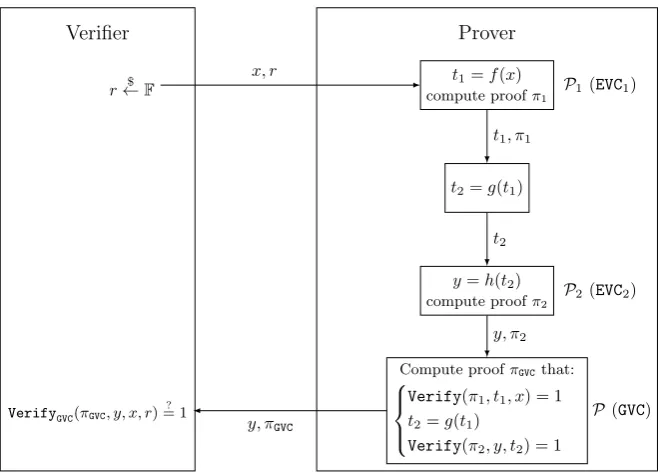
The generation of a proof fory=h(g(f(x))) involves several steps as depicted in Figure 2. Since the prover has to execute three different proving algorithms, the prover is viewed as the union of three provers, the first and the second sub-proversP1 andP2 being in charge of the efficient VC algorithm (EVC) and the third sub-proverP3 using the general verifiable computation (GVC) algorithm. In the Setup phase, the verifier and the prover agree on an arithmetic circuit which describes the computation of the functiongalong with the verification al-gorithms of the proof thatf andhwere correctly computed. The pre-processing phase of the GVC system takes the resulting circuit and outputs the correspond-ing evaluation and verification keys. In thequeryphase, the verifier sends the prover an inputxfor the computation along with a random value that will be an input for the efficient sub-proversP1 andP2. In theprovingphase,P1first computest1=f(x) and produces a proofπEVC1 of the correctness of the compu-tation, using the efficient proving algorithm. The prover P then computes the valuet2=g(t1) and sub-proverP2computesy=h(t2). Sub-proverP3then ver-ifies the proofsπEVC1 and πEVC2: if the verification fails it aborts. Otherwise,P3 provides the inputs/outputs of the previous computations to the GVC system and, using the evaluation key computed in the setup phase, builds a proofπGVC that:
1. the proofπEVC1 has been correctly verified, 2. the computationt2=g(t1) is correct, 3. the proofπEVC2 has been correctly verified
In the verification phase, the verifier checks that y was correctly computed using the GVC’s verification algorithm, the couple (y, πGVC) received from the prover, and (x, r).
Recall that our goal is to gain efficiency compared with the proof generation of the whole computation inside the GVC system. Therefore, we need proof algorithms with a verification algorithm that can be implemented efficiently as an arithmetic circuit and for which the running time of the verification algorithm is more efficient than running the computation. Since the Sum-Check protocol involves algebraic computations over a finite field, it can easily be implemented as an arithmetic circuit and fits well to our model.
3.2 Protocol description
Verifier
r←$ F
VerifyGVC(πGVC, y, x, r)= 1?
Prover
t1=f(x)
compute proofπ1 P1 (EVC1)
t2=g(t1)
t1, π1
y=h(t2)
compute proofπ2 P2(
EVC2)
t2
Compute proofπGVCthat:
Verify(π1, t1, x) = 1
t2=g(t1)
Verify(π2, y, t2) = 1
y, π2
P (GVC)
x, r
y, πGVC
Fig. 2.Embedded proof protocol
For the sake of simplicity, W1 and W2 are assumed to be square matrices: W1 ∈ Mn,n(F), W2 ∈ Mm,m(F). We denote d1 = logn, d2 = logm and we denote byH the Ajtai hash function (see Section 2 for details). The protocol is the following:
Setup: – Verifier and Prover agree on an arithmetic circuitCdescription for the computation. C implements both the evaluation of the function g and the verification algorithms of the Sum-Check protocols for the two matrix multiplications.
– (EKC, V KC)←KeyGen(1λ,C) Query Verifier:
– generates a random challenge (rL, rR)∈Flogn×Flogn
– sends the prover a matrix inputX and the challenge (rL, rR)
Proof Sub-proverP1, on inputX:
– computes the productT1=W1×X
– computes the multilinear extensionTe1(rL, rR)
– computes, using serialized Sum-Check protocol, the proof πEVC1 of the evaluation of the polynomial:
P(x) =Wf1(rL, x)·Xe(x, rR) (11) wherex= (x1, . . . , xd)∈Fd.
– ProverP computes the valueT2=g(T1) and sends it to sub-proverP2 Sub-proverP2, on inputT2:
– computes the productY =W2×T2
– computes the multilinear extensionYe(rL, rR)
– computes, using serialized Sum-Check protocol, the proof πEVC2 of the evaluation of the polynomial:
P(x) =Wf2(rL, x)·Te2(x, rR) (12) wherex= (x1, . . . , xd)∈Fd.
– Sends proverP the tuple (T2, W2, Y, πEVC2, rL, rR). ProverP: on input (X, W1, T1, πEVC1, rL, rR)
– Computes ˜T1(rL, rR).
– ParsesπEVC1 as: (P1, r1, P2, r2, . . . , Pd, rd)
– Verifiesπ:
• Checks that: P1(0) +P1(1) =Te1(rL, rR)
• Computes:ri+1=H(ai, bi, ci, ri), for i= 1, . . . , d, withr1=rLkrR
• Checks that: Pi(0) +Pi(1) =Pi−1(ri−1) fori= 2, . . . , d.
• FromXandW1, computes the multilinear extensions:Wf1(rL, r1, . . . , rd) andXe(r1, . . . , rd, rR)
• Checks that:
Pd(rd) =Wf1(rL, r1, . . . , rd)·Xe(r1, . . . , rd, rR) (13)
– Aborts if one of the previous checks fails. Otherwise, acceptsT1 as the product ofW1 andX.
– On input (T2, W2, Y, πEVC2, rL, rR), apply the verification algorithm as above. If all the checks pass, accept Y as the product of W2 and T2. Otherwise, abort.
– ComputesT2=ReLU(T1).
– Using Pinocchio, computes the final proofπGVCthatπEVC1 andπEVC2 have been verified andT2 has been correctly computed fromT1.
– Sends (Y, πGVC) to the Verifier. Verification Verifier:
– computesVerify(X, rR, rL, Y, πGVC)
– IfVerifyfails, rejects the valueY. Otherwise accepts the valueY as the result ofY =W2·ReLU(W1·X)
4
Efficiency Evaluation
Matrix multiplication cost. QAP encodes the constraints of all multiplication gates of the circuit to verify, hence the last operation performed in the circuit cannot be an addition. In a matrix multiplicationC =A·B, each component ci,j of the product is the result of an operation Pkai,k ·bk,j. Multiplications between components are first performed and the product componentci,j is the addition of the latter multiplications. The representation as a circuit has thus to add an extra multiplication gate, which is a multiplication by 1, to enable the verification of the last addition in the circuit constraints. Consequently, in the multiplication between n×n matrices, the computation of each of the n2 component requires n+ 1 multiplicative gates in the corresponding arithmetic circuit.
To sum up, a circuit implementing matrix multiplication between twon×n matrices requires (n+ 1)×n2=n3+n2 multiplication gates.
Sum-check verification cost. The verification algorithm of the Sum-Check protocol has three parts. The first one is the consistency checks for the re-ceived univariate polynomials, the second one is the computation of the mul-tilinear extension to perform the last check of the protocol while the last one is the hash computation of the challenge in the serialized proof. In the sequel of the paper, we assume that the sub-prover P has received a proof πEVC1 = (P1, r1, P2, r2, . . . , Pd, rd) from sub-proverP1. The same reasoning would apply forP2.
Consistency checks. Recall that the verifier has to check if:P1(0) +P1(1) is equal to the claimed value and if Pi(0) +Pi(1) =Pi−1(ri−1) for i = 2, . . . , d. If sub-prover P1 sends the coefficient of the degree 2 polynomials Pi, which we will denote byai, bi, ci, then the check becomes:
ai+bi+ 2ci =ai−1ri2−1+bi−1ri−1+ci−1
= (ai−1ri−1+bi−1)ri−1+ci−1. (14)
The cost of this check is 3 multiplicative gates for the equality testing (see [28]) and, using Horner algorithm, 2 multiplication gates for thePi−1(ri−1) evaluation, the computation of the left hand side being free. Adding the first check, which is only an equality check, we obtain a cost of 5·logn+ 3 multiplicative gates for (14).
Multilinear extension computation. For the final check, sub-proverPhas to com-pute the multilinear extension of the input matrices that we will denote by A, B, C for convenience. Suppose thatAis a (n, n) matrix and denoted= logn. A can be interpreted as a function A : {0,1}d×d
→ F, associating to each in-dex (i, j) value written in binary form the value A(i, j). In the last step of the Sum-Check protocol, the verifier has to compute ˜A(rL, r1, . . . , rd), where rL = (rL1, . . . , rLd)∈F
The algorithm is the following: ˜
A(r1, . . . , r2d)←0 ˜
A(r1, . . . , r2d)←A(r˜ 1, . . . , r2d) +A(i1, . . . , i2d)·χ(i1,...,i2d)(r1, . . . , r2d) (15) Where (i1, . . . , i2d) spans the hypercube{0,1}2d andχis defined in Section 2.3 in equation (9). On each loop the actualization of ˜A(r1, . . . , r2d) requires 6d mul-tiplications. The total number of multiplications is thus 6d22d= 6n2logn. Since the verifier has 3 multilinear extensions to compute from matrices of the same size, the total number of multiplications for the matrix multilinear extensions is 18n2logn.
Challenge computations in the proof serialization. The Sum-Check protocol, as performed for the matrix multiplication (Section 3.2), involves d rounds. The verifier need to compute a hash value to check the challenge of the next round is correct. The total cost is thusd·cost(H), where cost(H) is the cost required to compute the hash value to get the challenge. Using Ajtai hash function with the parameters given in Section 2.4, the cost of hashing the 4 field elements to get the new challenge would be: cost(H) = 4572 gates.
Gathering all the sub-costs, the overall cost to verify the Sum-Check protocol for matrix multiplication is 18n2logn+ 4577 logn+ 3.
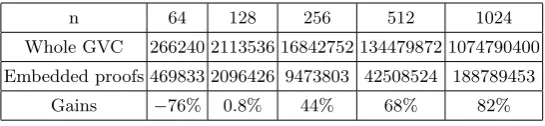
Table 1 compares the cost required to prove a matrix multiplication using our embedded proof system and computing the whole proof inside the GVC system. The cost is expressed as the number of multiplication gates inside the arithmetic circuit performing the computation.
Table 1.Matrix multiplication cost comparison (in multiplicative gates)
n 64 128 256 512 1024
Whole GVC 266240 2113536 16842752 134479872 1074790400
Embedded proofs 469833 2096426 9473803 42508524 188789453
Gains −76% 0.8% 44% 68% 82%
5
Security Evaluation
proofs has passed and that the computation t2=g(t1) is correct. Furthermore, theGVCsystem proves the correct execution of the functionF as defined below:
F : (x, t1, t2, π, g, y)7→
1 ifVerifyEVC1(x, t1, πEVC1) = 1 andt2=g(t1) andVerifyEVC2(t2, y, πEVC2) = 1,
0 otherwise.
5.1 Correctness
Theorem 2. If theEVCand theGVCsystems are correct then our embedded proof system is correct.
Proof. Assume that the value y = h(g(f(x))) has been correctly computed. It means that t1 = f(x) and t2 = g(t1) have also been correctly computed. Since theGVCsystem is correct, it ensures that the functionF will pass theGVC verification with probability 1, provided that its result is correct. Now, since the EVC1system is correct, the probability thatVerifyEVC1(x, t1, πEVC1) = 1 is 1. The same argument applies for the EVC2 system: since it is correct, the probability that VerifyEVC2(t2, y, πEVC2) = 1 is 1.
Therefore, ify=h(g(f(x))) has been correctly computed, then the function F will also be correctly computed and the verification of the embedded proof system will pass with probability 1.
5.2 Soundness
Theorem 3. If the EVC and the GVC systems are sound with soundness error respectively equal toEVCandGVC, then our embedded proof system is sound with
soundness error at most:=EVC1+EVC2+GVC.
Proof. Assume that a p.p.t. adversaryAembreturns a cheating proofπfor a re-sulty0on inputx, i.e.y0 6=h(g(f(x))) andπis accepted by the verifier with prob-ability higer than. We then construct an adversaryBthat breaks the soundness property of either the GVCor of one of the EVCsystems. We build B as follow:
Aemb interacts with the verifier of the embedded system until a cheating proof is accepted.Aembthen forwards the cheating tuple (x, t1, t2, πEVC1, πEVC2, y, π) for which the proofπhas been accepted.Bcan then submit a cheating proof to the GVCor theEVCsystems, depending on the result of the testst1
?
=f(x),t2 ? =g(t1) ory=? h(t2):
– t1=f(x)is not correct:
Therefore, the probability that the verifier of the embedded proof system accepts is:
P r[VEVC1 acceptsπ] =P r[VEVC1 accepts/Vembacceptsπ]×P r[Vembaccepts π] = 1×
>EVC1
ThusB breaks the soundness property ofEVC1.
– y=h(t2)is not correct:
Based on the same reasoning,Bwill break the soundness property of EVC2 by forwarding the tuple (t2, y, πEVC2) to theEVC2 system.
– t2=g(t1)is not correct:
This means that the proof π computed by the GVC system is accepted by
Vembeven ift2 has not been correctly computed. IfBforwardsπto a GVC system, it breaks its soundness.
6
Conclusion
We design an efficient verifiable computing scheme aiming at proving the cor-rectness of a neural network algorithm. Our scheme builds on the notion of proof composition and leverages an efficient VC scheme, namely the Sum-Check pro-tocol to improve the performance of Pinocchio in proving matrix multiplications. We prove that our scheme is sound and give an efficiency evaluation. As noted in Section 1.3, the composition technique described in the article can be ex-tended to other VC schemes and to an arbitrary number of sequential function evaluations, provided that they respect the requirements defined therein.
References
1. Ajtai, M.: Generating hard instances of lattice problems (extended abstract). In: Proceedings of the Twenty-Eighth Annual ACM Symposium on the Theory of Computing, Philadelphia, Pennsylvania, USA, May 22-24, 1996. pp. 99–108 (1996) 2. Arora, S., Safra, S.: Probabilistic checking of proofs: A new characterization of NP.
J. ACM 45(1), 70–122 (1998)
3. Ben-Sasson, E., Chiesa, A., Garman, C., Green, M., Miers, I., Tromer, E., Virza, M.: Zerocash: Decentralized anonymous payments from bitcoin. In: 2014 IEEE Symposium on Security and Privacy, SP 2014, Berkeley, CA, USA, May 18-21, 2014. pp. 459–474 (2014)
4. Ben-Sasson, E., Chiesa, A., Genkin, D., Tromer, E., Virza, M.: Snarks for C: veri-fying program executions succinctly and in zero knowledge. In: Advances in Cryp-tology - CRYPTO 2013 - 33rd Annual CrypCryp-tology Conference, Santa Barbara, CA, USA, August 18-22, 2013. Proceedings, Part II. pp. 90–108 (2013)
6. Bitansky, N., Canetti, R., Chiesa, A., Tromer, E.: Recursive composition and boot-strapping for SNARKS and proof-carrying data. In: Symposium on Theory of Com-puting Conference, STOC’13, Palo Alto, CA, USA, June 1-4, 2013. pp. 111–120 (2013),http://doi.acm.org/10.1145/2488608.2488623
7. Braun, B., Feldman, A.J., Ren, Z., Setty, S.T.V., Blumberg, A.J., Walfish, M.: Verifying computations with state. In: ACM SIGOPS 24th Symposium on Oper-ating Systems Principles, SOSP’13, Farmington, PA, USA, November 3-6, 2013. pp. 341–357 (2013)
8. Cormode, G., Mitzenmacher, M., Thaler, J.: Practical verified computation with streaming interactive proofs. In: Innovations in Theoretical Computer Science 2012, Cambridge, MA, USA, January 8-10, 2012. pp. 90–112 (2012)
9. Cormode, G., Thaler, J., Yi, K.: Verifying computations with streaming interac-tive proofs. PVLDB 5(1), 25–36 (2011),http://www.vldb.org/pvldb/vol5/p025_ grahamcormode_vldb2012.pdf
10. Costello, C., Fournet, C., Howell, J., Kohlweiss, M., Kreuter, B., Naehrig, M., Parno, B., Zahur, S.: Geppetto: Versatile verifiable computation. In: 2015 IEEE Symposium on Security and Privacy, SP 2015, San Jose, CA, USA, May 17-21, 2015. pp. 253–270 (2015)
11. Delignat-Lavaud, A., Fournet, C., Kohlweiss, M., Parno, B.: Cinderella: Turning shabby X.509 certificates into elegant anonymous credentials with the magic of verifiable computation. In: IEEE Symposium on Security and Privacy, SP 2016, San Jose, CA, USA, May 22-26, 2016. pp. 235–254 (2016)
12. Fiat, A., Shamir, A.: How to prove yourself: Practical solutions to identification and signature problems. In: Advances in Cryptology - CRYPTO ’86, Santa Barbara, California, USA, 1986, Proceedings. pp. 186–194 (1986)
13. Gennaro, R., Gentry, C., Parno, B.: Non-interactive verifiable computing: Out-sourcing computation to untrusted workers. In: Advances in Cryptology - CRYPTO 2010, 30th Annual Cryptology Conference, Santa Barbara, CA, USA, August 15-19, 2010. Proceedings. pp. 465–482 (2010)
14. Gennaro, R., Gentry, C., Parno, B., Raykova, M.: Quadratic span programs and succinct nizks without pcps. In: Advances in Cryptology - EUROCRYPT 2013, 32nd Annual International Conference on the Theory and Applications of Cryp-tographic Techniques, Athens, Greece, May 26-30, 2013. Proceedings. pp. 626–645 (2013)
15. Ghodsi, Z., Gu, T., Garg, S.: Safetynets: Verifiable execution of deep neural net-works on an untrusted cloud. CoRR abs/1706.10268 (2017), http://arxiv.org/ abs/1706.10268
16. Gilad-Bachrach, R., Dowlin, N., Laine, K., Lauter, K.E., Naehrig, M., Wernsing, J.: Cryptonets: Applying neural networks to encrypted data with high throughput and accuracy. In: Proceedings of the 33nd International Conference on Machine Learning, ICML 2016, New York City, NY, USA, June 19-24, 2016. pp. 201–210 (2016),http://jmlr.org/proceedings/papers/v48/gilad-bachrach16.html 17. Goldreich, O., Goldwasser, S., Halevi, S.: Collision-free hashing from lattice
prob-lems. Electronic Colloquium on Computational Complexity (ECCC) 3(42) (1996), http://eccc.hpi-web.de/eccc-reports/1996/TR96-042/index.html
18. Goldwasser, S., Kalai, Y.T., Rothblum, G.N.: Delegating computation: interactive proofs for muggles. In: Proceedings of the 40th Annual ACM Symposium on Theory of Computing, Victoria, British Columbia, Canada, May 17-20, 2008. pp. 113–122 (2008)
20. Groth, J.: Short pairing-based non-interactive zero-knowledge arguments. In: Ad-vances in Cryptology - ASIACRYPT 2010 - 16th International Conference on the Theory and Application of Cryptology and Information Security, Singapore, De-cember 5-9, 2010. Proceedings. pp. 321–340 (2010)
21. Ishai, Y., Kushilevitz, E., Ostrovsky, R.: Efficient arguments without short pcps. In: 22nd Annual IEEE Conference on Computational Complexity (CCC 2007), 13-16 June 2007, San Diego, California, USA. pp. 278–291 (2007)
22. Kilian, J.: A note on efficient zero-knowledge proofs and arguments (extended ab-stract). In: Proceedings of the 24th Annual ACM Symposium on Theory of Com-puting, May 4-6, 1992, Victoria, British Columbia, Canada. pp. 723–732 (1992) 23. Kosba, A., Zhao, Z., Miller, A., Qian, Y., Chan, H., Papamanthou, C., Pass, R.,
abhi shelat, Shi, E.: C∅c∅: A framework for building composable zero-knowledge proofs. Cryptology ePrint Archive, Report 2015/1093 (2015), http://eprint. iacr.org/2015/1093
24. Lund, C., Fortnow, L., Karloff, H.J., Nisan, N.: Algebraic methods for interactive proof systems. In: 31st Annual Symposium on Foundations of Computer Science, St. Louis, Missouri, USA, October 22-24, 1990, Volume I. pp. 2–10 (1990) 25. Micali, S.: Computationally sound proofs. SIAM J. Comput. 30(4), 1253–1298
(2000)
26. Secure Hash Standard (SHS). Federal Information Processing Standard 180-4 (2015), National Institute of Standards and Technology.
27. Naveh, A., Tromer, E.: Photoproof: Cryptographic image authentication for any set of permissible transformations. In: IEEE Symposium on Security and Privacy, SP 2016, San Jose, CA, USA, May 22-26, 2016. pp. 255–271 (2016)
28. Parno, B., Howell, J., Gentry, C., Raykova, M.: Pinocchio: Nearly practical verifi-able computation. In: 2013 IEEE Symposium on Security and Privacy, SP 2013, Berkeley, CA, USA, May 19-22, 2013. pp. 238–252 (2013)
29. Pointcheval, D., Stern, J.: Security arguments for digital signatures and blind signatures. J. Cryptology 13(3), 361–396 (2000), https://doi.org/10.1007/ s001450010003
30. Setty, S.T.V., McPherson, R., Blumberg, A.J., Walfish, M.: Making argument sys-tems for outsourced computation practical (sometimes). In: 19th Annual Network and Distributed System Security Symposium, NDSS 2012, San Diego, California, USA, February 5-8, 2012 (2012)
31. Thaler, J.: Time-optimal interactive proofs for circuit evaluation. In: Advances in Cryptology - CRYPTO 2013 - 33rd Annual Cryptology Conference, Santa Barbara, CA, USA, August 18-22, 2013. Proceedings, Part II. pp. 71–89 (2013)
32. Valiant, P.: Incrementally verifiable computation or proofs of knowledge imply time/space efficiency. In: Theory of Cryptography, Fifth Theory of Cryptography Conference, TCC 2008, New York, USA, March 19-21, 2008. pp. 1–18 (2008), https://doi.org/10.1007/978-3-540-78524-8_1
33. Wahby, R.S., Setty, S.T.V., Ren, Z., Blumberg, A.J., Walfish, M.: Efficient RAM and control flow in verifiable outsourced computation. In: 22nd Annual Network and Distributed System Security Symposium, NDSS 2015, San Diego, California, USA, February 8-11, 2015 (2015)