A constant rate non-malleable code in the split-state model
∗Divesh Aggarwal† Maciej Obremski‡
November 8, 2019
Abstract
Non-malleable codes, introduced by Dziembowski, Pietrzak and Wichs in ICS 2010, have emerged in the last few years as a fundamental object at the intersection of cryptography and coding theory. Non-malleable codes provide a useful message integrity guarantee in situations where traditional error-correction (and even error-detection) is impossible; for example, when the attacker can completely overwrite the encoded message. Informally, a code is non-malleable if the message contained in a modified codeword is either the original message, or a completely “unrelated value”.
The family which received the most attention is the family of tampering functions in the so called (2-part)split-statemodel: here the messagexis encoded into two sharesLandR, and the attacker is allowed to arbitrarily tamper with eachLandR individually.
In this work, we give a constant rate non-malleable code from the tampering family containing so called 2-lookahead functions and forgetful functions, and combined with the work of Dodis, Kazana and the authors from STOC 2015, this gives the firstconstant ratenon-malleable code in the split-state model with negligible error.
∗
A previous version of this paper was titled “Inception makes non-malleable codes shorter aswell!”. There has been a significant revision from the last version. We refer to Appendix B for a discussion of the differences between the previous and the current version.
†
Department of Computer Science and Center for Quantum Technologies, National University of Singapore. Email:
1
Introduction
Non-malleable codes, introduced by Dziembowski, Pietrzak and Wichs [DPW10], provide a useful mes-sage integrity guarantee in situations where traditional error-correction (and even error-detection) is impossible; for example, when the attacker can completely overwrite the encoded message. Informally, given a tampering familyF, anF-non-malleable code (E, D) encodes a given messagex into a codeword
y ← E(x) in a way that, if y is modified into y0 =f(y) by some f ∈ F, then the message x0 = D(y0) contained in the modified codewordy0 is either the original messagex, or a completely “unrelated value”. In other words, non-malleable codes aim to handle a much larger class of tampering functions F than traditional error-correcting or error-detecting codes, at the expense of potentially allowing the attacker to replace a given message x by an unrelated messagex0 (and also necessarily allowing for a small “sim-ulation error” ε). As shown by [DPW10], this relaxation still makes non-malleable codes quite useful in a variety of situations where (a) the tampering capabilities of the attacker might be too strong for error-detection, and, yet (b) changingxto unrelatedx0 is not useful for the attack. For example, imagine
x being a secret key for a signature scheme. In this case, tampering which keepsx the same corresponds to the traditional chosen message attack (covered by the traditional definition of secure signatures), while tampering which changes x to an unrelated value x0 will clearly not help in forging signatures under the original (un-tampered) verification key, as the attacker can produce such signatures under x0 by himself.
Split-State Model. Although such codes do not exist if the family of “tampering functions” F is
completely unrestricted [DPW10], they are known to exist for many broad tampering families F. One such natural family is the family of tampering functions in the so called split-state model. Here the
k-bit message xis encoded into 2 sharesy1, y2 of lengthneach, and the attacker is allowed toarbitrarily
tamper with eachyi individually. The rate of such an encoding is naturally defined asτ = 2kn.
Non-malleable codes in this model could be interpreted as “non-malleable secret-sharing schemes”: even ifboththe shares are independently tampered with, the recovered message is eitherxor is unrelated to x. Non-malleable codes in the split-state model have received a lot of attention so far [DPW10, LL12, DKO13, ADL14, CG14a, CG14b, Agg15, CGL16, Li17, Li18]. In addition, some of the recent results [GPR16, GK18a, GK18b, ADN+18, BS18, SV18] have shown application of non-malleable codes in the split-state model to other important problems like non-malleable commitments and non-malleable secret sharing.
The known results can be summarized as follows. The first non-malleable code in the split-state model against an information-theoretic adversary was constructed in [DKO13], who constructed a non-malleable code for 1-bit messages in the split-state model. Following that [ADL14, Agg15, AB16] gave the first information-theoretic construction supportingk-bit messages, but where the length of each share
n=O(k5). There was a plausible conjecture stated in [ADL14] about the non-malleability of the inner product function under which one would get a 2-part split-state code with constant rate, i.e., n=O(k). In [CG14a], it was shown that the notion of non-malleable codes in the split-state model is closely related to the notion of non-malleable two-source extractors and using this insight, and the alternating extraction protocol from [DP07], recent results [CGL16, Li17, Li18] have obtained improved constructions of non-malleable codes in the split-state model. The most recent result [Li18] gives a construction with rate c·log log log 1log log 1/ε/ε for some constant c. This result has a constant rate if ε is a constant, but the rate approaches 0 if ε is negligible in n, as is required for cryptographic applications. In particular, if we choose ε= 2−nΩ(1), then the rate is O(log loglognn).
The authors, along with Dodis and Kazana [ADKO15a] introduced the concept of non-malleable reductions and, under a plausible conjecture, gave a series of reductions that results in constant rate non-malleable codes in the split-state model 1.
1
However, until this work, the problem of unconditionally constructing constant rate non-malleable codes in the split-state model (with εnegligible in the size of the codeword) remains open.
Our Result. In this work, we give a constant rate non-malleable code in the split-state model.
Theorem 1.1 (Main Result). There exists an efficient, information-theoretically secureε-non-malleable
code in the split-state model with shares of sizeO(k), wherekis the length of the message, andε= 2−kΩ(1).
Our result is achieved by giving a non-malleable code against the tampering family G containing 2-lookahead tampering functions and forgetful tampering functions. Combined with a non-malleable reduction from the 2-split tampering family toG gives a non-malleable code in the split-state model. For an overview of our construction and a discussion of our proof techniques, we refer the reader to Section 2.
Other Related Work. If we relax the number of states to more than 2, or we restrict the adversary
to be computationally bounded, then there are known constructions of constant rate non-malleable codes with negligible error. In particular, some recent results [CZ14, KOS17, KOS18, GMW18] obtain near optimal non-malleable codes in thet-split-state model wheretis a constant greater than 2, and [AAG+16]
gave a construction of a rate 1 non-malleable code against computationally bounded adversaries.
Other results that look at an (enhanced) split-state model are Faust et al. [FMNV14] which consider the model where the adversary can tamper continuously, and [ADKO15b], that considers the model where the adversary, in addition to performing split-state tampering, is also allowed some limited interaction between the two states.
There have been some results that have obtained non-malleable codes against continuous tampering in the split-state model [AKO17, ADN+17].
In addition to the already-mentioned results, several recent works [CCFP11, CCP12, CKM11, FMVW14, AGM+14, AGM+15, BDSKM16, FHMV17, BDSKM18, BDSG+18] either used or built non-malleable
codes for various families F, but did not concentrate on the split-state model, which is our focus here. The notion of non-malleability was introduced by Dolev, Dwork and Naor [DDN00], and has found many applications in cryptography. Traditionally, non-malleability is defined in the computational setting, but recently non-malleability has been successfully defined and applied in the information-theoretic setting (generally resulting in somewhat simpler and cleaner definitions than their computational counter-parts). For example, in addition to non-malleable codes studied in this work, the work of Dodis and Wichs [DW09] defined the notion of non-malleable extractors as a tool for building round-efficient privacy amplification protocols.
Finally, the study of non-malleable codes falls into a much larger cryptographic framework of providing counter-measures against various classes of tampering attacks. This work was pioneered by the early works of [ISW03, GLM+03, IPSW06], and has since led to many subsequent models. We do not list all such tampering models, but we refer to [KKS11, LL12] for an excellent discussion of various such models.
Organization of the Paper. In Section 2, we provide an overview of our construction and our proof
2
Overview of the Construction and Techniques
2.1 Non-malleable reductions
In [ADKO15a], the notion of non-malleable codes w.r.t. to a tampering family F was generalized to a more versatile notion of non-malleable reductions from F to G. Intuitively, (F,G, ε)-non-malleable reduction allows one to encode a value x with y ← E(x), so that the tampering of y by y0 = f(y) for f ∈ F gets “reduced” (by the decoding function D(y0) = x0) to tampering with x itself via some (distribution over) G∈ G, that is D(f(y))≈ε G(x). For formal definitions and more details we refer to
the Section 3.2.
Notice that the notion ofnon-malleable code w.r.t. F, is simply a reduction from F to the family of “trivial manipulation functions” consisting of identity function and constant functions (see Def. 3.4 for formal definition). The utility of non-malleable reductions comes from the natural composition theorem that was shown in [ADKO15a], which allows to construct a non-malleable code by gradually make our tampering families simpler and simpler, until we eventually end up with a family of trivial manipulation functions mentioned above.
2.2 Important tampering families
Let us briefly introduce few important function families.
• t-split-state model. Is a family where the attacker can apply t arbitrarily correlated functions
h1, . . . , ht to t separate parts of memory (but, of course, each hi can only be applied to the i-th
part individually).
• forgetful family. Memory is split into t parts. Adversary can apply any tampering function that depends only on (t−1) parts. I.e. adversary has to ’forget’ at least one part of the memory (it is up to him which will be forgotten), besides that, it is not restricted in any way.
• lookahead manipulation family. There are t parts of memory (x1, . . . , xt), adversary tampers with
first part x01 =f1(x1), then with next parts while knowing all previous parts: x0i =fi(x1, . . . , xi).
In other words, x01 depends on x1, x02 depends on both x1 and x2, and in general, x0i depends on
x1, . . . , xi.
• 2−lookahead manipulation family. Here t parts of memory (for t even) are split into two groups: (x1, . . . , xt/2) and (xt/2+1, . . . , xt), each of the groups is tampered independently, within the groups
adversary applies lookahead manipulations. That means that x0i depends on x1, . . . , xi for i =
1, . . . , t/2, and fori=t/2 + 1, . . . , t we get thatx0i depends onxt/2+1, . . . , xi.
2.3 Reduction from 2−split state model
Theorem 2.1. [Informal]. It was shown in [ADKO15a] that there is an efficient non-malleable reduction
from the2−split statetampering family to a union of theforgetfultampering family and the2−lookahead
tampering family. Moreover this reduction has a constant rate, i.e. the size of the codeword is linear in the size of the message. (for a formal statement see Thm. 5.1).
2.4 Non-malleable code with rate zero but with additional properties
A key ingredient in our construction will be the non-malleable code construction from [ADL14]. Even though, this construction has rate n14 → 0 ([ADL14] claimed a rate of
1
n6 but it was shown to be
1
n4
using the same construction in [AB16]), it has some additional properties that allow us to bootstrap it to obtain a constant rate code against 2-lookahead tampering. In particular, the non-malleable code from [ADL14] has two additional properties that are crucial for our construction:
• Leakage resilient storage. The code in [ADL14] is built on inner product function, which is a strong 2-source extractor. Thus it has excellent leakage resilience properties. Even if the adversary sees one state, and obtains a lot of independent leakage from the other state, he still won’t be able to say anything about the message2.
• Detection of bijective tampering. The adversary cannot hope to retain a lot of information about the codeword in the tampered codeword, and still be able to tamper successfully. If the two tampered states carries a lot of information about original states then we are guaranteed that either the tampered codeword decodes to the original message is preserved or the codeword is not valid (and decodes to an error message, ⊥).
The two properties mentioned above together mean the following. A valid codeword encoding a valid message different from the original message can be produced only if the tampered codeword lost a significant fraction of the information about the original states. In fact, the tampered states carry so little3 information about the original states, that the tampered states and some additional leakage of the codeword put together are still not enough to retrieve any information about the original message.
2.5 Non-malleable code (NMC) against lookahead tampering - the construction4
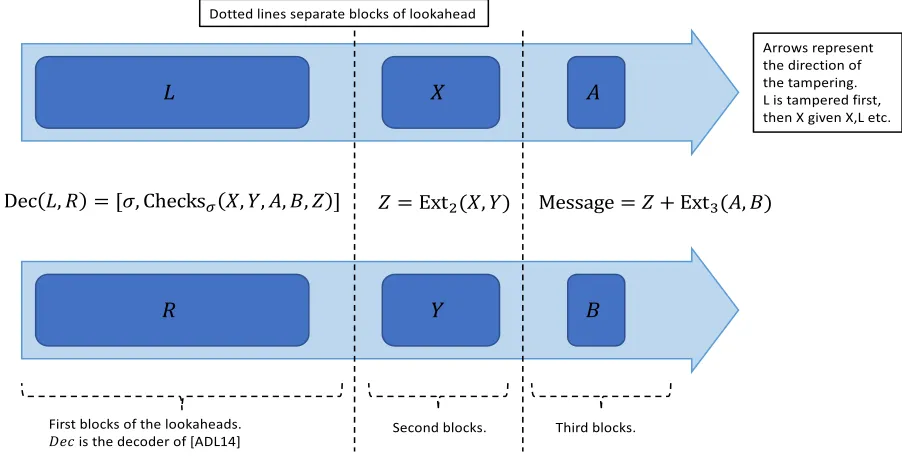
For clarity, we will first discuss the construction of a non-malleable code against lookahead tampering alone (without resilience to forgetful tampering). The construction is described in Figure 1. The main ingredients are:
• (Enc, Dec) a non-malleable code from [ADL14],
• Ext2 and Ext3 are inner product (strong 2-source) extractors with appropriate parameters,
• Checks is an appropriate 2-universal (collision resilient) hash function.
We would like to emphasize here that the reason this construction has a constant rate even though (Enc,Dec) was not constant rate is because we are usingDec(L, R) to only store “checks” to detect any tampering in X, Y, A, B and not to actually store the message.
2.6 A few tampering scenarios
We look at a few tampering scenarios to give the intuition behind the construction. We will writeL0, R0to denote statesLand Rafter tampering. We remind that sinceEnc,Decis a non-malleable code adversary can only preserve the decoding Dec(L, R) or overwrite it completely or create an invalid codeword.
2
The leakage resilience is meant to be exactly as described here. We are not referring to leakage resilient non-malleable codeas defined in [LL12] and [ADKO15b].
3The information rate of the tampered codeword to original codeword is way more then 1/2, but the rate of information
required to retrieve the message is close to 1, the gap between the two is of a constant order.
! " #
$ % &
Dec !, $ = [-, Checks2 ", %, #, &, 3 ] 3 = Ext8(", %) Message = 3 + Ext?(#, &)
Arrows represent the direction of the tampering. L is tampered first, then X given X,L etc.
First blocks of the lookaheads.
@ABis the decoder of [ADL14] Second blocks. Third blocks. Dotted lines separate blocks of lookahead
Figure 1: The decoding algorithm of NMC against lookahead tampering.
Scenario 1: The adversary preserves checks encoded with non-malleable code from [ADL14], i.e.
Dec(L0, R0) =Dec(L, R).
In this case any tampering with X, Y, A, B will be detected via the checks in Dec(L0, R0) =Dec(L, R). There is a technical issue with making this formal: the adversary tampers with X, A after seeingL and withY, Bafter seeingR, but we choose the lengths of the states appropriately so that we can model every-thing as a small leakage from LandRand the secrecy of checks is preserved i.e. X, X0, Y, Y0, A, A0, B, B0
together do not reveal any information about the random seed σ, and thus the probability that checks of original and tampered parts of the codeword will collide is negligible.
Scenario 2: The adversary overwrote checks i.e. Dec(L0, R0)6=Dec(L, R) is a valid codeword.
In this case, by the NMC properties, we get that after the decoding, the modified seed σ0 and the corresponding check value c0 are independent of the original values. However, we can not rule out the possibility that the adversary knows both σ0 and c0 (e.g., if he completely overwrote L, R by something unrelated). Now we have two sub-scenarios:
Scenario 2.1: Adversary lost some information aboutX orY.
In this case, either X can not be fully recovered from L0, X0, or Y cannot be fully recovered from R0, Y0. Then by the strong 2-source extractor property of Ext2, the adversary has lost all information about Z
Scenario 2.2: Adversary preserved information aboutX andY.
We know thatσ0 andc0are controlled by the adversary but completely independent of the original checks. We also know thatX0 andY0 must have high min-entropy, or else they wouldn’t carry information about
X, Y. In order to argue tamper detection in this case, we need to go into the details of the definition of our check. Our check function consists of two checks, one is a collision resilient hash function on
XkYkAkB using half of σ as a seed. The other half of σ say σ2 is used for a check onZ,
Check-Zσ2(Z) :=c2 =Z1⊕σ2,
where Z1 is an appropriate length prefix ofZ.
In this scenario, the check on Z comes into play. We have that X and Y are sample independently and uniform at random and Z := Ext2(X, Y). We can argue that X0, Y0 are high-entropic and independent
even givenL, R(and hence givenL0, R0), and thusZ0 =Ext2(X0, Y0) is close to uniform and independent of the message given L0, R0. Notice that the check for Z (or Z0) has the property that for any fixing of
σ02 and c02, the probability that forU uniformU⊕σ20 =c02 is negligible. Since, as we just discussed,Z0 is close to uniform and independent ofσ02 and c02 the probability thatZ0⊕σ20 =c02 is negligible, and hence the tampering is detected by the decoding algorithm with overwhelming probability.
Scenario 2.20: Imagine we are in the scenario 2.2 mentioned above, but we did not have the last parts
A, B in our encoding function, i.e. the message is simplyZ instead ofZ⊕Ext3(A, B).
Notice that in the previous scenario, we used that X0 and Y0 are independent of the message and since they have high entropy,Z0 =Ext2(X0, Y0) is close to uniform and independent of the message. We did not
show (and did not need) independence of Z and Z0, since Z was sampled uniformly and independently from the message. Now, however, if the message is simply Z, then we cannot say any more thatX0 and
Y0 are independent or that Ext2(X0, Y0) is uniform and independent of the message.
Our encoding algorithm appends random variablesA, B, respectively as the last part in both looka-heads to ensure thatX, Y are independent of the message m.
2.7 Why do we need additional properties of [ADL14]?
In Scenarios 2.1 and 2.2 we need to argue that all information about original Dec(L, R) has been lost. This is not quite as trivial as it seems at the first glance. Dec(L0, R0) might be independent of Dec(L, R) but L0, R0, X0, Y0, A0, B0 together might carry some information about the original checks. Imagine, for example, that Dec(L0, R0) is fixed and independent ofDec(L, R). We have to exclude the possibility that the rest of the codeword (X0, Y0, A0, B0) fulfills the checks from Dec(L0, R0) if and only if the first bit of
Dec(L, R) is equal toDec(L0, R0). If we didn’t rule out this possibility, thenDec(L0, R0) is not independent of Dec(L, R) conditioned on the codeword being valid. This is not only a technical issue, but given that
Dec(L, R) encodes a check on Z, this would raise a concern about the security of the whole scheme. As we discussed earlier, [ADL14] has the property that ifDec(L, R)6=Dec(L0, R0) then L0,R0 form a valid codeword if and only if it doesn’t carry much information about L, R, i.e. the tampering function on L and R are very far from bijective. Then we simply considerX0, Y0, A0, B0 as an extra leakage5 and we can show that L0, R0, X0, Y0, A0, B0 together do not carry enough information aboutL, Rand thus are independent of the original checks.
Another place where we use an additional properties of [ADL14] is in Scenario 1 where we need to show that X, X0, Y, Y0, A, A0, B, B0 doesn’t carry any information about Dec(L, R). here the argument is much more straight forward and follows from the leakage resilient storageproperty of the code.
5
2.8 Last step: resilience to forgetful tampering
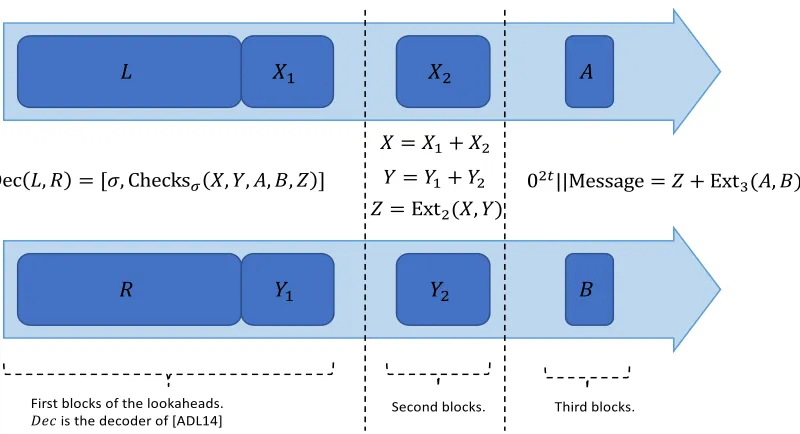
Finally in Section 5.2, we show how to add resilience to forgetful tampering. We need to modify our construction so that forgetting about any of the states leads to forgetting the message. This means that the message can not be retrieved using only 5 of the states (i.e. that the construction is 6 out of 6 secret sharing). First notice:
1. ForgettingA or B: by the property of inner product forgettingAorB immediately leads to losing any information about Ext3(A, B) and thus we lose information about the original message.
2. ForgettingX or Y: Losing information aboutZ immediately leads to losing any information about message. However, situation is more complicated, since L, Rencode the check on Z. Thus, not all information about Z is lost and some partial information about the message can be retrieved.
3. Forgetting L or R: forgetting any of the two is inconsequential, we can fully retrieve the message simply by calculating Ext2(X, Y) +Ext3(A, B).
Point 2: This problem can be easily resolved, notice thatL, Rcarry only information about the prefix
ofZ. Thus the only information about the encoded message the adversary can retrieve is the prefix of that message. To fix this, we simply require that the prefix of the message is 02t where 2tis the length of the check, which essentially means that the message is encoded only on the suffix i.eExt2(X, Y)+Ext3(A, B) = 02t||message.
Point 3: Notice that now, after the above fix, forgetting XorY leads to forgetting the whole message.
Using this fact, we can easily fix the issue from point 3. We will splitX(andY) into 2 statesX=X1+X2
(andY =Y1+Y2). Notice that forgetting any of the fourX1, X2, Y1, Y2leads to forgetting the message. We
will exploit this fact simply by extending states holding L and R to store LkX1 and RkY1 respectively,
while states previously storing X and Y will only store X2 and Y2 respectively (see Figure 2 for the
diagram of modified decoder function).
After the above modifications. Notice that:
1. Forgetting A or B: we still immediately lose the message.
2. Forgetting X2 or Y2: we lose the information about Z which immediately leads to losing any
information about the message.
3. ForgettingLkX1 or RkY1: forgetting any of the two means forgettingX1 orY1 which has the same
consequences as forgettingX2 orY2.
3
Preliminaries
3.1 Notation and Mathematical Preliminaries
For a set T, let UT denote a uniform distribution over T, and, for an integer `, let U` denote uniform
distribution over `bit strings. We say that b=a±δ if a−δ ≤ b≤a+δ. For any random variable A
and any set A, we denote A|A∈A to be the random variable A0 such that
∀a, Pr[A0=a] = Pr[A=a|A∈ A].
The statistical distance between two random variablesA, B is defined by
∆(A; B) = 1 2
X
v
! "# $
% &# '
Dec !, % = [., Checks3 ", &, $, ', 4 ]
4 = Ext#(", &)
0#<||Message = 4 + Ext B($, ')
First blocks of the lookaheads.
CDEis the decoder of [ADL14] Second blocks. Third blocks. "F
&F
" = "F+ "# & = &F+ &#
Figure 2: The decoding algorithm of NMC against lookahead and forgetful tampering .
We use A≈ε B as shorthand for ∆(A, B)≤ε.
Lemma 3.1. For any function α, if∆(A; B)≤ε, then ∆(α(A) ; α(B))≤ε.
Themin-entropy of a random variableW is H∞(W)
def
=−log(maxwPr[W =w]), and theconditional
min-entropy ofW givenZ is H∞(W|Z)
def
= −log (Ez←ZmaxwPr[W =w|Z =z]).
Definition 3.1. We say that a function Ext : Fn×Fn → F is a (k, ε)-2-source extractor if for all
independent sources X, Y ∈Fn such that min-entropy H
∞(X) +H∞(Y)≥k, we have(Y,Ext(X, Y))≈ε
(Y, Um), and (X,Ext(X, Y))≈ε(X, Um).
Lemma 3.2. For all positive integers n and any finite field F, and for all ε > 0, the inner product
function h·,·i:Fn×Fn→F is an efficient((n+ 1) log|F|+ 2 log 1ε, ε) 2-source extractor.
In particular, forn being an integer multiple of m, and interpreting elements of {0,1}m as elements
from F2m and those in {0,1}n to be from (F2m)n/m, we have that for any ε > 0 there exists an efficient
(n+m+ 2 log 1ε
, ε) 2-source extractorExt:{0,1}n× {0,1}n→ {0,1}m.
The following is a definition of an ε-almost universal hash function.
if for any x, y∈ {0,1}n such that x6=y,
Pr
R←{0,1}s(C(R, x) =C(R, y))≤ε
The following is a standard construction of a polynomial evaluation ε-universal hash function. The parameters are from [DW09].
Lemma 3.3. For any n, t > 2 logn, there exists an efficiently computable 2−t/2-almost univeral hash
function C:{0,1}s× {0,1}n→ {0,1}t with s= 2t.
3.2 Non-malleable Codes and Reductions
Definitions. In [ADKO15a], the notion of non-malleable codes w.r.t. to a tampering family F (see
[DPW10]) was generalized to a more versatile notion of non-malleable reductions from F to G. The following definitions are taken from [ADKO15a].
Definition 3.3 (non-malleable reduction). Let F ⊂AA and G ⊂BB be some classes of functions
(which we call manipulation functions). We will write:
(F ⇒ G, ε)
and say F reduces to G, if there exist an efficient randomized encoding function E : B → A, and an efficient deterministic decoding function D:A→B, such that (a) for allx ∈B, we have D(E(x)) =x, and (b) for all f ∈ F, there existsG such that for allx∈B,
∆D(f(E(x))) ; G(x)≤ε, (1)
where Gis adistributionoverG, and G(x) denotes the distribution g(x), where g←G. The pair (E, D) is called (F,G, ε)-non-malleable reduction.
Intuitively, (F,G, ε)-non-malleable reduction allows one to encode a value x by y ← E(x), so that tampering with y by y0 = f(y) for f ∈ F gets “reduced” (by the decoding function D(y0) = x0) to tampering with x itselfvia some (distribution over) g∈ G.
In particular, the notion ofnon-malleable code w.r.t. F, is simply a reduction from F to the family of “trivial manipulation functions” NMk defined below.
Definition 3.4. LetNMkdenote the set oftrivial manipulation functionsonk-bit strings, which consists
of the identity function I(x) =x and all constant functionsfc(x) =c, where c∈ {0,1}k.
We say that a pair (E, D) defines an (F, k, ε)-non-malleable code, if it defines a (F,NMk, ε
)-non-malleable reduction.
The utility of non-malleable reductions comes from the following natural composition theorem that was shown in [ADKO15a], which allows to gradually make our tampering families simpler and simpler, until we eventually end up with a non-malleable code (corresponding to the trivial familyNMk).
Theorem 3.1 (Composition). If (F ⇒ G, ε1) and (G ⇒ H, ε2), then (F ⇒ H, ε1+ε2).
We will also need the following trivial observation.
Observation 3.1 (Union). Let(E, D) be an(F,H, ε) and a(G,H, ε0)non-malleable reduction . Then
(E, D) is an (F ∪ G,H,max(ε, ε0)) non-malleable reduction .
Useful Tampering Families. We define several natural tampering families we will use in this work.
Definition 3.5. Given tampering familiesF ⊂AAandG ⊂BB, letF × G denote the class of functions
h from (A×B)A×B such that
h(x) =h1(x1)kh2(x2)
for someh1 ∈ F and h2 ∈ G and x=x1kx2, where x1 ∈A, x2 ∈B.
We also letF1:=F, and, fort≥1,Ft+1:=Ft× F.
We can now define the following tampering families:
• Sn= ({0,1}n){0,1}n
denote the class of allmanipulation functions on n-bit strings.
• Given t > 1, St
n denotes the tampering family in the t-split-state model, where the attacker can
apply t arbitrarily correlated functions h1, . . . , ht to t separate, n-bit parts of memory (but, of
course, each hi can only be applied to thei-th part individually).
• F ORt
n1,n2,...,nt denotes forgetful family. It is applied to t parts of memory of length ni but the
output value can depend only on (t−1) parts. More precisely: Let x ∈ {0,1}n be a bit vector
and xi ∈ {0,1}ni denote i-th block of n bits. For any h ∈ F ORtn1,n2,...,nt there exist a subset S ⊂ {1,2, . . . , t} of size (t−1) such that h(x) can be evaluated from xS. Besides that, it is not
restricted in any way.
• Finally, LA←n1t,...,nt, wheren=n1+· · ·+ntdenotes the class of lookahead manipulation functionsl
that can be rewritten as l= (l1, . . . , lt), forli :{0,1}n1+···+ni → {0,1}ni, and where
l(x) =l1(x1)k. . .klt(x1, . . . , xt)
forxi∈ {0,1}ni. In other words, ifl(x1, . . . , xt) =y1, . . . , yt, theny1 depends onx1, andy2 depends
on both x1 andx2, and in general, yi depends onx1, . . . , xi.
4
The non-malleable code construction from [ADL14, Agg15, AB16]
We will need the construction of non-malleable codes in the split-state model from [ADL14, Agg15, AB16]. We need a little more than just the non-malleability property of the construction. The following theorem states and proves the precise property of the code that we require for our construction. The proof appears in Appendix A and is a rather straightforward modification of the proofs in [ADL14, Agg15, AB16]. The reader can safely skip this section and return to it when referenced.
Theorem 4.1. There exists an efficient construction (Enc,Dec) of an ε-non-malleable code in the
split-state model from {0,1}7t to
Fnp ×Fnp with ε= 2−Ω(t),n=O(t5) andp≤2O(t) is a prime6. Furthermore, for any functions f :Fnp →Fnp, andg:Fnp →Fnp, the space Fnp ×Fnp can be partitioned into
Fnp × R0, L0×(Fnp \ R0), (Lsame,i× Rsame,i)1≤i≤q, (L⊥,i× R⊥,i)1≤i≤r,Rem
such that the following hold.
• L0={`∈Fn
p :|f−1(f(`))| ≥p0.45n, and R0 ={r ∈Fnp :|g−1(g(r))| ≥p0.45n, i.e., L0 is the subset
of Fnp on which f is “far from” being a bijective function, and R0 is the subset of Fnp on which g is “far from” being a bijective function.
• For all m ∈ {0,1}7t, for all i, Pr[Dec(Enc(m)) = m | Enc(m) ∈ L
same,i × Rsame,i] = 1, and |Lsame,i× Rsame,i| ≥p1.9n.
6The constant 7 in this Theorem statement are chosen to match those required in our results. There is some freedom in
• For all m ∈ {0,1}7t, for all i, Pr[Dec(Enc(m)) = ⊥ | Enc(m) ∈ L
⊥,i × R⊥,i] = 1−ε, and |L⊥,i× R⊥,i| ≥p1.9n.
• For all m∈ {0,1}7t, Pr[Enc(m)∈Rem]≤ε.
• The decoding function Dec(`, r) := h(Ext(`, r)) is a deterministic function of the inner product two-source extractor function from Fnp ×Fnp toFp.
5
Our constructions and the main result
It was shown in [ADKO15a] that
Theorem 5.1. For any q, there is ann=O(q) such that
(Sn2 ⇒ LA←q,q,q3 × LAq,q,q←3 ∪ F OR6q,q,q,q,q,q,2−Ω(q)).
So, now we construct non-malleable codes for the tampering familyLA←3
q,q,q× LA←q,q,q3 ∪ F OR6q,q,q,q,q,q.
In Section 5.1, we give a super-strong non-malleable code against 2-lookahead tampering family, and in Section 5.2, we show how to extend it to include the forgetful tampering family.
5.1 A non-malleable code against 2-lookahead tampering
Theorem 5.2. There exists a2−kΩ(1)-non-malleable code fork-bit messages against the tampering family
LA←3
O(k),O(k),O(k)× LA ←3
O(k),O(k),O(k).
Construction. Our construction (E, D) depicted in Figure 1 that achieves the above result is as
fol-lows7.
Encoding : Givenm∈ {0,1}k, we do the following.
• Let Ext3 be the inner product function fromF52k×F52k →F2k. Let A, B be chosen uniformly
at random from {0,1}5k.
• Let Ext2 be the inner product function from F252k ×F252k → F2k. Sample X, Y ∈ {0,1}25k
uniformly at random, conditioned onz:=Ext2(X, Y) =m⊕Ext3(A, B).
• Let σ1, σ2 be 2t-bit strings sampled uniformly at random fort= Θ(k1/5).
• Let C :{0,1}2t× {0,1}60k → {0,1}t be a 2−t/2-almost universal hash function as defined in
Lemma 3.3. Also, let z=z1kz2 where|z1|= 2t.
• Let s=σ1, σ2, c1:=C(σ1, XkYkAkB), c2:=z1⊕σ2.
• Let L, R := Enc(s), where (Enc,Dec) be a non-malleable code in the split state model given by Theorem 4.1 from {0,1}7tto
Fnp ×Fnp wheren=d100logkpe.
• Output (L, X, A) as the first part of the codeword, and (R, Y, B) as the second part.
Decoding : Given (L, X, A),(R, Y, B) we do the following.
• Compute s=Dec(L, R), and z=Ext2(X, Y).
• If s=⊥, output ⊥, else let s=σ1, σ2, c1, c2.
• If z1 6=c2⊕σ2, wherez1 is the first 2tbits of z, orc1 6=C(σ1, XkYkAkB), output⊥.
• Else output z⊕Ext3(A, B).
7We note here, that the construction is efficient. Please notice that sinceExt
2 andExt3are just inner product extractors
Overview of the proof. Given a message m ∈ {0,1}k, let E(z) = (L, X, A),(R, Y, B). Let f
1, g1 :
Fnp → Fnp, f2, g2 :Fnp × {0,1}25k → {0,1}25k, and f3, g3 :Fnp × {0,1}30k → {0,1}5k be arbitrarily chosen
functions, and let
L0 =f1(L), R0 =g1(R), X0 =f2(L, X), Y0 =g2(R, Y), A0 =f3(L, X, A), B0=g3(R, Y, B).
Also, letz0, z10, z20, σ10, σ20, c01, c02 be the corresponding tampered values.
As is the case with almost all proofs for non-malleable code constructions, our proof proceeds by first partitioning the ambient spaceFnp×{0,1}30k×Fnp×{0,1}30kdepending on the functionsf1, g1, f2, g2, f3, g3.
We then argue that for each partition, as long as the partition is large enough, conditioned on the random variables L, X, A, R, Y, B being restricted to be in that partition, we can show that either the codeword remains unchanged after tampering, or D((L0, X0, A0),(R0, Y0, B0)) = ⊥ with high probability, or the tampered codeword is almost independent of the message m, (i.e., it reveals no information about the message m).
We first consider the partition whereDec(L0, R0) = Dec(L, R). In this case, notice that if X, Y, A, B
are changed then with high probability, C(σ1, XkYkAkB) 6= C(σ1, XkYkAkB), and so the decoding
algorithm outputs ⊥ with high probability. On the other hand, if X, Y, A, B are unchanged, then the decoder outputssame. For the formal proof, we need to deal with the dependence between various random variables, and the detailed proof can be found in Lemma 7.1.
We next consider the partition where H∞(L0) +H∞(R0) nlogp, andDec(L0, R0)6=Dec(L, R). In
this case, by Theorem 4.1, we have that Dec(L0, R0) =⊥with high probability.
This leaves us with the partitions where one of H∞(L|L0) or H∞(R|R0) (say H∞(L|L0)) is at least
0.45nlogp. Notice that here we are using the fact that for an appropriate choice of partitions, we have that H∞(L0) +H∞(L|L0)≈nlogpforLchosen uniformly from that partition. This in particular means
that H∞(L|L0, X0, A0) ≥ 45k−25k−5k = 15k. Thus, again using the observation that Dec(L, R)
is a deterministic function of a strong two-source extractor h(Ext(L, R)), we have that Dec(L, R) is independent ofL0, R0, X0, Y0, A0, B0, X, Y, A, B. At this point, we can fixL, R, thereby fixingL0 =`0, R0 =
r0.
Thus, X0, Y0 are deterministic functions of X, Y, respectively. Now we further partition the space
{0,1}25k× {0,1}25kbased on the functionsf
2, g2. First we consider the case whereH∞(X0) +H∞(Y0)
26k. In this case, by using the fact that inner product is a strong 2-source extractor, and noting that
X, Y, and henceX0, Y0is independent of the messagem, we have thatz0 (and hencez10 is close to uniform and independent of the message m, and`0, r0. Thus, the probability that σ20 =c02⊕z10 is negligible, and hence the decoding algorithm outputs⊥ with high probability.
The only remaining case is when one ofH∞(X|X0) orH∞(Y|Y0) (sayH∞(X|X0)) is at least 10k, in
which case H∞(X|X0, A, A0) ≥5k, and hence by the strong extractor property of the inner product, we
have thatz=Ext2(X, Y) is independent ofX0, Y0, A0, B0, A, B and hence is independent of the tampered
codeword (since we already fixed L0, R0). The tampered codeword is thus independent of the message8.
5.2 A non-malleable code secure against 2-lookahead and forgetful tampering
Theorem 5.3. There is an 2−kΩ(1)-super-strong non-malleable code for k-bit messages against the
tam-pering family LA←3
O(k),O(k),O(k)× LA ←3
O(k),O(k),O(k)∪ F OR6O(k),O(k),O(k),O(k),O(k),O(k).
Proof. We modify the construction in Section 5.1 to get non-malleability against the forgetful family.
Construction. Our construction (E∗, D∗) depicted in Figure 2 that achieves the above result is as
follows.
Encoding : Our encoding algorithm is as follows.
8Sincem=Ext
• Given a message m∗∈ {0,1}k−2t, let m= 02tkm∗.
• Let X, A, Y, B, L, R, s, σ1, σ2, z, z1, z2, c1, c2 be as in the encoding of E(m), where E is the
encoding algorithm from Section 5.1.
• Choose X1, Y1 uniformly at random from {0,1}25k, and letX2 =X⊕X1,Y2=Y ⊕Y1.
• Output the three parts of the first lookahead as ((L, X1), X2, A), and the three parts of the
second lookahead as ((R, Y1), Y2, B).
Decoding : The decoding algorithm is as follows.
• Given ((L, X1), X2, A),((R, Y1), Y2, B), compute X=X1⊕X2, andY =Y1⊕Y2.
• Then D∗(((L, X1), X2, A),((R, Y1), Y2, B)) := D((L, X, A),(R, Y, B)), where D is as defined
in Section 5.1.
We now give a simple argument that shows that this construction is secure against the tampering fam-ily LA←O(3k),O(k),O(k)× LA←O(3k),O(k),O(k)∪ F OR6O(k),O(k),O(k),O(k),O(k),O(k) assuming the construction given in Theorem 5.2 is secure against the tampering family LA←O(3k),O(k),O(k)× LA←O(3k),O(k),O(k).
Non-malleability against 2-lookahead tampering. We first argue security against 2-lookahead
tampering. Let the tampering functions bef1, g1 :Fnp× {0,1}25k→Fnp,f2, g2 :Fnp× {0,1}25k→ {0,1}25k,
f3, g3:Fnp × {0,1}50k → {0,1}25k,f4, g4 :Fnp × {0,1}55k→ {0,1}5k, such that
L01=f1(L, X1), X10 =f2(L, X1), X20 =f3(L, X1, X2), A0 =f4(L, X1, X2, A),
and
R10 =g1(R, Y1), Y10 =g2(R, Y1), Y20 =g3(R, Y1, Y2), B0 =g4(R, Y1, Y2, B),
We show the result for every possible fixing of X1 =x andY1 =y. We define the functionsf1∗, f2∗, f3∗ as
f1∗(L) :=f1(L, x), f2∗(L, X) :=f2(L, x)⊕f3(L, x, X⊕x), f3∗(L, X, A) :=f4(L, x, X⊕x, A),
and similarly define g1∗, g2∗, g3∗, which is an attack inLA←3× LA←3 against the construction from Theo-rem 5.2. With this change, the proof is identical to that of TheoTheo-rem 5.2.
Non-malleability against forgetful tampering. In order to argue security against forgetful
tam-pering, consider the case where the adversary loses information about one of AorB (sayA), but knows
L, R, X1, X2, Y1, Y2, B. We assume that A, B, X1, X2, Y1, Y2 are uniformly distributed and L, R is
com-puted as in theE∗ givenA, B, X1, X2, Y1, Y2. In this case, sinceH∞(A|C(σ2, XkYkAkB))≥5k−t, and
thus we have that
∆(Ext3(A, B) ; Uk|B, X1, X2, Y1, Y2, L, R)≤2−1.5k.
For any messagem∗, we have thatExt3(A, B)⊕Ext2(X1, X2) =m∗(respectivelyUk⊕Ext2(X1, X2) =m),
and using Lemma 6.1, we have that upto statistical distance 2−0.5k,B, X1, X2, Y1, Y2, L, Rare independent
of the message m.
Similarly, if the adversary loses information about one of X2 or Y2 (say X2), then a similar
ar-gument shows that z2 is uniform and independent of A, B, X1, Y1, Y2, L, R, and hence conditioning on
(z1kz2)⊕Ext3(A, B) = 02tkm∗, which implies that upto statistical distance 2−Ω(k),m∗ is independent of A, B, X1, Y1, Y2, L, R.
Losing one of (L, X1) or (R, Y1) (say (L, X1)) is clearly worse for the adversary, and so the adversary
5.3 Final result via a non-malleable reduction from [ADKO15a]
Setting q= 125kin Theorem 5.4, and padding the required number of 0’s as a prefix to each part of the codeword, we obtain the following
Theorem 5.4. There is an2−qΩ(1)-super-strong non-malleable code fork−O(k1/5)-bit messages against
the tampering family LA←q,q,q3 × LA←q,q,q3 ∪ F OR6q,q,q,q,q,q.
Theorem 1.1 then follows from Theorem 3.1 and Theorem 5.1.
6
Some Additional Useful Lemmas
In this section, we list a few simple but useful results that we need for our technical proofs in Section 7 and Appendix A.
The following is a simple result from [ADL14] that says that if two pairs of random variables (X1, X2),(Y1, Y2) are statistically close to each other then X1 conditioned on X2 is statistically close
toY1 conditioned on Y2.
Lemma 6.1. LetX1, Y1∈ A1, andY1, Y2 ∈ A2 be random variables such that∆((X1, X2) ; (Y1, Y2))≤ε.
Then, for any non-empty set A0 ⊆ A1, we have
∆(X2|X1 ∈ A0 ; Y2 |Y1 ∈ A0)≤
2ε
Pr(X1 ∈ A0) .
The following is a variant of a similar simple lemma from [DKO13, ADL14]. The proof is just a simple application of triangle inequality.
Lemma 6.2. Let S be some random variable distributed over a set S, and let S1, . . . ,Sj be a partition
of S. Let φ : S → T be some function, and let D1, . . . , Dj be some random variables over the set T. Assume that for all 1≤i≤j,
∆ (φ(S)|S∈Si ; Di)≤εi.
Then
∆ (φ(S) ; D)≤XεiPr[S∈Si],
for some random variable D∈ T such that for all d Pr[D=d] =P
iPr[S∈ Si]·Pr[Di=d].
We will need the following simple lemma about the inner product 2-source source extractors.
Lemma 6.3. Let p ≥ 2 and n ≥ 10 be integers. Ext : Fnp ×Fnp → Fp be the inner product 2-source
extractor with |Fp| = p. Let Ext−1(b) to be a random variable that chooses a random element (x, y) in Fnp ×Fnp, such that Ext(x, y) =b. Then, for any b∈ B, and any setS ⊂Fnp ×Fnp
• If |S| ≤δp2n, then
Pr[Ext−1(b)∈ S]≤2δp .
c
• If S =A × B for some A,B ⊆Fn
p, and |A × B| ≥p1.9n, then
Pr[Ext−1(b)∈ A × B]
|A × B|/p2n = 1±p
Proof. We have that
Pr[Ext−1(b)∈ S] = number of pairs (x, y)∈ S such that Ext(x, y) =b number of pairs (x, y)∈Fnp ×Fnp such that Ext(x, y) =b
.
The denominator in the above is p2n−1±pn, which immediately implies that if|S| ≤δp2n then
Pr[Ext−1(b)∈ S]≤ δp
2n
p2n−1−pn ≤
2δp2n
p2n−1 = 2δp .
For seeing the second item, we observe by the 2-source extractor property that the number of pairs (x, y)∈ A × B such thatExt(x, y) =bis |A×B|p (1±p−0.45n+1).
The following corollary is immediate from the above.
Corollary 6.1. Let p ≥ 2 and n ≥ 10 be integers. Let Ext : Fnp ×Fnp → Fp be the inner product 2
-source extractor with |Fp|=p. Let S1,S2, . . . ,Sq,Sq+1 be a partition of Fnp ×Fnp such that for 1≤i≤q, Si =Li× Ri for someLi,Ri ⊆Fnp and |Si| ≥p1.9n. Also, |Sq+1| ≤δpn. LetIb be a random variable that takes the value i ∈[q+ 1] if Ext−1(b) ∈ Si, and I be a random variable that takes the value i ∈[q+ 1] with probability |Si|
p2n. Then for any b∈F
∆(I ; Ib)≤p−0.4n+ 2δp .
Proof. We have that
∆(I ; Ib)≤max(Pr[I =q+ 1],Pr[Ib =q+ 1]) + q X
i=1
Pr[I =i]−Pr[Ib =i]
≤2δp+
q X
i=1
|Si|
pn p
−0.4n
≤2δp+p−0.4n,
as needed.
7
Proof of Theorem 5.2
Given a message m ∈ {0,1}k, let the encoding of the message be E(m) = (L, X, A),(R, Y, B), where
(L, X, A) is the first part of the encoding and (R, Y, B) is the second part of the encoding. After tampering, let the codeword be (L0, X0, A0),(R0, Y0, B0). Then, since the allowed tampering is independent lookahead tampering on the two parts, L0 is a function of L, X0 is a function of L, X, and A0 is a function of (L, X, A). The second part of the tampered codeword (R0, Y0, B0) has a similar dependence on (R, Y, B). Let the functionsf1, g1:Fnp →Fnp,f2, g2 :Fnp× {0,1}25k → {0,1}25k, andf3, g3 :Fpn× {0,1}30k → {0,1}5k
be arbitrarily chosen tampering functions, and let (L0, X0, A0),(R0, Y0, B0) be
L0 =f1(L), R0 =g1(R), X0 =f2(L, X), Y0 =g2(R, Y), A0 =f3(L, X, A), B0=g3(R, Y, B).
Also, for convenience, we denote Ext2(X0, Y0) as z0 = z01kz02, and Dec(L0, R0) as σ10kσ20kc01kc02, where
c02 =z10 ⊕σ20 and c01 =C(σ10, X0kY0kA0kB0).
We will now partition the domain to which the codeword (L, X, A),(R, Y, B) belong based on the choice of the tampering functions mentioned above, such that
• Conditioned on E(m) belonging to a particular partition, the function corresponding to decoding of the tampered codeword D((L0, X0, A0),(R0, Y0, B0)) is distributed over a convex combination of the identity function and constant functions, and the distribution is independent of the messagem.
We will begin by considering partitions of L × R based on the choice of the functions f1 and g1 as in
Theorem 4.1 (with the functions f and g in Theorem 4.1 replaced by f1 andg1, respectively).
7.1 Dec(L, R) remains unchanged after tampering
We first consider the partitions where, after tampering, Dec(L, R) =Dec(L0, R0).
Lemma 7.1. If for some i,|Lsame,i× Rsame,i| ≥p1.9n, then for any m∈ {0,1}k
D(E(m))L∈Lsame,i,R∈Rsame,i ≈2−t/3 G(m),
for some function G(m) in NMk.
Proof. For the purpose of the proof of this lemma, we assume that E(m) = (L, X, A),(R, Y, B) is such that L∈ Lsame,i, R∈ Rsame,i. Thus, we have that Dec(L, R) = Dec(L0, R0). We have thatDec(L, R) is
a deterministic function of Ext(L, R), where Ext is (the inner product) strong 2-source extractor. Since the size of X0, A0 is much smaller than that of L, we wish to argue that even thoughX0, A0 can depend on L, there is enough entropy in L given X0 and A0, and henceExt(L, R) (and consequently,Dec(L, R)) is independent X0, A0, Y0, B0 by the strong 2-source extractor property ofExt(·,·). Thus, any change in
X, Y, A, B will be detected by the checks in Dec(L0, R0) = Dec(L, R). This argument is not sufficiently formal since L, R are co-related with X, Y, A, B since c1 = C(σ1, XkYkAkB) and c2 = z1 ⊕σ2, where Dec(L, R) =σ1kσ2kc1kc2.
To make the above intuition formal, we introduce new random variables L,e Re be sampled uniformly
from Lsame,i,Rsame,i respectively9. Also, notice thatσ1, σ2 are chosen uniformly at random independent
of X, Y, A, B. Then,
H∞(Le|f2(L, Xe ), f3(L, X, Ae )) +H∞(Re)≥190k−30k= 160k .
Thus,
∆Ext(L,e Re) ; UZp |X, Y, A, B, f2(L, Xe ), g2(R, Ye ), f3(L, X, Ae ), g3(R, Y, Be ), σ1, σ2
≤2−29k.
Conditioning onh(Ext(L,e Re)) =σ1, σ2, C(σ1, XkYkAkB), σ2⊕z1, wherez1is the first 2tbits ofExt2(X, Y)
(respectively, h(UZp) =σ1, σ2, C(σ1, XkYkAkB), σ2⊕z1) and using Lemma 6.1, we have that
X, Y, A, B, f2(L, X), g2(R, Y), f3(L, X, A), g3(R, Y, B), σ1, σ2 (2)
≈2−28k X, Y, A, B, f2(L, Xe ), g2(R, Ye ), f3(L, X, Ae ), g3(R, Y, Be ), σ1, σ2.
In the above, we have used the fact that the joint distribution of
Ext(L,e Re), X, Y, A, B, f2(L, Xe ), g2(R, Ye ), f3(L, X, Ae ), g3(R, Y, Be ), σ1, σ2
conditioned on h(Ext(L,e Re)) =σ1, σ2, C(σ1, XkYkAkB), σ2⊕z1 is identical to the joint distribution
Ext(L, R), X, Y, A, B, f2(L, X), g2(R, Y), f3(L, X, A), g3(R, Y, B), σ1, σ2 .
9
Since we are working with extractors we need independence. VariablesL, Rare not independent since they form a valid [ADL14] codeword. We will start withL,e Reindependent, run the extraction argument and only at the end condition onL,e Re
Notice that the decoding of the tampered codeword D((L0, X0, A0),(R0, Y0, B0)) is a deterministic func-tion of Dec(L0, R0) =Dec(L, R), f2(L, X), g2(R, Y), f3(L, X, A), g3(R, Y, B), which is in turn a
determin-istic function of X, Y, A, B, f2(L, X), g2(R, Y), f3(L, X, A), g3(R, Y, B), σ1, σ2.10 The inequality (2) above
shows that up to statistical distance 2−28k, we can consider D((L0, X0, A0),(R0, Y0, B0)) as the same
de-terministic function of X, Y, A, B, f2(L, Xe ), g2(R, Ye ), f3(L, X, Ae ), g3(R, Y, Be ), σ1, σ2.
Now we fixA=α, andB =β. Let φ(`, x) be a binary function such thatφ(`, x) = 1 iff2(`, x) =x
and f3(`, x, α) = α, and 0, otherwise. Similarly, let ψ(r, y) be a binary function such that ψ(r, y) = 1 if g2(r, y) =y and g3(r, y, β) =β, and 0, otherwise.
By the almost universality ofC and from inequality (2), we have that the decoding of the tampered codeword D((L0, X0, A0),(R0, Y0, B0)) =⊥with probability at least
Pr[f2(L, Xe )6=X ∨ g2(R, Ye )6=Y ∨ f3(L, X, αe )6=α ∨ g3(R, Y, βe )6=β]−2−t/2−2−28k.
Also, with probability
Pr[f2(L, Xe ) =X ∧g2(R, Ye ) =Y ∧ f3(L, X, αe ) =α ∧ g3(R, Y, βe ) =β]−2−28k ,
we have thatD((L0, X0, A0),(R0, Y0, B0)) =m. Thus, upto statistical distance 2−t/2−2−27k,φ( e
L, X) and
ψ(R, Ye ) determine D(E(m)) = D((L0, X0, A0),(R0, Y0, B0)). We would be done at this point if φ(L, Xe )
and ψ(R, Ye ) were independent of the message m. However, Ext2(X, Y) = m⊕Ext3(α, β), and hence
there is a (mild) dependence between m and the pair φ(L, Xe ) and ψ(R, Ye ). We show below that this
dependence does not affect the claimed result.
We now define a functionGas follows. Let X,e Ye be chosen uniformly at random in {0,1}25k and let
e
m :=Ext2(X,e Ye)⊕Ext3(α, β). For any m∈ {0,1}k,G(m) =m ifφ(L,e Xe) = 1 and ψ(R,e Xe) = 1, and 0,
otherwise.
It is sufficient to show that the pair φ(L,e Xe), ψ(R,e Ye) is statistically close to φ(L, Xe ), ψ(R, Ye ).
To see this, notice that H∞(Xe|φ(L,e Xe)) ≥ 25k−1, and hence, by the strong 2-source extractor
property of Ext2, we have that
Ext2(X,e Ye), φ(L,e Xe), ψ(R,e Ye)≈2−11k Uk, φ(L,e Xe), ψ(R,e Ye).
Conditioning onExt2(X,e Ye) =m⊕Ext3(α, β) (respectively,Uk =m⊕Ext3(α, β)) and applying Lemma 6.1,
we get that
φ(L, Xe ), ψ(R, Ye )≈2−10k φ(L,e Xe), ψ(R,e Ye),
where we used the fact that Ext2(X,e Ye), φ(L,e Xe), ψ(R,e Ye) conditioned onExt2(X,e Ye) =m⊕Ext3(α, β) is
distributed identically to Ext2(X, Y), φ(L, Xe ), ψ(R, Ye ).
Since 2−t/2+ 2−27k+ 2−10k<2−t/3, we get the desired result.
7.2 f1 is far from being bijective
We now consider the case where f1 is far from being bijective, i.e., for every element y inFnp has a large
number of preimages with respect tof1. The case whereg1 is far from being bijective is similar.
Lemma 7.2. Let L0 be as in Theorem 4.1, and letRbe a subset ofFnp such that|L0× R| ≥p1.9n. Then
for any m∈ {0,1}k
D(E(m))L∈L0,R∈R≈2−t/3 G(m),
for some function G(m) in NMk.
10
Proof. For the purpose of the proof of this lemma, we assume that E(m) = (L, X, A),(R, Y, B) is such that L∈ L0, R∈ R.
We first give an intuition for the proof. We have thatDec(L, R) is a deterministic function ofExt(L, R), where Extis (the inner product) strong 2-source extractor. Since the size of X0, A0 is much smaller than that of L and f1 is far from being a bijection, we wish to argue that even thoughX0, A0 can depend on L, there is enough entropy inLgiven L0,X0 and A0, and henceExt(L, R) (and consequently, Dec(L, R)) is independent L0, X, A, X0, A0, R0, Y, B, Y0, B0 by the strong 2-source extractor property of Ext(·,·). To complete the proof, we need to consider two cases - the first where one ofX0, Y0is far from being a bijective function of X, Y, and the second where bothX0, Y0 are close to being bijective functions of X, Y. In the first case, using the property of the strong extractor, we can argue that the tampered codeword (and hence its decoded value) is independent of the message m. In the second case, z0 =Ext(X0, Y0) is close to being uniform and the probability that c02 =σ20 ⊕z20 will be small.
To make the above argument formal, one has to again worry about the dependence between various parts of the codeword since c1 =C(σ1, XkYkAkB) and c2=z1⊕σ2, whereDec(L, R) =σ1kσ2kc1kc2.
For the purpose of the proof, we introduce new random variablesL,e Resampled uniformly from L0,R,
respectively. Also, notice that σ1, σ2 are chosen uniformly at random independent of X, Y, A, B. Let
e
L0=f1(Le),Re0 =g1(Re).
Now, letDec(Le0,Re0) =σe01kσe20kec01kec02 ifDec(Le0,Re0)=6 ⊥. Also, letze0 =Ext2(f2(L, Xe ), g2(R, Ye )), and letez01
be the first 2tbits of ez 0.
Since
H∞(Le|Le0,Xe0, A0) +H∞(Re)≥45k−25k−5k+ 90k= 105k ,
we have by the strong 2-source extractor property of Ext that
∆Ext(L,e Re) ; UZp|X, Y, A, B,Le0,Re0, f2(L, Xe ), g2(R, Ye ), f3(L, X, Ae ), g3(R, Y, Be ), σ1, σ2
≤2−2k.
Conditioning onh(Ext(L,e Re)) =σ1, σ2, C(σ1, XkYkAkB), σ2⊕z1, wherez1is the first 2tbits ofExt2(X,e Ye)
(respectively, h(UZp) =σ1, σ2, C(σ1, XkYkAkB), σ2⊕z1), and using Lemma 6.1, we have that
∆(L0, R0, X0, Y0, A0, B0) ; Le0,Re0, f2(L, Xe ), g2(R, Ye ), f3(L, X, Ae ), g3(R, Y, Be )
|X, Y, A, B≤2−2k .
(3) As in Lemma 7.1, here we have used the fact that the joint distribution of
Ext(L,e Re), X, Y, A, B, f2(L, Xe ), g2(R, Ye ), f3(L, X, Ae ), g3(R, Y, Be ), σ1, σ2
conditioned on h(Ext(L,e Re)) =σ1, σ2, C(σ1, XkYkAkB), σ2⊕z1 is identical to the joint distribution
Ext(L, R), X, Y, A, B, f2(L, X), g2(R, Y), f3(L, X, A), g3(R, Y, B), σ1, σ2 .
Thus, up to statistical distance 2−2k, it suffices to show the statement of the lemma assuming that L
and R are replaced by Le and Re, respectively, i.e., where L,e Re are chosen without any dependence on
X, Y, A, B.
SinceL,e Re are uniformly distributed, it is sufficient to find a distribution D=D(`, r) independent of
the messagem for every `, r∈Fn
p such that
D((f1(`), f2(`, X), f3(`, X, A)) , (g1(r), g2(r, Y), g3(r, Y, B)))≈2−0.4t D. (4)
This will imply the final result since 2−0.4t+ 2−2k<2−t/3.
The inequality 4 is immediate for the case whenDec(f1(`), g1(r)) =⊥since we can chooseG`,r(m) =⊥
for all m, and so we restrict our attention to the case when Dec(f1(`), g1(r)) =eσ 0 1kσe
0 2kec
0 1ec
0
2 6=⊥. Notice
Since `, r is fixed, for the remainder of the proof, we shorthand f2(`, x), g2(r, y), f3(`, x, a), and g3(r, y, b) byf2(x), g2(y), f3(x, a), and g3(x, b), respectively for anyx, y, a, b.
We partition{0,1}25k× {0,1}25k into X
0× Y0,X0× Y1,X1× Y0, and X1× Y1, where
X0 ={x∈ {0,1}25k| |f2−1(f2(x))| ≥210.5k},
Y0 ={y∈ {0,1}25k| |g−1
2 (g2(y))| ≥210.5k},
X1 ={0,1}25k\X
0, andY1 ={0,1}25k\Y0. We will now split our argument into cases whereX, Y ∈ Xi×Yj
for i, j ∈ {0,1}. Intuitively speaking if X ∈ X0, then X has high entropy given f2(X) and hence, by
the strong extractor property of Ext2, the tampered codeword is independent of the messagem. Similar conclusion is obtained when Y ∈ Y0. On the other hand, ifX∈ X0, and Y ∈ Y0, thenf2(X), g2(Y) have
sufficient entropy to ensure thatExt2(f2(X), g2(Y)) looks uniform and so the probability thatσ20⊕z02=c02
is small.
Claim 7.1. If |X0× Y0| ≥248.5k, then
D((f1(`), f2(X), f3(X, A)) , (g1(r), g2(Y), g3(Y, B)))|X∈X0,Y∈Y0 ≈2−0.5k D0,0 ,
for some distribution D0,0 over {0,1}k∪ {⊥}independent of the message m.
Proof. Let X,e Ye be uniform in X0,Y0, respectively. Then, H∞(Xe|f2(Xe), A, f3(X, Ae ))≥ 5.5k, and also
H∞(Ye)≥23.5k. Thus, by the strong 2-source extractor property of the inner product,
∆(Ext2(X,e Ye) ; Uk|A, B, f2(Xe), g2(Ye), f3(X, Ae ), g3(Y , Be ))≤2−1.5k.
Conditioning onExt2(X,e Ye) =m⊕Ext3(A, B) (respectivelyUk=m⊕Ext3(A, B)), and using Lemma 6.1,
we get that D((f1(`), f2(X), f3(X, A)) , (g1(r), g2(Y), g3(Y, B)))|X∈X0,Y∈Y0 is 2
−0.5k close to
D0,0 :=D
f1(`), f2(Xe), f3(X, Ae )
,
g1(r), g2(Ye), g3(Y , Be )
.
Here we have used the fact that
A, B, f2(Xe), g2(Ye), f3(X, Ae ), g3(Y , Be )
conditioned on Ext2(X,e Ye) =m⊕Ext3(A, B) is distributed identically as
A, B, f2(X), g2(Y), f3(X, A), g3(Y, B)|X∈X0,Y∈Y0 .
To conclude the proof, we just need to observe that the distribution D defined above is independent of the messagem.
Similarly, since we only used that one off2, g2 has a large preimage, we have the following:
Claim 7.2. If |X0× Y1| ≥248.5k, then
D((f1(`), f2(X), f3(X, A)) ,(g1(r), g2(Y), g3(Y, B)))|X∈X0,Y∈Y1 ≈2−0.5k D,
for some distribution D0,1 over {0,1}k∪ {⊥}independent of the message m.
Claim 7.3. If |X1× Y0| ≥248.5k, then
D((f1(`), f2(X), f3(X, A)) ,(g1(r), g2(Y), g3(Y, B)))|X∈X1,Y∈Y0 ≈2−0.5k D,
We now show a similar result for X1× Y1.
Claim 7.4. If |X1× Y1| ≥248.5k, then
D((f1(`), f2(X), f3(X, A)) , (g1(r), g2(Y), g3(Y, B)))|X∈X1,Y∈Y1 ≈2−0.5k+2−0.5t D1,1 ,
where D1,1 :=⊥.
Proof. Note thatX, Y restricted to X∈ X1, Y ∈ Y1 are uniform in X1,Y1, respectively and independent
of the message m.11 In this case,H∞(f2(X)) +H∞(g2(Y))≥48.5k−10.5k−10.5k= 27.5k. Thus,
∆(Ext2(f2(X), g2(Y)) ; Uk)≤2−0.5k .
Thus, the probability that z10 ⊕σe02=ec 0
2 is at most 2t/12 +
1
20.5k, which implies that
Pr[D((f1(`), f2(X), f3(X, A)) , (g1(r), g2(Y), g3(Y, B))) =⊥]≥1−2−0.5k−2−0.5t,
as needed.
Finally, we choose the distribution Dto be the convex combination of Di,j fori, j∈ {0,1} such that the distribution Di,j is chosen with probability |Xi×Yj|
250k .
Since X, Y are uniformly distributed in {0,1}25k, the probability that (X, Y) ∈ X
i × Yj is |X2i50×Ykj|.
Thus, by Claims 7.1, 7.2, 7.3, and 7.4, we have that
∆ (D((f1(`), f2(`, X), f3(`, X, A)) , (g1(r), g2(r, Y), g3(r, Y, B))) ; D)≤2−0.5k+ 2−0.5t.
Similar to Lemma 7.2, we obtain the following.
Lemma 7.3. Let R0 be as in Theorem 4.1, such that |Fnp × R0| ≥p1.99n. Then for anym∈ {0,1}k
D(E(m))L∈L0,R∈R≈2−t/3 G(m),
for some function G(m) in NMk.
7.3 Finishing the proof
We now prove Theorem 5.2. For this, we consider the partitoning as in Fnp ×Fnp as in Theorem 4.1.
We have shown in Lemma 7.1 that for any partition of the form Lsame,i× Rsame,i, there is a function
GP(m)∈NMk such that
(∆(D(E(m))L,R∈P ; GP(m))≤2−t/3 .
Moreover, for a partition P of the form L⊥,i × R⊥,i, if L, R ∈ P, then Dec(L, R) = ⊥, and hence
D(E(m)) =⊥. Thus, for such a partition,
(∆(D(E(m))L,R∈P ; ⊥) =O(ε)≤2−Ω(t).
depending on the functionsf1, g1. Also, by Lemmas 7.2, and 7.3, for the partitionP being one ofFnp×R0
orL0×Fn
p \ R0, if|P| ≥p1.9n, there is a functionGP(m)∈NMk such that
(∆(D(E(m))L,R∈P ; GP(m))≤2−t/3 .
11
Also, if |P|< p1.9n, then by Lemma 6.3, Pr[L, R∈ P]≤2p−0.1n+1= 2−Ω(t). Thus, consider the function G∗ formed as a convex combination of the functions GP, given above, where the partition P is chosen
with probability Pr[(L, R)∈ P]. By Lemma 6.2, it is immediate that
(∆(D(E(m)) ; G∗(m))≤2−Ω(t) .
We would like to say that function G∗ is in theNMk family since it is a convex combination of functions
in NMk. Unfortunately it is not that trivial, the weights of the convex combination might depend
on m because the probability of falling into particular partition Pr[(L, R) ∈ P] might depend on the message m. To resolve this, consider a random function G that is a convex combination of GP that
chooses the partition P with probability p|P|2n. It is easy to see that G ∈ NMk. By Corollary 6.1,
∆(G∗(m) ; G(m))≤2−Ω(t), and the result follows.
References
[AAG+16] Divesh Aggarwal, Shashank Agrawal, Divya Gupta, Hemanta K Maji, Omkant Pandey, and Manoj Prabhakaran. Optimal computational split-state non-malleable codes. InTheory of Cryptography Conference, pages 393–417. Springer, 2016.
[AB16] Divesh Aggarwal and Jop Bri¨et. Revisiting the sanders-bogolyubov-ruzsa theorem in f p n and its application to non-malleable codes. In Information Theory (ISIT), 2016 IEEE International Symposium on, pages 1322–1326. Ieee, 2016.
[ADKO15a] Divesh Aggarwal, Yevgeniy Dodis, Tomasz Kazana, and Maciej Obremski. Non-malleable reductions and applications. In Proceedings of the Forty-Seventh Annual ACM on
Sympo-sium on Theory of Computing, STOC 2015, Portland, OR, USA, June 14-17, 2015, pages
459–468, 2015.
[ADKO15b] Divesh Aggarwal, Stefan Dziembowski, Tomasz Kazana, and Maciej Obremski. Leakage-resilient non-malleable codes, 2015.
[ADL14] Divesh Aggarwal, Yevgeniy Dodis, and Shachar Lovett. Non-malleable codes from additive combinatorics. InSTOC. ACM, 2014.
[ADN+17] Divesh Aggarwal, Nico Dottling, Jesper Buus Nielsen, Maciej Obremski, and Erick Pur-wanto. Continuous non-malleable codes in the 8-split-state model. Technical report, Cryp-tology ePrint Archive, Report 2017/357, 2017.
[ADN+18] Divesh Aggarwal, Ivan Damg˚ard, Jesper Buus Nielsen, Maciej Obremski, Erick Purwanto, Joao Ribeiro, and Mark Simkin. Stronger leakage-resilient and non-malleable secret-sharing schemes for general access structures. IACR Cryptology ePrint Archive, 2018:1147, 2018.
[Agg15] Divesh Aggarwal. Affine-evasive sets modulo a prime. Information Processing Letters, 115(2):382–385, 2015.
[AGM+14] Shashank Agrawal, Divya Gupta, Hemanta K. Maji, Omkant Pandey, and Manoj Prab-hakaran. Explicit non-malleable codes resistant to permutations and perturbations. IACR Cryptology ePrint Archive, 2014:841, 2014.
[AKO17] Divesh Aggarwal, Tomasz Kazana, and Maciej Obremski. Inception makes non-malleable codes stronger. In Theory of Cryptography Conference, pages 319–343. Springer, 2017.
[BDSG+18] Marshall Ball, Dana Dachman-Soled, Siyao Guo, Tal Malkin, and Li-Yang Tan. Non-malleable codes for small-depth circuits. In 2018 IEEE 59th Annual Symposium on Foun-dations of Computer Science (FOCS), pages 826–837. IEEE, 2018.
[BDSKM16] Marshall Ball, Dana Dachman-Soled, Mukul Kulkarni, and Tal Malkin. Non-malleable codes for bounded depth, bounded fan-in circuits. In Annual International Conference on the Theory and Applications of Cryptographic Techniques, pages 881–908. Springer, 2016.
[BDSKM18] Marshall Ball, Dana Dachman-Soled, Mukul Kulkarni, and Tal Malkin. Non-malleable codes from average-case hardness: Decision trees, and streaming space-bounded tampering. In An-nual International Conference on the Theory and Applications of Cryptographic Techniques, pages 618–650. Springer, 2018.
[BS18] Saikrishna Badrinarayanan and Akshayaram Srinivasan. Revisiting non-malleable secret sharing. IACR Cryptology ePrint Archive, 2018:1144, 2018.
[CCFP11] Herv´e Chabanne, G´erard Cohen, J Flori, and Alain Patey. Non-malleable codes from the wire-tap channel. InInformation Theory Workshop (ITW), 2011 IEEE, pages 55–59. IEEE, 2011.
[CCP12] Herve Chabanne, Gerard Cohen, and Alain Patey. Secure network coding and non-malleable codes: Protection against linear tampering. InInformation Theory Proceedings (ISIT), 2012 IEEE International Symposium on, pages 2546–2550. IEEE, 2012.
[CG14a] Mahdi Cheraghchi and Venkatesan Guruswami. Capacity of non-malleable codes. InITCS, 2014.
[CG14b] Mahdi Cheraghchi and Venkatesan Guruswami. Non-malleable coding against bit-wise and split-state tampering. InTCC, 2014.
[CGL16] Eshan Chattopadhyay, Vipul Goyal, and Xin Li. Non-malleable extractors and codes, with their many tampered extensions. InProceedings of the forty-eighth annual ACM symposium
on Theory of Computing, pages 285–298. ACM, 2016.
[CKM11] Seung Geol Choi, Aggelos Kiayias, and Tal Malkin. Bitr: built-in tamper resilience. In
Advances in Cryptology–ASIACRYPT 2011, pages 740–758. Springer, 2011.
[CZ14] Eshan Chattopadhyay and David Zuckerman. Non-malleable codes in the constant split-state model. To appear in FOCS, 2014.
[DDN00] D. Dolev, C. Dwork, and M. Naor. Nonmalleable cryptography. SIAM, 30:391–437, 2000.
[DKO13] Stefan Dziembowski, Tomasz Kazana, and Maciej Obremski. Non-malleable codes from two-source extractors. In Advances in Cryptology-CRYPTO 2013. Springer, 2013.
[DP07] Stefan Dziembowski and Krzysztof Pietrzak. Intrusion-resilient secret sharing. In
Foun-dations of Computer Science, 2007. FOCS’07. 48th Annual IEEE Symposium on, pages
227–237. IEEE, 2007.