DeepMarks: A Digital Fingerprinting Framework
for Deep Neural Networks
Huili Chen, Bita Darvish Rohani, and Farinaz Koushanfar
University of California, San Diego
[email protected], [email protected] [email protected]
Abstract—This paper proposes DeepMarks, a novel end-to-end framework for systematic fingerprinting in the context of Deep Learning (DL). Remarkable progress has been made in the area of deep learning. Sharing the trained DL models has become a trend that is ubiquitous in various fields ranging from biomedical diagnosis to stock prediction. As the availability and popularity of pretrained models are increasing, it is critical to protect the Intellectual Property (IP) of the model owner. DeepMarks introduces the first fingerprinting methodology that enables the model owner to embed unique fingerprints within the parameters (weights) of her model and later identify undesired usages of her distributed models. The proposed framework embeds the fingerprints in the Probability Density Function (pdf) of trainable weights by leveraging the extra capacity available in contem-porary DL models. DeepMarks is robust against fingerprints collusion as well as network transformation attacks, including model compression and model fine-tuning. Extensive proof-of-concept evaluations on MNIST and CIFAR10 datasets, as well as a wide variety of deep neural networks architectures such as Wide Residual Networks (WRNs) and Convolutional Neural Networks (CNNs), corroborate the effectiveness and robustness of DeepMarks framework.
Index Terms—Fingerprinting, Deep Neural Networks, Intellec-tual Property Protection
I. INTRODUCTION
The recent advance in deep learning and neural networks has provided a paradigm shift in various scientific fields. In particular, numerous deep neuron networks (DNNs) such as GoogLeNet [1], AlexNet [2], Residual Network [3], and Neu-ral Architecture Search networks [4] have become prevalent standards for applications including autonomous transporta-tion, automated manufacturing, natural language processing, intelligent warfare and smart health [5], [6], [7]. Meanwhile, open-sourced deep learning frameworks have enabled users to develop customized machine learning systems based on the existing models. PyTorch [8], Tensorflow [9], Keras [10], MXNet [11], and Caffe [12] are examples of such tools.
The distribution of pre-trained neural networks is a promis-ing trend and makes the utilization of DNNs easier. For instance, Caffe provides Model Zoo that includes built neural networks and pre-trained weights for various applications [13]. As the accessibility of models increases, a practical concern is the IP protection and Digital Right Management (DRM) of the distributed models. On the one hand, DL models are usually trained by allocating significant computational resources to process massive training data. The built models are therefore considered as the owner’s IP and need to be
protected to preserve the competitive advantages. On the other hand, malicious attackers may take advantage of the models for illegal usages. The potential problems need to be taken into account during the design and training of the DL models before the owners make their models publicly available.
Previous works have identified the importance of IP protec-tion in DL domain and propose watermarking methodologies for DNNs. The authors of [14], [15] present a new approach for watermarking DNNs by embedding the IP information in the weights. The embedded watermark can be extracted by the owner assuming the details of the models are available to the owner (‘white-box’ setting). To provide IP protection for a remote neural network where the model is exposed as a service (‘black-box’ setting), the paper [16] proposes a zero-bit wa-termarking methodology by tweaking the decision boundary. The paper [17] presents a generic watermarking framework for IP protection in both white-box and black-box scenarios by embedding the watermarks in the pdf of the activation sets of the target layers. To the best of our knowledge, there is no prior work that has targeted fingerprinting for DNNs.
This paper proposes DeepMarks, a novel end-to-end frame-work that enables coherent integration of robust digital finger-printing in contemporary deep learning models. DeepMarks, for the first time, introduces a genericfunctional fingerprint-ing methodology for DNNs. The proposed methodology is simultaneouslyuser and model dependent. DeepMarks works by assigning a unique binary code-vector (a.k.a., fingerprint) to each user and embedding the fingerprint information in the probabilistic distribution of the weights while preserving the accuracy. We demonstrate the robustness of our proposed framework against collusion and transformation attacks includ-ing model compression/pruninclud-ing, and model fine-tuninclud-ing. The explicit technical contributions of this paper are as follows:
• Proposing DeepMarks, the first end-to-end framework
for systematic deep learning IP protection and digital right management. A novel fingerprinting methodology is introduced to encode the pdf of the DL models and effectively trace the IP ownership as well as the usage of each distributed model.
• Performing extensive proof-of-concept evaluation on
var-ious benchmarks including commonly used MNIST, CI-FAR10 datasets. Our evaluations corroborate the effec-tiveness of DeepMarks to detect IP ownership and track the individual culprits/colluders who use the model for unintended purposes.
II. PROBLEMFORMULATION
Fingerprinting is defined as the task of embedding a v -bit binary code-vector cj ∈ {0,1}v in the weights of a
host neural network. Here, j = 1, ..., n denotes the index for each distributed user where n is the number of total users. The fingerprint information can be either embedded in one or multiple layers of the DNN model. The objective of fingerprinting is two-fold: (i) claiming the ownership of a specific neural network, and (ii) tracing the unintended usage of the model by distributed users. In the following sections, we formulate the requirements for digital fingerprinting in the context of DL and discuss possible attacks that might render the embedded fingerprints ineffective.
A. Requirements
Table I summarizes the requirement for an effective fin-gerprints in the deep neural network domain. In addition to fidelity, efficiency, security, capacity, reliability, integrity, and robustness requirements that are shared between fingerprinting and watermarking, a successful fingerprinting methodology should also satisfy the uniqueness, scalability, and collusion resilience criteria.
On the one hand, uniqueness is the intrinsic property of fingerprints. Since the model owner aims to track the usage of the model distributed to each specific user, the uniqueness of fingerprints is essential to ensure correct identification of the target user. On the other hand, as the number of participants involved in the distribution of neural networks increases, scalability is another key factor to perform IP protection and digital right management in large-scale settings. Particularly, the fingerprinting methodology should be able to accommodate a large number of distributed users.
Collusion attacks can result in the attenuation of the fin-gerprint from each colluder and have been identified as cost-effective attacks in the multi-media domain. In a traditional collusion attack, multiple users work together to produce an unmarked content using differently marked versions of the same content [18]. In the domain of DL, a group of users who have the same host neural network but different fingerprints may work collaboratively to construct a model where no fingerprints can be detected by the owner. Considering the practicality of such attacks, We include collusion resilience
in the robustness requirement for DNN fingerprinting.
B. Attack Models
Corresponding to the robustness requirements listed in Ta-ble I, we discuss three types of DL domain-specific attacks that the fingerprinting methodology should be resistant to: model fine-tuning, model compression, and collusion attacks.
Model Fine-tuning. Fine-tuning the pre-trained neural net-works for transfer learning is a common practice since training a DL model from scratch is computationally expensive [19]. For this reason, model fine-tuning can be an unintentional model transformation conducted by honest users or an inten-tional attack performed by malicious users. The parameters of the model are changed during fine-tuning, therefore the em-bedded fingerprints should be robust against this modification.
Model Compression. Compressing the DNN models by pa-rameter pruning is a typical technique to reduce the computa-tional overhead of executing a neural network [20]. Genuine users may leverage parameter pruning to make their models compressed while adversaries may apply pruning to remove the fingerprints embedded by the owner. Since pruning alters the model parameters that carry the fingerprints information, an effective fingerprinting methodology shall be resistant to parameter pruning.
Collusion Attack. Multiple attackers who have the same host neural network with different embedded fingerprints may perform collusion attacks to produce an unmarked model. We consider fingerprints averaging attack which is a common collusion attack and demonstrate how DeepMarks is robust against such attacks.
III. FINGERPRINTEMBEDDING
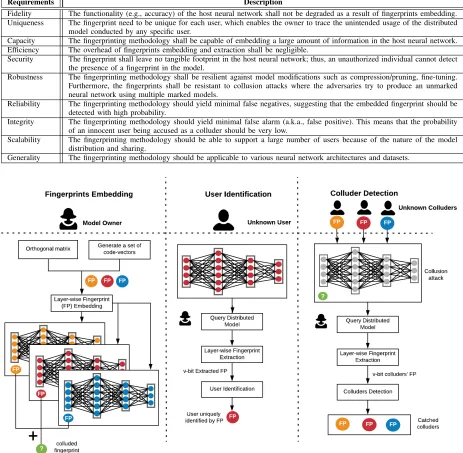
The global flow of DeepMarks is illustrated in Figure 1. In order to trace the models that are distributed to individual users, the owner first assigns a specific code-vector to each user. Given the code-vector and an orthonormal basis matrix, a unique fingerprint is constructed to identify each user. The designed fingerprint is then embedded in the weights distribu-tion for each user by fine-tuning the model with an additive
embedding loss. To identify a specific user, the owner assesses the weights of the marked layers in her model and extracts the corresponding code-vector. The decoded code-vector thus uniquely identifies the inquired user. In addition, DeepMarks enables the owner to detect colluders who work collaboratively and try to generate a model where no fingerprints can be detected by the owner.
There are two types of fingerprint modulation mechanisms in the multi-media domain: (i) orthogonal modulation, and (ii) coded modulation [18]. In the rest of this section, we discuss how DeepMarks framework adopts these two finger-printing methods to provide a generic solution for DNNs.
A. Orthogonal Fingerprinting
As discussed in Section II-A, uniqueness is an essen-tial requirement for fingerprinting to track individual users.
Orthogonal modulation is a technique that uses orthogonal signals to represent different information [21]. By using mu-tually orthogonal watermarks as fingerprints, the separability between users can be maximized. Given an orthogonal matrix
Uv×v= [u1, ...,uv], the unique fingerprint for userj can be
constructed by assigning each column to a user:
TABLE I: Requirements for an effective fingerprinting methodology of deep neural networks.
Requirements Description
Fidelity The functionality (e.g., accuracy) of the host neural network shall not be degraded as a result of fingerprints embedding. Uniqueness The fingerprint need to be unique for each user, which enables the owner to trace the unintended usage of the distributed
model conducted by any specific user.
Capacity The fingerprinting methodology shall be capable of embedding a large amount of information in the host neural network. Efficiency The overhead of fingerprints embedding and extraction shall be negligible.
Security The fingerprint shall leave no tangible footprint in the host neural network; thus, an unauthorized individual cannot detect the presence of a fingerprint in the model.
Robustness The fingerprinting methodology shall be resilient against model modifications such as compression/pruning, fine-tuning. Furthermore, the fingerprints shall be resistant to collusion attacks where the adversaries try to produce an unmarked neural network using multiple marked models.
Reliability The fingerprinting methodology should yield minimal false negatives, suggesting that the embedded fingerprint should be detected with high probability.
Integrity The fingerprinting methodology should yield minimal false alarm (a.k.a., false positive). This means that the probability of an innocent user being accused as a colluder should be very low.
Scalability The fingerprinting methodology should be able to support a large number of users because of the nature of the model distribution and sharing.
Generality The fingerprinting methodology should be applicable to various neural network architectures and datasets.
Fig. 1: DeepMarks Global Flow: DeepMarks performs fingerprinting on DL models by embedding the designated fingerprinting information in the distribution of weights for selected layers. To enable IP protection and digital right management, DeepMarks allows the model owner to extract the embedded fingerprints for user identification as well as colluder detection after distributing the models.
whereujis thejthcolumn of the matrixU,j= 1, ...v. Here, v orthogonal signals deliverB =log2v bits information and can be recovered fromvcorrelators. The orthogonal matrix can be generated from element-wise Gaussian distribution [18].
Regularizing neural networks for security purpose has been presented in previous works [22], [17]. However, none of these works focuses on the fingerprinting of the DL models. DeepMarks embeds the constructed fingerprint in the target layers of the host model by adding the following term to the loss function conventionally used for training/fine-tuning deep
neural networks:
L=L0 +γ M SE(fj−Xw). (2)
Here,L0 is the conventional loss function (e.g. cross-entropy loss), M SE is the mean square error function, γ is the embedding strength that controls the trade-off between the two loss terms,Xis the secret random projection matrix generated by the owner.wis the flattened averaged weights of the target layers for embedding the pertinent fingerprint.
As a proof-of-concept analysis, we embed the fingerprint
the weight Wis a 4D tensor W∈RD×D×F×H whereD is the input depth, F is the kernel size, and H is the number of channels in the convolutional layer. The ordering of filter channels does not change the output of the neural network if the parameters in the consecutive layers are rearranged corre-spondingly [14]. As such, we take the average of Wover all channels and stretch the resulting tensor into a vectorw∈RN, where N =D×D×F. The rearranged weight vector w is then multiplied with a secret random matrix X∈Rv×N and compared with the fingerprint fj. The additional embedding loss term M SE(fj −Xw) inserts the fingerprint fj in the
distribution of the target layer weights by enforcing the model to minimize the embedding loss together with the conventional loss during the training/fine-tuning of the DNN model.
Since each user corresponds to a column vector in the orthogonal basis matrix, the maximum number of users is equal to the dimension of the fingerprint (which is also the number of orthogonal bases): n = v. Thus, the amount of customers that the same neural network can be distributed to is limited by the fingerprints dimension. Orthogonal fingerprints are developed based on spread spectrum watermarking [23]. The straightforward concept and simplicity of implementation make orthogonal fingerprinting attractive to identification ap-plications where only a small group of users are involved. Although orthogonality helps to distinguish individual users, the independent nature of orthogonal fingerprints makes it vulnerable to collusion attacks [18].
B. Coded Fingerprinting
To support a large group of users and improve the collision resilience of the fingerprints, coded modulation is leveraged to introduce correlation between fingerprints [24], [25]. Similar ideas have been discussed in Antipodal CDMA-type water-marking where the correlation contributions only decrease at the locations where the watermarks code-bits are differ-ent [26]. Correlation not only allows the system to support a larger number of fingerprints than the dimensionality of the orthogonal basis vectors, but also alleviates the attenuation of fingerprints due to collusion attacks. The challenge for coded fingerprinting is to design code-vectors such that (i) the correlations are introduced in a strategical way, and (ii) the correct identification of the users involved in a collusion attack is facilitated.
Anti-collusion codes (ACC) is proposed in [18] for coded fingerprinting and have the property that the composition of any subset ofKor fewer code-vectors is unique. This property allows the owner to identify a group ofK or fewer colluders accurately. A K-resilient AND-ACC is a codebook where the element-wise composition is logic-AND and allows for the accurate identification of K unique colluders from their composition. Previous works in the multi-media domain have shown thatBalanced Incomplete Block Design(BIBD) can be used to generate ACCs of binary values [27]. A(v, k, λ)-BIBD is a pair(X,A)whereAis the collection ofk-element subsets (blocks) of av-dimension setX such that each pair of elements of X appear together exactly λ times in the subsets [24],
[28]. The (v, k, λ)-BIBD has b =λ(v2−v)/
(k2−k)blocks (k is the block size) and can be represented by its corresponding incidence matrixCv×b. The elements in the incidence matrix have binary values where:
cij = (
1, ifithvalue occurs injth block
0, otherwise.
By setting the number of concurrent occurrence to one (λ = 1) and assigning the bit complement of columns of the incidence matrix Cv×b as the code-vectors, the resulting
(v, k,1)-BIBD code is (k−1)-resilient and supports up to
n = b users [24]. The theory of BIBD shows that the parameters satisfy the relationship b > v [28], which means the number of users (or fingerprints) is larger than the di-mension of the orthogonal basis vectors. More specifically, the BIBD-ACC construction only requires O(√n) basis vec-tors to accommodate n users instead of O(n) in orthogonal fingerprinting scheme. Systematic approaches for constructing infinite families of BIBDs have been developed [29], which provides a vast supply of ACCs.
Given the designed incidence matrix Cv×b, the coefficient matrixBv×bfor fingerprints embedding can be computed from the linear mappingbij= 2cij−1, thusbij ∈ {±1}corresponds to the antipolar form [30]. The fingerprint for jth user is then constructed from the orthogonal matrix Uv×v and the coefficient matrixBv×b as follows:
fj= v X
i=1
bijuj, (3)
where bj ∈ {±1} v
is the coefficient vector associated with userj. Finally, The designed fingerprintfj is embedded in the
weights of the target model by adding the embedding loss to the conventional loss as shown in Equation 2.
Comparing the orthogonal fingerprinting in Equation 1 with the coded fingerprinting in Equation 3, one can see that orthogonal fingerprinting can be implemented by coded fin-gerprinting if an identity matrix is used as the ACC codebook
C=I. This, in turn, means that the code-vector assigned to each user only has one element that equals to 1 and all the others are zeros. Therefore, orthogonal fingerprinting can be considered as a special case of coded fingerprinting.
IV. FINGERPRINTEXTRACTION
detection settings [18], [31]. DeepMarks leverages blind detec-tion scheme and does not require the knowledge of the original content; thus content registration and storage resources are not needed. We discuss the workflow of extracting the code-vector from the marked weights and detecting participants in fingerprints collusion attacks for both fingerprinting methods in the following sections.
A. Orthogonal Fingerprinting
Code-vector extraction. As discussed in Section II, one objective of embedding fingerprints in the DNNs is to uniquely identify individual users. Since the fingerprint is determined by the corresponding code-vector, we formulate the problem of user identification as code-vector extraction from the marked weighs in each distributed model.
The embedding methodology of orthogonal fingerprinting is described in Section III-A. In the inquiry stage, DeepMarks first acquires the weights tensor Wgj of the pertinent marked
layers for the target userjand computes the flattened averaged version wfj. The fingerprint is recovered from the
multipli-cation fej = Xwfj where X is the random projection matrix specified by the owner. For simplicity, we use orthonormal columns to construct the basis matrixU, thus the correlation score vector (which is also the coefficient vector) can be computed as follows:
e
bj=efj T
U= [fej T
u1, ...,fej T
uv]. (4)
Since the fingerprints are orthogonal, only jth component in the correlation scores bej will have large magnitude while all
the other elements will be nearly zeros. Finally, the code-vector cej ∈ {0,1}v assigned to jth user is extracted by
element-wise hard-thresholding of the correlation vectorbej.
Colluder detection. Recall that the second objective of the owner for leveraging fingerprinting is to trace illegal redistri-bution or unintended usages of the models. Here we consider a typical linear collusion attack where K colluders average their fingerprints and collaboratively generate a new model where the fingerprint is not detectable. To detect participants in the collusion attack, the owner first computes the correlation scores between the colluded fingerprint and each basis vector as shown in Equation 4. Element-wise hard-thresholding is then performed on the correlation vector where the positions of “1”s correspond to the indices of the colluders. According to Equation 4, the magnitude of averaged fingerprints is attenuated by K1 assuming there areKcolluders participating in the attack. As shown in [18], O(pv
/logv) colluders are sufficient to defeat the fingerprinting system, where v is the dimension of the fingerprint.
B. Coded Fingerprinting
Code-vector extraction. Similar to the extraction of or-thogonal fingerprints, the owner acquires the weights in the marked layersgWjand computes its averaged flattened version
f
wj, then extracts the colluders’ fingerprint fej=Xwfj. The
extracted fingerprint is then multiplied with the basis matrix
to compute the correlation score vector bej = fej T
U. Finally, the ACC code-vector cej assigned to the jth user is decoded
frombej by hard-thresholding.
To illustrate the workflow of code-vector extraction for coded fingerprinting, let us consider a (7,3,1)-BIBD code-book given in Equation 5. The coefficient vector of each fingerprint is constructed by mapping each column of the codebookCto the antipodal form{±1}. The fingerprints for all users are shown in Equation 6:
C=
0 0 0 1 1 1 1
0 1 1 1 0 1 1
1 0 1 0 1 0 1
0 1 1 1 1 0 0
1 1 0 0 1 1 0
1 0 1 1 0 1 0
1 1 0 1 0 0 1
, (5)
f1=−u1−u2+u3−u4+u5+u6+u7,
· · ·
f6= +u1+u2−u3−u4+u5+u6−u7,
f7= +u1+u2+u3−u4−u5−u6+u7,
(6)
whereui (i= 1, ...,7) are orthogonal columns of the matrix U. For user 1, her coefficient vector can be recovered by computing the correlation scores:
f
b1=f1T[u1, ...,u7] = [−1,−1,+1,−1,+1,+1,+1].
The corresponding code-vector is then extracted by the inverse linear mappingcij =12(bij+ 1). The resulting code-vector is
f
c1= [0,0,1,0,1,1,1], which is exactly the same as the first
column of C. The consistency shows that BIBD AND-ACC codebooks can be leveraged to identify individual users.
Colluder detection.Recall that in Section III-B, we discuss the property of BIBD and its application for constructing anti-collusion codes. Here, we describe how to use the intrinsic asset of AND-ACC for colluder detection in fingerprints averaging attack. Assuming the positions of the marked layer are known to the colluders, they can perform element-wise average on their weight tensors in the pertinent layers and generate Wavg as the response to the owner’s inquiry. The owner then computes the correlation vectorbavg as follows:
favg=Xwavg, (7)
bavg= (favg)TU. (8)
descending order and iteratively narrow down the set of suspected users until the corresponding likelihood estimation of the colluder set stops increasing. Sequential detector directly estimates the colluder set from the pdf of the correlation statis-tics without decoding the ACC code-vector. For details about each detection method, we refer readers to the paper [18].
DeepMarks deploys hard-thresholding detector for colluders identification. The ACC code-vector is decoded from the correlation vector bavg = [bavg
1 , ..., bavgv ] by comparing each component with the thresholdτ:
cavgi =
(
1,ifbavgi > τ ,
0,otherwise. (9)
Given the ACC code-vector of the colluders cavg, the
re-maining problem is to find the subsets of columns from the codebook C such that their logic-AND composition is equal tocavg. For a(v, k,1)-BIBD-ACC, at most(k−1)colluders can be uniquely identified.
As an example, we demonstrate the colluder detection scheme of DeepMarks using the (7,3,1)-BIBD codebook given in Equation 5. Assuming user 6 and user7 collectively generate the averaged fingerprint:
favg= 1
2(f6+f7),
= 1
2(2u1+ 2u2−2u4).
The owner assesses the averaged fingerprint and computes the correlation scores as the following:
bavg = (favg)TU= [1,1,0,−1,0,0,0].
The colluders’ code-vector is then extracted according to decision rule in Equation 9:
cavg= [1,1,0,0,0,0,0].
It can be observed that the logic-AND of column 6 and column 7 in the codebook C is exactly equal tocavg, while
all the other compositions cannot produce the same result. This example shows that the two colluders can be uniquely identified using the designed BIBD AND-ACC codebook.
V. EVALUATION
We evaluate the performance of DeepMarks on MNIST [33] and CIFAR10 [34] datasets and two different neural network architectures: convolutional neural networks and wide residual networks. The topologies of these two models are summa-rized in Table II. The fingerprints are embedded in the first convolutional layer of the underlying neural network. Since orthogonal fingerprinting can be considered as a sub-category of coded fingerprinting, we focus on the comprehensive eval-uation of latter one. Both MNIST-CNN and CIFAR10-WRN benchmarks are used to assess the performance of coded fingerprinting while only MNIST-CNN benchmark is used to demonstrate the workflow of orthogonal fingerprinting.
A. Coded Fingerprinting Evaluation
In the evaluations of coded fingerprinting, we use a (31,6,1)-BIBD AND-ACC codebook (C) and assign each column as a code-vector for individual users. The codebook can accommodaten = kv((vk−−1)1) = 31 users and is resilient to at most(k−1) = 5colluders, theoretically. The embedding strength in Equation 2 is set toγ= 0.1and the pre-trained host neural network is fine-tuned with the additional embedding loss for 20 epochs in order to embed the fingerprints. The threshold for extracting the code-vector is set to τ= 0.85 in all experiments. We perform a comprehensive examination of the DeepMarks’ performance in the rest of this paper.
Fidelity. To show that the insertion of fingerprints does not impair the original task, we compare the test accuracy of the baseline (host neural network without tuning), the tuned model without embedding fingerprints, and the fine-tuned model with fingerprints embedded. The comparison of results are summarized in Table III. It can be observed from the table that embedding fingerprints in the (deep) neural network does not induce any accuracy drop and can even slightly improve the accuracy of the fine-tuned model. Thus, DeepMarks meets the fidelity requirement listed in Table I.
Uniqueness.The uniqueness of code modulated fingerprinting originates from the(v, k.1)-BIBD ACC codebook. Since the code-vector assigned to each user is the bit complement of columns of the incidence matrix [18] which has no repeated columns, individual users are uniquely identified by the asso-ciated ACC code-vectors.
Scalability. Due to the intrinsic requirement of model dis-tribution and sharing, the fingerprinting methodology should be capable of accommodating a large number of users. For a (v, k,1)-BIBD ACC codebook, the maximum number of users is decided by the code length v and the block sizek:
n= v(v−1)
k(k−1).
Systematic approaches to design various families of BIBDs have been well studied in previous literature [29], [36]. For instance, Steiner triple systems are families of(v,3,1)-BIBD systems and are shown to exist if and only if v ≡ 1 or 3 (mod 6) [36]. An alternative method to design BIBDs is to use projective and affine geometry in d−dimension over
Zp, where p is of prime power. (p d+1−1
p−1 , p + 1,1)-BIBDs and(pd, p,1)-BIBDs can be constructed from projective and affine geometry [29], [37]. By choosing a large dimension of fingerprints in Steiner triple systems, or using projective geometry in a high dimensional space, the number of users allowed in our proposed framework can be sufficiently large. Therefore, the scalability of DeepMarks is guaranteed by a properly designed BIBD ACC codebook. By expanding the ACC codebook, DeepMarks supports IP protection and DRM when new users join in the model distribution system.
TABLE II: Benchmark neural network architectures. Here,64C3(1)indicates a convolutional layer with64output channels and3×3filters applied with a stride of 2,M P2(1)denotes a max-pooling layer over regions of size2×2and stride of 1, and512F Cis a fully-connected layer consisting of512output neurons. ReLU is used as the activation function in all the two benchmarks.
Dataset Model Type Architecture
MNIST CNN 784-32C3(1)-32C3(1)-MP2(1)-64C3(1)-64C3(1)-512FC-10FC
CIFAR10 WRN Please refer to [35]
TABLE III: Fidelity requirement. The baseline accuracy is preserved after fingerprint embedding in the underlying benchmarks.
Benchmark MNIST-CNN CIFAR10-WRN
Setting Baseline Fine-tune without fingerprint
Fine-tune with
fingerprint Baseline
Fine-tune without fingerprint
Fine-tune with fingerprint
Test Accuracy (%) 99.52 99.66 99.72 91.85 91.99 92.03
and model modifications, including parameter pruning as well as model fine-tuning on MNIST and CIFAR10 benchmarks. For all attacks, we assume the fingerprinting method as well as the positions of the marked layers are known to the attackers. The code-vector extraction and colluder detection scheme are described in Section IV-B.
We use a(31,6,1)-BIBD AND-ACC codebook and assume there are 31 users in total. For a given number of colluders, 10,000random simulations are performed to generate different colluders sets from all users. When the colluder set is too large to be uniquely identified by the BIBD AND-ACC codebook, we consider all feasible colluder sets that match the extracted code-vector resulting from the fingerprints collusion and take the mean value of the detection rates as well as the false alarm rates. The average performance over 10,000 random tests is used as the final metric. The details of the robustness tests against the three aforementioned attacks are explained in the following sections.
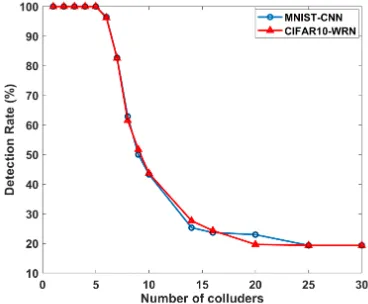
(I) Fingerprints collusion.Figure 2 shows the detection rates of DeepMarks when different number of users participate in the collusion attack. As can be seen from Figure 2, the detection rate is100%when the number of colluders is smaller or equal to 5, which means the collusion resilience level is
Kmax = 5 with the (31,6,1)-BIBD ACC codebook. When the number of colluders further increases, the detection rate starts to decrease, and finally reaches a stable value at19.35%. Along with the evaluation of detection rates, we also assess the false alarm rates of DeepMarks using 10,000 random simulations and summarize the results in Figure 3. It can be seen that the false accuse rate remains 0% when the number of colluders does not exceed 5, which is consistent with
Kmax= 5 found in the evaluations of detection rates. When the number of colluders increases, the false alarm rate first increases and stays at a stable value at the end.
Comparing the detection performance of DeepMarks on MNIST-CNN and CIFAR10-WRN benchmarks shown in Fig-ures 2 and 3, one can observe that the detection rates and the false alarm rates are approximately the same for two benchmarks given the same number of colluders. The con-sistency across benchmarks derives from the correct code-vector extraction and the unique identification property of BIBD ACC codebooks. The colluder detection scheme of DeepMarks can be considered as a high-level protocol which is
completely independent of the underlying network architecture and the dataset. Therefore, our proposed framework meets the
generalityrequirement listed in Table I.
The high detection rates and low false alarm rates corrob-orate that DeepMarks satisfies the reliability and integrity
requirements in Table I, respectively. Furthermore, the max-imal number of colluders that the system can identify with 100% detection rate and 0% false alarm rate is found to be
Kmax= 5, which is consistent with the theoretical tolerance (k−1) given by the BIBD AND-ACC. The consistency helps the owner to choose the proper ACC codebook based on her desired collusion resilience requirement.
Fig. 2: Detection (true positive) rates of fingerprints averaging attack. Using (31,6,1)-BIBD ACC codebook, up to 5 colluders can be uniquely identified with100%detection rate.
Fig. 3: False alarm (false positive) rates of fingerprints averaging attack. Using a(31,6,1)-BIBD ACC codebook, no false accusement occurs if the number of colluders is smaller or equal to 5.
(a) (b)
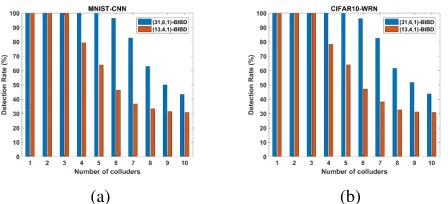
Fig. 4: Detection rates of fingerprints collusion attacks on (a) MNIST-CNN and (b) CIFAR10-WRN benchmarks when different ACC codebooks are used. The codebook with larger block sizekhas better detection capability of collusion attacks.
(a) (b)
Fig. 5: False alarm rates of fingerprints collusion attacks on (a) MNIST-CNN and (b) CIFAR10-WRN benchmarks. Given the same number of colluders, the (31,6,1)-BIBD ACC codebook has lower false alarm rates than the(13.4.1)-BIBD ACC codebook.
rate as well as lower false accuse rate compared to(13,4,1) -BIBD codebook given a specific number of colluders. Same conclusions hold for the collusion resilience against parameter pruning and model fine-tuning attacks. For simplicity, the results are not presented here.
(II) Model fine-tuning.To evaluate the robustness against the fine-tuning attack, we retrain the fingerprinted model using only conventional cross-entropy loss as the objective function. The code-vector extraction and colluder detection scheme are the same as in the evaluation of fingerprints collusion attacks.
The detection rates and false alarm rates of DeepMarks on MNIST and CIFAR10 datasets are shown in Figures 6 and 7, respectively. Compared with Figures 2 and 3, where the robustness against collusion attacks is evaluated without model fine-tuning, the same trend can be observed and the collusion resistance level remains the same Kmax = 5, showing that DeepMarks is robust against model fine-tuning attacks.
Fig. 6: Detect rates of fingerprint collusion with model fine-tuning. DeepMarks attains high detection rate and the same resilience level
Kmax= 5 even if the marked neural network is fine-tuned.
Fig. 7: False alarm rates of fingerprint collusion with model fine-tuning. The collusion resilience level(Kmax= 5)is not affected by
fine-tuning attack.
Fig. 8: Code-vector extraction accuracy and test accuracy under different pruning rates. The test accuracy of MNIST-CNN drops when the pruning rate when the pruning rates is larger than95%while the ACC decoding accuracy remains at100%.
Fig. 9: Code-vector extraction accuracy and test accuracy under different pruning rates. The ACC decoding accuracy is robust up to 99.99% pruning rate while the test accuracy of CIFAR10-WRN benchmark degrades when the pruning rate is greater than90%.
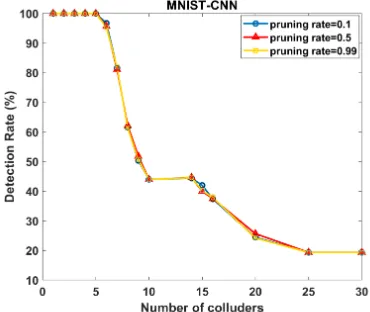
We further assess the robustness of DeepMarks for colluders identification against parameter pruning. Figures 10 and 11 show the detection rates of DeepMarks under three differ-ent pruning rates (10%,50%,99%) using MNIST-CNN and CIFAR10-WRN benchmarks, respectively. Similar to the trend shown in Figure 2, the same collusion resilience levelKmax=
5 is observed in Figures 10 and 11; suggesting that the
reliability and the robustness criteria are satisfied for the parameter pruning attacks as well.
To assess the integrity of DeepMarks, the false alarm rates under three different pruning rates are also evaluated on MNIST and CIFAR10 datasets. From the experimental results shown in Figures 12 and 13, one can see that no false accusement will occur if the number of colluders is smaller or equal toKmax= 5, which is consistent with the evaluation of fingerprints collusion attacks. This consistency indicates that our colluder detection scheme satisfies theintegritycriterion and is robust against parameter pruning attacks.
Fig. 10: Detection rates of fingerprint collusion with three different pruning rates on MNIST dataset. The collusion resistance level
Kmax= 5 is robust up to99%parameter pruning.
Fig. 11: Detection rates of the fingerprints collusion attack with three different pruning rates on CIFAR10 dataset. The collusion resistance level remains atKmax= 5when the parameter pruning is mounted
on fingerprints collusion attacks.
Fig. 13: False alarm rates of collusion attacks on CIFAR10 dataset where three pruning rates are used. Innocent users will not be incorrectly accused if the number of colluders is at most 5.
In conclusion, the high detection rates and low false alarm rates under different attack scenarios corroborate that DeepMarks satisfies the robustness, reliability, and integrity requirements discussed in Table I. The consistency of detection performance across benchmarks indicates that DeepMarks meets the generality requirement.
Efficiency.Here, we discuss the efficiency of the fingerprinting methodology in terms of the runtime overhead for fingerprints embedding and the efficiency of the AND-ACC codebook.
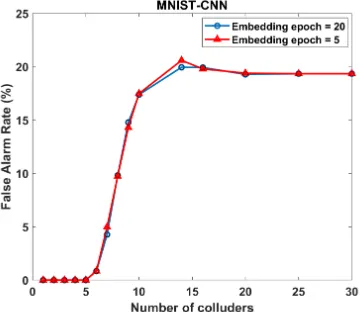
• Fingerprints Embedding Overhead. Since each dis-tributed model needs to be retrained with the fingerprint embedding loss, it is necessary that the fingerprinting methodology has low runtime overhead of generating individual fingerprints. We evaluate the fingerprints em-bedding efficiency of DeepMarks by retraining the un-marked host neural network for 20 epochs and 5 epochs. The robustness of the resulting two marked models against fingerprints collusion attacks is compared. Fig-ures 14 and 15 demonstrate the detection rates and false alarm rates of these two marked models using MNIST-CNN benchmark. As can be seen from the comparison, embedding fingerprints by retraining the neural network for 5 epochs is sufficient to ensure the collusion resistance of the embedded fingerprints, suggesting that the runtime overhead induced by DeepMarks is negligible. We also observe that the marked models retrained for 5 epochs and 20 epochs have the same collusion resistance level against parameter pruning and model fine-tuning attacks.
• ACC Codebook Efficiency. In the multi-media domain, the efficiency of an AND-ACC codebook for a given collusion resistance is defined as the number of users that can be supported per basis vector: β = nv. For a (v, k,1)-BIBD AND-ACC, the codebook efficiency is:
β = v−1
k(k−1). (10)
Thus, for a fixed resilience level k, the efficiency of an AND-ACC codebook constructed from BIBDs improves
Fig. 14: Detection rates of fingerprint collusion attacks on MNIST-CNN benchmark. The same detection performance can be observed when the unmarked model is retrained for two different epochs for fingerprints embedding.
as the code length increases [24]. DeepMarks allows the owner to design an efficient coded fingerprinting methodology by choosing appropriate parameters for the BIBD ACC codebook.
In contrast with orthogonal fingerprinting where the num-ber of users is the same as the fingerprint dimension
n=v (thusβ = 1), it has been proven that a (v, k, λ) -BIBD has n ≥ v [28], meaning that the codebook efficiency of the BIBD construction satisfies β ≥ 1. Equation 10 shows the trade-off between the code length
vand the collusion resilience levelk. When the codebook efficiency is fixed, higher resistance level requires longer fingerprinting codes.
Fig. 15: False alarm rates of fingerprints collusion attacks on MNIST-CNN benchmark when two different embedding epochs are used. Retraining for 5 epochs is sufficient to ensure low false alarm rates.
B. Orthogonal Fingerprinting Evaluation
users, while the collusion-resilience and scalability are not competitive with coded fingerprinting. In addition, orthogonal fingerprinting is essentially a special case of coded fingerprint-ing whose codebook is an identity matrix. For this reason, we evaluate the uniqueness, collusion resilience, and scalability of orthogonal fingerprinting while the comprehensive assessment is not shown here.
Uniqueness. Each user can be uniquely identified by com-puting the correlation scores using Equation 4. An example of user identification is shown in Figure 16 where user 11 is selected as the target. The correct user can be easily found from the position of the “spike” in correlation scores due to the orthogonality of fingerprints.
Fig. 16: Correlation scores of the fingerprint assigned to user 11 with the fingerprints of all 30 users when orthogonal fingerprinting is applied. The target user can be uniquely identified from the position of the “spike” in the correlation statistics.
Collusion resilience. We evaluate the collusion resistance of orthogonal fingerprinting according to the colluder identifica-tion scheme discussed in Secidentifica-tion IV-A. The detecidentifica-tion results of three colluders are shown in Figure 17, which suggests that the three participants in the collusion attack can be accurately identified by thresholding the correlation scores. However, when more users contribute to the collusion of fingerprints, the correlation scores of true colluders attenuate fast and the colluder set cannot be perfectly identified. Figure 18 shows the detection results of seven colluders where user 30 is falsely accused with the decision threshold denoted by the red dashed line. As can be seen from Figure 18, there is no decision threshold that can ensure complete detection of all colluders and no false alarms of innocent users. Thus, orthogonal fingerprinting suffers from fingerprints attenuation and has a high chance of false positives as well as false negatives when collusion happens.
Scalability.Orthogonal fingerprinting requires the code length to be O(n)bits for accommodatingn users, which could be much larger than the code bitsO(√n)needed in coded finger-printing. Thereby, the scalability of orthogonal fingerprinting is inferior to that of code modulated fingerprinting.
Fig. 17: Detection results of three colluders (user 5, user 10, and user 15) participating in the collusion attack. The red dashed line is the threshold (0.3) that can catch all colluders correctly.
Fig. 18: Detection results of seven colluders (user 1, 5, 10, 15, 20, 25 and 28) participating in fingerprints collusion. User 30 is falsely accused if the red dashed line is used as the threshold.
VI. CONCLUSION
network architectures.
REFERENCES
[1] C. Szegedy, W. Liu, Y. Jia, P. Sermanet, S. Reed, D. Anguelov, D. Erhan, V. Vanhoucke, A. Rabinovichet al., “Going deeper with convolutions.” Cvpr, 2015.
[2] A. Krizhevsky, I. Sutskever, and G. E. Hinton, “Imagenet classification with deep convolutional neural networks,” inAdvances in neural infor-mation processing systems, 2012, pp. 1097–1105.
[3] K. He, X. Zhang, S. Ren, and J. Sun, “Deep residual learning for image recognition,” inProceedings of the IEEE conference on computer vision and pattern recognition, 2016, pp. 770–778.
[4] B. Zoph, V. Vasudevan, J. Shlens, and Q. V. Le, “Learning trans-ferable architectures for scalable image recognition,” arXiv preprint arXiv:1707.07012, 2017.
[5] Y. LeCun, Y. Bengio, and G. Hinton, “Deep learning,”nature, vol. 521, no. 7553, p. 436, 2015.
[6] J. Schmidhuber, “Deep learning in neural networks: An overview,”
Neural networks, vol. 61, pp. 85–117, 2015.
[7] R. Collobert and J. Weston, “A unified architecture for natural language processing: Deep neural networks with multitask learning,” in Proceed-ings of the 25th international conference on Machine learning. ACM, 2008, pp. 160–167.
[8] A. Paszke, S. Gross, S. Chintala, G. Chanan, E. Yang, Z. DeVito, Z. Lin, A. Desmaison, L. Antiga, and A. Lerer, “Automatic differentiation in pytorch,” 2017.
[9] M. Abadi, P. Barham, J. Chen, Z. Chen, A. Davis, J. Dean, M. Devin, S. Ghemawat, G. Irving, M. Isardet al., “Tensorflow: A system for large-scale machine learning.” inOSDI, vol. 16, 2016, pp. 265–283. [10] F. Cholletet al., “Keras,” https://github.com/keras-team/keras, 2015. [11] T. Chen, M. Li, Y. Li, M. Lin, N. Wang, M. Wang, T. Xiao, B. Xu,
C. Zhang, and Z. Zhang, “Mxnet: A flexible and efficient machine learning library for heterogeneous distributed systems,”arXiv preprint arXiv:1512.01274, 2015.
[12] Y. Jia, E. Shelhamer, J. Donahue, S. Karayev, J. Long, R. Girshick, S. Guadarrama, and T. Darrell, “Caffe: Convolutional architecture for fast feature embedding,”arXiv preprint arXiv:1408.5093, 2014. [13] Caffe, “Model zoo,” https://github.com/BVLC/caffe/wiki/Model-Zoo,
2017.
[14] Y. Uchida, Y. Nagai, S. Sakazawa, and S. Satoh, “Embedding water-marks into deep neural networks,” inProceedings of the 2017 ACM on International Conference on Multimedia Retrieval. ACM, 2017, pp. 269–277.
[15] Y. Nagai, Y. Uchida, S. Sakazawa, and S. Satoh, “Digital watermarking for deep neural networks,”International Journal of Multimedia Infor-mation Retrieval, vol. 7, no. 1, pp. 3–16, 2018.
[16] E. L. Merrer, P. Perez, and G. Tr´edan, “Adversarial frontier stitching for remote neural network watermarking,”arXiv preprint arXiv:1711.01894, 2017.
[17] B. D. Rouhani, H. Chen, and F. Koushanfar, “Deepsigns: A generic watermarking framework for ip protection of deep learning models,” 2017. [Online]. Available: https://arxiv.org/abs/1804.00750
[18] M. Wu, W. Trappe, Z. J. Wang, and K. R. Liu, “Collusion-resistant mul-timedia fingerprinting: a unified framework,” inSecurity, Steganography, and Watermarking of Multimedia Contents VI, vol. 5306. International Society for Optics and Photonics, 2004, pp. 748–760.
[19] H.-C. Shin, H. R. Roth, M. Gao, L. Lu, Z. Xu, I. Nogues, J. Yao, D. Mollura, and R. M. Summers, “Deep convolutional neural networks for computer-aided detection: Cnn architectures, dataset characteristics and transfer learning,”IEEE transactions on medical imaging, vol. 35, no. 5, pp. 1285–1298, 2016.
[20] S. Han, J. Pool, J. Tran, and W. Dally, “Learning both weights and con-nections for efficient neural network,” inAdvances in neural information processing systems, 2015, pp. 1135–1143.
[21] M. Wu and B. Liu, “Data hiding in image and video. i. fundamental issues and solutions,”IEEE Transactions on image processing, vol. 12, no. 6, pp. 685–695, 2003.
[22] B. D. Rouhani, M. Samragh, T. Javidi, and F. Koushanfar, “Curtail: Characterizing and thwarting adversarial deep learn-ing,” CoRR, vol. abs/1709.02538, 2017. [Online]. Available: http://arxiv.org/abs/1709.02538
[23] I. J. Cox, J. Kilian, F. T. Leighton, and T. Shamoon, “Secure spread spectrum watermarking for multimedia,” IEEE transactions on image processing, vol. 6, no. 12, pp. 1673–1687, 1997.
[24] W. Trappe, M. Wu, Z. J. Wang, and K. R. Liu, “Anti-collusion fin-gerprinting for multimedia,”IEEE Transactions on Signal Processing, vol. 51, no. 4, pp. 1069–1087, 2003.
[25] W. Trappe, M. Wu, and K. R. Liu, “Collusion-resistant fingerprinting for multimedia,” inAcoustics, Speech, and Signal Processing (ICASSP), 2002 IEEE International Conference on, vol. 4. IEEE, 2002, pp. IV– 3309.
[26] K. R. Liu, Multimedia fingerprinting forensics for traitor tracing. Hindawi Publishing Corporation, 2005, vol. 4.
[27] Y. Yu, H. Lu, X. Chen, and Z. Zhang, “Group-oriented anti-collusion fingerprint based on bibd code,” ine-Business and Information System Security (EBISS), 2010 2nd International Conference on. IEEE, 2010, pp. 1–5.
[28] J. H. Dinitz and D. R. Stinson,Contemporary design theory: A collection of Surveys. John Wiley & Sons, 1992, vol. 26.
[29] C. J. Colbourn and J. H. Dinitz,Handbook of combinatorial designs. CRC press, 2006.
[30] J. G. Proakis, M. Salehi, N. Zhou, and X. Li,Communication systems engineering. Prentice Hall New Jersey, 1994, vol. 2.
[31] H. V. Zhao and K. R. Liu, “Fingerprint multicast in secure video streaming,” IEEE Transactions on Image Processing, vol. 15, no. 1, pp. 12–29, 2006.
[32] S. Jain, “Digital watermarking techniques: a case study in fingerprints & faces,” inProc. Indian Conf. Computer Vision, Graphics, and Image Processing, 2000, pp. 139–144.
[33] Y. LeCun, C. Cortes, and C. J. Burges, “The mnist database of handwritten digits,” 1998.
[34] A. Krizhevsky and G. Hinton, “Learning multiple layers of features from tiny images,” 2009.
[35] S. Zagoruyko and N. Komodakis, “Wide residual networks,” arXiv preprint arXiv:1605.07146, 2016.
[36] C. A. Rodger and C. C. Lindner, Design theory. Chapman and Hall/CRC, 2008.