Lightweight Anonymous Subscription
with Efficient Revocation
Vireshwar Kumar
[email protected]
Virginia Tech
He Li
[email protected]
Virginia Tech
Noah Luther
[email protected]
Virginia Tech
Pranav Asokan
[email protected]
Virginia Tech
Jung-Min (Jerry) Park
[email protected]
Virginia Tech
Kaigui Bian
[email protected]
Peking University
Martin B. H. Weiss
[email protected]
University of Pittsburgh
Taieb Znati
[email protected]
University of Pittsburgh
Abstract
proce-dure (i.e., signature generation) to its offline proceproce-dure (i.e., acquisition of keys/credentials). We have conducted a thorough analysis of LASER’s performance-related features and compared the findings to the prior art. We have also conducted a comprehensive evaluation of LASER by im-plementing it on a laptop platform with an on-board TPM. To the best of our knowledge, the results presented in this paper represent the first
implementation and analysis of a scheme using an actual TPM cryptopro-cessor that is compliant with the most recent TPM specification version 2.0. We have thoroughly analyzed the security of LASER in the random oracle model.
1
Introduction
There has been a rapid growth in the online electronic subscription services where the subscribed users (SUs) access contents (e.g., video) and/or resources (e.g., software) made available by the service providers (SPs). In many subscrip-tion services, the SUs have significant concerns for remaining anonymous and preserving privacy so that the SPs cannot track their interests, usage patterns, geographical locations, and other personal details. The notion of anonymity in the subscription services has been further fueled by multiple data breaches in the recent years [1]. Hence, there is a major research thrust to develop an Anonymous Subscription System(ASS) in which the SPs provide access of their services to the subscribed and authenticated, but anonymous SUs [2, 3, 4, 5]. Direct Anonymous Attestation (DAA) is the most appropriate cryptographic protocol to realize the ASS as DAA enables privacy-preserving authentication of a SU’s platform by utilizing the cryptographic key which is securely embedded into the platform’s hardware [6].
(EPID) in the chipsets and processors shipped between the years 2008 and 2016 [11, 12]. EPID is a revised DAA scheme with the support for signature-based revocation (i.e., the ability of revoking a platform based on its malicious signa-ture). Note that platforms with these chipsets also support other DAA schemes similar to EPID [13]. Intel’s Software Guard Extensions (SGX) technology which is utilized for secure remote computation and digital rights management also provides support for DAA schemes [14].
Although the computing industry and academia have made noteworthy strides in improving the security and efficacy of DAA schemes in recent years, all the existing schemes in the literature still share a common critical drawback of inefficient revocation check procedures that may hinder their widespread adop-tion [8, 9, 13]. To support the revocaadop-tion check procedure, the existing DAA schemes employ a signature-based revocation list [8, 13]. This list contains tu-ples retrieved from the malicious login signatures which are generated by the malicious platforms. In these schemes, for each revoked tuple included in the revocation list, a platform needs to generate a proof of non-revocation of its secret key with respect to the tuple, and include it as a part of its signature. Hence, two things increase linearly with the number of revoked platforms indi-cated in the revocation list [15]: (1) the computational complexity of generating the login signature; and (2) the communication overhead in terms of the length of the login signature. These shortcomings are common to the existing DAA schemes, and they pose a significant technical challenge in terms of the deploy-ment of DAA in real-world applications—i.e., the computational complexity and the communication overhead become unacceptably high for most applications when the revocation list grows beyond a modest size (e.g., a few hundred). This challenge also implies that the existing schemes are not appropriate for the sub-scription systems that have stringent latency requirements. Note that several hundreds of platforms are revoked per day in a network with a large number (e.g., a million) of users [16, 17]. Also, in the case of a discovery of a severe vulnerability, several thousands of TPM secret keys may need to be revoked at once [18].
In this paper, we propose a novel ECC-based DAA scheme calledLightweight Anonymous Subscription with Efficient Revocation (LASER) which addresses the problem of revocation scalability in DAA. In LASER, the computational complexity of the login signature generation procedure and communication over-head of the login signature are multiple orders of magnitude lower than the prior art. LASER achieves this significant performance improvement by shifting most of the computational and communication costs (due to the revocation check pro-cedure) from the DAA’sonline procedure (i.e., login signature generation) to its offline procedure (i.e., acquisition of keys/credentials). This strategy sig-nificantly improves the practicality of DAA in real-world applications, because the critical performance bottlenecks of those applications are determined by the performance of the online procedure. Unlike legacy DAA schemes, LASER is scalable, and can be deployed in the large subscription system which is expected to have a long revocation list.
platform satisfy the concept of absolute unlinkability (i.e., the signatures are unlinkable by the issuer and the verifier). Here, linking two signatures means that they are proved to be generated by the same platform. In addition to the concept of absolute unlinkability, our design of LASER leads to a novel concept of unlinkability calledconditional unlinkability where the generated signatures remain unlinkable by the verifier, but they may or may not be linkable by the issuer. In this paper, we propose the notion of adaptable unlinkability which implies that the platform is able to adaptably select one of the two concepts of unlinkability of its login signatures. Our results exhibit that the notion of adapt-able unlinkability enadapt-ables LASER to provide the needed privacy in a flexible and practical manner.
The paper’s main contributions are summarized below.
1. We propose a novel anonymous subscription scheme called LASER which significantly reduces the computational and communication costs of the login signature generation procedure compared to the prior art.
2. We design LASER using the existing TPM algorithms under the framework of the TPM specification version 2.0. Hence, LASER can be readily deployed in an existing network comprised of platforms with on-board TPM 2.0.
3. LASER and our strategy for designing it provide valuable insights into how to address the open problem of reducing the costs of revocation in DAA. Furthermore, we expect that the notion of adaptable unlinkability may pave the way for designing practical and scalable DAA schemes.
4. We have validated our analytical results by implementing LASER on a laptop platform with an on-board TPM. To the best of our knowledge,the results presented in this paper represent the first implementation and analysis of an anonymous authentication scheme using an actual TPM cryptoprocessor that is compliant with the TPM specification version 2.0.
5. We have analyzed the security of LASER in the random oracle model un-der the complexity assumptions which are widely utilized in analyzing the security of DAA schemes.
2
Related Work
exists a trade-off between the SP’s desire for a long epoch (to reduce SP-side computations) and SU’s desire for a short epoch (so that it can “re-anonymize” its different login requests). Lee et al. mitigate this trade-off by having short epochs, and proposing an efficient re-authentication technique for the SUs who do not need unlinkability between two epochs [3]. However, this scheme is lim-ited by the lack of the revocation algorithm and the requirement of tight time synchronization among all the entities in the ASS.
We assert thatDirect Anonymous Attestation(DAA) is the most appropriate cryptographic protocol for realizing ASS [6]. DAA enables privacy-preserving authentication of a SU’s platform by utilizing the cryptographic key which is securely embedded in the platform’s hardware. The embedded key cannot be retrieved and distributed by the SU. The aforementioned trade-off related to the authentication epochs does not exist in DAA. Also, no tight time synchro-nization is required among the entities in DAA.
Brickell et al. proposed the first instantiation of RSA-based DAA for anony-mous attestation of a computing platform [6]. This work has been followed by a number of enhancements to DAA. The most notable RSA-based DAA scheme is called the Enhanced Privacy ID (EPID) [12] which supplements DAA with a revocation check procedure. Compared to RSA-based DAA schemes, the ECC-based DAA schemes are significantly more efficient in terms of the com-putational complexity and communication overhead [8, 13, 20, 21]. However, in the schemes which support signature-based revocation, the revocation check procedures are very inefficient in terms of the computational and communication costs [22, 15, 23]. The computational complexity of the signature generation al-gorithm at the platform, and the length of the signature increase linearly with the number of revoked platforms. Hence, the existing DAA schemes are not scalable—i.e., they are impractical to use for applications in which the length of the revocation list is expected to grow beyond a modest size (e.g., a few hundred).
To mitigate the high overhead of the revocation check procedure, Brickell and Li [12], and Chen and Li [15] proposed a somewhat trivial solution—it requires the issuer to “reset” the group that it is managing (i.e., replace all credentials and keys of the platforms with new ones) when the number of tuples in the revocation list exceeds a pre-determined threshold value. Note that in order to reset a group, each platform needs to re-establish a communication link with the issuer, obtain the credentials, and execute corresponding computations. Hence, this approach is far from a panacea, and is impractical for a large network with a large number of platforms. In this paper, LASER along with the proposed notion of adaptable unlinkability addresses the open problem of reducing the cost of revocation in DAA making it more practical to be used for the ASS.
with the most recent TPM specification version 2.0.
3
Overview of LASER
We propose a novel DAA scheme calledLightweight Anonymous Subscription with Efficient Revocation (LASER) which mitigates the problem of revocation scalability plaguing the existing DAA schemes. We formally define the compo-nents of LASER as follows.
Definition 1. LASER is composed of the following protocols.
1. (gpk,isk)←Setup(1λ): This setup algorithm is run by the issuer. The input to this algorithm is a security parameter 1λ, whereλ∈
N. Here,Nrepresents
the set of natural numbers. This algorithm outputs anissuer’s secret key, represented by isk, and a corresponding group public key, represented by
gpk. Theiskis known only to the issuer, andgpkis published.
2. (tsk,hdl,tpk,mcl)←MemCreGen(gpk,isk, ms): To join the group created
by the issuer, the TPM and the host of the platform run this registration protocol with the issuer. The inputs to the issuer aregpkandisk, the input to the TPM is gpk, and the inputs to the host are gpkand ms∈N. Here,
ms represents the number of absolutely unlinkable credentials (discussed in
Section 4.2) allotted to each platform, and its value is set by the host based on the unlinkability requirement of the platform. In this protocol, the TPM generates a TPM’s secret key, represented by tsk, a correspondingTPM’s public key, represented bytpk, and a key handle, represented by hdl. The
hdl specifies the location of the tsk in the secure memory of TPM. The
tskis known only to the TPM, andtpkandhdlare forwarded to the host. Further, the host acquires amembership credential, represented bymemCrej,
for eachj∈[1, ms], from the issuer. Finally, the host outputs amembership
credential list, represented bymcl= (memCre1,· · ·,memCrems).
3. (ctl0,logCrej)←LogCreGen(gpk,isk,ctl,tsk,hdl,tpk,memCrej): The TPM
and the host run this login credential acquisition protocol with the issuer. In this protocol, the inputs to the issuer aregpk,isk, and acredential token list, represented byctl, the inputs to the TPM aregpkandtsk, and the inputs to the host aregpk,hdl, tpk, and memCrej. The ctlis securely stored and
maintained by the issuer. In this protocol, the issuer outputs an updated list
ctl0, and the host acquires a login credential, represented bylogCrej, from
the issuer.
4. (logCrej,cul0)← SelectLogCre(lcl,cul,csr): This credential selection
al-gorithm is performed by the host. The inputs to the host are alogin creden-tial list, represented bylcl, acredential-usage list, represented bycul, and a credential-selection rule, represented by csr. Before running this algorithm, the TPM and the host run the LogCreGen protocol with the issuer for all
Each instance of the LogCreGen protocol is initiated by the host after a randomly selected time interval. To keep track of the utilized credentials from lcl, the host maintains the credential-usage list cul. The host also employs an application-based rule assignment for csr which takes one of the two values, i.e., csr ∈ {absUnlink,conUnlink}, corresponding to the application-based request to generate an absolutely unlinkable signature or a conditionally unlinkable signature, respectively. In this algorithm, the host selects the value of j∈[1, ms] based on the rulecsrand the current usage
listcul. It outputs a login credentiallogCrejfromlcl. It also outputs the
updated listcul0.
5. σs ← Sign(gpk,tsk,hdl,tpk,logCrej, M): This login signature generation
protocol is performed between the TPM and the host. The inputs to the TPM aregpkandtsk, and the inputs to the host aregpk,hdl,tpk,logCrej
and a login request message, represented by M ∈ {0,1}∗. This protocol
outputs a login signatureσs.
6. valid/invalid ← Verify(gpk, σs, M,tRL,kRL): This verification algorithm
takes gpk, a purported login signature σs, a login request message M, a
token-based revocation list, represented by tRL, and a key-based revocation list, represented by kRL, as inputs. The tRL and kRL are maintained and published by the issuer. This algorithm verifies: (1) whether the signature is honestly generated, (2) whether the login credential used to generate the signature is not revoked, and (3) whether the TPM’s secret key is not revoked. If all of these three verification steps are successful, this algorithm outputs the valuevalid; otherwise, it outputs the valueinvalid.
7. Revoke: Using this algorithm, the issuer revokes the keys and credentials of a compromised platform. The revocation can be driven by the verifier, the issuer or the platform’s user. Hence, this algorithm comprises of three sub-algorithms, and only one of these sub-algorithms is run based on the available inputs.
(a) tRL0←RevokeSign(gpk,ctl, σs, M,tRL,kRL): This is the verifier-driven
signature-based revocation sub-algorithm which is utilized when the ver-ifier provides a malicious signature from a platform to the issuer. It takes gpk,ctl, a signatureσs, a messageM,tRL, andkRL, as inputs.
It updates thetRL, and outputs the updated list,tRL0.
(b) tRL0←RevokeTpk(gpk,ctl,cre,tpk,tRL): This is the platform’s user-driven TPM’s public key-based revocation sub-algorithm which is uti-lized when the platform cannot generate an honest signature on a mes-sage (e.g., when the platform is stolen). It takesgpk,ctl, a membership or login credentialcre,tpk, andtRL, as inputs. It updates thetRL, and outputs the updated list, tRL0.
issuer finds that the TPM’s secret key has been extracted from the TPM, and published along with a valid membership or login credential. It takesgpk, a membership/login credentialcre,tsk, andkRL, as inputs. It updates thekRL, and outputs the updated list,kRL0.
8. true/false ← Identify(gpk, σs, M,tsk∗): This signature tracing algorithm
is required to characterize the security properties. It takesgpk, a signature
σs, a message M, and a TPM’s secret key tsk∗ as inputs. It outputs the
valuetrueifσsis proved to be generated usingtsk∗; otherwise, it outputs
the valuefalse.
We paraphrase the above definition of LASER as follows. In LASER, the platform obtains two types of credentials—(1) membership credentials through theMemCreGenprotocol, and (2) login credentials through theLogCreGen pro-tocol. In theMemCreGenprotocol, the platform registers with the issuer using the TPM’s secret key, and obtainsmsmembership credentials. In theLogCreGen
protocol, the platform utilizes a membership credential, and acquires a corre-sponding login credential from the issuer. The platform executes theLogCreGen protocol for ms number of times at random time intervals. This means that
multiple instances ofLogCreGenprotocol are performed with the issuer by mul-tiple platforms within a time interval, and hence the issuer cannot learn the relationship among the login credentials by the timing and cannot link the ac-quired login credentials to a particular platform. Through the Sign protocol, the platform utilizes a login credential to generate a signature on the login re-quest message communicated to the verifier. Through theVerifyalgorithm, the verifier checks the validity of the signature, and the revocation status of the platform.
To support the revocation check procedure, the issuer publishes two revoca-tion lists: (1) the token-based revocarevoca-tion listtRLwhich contains all the revoked tokens, and (2) the key-based revocation listkRLwhich contains all the revoked TPM’s secret keys. Also, the issuer includes a revocation token, represented byyj, in each login credential. In theSign protocol, the platform includes the
TPM’s secret keytskand the revocation tokenyj as exponents over randomly
selected bases. In the Verify algorithm, the verifier determines the revocation status oftskcorresponding to each revoked key included inkRL, and the revo-cation status ofyj corresponding to each revoked token included intRL.
Recall that in the existing DAA schemes, for each revoked tuple included in the revocation list, the platform needs to generate a proof of non-revocation of its TPM’s secret key with respect to the tuple, and include it as a part of its login signature [15]. Unlike the existing DAA schemes, in LASER, the platform does not need to generate any proof of knowledge of non-revocation of its TPM’s secret key. However, in LASER, the platform needs to obtainms
login credentials by running theLogCreGen protocol for ms number of times.
advantages. Firstly, during the login signature generation protocol, the TPM is notburdened with any computations related to the revocation check procedure, and this results in a significant reduction in the computational complexity of login signature generation. Secondly, the length of the login signature generated by the platform and communicated to the verifier is constant, and does not grow proportionally with the length of the revocation list. These two advantages are especially important when a DAA scheme needs to be deployed for the ASS with a large number of SUs.
4
Security Definitions
Most of the ECC-based DAA schemes are proved secure in the game-based security model presented by Brickell et al. [20]. Over the years, the game-based security model for DAA has been further developed [25, 26]. However, Camenisch et al. have identified specific shortcomings in the security models utilized in the existing DAA schemes, and have presented a simulation-based security model for DAA [13, 27]. In this paper, LASER utilizes the game-based security model which does not suffer from the shortcomings mentioned in [13]. In the following discussions, we present the definitions of the security properties of LASER.
4.1
Correctness
The correctness property implies that a signature generated using the login signature generation protocol by an unrevoked platform is correctly verified using the verification algorithm, and is correctly traced back to the platform, as defined below.
Definition 2. For all λ,ms,ctl,cul,csr,M,tRL, andkRL, LASER satisfies
the correctness property if
(gpk,isk)←Setup(1λ),
(tsk,hdl,tpk,mcl)←MemCreGen(gpk,isk, ms),
(ctl0,logCrej)←LogCreGen(gpk,isk,ctl,tsk,hdl,tpk,memCrej),∀j∈[1, ms],
(logCrej,cul0)←SelectLogCre(lcl,cul,csr),and
σs←Sign(gpk,tsk,hdl,tpk,logCrej, M),then
valid←Verify(gpk, σs, M,tRL,kRL),and
true←Identify(gpk, σs, M,tsk).
4.2
Adaptable Anonymity
The notion of adaptable anonymity consists of the following two properties.
2. Adaptable unlinkability: This notion requires that the platform is able to adaptably control whether or not any two signatures can be linked by a particular entity. This is a new notion of unlinkability in a DAA scheme introduced in this paper. For any two signatures, the platform may select one of the following two properties of adaptable unlinkability.
(a) Absolute unlinkability: The two signatures cannot be linked either by the issuer or by the verifier.
(b) Conditional unlinkability: The two signatures cannot be linked by the verifier, but they may or may not be linkable by the issuer.
The definition of adaptable anonymity follows the definitions of absolute and conditional unlinkability as presented below.
Definition 3. For an adversaryAand a challengerC, theabsolute unlinkability gameis defined as follows.
1. Setup: C simulates the Setup algorithm, and provides Awith the resulting
isk and gpk. C also creates mt platforms with identities Pi, ∀i ∈ [1, mt].
Further,Cinitializes a list of the corrupted platforms,cpl=∅, and a list of
corrupted credentials,ccl=∅. Here,∅represents an empty set.
2. MemCreGen: Cacts as the platform, and simulates the protocolMemCreGen with A which acts as the issuer. For alli ∈ [1, mt], C generates tski, and
acquiresmemCreij,∀j∈[1, ms].
3. LogCreGen: C acts as the platform, and simulates the LogCreGen protocol withAwhich acts as the issuer. For alli∈[1, mt] andj∈[1, ms],Cacquires
logCreij.
4. Queries-Phase I:Aqueries Cabout the following.
(a) Sign: ArequestsCto generate a signature on a messageM on behalf of
Pi. Cruns theSelectLogCrewith the credential-selection ruleconUnlink
or absUnlink. IfC utilizes the ruleabsUnlink, it appendslogCreij to
ccl. Further,Csimulates theSignprotocol, and responds toAwith the signatureσs.
(b) TskCorrupt: A requests C to provide the TPM’s secret key of Pi. C
responds to Awithtski, and appendsPi tocpl.
(c) MemCreCorrupt: Arequests thejthmembership credential of platform
Pi. C responds to A with memCreij, and appends the corresponding
logCreij toccl.
(d) LogCreCorrupt: Arequests the jth login credential of platform P i. C
responds to AwithlogCreij, and appendslogCreij toccl.
5. Challenge: A submits to C a message M and two platforms Pi0 and Pi1
represents a random selection. Corresponding to Piφ, C selectslogCreiφjφ
using the credential-selection ruleabsUnlinkin theSelectLogCrealgorithm such thatlogCreiφjφ ∈/ccl. Further,Cruns theSignprotocol, and responds
with the signatureσsonM.
6. Queries-Phase II (Restricted Queries): After obtaining the challenge,A con-tinues to probeCwith the queries mentioned inQueries-Phase I, except for the TskCorrupt queries for tski0 and tski1, MemCreCorrupt queries for memCrei0j0 and memCrei1j1, and LogCreCorrupt queries for logCrei0j0 and logCrei1j1.
7. Output: Aoutputs a bitφ0 indicating its guess ofφ.
A wins the game if φ0 = φ, and the advantage of A is defined as Advabs
A =
|Pr(φ0=φ)−1/2|, where Pr represents the probability of an event. LASER with the ruleabsUnlinksatisfies the absolute unlinkability property if the advantage of any probabilistic polynomial time (PPT) adversary on winning the absolute unlinkability game is negligibly small.
Definition 4. For an adversaryAand a challengerC, theconditional unlinka-bility game is defined as follows.
1. Setup: C simulates the Setup algorithm, and provides Awith the resulting
gpk. C does not revealisktoA. Calso createsmtplatforms with identities
Pi,∀i∈[1, mt]. Further,C initializes two listscplandccl.
2. MemCreGen: C acts as the platform as well as the issuer, and simulates MemCreGen protocol to generate tski, ∀i ∈ [1, mt], and memCreij, ∀i ∈
[1, mt], j∈[1, ms].
3. LogCreGen: C acts as the platform as well as the issuer, and simulates LogCreGenprotocol to generatelogCreij,∀i∈[1, mt] and ∀j∈[1, ms].
4. Queries-Phase I:AprobesCwith the queries defined in theQueries-Phase I in the absolute unlinkability game. AprobesCwith the following additional queries.
(a) Revoke: ArequestsCto revoke the login credential utilized to generate a signature σ0
son a messageM0. C simulates theRevokealgorithm and
responds with the updated tRL0.
5. Challenge: Asubmits toCa messageM and two platformsPi0 andPi1 with
the restriction thatPi0, Pi1 ∈/ cpl. C selects φ←${0,1}. Corresponding to
Piφ, C selects logCreiφjφ using the credential-selection rule conUnlink in
theSelectLogCrealgorithm such thatlogCreiφjφ ∈/ccl. Further,Cruns the
Signprotocol, and responds with the signatureσsonM.
7. Output: Aoutputs a bitφ0 indicating its guess ofφ.
A wins the game if φ0 = φ, and the advantage of A is defined as Advcon
A =
|Pr(φ0 = φ)−1/2|. LASER with the rule conUnlinksatisfies the conditional unlinkability property if the advantage of any PPT adversary on winning the conditional unlinkability game is negligibly small.
Definition 5. LASER satisfies the adaptable anonymity property if LASER satisfies the absolute unlinkability property for the signatures generated using the credential-selection ruleabsUnlink, and the conditional unlinkability prop-erty for the signatures generated using the credential-selection ruleconUnlink.
4.3
Traceability
The traceability property implies that no colluding set of platforms can create a valid signature that can not be traced back to any platform, as defined below.
Definition 6. For an adversaryAand a challengerC, thetraceability game is defined as follows.
1. TheSetup,MemCreGen,LogCreGenandQueriesphases in this game are de-fined in the same manner as theSetup,MemCreGen,LogCreGenandQueries phases in conditional unlinkability game, respectively.
2. Output: A outputs a message M∗ and a signature σ∗ for given tRL∗ and
kRL∗.
Awins the above traceability game if: 1. valid←Verify(gpk, σ∗, M∗,tRL∗,kRL∗);
2. Adid not obtainσ∗ by making aSign query; and
3. ∀i∈[1, mt],false←Identify(gpk, σ∗, M∗,tski).
LASER satisfies the traceability property if for any PPT adversary, the proba-bility on winning the traceaproba-bility game is negligibly small.
4.4
Non-frameability
The non-frameability property implies that no colluding set of entities (including the issuer) can forge a valid signature that can be traced back to a non-colluding platform, as defined below.
Definition 7. For an adversary A and a challenger C, the non-frameability gameis defined as follows.
2. Output: A outputs a message M∗ and a signature σ∗ corresponding to a
platformPi∗.
Awins the above non-frameability game if: 1. Adid not obtainσ∗ by making aSign query;
2. Pi∗ ∈/ cpl; and
3. true←Identify(gpk, σ∗, M∗,tski∗), wheretski∗ is the TPM’s secret key of the platformPi∗.
LASER satisfies the non-frameability property if for any PPT adversary, the probability on winning the non-frameability game is negligibly small.
Among the above properties, the adaptable unlinkability is an important notion to consider in evaluating LASER with respect to other DAA schemes. In the existing DAA schemes, the platform obtains a credential, and can generate signatures which are unlinkable by both the verifier and the issuer, and hence have absolute unlinkability. However, in LASER, we observe that the platform obtains ms login credentials, and has the option to generate signatures in two
categories. In the first category, if a signature is generated using a login creden-tial which was not utilized earlier to generate any other signature, neither the issuer and nor the verifier is able to link this signature to any other signature generated by the same platform. Hence, in LASER, the platform can generate
ms signatures which satisfy the absolute unlinkability property. In the second
category, if a signature is generated using a login credential which was also uti-lized earlier, the issuer can link this signature to all the signatures generated previously using the same login credential. But even in this second category, the verifier is not able to determine whether any two signatures are generated using the same login credential. Hence, the platform can generate a large number (which is not limited by the parameterms) of signatures which satisfy
condi-tional unlinkability property. Note that in the second category, if two signatures are generated using two different login credentials, even the issuer is not able to determine whether the two signatures are generated by the same platform.
Hence, in terms of security properties, there are two attributes of LASER which distinguish it from all other DAA schemes. First, LASER enables the platform to generate signatures which satisfy conditional unlinkability property. This attribute makes LASER usable in applications which desire a trade-off be-tween the absolute and no unlinkability properties. Second, LASER satisfies the absolute unlinkability property in a limited sense, i.e., the number of absolutely unlinkable signatures is limited by the number of the different login credentials. LASER exploits this attribute to significantly reduce the large computational complexity and communication overhead plaguing the existing DAA schemes.
5
Background and Assumptions
the issuer and generation of anonymous login signatures sent for verification to the SP (verifier). A comprehensive anonymous subscription system requires additional mechanisms (e.g., a network-anonymity service [28] and a private information retrieval scheme [29]) to anonymize other aspects of the SU’s inter-action with the SP. The discussion of these mechanisms is out of scope of this paper.
We assume that each TPM has a secret endorsement keyST embedded into
it, and there is an associated public key PT. We also assume that the issuer
has a secret/public key pair (SI, PI). These keys are utilized for the secure
communication between the platform and the issuer. The discussions of the procedures of establishing this secure channel are out of scope of this paper.
Let Z∗p represent the set of integers modulo p. Also, let there be a pair
of multiplicative cyclic groups of prime order p, (G1,G2), called a bilinear
group pair, such that there exists a group GT and a bilinear mapping
func-tion, e : G1×G2 → GT. We utilize the Type 3 pairing which means that
G1 6= G2, and there does not exist any computable isomorphism fromG1 to
G2 [30]. Further, we assume that there exists a collision resistant hash func-tion Hz : {0,1}∗ → Z∗p, which is treated as a random oracle. LASER
uti-lizes the BBS+ signatures for providing anonymous authentication [31, 32, 33]. We provide the definition of BBS+ signature in Appendix A. The definitions of the group mapping function Hg, and the algorithms TPM2 CreatePrimary,
TPM2 Commitand TPM2 Mod Signare presented in Appendix B. These con-cise definitions have been extracted from the elaborate definitions included in the TPM specification version 2.0 [7, 25].
The security of LASER is proved in the random oracle model based on the discrete logarithm (DL) assumption, the decisional Diffie-Hellman (DDH) assumption [34], and theq-strong Diffie-Hellman (q-SDH) assumption [35] which are defined as follows.
Assumption 1 (G1-DDH Assumption). Given (P, Pa, Pb, Pc) ∈ G41, where
a, b∈Z∗p, as input for each PPT algorithm A, the probability with which A is
able to differentiate whetherc=a·b, orc←$Z∗p, is negligibly small.
Assumption 2(q-SDH Assumption). Given a(q+3)-tupleg1, gγ1,· · · , g
γq
1 , g2, g2γ
,
whereg1←$G1,g2←$G2, andγ←$Z∗p, as input for each PPT algorithmA, the
probability thatAoutputs a pairg11/(γ+z), z, wherez∈Z∗
p, is negligibly small.
6
Details of LASER
6.1
Setup
We assume that there exists an asymmetric bilinear group pair (G1,G2) of prime order p, a bilinear mapping function e :G1×G2 →GT, and a hash function
Hz:{0,1}∗→Z∗p. The parameters for (G1,G2, e,Hz) are published.
(gpk,isk)←Setup(1λ)
This algorithm is run by the issuer. With the input 1λ, it outputsiskand
gpk. It proceeds as follows.
1. Select g1←$G1 and g2←$G2 such that g1 and g2 are the generators of G1 andG2, respectively.
2. Selecth1, h2, h3←$G1, andγ←$Z∗p.
3. Computeω=g2γ; and setisk=γ, andgpk= (g1, h1, h2, h3, g2, ω).
4. Output (gpk,isk).
6.2
Registration
(tsk,hdl,tpk,mcl)←MemCreGen(gpk,isk, ms)
This registration protocol is performed among the TPM, the host and the issuer. The inputs to the issuer aregpkandisk, the input to the TPM isgpk, and the inputs to the host aregpkandms. In this protocol, the TPM generates
tsk, stores it in its secure memory, and outputstpkandhdl. The host outputs
mcl. It proceeds as follows.
1. Upon the request of the host, the TPM runs the algorithmTPM2 CreatePrimary (discussed in Appendix B.2), generatestsk=f, and forwards the outputs
hdlandtpk=I=hf1, to the host.
2. The TPM and the host generate a registration-request signature σm on a
nonce nm←${0,1}λ to present the signature proof of knowledge (SPK) of
tskalong withms parametersu01, u20,· · ·, u0ms←$Z
∗
p. Theσmis given as
σm←SP K
n
(f, u01, u02,· · · , u0ms) :U1=h
f
1·h
u01
2 ,
U2=hf1·h
u02
2 ,· · ·, Ums=h
f
1·h
u0ms
2
o
(nm). (1)
3. The host sends (nm, σm) to the issuer.
4. The issuer verifies the validity of signatureσm. If the verification fails, the
issuer aborts; otherwise, the issuer proceeds as follows.
(a) For eachj ∈[1, ms], selectu00j, vj←$Z∗p, and computeJj =
g1·Uj·h u00j
2
γ+1vj
.
(b) Send (J1, u001, v1,· · ·, Jms, u
00
5. The host performs the following.
(a) For each j ∈ [1, ms], compute uj = u0j +u00j, and set a membership
credentialmemCrej = (Jj, uj, vj). Note that (Jj, uj, vj) is a BBS+
sig-nature onf.
(b) Outputmcl= (memCre1,· · ·,memCrems).
6.3
Acquisition of Login Credential
We assume that the credential token list is represented asctl={(Ki, yi) :Ki∈
G1, yi ∈Z∗p,∀i ∈ [1, mtms]}, wheremt represents the number of platforms in
the network.
(ctl0,logCrej)←LogCreGen(gpk,isk,ctl,tsk,hdl,tpk,memCrej)
This protocol is performed among the TPM, the host and the issuer. The inputs to the issuer aregpk,iskandctl, the inputs to the TPM aregpkand
tsk, and the inputs to the host aregpk,hdl,tpkandmemCrej. In this protocol,
the issuer outputs the updated listctl0, and the host outputs a login credential
logCrej. This protocol proceeds as follows.
1. The host and the TPM generate a login credential-request signatureσg on
a nonceng←${0,1}λ to present the SPK oftsk,uj, a parameterxj←$Z∗p,
and a BBS+ signature (Jj, uj, vj) onf. Theσg is given as
σg←SP K {(f, uj, vj, xj) :Cg=Bgf, Kj =g uj
1 , Lj =h f
1·h
xj
2 ,
e(Jj, ω·g vj
2 ) =e(g1·hf1·h
uj
2 , g2)}(ng). (2)
2. The host sends (ng, σg) to the issuer.
3. The issuer verifies: (1) whether the signature is honestly generated, and (2) whether the membership credential has not been utilized previously to acquire a login credential. If both the verification steps (as shown below) are successful, the issuer proceeds; otherwise it aborts.
(a) Verify the validity ofσg.
(b) For the entries corresponding toKi in the listctl, verify thatKj ∈/ ctl
by utilizing a conventional binary search algorithm.
4. The issuer proceeds as follows.
(a) Selectyj, zj←$Z∗p; and computeAj= g1·Lj·h yj
3
γ+1zj.
(b) Append an entry of the tuple (Kj, yj) to the list ctl, and output the
updated listctl0.
(c) Send (Aj, yj, zj) to the host.
5. The host outputs the login credential,logCrej= (Aj, xj, yj, zj). Note that
6.4
Selection of Login Credential
After running the LogCreGen protocol for ms number of times, the host sets
the login credential list lcl = (logCre1,· · ·,logCrems). Each entry in the
credential-usage list cul takes one of the three values, i.e., culj ∈ {unUsed,
absUsed,conUsed}, corresponding to the cases wherelogCrej has never been
utilized, has already been utilized to generate an absolutely unlinkable sig-nature, or has already been utilized to generate one or more conditionally unlinkable signatures, respectively. The credential-selection rule is given as
csr∈ {absUnlink,conUnlink}.
(logCrej,cul0)←SelectLogCre(lcl,cul,csr)
This selection algorithm is performed by the host. The inputs to this algo-rithm arelcl,cul, andcsr. This algorithm outputs a login credentiallogCrej
and an updated listcul0 as follows.
1. If csr = absUnlink, select j ∈ [1, ms] such that culj = unUsed, and set
culj=absUsed; otherwise, ifcsr=conUnlink, selectj∈[1, ms] such that
culj=unUsedorculj=conUsed, and setculj=conUsed.
2. Select the login credentiallogCrejfromlcl.
3. OutputlogCrej, and the updated list cul0.
6.5
Login Signature Generation
σs←Sign(gpk,tsk,hdl,tpk,logCrej, M)
This login signature generation protocol is performed between the TPM and the host. The inputs to the TPM aregpkandtsk, and the inputs to the host are
gpk, hdl,tpk,logCrej and a login request messageM. This protocol outputs
a login signatureσswhich presents the SPK oftsk, a valid revocation tokenyj,
and a BBS+ signature (Aj, yj, zj) on (f, xj). Theσs is given as
σs←SP K {(f, xj, yj, zj) :Cs=Bfs, Es=Dysj,
e(Aj, ω·g zj
2 ) =e(g1·h
f
1·h
xj
2 ·h
yj
3 , g2)}(M). (3)
6.6
Login Signature Verification
We assume that the token-based revocation listtRLis represented astRL={yi:
yi∈Z∗p,∀i∈[1, mr]}, wheremris the number of revoked login credentials. The
key-based revocation listkRLis represented askRL={fi :fi∈Z∗p,∀i∈[1, mk]},
wheremk is the number of revoked TPM’s secret keys.
valid/invalid←Verify(gpk, σs, M,tRL,kRL)
This verification algorithm takesgpk, a purported login signatureσs, a login
is not revoked. If all of these three verification steps (as shown below) are successful, this algorithm outputs the value valid; otherwise it outputs the valueinvalid.
1. Verify the validity of the signatureσs.
2. For each entry ofyi intRL, computeEi=Dsyi, and verify thatEi6=Es.
3. For each entry offi inkRL, computeCi=Bsfi, and verify thatCi6=Cs.
6.7
Revocation
The revocation algorithm Revoke comprises of following three sub-algorithms, and only one of these sub-algorithms is run based on the available inputs.
tRL0 ←RevokeSign(gpk,ctl, σs, M,tRL,kRL)
The inputs to this signature-based revocation sub-algorithm are gpk, ctl, a signature σs, a message M, tRL and kRL. This sub-algorithm outputs the
updated revocation list,tRL0, using the following steps.
1. Verify thatσsis an honestly generated signature, i.e.,
valid←Verify(gpk, σs, M,tRL,kRL). If the verification fails, abort.
2. For each entry ofyi in the listctl, computeEi=Dysi, and find the indexi
such thatEi=Es.
3. Append yi to tRL, and output the updated tRL0. This revokes the login
credential utilized to generate the signatureσs.
tRL0 ←RevokeTpk(gpk,ctl,tpk,cre,tRL)
The inputs to this TPM’s public key-based revocation sub-algorithm aregpk,
ctl, tpk, a membership or login credentialcre, andtRL. This sub-algorithm outputs the updated revocation list,tRL0, as follows.
1. Ifcreis a membership credential,
(a) Verify that e(Jj, ω·g vj
2 ) = e(g1·h
f
1·h
uj
2 , g2). If the verification fails, abort.
(b) ComputeKj=g uj
1 , and search for the indexiin the entries correspond-ing toKiin thectlfor whichKi=Kj using conventional binary search
algorithm.
2. Ifcreis a login credential,
(a) Verify that e(Aj, ω·g zj
2 ) = e(g1·hf1·h
xj
2 ·h
yj
3 , g2). If the verification fails, abort.
(b) Search for the index iin the entries corresponding to yi in thectlfor
3. Append the correspondingyi from the list ctlto thetRL. This revokes the
corresponding login credential.
kRL0 ←RevokeTsk(gpk,cre,tsk,kRL)
The inputs to this TPM’s secret key-based revocation sub-algorithm aregpk, a membership or login credentialcre,tsk, andkRL. This sub-algorithm outputs the updated revocation list,kRL0, as follows.
1. Ifcreis a membership credential, verify thate(Jj, ω·g vj
2 ) =e(g1·hf1·h
uj
2 , g2). If the verification fails, abort.
2. Ifcreis a login credential, verify thate(Aj, ω·g zj
2 ) =e(g1·h
f
1·h
xj
2 ·h
yj
3 , g2). If the verification fails, abort.
3. Appendf to thekRL, and output the updatedkRL0. This revokes thetsk.
Note that LASER enables practical and flexible revocation which is a de-sirable characteristic in the context of the subscription system. The three sub-algorithms mentioned above correspond to the following three cases. Firstly, if only one of platform’s login credentials is compromised, then the issuer should specifically revoke only the compromised login credential, and should not need to revoke the platform. Hence, in LASER, using theRevokeSignsub-algorithm, the issuer revokes only the login credential utilized to generate the signature
σs. Since the platform hasms login credentials, the platform is able to
gen-erate valid signatures using other unrevoked login credentials. Secondly, if the host is compromised, the issuer should revoke all the login credentials without knowing thetsk. Hence, in LASER, using theRevokeTpk sub-algorithm, the issuer revokes the compromised login credentials which are provided to the is-suer by the platform. In this case, if the SU needs to revoke the platform’s login credentials after it is stolen, he/she needs to storetpkandmclorlclat a device other than the platform, and provide them to the issuer [23]. Thirdly, if the platform is completely compromised and the TPM’s secret key is pub-lished, the issuer should revoke the platform such that the platform is not able to generate valid signatures using any of the acquired login credentials. Hence, using the RevokeTsksub-algorithm, the issuer revokes tsk. Since the compro-mise of a login credential is significantly more likely than that of an embedded TPM’s secret key, we assume that the length of the token-based revocation list
tRLis significantly larger than that of the key-based revocation list kRL, i.e.,
mr>> mk.
6.8
Signature Tracing
true/false←Identify(gpk, σs, M,tsk∗)
This algorithm takesgpk, a signatureσs, a messageM, and a TPM’s secret
key tsk∗ as inputs. Through the following steps, this algorithm outputs the
valuetrueifσs is proved to have been generated usingtsk∗=f∗; otherwise it
outputs the valuefalse.
1. Verify thatσsis an honestly generated signature, i.e.,
valid← Verify(gpk, σs, M,∅,∅). If the verification fails, output the value
false.
2. ComputeC∗ = Bsf∗, and verify that Cs =C∗. If the verification succeeds,
output the valuetrue; otherwise output the valuefalse.
7
Analytical Evaluation
In this section, we analytically evaluate the computational complexity and com-munication overhead of LASER, and compare LASER’s performance with the ECC-based DAA scheme proposed by Camenisch, Drijvers and Lehmann (CDL-EPID) [13]. We utilize the same technique presented in [13] to generate the SPKs presented in equations (1), (2) and (3). We select CDL-EPID with no attributes as the benchmark scheme because similar to LASER, CDL-EPID: (1) employs the notion of signature-based revocation, (2) splits the workload at the platform between the TPM and the host, and (3) is traceable under theq-SDH assumption. We do not consider the data storage requirements since the storage capacity is assumed to be abundantly available at the host, the verifier and the issuer, and the storage requirement is assumed to be the same at the TPM for both the DAA schemes.
In the following discussion, we consider only the computationally expen-sive operations—i.e., exponentiation in G1 and bilinear mapping. The time taken to perform all other operations, e.g., multiplication, addition, inverse, bi-nary search, etc., are significantly smaller than the time taken to compute an exponentiation inG1, and hence are ignored. We represent the number of ex-ponentiations inG1 and bilinear mappings byEG1 andBM, respectively. Also,
let the number of elements inG1andZ∗pcommunicated between the entities be
represented byLG1 andLZp, respectively.
7.1
Computational Complexity
Table 1: Comparison of the number of the offline and online computational operations in the DAA schemes.
CDL-EPID LASER
EG1 BM EG1 BM
offline
TPM 2 0 2 + 3ms 0
Host 0 0 16ms 0
Issuer 4 0 21ms 2ms
online
TPM 3 + 3mr 0 3 0
Host 8 + 5mr 0 14 0
Verifier 10 + 5mr 2 12 +mr 2
Table 2: Comparison of the number of elements in the offline and online com-munication in the DAA schemes.
CDL-EPID LASER
LG1 LZp LG1 LZp
offline
p-i-sig 1 3 8ms 3 + 10ms
i-p-cre 1 2 2ms 4ms
i-p-rev 2mr 0 0 0
i-v-rev 2mr 0 0 mr
online p-v-sig 5 +mr 7 + 4mr 7 8
membership and/or login credentials. The operations which need to be per-formed in real time are classified as online operations. The online operations include the computations at the TPM and the host for generating the login signature, and the computations at the verifier for verifying the signature.
Table 1 presents the number of computationally expensive offline and online operations performed by each entity in the two DAA schemes. In LASER, the total offline computational complexities are computed by summing the com-putational complexities in the MemCreGen and the LogCreGen protocols. In Table 1, we observe that the computational complexities of the offline oper-ations in CDL-EPID and LASER are O(1) and O(ms), respectively. Most
importantly, in Table 1, we observe that the computational complexities of the platform’s online operations areO(mr) in CDL-EPID as compared toO(1) in
LASER. Note that the computational complexity of verifier’s online operations are O(mr) in CDL-EPID as well as LASER. However, in the context of the
subscriptions system, we assume that the verifiers (SPs) have access to servers with large computational resources, and hence they are able to handle the large computational cost of the revocation check procedure.
7.2
Communication Overhead
in real time are classified as offline communications. The offline communication overhead includes the communication from the platform to the issuer for send-ing the signatures with requests for the membership and/or login credentials (represented byp-i-sig). It also includes the communication from the issuer to the platform for sending the membership and/or login credentials (represented byi-p-cre), and the revocation list (represented byi-p-rev). Further, it includes the communication from the issuer to the verifier for sending the revocation list (represented byi-v-rev). The communications which need to be performed in real time are classified as online communications. The online communication overhead includes the communication between the platform and the verifier for sending and receiving the login signature (represented byp-v-sig).
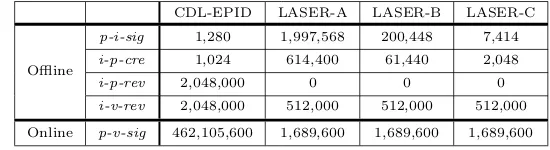
Table 2 presents the number of offline and online elements communicated between the entities in the two DAA schemes. In LASER, the offline commu-nication overheads are computed by summing the commucommu-nication overheads in theMemCreGen and the LogCreGenprotocols. In Table 2, we observe that in CDL-EPID, the sum of the offline communication overheads at the platform and the verifier increase byO(mr). In LASER, the sum of the offline communication
overheads increases byO(ms) at the platform andO(mr) at the verifier. Most
importantly, in Table 2, we observe that the online communication overhead increases byO(mr) in CDL-EPID as compared toO(1) in LASER.
8
Implementation Results
We present an illustrative application scenario where LASER is employed to realize the ASS. We obtain the results by implementing the application scenario on a laptop platform with an on-board TPM. To the best of our knowledge, this is the first implementation and analysis of an anonymous authentication scheme using an actual TPM cryptoprocessor that is compliant with the TPM specification version 2.0. Note that the design of LASER under the framework of the most recent specification also simplifies its adaptation and evaluation in existing networks.
8.1
Illustrative Application Scenario
1. CDL-EPID: During subscription, each SU obtains the membership credential using the offline procedure. Then, each SU generates absolutely unlinkable signatures for the ten SPs per day through the online procedure.
2. LASER with absolute unlinkability (LASER-A): During subscription with the issuer, through offline procedure, each SU obtains 300 membership cre-dentials and corresponding login crecre-dentials (i.e., ms = 300). Using these
login credentials, each SU generates absolutely unlinkable signatures for the ten SPs per day through the online procedure.
3. LASER with conditional unlinkability where the issuer can link some login signatures (LASER-B): Through the offline procedure, the SU obtains 30 membership credentials and corresponding login credentials (i.e.,ms= 30).
Each SU generates conditionally unlinkable signatures for the ten SPs per day using a login credential through the online procedure. Any two signa-tures generated on the same day remain linkable by the issuer, but any two signatures generated on two different days remain unlinkable by the issuer.
4. LASER with conditional unlinkability where the issuer can link all the login signatures (LASER-C): During subscription, each SU obtains only one mem-bership credential and corresponding login credential (i.e.,ms= 1). Each SU
generates conditionally unlinkable signatures through the online procedure. Hence, the signatures generated throughout the month are unlinkable by the SPs, but linkable by the issuer.
8.2
Details of the Prototype
We obtain the computational overheads in the above deployment cases by imple-menting them on a Lenovo laptop with 2.6 GHz Intel i7 6600U CPU. We leverage OpenSSL, the pairing-based cryptography (PBC) library [37], and IBM Trusted Software Stack (TSS) for TPM 2.0 [38] to prototype CDL-EPID and LASER inC. The prototypes of the TPM and the host in LASER comprise of 600 and 1800 lines of code, respectively. The total development time of the prototypes is around 1000 man-hours. We utilize the Barreto-Naehrig (BN) curve which is standardized for DAA by the TCG [39]. Specifically, we utilize the “Type F” internal described in PBC library which is constructed on the curve of the formy2=x3+ 3 with embedding degree 12 where the lengths of an element in
Z∗p and G1 are 256 bits and 512 bits, respectively. With this curve, the DAA provides 128 bits of security which is approximately the same level of security as a symmetric key encryption with a key size of 128 bits, or an RSA signature with a modulus size of 3072 bits.
primaryHandle = primaryHandle; inSensitive.sensitive.data.t.size = 0; inSensitive.sensitive.userAuth.t.size = 0; inPublic.publicArea.type = TPM_ALG_ECC; inPublic.publicArea.nameAlg = halg;
inPublic.publicArea.objectAttributes.val = 0;
inPublic.publicArea.objectAttributes.val |= TPMA_OBJECT_FIXEDTPM; inPublic.publicArea.objectAttributes.val |= TPMA_OBJECT_FIXEDPARENT; inPublic.publicArea.objectAttributes.val |= TPMA_OBJECT_SENSITIVEDATAORIGIN; inPublic.publicArea.objectAttributes.val |= TPMA_OBJECT_USERWITHAUTH; inPublic.publicArea.objectAttributes.val &= ~TPMA_OBJECT_ADMINWITHPOLICY; inPublic.publicArea.objectAttributes.val |= TPMA_OBJECT_NODA;
inPublic.publicArea.objectAttributes.val &= ~TPMA_OBJECT_RESTRICTED; inPublic.publicArea.objectAttributes.val &= ~TPMA_OBJECT_DECRYPT; inPublic.publicArea.objectAttributes.val |= TPMA_OBJECT_SIGN; inPublic.publicArea.authPolicy.t.size = 0;
inPublic.publicArea.parameters.eccDetail.symmetric.algorithm = TPM_ALG_NULL; inPublic.publicArea.parameters.eccDetail.scheme.scheme = TPM_ALG_ECDAA; inPublic.publicArea.parameters.eccDetail.curveID = TPM_ECC_BN_P256; inPublic.publicArea.parameters.eccDetail.kdf.scheme = TPM_ALG_NULL; inPublic.publicArea.parameters.eccDetail.kdf.details.mgf1.hashAlg = halg; inPublic.publicArea.parameters.eccDetail.scheme.details.ecdaa.hashAlg = halg; inPublic.publicArea.unique.ecc.x.t.size = 0;
inPublic.publicArea.unique.ecc.y.t.size = 0; outsideInfo.t.size = 0;
creationPCR.count = 0;
Figure 1: Configuration parameters forTPM2 CreatePrimary.
a static DH oracle. This algorithm is presented in [41], and utilized in the most recent DAA scheme [13]. However, an on-board TPM chip cannot perform this algorithm as it is not part of the specifications and there is no available in-terface to modify the existing algorithms. Hence, we are forced to utilize the TPM2 Signalgorithm given in the specifications for obtaining the implementa-tion results. This means that although the construcimplementa-tion of LASER provides 128 bits of security, its prototype implementation in this paper offers only 85 bits of security [42].
It is quite challenging to work with the TPM algorithms by jumping di-rectly into the TPM standard [43]. Much of this complexity is abstracted away by utilizing the IBM TSS. The TSS is a software package that can be linked to the application to serve as a communication layer between the application and the TPM. This functionality is extremely helpful and is utilized for writ-ing applications that do not require lower-level access to read and write TPM structures. The individual TPM algorithms can be run using the commands from the TSS after setting the appropriate configuration parameters. However, in our experience, the most challenging task of prototyping LASER using TSS was to determine the configuration parameters which were needed for a given TPM command. Due to the absence of any open-source illustration, we needed to delve into the TPM specification version 2.0 to tackle this challenge. Fig-ure 1 presents the configuration parameters utilized for theTPM2 CreatePrimary algorithm which is discussed in Appendix B.2.
100 101 102 103 104 Number of revoked login credentials (m
r)
100
102
104
106
108
Computational cost (ms)
CDL-EPID, On-line
LASER-A, LASER-B and LASER-C, On-line
Figure 2: Comparison of the platform’s online computational costs in the DAA schemes.
Hence, we utilized TPM 2.0 emulator [44], and developed the initial code with the TSS to correctly interface with the TPM emulator. We optimized the code using the conventional techniques, such as, computing multi-exponentiation in
G1. Further, we needed to modify the BIOS settings to enable the security chip
on the laptop platform. We installed and loaded the TPM device driver, and verified that the hardware TPM was functional. Finally, we ported the emulator implementation code to work with the hardware TPM.
8.3
Results
By averaging over 100 iterations, we obtain the running time in milliseconds (ms) for different protocols in LASER and CDL-EPID. Figure 2 presents the curves for the platform’s online computational costs in CDL-EPID, A, LASER-B, and LASER-C vs. mr. We observe that the online computational cost in
CDL-EPID increases linearly with the increase in mr. However, the online
computational costs in LASER-A, LASER-B and LASER-C do not change with
mr. Withmr= 1000, the time taken to generate a signature is only 348 ms in
Table 3: Comparison of the running time (in milliseconds) of the operations in the DAA schemes.
CDL-EPID LASER-A LASER-B LASER-C
Offline
TPM 749 94,765 10,176 1,091
Host 11 13,811 1,391 57
Issuer 24 29,429 3,012 175
Online
TPM 93,637,299 94,008 94,008 94,008
Host 8,996,412 10,362 10,362 10,362
Verifier 1,236,690 327,909 327,909 327,909
Table 4: Comparison of the communication overhead (in bits) between the entities in the DAA schemes.
CDL-EPID LASER-A LASER-B LASER-C
Offline
p-i-sig 1,280 1,997,568 200,448 7,414
i-p-cre 1,024 614,400 61,440 2,048
i-p-rev 2,048,000 0 0 0
i-v-rev 2,048,000 512,000 512,000 512,000
Online p-v-sig 462,105,600 1,689,600 1,689,600 1,689,600
operations.
Table 4 presents the monthly online and offline communication overheads in the four cases in the aforementioned scenario. We observe that LASER-B and LASER-C result in the same online communication cost, but significantly lower offline communication costs when compared to LASER-A. We also observe that LASER-A is more than two orders of magnitude more efficient than CDL-EPID in terms of the online communication overhead.
From the above results, we observe that LASER-A incurs significantly lower online overhead - in terms of both computation and communication - compared to CDL-DAA at the cost of higher offline overhead. As the online procedure require significantly lower latency than the offline procedure, LASER-A is more practical than CDL-EPID whenmris large.
9
Conclusion
In this paper, we propose a novel DAA scheme called Lightweight Anonymous Subscription with Efficient Revocation (LASER) which can be utilized to realize the anonymous subscription system. We show that the revocation is the primary performance bottleneck of modern DAA schemes and that existing schemes do not scale well to large networks because of the high computational and commu-nication costs corresponding to their revocation check procedures. By using the novel concept of adaptable unlinkability, LASER manages to significantly re-duce the computational and communication burden of the SU platform’s online protocol at the cost of increased burden of the SU platform’s offline protocol.
References
[1] Ponemon Institute, “Cost of data breach study: Global overview,” 2017.
[2] M. Blanton, “Online subscriptions with anonymous access,” inProceedings of the ACM Symposium on Information, Computer and Communications Security (ASIACCS), pp. 217–227, 2008.
[3] M. Z. Lee, A. M. Dunn, B. Waters, E. Witchel, and J. Katz, “Anon-pass: Practical anonymous subscriptions,” in Proceedings of the IEEE Sympo-sium on Security and Privacy (S&P), pp. 319–333, 2013.
[4] N. Komninos and A. K. Junejo, “Privacy preserving attribute based en-cryption for multiple cloud collaborative environment,” inIEEE/ACM 8th International Conference on Utility and Cloud Computing (UCC), pp. 595– 600, 2015.
[5] T. Gupta, N. Crooks, W. Mulhern, S. Setty, L. Alvisi, and M. Walfish, “Scalable and private media consumption with popcorn,” inProceedings of the 13th Usenix Conference on Networked Systems Design and Implemen-tation (NSDI), pp. 91–107, 2016.
[6] E. Brickell, J. Camenisch, and L. Chen, “Direct anonymous attestation,” in Proceedings of the 11th ACM Conference on Computer and Communi-cations Security (CCS), pp. 132–145, 2004.
[7] Trusted Computing Group, “TPM library specification,” 2014.
[8] E. Brickell and J. Li, “Enhanced privacy ID from bilinear pairing for hard-ware authentication and attestation,” inIEEE Second International Con-ference on Social Computing (SocialCom), pp. 768–775, 2010.
[9] L. Chen, D. Page, and N. P. Smart, “On the design and implementation of an efficient DAA scheme,” in International Conference on Smart Card Research and Advanced Application, pp. 223–237, 2010.
[11] G. AlLee, “EPID for IoT security,” 2016.
[12] E. Brickell and J. Li, “Enhanced privacy ID: A direct anonymous attesta-tion scheme with enhanced revocaattesta-tion capabilities,”IEEE Transactions on Dependable and Secure Computing, vol. 9, no. 3, pp. 345–360, 2012.
[13] J. Camenisch, M. Drijvers, and A. Lehmann, “Anonymous attestation us-ing the strong Diffie Hellman assumption revisited.” Cryptology ePrint Archive, Report 2016/663, 2016.
[14] V. Costan and S. Devadas, “Intel SGX explained,”
[15] L. Chen and J. Li, “Revocation of direct anonymous attestation,” in Inter-national Conference on Trusted Systems, pp. 128–147, 2010.
[16] Y. Liu, W. Tome, L. Zhang, D. Choffnes, D. Levin, B. Maggs, A. Mislove, A. Schulman, and C. Wilson, “An end-to-end measurement of certificate revocation in the web’s PKI,” in Proceedings of the Internet Measurement Conference (IMC), pp. 183–196, 2015.
[17] Ponemon Institute, “The billion dollar lost laptop problem: Benchmark study of U.S. organizations,” 2010.
[18] M. Nemec, M. Sys, P. Svenda, D. Klinec, and V. Matyas, “The return of coppersmith’s attack: Practical factorization of widely used RSA moduli,” in Proceedings of the ACM SIGSAC Conference on Computer and Com-munications Security (CCS), pp. 1631–1648, 2017.
[19] D. Boneh and H. Shacham, “Group signatures with verifier-local revoca-tion,” inProceedings of the 11th ACM Conference on Computer and Com-munications Security (CCS), pp. 168–177, 2004.
[20] E. Brickell and J. Li, “A pairing-based DAA scheme further reducing TPM resources,” inInternational Conference on Trust and Trustworthy Comput-ing (TRUST), pp. 181–195, 2010.
[21] L. Chen and R. Urian, “DAA-A: Direct anonymous attestation with at-tributes,” inInternational Conference on Trust and Trustworthy Comput-ing (TRUST), pp. 228–245, 2015.
[22] M. H. Au and A. Kapadia, “PERM: Practical reputation-based blacklisting without TTPs,” in Proceedings of the ACM Conference on Computer and Communications Security (CCS), pp. 929–940, 2012.
[24] L. Xi, D. Feng, Y. Qin, F. Wei, J. Shao, and B. Yang, “Direct anony-mous attestation in practice: Implementation and efficient revocation,” in Twelfth Annual International Conference on Privacy, Security and Trust (PST), pp. 67–74, 2014.
[25] L. Chen and J. Li, “Flexible and scalable digital signatures in TPM 2.0,” in Proceedings of the ACM SIGSAC Conference on Computer and Com-munications Security (CCS), pp. 37–48, 2013.
[26] D. Bernhard, G. Fuchsbauer, E. Ghadafi, N. P. Smart, and B. Warin-schi, “Anonymous attestation with user-controlled linkability,” Interna-tional Journal of Information Security, vol. 12, no. 3, pp. 219–249, 2013.
[27] J. Camenisch, M. Drijvers, and A. Lehmann, “Universally composable di-rect anonymous attestation,” in IACR International Workshop on Public Key Cryptography, pp. 234–264, 2016.
[28] R. Dingledine, N. Mathewson, and P. Syverson, “Tor: The second-generation onion router,” inProceedings of the 13th Conference on USENIX Security Symposium - Volume 13, pp. 21–21, 2004.
[29] B. Chor, O. Goldreich, E. Kushilevitz, and M. Sudan, “Private information retrieval,” in Proceedings of IEEE 36th Annual Foundations of Computer Science, pp. 41–50, 1995.
[30] S. D. Galbraith, K. G. Paterson, and N. P. Smart, “Pairings for cryptog-raphers,” Discrete Applied Mathematics, vol. 156, no. 16, pp. 3113–3121, 2008.
[31] D. Boneh, X. Boyen, and H. Shacham, “Short group signatures,” in Ad-vances in Cryptology - CRYPTO, pp. 41–55, 2004.
[32] J. Camenisch and A. Lysyanskaya, “Signature schemes and anonymous credentials from bilinear maps,” in Advances in Cryptology - CRYPTO, pp. 56–72, 2004.
[33] M. H. Au, W. Susilo, and Y. Mu, “Constant-size dynamic k-TAA,” in Pro-ceedings of the 5th International Conference on Security and Cryptography for Networks (SCN), pp. 111–125, 2006.
[34] D. Boneh, “The decision Diffie-Hellman problem,” in Proceedings of the Third International Symposium on Algorithmic Number Theory, pp. 48– 63, 1998.
[35] D. Boneh and X. Boyen, “Short signatures without random oracles and the SDH assumption in bilinear groups,”Journal of Cryptology, vol. 21, no. 2, pp. 149–177, 2008.
[37] B. Lynn, “PBC: Pairing-based cryptography,” 2017.
[38] K. Goldman, “IBM TPM 2.0 TSS,” 2017.
[39] P. S. L. M. Barreto and M. Naehrig, “Pairing-friendly elliptic curves of prime order,” in International Workshop on Selected Areas in Cryptogra-phy, pp. 319–331, 2005.
[40] T. Acar, L. Nguyen, and G. Zaverucha, “A TPM diffie-hellman oracle,” IACR Cryptology ePrint Archive, p. 667, 2013.
[41] L. Xi, K. Yang, Z. Zhang, and D. Feng, “DAA-related APIs in TPM 2.0 re-visited,” inInternational Conference on Trust and Trustworthy Computing (TRUST), pp. 1–18, 2014.
[42] J. Camenisch, L. Chen, M. Drijvers, A. Lehmann, D. Novick, and R. Urian, “One TPM to bind them all: Fixing TPM 2.0 for provably secure anony-mous attestation,” in Proceedings of 38th IEEE Symposium on Security and Privacy (S&P), 2017. to appear.
[43] W. Arthur and D. Challener, A Practical Guide to TPM 2.0: Using the Trusted Platform Module in the New Age of Security. Apress, 1st ed., 2015.
[44] K. Goldman, “IBM TPM 2.0 emulator,” 2017.
A
BBS+ Signature
The BBS+ signature is defined as follows [31, 32, 33].
1. (pk,sk)←BBS Setup(1λ): The input to this algorithm is the security
param-eter 1λ. This algorithm selectsg
1, h1, h2, h3←$G1, g2←$G2, γ←$Z∗p; and
computesω=g2γ. This algorithm sets the public keypk= (g1, h1, h2, h3, g2, ω), and the secret keysk=γ. It outputs (pk,sk).
2. σb ← BBS Sign(pk,sk, f, x): The inputs to this algorithm are pk, sk, and
two messages f, x ∈ Z∗p. This algorithm selects y, z←$Z∗p, and computes
A= (g1·h
f
1·h
x
2·h
y
3)
1/(γ+z). It sets the signatureσ
b= (A, y, z), and outputs
σb.
3. valid/invalid←BBS Verify(pk, σb, f, x): The inputs to this algorithm are
pk, a signature σb, and two messages f andx. This algorithm verifies that
e(A, ω·gz
2) =e(g1·hf1·hx2·h
y
3, g2). If the verification succeeds, this algorithm outputs the valuevalid; otherwise, it outputs the valueinvalid.
B
TPM: Functions and Algorithms
B.1
Group Mapping
With the hash function Hz, a group mapping function Hg :Zp∗ →Z∗p×G1, is constructed as follows. We assume that the groupG1 is constructed using the elliptic curvey2=x3+a
cx+bc, whereac andbc are constant parameters, and
the tuple (x, y) represents an element in G1. Here, x, y, ac, bc ∈ Z∗p. With an
inputa0∈Z∗p, the functionHg outputs a tuple (a1, b1, b2), wherea1∈Z∗p, and
(b1, b2)∈G1, as follows.
1. Seti= 0, wherei is an integer.
2. Compute a1 = Hz(a0 k i), x = Hz(a1), and z = x3+acx+bc. Here, k
represents concatenation of two strings of bits.
3. Compute y =√z. If y does not exist, set i =i+ 1, and start back from Step (2).
4. Setb1=xandb2=y, and output (a1, b1, b2).
B.2
Key Generation
We assume that the TPM has an internal secret valueDAAseed, and an internal counter valuecnt.
(hdl,tpk)←TPM2 CreatePrimary(PI): GivenPI ∈ {0,1}∗, this algorithm
per-forms the following steps.
1. Computef =Hz(DAAseedkcntkPI).
2. Set the TPM’s secret keytsk=f, storetsk, and generate a key handlehdl
which specifies its location in the secure memory of the TPM.
3. ComputeI=hf1, settpk=I, and output (hdl,tpk).
B.3
Commitment Generation
(ctr, C, S1, S2) ← TPM2 Commit(hdl, a1, b2, h1): With the key handle hdl,
a1, b2∈Z∗p, andh1∈G1, as inputs, this algorithm performs the following.
1. Retrievetsk=f using the key handlehdl.
2. Selectrf←$Z∗p.
3. Ifa1=∅, setC=∅andS1=∅; otherwise, perform the following.
(a) Computeb1=Hz(a1), and setB = (b1, b2). (b) ComputeC=Bf, andS
1=Brf.
4. Ifh1=∅, setS2=∅; otherwise, compute S2=h
rf
1 .
5. Storerf, and generate a counter valuectrwhich specifies its location in the
secure memory of the TPM.
B.4
Signature Generation
(nt, ct, sf) ←TPM2 Mod Sign(hdl,ctr, ch, M): With the key handlehdl, the
counter valuectr,ch∈Z∗p, and a messageM ∈ {0,1}∗as inputs, this algorithm
performs the following.
1. Retrieve the TPM’s secret key tsk =f using the key handle hdl, and rf
using the counter valuectr.
2. Select a nonce nt←${0,1}λ, compute ct = Hz(ch k nt k M) and sf =
rf +ct·f, and output (nt, ct, sf).
C
Detailed Proofs of Security
In this section, we provide the theorems corresponding to the security properties discussed in Section 4, and provide comprehensive proofs for them.
Theorem 1. LASER satisfies the correctness property.
Proof. This follows from the specifications of the scheme.
Lemma 2. In the random oracle model, LASER with the credential-selection
ruleabsUnlinkis absolutely unlinkable under theG1-DDH assumption.
Proof. Let there be an adversaryAwhich succeeds to break the absolute unlink-ability property of LASER with the credential-selection ruleabsUnlinkwith a non-negligible probability. Given theG1-DDH instance, a simulator S intends
to find out whetherc=a·b, orc←$Z∗p. To achieve this,S sets up the following
absolute unlinkability game to interact withA.
1. Setup: S simulates theSetupalgorithm, setsh1=P, and sendsiskandgpk to A. S creates mt platforms with identitiesPi, ∀i ∈[1, mt], and selects a
specificPi∗. Further,S initializes a list of the corrupted platforms,cpl=∅, and a list of corrupted credentials,ccl=∅.
2. MemCreGen: S which acts as a platform, simulates MemCreGen protocol withA which acts as the issuer. For each i∈[1, mt], S acquires the
mem-bership credentials memCreij, ∀j ∈[1, ms] by generating the σm differently
for the following two cases.
(a) Ifi6=i∗,S generates the secret keytski, and the corresponding
signa-tureσm.
(b) If i = i∗, S sets tpk∗ = I∗ =Pa, and simulates the signature σm. S
backpatches the hash oracle to preserve consistency.
3. LogCreGen: S acts as the platform, and simulates theLogCreGen protocol with A which acts as the issuer. For each i ∈ [1, mt], and j ∈ [1, ms], S
acquires a login credentiallogCreijby generating the signatureσgdifferently