A Relay Based Controller Designing of Hybrid
Power Systems
Arun G Enchckal
1, Ashna C Abraham
2, Shareena MK
3, Shijina K
4UG Student, Dept. of EEE, Athanasius College of Engineering, Kothamangalam, Kerala, India1
UG Student, Dept. of EEE, Athanasius College of Engineering, Kothamangalam, Kerala, India2
UG Student, Dept. of EEE, Athanasius College of Engineering, Kothamangalam, Kerala, India3
UG Student, Dept. of EEE, Athanasius College of Engineering, Kothamangalam, Kerala, India4
ABSTRACT:The complementary nature of wind and solar determines the advantages and potentiality of hybrid power generation systems. The energy management system switches the mode of power supply and controls the load share according to the condition of wind power, solar radiation and load requirement. Through the suitable allotter of the generation ratio from wind power and photovoltaic cells, the distribution grid system, combined with battery bank can provide user with reliable electric power. This energy management system is applied in experimental equipment. The energy management system helps in overcoming the uncertainties of a renewable power source by paralleling of multiple power sources along with the main grid connection.
KEYWORDS: Energy management, Paralleling of multiple sources, MPPT.
I.INTRODUCTION
World energy consumption has been on the rise worldwide as developing nations begin to industrialize and as consumers in developed nations buy more energy consuming appliances to make life more comfortable. If the current trends continue, we may face an energy shortage in future. All the energy on earth is derived from the sun .However, it occurs in various forms that today, man has developed the technology to exploit and use for agricultural, industrial and personal advancement. Energy used to power our lives can be divided into two types: Renewable and Non-renewable. Renewable sources are those sources that are continuously replenished by the action of the sun on the earth. They include wind, hydro-power, solar, bio-fuels and geothermal. Non-renewable sources are usually fossil fuels whose supplies will one day run out. An exception is Nuclear power which, though a non-renewable, is not produced from a fossil fuel.
It's something of an uncomfortable fact that civilized society is almost completely reliant upon fossil fuels for nearly every aspect of its existence. While fossil fuels have been integral in the development of most industrial nations, there are a few realities of using them that society needs to come to terms with. There are many arguments in favour of society's need for renewable energy. It's a fact that the climate is changing and that fossil fuel emissions are contributing greatly to that change. By contrast, solar energy panels and wind turbines generate zero emissions in their generation of electricity. By recent Greenpeace estimates, the world could save around $180 billion a year by switching 70% of the planet's electricity production to renewable options. While this alone is an excellent economic argument in favour of renewable energy, the truth is that the sheer savings involved aren't the only economic factors that support the use of renewable energy as a positive way forward. Some local markets are already starting to gain access to renewable energy options in their local power grid that have them saving more money than with traditional fossil fuel sources. Historically, coal powered the Industrial revolution but when $5 barrel oil began to flow, coal declined in importance until the oil embargo which brought it back into importance.
II. LTERATURE SURVEY
Yukihiro Ozaki et.al in his paper presents the power control of a stand-alone photovoltaic/ wind/ energy storage hybrid generation system with maximum power point tracker. In this paper, a hybrid generation system combining photovoltaic (PV), wind turbine (WT) and Electric Double Layer Capacitor (EDLC) is presented to supply stable power to residential power applications as stand-alone loads. The photovoltaic and wind systems are used as main energy sources while the EDLC is used as storage device. Three individual DC/DC converters are used to control the power to the load. Control with DC/DC converters is used for Maximum Power Point Tracker (MPPT) and hence maximum power extracting from the solar photovoltaic systems and wind turbine. Power fluctuation of renewable energy is compensated using Maximum Power Point Tracker. The system controls EDLC power to match demand and supply power. If PV and WT generate power is lower than demand power, the EDLC is controlled to discharge power to complete the difference of supply and demand power. If PV and WT generate power is higher than demand power, the EDLC is controlled to charge power.
Mohammad Nasim Imtiaz Khan et.al in their paper proposes the modeling and simulation of an efficient charge controller for photovoltaic system with maximum power point tracking. Design and simulation of an efficient, cost effective Charge Controller for Photovoltaic (PV) System is presented in the paper. To harness maximum power from the PV panel, the charge controller is equipped with Maximum Power Point Tracking (MPPT) feature. An efficient algorithm for MPPT is developed which requires less iteration to reach Maximum Power Point (MPP) than the traditional Perturb and Observe (P and O) method. Only an input voltage sensor is needed for the design and algorithm to track the MPP which makes the charge controller cost effective.
Zhenhua Jiang et.al in their work studies power management of hybrid photovoltaic-fuel cell power systems. To overcome the problem of intermittent power generation, PV power systems may be integrated with other power sources. Fuel cells are an attractive option because of high efficiency, modularity and fuel flexibility; however, one main week point is their slow dynamics. On the other hand, current technology batteries by themselves are usually insufficient to provide the long-term energy that the increasing loads require. Hybrid systems composed of fuel cells and batteries can be integrated with PV power systems to provide uninterrupted high-quality power. The goal of this study is to design an effective power management system for a PV/fuel cell/battery hybrid power system so that the combination can be used as a reliable power source.
III.SYSTEM MODEL AND BLOCK DIAGRAM
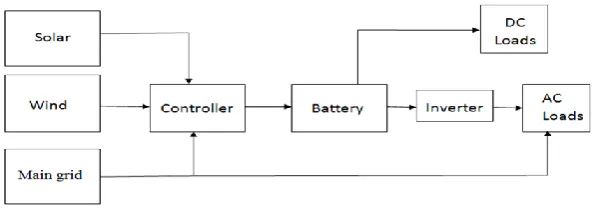
The block schematic representation of the project is shown in Fig 2. Wind-solar hybrid power generation systems include photovoltaic (PV) system, wind turbine (WT) and its associated battery unit. The Hybrid system is connected to grid to meet load demands in a reliable manner. The power sources are switched according to the availability of the power based on a definite algorithm. Converters are also provided for meeting the requirements of loads.
Fig 2: Block Diagram
IV.CONTROLLER CIRCUIT DESIGN
The disadvantage while dealing with the implementation of a hybrid system is the uncertainties of the resource availability. So a control mechanism should be provided for ensure reliability. Even if the output from a source is unavailable or is insufficient to meet the demand, other sources should complement it so that the user will get uninterrupted power. The Algorithm based on which the control mechanism is designed is given below in Table 1.
Table 1: Controller Design Algorithm
If the solar and grid power is available together the battery is charged from the solar power. Similarly if wind and grid power is available, the wind power is used to drive the load. When all three sources that is solar, wind and grid power is available output from both solar and wind are taken together to avoid the wastage. When none of the renewable sources are active, the grid power is utilized. In this scheme we can eliminate wastage and ensure minimum consumption of energy from the grid source.
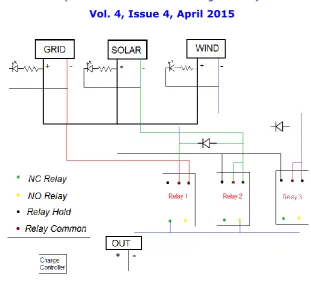
Fig 3: Controller circuit
The two diodes connected relay 1 and relay 2 and relay1 and relay 3 ensures that relay 1 is inoperative when either relay 2 or relay 3 or both is operating. That is the grid power is switched off when any of the renewable source is available. When both wind and solar is available, relay 3 and relay 2 are both operating and the battery is charged from both sources. Grid power is only active when no other option is available. Three LED's are connected each across solar, wind and grid power output. These are provided as the indicators to identify which incoming source is available at a definite period. An LED is also given to the output side indicating the flow of power from the control circuitry to the charge controller and there by charging the battery.
V.HARDWARE
Photovoltaic Cell
A solar cell, or photovoltaic cell (PV), is a device that converts light into electric current 1880s.The array of a photovoltaic power system, or PV system, produces direct current (DC) power which actuates with the sunlight's intensity. For practical use this usually requires conversion to certain desired voltages or alternating current (AC), through the use of inverters. Multiple solar cells are connected inside modules. Modules are wired together to form arrays, then tied to an inverter, which produces power at the desired voltage. For solar cells, a thin semiconductor wafer is specially treated to form an electric field, positive on one side and negative on the other. When light energy strikes the solar cell, electrons are knocked loose from the atoms in the semi-conductor material. If electrical conductors are attached to the positive and negative sides, forming an electrical circuit, the electrons can be captured in the form of an electric current that is, electricity. This electricity can then be used to power a load.
Wind turbine
This model is implemented with a 4V output wind generating system. The 3 blade fan is coupled to the shaft of a 12V, 2000 rpm micro motor. When the fan is made to rotate an output according to the fan speed appears across the motor terminals. For larger output larger fan sizes must be used. Since our bus bar is of 12V dc, the maximum output of 4V is to stepped to 12V. An op-amp (LM 741) is used to get the required output level. Even if the input from Wind turbine exceeds 4V the output to controller is limited to 12V by the saturation of op-amp.
MPPT charge controller
MPPT or Maximum Power Point Tracking is algorithm that included in charge controllers used for extracting maximum available power from PV module under certain conditions. The voltage at which PV module can produce maximum power is called maximum power point (or peak power voltage). Maximum power varies with solar radiation, ambient temperature and solar cell temperature.
The major principle of MPPT is to extract the maximum available power from PV module by making them operate at the most efficient voltage (maximum power point). MPPT checks output of PV module, compares it to battery voltage then fixes what is the best power that PV module can produce to charge the battery and converts it to the best voltage to get maximum current into battery. It can also supply power to a DC load, which is connected directly to the battery. The MPPT process will raise the current while lowering the voltage. This can be done through a process called DC to DC conversion. The reason this works is because we can exchange current and voltage and yet have the same amount of power (Watts) Notice the voltage is lowered as the current is raised yet it produces the same power. MPPT circuits use this process to lower the voltage close to the battery voltage while raising the current. As long as the voltage reaching the MPPT controller is higher than the battery voltage by about 5% or more, then the MPPT output current will be higher than the input.
VI. RESULT AND DISCUSSION
The grid connected solar-wind hybrid system model was successfully implemented. The control circuit was designed using 12V relays. Then consumption of power from main grid was limited to minimum thus depending more on the renewable sources of power. When there is availability of solar power or wind power, the corresponding relay was switched on and the battery was charged through the charge controller. When solar and wind power are both absent the battery is charged from the main grid. Also when both solar and wind is available, both relays corresponding to each one was turned on and the battery was charged from both sources thus avoiding the wastage. Thus reliability is ensured. The work can be developed for higher power levels to have practical applications in systems like smart grid. And using suitable methods of synchronizing it can be further developed to supply power back to main grid during excess production. On grid power systems with higher rating can be set up to provide power to isolated regions with plenty non-renewable resource availability. Fig 4 shows the picture of implemented hardware model.
Fig 4: Hardware Setup
VII.CONCLUSION
be efficiently exploited, the economic and environmental benefits of renewable sources. suggest that this is a sound area of investment.
REFERENCES
[1] B. Lindemark, G. Oberg, “Solar power for radio base station (RBS) sites applications including system dimensioning, cell planning and
operation”, Proceedings of 23rd International Telecommunications Energy Conference, pp. 587 – 590, 14-18 Oct. 2001.
[2] L. McCarthy, J. Pieper, A. Rues, C. H. Wu, “Performance monitoring in UMR's solar car”, IEEE Instrumentation & Measurement Magazine, Vol. 3, No. 3, pp. 19-23, Sept. 2000.
[3] H. J. Wenger, C. Jennings, J. J. Iannucci, “Carrisa Plains PV power plant performance”, Proceedings of IEEE Photovoltaic Specialists Conference, vol.2, pp. 844-849, May 1990.
[4] T. M., “Autonomous Photovoltaic-Diesel Power System Design”, Proceedings of IEEE Photovoltaic Specialists Conference, Las Vegas, Nevada, October 1985, pp. 280-284.
[5] K. Tam, P. Kumar, M. Foreman, “Enhancing the Utilization of Photovoltaic Power Generation by Superconductive Magnetic Energy Storage”,
IEEE Transactions on Energy Conversion, Vol. 4, No. 3, September 1989, pp. 314-321.
[6] A. Chaurey, S. Dembi, “Battery Storage for PV Power Systems: An Overview”, Renewable Energy, Vol. 2, No. 3, pp. 227-235, 1992.